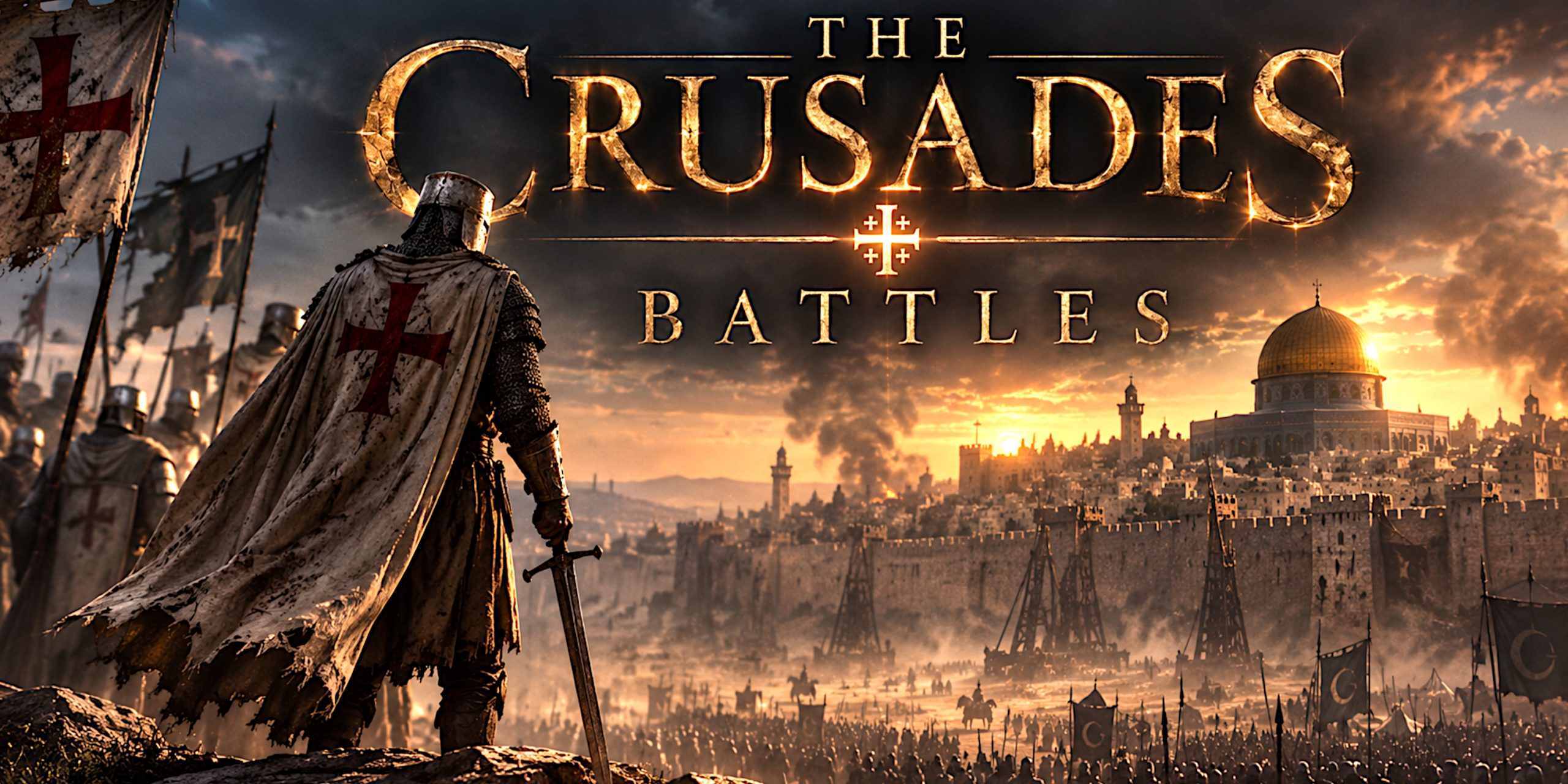
The Crusades produced some of the most famous sieges and battles of the Middle Ages. Jerusalem, Antioch, Hattin, Acre and Arsuf became names repeated by Christian and Muslim chroniclers for generations, although rarely with much agreement about what exactly had happened.
That is part of the difficulty in ranking them.
Medieval chroniclers loved enormous armies. Tens of thousands could become hundreds of thousands with alarming ease, particularly when a writer wanted a victory to look miraculous or a defeat suitably apocalyptic. Modern estimates are generally more restrained. For that reason, the battles below are ranked primarily by strategic importance, military scale, casualties and long-term consequences, rather than accepting medieval troop figures at face value.
I have also used “Crusades” in the broader historical sense. This includes the campaigns in the Levant and Egypt, together with major later crusading expeditions against the Ottomans. It does not mean every battle involving a Latin Christian army somewhere east of Venice qualifies. Medieval history is complicated enough without making it work overtime.
The Biggest Crusader Battles at a Glance
| Rank | Battle or Siege | Date | Conflict | Result |
|---|---|---|---|---|
| 1 | Battle of Hattin | 1187 | Wars of the Crusader States | Ayyubid victory |
| 2 | Siege of Jerusalem | 1099 | First Crusade | Crusader victory |
| 3 | Siege of Antioch | 1097–1098 | First Crusade | Crusader victory |
| 4 | Siege of Acre | 1189–1191 | Third Crusade | Crusader victory |
| 5 | Siege of Acre | 1291 | Fall of the Crusader States | Mamluk victory |
| 6 | Battle of Arsuf | 1191 | Third Crusade | Crusader victory |
| 7 | Siege of Damietta | 1218–1219 | Fifth Crusade | Crusader victory |
| 8 | Battle of La Forbie | 1244 | Crusader-Ayyubid Wars | Ayyubid/Khwarazmian victory |
| 9 | Battle of Mansurah | 1250 | Seventh Crusade | Ayyubid victory |
| 10 | Battle of Dorylaeum | 1097 | First Crusade | Crusader victory |
| 11 | Siege of Damascus | 1148 | Second Crusade | Muslim victory |
| 12 | Battle of Nicopolis | 1396 | Crusade of Nicopolis | Ottoman victory |
| 13 | Battle of Montgisard | 1177 | Crusader-Ayyubid Wars | Crusader victory |
| 14 | Siege of Jerusalem | 1187 | Saladin’s conquest | Ayyubid victory |
| 15 | Battle of Iconium | 1190 | Third Crusade | Crusader victory |
| 16 | Siege of Antioch | 1268 | Mamluk campaigns | Mamluk victory |
| 17 | Battle of Harim | 1164 | Crusader-Zengid Wars | Zengid victory |
| 18 | Siege of Tripoli | 1289 | Mamluk campaigns | Mamluk victory |
| 19 | Battle of Azaz | 1125 | Crusader-Seljuk Wars | Crusader victory |
| 20 | Siege of Jacob’s Ford | 1179 | Crusader-Ayyubid Wars | Ayyubid victory |
1. Battle of Hattin, 1187
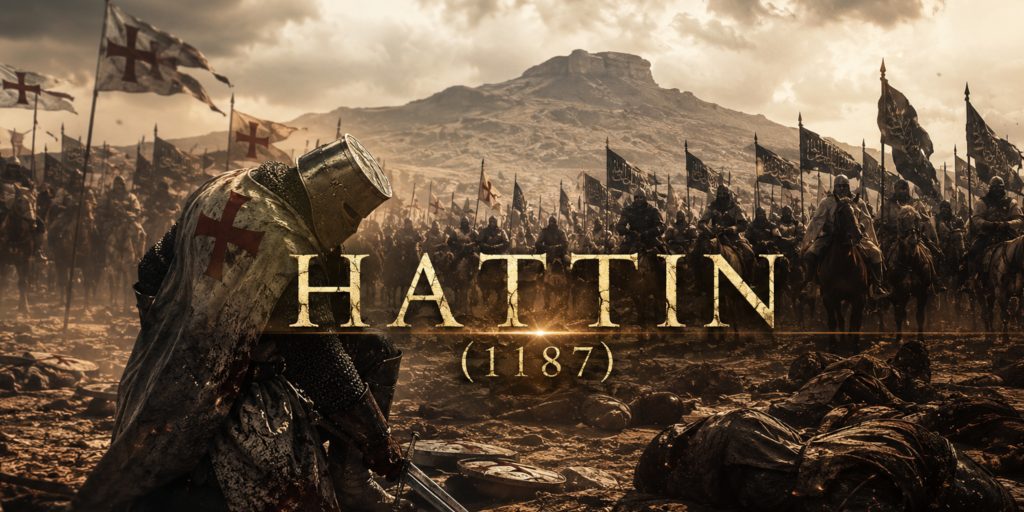
If one battle deserves to stand above the others, I would choose Hattin.
On 4 July 1187, Saladin destroyed the main field army of the Kingdom of Jerusalem near the Horns of Hattin. The defeat was so complete that it transformed the political geography of the Holy Land within months.
King Guy of Lusignan had marched his army away from the reliable water supply at Sepphoris in an attempt to relieve Tiberias. Saladin exploited the decision ruthlessly.
The Crusaders were harassed by mounted archers as they struggled across dry country in intense summer heat. Fires added smoke and further misery. By the time the decisive fighting began, thirst was already doing some of Saladin’s work for him.
A Frankish account attributed to Ernoul records:
“The heat was so great that they could not go on so that they could come to water.”
The collapse became catastrophic. Guy was captured, Reynald of Châtillon was executed, large numbers of Templars and Hospitallers were killed, and the relic of the True Cross was lost.
Why Hattin mattered
- The principal Crusader field army was effectively destroyed.
- Jerusalem was left desperately short of defenders.
- Saladin captured a succession of Crusader towns and fortresses.
- The defeat directly contributed to the fall of Jerusalem.
- News of the disaster helped provoke the Third Crusade.
Hattin was more than a lost battle. It was the moment when decades of Crusader political weakness finally received a military bill for payment.
2. Siege of Jerusalem, 1099
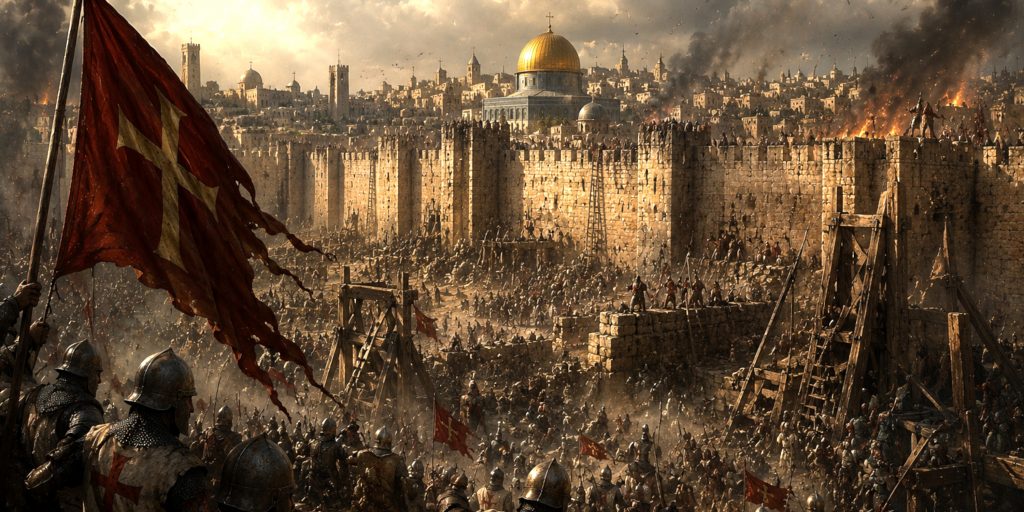
The capture of Jerusalem on 15 July 1099 was the defining military achievement of the First Crusade.
The Crusaders who reached the city were a fraction of the host that had left western Europe. They had endured hunger, disease, desertion, combat and the long siege of Antioch. Jerusalem itself was defended by a Fatimid garrison under Iftikhar al-Dawla.
With timber desperately scarce around the city, the attackers constructed siege equipment using material brought from further afield. On 15 July, forces associated with Godfrey of Bouillon broke through the northern defences.
What followed was a massacre of Muslim and Jewish inhabitants.
Raymond of Aguilers produced one of the most notorious descriptions of the killing, claiming:
“Men rode in blood up to their knees and bridle reins.”
That should not be read literally. Medieval writers regularly used biblical imagery, and the passage consciously evokes the Book of Revelation. It nevertheless reflects the brutality of the sack.
Why Jerusalem mattered
The victory established the Kingdom of Jerusalem and gave the First Crusade the triumph around which its entire subsequent legend was constructed.
Without Jerusalem, the First Crusade might have been remembered as an extraordinary armed pilgrimage that captured several cities. With Jerusalem, it became one of the most consequential military expeditions of the medieval period.
3. Siege of Antioch, 1097–1098
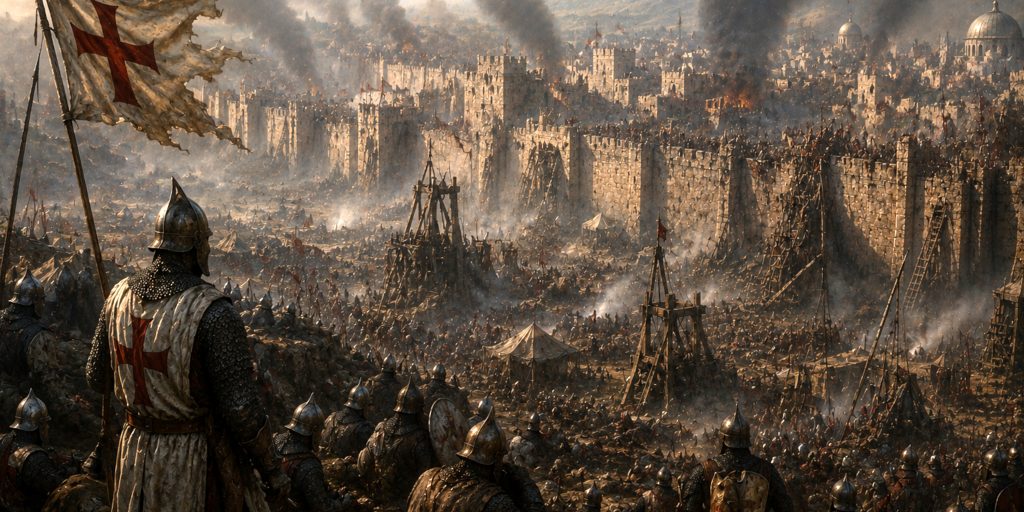
Antioch nearly destroyed the First Crusade before Jerusalem was even reached.
The enormous fortified city was surrounded from October 1097. The Crusaders could not completely encircle it, supplies became desperately scarce, horses died in large numbers and desertion increased.
Bohemond of Taranto eventually established contact with Firouz, a guard responsible for part of the walls. Crusaders entered the city during the night of 2 to 3 June 1098.
Then came the unpleasant surprise.
A large relief army under Kerbogha of Mosul arrived almost immediately, meaning the besiegers became the besieged.
The Crusader army nevertheless marched out on 28 June and defeated Kerbogha’s coalition.
Why Antioch mattered
Antioch demonstrated something that appears repeatedly throughout Crusading warfare: cohesion could matter more than numbers.
Kerbogha commanded a coalition containing competing political interests. The Crusaders were hardly strangers to quarrelling themselves, but in the critical engagement they maintained enough cohesion to survive.
Bohemond subsequently retained Antioch, creating the Principality of Antioch and considerably annoying Raymond of Toulouse. Crusader leaders could usually find time for an argument, even immediately after escaping annihilation.
4. Siege of Acre, 1189–1191
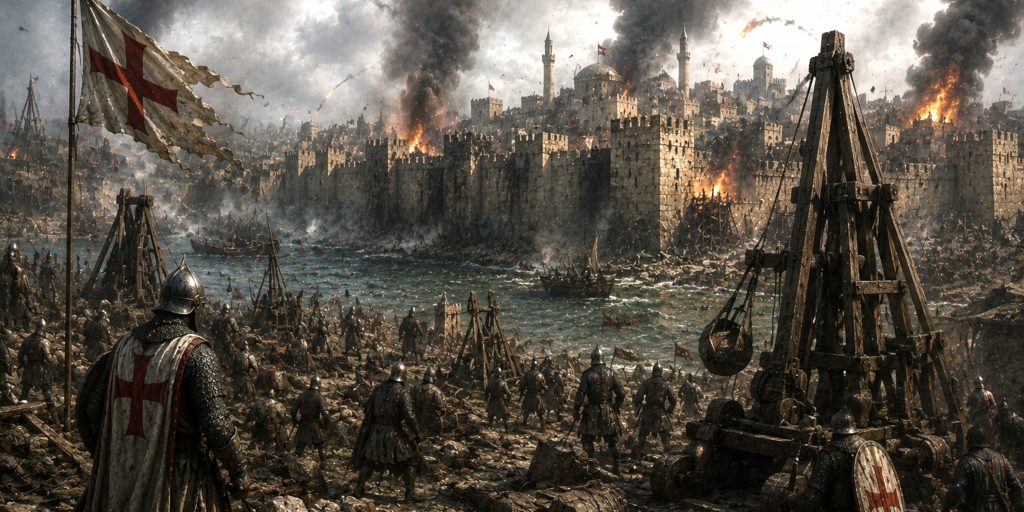
Acre was one of the strangest sieges of the medieval world.
The Crusaders besieged Acre while Saladin’s army effectively surrounded the besiegers. For nearly two years, armies arrived from across Europe, disease swept through the camps and repeated attacks were launched from both sides.
The arrival of Philip II of France and Richard I of England transformed the campaign. Powerful siege engines battered the fortifications while defenders attempted repairs and counterattacks.
Acre finally surrendered on 12 July 1191.
Why Acre mattered
The victory restored a major coastal base to the Crusaders following the catastrophe at Hattin.
It also brought Richard the Lionheart and Saladin into the campaign that would define both men’s popular reputations.
Yet the aftermath was ugly. Negotiations over prisoners broke down, and Richard ordered the execution of thousands of Muslim captives outside Acre.
The age of chivalry was perfectly capable of producing admirable individual courage. It was rather less dependable when several thousand inconvenient prisoners needed feeding.
5. Siege of Acre, 1291
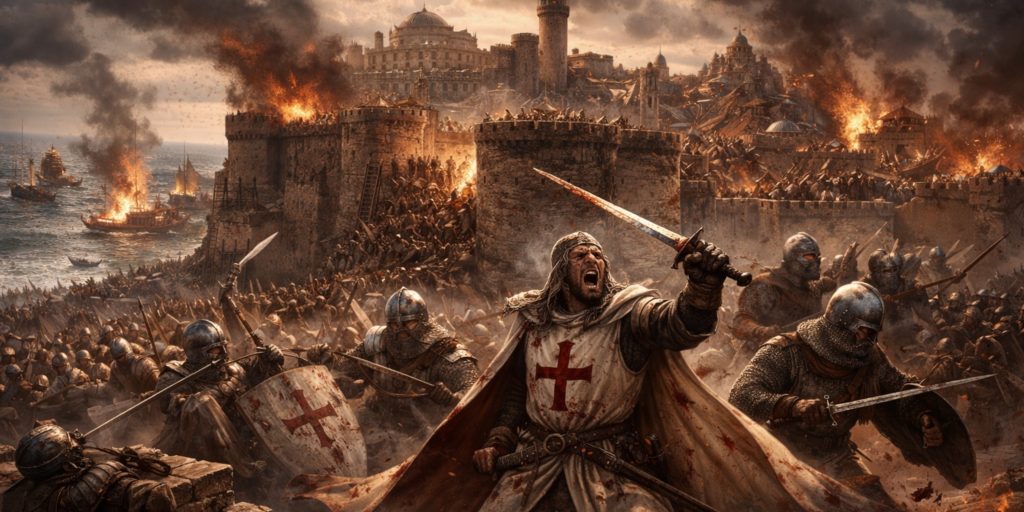
A century after Richard’s victory, Acre became the scene of one of the final disasters of the mainland Crusader states.
Sultan al-Ashraf Khalil assembled a large Mamluk army supported by extensive siege equipment. The defenders included Templars, Hospitallers, Teutonic Knights and secular troops.
Mamluk engineers subjected the walls to sustained bombardment and mining. On 18 May 1291, the main defences were overwhelmed.
The fighting continued around the Templar stronghold, but organised resistance was doomed.
A western account remembered Acre as:
“the flower, chief and pride of all the cities of the East.”
Medieval descriptions give fantastically inflated numbers for both armies and casualties. They should be treated as evidence for how enormous the event felt to contemporaries, rather than as reliable military statistics.
Why Acre mattered
Its fall effectively ended the principal Latin Christian presence on the mainland of the Holy Land.
Tyre, Sidon and Beirut were subsequently abandoned or captured. Crusading projects continued, but the political world created by the First Crusade was essentially finished.
6. Battle of Arsuf, 1191
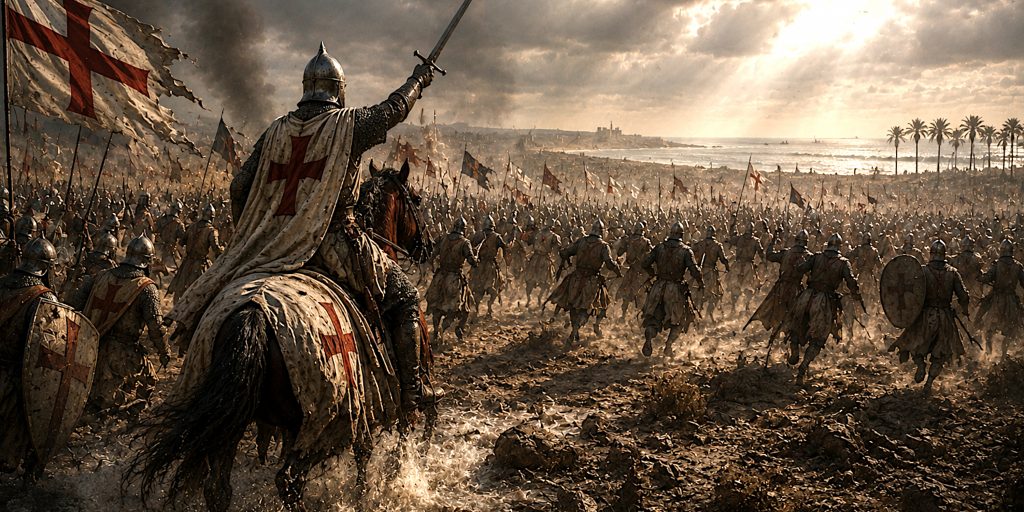
Arsuf on 7 September 1191 is probably Richard the Lionheart’s finest battlefield performance.
After taking Acre, Richard marched south towards Jaffa. Saladin’s mounted troops repeatedly harassed the column, hoping to break its formation and induce the heavy cavalry to charge prematurely.
Richard kept his army close to the coast. Infantry and crossbowmen screened the knights while the fleet provided logistical support.
Eventually the Hospitallers at the rear charged. Richard responded by committing the wider cavalry force.
The counterattack drove Saladin’s troops from the field.
Why Arsuf mattered
Arsuf demonstrated the extraordinary striking power of disciplined heavy cavalry when properly supported by infantry.
More importantly, Richard prevented Saladin from destroying the Third Crusade’s army on the march.
It did not recover Jerusalem. It did, however, secure Richard’s coastal advance and demonstrate that Saladin could be defeated in a major field engagement.
7. Siege of Damietta, 1218–1219
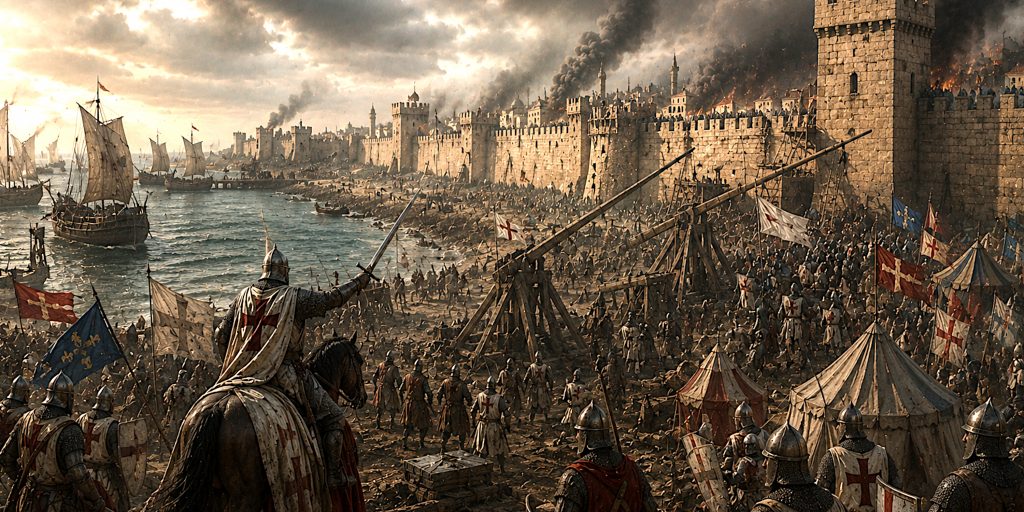
The Fifth Crusade targeted Egypt rather than Jerusalem directly.
This was strategically sensible. Egypt was the economic and political centre of Ayyubid power, and control of Damietta could potentially be exchanged for territory in Palestine.
Crusaders captured the city’s famous chain tower before settling into a prolonged siege. Damietta finally fell in November 1219 after disease and starvation had devastated its population.
Then the Crusaders managed to convert success into disaster.
Al-Kamil offered terms that included the restoration of Jerusalem, but negotiations failed. The Crusader army advanced towards Cairo in 1221, became trapped by flooding and was forced to surrender Damietta.
Why Damietta mattered
The Fifth Crusade remains one of history’s better examples of winning the difficult part and then making an impressive mess of everything afterwards.
The campaign also demonstrated that control of the Nile Delta required understanding water, terrain and logistics every bit as much as winning battles.
8. Battle of La Forbie, 1244
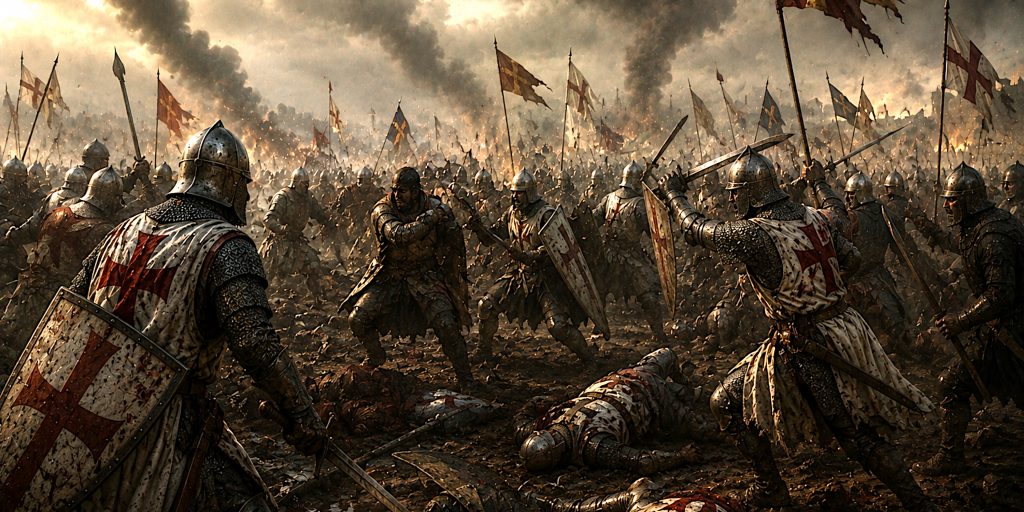
La Forbie, also called the Battle of Hiribya, deserves considerably more attention than it usually receives.
Following the Khwarazmian sack of Jerusalem, the Crusader states formed an unusual alliance with Muslim rulers opposed to Egypt. Their combined forces met an Egyptian-Khwarazmian army near Gaza in October 1244.
The fighting lasted for roughly two days.
The allied army was shattered.
Why La Forbie mattered
The military orders suffered particularly severe losses. Hundreds of Templars and Hospitallers were reportedly killed, while numerous leading nobles were captured.
In terms of destruction inflicted upon the military manpower of the Crusader states, La Forbie has sometimes been compared with Hattin.
Yet it never acquired the same cultural fame. Hattin had Saladin, the True Cross and the road to Jerusalem. La Forbie had the misfortune to be equally grim but considerably less marketable.
9. Battle of Mansurah, 1250
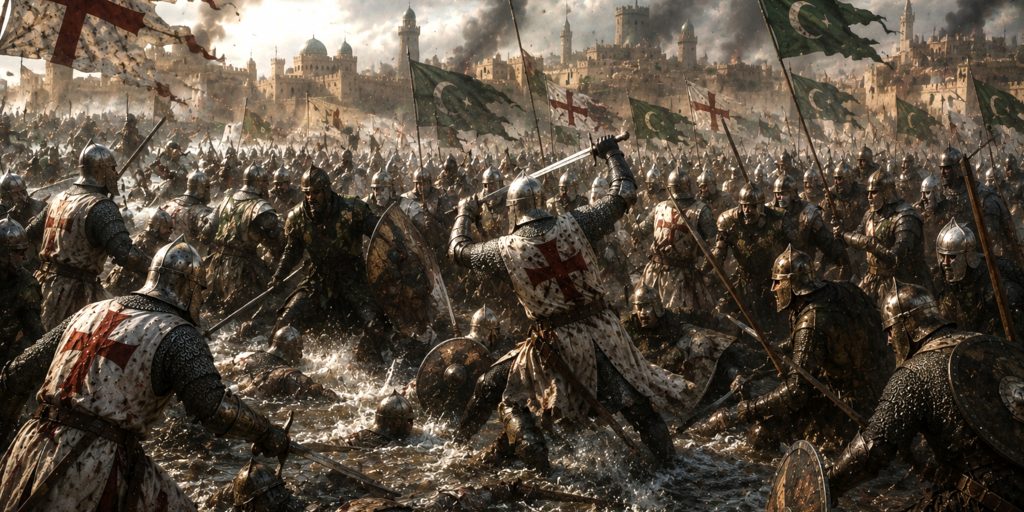
Louis IX of France led the Seventh Crusade into Egypt in 1249.
After taking Damietta, the Crusaders advanced towards Mansurah. In February 1250, Robert of Artois led an assault across a canal and achieved an initial breakthrough.
Rather than wait for the main army, Robert pushed into Mansurah.
This proved disastrous.
Ayyubid and Mamluk troops counterattacked through the narrow streets. Robert was killed along with many Templars and other knights.
Louis continued the campaign, but disease and logistical collapse followed. He was eventually captured after the retreat towards Damietta.
Why Mansurah mattered
The campaign helped establish the military reputation of the Mamluks, including the future Sultan Baibars.
Louis survived captivity and remained committed to crusading, but the defeat demonstrated how difficult an invasion of Egypt could become once an army moved beyond its coastal supply base.
10. Battle of Dorylaeum, 1097
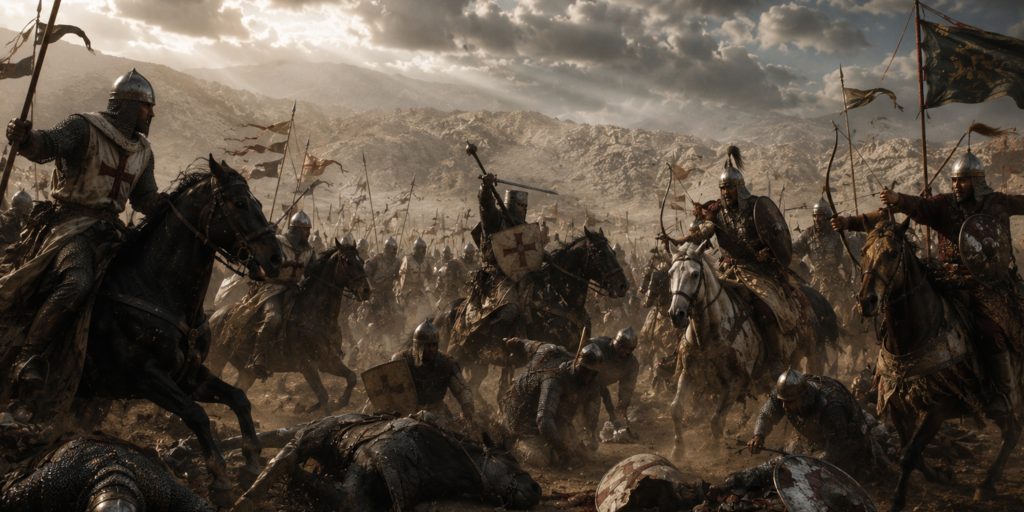
The First Crusade might have ended in Anatolia.
On 1 July 1097, the vanguard under Bohemond of Taranto was attacked near Dorylaeum by forces commanded by Kilij Arslan.
Seljuk mounted archers surrounded the Crusader force and subjected it to repeated missile attacks.
Bohemond organised a defensive position and waited.
Eventually the remainder of the Crusader army arrived. The arrival of fresh forces transformed the battle, and Kilij Arslan withdrew.
Why Dorylaeum mattered
The victory opened the route across much of Anatolia.
It also demonstrated one of the central tactical problems European armies faced in the eastern Mediterranean: how to survive against highly mobile mounted archers without allowing formations to disintegrate.
The answer was usually discipline, missile troops and patience. Charging after every horse archer who insulted you from a safe distance was rarely a sophisticated alternative.
11. Siege of Damascus, 1148
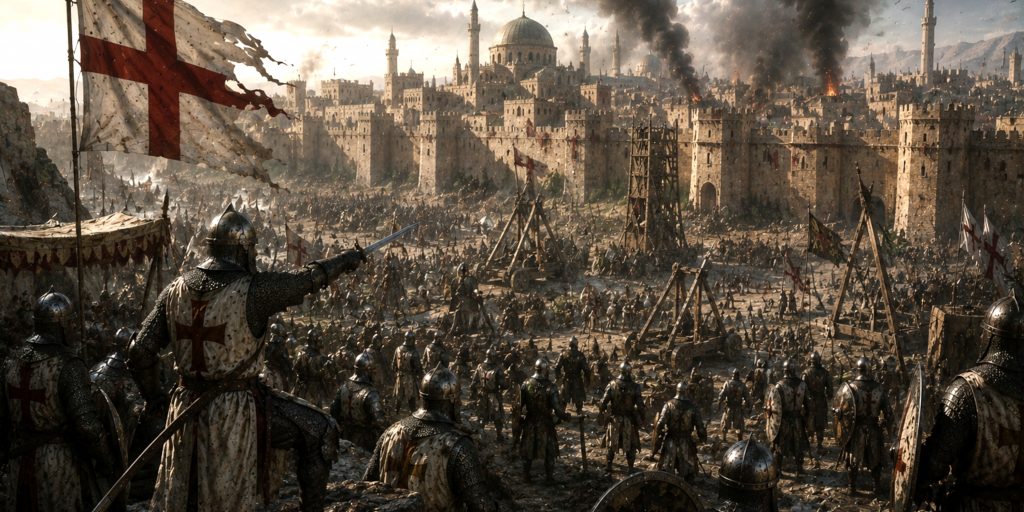
The Second Crusade was launched after the fall of Edessa in 1144.
Its greatest military effort in the Holy Land was directed not against Edessa but Damascus, a decision that remains controversial.
Conrad III of Germany, Louis VII of France and Baldwin III of Jerusalem assembled their forces outside the city in July 1148.
Initial attacks made progress through the orchards west of Damascus. The Crusaders then shifted position towards the less defensible but much less fertile eastern side.
Within days the siege collapsed.
Why Damascus mattered
The failure destroyed much of the Second Crusade’s remaining credibility.
Worse, Damascus had previously been capable of cooperating with the Kingdom of Jerusalem against the Zengids. The attack encouraged the city towards closer alignment with Nur ad-Din.
It was therefore not simply an unsuccessful siege. It helped make the Crusaders’ strategic position worse.
That takes a particular sort of talent.
12. Battle of Nicopolis, 1396
Nicopolis belongs to a later age of crusading, when the Ottoman advance into the Balkans had become the principal concern.
A multinational army containing Hungarian, French, Burgundian, German and other forces marched against Sultan Bayezid I.
At Nicopolis, French and Burgundian knights launched an aggressive frontal attack. They broke through initial Ottoman positions but became exhausted and disorganised.
Bayezid’s reserves counterattacked.
The crusading army collapsed.
Why Nicopolis mattered
The defeat destroyed one of the largest western expeditions mounted against the early Ottoman Empire.
Large numbers of prisoners were taken, and many were executed.
Nicopolis also exposed an enduring military problem in multinational crusading armies: noble courage was plentiful, unified command rather less so.
13. Battle of Montgisard, 1177
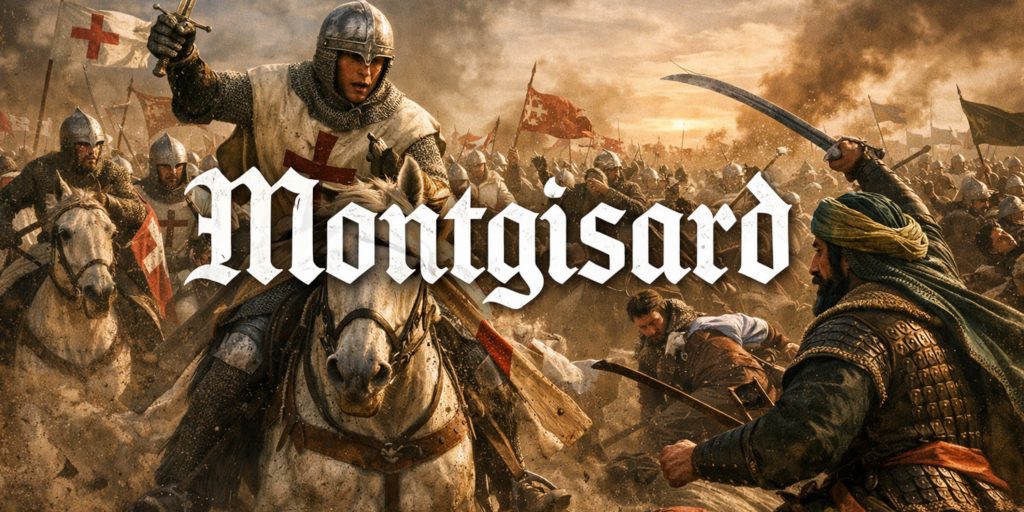
Montgisard is famous largely because Baldwin IV of Jerusalem defeated a much larger army commanded by Saladin.
Saladin had invaded the Kingdom of Jerusalem believing serious resistance unlikely. Baldwin gathered the troops available to him, including knights of the military orders, and intercepted the Ayyubid army near Montgisard.
The Crusader charge caught Saladin’s forces in a vulnerable condition.
His army broke.
Saladin escaped, but the defeat was severe.
Why Montgisard mattered
The victory delayed Saladin’s immediate ambitions and became central to Baldwin IV’s reputation.
The king was still a young man and already suffering from leprosy. His personal participation gave the battle an almost irresistible narrative quality.
Yet Montgisard should not be exaggerated into a permanent strategic reversal. Saladin recovered. Ten years later, Hattin demonstrated just how completely.
14. Siege of Jerusalem, 1187
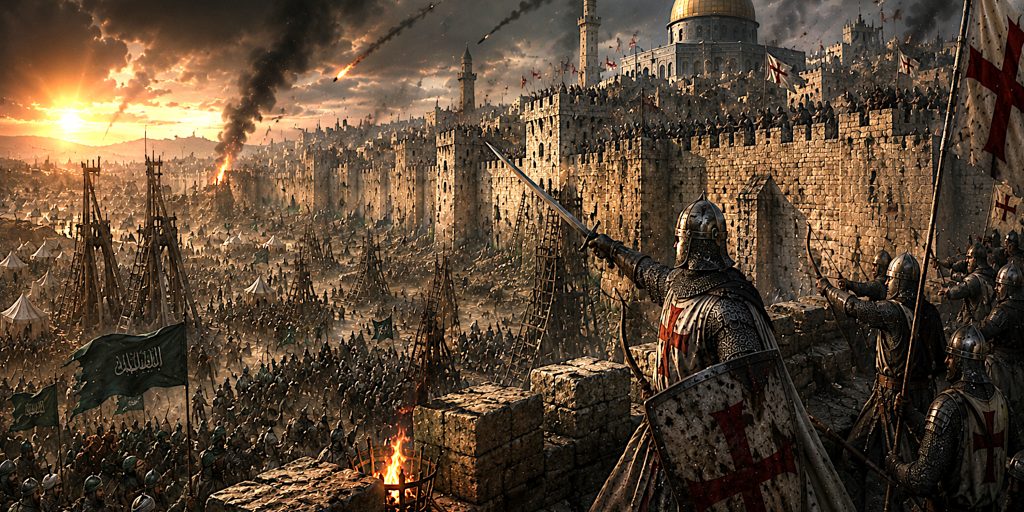
After Hattin, Jerusalem was defended by Balian of Ibelin and a hastily assembled population with very few experienced fighting men.
Saladin began the siege in September.
Balian organised the defence, knighted men to increase the city’s tiny knightly contingent and prepared for an assault.
When it became clear that continued resistance might result in a bloody sack, negotiations began.
Jerusalem surrendered on 2 October 1187.
Why Jerusalem mattered
The contrast with 1099 is important.
Saladin permitted many inhabitants to ransom themselves rather than allowing the wholesale massacre associated with the First Crusade’s capture of the city. Many poor inhabitants were also released through payments and acts of clemency, although others entered slavery.
The recovery of Jerusalem made Saladin the dominant Muslim ruler of his generation and sent a political shock through western Europe.
The Third Crusade followed.
15. Battle of Iconium, 1190
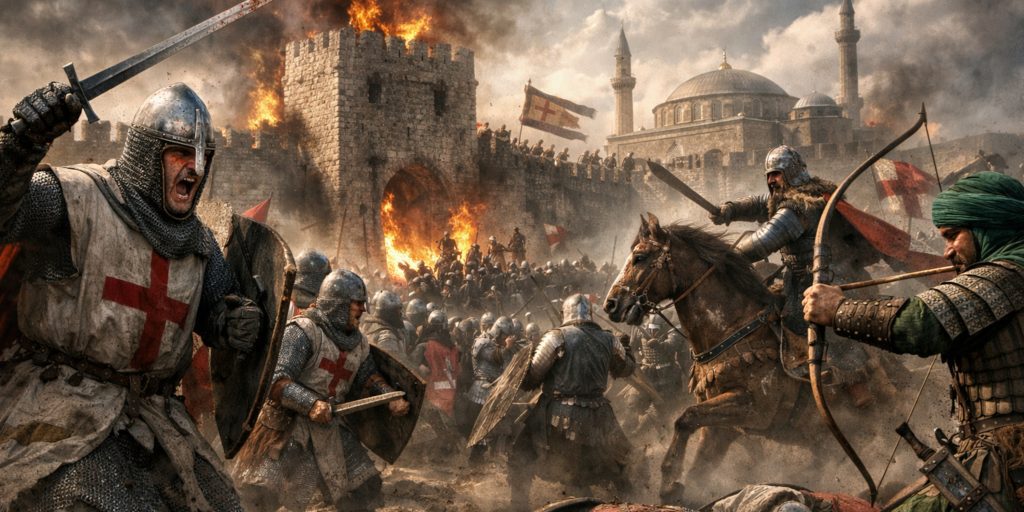
Frederick I Barbarossa led perhaps the most formidable contingent of the Third Crusade overland through Anatolia.
The German army faced harassment, shortages and attacks from forces of the Sultanate of Rûm.
At Iconium in May 1190, Frederick’s forces defeated their opponents and captured the city.
It appeared that an exceptionally powerful German army might soon arrive in Syria.
Then Frederick drowned in the Saleph River the following month.
Why Iconium mattered
The battle demonstrated the strength of the German expedition, but its aftermath also shows how dependent medieval campaigns could be upon individual rulers.
After Frederick’s death, much of his army dispersed.
Saladin had been spared the arrival of a force that might have substantially altered the Third Crusade.
16. Siege of Antioch, 1268
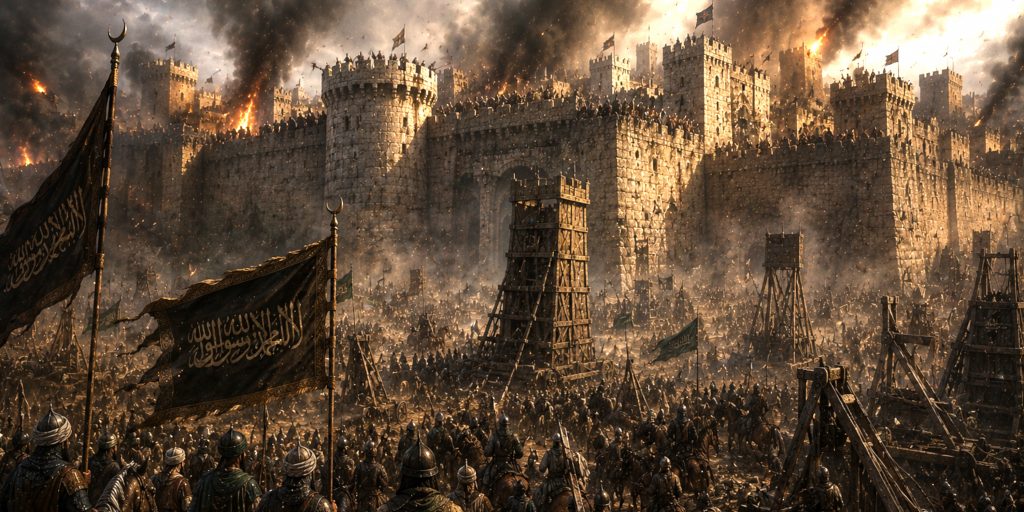
By the thirteenth century, the strategic balance had changed dramatically.
Sultan Baibars attacked Antioch in May 1268. The city that had resisted the First Crusade for months fell with startling speed.
A massacre and mass enslavement followed.
Why Antioch mattered
The Principality of Antioch had survived since 1098. Its destruction removed one of the oldest political creations of the First Crusade.
Baibars understood siege warfare, intelligence and psychological warfare extremely well. His campaigns systematically dismantled Crusader positions rather than relying upon one spectacular victory.
Acre would survive another 23 years, but the direction of events was increasingly obvious.
17. Battle of Harim, 1164
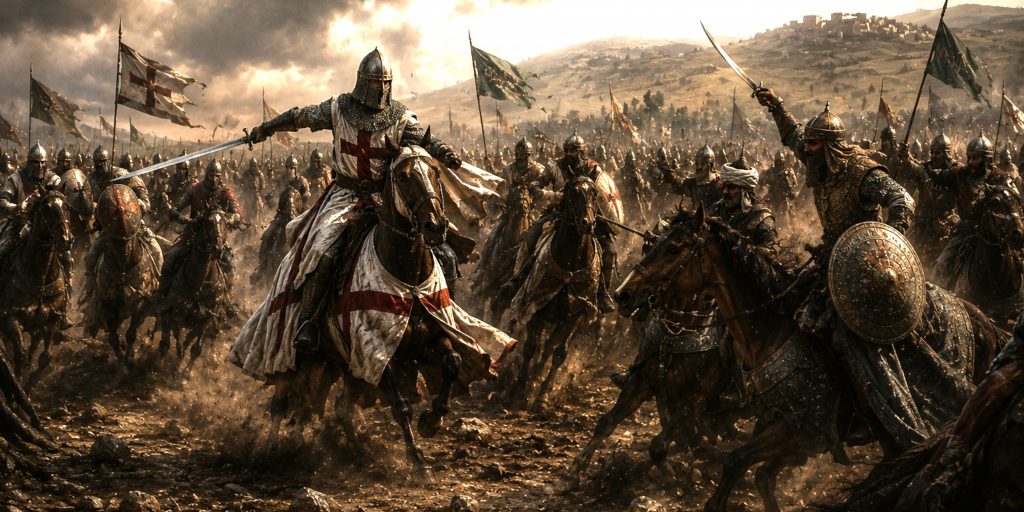
In August 1164, Nur ad-Din confronted a coalition of Crusader and Armenian forces near Harim.
The Christian cavalry pursued retreating Muslim troops and lost cohesion.
It was a familiar danger.
Nur ad-Din counterattacked and inflicted a major defeat. Several important leaders were captured, including Bohemond III of Antioch and Raymond III of Tripoli.
Why Harim mattered
The battle weakened the northern Crusader states and strengthened Nur ad-Din’s position in Syria.
It also provided another demonstration that the heavy cavalry charge was neither obsolete nor invincible. Used at the right moment it could be devastating. Used against an enemy deliberately inviting pursuit, it could become a remarkably expensive way of travelling into captivity.
18. Siege of Tripoli, 1289
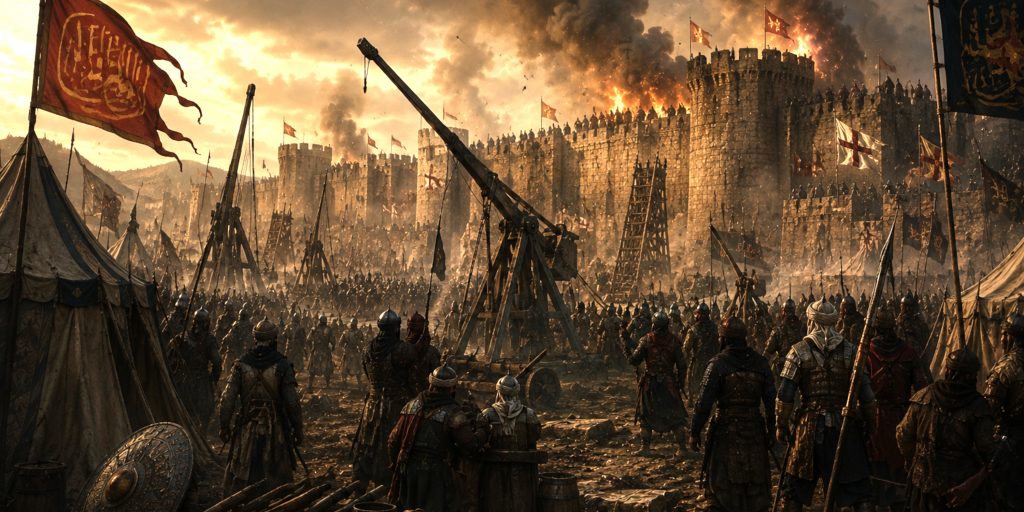
Sultan Qalawun attacked Tripoli in March 1289.
The city possessed formidable defences but suffered from political division. Mamluk siege engines battered the walls until breaches were opened.
The city fell in April.
Many inhabitants were killed or enslaved, while others escaped by sea.
Why Tripoli mattered
The County of Tripoli had existed for nearly 180 years.
Its destruction left Acre as the principal remaining centre of Latin power on the mainland. Two years later Acre itself would fall.
Taken together, Tripoli in 1289 and Acre in 1291 mark the final dismantling of the territorial system created by the First Crusade.
19. Battle of Azaz, 1125
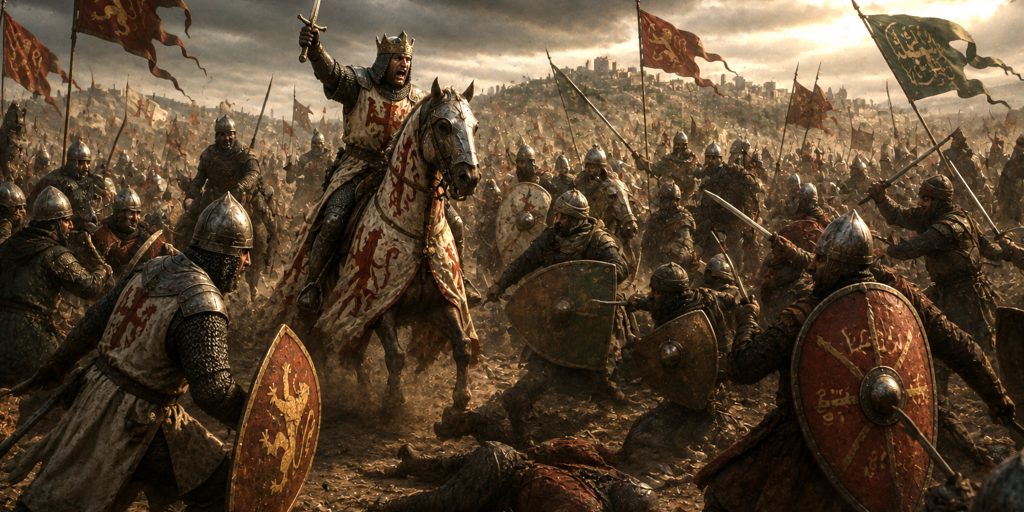
Baldwin II of Jerusalem led a Crusader army against a larger Muslim coalition near Azaz in June 1125.
The Crusaders appear to have used a controlled withdrawal before counterattacking.
The Muslim army was defeated and its camp captured.
Why Azaz mattered
The victory relieved pressure on Azaz and strengthened the Crusader position in northern Syria.
It also helped Baldwin recover prisoners and considerable booty.
Azaz lacks the fame of Hattin or Arsuf, but it belongs to the long period in which the survival of the Crusader states depended upon precisely these sorts of regional victories.
20. Siege of Jacob’s Ford, 1179
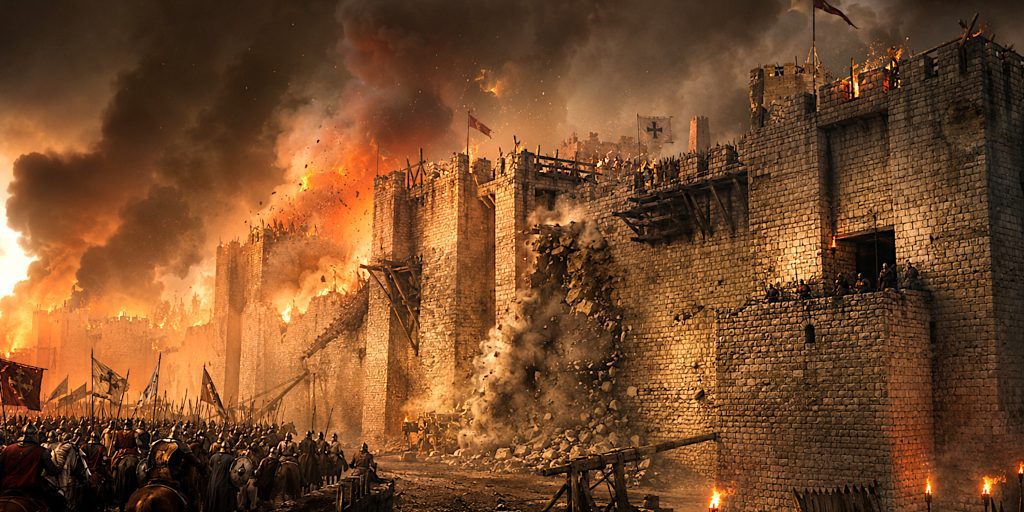
Baldwin IV attempted to construct a major fortress at Jacob’s Ford on the River Jordan, controlling an important crossing close to Damascus.
Saladin understood the danger immediately.
He attacked the unfinished castle in August 1179. After fierce resistance, Ayyubid forces breached the fortifications.
The garrison was overwhelmed and the castle destroyed.
Why Jacob’s Ford mattered
The siege was relatively small compared with Jerusalem or Acre, but strategically revealing.
Baldwin had attempted to alter the geography of the frontier by planting a powerful fortress directly on an important invasion route.
Saladin refused to let him finish it.
The episode shows that Crusader warfare was about much more than knights charging across open fields. Castles, roads, water sources, ports and river crossings determined where armies could operate and whether kingdoms could survive.
Arms and Armour of the Crusades
The Crusades covered roughly two centuries of warfare in the Levant, and considerably longer if later expeditions are included. There was therefore no single “Crusader sword” or fixed set of equipment.
Western Christian forces
Typical equipment included:
- Mail hauberks and coifs
- Conical and later enclosed helmets
- Kite and heater shields
- Lances
- Arming swords
- Maces
- Battle axes
- Spears
- Crossbows
- Self bows
- Padded textile armour
During the First Crusade, the classic knight remained primarily protected by mail. By the thirteenth century, additional reinforcement around the knees, elbows and limbs was increasingly appearing.
The sword remained an important sidearm, but the lance was generally the knight’s principal weapon during a mounted charge.
Common sword forms included weapons corresponding broadly to later Oakeshott Types X, XI and XII, although applying modern typologies too rigidly to battlefield accounts can give an artificial impression of precision.
Muslim forces
Ayyubid, Seljuk, Syrian, Egyptian and later Mamluk armies were equally varied.
Weapons included:
- Composite bows
- Spears and lances
- Straight and curved swords
- Maces
- Javelins
- Shields
- Siege engines
Mail, lamellar and textile armour were used according to period, region and status.
The popular image of European knights armed exclusively with straight swords fighting Muslim cavalry universally equipped with deeply curved sabres is much too neat. Straight blades remained common throughout the Islamic world, while equipment changed substantially across the two centuries covered here.
How Crusader Armies Actually Fought
The romantic image of the Crusades tends to focus upon knights.
They were important, but they were only one component of a functioning army.
Heavy cavalry could deliver enormous shock, particularly against an enemy caught in poor formation. Yet knights needed infantry support.
Crossbowmen and archers could suppress enemy missile troops. Spearmen protected formations. Engineers built siege machines. Sailors maintained supply lines. Labourers dug trenches, filled ditches and constructed fortifications.
At Arsuf, Richard’s ability to keep infantry and cavalry functioning together was crucial. At Hattin, the disintegration of that relationship helped produce catastrophe.
The lesson appears repeatedly.
Medieval warfare rewarded courage, but it rewarded organisation rather more consistently.
Siege Warfare Was the Real Heart of the Crusades
For all the fame of Hattin and Arsuf, much of Crusading warfare consisted of sieges.
Jerusalem, Antioch, Acre, Damietta, Edessa, Ascalon, Tripoli and countless smaller fortresses were won or lost through engineering, starvation, negotiation and betrayal.
Siege weapons included:
- Counterweight and traction trebuchets
- Mangonels
- Siege towers
- Battering rams
- Mining equipment
- Crossbows
- Incendiary weapons
Mining was particularly dangerous. Attackers excavated tunnels beneath walls, supported them with timber and then burned the supports to collapse sections of masonry.
Defenders responded with countermines, missile fire and sorties.
The enormous castles associated with the Crusader states were not architectural vanity. They were attempts to control territory with limited manpower.
The Problem With Crusader Army Numbers
Any ranking of the largest Crusader battles needs a warning attached to the numbers.
Contemporary chroniclers routinely exaggerated army sizes.
At Acre in 1291, one western account claimed that the Sultan possessed hundreds of thousands of soldiers. Such numbers are not credible as literal estimates of field strength.
The exaggeration had a purpose. A vast enemy made heroic resistance more heroic, miraculous victory more miraculous and catastrophic defeat more understandable.
Modern historians instead examine logistics, marching space, water supplies, naval capacity, payroll evidence and other constraints.
Consequently, figures given for battles such as Hattin, Arsuf and Jerusalem should normally be understood as estimates rather than headcounts.
A medieval chronicler with an abacus is still a medieval chronicler.
Which Was the Bloodiest Battle of the Crusades?
There is no reliable answer.
Jerusalem in 1099 involved extensive killing following the capture of the city. Hattin destroyed or captured much of the Kingdom of Jerusalem’s field army. La Forbie inflicted devastating losses on the military orders and their allies. Acre in 1291 ended with massacre, enslavement and desperate attempts by civilians to escape by sea.
The problem is that casualty figures are among the least reliable statistics in medieval sources.
Rather than naming a precise “bloodiest” battle, it is safer to identify Jerusalem, Hattin, La Forbie and Acre as among the most destructive episodes of Crusading warfare.
Which Crusader Battle Was the Most Important?
For me, the argument comes down to Jerusalem in 1099 and Hattin in 1187.
Jerusalem created the political and religious triumph that gave the First Crusade its extraordinary place in medieval history.
Hattin reversed much of that achievement in a single campaign.
I rank Hattin first because its military consequences were unusually immediate. Saladin did not merely defeat an army. He removed the principal force capable of defending the Kingdom of Jerusalem and then exploited the victory with extraordinary speed.
Jerusalem fell less than three months later.
Arsuf was tactically impressive. Antioch was an extraordinary feat of endurance. Acre was enormous. But Hattin changed the balance of power in a way few medieval battles managed.
Contemporary Voices From the Crusades
The chronicles are partisan, religious and frequently exaggerated, but that is precisely why they are so valuable. They show us how contemporaries understood these events.
On the crisis at Hattin, a Latin account has Raymond of Tripoli warning against abandoning water:
“We should not move away from water, food, and other necessities.”
Ernoul described the consequences once the march began:
“The heat was so great that they could not go on.”
A western account of Acre’s final fall remembered the city as:
“the flower, chief and pride of all the cities of the East.”
Accounts of Jerusalem in 1099 are more disturbing. Raymond of Aguilers used deliberately biblical language to describe the slaughter:
“Men rode in blood up to their knees and bridle reins.”
These passages should never be treated like modern battlefield reporting. They were written to explain divine favour, condemn enemies, celebrate patrons and give moral meaning to catastrophe.
But remove them entirely and something important disappears. Battles were experienced not as tidy arrows moving across maps, but as heat, thirst, terror, religious conviction, confusion and, rather often, somebody making a decision everyone else would spend the next century arguing about.
What the Greatest Crusader Battles Tell Us
The military history of the Crusades is far more interesting once we move beyond the familiar image of armoured knights fighting “Saracens”.
The First Crusade succeeded partly because its opponents were politically divided. The Crusader states survived because they developed castles, ports, alliances and sophisticated military institutions. Muslim political consolidation under Nur ad-Din and Saladin changed that equation. The Mamluks later applied relentless military pressure until the remaining mainland enclaves disappeared.
Neither side possessed a permanent tactical advantage.
Western heavy cavalry could be devastating. Muslim mounted archery could tear formations apart. Crossbows were dangerous. Fortifications could transform campaigns. None guaranteed victory.
Again and again, logistics decided what bravery could not.
Hattin was decided partly by water. Acre depended upon maritime supply. Damietta revolved around the Nile. Antioch nearly ended because the Crusaders were starving.
That is perhaps the most useful corrective to the romantic version of Crusading warfare. The knight with his sword makes a splendid image. Behind him stood an entire military system desperately trying to ensure that he, his horse and several thousand equally hungry companions had something to drink tomorrow.
Final Ranking
If we judge these encounters by their combination of scale, military significance and historical consequences, the five that stand above the rest are:
Hattin, 1187
The destruction of the Kingdom of Jerusalem’s field army and the decisive victory of Saladin.
Jerusalem, 1099
The capture that fulfilled the central objective of the First Crusade and created the Kingdom of Jerusalem.
Antioch, 1097–1098
The brutal siege and counter-siege that could easily have ended the First Crusade.
Acre, 1189–1191
The colossal struggle that became the military centrepiece of the Third Crusade.
Acre, 1291
The siege that effectively extinguished the mainland Crusader states.
There were larger armies in medieval history and bloodier battles may have occurred elsewhere, but few sequences of warfare compressed so much religious ambition, political rivalry and military adaptation into such a contested landscape.
The Crusades were never a simple contest between two coherent sides. Latin Christians fought other Christians. Muslim rulers allied with Crusader states against Muslim rivals. Byzantine interests collided with western ambitions. Military orders pursued their own strategies. Kings quarrelled. Barons defected. Alliances changed.
That complicated reality is worth preserving.
It also makes the history considerably better.