The Last Duel makes medieval honour look exhausting. Everyone is defending it, demanding recognition for it or using it to justify something dreadful. Meanwhile, the person with the most to lose struggles to get a word in.
Ridley Scott’s historical drama follows a rape accusation in fourteenth-century France and the judicial combat that follows. Matt Damon and Adam Driver supply the armour, resentment and spectacularly poor judgement. Jodie Comer gives the film its purpose.
It is an absorbing, sometimes heavy-handed film with an exceptional central performance and a climactic fight that feels frighteningly physical. Its strongest scenes, though, happen well before anyone picks up a sword.
Review verdict: 4/5
Content note: The film includes prolonged sexual violence, depicted twice, domestic abuse and graphic combat. This review discusses its premise and structure without revealing the duel’s outcome. BBFC
The Last Duel at a Glance
| Detail | Information |
|---|---|
| Director | Ridley Scott |
| Screenwriters | Nicole Holofcener, Ben Affleck and Matt Damon |
| Main cast | Jodie Comer, Matt Damon, Adam Driver and Ben Affleck |
| Release year | 2021 |
| Running time | Approximately 153 minutes |
| Setting | Fourteenth-century France |
| Source material | Eric Jager’s non-fiction book, The Last Duel |
The film adapts the historical case involving Jean de Carrouges, Jacques Le Gris and Marguerite de Carrouges.
What Is The Last Duel About?
Jean de Carrouges is a soldier with an increasingly impressive collection of grievances. His former friend Jacques Le Gris enjoys the favour of their overlord, Count Pierre d’Alençon, while Jean believes his service and family standing deserve greater rewards.
Land, money and wounded pride sour their relationship. Then Jean’s wife, Marguerite, accuses Le Gris of rape. Jean pursues a judicial duel, placing the case before a system that treats victory in combat as evidence of divine judgement.
The premise creates an immediate tension. Jean presents himself as Marguerite’s defender, yet his pursuit of vindication exposes her to further danger. His understanding of justice leaves remarkably little room for asking what she wants.
Why the Three Perspectives Matter
The film revisits events through Jean’s account, Le Gris’s account and finally Marguerite’s. Describing this as a Rashomon-style structure is useful, provided we recognise where the comparison stops.
Scott is not asking us to treat every version as equally credible. The final chapter explicitly privileges Marguerite’s account. The earlier sections reveal how the men edit events to preserve their preferred images of themselves.
Jean remembers loyalty, courage and marital devotion. Le Gris sees sophistication, attraction and entitlement dressed up as romance. Small changes in delivery and emphasis gradually dismantle both portraits.
A greeting becomes less affectionate. A supposedly generous gesture acquires conditions. What one man remembers as an important moment barely registers with someone else.
I find these quieter revisions more effective than the grand declarations about truth. They catch something recognisable about self-deception: people rarely cast themselves as the tedious, selfish presence in somebody else’s afternoon.
There is a cost, however. The repeated scenes slow the middle of an already lengthy film. Some reveal enough to justify another visit; others underline conclusions we have already reached.
Jodie Comer Gives the Film Its Emotional Weight
Comer has the most difficult role because Marguerite initially appears within stories controlled by other people. Her performance must establish a person even when the narrative reduces her to a desirable wife, a source of status or an object of fantasy.
When her chapter arrives, that restricted view opens out.
We see intelligence, practical competence and a clearer understanding of the household than Jean’s self-important account allows. Comer makes these qualities feel ordinary rather than exceptional. Marguerite has a life to manage, and being surrounded by men with titles has not made the work easier.
Her strongest acting is often restrained. A pause before answering, a guarded expression or the effort required to remain composed communicates more than a speech could.
The courtroom scenes are particularly painful. Comer shows the strain of answering questions from people who scrutinise Marguerite’s behaviour more eagerly than the violence she describes. Her performance keeps the film grounded when the screenplay becomes overly explicit about its themes.
Damon, Driver and Affleck Make an Uncomfortable Company
Damon plays Jean as stubborn, physically capable and deeply invested in his own importance. His courage does not make him considerate. Nor does his willingness to fight automatically make him a good husband.
That distinction gives the performance its bite. Jean can recognise an insult at extraordinary range while missing distress directly in front of him.
Driver’s Le Gris is more socially fluent. He understands charm, patronage and the advantages of appearing cultivated. Driver lets that confidence become revealing: Le Gris is accustomed to interpreting the world in ways that favour him, including other people’s intentions.
Affleck brings a sour comic energy to Count Pierre. His court offers wealth, access and amusement to those he likes, with little patience for anyone who makes demands on his conscience. The blond hair attracts attention, but the performance underneath it is sharply judged.
Together, they create a persuasive social environment in which influence can make bad behaviour look entirely reasonable to the people benefiting from it.
Ridley Scott’s Medieval France Feels Cold and Claustrophobic
Scott remains very good at making a historical setting feel inhabited. Courtyards, chambers and muddy roads have texture. Buildings communicate wealth and hierarchy before anyone explains who owns them.
The visual palette is subdued, sometimes almost aggressively so. There are moments when medieval France appears to have misplaced every colour except wet stone.
Still, the approach suits this particular story. Interiors feel enclosed, privacy is precarious and public appearances require constant management. A banquet can be as uncomfortable as a battlefield, especially when everyone present understands the insult concealed inside a polite exchange.
The production’s physical detail gives the drama credibility. That atmosphere should not be confused with complete historical accuracy, but it makes the characters’ world tangible.
How Good Is the Final Duel?
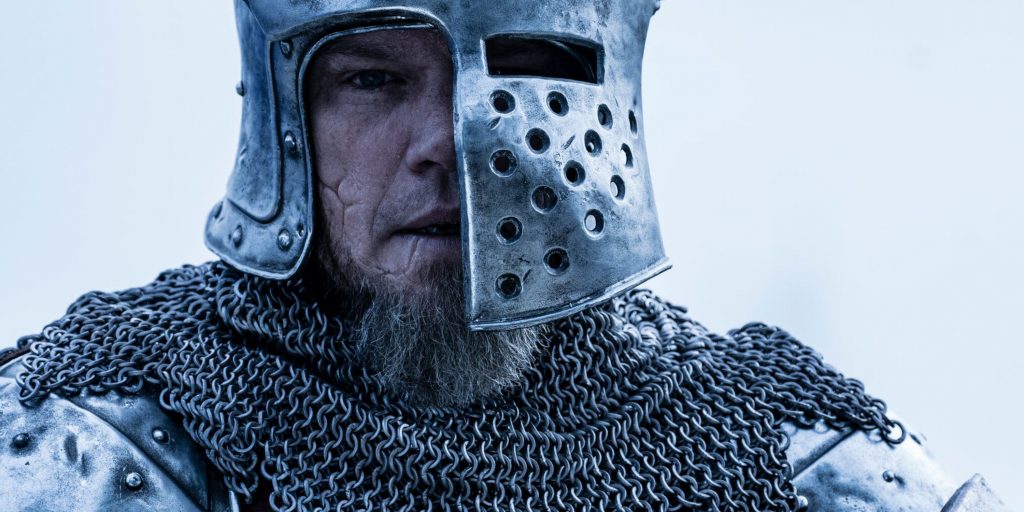
The final fight is superbly staged. It is ugly, tense and increasingly desperate, with very little interest in making either participant look graceful.
Its strongest quality is the sense of effort. Impacts interrupt movement. Losing balance matters. Once the distance closes, controlling the other man becomes as urgent as landing a blow.
For readers interested in longswords, the attraction lies in seeing armoured combat treated as a physical struggle involving weapons, leverage and close contact. The choreography gives the encounter a changing rhythm rather than settling into endless exchanges of convenient sword strikes.
But the emotional stakes make it work. Scott keeps Marguerite’s position present throughout. The crowd can enjoy the spectacle; she has to live with its consequences.
That difference makes the sequence more disturbing than a straightforward contest between hero and villain.
How Historically Accurate Is The Last Duel?
The central case is historical. Carrouges and Le Gris fought in Paris on 29 December 1386, following Marguerite’s accusation. The film draws on Eric Jager’s reconstruction, while imagining private conversations and experiences that the surviving evidence cannot fully recover.
The title also needs qualification. This was the last judicial duel authorised by the Parlement of Paris, rather than the last duel fought anywhere in France. Other forms of duelling continued. Historians also disagree about the fight’s details and duration, so its elaborate screen choreography should be treated as dramatisation.
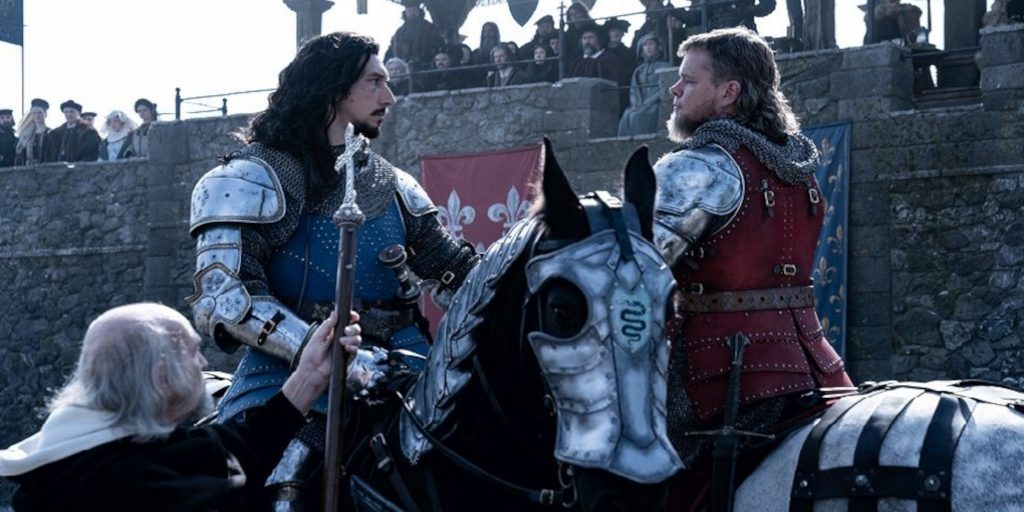
The armour deserves similar caution. The conspicuously exposed faces help us follow the actors, but they are a cinematic compromise. Claims that every weapon, helmet and movement reproduces 1386 precisely would be difficult to defend.
The original review’s suggestion that armour primarily restricted movement also needs care. Well-fitted armour allowed considerable mobility. The exhausting conditions of a fight come from exertion, danger and an opponent actively trying to overwhelm you, rather than from wearing an inconvenient metal costume.
A further distinction matters: the film’s moral clarity about Marguerite belongs to its storytelling. It cannot give us documentary access to every aspect of the historical woman’s experience.
Where the Film Struggles
The screenplay occasionally distrusts its audience. Characters explain ideas that the performances and situations have already made clear. A little less emphasis would have allowed some scenes to land harder.
Marguerite’s chapter also arrives late enough to create a legitimate frustration. The structure exposes the men’s dominance by making us spend so much time inside their accounts, but it also postpones the film’s most compelling perspective.
Most difficult is the decision to depict the assault twice. The altered framing exposes Le Gris’s self-serving interpretation, yet the repetition asks a great deal of the viewer. Its narrative purpose does not settle the question of whether both depictions were necessary.
These are substantial reservations. They sit alongside admiration for a film willing to make its prestigious male leads so persistently unappealing.
Is The Last Duel Worth Watching?
Yes, if you want a demanding historical drama with strong performances and a remarkable final combat sequence.
Viewers expecting the momentum of Gladiator may find the legal disputes, property arguments and repeated encounters slow going. Those details matter, though. They establish a society where status shapes whose account receives attention and whose suffering becomes somebody else’s grievance.
Alongside the films in our best historical movies guide, The Last Duel stands out for the discomfort beneath its spectacle.
My strongest reason to watch is Comer. She gives Marguerite a presence that survives the film’s structural delays and occasional overstatement. Scott delivers the promised clash of steel, but her performance is what remains afterwards.
Final rating: 4/5. An intelligent, harrowing historical drama whose uneven pacing is outweighed by its performances and unsettling treatment of honour.