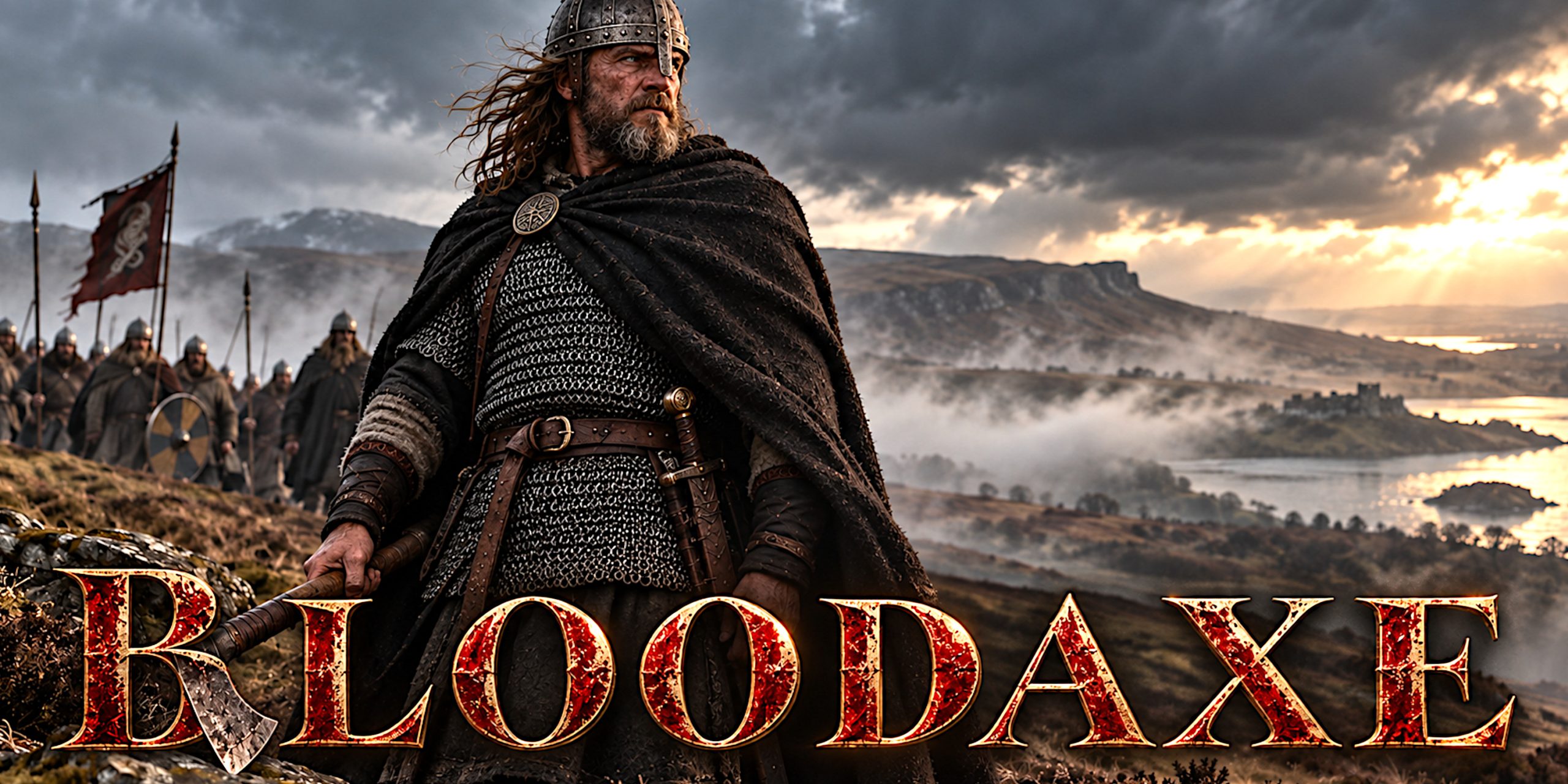
Erik Bloodaxe has one of those names that appears to have done half the historian’s work before she has opened a book. There will be violence, probably a disputed inheritance, and very little chance of a peaceful retirement.
The man behind it is harder to recover. A King Eric ruled Viking York in the mid-tenth century. Coins bearing his name survive. English chronicles record his acceptance and rejection by the Northumbrians. The familiar Norwegian prince who murdered his brothers, married Gunnhild and died fighting in England emerges much more fully in later Scandinavian literature.
I find that gap more interesting than a tidy tale of relentless brutality. Erik’s story is about power, exile and the manufacture of a royal reputation, with an awkward question running through it: how much of the biography belongs to one man?
Erik Bloodaxe at a Glance
| Detail | What the evidence allows us to say |
|---|---|
| Name | Erik, Eric or Eiríkr; traditionally Eiríkr Haraldsson |
| Birth | Unknown; often placed around the late ninth or early tenth century |
| Norwegian kingship | Traditionally in the early 930s; dates and extent of authority uncertain |
| Rule at York | Conventionally dated to 947/948–948 and 952–954 |
| Father | York’s Eric is called Harald’s son; identification with Harald Fairhair rests on Scandinavian tradition |
| Wife | Gunnhild in the saga tradition; details of her origins conflict |
| Death | Conventionally dated to 954, associated in later accounts with Stainmore |
| Strongest physical evidence | Silver pennies minted in his name at York |
| Main difficulty | Connecting the documented king at York with the Norwegian saga figure |
These dates are a working framework rather than a complete itinerary. The sources do not support the precision sometimes imposed on them.
What Sources Tell Us About Erik Bloodaxe
Three kinds of evidence need to be kept in view.
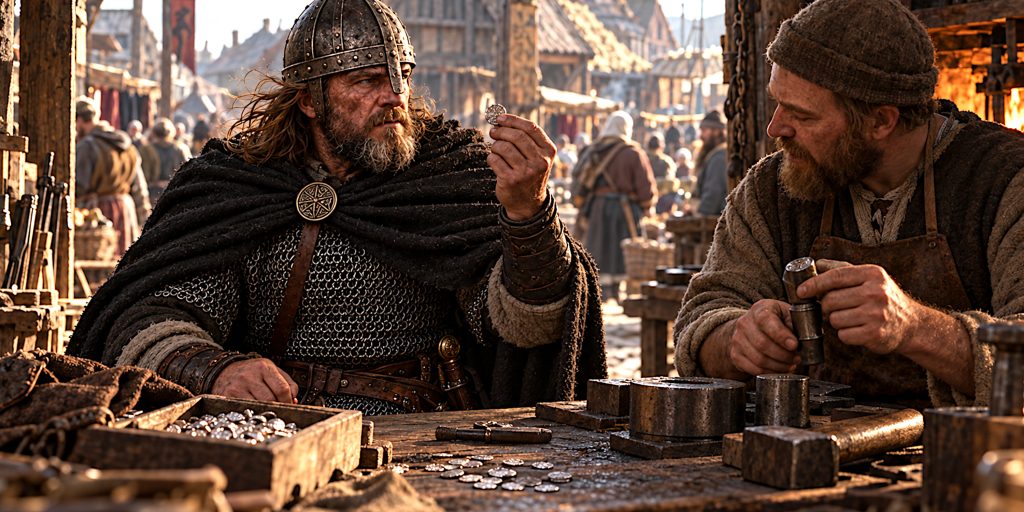
Coins establish that a ruler named Eric exercised royal authority at York. They are contemporary objects, although they cannot explain his ancestry or personality.
English annalistic sources, particularly versions of the Anglo-Saxon Chronicle, provide the outline of his Northumbrian career. Their chronology needs care, and their political viewpoint is hardly neutral.
Scandinavian histories and sagas, including Heimskringla, Fagrskinna and Egil’s Saga, provide much of the personal drama. Their surviving narratives were written centuries after the events. Older poetry may preserve earlier material, but its transmission and interpretation introduce further problems.
Historian Clare Downham has challenged the conventional identification of Norway’s Erik Bloodaxe with York’s Eric. Her argument has not produced agreement, but it exposes a genuine weakness in the familiar biography: the connection cannot simply be assumed. See Downham’s research.
For this article, the traditional identification remains the framework, with the uncertainties left visible.
Why Was He Called Bloodaxe?
The Old Norse nickname blóðøx means “bloodaxe” or “bloody axe”. Its original significance is uncertain.
Later accounts connect it with his violence as a raider or his killing of brothers during the struggle for Norway. Neither explanation gives us a securely documented moment when the nickname began.
It also tells us nothing reliable about a particular axe. No surviving weapon can be identified as the object that supposedly supplied his name.
A memorable epithet can preserve a reputation while making the person behind it less visible. “Bloodaxe” invites us to expect a monster, then encourages us to treat every monstrous story as confirmation. It is a wonderfully efficient arrangement for a storyteller.
Norway, Harald Fairhair and the Struggle for Power
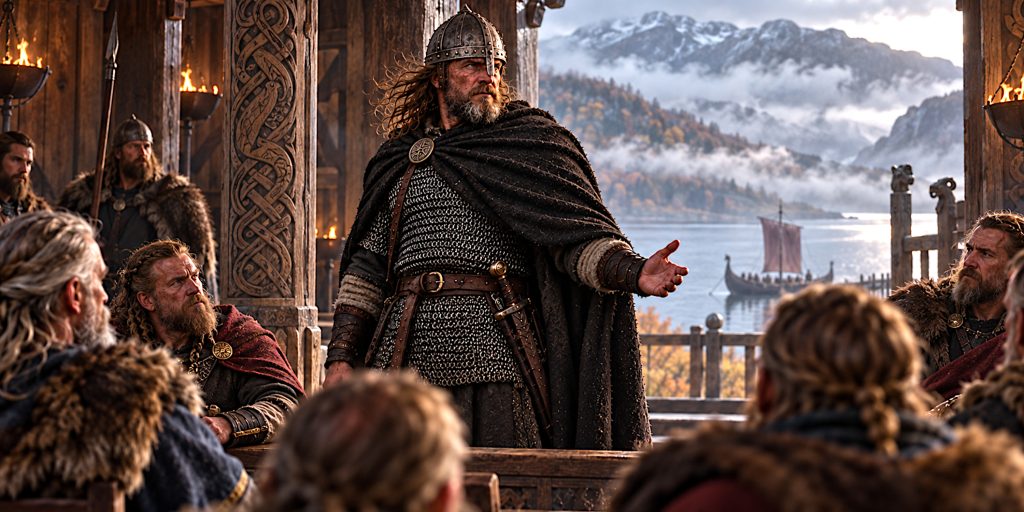
In Scandinavian tradition, Erik was a son of Harald Fairhair and a favoured heir. Harald’s many sons competed for authority, and Erik eliminated rivals as he sought to concentrate power.
The broad setting is plausible: rule depended on personal alliances, regional support and the ability to reward followers. However, the detailed family killings and succession narrative come from later accounts. Norway should not be imagined as a settled modern state with a crown waiting neatly on a cushion.
The sagas eventually give Erik an effective challenger in his younger half-brother Håkon, later called Håkon the Good. Raised at the English court of Æthelstan according to tradition, Håkon returned and gained the support needed to displace him.
In the literary contrast, Erik is harsh and destructive while Håkon offers a more acceptable kingship. That contrast helps organise the story. It does not give us an impartial assessment of either man.
The safest conclusion is that Erik’s Norwegian career belongs to a poorly documented period of contested authority. Its exact dates, geographical reach and personal details remain uncertain.
Gunnhild: Queen, Political Partner and Convenient Villain
Gunnhild is among the most compelling figures in Erik’s story. Later traditions describe an ambitious queen, the mother of royal sons and, in some accounts, a practitioner of dangerous magic. Accounts of her parentage also disagree.
As a woman reading these narratives, I am wary of how efficiently political influence becomes sorcery. A queen who protects her children’s prospects has motives we can understand without supplying supernatural assistance.
That does not make Gunnhild harmless, or prove that every hostile story is invented. It means that accusations of witchcraft tell us about the storyteller’s assumptions as well as the woman being described.
Her later designation as “Mother of Kings” points towards the dynasty’s continuing ambitions. Her sons, including Harald Greycloak in the Norwegian tradition, carried the family’s claims beyond Erik’s defeat.
How Erik Became King of York
York was a valuable prize within a contested northern political world. Its rulers faced pressure from English kings to the south and Scandinavian rivals linked to the Irish Sea.
The conventional chronology places Eric’s first Northumbrian kingship in 947 or 948. Local acceptance mattered. He was not simply a raider who arrived, announced his nickname and inherited the tax receipts.
Northumbrian leaders had their own interests. Supporting a Scandinavian king could help resist southern domination, but it could also provoke a destructive response.
That response came from King Eadred. His campaign devastated Northumbria and included the burning of St Wilfrid’s minster at Ripon. Eric’s supporters subsequently attacked the returning English army near Castleford. The Chronicle, in a commonly used translation, describes a “great slaughter”.
Eadred threatened further retaliation. The Northumbrians abandoned Eric and reached terms with the English king. His battlefield success had failed to secure his political position.
The York Museums Trust account provides a useful outline of these events.
His Return to York and Final Expulsion
Eric’s first removal did not settle the succession. Olaf Sihtricsson, also known as Amlaíb Cuarán, ruled before Eric’s conventional return in 952.
By 954, Eric was expelled again. Eadred secured control, ending the separate Scandinavian kingship based at York.
I would hesitate to describe this simply as a personal failure of courage or leadership. A king could command effective warriors and still lack the durable support needed to survive between stronger competing powers.
The people expected to endure retaliation also had a say. Loyalty becomes less straightforward when someone else’s royal ambitions leave your property burning.
Arms and Armour: What Would Erik Have Used?
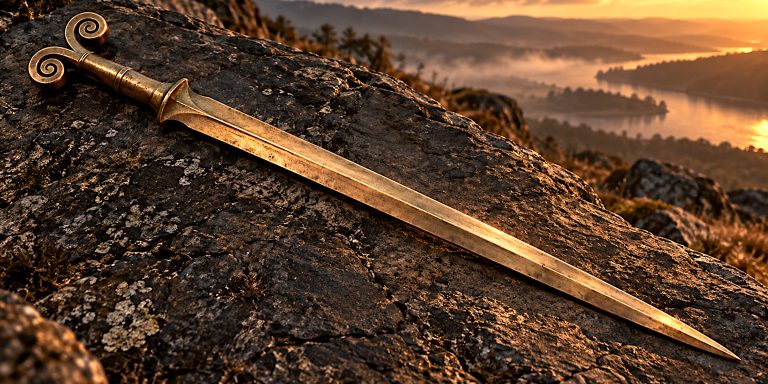
No securely authenticated sword, axe, helmet or mail shirt survives as Erik’s personal equipment. Any reconstruction must therefore draw on the wider tenth-century military world.
| Equipment | Historically reasonable reconstruction |
|---|---|
| Sword | A single-handed, double-edged sword with a straight blade, short guard and shaped pommel |
| Axe | A practical iron axe on a wooden haft, rather than an enormous fantasy weapon |
| Spear | An important weapon for both elite fighters and ordinary warriors |
| Shield | A round wooden shield with an iron boss |
| Armour | Mail was available to wealthy warriors; Erik’s individual equipment is unknown |
| Helmet | Plausible for a well-equipped ruler, but no personal example is known |
| Clothing | Wool and linen, with quality, decoration and fittings expressing status |
“Viking sword” is a broad modern description, not a single uniform model. Assigning Erik a particular Petersen hilt type would imply evidence we do not possess.
His nickname should not obscure the sword. A sword appears on a surviving York penny issued in Eric’s name, although a coin design cannot identify his personal weapon.
Coins and Archaeology
The silver pennies are the most direct surviving material evidence for Eric’s kingship. They bear his name and royal title, expressed as ERIC REX.
A later issue includes a sword design. The British Museum’s interpretation connects this with earlier York coinage associated with St Peter, while also allowing martial associations. Religious symbolism and royal authority could share the same small piece of silver.
The British Museum’s silver penny is a particularly useful object for understanding this.
York’s archaeology supplies a wider setting of settlement, production and commerce. It helps restore the inhabitants who disappear when the history becomes a sequence of royal expulsions.
The York Archaeological Trust has suggested that redevelopment around the period of Erik’s fall may reflect changed ownership. This remains an interpretation, not archaeological proof of a particular political decision.
There is no securely identified grave of Erik Bloodaxe. Rey Cross on Stainmore is associated with him in local tradition, but that association does not establish a burial.
How Did Erik Bloodaxe Die?
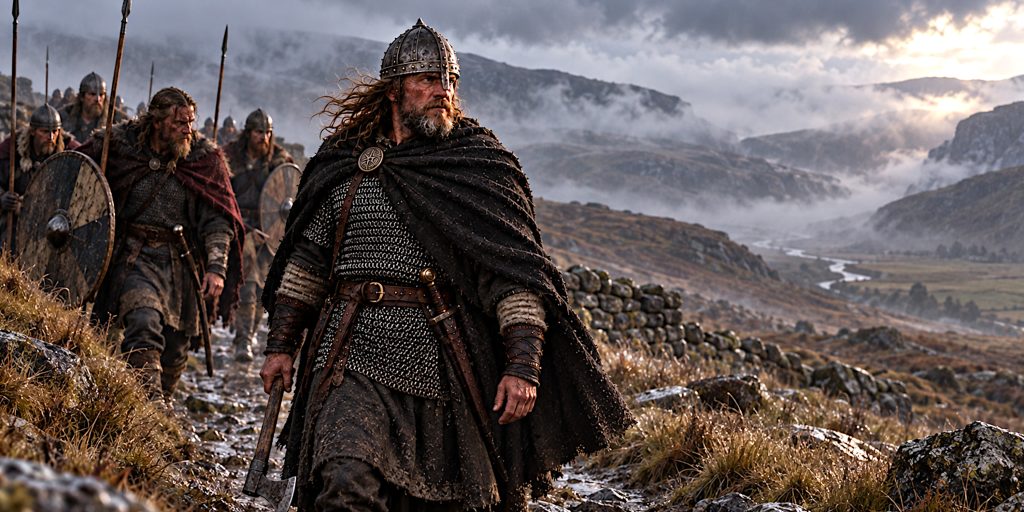
The conventional account places his death in 954 after his final expulsion from York.
Later English tradition locates the killing at Stainmore, on the Pennine route towards the west. Maccus is named as his killer, with betrayal involving Oswulf of Bamburgh appearing in the narrative tradition.
The York Archaeological Trust summary explains the commonly accepted outline and the possibility that Erik was seeking an escape towards the Irish Sea.
We cannot reconstruct a dependable battle plan, army size or sequence of final blows. Even “Battle of Stainmore” can sound more precise than the evidence warrants.
Scandinavian traditions offer differing endings. The familiar image of a doomed warrior dying magnificently belongs partly to the way royal death was remembered and presented.
Poetry, Egil and the Afterlife of a King
The poem Eiríksmál, generally associated with Erik’s death, imagines his reception in Valhalla. It is often treated as preserving tenth-century praise poetry, although it survives through later transmission.
Its value lies in the royal image it constructs. A defeated ruler can become a warrior whom the gods themselves wish to receive. Political disaster on earth acquires a rather better reception elsewhere.
Egil’s Saga supplies another famous literary encounter. The poet Egil Skallagrímsson, an enemy of Erik and Gunnhild, escapes death through the composition of a praise poem known as the Head-Ransom.
The episode makes excellent literature. Its surviving narrative is much later than the supposed meeting, so it cannot be treated as a transcript from Erik’s court.
Poetry mattered because reputation mattered. A ruler’s generosity, ferocity and ancestry could all be argued through verse. Kings needed people to tell the right stories about them, preferably while everyone concerned still had a head.
Erik Bloodaxe Timeline
| Date | Event and qualification |
|---|---|
| Late ninth or early tenth century | Possible period of birth; no secure date |
| Early 930s | Traditional period of Norwegian rule |
| 930s | Displacement by Håkon in the saga narrative; chronology uncertain |
| 947/948 | Conventional beginning of first rule at York |
| 948 | English campaign, Castleford fighting and Eric’s removal in the usual chronology |
| 952 | Conventional return to power at York |
| 954 | Final expulsion; traditional date of death |
| Late twelfth and thirteenth centuries | Surviving Scandinavian narratives develop the familiar biography |
What Was Erik Bloodaxe’s Legacy?
Watch the Trailer to the upcoming series:
Erik’s final expulsion marks the end of the separate Scandinavian royal line at York. It did not remove Scandinavian people, language, trading connections or cultural influence from northern England.
His longer reputation rests on an unusually potent mixture of coins, brief annals, royal poetry and later storytelling. There is enough evidence to establish a historical ruler, but far less to establish the complete man presented in popular biographies.
My own reading is that we lose something when we reduce him to an axe and a temper. The more revealing figure is a king whose authority depended on shifting support, whose defeats could be rewritten as heroic destiny, and whose name outlived almost everything certain about him.
That is a substantial legacy. It is also a warning about letting a very good nickname write the history.