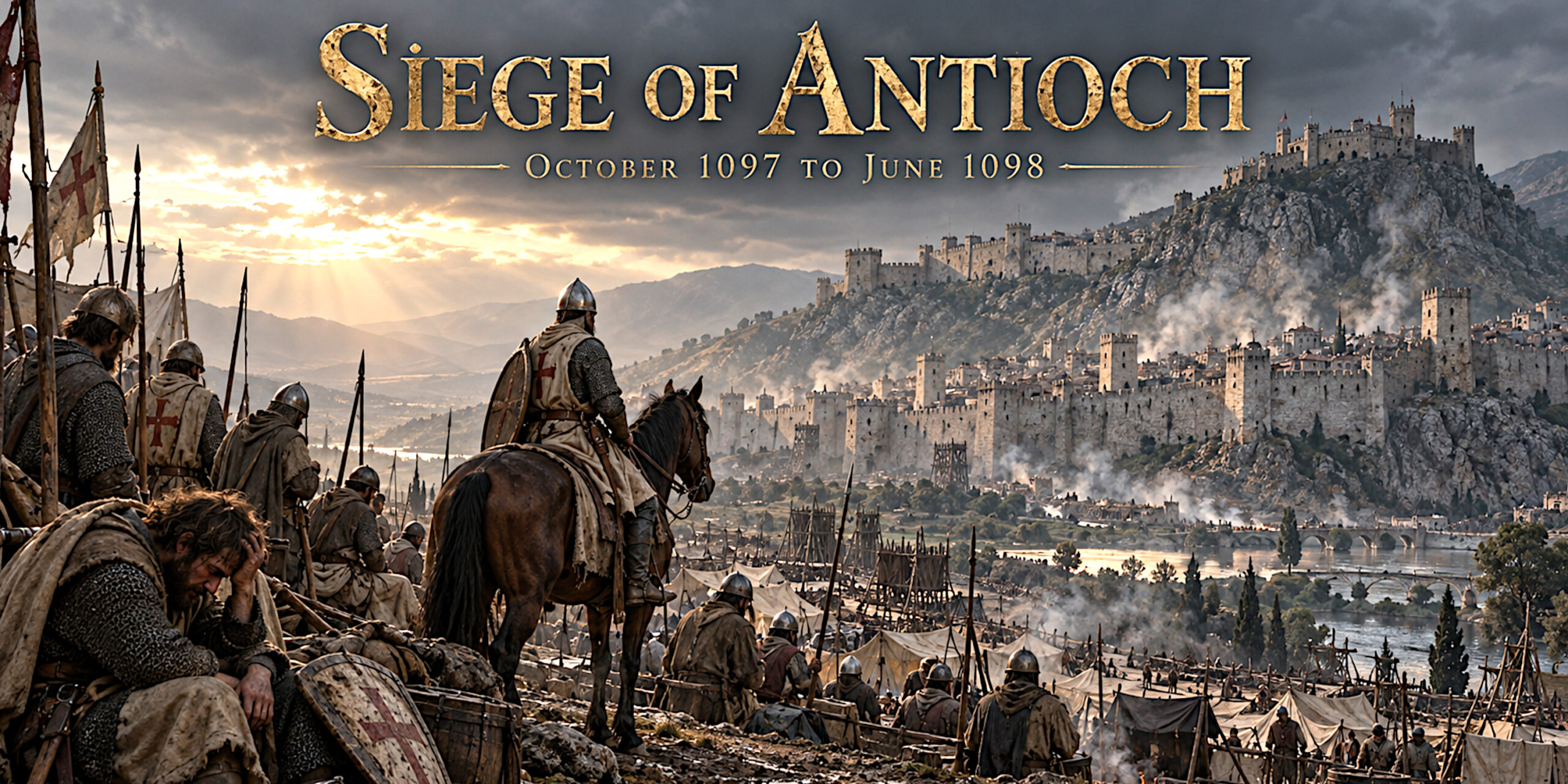
The Siege of Antioch brought the First Crusade close to destruction. Between October 1097 and June 1098, the crusaders struggled to take a city whose defences were far stronger than their arrangements for feeding themselves. When they finally broke in, they discovered that possession of Antioch came with an immediate disadvantage: they were now the people trapped inside.
The campaign unfolded in two distinct stages. First, the crusaders besieged Antioch’s Turkish garrison. Then a relief army under Kerbogha of Mosul besieged the victorious crusaders. Their eventual victory outside the walls on 28 June 1098 secured the city and allowed the expedition towards Jerusalem to survive.
What holds my attention is how uncertain that outcome remained. Later accounts could present Antioch as a triumph guided by providence. Those living through it had to contend with rain, hunger, frightened horses and commanders already arguing over ownership.
Siege of Antioch at a Glance
| Detail | Summary |
|---|---|
| Campaign | First Crusade |
| Location | Antioch on the Orontes, modern Antakya, Türkiye |
| First siege | 21 October 1097 to 3 June 1098 |
| Second siege | Early June to 28 June 1098 |
| Main crusader commanders | Bohemond of Taranto, Raymond IV of Toulouse, Godfrey of Bouillon and other contingent leaders |
| Governor of Antioch | Yaghi-Siyan |
| Principal relief commander | Kerbogha, atabeg of Mosul |
| Decisive events | Entry through towers secured by Firouz; defeat of Kerbogha’s army |
| Outcome | Crusader victory and the eventual establishment of the Principality of Antioch |
The capture of the city on 3 June did not include its citadel. That stronghold remained hostile until after Kerbogha’s defeat, leaving the crusaders threatened from above as well as outside the walls.
Why Antioch Mattered
Antioch occupied a commanding position between Anatolia and northern Syria. Leaving a substantial enemy garrison behind would have endangered the crusaders’ communications and supply routes as they moved south.
The city also carried considerable religious and political weight. It was an ancient centre of Christianity, while the Byzantine emperor Alexios I regarded it as territory that should return to imperial control.
For Bohemond, however, Antioch offered the possibility of a principality of his own. The campaign therefore contained a dispute that battlefield success could only sharpen: were the crusaders recovering Byzantine territory, or acquiring land for themselves?
The Muslim side was equally divided. Rival rulers could recognise the danger posed by the crusade without trusting one another sufficiently to respond together.
Forces
No reliable muster rolls survive. Medieval totals often mix fighting men, servants, pilgrims and other followers, while losses and temporary departures continually changed the armies’ strength.
| Force | Broad assessment | Important qualification |
|---|---|---|
| Crusader host arriving at Antioch | Tens of thousands of people, including combatants and non-combatants | Often quoted totals around 30,000–40,000 should not be treated as a count of effective soldiers |
| Antioch’s garrison | Several thousand defenders | Exact strength and the contribution of local manpower remain uncertain |
| Earlier relief forces | Separate armies associated with Damascus and Aleppo | They approached at different times rather than as one coordinated offensive |
| Kerbogha’s coalition | A substantial army assembled from several regional contingents | Precise totals are insecure; political cohesion mattered as much as size |
| Crusaders fighting in late June | A severely depleted force with relatively few serviceable horses | Initial campaign figures cannot be carried forward unchanged |
Stephen of Blois claimed that more than 5,000 Turkish soldiers had entered Antioch, alongside other groups. His letter is valuable contemporary testimony, but it remains a participant’s estimate rather than an audited return.
The distinction matters. A knight whose horse had died might still fight effectively on foot, but he could no longer perform the same role in reconnaissance, pursuit or a mounted charge.
Leaders and Troop Composition
| Leader | Position | Contribution |
|---|---|---|
| Bohemond of Taranto | Leader of the southern Italian Normans | Prominent in field operations and negotiations with Firouz; subsequently established control over Antioch |
| Raymond IV of Toulouse | Leader of the southern French contingent | A major source of men and resources; challenged Bohemond’s ambitions |
| Godfrey of Bouillon | Leading Lotharingian commander | Took part in siege operations and the final battle |
| Adhemar of Le Puy | Papal legate | Provided religious authority and helped maintain cooperation |
| Robert of Normandy and Robert of Flanders | Independent contingent leaders | Supplied important fighting forces |
| Yaghi-Siyan | Governor of Antioch | Directed the defence, organised sorties and sought outside assistance |
| Kerbogha of Mosul | Commander of the principal relief coalition | Attempted to recover Antioch after its capture |
The crusader army operated through several powerful leaders rather than a permanent supreme commander. Cooperation could be effective, but it required repeated negotiation. Medieval aristocrats rarely suffered from a shortage of opinions.
Crusader troop composition included:
- Mounted knights and other horsemen, although horse losses increasingly forced men to fight on foot.
- Spearmen, archers and crossbowmen.
- Armed retainers with varying levels of protection.
- Clergy, servants, craftspeople and other followers who sustained the army.
The defending and relief forces included:
- Turkish mounted archers.
- Armoured cavalry equipped for close combat.
- Garrison infantry and missile troops.
- Regional contingents whose loyalty rested primarily with their own commanders.
Neither army should be imagined as a neatly uniform national force.
Arms and Armour
Antioch belongs to the world of mail, shields, spears and composite bows. The fully enclosed helmets and extensive plate armour familiar from later medieval warfare do not belong here.
The equipment below represents plausible late eleventh-century forms. It is not a catalogue of weapons excavated from the siege.
| Weapon or protection | Likely users | Role and limitations |
|---|---|---|
| Straight, double-edged knightly sword | Crusader knights and wealthier retainers | A one-handed cutting and thrusting weapon, generally used with a shield |
| Oakeshott Type X and early Type XI forms | Appropriate comparisons for western swords of the period | Modern classifications describing broad, fullered blades and longer, narrower variants; individual commanders’ swords cannot usually be identified |
| Early Turkic sabre | Some Turkish cavalry | A single-edged cutting weapon, generally less dramatically curved than many later Ottoman examples |
| Straight Islamic sword | Some Muslim troops | Straight blades remained part of the regional weapons tradition |
| Lance and spear | Cavalry and infantry on both sides | Essential weapons for mounted attacks, holding ground and fighting at reach |
| Composite bow | Particularly Turkish mounted archers | Allowed mobile harassment and concentrated shooting |
| Bow and crossbow | Crusader missile troops | Useful in defending positions and supporting other troops |
| Mail hauberk | Knights and other well-equipped warriors | Flexible protection, normally combined with a helmet and shield |
| Mail, lamellar and other armour | Better-equipped Muslim troops | Equipment varied considerably between contingents |
The familiar image of every Muslim warrior carrying an exaggeratedly curved “scimitar” is misleading. Surviving Islamic weapons demonstrate a more varied tradition, including straight swords and comparatively gently curved blades.
For the crusaders, a conical helmet with a nasal guard and a substantial kite shield are appropriate reference points. Protection varied with wealth, supply and the gradual loss of equipment.
A sword could be precious, practical and prestigious. It could not compensate for an empty supply cart.
The First Siege: October 1097 to June 1098

Antioch’s walls climbed steep ground towards the citadel on Mount Silpius. Their scale prevented the crusaders from establishing a complete encirclement at the outset.
Instead, they occupied accessible approaches and gradually tightened their grip. The campaign became a struggle over gates, roads, fortified positions and access to supplies.
Three pressures shaped the siege:
- Hunger: local resources were exhausted, while buying food became ruinously expensive.
- Sorties: defenders attacked isolated men, working parties and vulnerable movements outside the camps.
- Relief armies: the crusaders repeatedly had to fight outward while maintaining pressure on the city.
Foraging created its own trap. Sending men away might bring back food, but it weakened the siege and exposed those men to attack. Keeping everyone together offered security while consuming supplies faster.
Sea connections through the port of St Symeon helped sustain the expedition, although goods still had to travel inland. Ships arriving on the coast did not make the road to Antioch safe.
The winter was also cold and wet. Stephen of Blois explicitly rejected the comfortable assumption that Syria must always be hot. His correction has the weary authority of someone who had spent too long standing in the rain.
How the Crusaders Entered Antioch

The decisive opening came through Firouz, a man responsible for towers in the city’s defences.
Bohemond negotiated secretly with him, then arranged for a small party to climb into the defended circuit during the night of 2–3 June 1098. Once a foothold had been secured, larger numbers entered.
Firouz is often described as an Armenian convert to Islam, although accounts differ over his identity and motives. Reward, grievance and personal calculation all feature in explanations of his decision.
The capture brought killing and plunder. Yaghi-Siyan fled and was killed outside the city. The victorious army occupied Antioch, but the citadel remained beyond its control.
The suffering of the inhabitants deserves more attention than it often receives. In triumphal narratives, civilians can disappear behind the achievement of opening a gate. They were the people who had to live with what followed.
The Second Siege and the Holy Lance
Kerbogha’s arrival reversed the crusaders’ position. Their newly captured refuge became a place of confinement, with hostile forces outside and the citadel still threatening them from above.
Food shortages returned with devastating force. Desertion and fear undermined confidence.
During this crisis, Peter Bartholomew claimed that St Andrew had revealed the location of the spear that pierced Christ’s side. On 14 June, an iron object identified as the Holy Lance was recovered during digging in the Church of St Peter.
Some accepted it as divine reassurance. Others doubted the claim.
Historians can establish its importance to belief and morale without accepting its authenticity. Nor is it necessary to assume that everyone involved was knowingly staging a fraud. Conviction, political usefulness and uncertainty could coexist.
The discovery offered hope. Hope still required commanders to organise an army capable of leaving the gates.
The Battle of Antioch: 28 June 1098

The crusaders emerged to fight in organised divisions, with Bohemond exercising a leading role. This was a coordinated attempt to escape a worsening strategic position.
Kerbogha’s force failed to destroy them as they deployed. Fighting followed, but his coalition did not maintain its cohesion. Rival interests and distrust helped turn military pressure into a wider collapse.
The best explanation combines several factors:
- Crusader formations retained sufficient discipline to advance and support one another.
- Commanders had accumulated experience fighting together.
- Religious confidence helped sustain men under extreme pressure.
- Kerbogha could not rely on every contingent remaining committed.
The victory cannot be reduced to a miraculous charge or to enemy disunity alone. Men still had to stand, advance and fight.
After the relief army withdrew, the citadel surrendered. Its capitulation completed a conquest that the entry of 3 June had left unfinished.
Battle Timeline
| Date | Event |
|---|---|
| 21 October 1097 | Crusaders begin the siege |
| November 1097 | Maritime assistance strengthens connections with the coast |
| December 1097 | Supply shortages worsen; major foraging operations become necessary |
| Late December 1097 | Bohemond and Robert of Flanders encounter forces associated with Duqaq of Damascus |
| Winter 1097–1098 | Hunger, illness, rain and desertion weaken the besiegers |
| 9 February 1098 | Crusaders defeat a relief force associated with Ridwan of Aleppo |
| March 1098 | Fighting and additional fortifications help tighten control of approaches |
| Night of 2–3 June 1098 | Firouz enables crusaders to enter the defences |
| 3 June 1098 | City captured; citadel continues to resist |
| Early June 1098 | Kerbogha’s army arrives and begins the second siege |
| 14 June 1098 | Discovery of the object identified as the Holy Lance |
| 28 June 1098 | Crusaders defeat Kerbogha outside Antioch |
| Following the victory | Citadel surrenders |
Some accounts differ over the precise dating of movements during the opening days of June. The distinction between the capture of the city and the subsequent relief battle is much firmer.
Contemporary Quotes: Reading the Witnesses Carefully
Contemporary testimony brings us close to Antioch, but closeness does not guarantee neutrality.
Stephen of Blois, writing to his wife Adela in March 1098, described the city as:
“fortified with incredible strength and almost impregnable.”
His letter also presents himself as prosperous and influential. That combination is revealing: accounts sent home could reassure families and defend reputations while acknowledging hardship.
The anonymous author of the Gesta Francorum described the winter food crisis:
“grain and all food began to be excessively dear”
The same work records the response to the supposed Holy Lance:
“a joy beyond measure arose in the whole city.”
These are translations reproduced in Fordham University’s Medieval Sourcebook. The author participated in the crusade and favoured Bohemond, making the narrative indispensable but partisan. Its reports of supernatural assistance reveal the author’s interpretation of victory, rather than independently verifiable battlefield events.
Archaeology: What Survives and What Remains Uncertain
Antioch’s most important physical evidence is its defensive landscape: steep slopes, surviving masonry and the relationship between the lower city and the citadel.
The walls contain multiple phases of construction and repair. Describing them all simply as “crusader walls” conceals their much longer history. Architectural research combines standing remains with earlier surveys, drawings and written descriptions.
The major excavations directed by Princeton between 1932 and 1939 recovered extensive material from Antioch and its surroundings. Their celebrated mosaics illuminate the ancient city, but they should not be presented as evidence for the fighting of 1097–1098.
| Evidence | What it can contribute | Main limitation |
|---|---|---|
| Walls and towers | Understanding defensive scale and construction | Surviving fabric belongs to different periods |
| Terrain and historic plans | Reconstructing approaches and tactical constraints | Gate names and exact locations can be disputed |
| Excavated urban material | Understanding occupation and daily life | Objects need secure contexts before association with the siege |
| Written accounts compared with topography | Testing whether reported movements are plausible | Agreement with terrain does not prove every narrative detail |
Claims that particular arrowheads, mail fragments or excavated camps belong to this siege require specific published evidence. A medieval object found near Antioch is not automatically a souvenir of June 1098.
Outcome and Legacy
Antioch’s capture gave the crusaders a major northern stronghold and allowed the First Crusade to continue towards Jerusalem. It also produced a lasting dispute with Byzantium as Bohemond consolidated his position.
The principality that developed around the city endured until Antioch’s capture by the Mamluk sultan Baybars in 1268.
Yet the campaign’s significance extends beyond the establishment of another crusader state. Antioch demonstrates how medieval armies depended on food, transport, local knowledge and cooperation as much as martial skill.
I find the survival of the crusader army extraordinary without needing to make it inevitable. Its victory emerged from effective fighting, calculated betrayal, religious conviction and failures among its opponents. For the inhabitants caught between those armies, the legacy was considerably less triumphant.