The Siege of Jacob’s Ford stands among the most decisive engagements of the Crusades, despite lasting only a matter of days. In August 1179, Saladin captured and demolished the newly built fortress of Chastellet, eliminating one of the Kingdom of Jerusalem’s most ambitious defensive projects before it could become a permanent threat.
For the Crusaders, Jacob’s Ford represented a strategic masterpiece. For Saladin, it was an unacceptable provocation that demanded an immediate response. He understood something many medieval rulers occasionally forgot. A fortress under construction is infinitely easier to destroy than one that has stood for twenty years.
The result reshaped the military balance in northern Palestine and foreshadowed the greater conflicts that would culminate at Hattin eight years later.
Background
Following the uneasy truce between King Baldwin IV of Jerusalem and Saladin, the Crusaders sought to strengthen their northern frontier.
Jacob’s Ford, known in Latin as Vadum Iacob, crossed the River Jordan on the road linking Damascus with Galilee. According to biblical tradition, it was near the place where Jacob crossed the river after wrestling with the angel.
Whoever controlled this crossing controlled movement between Syria and the Kingdom of Jerusalem.
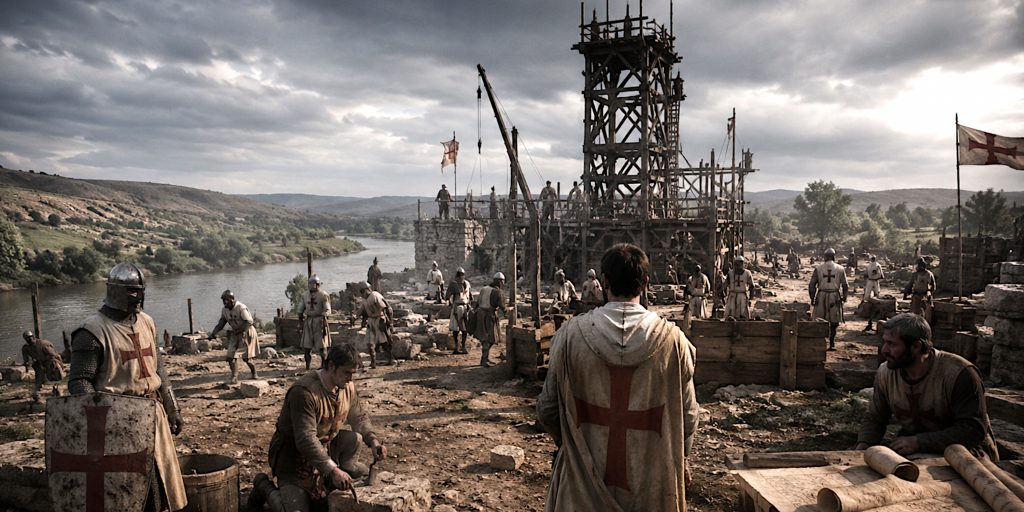
The Knights Templar received permission to construct an enormous stone fortress called Chastellet during 1178.
Its purpose was clear:
- Prevent Muslim invasions into Galilee.
- Threaten Damascus itself.
- Protect northern Crusader settlements.
- Strengthen communication between Acre and the inland castles.
Saladin immediately recognised the danger.
He reportedly offered increasingly generous sums of gold if the Crusaders would abandon construction. Baldwin IV refused.
Negotiation had failed.
The only remaining option was force.
Why Jacob’s Ford Mattered
| Strategic Advantage | Importance |
|---|---|
| Jordan crossing | Controlled one of the easiest crossings of the river |
| Road network | Connected Damascus with Galilee |
| Military base | Allowed rapid Crusader offensives |
| Frontier defence | Protected northern settlements |
| Psychological impact | Demonstrated Crusader expansion despite Saladin’s growing power |
Forces
Crusader Garrison
| Component | Estimated Strength |
|---|---|
| Knights | 80 to 100 |
| Templar brothers | Approximately 40 |
| Infantry | 700 to 1,200 |
| Engineers and labourers | Several hundred |
| Civilians | Present within fortress works |
Commander
- Hugh of St Amand, Grand Master of the Knights Templar
- Local Templar officers
- Royal officials overseeing construction
Ayyubid Army
| Component | Estimated Strength |
|---|---|
| Cavalry | 8,000 to 12,000 |
| Infantry | Several thousand |
| Archers | Large numbers |
| Engineers | Specialist siege crews |
| Sappers | Experienced miners and labourers |
Commander
- Saladin
- Senior Ayyubid emirs
- Professional military engineers
Although exact figures remain debated, Saladin enjoyed overwhelming numerical superiority.
Leaders
| Commander | Side | Role |
|---|---|---|
| Saladin | Ayyubid Sultan | Directed siege and assault |
| Hugh of St Amand | Knights Templar | Oversaw fortress defence |
| Baldwin IV | Kingdom of Jerusalem | Too distant to relieve fortress in time |
Baldwin attempted to march north with relief forces but arrived after the fortress had already fallen.
Timing, as so often in medieval warfare, proved utterly unforgiving.
Arms and Armour
The siege combined heavy cavalry traditions with specialised siege engineering.
Crusader Equipment
Swords
- Knightly arming sword (Oakeshott Types X, XI and XII)
- Early cruciform longswords among wealthier knights
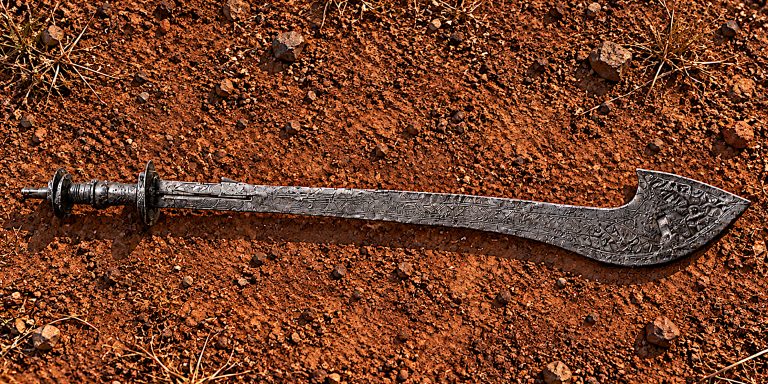
- Falchions carried by some infantry
Other Weapons
- Lances
- Spears
- Crossbows
- Long spears
- Axes
- Maces
- Stone-throwing engines
Armour
- Mail hauberks
- Mail chausses
- Conical great helms
- Nasal helmets
- Kite shields
- Quilted gambesons
Ayyubid Equipment
Swords
- Straight double-edged Islamic swords
- Early curved sabres becoming increasingly common
- Kilij-style Turkic blades among mounted warriors
Other Weapons
- Composite bows
- Spears
- Javelins
- Maces
- Siege ladders
- Mining tools
- Fire weapons
Armour
- Lamellar armour
- Scale armour
- Mail shirts
- Turbans reinforced with mail
- Round shields
- Horse armour for elite cavalry
The contrast between armies reflected two evolving military traditions. Crusaders continued relying upon heavily armoured shock cavalry, while Saladin’s forces combined mobility, missile fire and increasingly sophisticated siegecraft.
The Siege
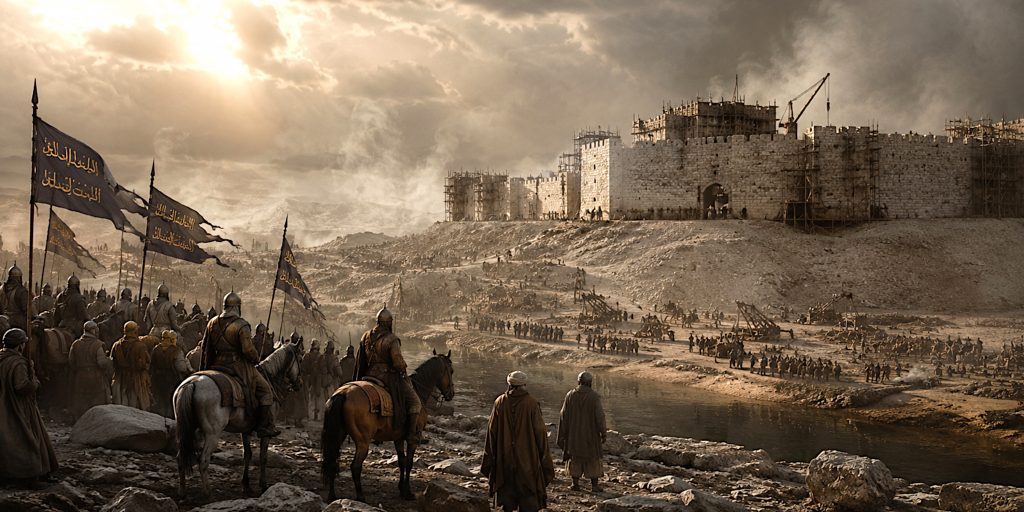
Construction had not yet been completed when Saladin advanced in August 1179.
The walls remained vulnerable.
The garrison lacked sufficient manpower.
Saladin surrounded the fortress before Baldwin IV could organise an effective relief.
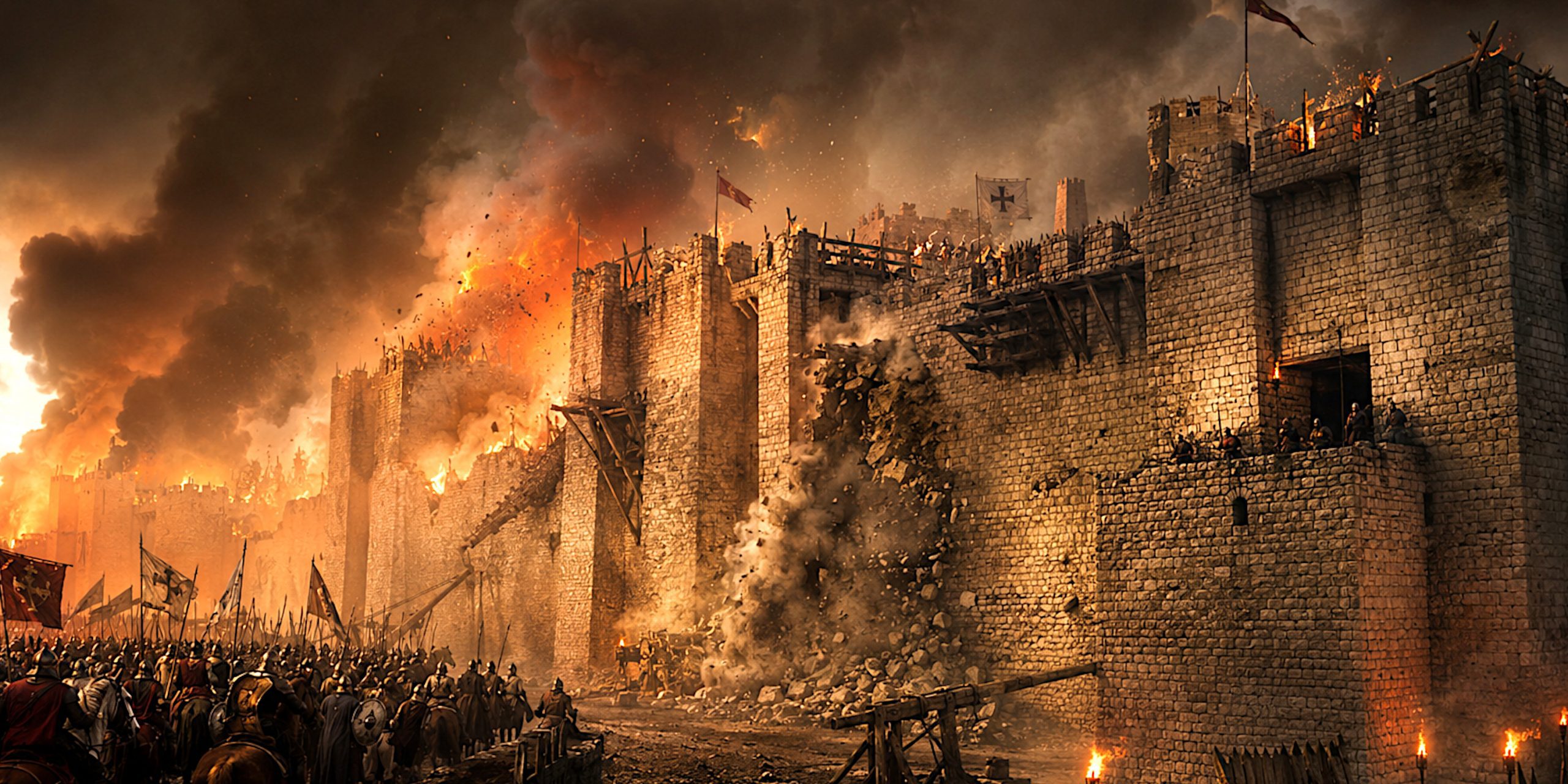
Rather than relying upon prolonged starvation, Saladin ordered immediate mining operations beneath the walls.
His engineers dug tunnels supported by timber.
Once complete, the supports were burned.
The collapsing tunnels brought down substantial sections of the curtain wall.
The breach allowed Ayyubid troops to storm inside.
The fighting quickly became desperate.
Many defenders were killed during the assault.
Others were captured.
The fortress itself was systematically dismantled to ensure it could never again threaten Damascus.
It was an exceptionally efficient siege. Medieval engineering rarely receives the admiration reserved for knights charging dramatically across fields, yet it frequently decided wars long before anyone had the opportunity to behave heroically.
Battle Timeline
| Date | Event |
|---|---|
| Late 1178 | Construction of Chastellet begins |
| Early 1179 | Saladin attempts diplomatic settlement |
| Summer 1179 | Baldwin refuses financial offers |
| 23 August 1179 | Saladin surrounds Jacob’s Ford |
| 24 August | Mining operations intensify |
| 29 August | Wall collapses after tunnelling |
| 30 August | Fortress stormed and captured |
| Immediately afterwards | Chastellet demolished |
| Following weeks | Saladin secures northern frontier |
Casualties
| Side | Estimated Losses |
|---|---|
| Crusaders | Around 700 to 800 killed |
| Prisoners | Numerous Templars captured |
| Ayyubids | Relatively light compared with attackers |
Some medieval accounts describe bodies being buried hastily due to fears of disease during the summer heat.
Archaeology
Jacob’s Ford has become one of the most important Crusader archaeological sites ever excavated.
Major excavations directed by Professor Ronnie Ellenblum and later international teams uncovered remarkable evidence of the siege.
Important discoveries include:
- Burnt defensive walls.
- Collapsed stonework from mining.
- Human skeletons.
- Arrowheads.
- Crossbow bolts.
- Iron nails from siege works.
- Mason’s tools abandoned during construction.
- Coins dating to Baldwin IV’s reign.
- Animal remains showing the fortress’s food supply.
Perhaps the most remarkable discovery was the mass burial containing defenders killed during the final assault.
Scientific analysis has revealed traumatic injuries consistent with close combat, confirming contemporary descriptions of the fighting.
Archaeologists also identified evidence of the tunnel used to undermine the walls, providing rare physical confirmation of medieval mining techniques.
Few Crusader battlefields have yielded such a detailed archaeological picture of a siege.
Contemporary Quotes
The chronicler William of Tyre, writing before the siege but describing the strategic importance of the site, noted:
“It guarded the passage over the Jordan.”
The Muslim historian Baha ad-Din later praised Saladin’s determination:
“He resolved that it should be destroyed before it became stronger.”
The chronicler Ibn al-Athir described the assault:
“The Muslims entered by force and slew those within.”
These accounts naturally reflect their authors’ loyalties, yet together they provide a remarkably consistent picture of a rapid and decisive victory.
Why the Crusaders Lost
Several factors combined to produce defeat.
- Construction remained incomplete.
- Saladin acted with remarkable speed.
- Relief forces arrived too late.
- Ayyubid mining proved devastating.
- The garrison was too small for prolonged defence.
- Saladin concentrated overwhelming force at a single objective.
Perhaps the greatest lesson lies in Saladin’s refusal to allow strategic patience to favour his enemy. Many rulers would have watched construction continue while debating their options. Saladin marched.
Legacy
The destruction of Chastellet secured Damascus against immediate Crusader pressure.
It also enhanced Saladin’s prestige across the Islamic world, demonstrating that he could defeat the Kingdom of Jerusalem in open operations rather than merely defending territory.
For the Crusaders, the defeat exposed weaknesses in frontier strategy and highlighted how vulnerable isolated fortifications remained without rapid field support.
Eight years later, after Hattin, many of these lessons would return with brutal clarity.
Jacob’s Ford therefore deserves attention not simply as a successful siege, but as one of the key stepping stones towards Saladin’s conquest of Jerusalem in 1187.
Historical Assessment
The Siege of Jacob’s Ford illustrates medieval warfare at its most practical. Rather than relying upon dramatic cavalry charges or romantic last stands, the outcome rested on engineering, logistics and speed.
The Crusaders had chosen an excellent location for their fortress. Unfortunately for them, Saladin recognised its importance just as clearly.
There is also something quietly sobering about the archaeology. Excavated walls, shattered weapons and hastily buried skeletons remind us that beneath the grand strategies of kings and sultans stood hundreds of ordinary soldiers and labourers whose stories ended beneath unfinished stone. History has a habit of celebrating castles. Archaeology tends to introduce us to the people who never walked out of them.
Further Reading
- William of Tyre, Historia Rerum in Partibus Transmarinis Gestarum
- Baha ad-Din ibn Shaddad, The Rare and Excellent History of Saladin
- Ibn al-Athir, The Complete History
- Ronnie Ellenblum, Crusader Castles and Modern Histories
- Denys Pringle, The Churches of the Crusader Kingdom of Jerusalem