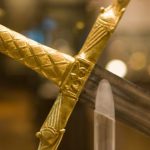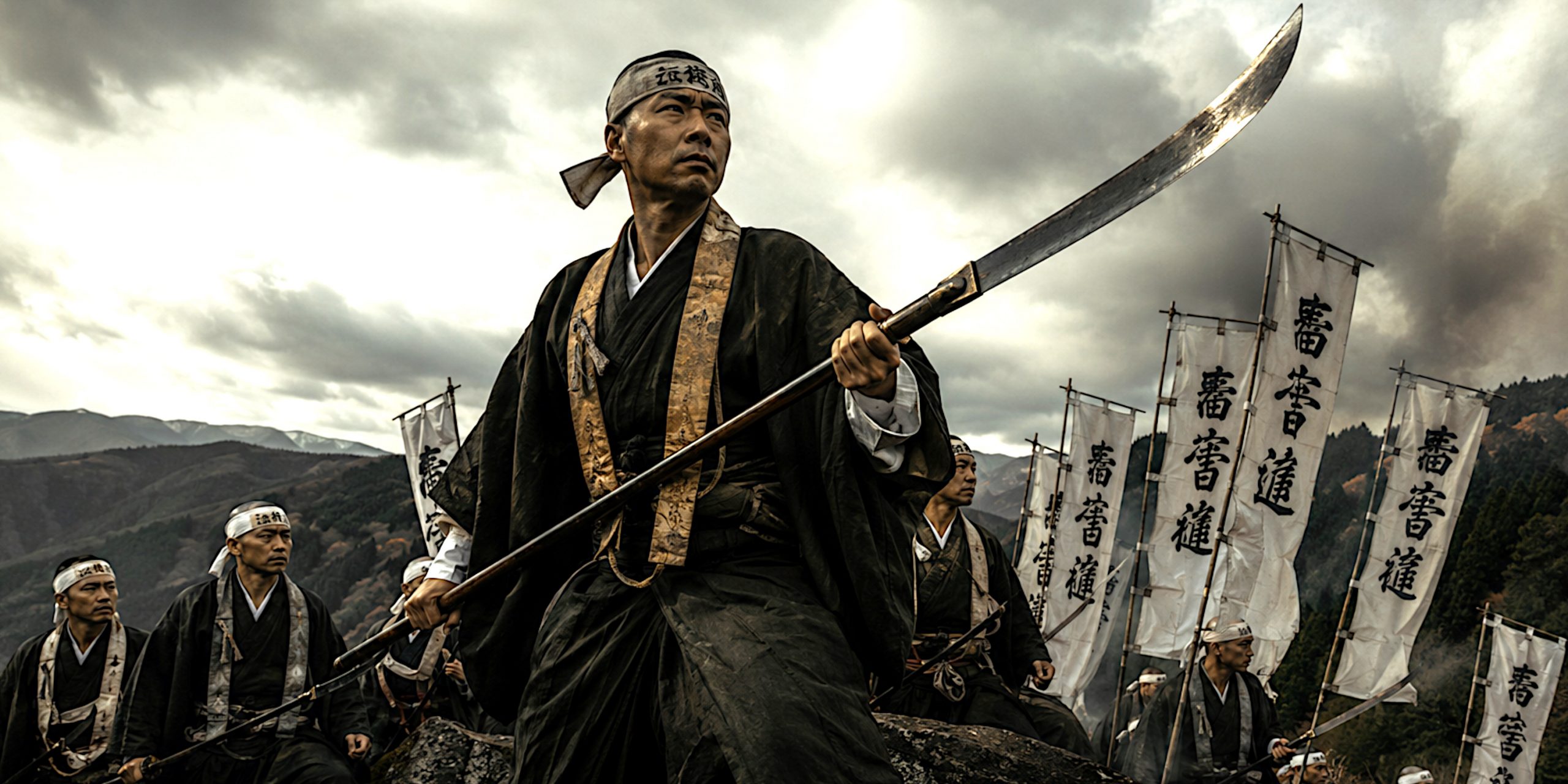
Japan’s sōhei, usually translated as warrior monks, tend to be presented in popular culture as shaven-headed Buddhist berserkers charging into battle with naginata held high. There is some truth buried in that image, but the reality was considerably more complicated.
The great Buddhist institutions of medieval Japan were religious communities, political powers, landowners and, when circumstances required it, military organisations. Their armed followers fought rival temples, defended estates, intervened in disputes at the imperial court and became entangled in the wars of the samurai.
By the fifteenth and sixteenth centuries, some religious establishments could field forces substantial enough to concern the greatest warlords in Japan. Yet calling every armed man attached to a monastery a “warrior monk” is misleading. Some were ordained monks. Others were lower-ranking religious personnel, estate warriors, local samurai, servants or hired fighting men.
The sōhei were therefore less a distinct warrior class than the military expression of Japan’s powerful medieval religious institutions. That distinction matters.
Who Were the Sōhei?
The Japanese term sōhei (僧兵) literally combines the characters for monk and soldier. Historians need to handle the label with some care because its modern use can suggest a clearly defined military order comparable to the Knights Templar.
There was no single organisation of sōhei.
Armed religious communities developed around different temples and Buddhist traditions, with their own interests and allegiances. Among the institutions most strongly associated with warrior monks were:
- Enryaku-ji on Mount Hiei, associated with Tendai Buddhism
- Kōfuku-ji at Nara
- Tōdai-ji at Nara
- Mii-dera, also known as Onjō-ji
- Negoro-ji, associated with the Negoro armed community
- Various temples and religious leagues that became involved in the warfare of the Sengoku period
The armed followers of these institutions might protect temple property, enforce political demands or participate directly in military campaigns.
That makes “warrior monk” a convenient description rather than a perfect social category.
Why Buddhist Monasteries Needed Armies
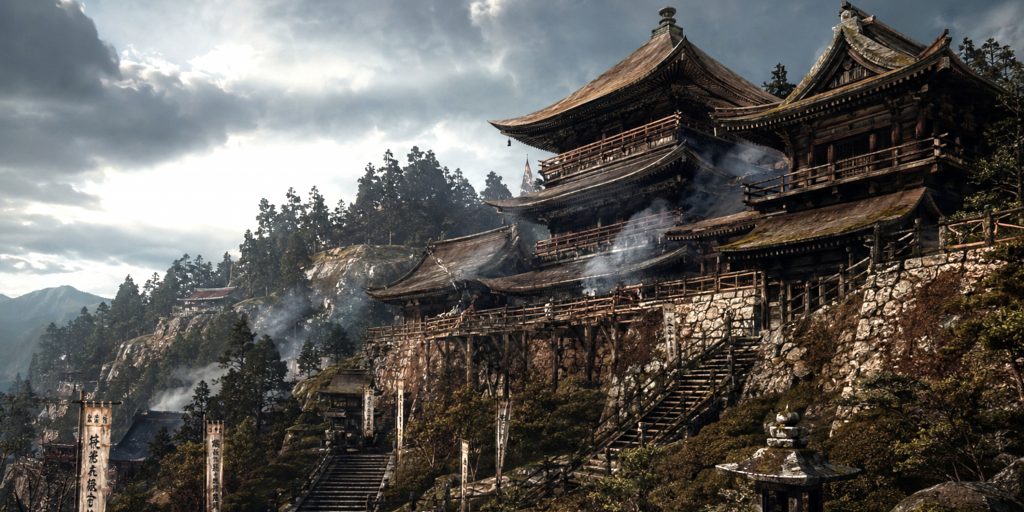
The obvious question is why Buddhist monks were carrying weapons in the first place.
Medieval Japanese monasteries were not simply quiet places of contemplation. Major temples controlled estates, collected revenues, employed retainers and possessed considerable political influence.
Land meant wealth. Wealth required protection.
Disputes arose over:
- Estate boundaries
- Taxation
- Appointment of religious officials
- Control of subsidiary temples
- Pilgrimage revenues
- Political influence at court
- Rivalry between Buddhist institutions
- Relations with provincial warriors
Violence became one method of settling these disputes.
There is an uncomfortable irony in Buddhist institutions developing substantial military establishments, although medieval religious organisations elsewhere were hardly strangers to armed force. Humans have always shown considerable ingenuity when reconciling doctrine with property disputes.
The Rise of the Warrior Monks
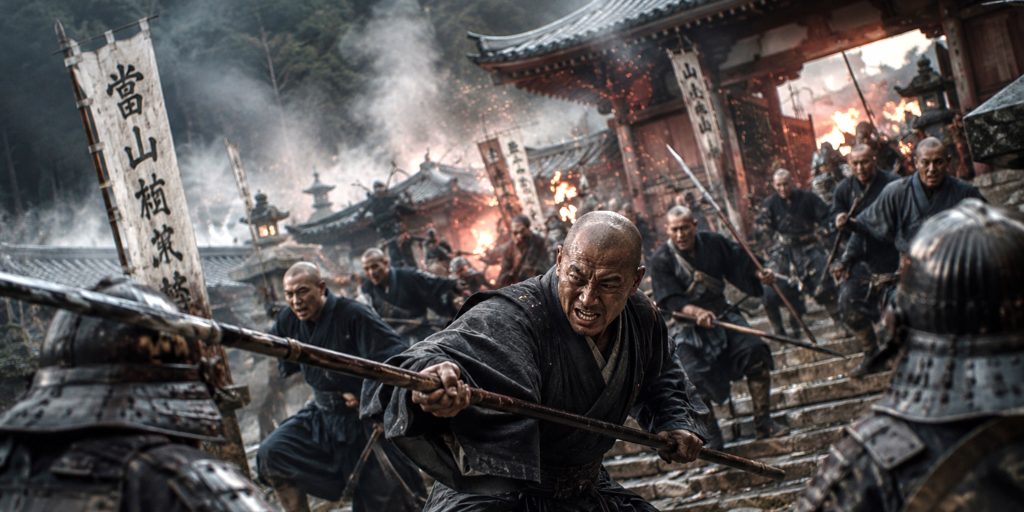
Armed conflict involving Buddhist establishments can be traced back well before the Sengoku period.
During the Heian period, powerful monasteries accumulated extensive estates and political influence. Rivalries became particularly bitter between institutions such as Enryaku-ji and Mii-dera.
Temple communities sometimes marched on Kyoto to press their demands upon the imperial authorities.
These demonstrations were known as gōso, forceful religious protests in which monks and their supporters could carry sacred objects or portable shrines into the capital.
The symbolism was powerful. Authorities faced both armed demonstrators and the spiritual consequences of resisting a sacred institution.
It was medieval political lobbying with rather more polearms.
Enryaku-ji and Mount Hiei
Few institutions are more closely connected with the traditional image of the sōhei than Enryaku-ji.
Founded on Mount Hiei overlooking Kyoto, Enryaku-ji became one of Japan’s most important Buddhist centres. Its position also gave it considerable strategic significance.
The monastery possessed extensive estates and influence. Its religious community was enormous by medieval standards and divided into numerous halls and sub-temples.
Armed supporters became involved in conflicts with rival monasteries and political authorities.
The relationship between Enryaku-ji and Mii-dera was particularly violent. Religious disagreements were mixed with disputes over appointments and institutional authority. Temples were attacked and buildings burned during successive confrontations.
The romantic picture of disciplined warrior monks defending Buddhism rather falls apart here. Some of the fiercest fighting associated with the sōhei was between Buddhists.
Sōhei and the Genpei War
Religious forces became involved in the Genpei War of 1180 to 1185, the struggle between the Taira and Minamoto.
One of the most famous episodes occurred at the Battle of Uji in 1180.
Prince Mochihito and Minamoto no Yorimasa opposed the Taira and sought refuge at Byōdō-in near Uji. Warrior monks from Mii-dera became associated with their defence.
The fighting around the bridge over the Uji River became one of the celebrated episodes of medieval Japanese military literature.
The Heike Monogatari or Tale of the Heike describes warriors removing bridge planks to hinder the attackers and fighting around the river crossing.
Its accounts should not be treated as straightforward battlefield reporting. The work is literary, shaped by oral tradition and Buddhist ideas about impermanence. Nevertheless, it preserves how later medieval Japanese audiences imagined the fighting men of the great temples.
Benkei: History, Literature and Legend
No figure is more closely associated with the warrior monk than Musashibō Benkei.
According to later tradition, Benkei was a formidable monk who defeated numerous opponents before encountering the young Minamoto no Yoshitsune. After losing to Yoshitsune, he became his devoted follower.
His most famous moment supposedly came during Yoshitsune’s final stand at Koromogawa in 1189.
Benkei is said to have defended a bridge or gateway against overwhelming enemies and died standing upright, pierced by arrows.
The episode became known as the Standing Death of Benkei.
The difficulty is separating the historical Benkei from the literary character.
Early evidence for his life is extremely thin. Later chronicles, nō drama, kabuki and popular storytelling greatly expanded his exploits.
Benkei tells us something important about sōhei nevertheless. The warrior monk became an archetype in Japanese culture: physically immense, ferocious in combat, fiercely loyal and usually carrying a naginata.
The historical sōhei were considerably less obliging about fitting the stereotype.
Sōhei During the Kamakura Period
The establishment of the Kamakura shogunate did not eliminate the military power of religious institutions.
Temples continued to control estates and participate in regional disputes. Some maintained relationships with warrior families, while others possessed their own armed followers.
Religious institutions existed within the same political landscape as the samurai rather than outside it.
This produced overlapping identities.
A man fighting for a monastery might have connections with local warrior families. A samurai might patronise a temple while fighting another religious establishment. Monastic institutions themselves could become deeply involved in secular politics.
Trying to divide medieval Japan neatly into “samurai” and “monks” quickly becomes frustrating. Medieval society had no obligation to organise itself conveniently for modern readers.
The Sōhei in the Nanboku-chō Wars
The fourteenth-century conflicts between the Northern and Southern Courts drew religious institutions further into military politics.
Mount Hiei became strategically important because of its proximity to Kyoto. Temples, fortifications and mountain routes could influence military operations around the capital.
Religious establishments supported different factions according to political interests, institutional rivalries and local circumstances.
This period also demonstrates why the term sōhei can become misleading. Armies associated with monasteries could contain genuine monks alongside professional warriors and locally recruited troops.
The monastery might provide the political identity of the force without every combatant belonging to the clergy.
The Sōhei During the Sengoku Period
The Sengoku period, broadly spanning the later fifteenth and sixteenth centuries, transformed Japanese warfare.
Armies grew larger. Fortifications became more sophisticated. Spears became increasingly important. Firearms appeared in significant numbers after the introduction of the arquebus in the sixteenth century.
Religious military communities adapted.
Some monasteries resembled fortified complexes capable of supporting substantial armed populations. Their forces could include:
- Monks
- Samurai retainers
- Foot soldiers
- Estate personnel
- Local supporters
- Mercenaries
- Arquebusiers
By this stage, the popular distinction between temple army and samurai army becomes particularly blurred.
Arms and Armour
There was no universal sōhei equipment set. Weapons depended on period, wealth, status and military role.
Weapons associated with the sōhei
| Weapon | Use |
|---|---|
| Naginata | Cutting polearm strongly associated with warrior monks in literature and art |
| Yari | Spear increasingly important during later medieval warfare |
| Tachi | Curved sword worn suspended from the belt, particularly characteristic of earlier samurai warfare |
| Uchigatana | Sword worn edge-up through the sash, increasingly common during the later medieval period |
| Katana | Later development and terminology associated with the uchigatana tradition |
| Wakizashi and shorter blades | Sidearms and close-quarter weapons, particularly in later periods |
| Tantō | Dagger used as a secondary weapon |
| Yumi | Longbow, central to Japanese warfare long before the popular dominance of the sword |
| Tanegashima teppō | Matchlock arquebus adopted by some religious military organisations during the sixteenth century |
The naginata
The weapon most strongly connected with the sōhei is the naginata.
Its long shaft carried a curved single-edged blade capable of powerful cutting attacks while giving the wielder greater reach than a sword.
Naginata appear in medieval sources and artistic representations, but the idea that virtually every warrior monk carried one is largely the product of later visual convention.
A sixteenth-century temple army facing massed spearmen and firearms had little reason to reject effective contemporary weapons simply because later artists expected monks to look picturesque.
Swords used by warrior monks
Earlier sōhei could have used tachi, the classic suspended sword associated with the mounted warrior elite of the Heian and Kamakura periods.
By the Muromachi and Sengoku periods, uchigatana became increasingly important. These were worn thrust through the sash with the cutting edge upwards.
Shorter blades, including tantō, provided practical secondary weapons.
Sword ownership also reflected status. A wealthy senior figure or warrior attached to a major monastery might possess significantly better blades and fittings than an ordinary foot soldier.
Armour
Warrior monks did not possess a unique armour type.
Depending upon period and status they could use equipment familiar throughout Japanese military society:
- Ō-yoroi, particularly among elite mounted warriors in earlier centuries
- Dō-maru, wrapping around the torso and increasingly used by warriors fighting on foot
- Haramaki, another practical torso defence
- Kabuto helmets
- Kote armoured sleeves
- Suneate shin guards
- Haidate thigh protection
- Later tōsei gusoku, the more practical armour systems associated with Sengoku warfare
Monastic robes might be worn with or over military equipment in some representations, although battlefield dress would have varied enormously.
Firearms and the Religious Armies
One of the more interesting developments occurred after matchlock firearms reached Japan in the sixteenth century.
Religious military communities were not technologically conservative.
The Negoro-shū, associated with Negoro-ji, became particularly famous for firearms. Their fighting men developed a reputation for effective arquebus use and participated in the increasingly gunpowder-heavy warfare of the later Sengoku period.
This is worth stressing because the familiar image of the sōhei is usually rooted in much earlier warfare.
The late sixteenth-century religious warrior might be carrying a matchlock rather than a naginata.
History has an unfortunate habit of refusing to dress according to its publicity material.
Fortified Monasteries
Large temple complexes could possess formidable defensive features.
Mountain locations were naturally advantageous, while religious compounds could include:
- Walls
- Gates
- Defensive halls
- Elevated positions
- Controlled approaches
- Residential compounds
- Storehouses
- Wells and water supplies
- Networks of subsidiary temples
Some became effectively fortified settlements.
Their destruction could therefore require substantial military operations rather than a simple raid.
Archaeology and Surviving Evidence
Archaeology presents particular difficulties when studying the sōhei because weapons and armour discovered at temple sites cannot automatically be identified as belonging to warrior monks.
Religious complexes housed large populations and frequently experienced rebuilding, warfare and fire.
Evidence relevant to their military history includes:
Mount Hiei
Archaeological investigation of the Enryaku-ji complex demonstrates the enormous physical scale of the religious settlement.
The repeated destruction and reconstruction of buildings corresponds with the institution’s turbulent medieval history.
The most dramatic destruction occurred in 1571, when Oda Nobunaga’s forces attacked Mount Hiei.
Burn layers and reconstructed structures provide material evidence for episodes of violence, although linking individual military objects to specific sōhei remains difficult.
Negoro-ji
Negoro-ji is particularly important for understanding late medieval religious militarisation.
The complex expanded into a large settlement with numerous subsidiary buildings before its destruction by Toyotomi Hideyoshi’s forces in 1585.
Archaeological remains help reveal the scale of occupation and destruction.
Weapons and armour
Surviving medieval Japanese weapons preserved in temples, shrines, museums and collections demonstrate the kinds of equipment available to religious warriors.
However, provenance must be treated carefully.
A naginata preserved by a temple is not automatically the personal weapon of a famous sōhei. Traditional attribution and archaeological evidence are very different things.
Contemporary and Medieval Accounts
Much of what we know about warrior monks comes from chronicles, diaries and military tales.
These sources are invaluable but rarely neutral.
The Heike Monogatari describes the martial exploits of monks and warriors during the Genpei War. Its famous opening establishes the Buddhist theme of impermanence:
“The sound of the Gion Shōja bells echoes the impermanence of all things.”
The irony is rather magnificent. A work beginning with a meditation on worldly impermanence proceeds to spend a great deal of time describing people violently helping one another achieve it.
Another important source is the Taiheiki, composed around the conflicts of the fourteenth century. It records military and political events involving temples and religious figures during the struggles surrounding the Northern and Southern Courts.
Such works should be read as literary historical sources rather than modern chronicles. Speeches, heroic encounters and precise battlefield exploits may reflect storytelling traditions as much as eyewitness testimony.
Oda Nobunaga and the Destruction of Mount Hiei
The military independence of the great religious institutions eventually collided with the ambitions of Japan’s unifiers.
The decisive figure was Oda Nobunaga.
Enryaku-ji occupied a strategically sensitive position near Kyoto and had become entangled in opposition to Nobunaga.
In 1571, Nobunaga ordered an attack on Mount Hiei.
The complex was burned and inhabitants were killed. Contemporary and later accounts disagree over the exact scale of the massacre, and traditional figures should be treated cautiously.
Nevertheless, the destruction was extensive.
The attack became one of the defining events of Nobunaga’s career and a powerful demonstration that even the most prestigious Buddhist establishments could no longer assume political or military immunity.
Negoro-ji and Hideyoshi
Religious military power did not disappear immediately.
The Negoro community remained formidable during the later sixteenth century.
Its warriors were especially associated with firearms and became involved in the complex wars accompanying the rise of Toyotomi Hideyoshi.
In 1585, Hideyoshi launched a major campaign against Negoro-ji.
The complex was captured and much of it destroyed.
The campaign formed part of the wider suppression of autonomous military organisations as Japan moved towards political reunification.
Sōhei and the Ikkō-ikki: Not the Same Thing
Sōhei are frequently confused with the Ikkō-ikki.
The distinction is important.
The Ikkō-ikki were leagues associated particularly with Jōdo Shinshū, or True Pure Land Buddhism. They could include:
- Peasants
- Local warriors
- Priests
- Townspeople
- Landholders
- Religious followers
They created powerful political and military movements, most famously around Ishiyama Hongan-ji.
Although religious fighters were present, the Ikkō-ikki were broader social and political coalitions rather than simply armies of warrior monks.
Calling all of them sōhei obscures one of the most interesting popular movements of Sengoku Japan.
Sōhei Compared with Samurai
| Feature | Sōhei and temple forces | Samurai |
| Primary affiliation | Religious institution | Lord, clan or warrior household |
| Social status | Highly varied | Warrior status |
| Weapons | Naginata, yari, bows, swords, firearms | Yari, bows, swords, firearms and other weapons |
| Armour | Contemporary Japanese military armour | Contemporary Japanese military armour |
| Main purpose | Protect religious and institutional interests | Military and political service |
| Organisation | Temple and estate networks | Clan and feudal military structures |
| Religious status | Some combatants were monks | Usually lay warriors |
The similarities are as important as the differences.
A temple army and a daimyō’s army operating during the Sengoku period could use remarkably similar weapons, armour and tactical methods.
The distinguishing feature was primarily institutional allegiance.
How Did Sōhei Fight?
There was no distinctive universal “warrior monk martial art”.
Earlier forces fought according to the military practices of their period, using bows, swords and polearms.
By the Sengoku period, temple armies could operate much like other Japanese forces.
They used:
- Defensive positions
- Massed infantry
- Spears
- Archery
- Firearms
- Fortified compounds
- Raiding
- Political alliances
- Control of roads and strategic terrain
The naginata undoubtedly mattered, but tactical effectiveness depended upon considerably more than heroic monks swinging polearms.
The Decline of the Sōhei
The decline of independent religious armies was closely connected with the unification of Japan.
Nobunaga, Hideyoshi and eventually Tokugawa Ieyasu constructed political systems that left increasingly little room for autonomous religious military powers.
Major turning points included:
| Date | Event | Significance |
| 1180 | Battle of Uji | Warrior monks become prominent in Genpei War tradition |
| 12th to 14th centuries | Temple conflicts around Kyoto and Nara | Religious institutions maintain armed followings |
| 14th century | Nanboku-chō wars | Monasteries become involved in wider military struggles |
| 15th century | Expansion of Sengoku warfare | Religious forces adapt to increasingly organised warfare |
| 1540s onwards | Spread of matchlock firearms | Some religious forces adopt gunpowder weapons |
| 1571 | Destruction of Enryaku-ji | Nobunaga breaks one of Japan’s most powerful religious military centres |
| 1580 | Surrender of Ishiyama Hongan-ji | Major religious opposition to Nobunaga collapses |
| 1585 | Destruction of Negoro-ji | Hideyoshi suppresses another powerful armed religious community |
| Early 17th century | Tokugawa consolidation | Autonomous temple armies cease to be major political forces |
Myth Versus Reality
The popular sōhei image contains genuine medieval elements but compresses several centuries of history into one character.
The stereotype: A shaven-headed monk in robes and armour carrying a naginata.
The historical reality: Religious armies containing monks, warriors, servants, estate personnel and other armed followers using whatever effective weapons were available.
The stereotype: Sōhei fought primarily to defend Buddhism.
The historical reality: They fought over theology, land, appointments, political influence, institutional rivalries and survival.
The stereotype: They were fundamentally different from samurai.
The historical reality: Their military equipment and battlefield methods often overlapped considerably with those of contemporary warrior forces.
Where to See Sōhei History in Japan
Several surviving locations are particularly important.
Enryaku-ji, Mount Hiei
The essential site for understanding the political and religious power of medieval Japanese monasteries. Much of what visitors see today reflects reconstruction after Nobunaga’s attack, but the landscape itself explains why Mount Hiei mattered.
Mii-dera, Ōtsu
Closely associated with the long rivalry involving Enryaku-ji and an excellent place for understanding the institutional conflicts behind the sōhei tradition.
Negoro-ji, Wakayama
One of the best sites for exploring the militarised Buddhist communities of the Sengoku period and their relationship with firearms.
Byōdō-in, Uji
The surviving temple provides geographical context for the famous fighting at Uji during the opening phase of the Genpei War.
Japanese museum collections
Museums including the Tokyo National Museum, Kyoto National Museum and regional collections preserve medieval armour, swords, naginata, bows and firearms comparable to equipment used by temple forces.
Individual objects should be distinguished from items with a securely documented connection to specific warrior monks.
How Much of the Sōhei Legend Can We Trust?
This is where the subject becomes particularly interesting.
There is no serious doubt that powerful monasteries maintained armed followers and participated in warfare. Documentary, literary and archaeological evidence establishes that clearly.
What is less secure is the neat popular image of a separate warrior-monk caste.
Medieval chronicles celebrated exceptional fighters. Later literature transformed figures such as Benkei into cultural heroes. Edo-period art and theatre further developed the visual vocabulary of the warrior monk.
Modern film, manga, anime and games inherited that tradition.
The result is a recognisable sōhei archetype built from genuine history, medieval literature and centuries of artistic embellishment.
For historians, the trick is not to discard the legend entirely. Legends themselves are evidence. They tell us how later Japanese society chose to remember the armed monks of its medieval past.
Legacy
The sōhei deserve more serious attention than their familiar naginata-wielding image sometimes receives.
Their history exposes something fundamental about medieval Japan. Religious authority, landownership and military power were deeply connected. Major monasteries could operate as political institutions with economic interests that required defending.
Some monks genuinely fought. Some temple armies contained large numbers of people who were not monks at all. Their weapons ranged from bows and naginata to tachi, uchigatana, yari and eventually matchlock firearms.
By the late sixteenth century, Japan’s increasingly powerful warlords were unwilling to tolerate autonomous military organisations sitting on strategic territory. The destruction of Enryaku-ji and Negoro-ji marked more than victories over troublesome monasteries. They formed part of the wider destruction of the fragmented medieval political order.
The sōhei survived in cultural memory long after their military importance disappeared.
And perhaps inevitably, the naginata survived in the popular imagination rather better than the complicated arguments about taxation, estates and ecclesiastical appointments. History usually remembers the polearm.