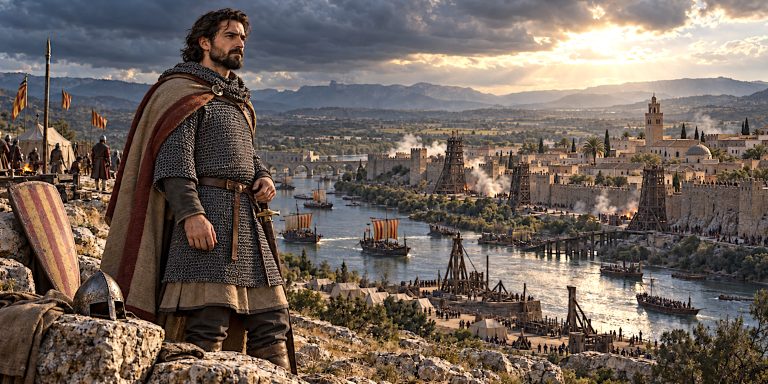
Louis VII of France (1120 to 1180), often called Louis the Young, ruled from 1137 until his death. His reign is frequently overshadowed by two enormous figures: his former wife Eleanor of Aquitaine and his rival Henry II of England. That is slightly unfair. Louis was not a spectacular battlefield commander, but he inherited a fragile monarchy and left behind a stronger, more organised French crown.
He was a king shaped by contradictions. Raised for the Church before the death of his elder brother made him heir, Louis carried a monk-like seriousness into politics. Medieval chroniclers often admired his piety but questioned his decisiveness. In a century dominated by ruthless personalities, Louis sometimes seemed like a man trying to win a knife fight with a prayer book.
Yet his reign mattered. His failures exposed weaknesses in French royal power, while his reforms quietly prepared the ground for the achievements of his son Philip II Augustus.
Early Life and Rise to the Throne
Louis was born in 1120, the second son of King Louis VI “the Fat” and Adelaide of Maurienne. His early education was intended for a religious career, giving him strong theological knowledge and a lifelong attachment to the Church.
Everything changed in 1131 when his elder brother Philip died after a riding accident. Louis became heir and was crowned junior king shortly afterwards.
In 1137 he married Eleanor of Aquitaine, one of the wealthiest heiresses in Europe. Days later Louis VI died, leaving the young couple as rulers of a kingdom that suddenly stretched from northern France to the Pyrenees.
On paper, it was a political masterpiece. In reality, the union brought together two very different personalities:
- Louis was cautious, religious and uncomfortable with courtly excess
- Eleanor was politically sharp, ambitious and raised in the sophisticated culture of Aquitaine
Their marriage would reshape European history.
The Kingdom Louis Inherited
The France of Louis VII was not the centralised nation we imagine today. The king directly controlled only the royal domain around Paris and Orléans. Powerful nobles often possessed greater resources.
Major challenges included:
- Maintaining authority over independent-minded lords
- Expanding royal justice and administration
- Managing relations with the Church
- Containing the growing power of the Angevin dynasty
Louis understood monarchy as a sacred duty. He lacked the aggressive genius of some rivals, but he helped develop the idea that the king of France stood above ordinary feudal politics.
Battles and Military Acumen
Conflict With Theobald II of Champagne
One of Louis’ earliest military struggles came against Theobald II of Champagne.
The conflict was linked to disputes involving royal authority, marriage politics and Church appointments. Louis invaded Champagne in 1142, leading to one of the darkest moments of his reign.
During the attack on Vitry-en-Perthois, a church sheltering civilians was burned, reportedly killing many inside. Medieval sources claim Louis was deeply affected by the tragedy.
The incident influenced his decision to join the Second Crusade.
The Second Crusade (1147 to 1149)
The Second Crusade became the defining military episode of Louis VII’s life.
French Forces
The French army contained:
- Feudal knights from northern and southern France
- Mounted household troops
- Infantry levies
- Crossbowmen and archers
- Clerics and non-combatant followers
Exact numbers remain debated, but medieval armies were often smaller than chroniclers claimed.
Campaign Problems
Louis faced severe difficulties:
- Poor coordination with Conrad III of Germany
- Supply shortages crossing Anatolia
- Attacks from Seljuk Turkish forces
- Tensions among crusader leaders
The disastrous march through Asia Minor exposed weaknesses in logistics and command.
At the Battle of Mount Cadmus in 1148, the French suffered heavy losses after their army became divided. Louis personally survived fierce fighting, with accounts describing him defending himself bravely.
The later siege of Damascus failed, effectively ending the crusade.
Rivalry With Henry II of England
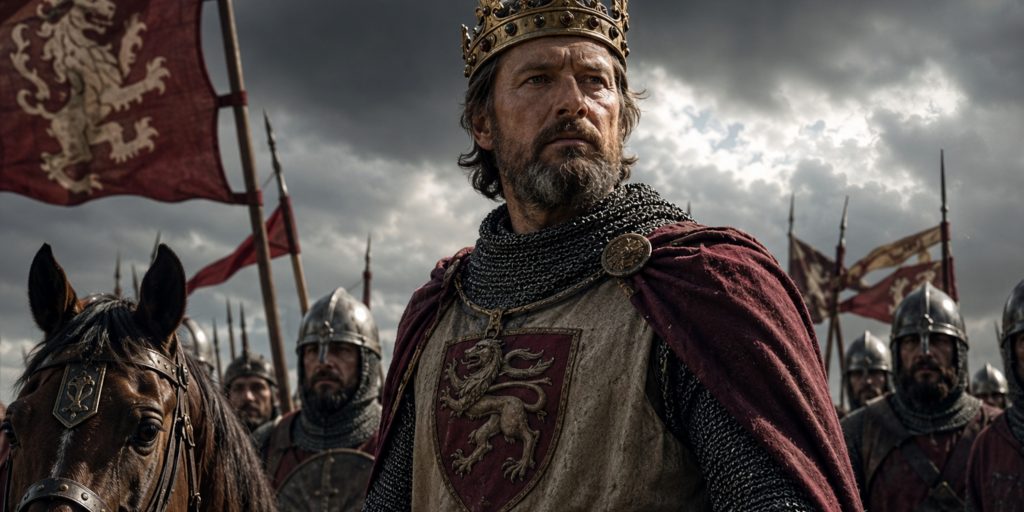
Louis’ greatest political opponent was Henry II.
After Louis and Eleanor’s marriage was annulled in 1152, Eleanor quickly married Henry of Anjou. When Henry became king of England in 1154, he controlled:
- England
- Normandy
- Anjou
- Maine
- Touraine
- Aquitaine
The English king suddenly possessed more French territory than the French king himself.
Louis could rarely defeat Henry directly, so he relied on diplomacy:
- Supporting rebellious nobles
- Encouraging disputes within Henry’s family
- Strengthening alliances
- Preserving Capetian authority
It was patient political warfare rather than battlefield brilliance.
Support for Henry II’s Sons
During the Revolt of 1173 to 1174, Louis supported Henry the Young King and his brothers against their father.
Militarily, the campaign achieved limited results, but politically it showed Louis understood Henry II’s greatest weakness: his own family.
Later French kings would use similar strategies with devastating success.
Arms and Armour During Louis VII’s Reign
The 12th-Century Knight
Louis VII lived during a transitional period in medieval warfare. The knight of his reign was heavily protected but not yet wearing the full plate armour associated with later centuries.
A royal knight around Louis’ time typically used:
Armour
Mail Hauberk
The main defence of elite warriors.
Features:
- Interlinked iron rings
- Knee-length protection
- Long sleeves
- Often combined with mail mittens and chausses for the legs
Helmet Types
Common helmets included:
- Nasal helmets
- Early enclosed helmets
- Conical helmets influenced by Norman styles
The great helm was beginning to develop but had not yet become the dominant battlefield image of the 13th century.
Shield
The kite shield remained common, although shorter heater-style shields began emerging later.
Advantages:
- Protected cavalry during charges
- Displayed heraldic symbols
- Helped identify nobles in battle
Weapons Used By Louis VII’s Forces
Arming Sword
The classic knightly sword of the period.
Typical features:
- Straight double-edged blade
- Length around 70 to 80 cm
- Cruciform guard
- Designed for cutting and thrusting
Examples include swords classified today within the Oakeshott Type XI and early Type XII groups.
Lance
The dominant weapon of aristocratic cavalry.
By Louis’ lifetime, the couched lance technique was increasingly important, allowing knights to deliver powerful shock charges.
Other Weapons
French armies also used:
- Spears
- Axes
- Maces
- Crossbows
- Short bows
The sword carried prestige, but battles were usually won by organisation, cavalry discipline and logistics.
Personality and Leadership Style
Louis VII was not a natural warrior king in the mould of Richard the Lionheart or William the Conqueror.
His strengths:
- Patience
- Religious legitimacy
- Administrative improvement
- Long-term political thinking
His weaknesses:
- Slow decision-making
- Poor military organisation during the crusade
- Difficulty controlling stronger personalities
As a historian, I find Louis fascinating because his reign shows that medieval success was not always loud. The kings who charged first into battle became legends, but the kings who preserved institutions often built the foundations those legends stood on.
Louis survived. In medieval politics, that alone was an underrated talent.
Marriage to Eleanor of Aquitaine and Its Consequences

The annulment of Louis and Eleanor’s marriage in 1152 was one of the most consequential decisions of the Middle Ages.
Their daughters remained legitimate, but Louis lost direct influence over Aquitaine. Eleanor’s marriage to Henry II created the Angevin Empire and transformed European politics.
It is tempting to portray this as Louis’ greatest mistake, although the reality was complicated. The marriage was politically unstable, and the lack of a male heir created enormous pressure.
The consequences, however, were undeniable.
Government and Achievements
Despite military disappointments, Louis VII strengthened France internally.
Important developments included:
- Greater use of royal officials
- Expansion of royal justice
- Stronger connections with towns
- Support for religious institutions
- Preservation of Capetian succession
His greatest political success came in 1179 when he had his son Philip crowned before his own death, ensuring a smooth transfer of power.
Philip II would later dismantle much of the Angevin Empire that had overshadowed Louis.
Artefacts From The Reign Of Louis VII and Where To See Them
Basilica of Saint-Denis, France
The royal abbey of Saint-Denis was central to Capetian identity.
Connected items include:
- Royal tomb sculpture
- Medieval architectural remains
- Objects associated with Capetian kingship
Louis VII was buried there after his remains were later transferred from Barbeau Abbey.
Musée de Cluny, Paris
The museum contains important objects from 12th-century France, including:
- Religious artwork
- Manuscripts
- Metalwork
- Everyday medieval objects
While personal possessions of Louis VII are extremely rare, collections like this reveal the world his court inhabited.
French National Library (Bibliothèque nationale de France)
Important for:
- Royal charters
- Illuminated manuscripts
- Administrative documents
These sources provide some of the strongest evidence for how Louis governed.
Crusader-Era Collections
Weapons and armour from Louis’ exact ownership have not survived, but comparable 12th-century military objects can be studied in major collections such as:
- Musée de l’Armée, Paris
- Royal Armouries, Leeds
- Metropolitan Museum of Art, New York
Latest Archaeology and Historical Research
Modern research on Louis VII focuses less on finding personal relics and more on understanding the society he ruled.
Important areas include:
Capetian Administration
Recent scholarship has examined charters and documents to show how royal power expanded gradually before Philip II.
Crusader Archaeology
Archaeology in the eastern Mediterranean has improved understanding of:
- Crusader fortifications
- Military logistics
- Weapon production
- Cultural exchange between Latin and Islamic societies
Findings suggest crusading armies were far more dependent on local conditions, supplies and diplomacy than older heroic narratives suggested.
Medieval Paris
Excavations and studies of 12th-century Paris continue to reveal the growth of the city that became the centre of French royal authority.
Louis’ Paris was changing from a royal base into the heart of a kingdom.
Death and Legacy
Louis VII died on 18 September 1180. His reputation has always been complicated.
He lost Aquitaine. He failed in the Second Crusade. He spent decades struggling against Henry II.
Yet he also:
- Preserved the Capetian dynasty
- Strengthened royal authority
- Maintained France against a much larger rival
- Prepared the way for Philip II’s victories
Louis VII was not the medieval king who won the glorious final battle. He was the exhausted player who kept the pieces on the board long enough for the next generation to win.
History often remembers the conquerors. Sometimes it should spare a thought for the survivors.
Watch the documentary: