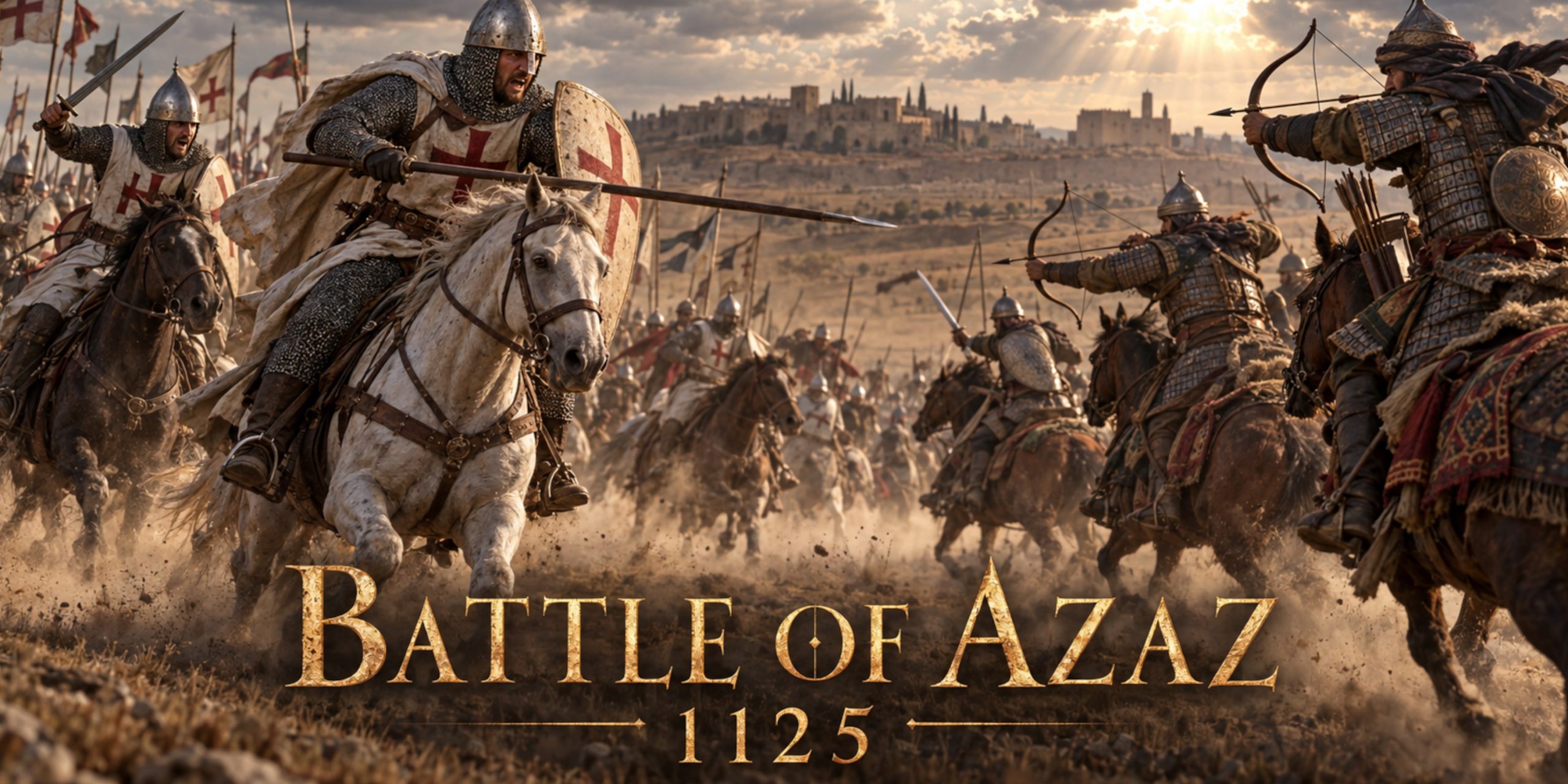
The Battle of Azaz was a victory for Baldwin II of Jerusalem and his allies over the army of Aq-Sunqur al-Bursuqi, ruler of Mosul and Aleppo, in June 1125. It relieved a threatened Frankish stronghold north of Aleppo and demonstrated the value of cooperation between the Crusader states.
The familiar date is 11 June, although the chronology is not entirely settled. The outcome is clearer: Baldwin’s coalition held together, the besieging army was defeated, and Azaz remained in Frankish hands.
What interests me most is the difficulty behind that success. Baldwin had to bring several rulers into the same army, preserve its discipline under pressure and persuade mobile opponents to accept close combat. Medieval kingship involved rather more administration than the paintings usually admit.
Battle of Azaz at a Glance
| Detail | Summary |
|---|---|
| Date | June 1125, conventionally 11 June |
| Location | Near Azaz, north of Aleppo, in modern Syria |
| Conflict | Warfare between the Crusader states and neighbouring Muslim powers |
| Frankish commander | Baldwin II of Jerusalem |
| Opposing commanders | Aq-Sunqur al-Bursuqi, supported by Toghtekin of Damascus |
| Result | Frankish victory and relief of Azaz |
| Immediate importance | Protection of a northern stronghold and capture of valuable booty |
| Principal uncertainty | Army strengths, losses and the precise sequence of tactical movements |
Why Azaz Mattered
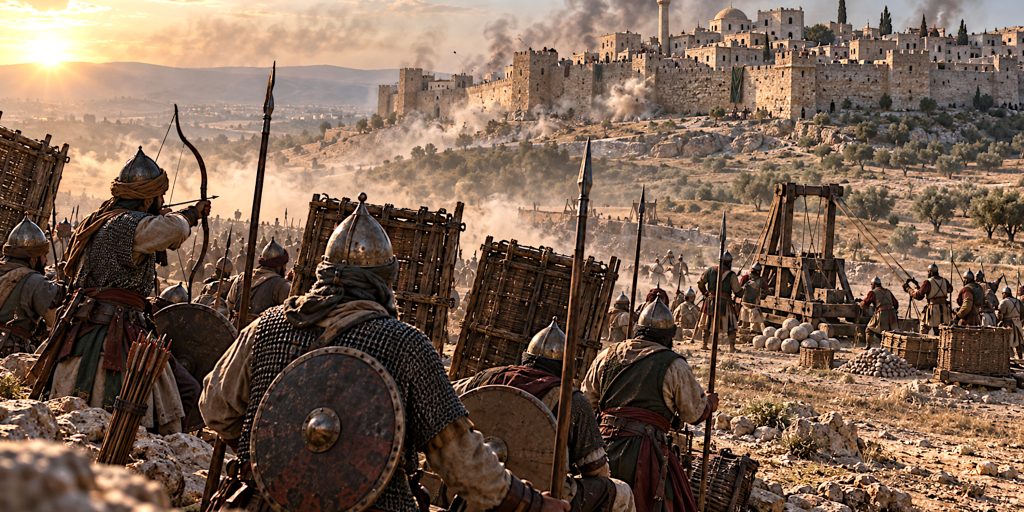
Azaz lay close enough to Aleppo to make its possession a serious concern for the city’s rulers. A fortress here could support raids, shelter troops and help sustain pressure on the surrounding countryside.
The wider struggle had already produced sharp reversals. Roger of Salerno’s army suffered a disastrous defeat at the Field of Blood in 1119. Baldwin subsequently assumed responsibility for Antioch’s defence as regent. His captivity in 1123 and release in 1124 added another interruption to an already demanding reign.
The Frankish attempt to take Aleppo in 1124–25 failed when al-Bursuqi intervened. The initiative then passed to the Muslim coalition, whose campaign threatened northern Frankish positions, including Azaz.
Relieving the town was therefore a practical military necessity. Losing successive frontier strongholds could make the next campaigning season considerably worse. Castles were expensive to acquire and remarkably inconvenient to replace.
For Baldwin’s wider responsibilities, see the review of Alan V. Murray’s study of Baldwin of Bourcq.
Forces
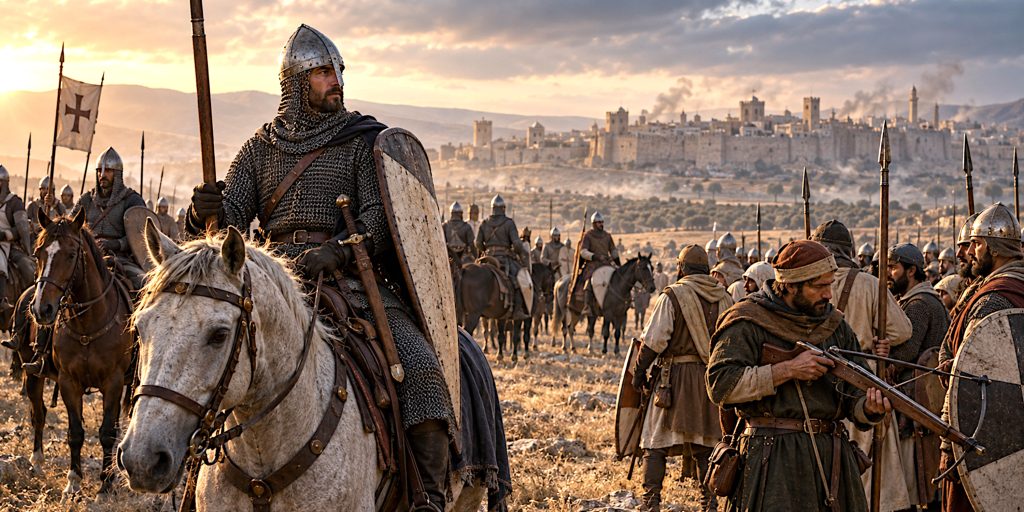
The commonly repeated figures give Baldwin about 1,100 mounted knights and 2,000 infantry. The Muslim army is often estimated at 15,000, but this should be treated as a reported figure rather than a verified count.
Medieval chronicles rarely provide the information needed to distinguish combatants, attendants, garrison troops and men present during different stages of a campaign. An impressive total is not automatically a useful total.
| Army | Commonly cited strength | Likely composition | Confidence |
|---|---|---|---|
| Baldwin’s coalition | Around 1,100 knights and 2,000 infantry | Mounted knights, foot soldiers and missile troops from several Frankish territories | Traditional estimate, not a surviving muster roll |
| Al-Bursuqi’s coalition | Often given as 15,000 | Turkish mounted archers, other cavalry, infantry and siege personnel | Exact total especially uncertain |
Fulcher of Chartres describes thirteen Frankish formations and twenty-one opposing formations. These are useful indications of organisation, but they cannot be converted into fixed unit strengths.
Leaders and Troop Composition
| Leader | Position | Role in the campaign |
|---|---|---|
| Baldwin II | King of Jerusalem and regent of Antioch | Directed the relief army and coordinated its contingents |
| Joscelin I | Count of Edessa | A principal northern ally and commander |
| Pons | Count of Tripoli | Brought support from Tripoli |
| Aq-Sunqur al-Bursuqi | Ruler of Mosul and Aleppo | Led the offensive against Frankish positions |
| Toghtekin | Ruler of Damascus | Supported al-Bursuqi’s coalition |
Bohemond II should not be listed as a commander at Azaz. He arrived to take up rule in Antioch in 1126, after the battle.
The coalition armies contained different kinds of troops:
- Frankish knights: mounted fighters whose effectiveness depended on cohesion, suitable ground and support from the rest of the army.
- Frankish infantry: foot soldiers who helped protect the mounted contingent and sustain a formation under attack. Spears, bows and crossbows belong to the period’s military context, although their exact distribution at Azaz is unknown.
- Turkish mounted archers: mobile troops capable of harassment, pursuit and attacks on horses as well as riders.
- Other Muslim cavalry: mounted fighters who could engage with lances and swords. The army should not be imagined as consisting entirely of lightly equipped archers.
- Infantry and siege personnel: essential to the operation against the town, even though the surviving narratives give cavalry more attention.
Arms and Armour
There is no surviving equipment inventory for either army at Azaz. The following reconstruction uses the weapons and protective equipment of the early twelfth-century Levant. It identifies plausible types, not objects recovered from this battlefield.
| Troop type | Weapons | Protection | Evidence limit |
|---|---|---|---|
| Frankish knight | Lance, single-handed sword and sometimes a mace | Mail hauberk, helmet, shield and textile layers | Individual equipment varied |
| Frankish foot soldier | Spear, bow or crossbow; swords and other sidearms according to means | Shields; variable access to helmets and mail | Not every infantryman was fully armoured |
| Turkish mounted archer | Composite bow, arrows and a sidearm; some also carried lances | Variable armour, from light protection to mail or lamellar | Archery and armour were not mutually exclusive |
| More heavily equipped Muslim cavalry | Lance, sword and mace; bows could also be carried | Mail, lamellar or other regional armour, with helmets and shields | No battle-specific allocation survives |
| Siege troops | Missile weapons and tools for attacking fortifications | Variable | Chronicle references do not establish exact machine designs |
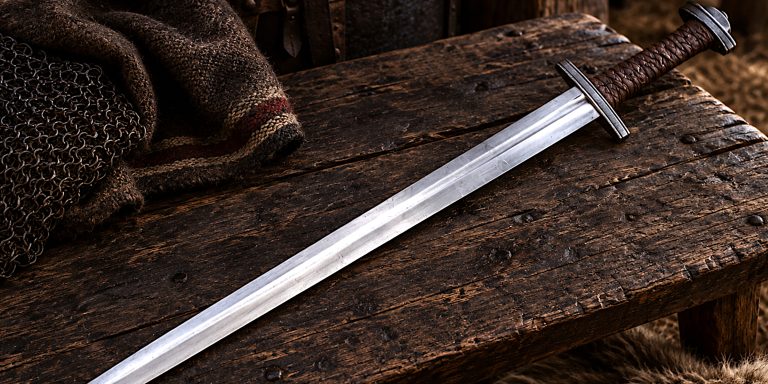
Sword types appropriate to the period include:
- Frankish single-handed knightly swords: straight, double-edged blades with crossguards, generally described today as arming swords. Oakeshott Type X and XI forms are useful comparative categories, not confirmed identifications from Azaz.
- Straight Islamic swords: these remained important alongside curved weapons. Muslim military equipment cannot be reduced to the familiar cinema scimitar.
- Early Turkic sabres: curved, single-edged blades were part of the wider steppe tradition. Their presence is plausible, but their numbers and precise forms at Azaz are unknown.
The Metropolitan Museum’s study of Islamic arms and armour provides useful context for the coexistence of straight swords and sabres.
Kite shields and mail are appropriate to a Frankish reconstruction. Fully developed plate harnesses, late medieval great helms and uniform national heraldry are not. An army in 1125 should look like an early twelfth-century army, however tempting the later armour might be.
How the Battle Was Won
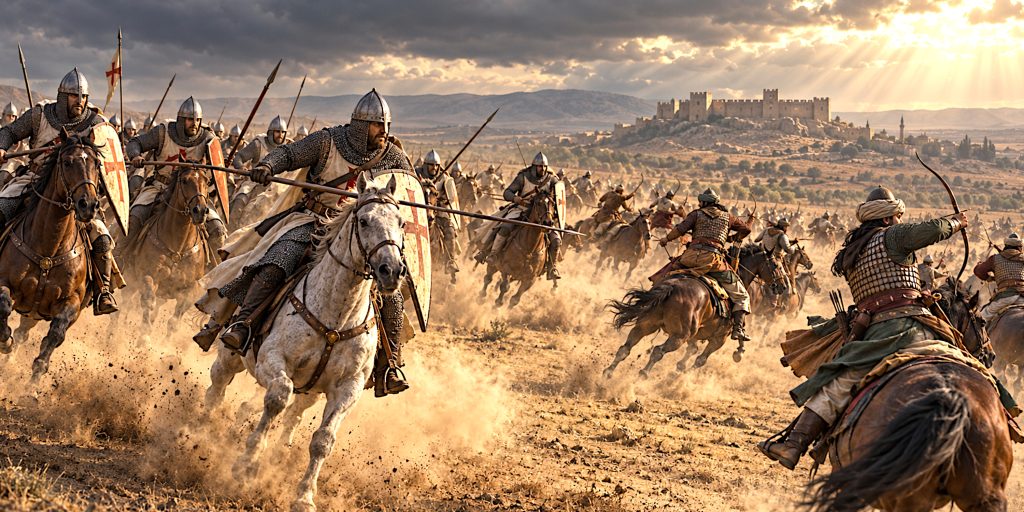
The central tactical problem was distance. Mounted archers could exploit their mobility to avoid the close fighting in which Frankish knights were especially dangerous. Baldwin needed to turn pursuit into an opportunity.
A familiar reconstruction describes a controlled withdrawal away from Azaz, followed by a sudden reversal against the pursuing army. Nicholas Morton’s account includes coordination with the garrison through a smoke signal, then a charge into cavalry whose pursuit had brought them too close together.
That account is valuable, but it should not become an unquestioned minute-by-minute script. Fulcher’s description emphasises ordered formations, the king’s command, trumpet signals and hard fighting. Different narratives preserve different details.
The strongest interpretation is that Baldwin maintained sufficient control to bring his coalition into effective close combat. The opposing troops resisted, then broke. A theatrical claim that the entire Muslim army was neatly surrounded is less secure than the broader conclusion that its mobility advantage was overcome.
See Nicholas Morton’s discussion of the battle’s tactics.
Battle Timeline
| Date or phase | Event |
|---|---|
| 1118 | Azaz passes into Frankish control |
| 1119 | Defeat at the Field of Blood weakens Antioch |
| 1123–24 | Baldwin is captured and subsequently released |
| Late 1124 to early 1125 | The Frankish siege of Aleppo ends following al-Bursuqi’s intervention |
| Spring and early summer 1125 | The Muslim coalition campaigns against northern Frankish strongholds and threatens Azaz |
| June 1125 | Baldwin, Joscelin and Pons bring together a relief army |
| Manoeuvre phase | Accounts describe movement away from Azaz and pursuit by the opposing army |
| Main engagement | Baldwin’s forces engage at close quarters and defeat the coalition |
| After the victory | Azaz is relieved and valuable booty is taken |
| 1126–28 | Changes in leadership and regional alliances reshape the strategic situation |
The usual battle date is 11 June 1125. Precise timings for individual movements, charges and the end of the fighting cannot be established confidently.
Contemporary Quotes and the Problem of Evidence
Fulcher of Chartres was a contemporary chronicler associated with the Kingdom of Jerusalem. His account is close in time to the campaign, but that does not make him a neutral observer or establish that he personally witnessed every movement.
He reports Baldwin’s appeal:
“Help us, God!”
Fulcher also writes that the troops:
“did not dare to begin the battle until the king had ordered it.”
Both extracts are translated here from the Latin of Historia Hierosolymitana, Book III, chapter XLII. Together they convey religious conviction and the importance of command discipline. They are a chronicler’s rendering, not a transcript of battlefield speech.
His account also acknowledges strong initial resistance from the opposing army, a useful corrective to any suggestion that the victory was effortless. The text is available in Fulcher’s Latin account with a historical French translation.
William of Tyre wrote later in the twelfth century. Ibn al-Athir wrote later still. Their accounts are important, but neither writer should be presented as a contemporary eyewitness to Azaz.
Archaeology
The battle is known chiefly through written accounts. A securely identified battlefield assemblage of weapons, burials or siege remains attributable to June 1125 has not been established in the evidence used here.
That distinction matters. A medieval wall in Azaz does not automatically belong to this siege. An arrowhead found nearby would require a recorded context and reliable dating before it could be connected to the battle.
Evidence that could strengthen future understanding includes:
- Survey of the medieval town and its surrounding terrain.
- Excavation of securely dated destruction or repair layers.
- Weapons recovered from documented archaeological contexts.
- Coins within sealed deposits, rather than isolated finds.
- Human or animal remains with both reliable dating and evidence of trauma.
These are research possibilities, not discoveries already made. The earlier article’s claims about excavated siege works and battle-related coins need named excavation reports before they can be retained.
Casualties, Booty and the Immediate Aftermath
The casualty figures vary markedly. Later accounts and modern summaries repeat estimates ranging from more than a thousand to several thousand Muslim dead, alongside remarkably low Frankish losses. These cannot be reconciled into a dependable total.
What is much firmer is the military outcome: the siege failed, Baldwin’s coalition captured booty and the defeated force withdrew. The proceeds helped fund the release of captives, including Joscelin’s son, the future Joscelin II.
Ransom was woven into warfare, diplomacy and family politics. A successful battle could restore both a frontier position and the relatives who had been pledged to secure an earlier agreement.
Legacy: A Victory with Limits
Azaz demonstrated that the Crusader states could cooperate effectively and that Baldwin could manage a coalition under difficult conditions. It also showed the danger of assuming that mounted archery or heavy cavalry offered an automatic answer to every tactical problem.
The victory did not deliver Aleppo or settle the struggle for northern Syria. Rivalries among the Frankish rulers persisted, while Zengi’s rise in Mosul in 1127 and Aleppo in 1128 changed the regional balance.
My reading of Azaz is therefore a measured one. It was a substantial battlefield success with immediate practical rewards. Its longer significance lay in the breathing space it provided and the military judgement it revealed. Baldwin won the encounter; keeping its advantages proved a harder task.