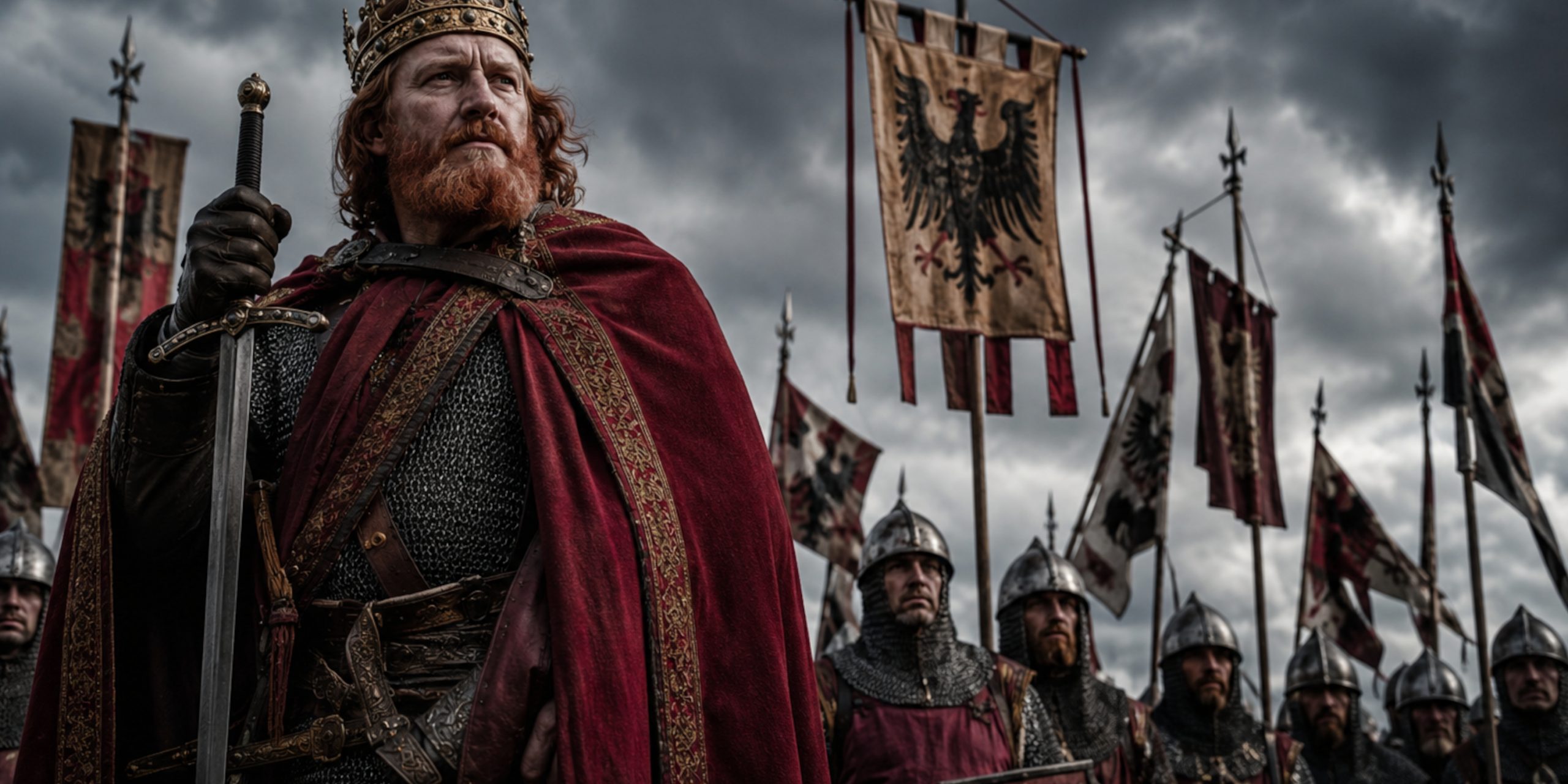
Few medieval rulers carried the weight of an idea quite like Frederick Barbarossa. To his supporters he was the emperor who would restore Roman authority in Europe. To his enemies he was a relentless imperial force who refused to accept that kings, cities or even popes should stand above him.
Born around 1122, Frederick I of Hohenstaufen became King of Germany in 1152 and Holy Roman Emperor in 1155. His nickname Barbarossa, meaning “Red Beard” in Italian, came from the northern Italian cities that spent decades fighting against him. It is strangely fitting that one of history’s most famous imperial titles came from his opponents.
Barbarossa’s reign was defined by ambition. He fought in Germany, Poland, Italy and the eastern Mediterranean. He strengthened royal authority, reorganised imperial administration and became one of the central figures of the Third Crusade.
He was not always victorious. His dream of reviving imperial dominance over Italy ultimately failed. Yet his influence lasted centuries, creating a legend powerful enough that later generations imagined him sleeping beneath a mountain, waiting to return when Germany needed him.
Early Life and Rise of the Hohenstaufen Dynasty
Frederick was born into the powerful Hohenstaufen family, a dynasty that controlled Swabia and became one of the dominant political forces in medieval Germany.
His background gave him connections to two rival factions:
- The Hohenstaufen family through his father, Frederick II Duke of Swabia
- The Welf dynasty through his mother, Judith of Bavaria
This mixed ancestry helped him become a compromise candidate after the death of King Conrad III. Many nobles believed Frederick could heal divisions within the empire.
When he became king in 1152, he inherited a complicated political landscape. The Holy Roman Empire was not a centralised state. It was a collection of duchies, bishoprics, cities and territories where authority depended on negotiation as much as command.
Frederick intended to change that.
The Vision of a Restored Roman Empire
Barbarossa believed imperial power came directly from God and inherited the authority of ancient Rome. His reign promoted the concept of the “Holy Empire”, emphasising the emperor as a ruler with universal significance.
His goals included:
- Strengthening imperial control over Germany
- Reasserting authority over northern Italian cities
- Defending imperial rights against the Papacy
- Creating a more organised system of law and governance
The problem, as medieval rulers regularly discovered, was that everyone liked the idea of order until someone else was giving the orders.
The wealthy cities of northern Italy had grown powerful through trade and increasingly governed themselves. They had little interest in becoming obedient imperial possessions again.
Battles and Military Acumen
Frederick Barbarossa was one of the most experienced commanders of the 12th century. His style combined traditional knightly warfare with careful organisation, diplomacy and political strategy.
He was not simply a battlefield commander. His greatest strength was the ability to gather armies from a fragmented empire and keep powerful nobles cooperating.
Major Campaigns and Battles
| Conflict | Date | Opponents | Result |
|---|---|---|---|
| First Italian Campaign | 1154 to 1155 | Northern Italian cities | Imperial victory, crowned emperor |
| Siege of Milan | 1162 | Milanese forces | Major imperial victory |
| Battle of Legnano | 1176 | Lombard League | Imperial defeat |
| Polish Campaign | 1157 | Duke Bolesław IV | Imperial success |
| Third Crusade | 1189 to 1190 | Forces opposing Crusader advance | Successful march before his death |
The Destruction of Milan
The capture of Milan in 1162 was Barbarossa’s greatest military success in Italy.
Milan had resisted imperial authority and became the centre of opposition against him. After a prolonged struggle, the city surrendered.
Frederick ordered severe punishment:
- Defensive walls were destroyed
- Political structures were dismantled
- Citizens were temporarily dispersed
- Rival Italian cities assisted in the destruction
It was intended as a warning. Instead, it helped create stronger resistance.
The Lombard cities learned a simple lesson. Separately they could be crushed. Together they had a chance.
The Battle of Legnano
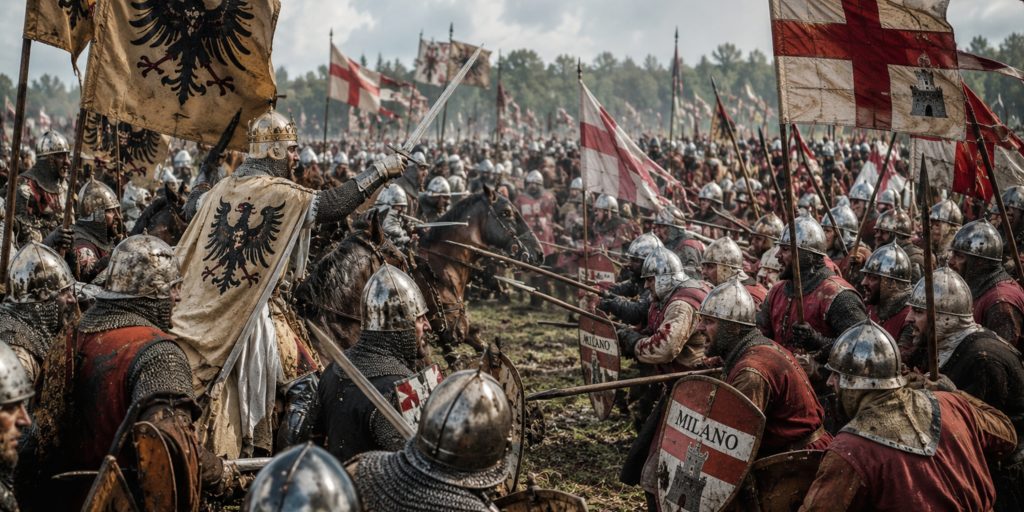
In 1176, Barbarossa faced the Lombard League at Legnano.
The battle showed the changing nature of medieval warfare. Imperial knights remained among the most feared soldiers in Europe, but disciplined urban infantry could resist cavalry charges when organised effectively.
The Lombard forces defended around the carroccio, a symbolic war wagon carrying the city standard.
Frederick’s army was defeated, forcing him to negotiate. The Peace of Constance in 1183 recognised many freedoms of the Italian cities while maintaining symbolic imperial authority.
It was a compromise, but not the Roman revival Barbarossa imagined.
Arms and Armour of Frederick Barbarossa’s Era
The 12th century was a fascinating transition point in medieval warfare. Barbarossa’s armies represented the classic age of the mounted knight before the rise of heavier plate armour.
Frederick Barbarossa’s Likely Equipment
As emperor, Frederick would have possessed the finest military equipment available.
Likely arms and armour included:
Helmet
- Conical nasal helmet early in his career
- Early enclosed helmets becoming more common by the late 12th century
- Decorated ceremonial examples for imperial occasions
Armour
- Riveted mail hauberk covering torso, arms and thighs
- Mail chausses protecting the legs
- Padded gambeson beneath armour
- Shield carrying heraldic symbols
Weapons
- Knightly arming sword
- Lance for cavalry combat
- Dagger or knife as a secondary weapon
- Mace or other impact weapon depending on battlefield needs
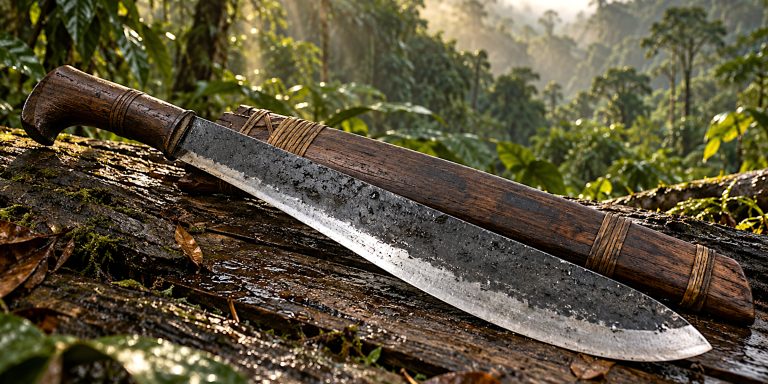
The classic sword of Barbarossa’s period was a straight double-edged knightly sword, commonly classified today among Oakeshott Type XI and early Type XII examples.
These swords usually featured:
- Blade length around 75 to 90 cm
- Broad fuller to reduce weight
- Optimised cutting ability
- Cruciform guard
- One-handed use with shield
Barbarossa’s Army
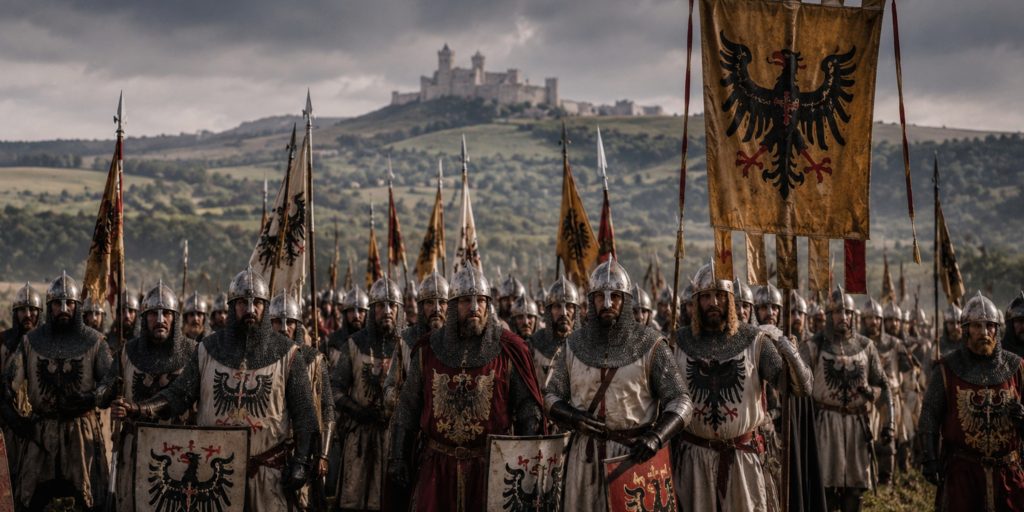
The emperor’s forces were built around the military traditions of the Holy Roman Empire.
Heavy Cavalry
Elite knights formed the striking arm of the army.
Equipment:
- Mail armour
- Lances
- Arming swords
- Shields
- Warhorses
These warriors relied on shock tactics, but they also fought dismounted when necessary.
Infantry
Often overlooked, infantry played an essential role.
Common troops used:
- Spears
- Polearms
- Crossbows
- Bows
- Axes
- Short swords and knives
Siege Specialists
Italian warfare involved many fortified cities, making siege warfare essential.
Barbarossa used:
- Siege towers
- Battering rams
- Mining operations
- Stone-throwing engines
His campaigns were often decided by logistics and engineering rather than heroic cavalry charges.
Frederick Barbarossa and the Third Crusade
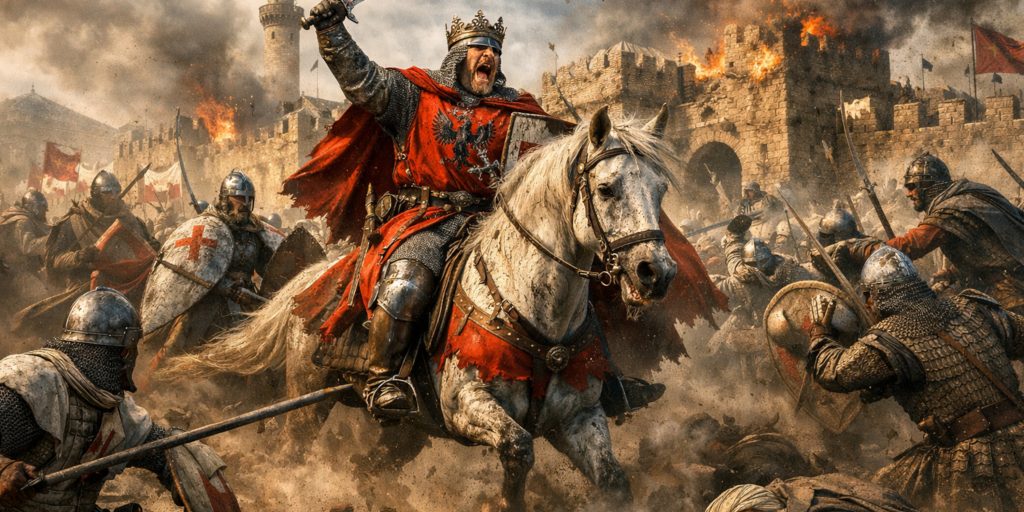
In 1189, an elderly Barbarossa joined the Third Crusade after the capture of Jerusalem by Saladin.
Despite being around 67 years old, he personally led a huge imperial army east. The campaign demonstrated his organisational ability. Moving thousands of soldiers across Europe and Anatolia was an extraordinary achievement.
His forces defeated opposition during the march, including success at the Battle of Iconium in 1190.
Then disaster struck.
While travelling through Anatolia, Frederick drowned in the Saleph River. Accounts differ on whether he was swimming, crossing the river, or suffered a medical emergency.
His death devastated the German crusading force. Many soldiers returned home, while others continued toward the Holy Land.
It remains one of history’s great “what if” moments. A united crusading army under Barbarossa, Richard the Lionheart and Philip II of France would have been a formidable combination.
Where to See Artefacts From Frederick Barbarossa’s Reign
Many objects connected directly or indirectly with Barbarossa’s world survive across Europe.
Imperial Palace of Gelnhausen, Germany
Founded by Barbarossa in the 12th century, this palace remains one of the strongest architectural links to his rule.
Visitors can see:
- Surviving imperial architecture
- Romanesque stonework
- Evidence of Hohenstaufen royal building projects
Aachen Cathedral Treasury, Germany
Aachen was deeply connected with imperial tradition.
Collections include:
- Imperial religious treasures
- Medieval craftsmanship
- Objects associated with Holy Roman imperial ceremony
Kunsthistorisches Museum, Vienna
The museum preserves items linked with the wider Holy Roman Empire.
Important collections include:
- Imperial regalia
- Medieval weapons
- Ceremonial objects
Castles and Hohenstaufen Sites
Important locations include:
- Hohenstaufen Castle site
- Trifels Castle
- Imperial residences across Germany
Many surviving objects are not Barbarossa’s personal possessions, but they reveal the elite world in which he lived.
Latest Archaeology and Research
Modern research into Barbarossa’s era focuses less on finding legendary relics and more on understanding the political and military systems behind his empire.
Recent studies have examined:
- Hohenstaufen castle construction
- Medieval settlement patterns
- Battlefield landscapes
- Trade networks in imperial territories
- Material culture of 12th-century knights
Archaeology around imperial sites continues to reveal how Barbarossa projected power. Stone castles, palaces and fortified towns were not only military structures. They were statements carved into the landscape.
Medieval rulers understood branding long before anyone created the word.
Death and the Barbarossa Legend
After his death in 1190, Frederick became larger than history.
The most famous legend claimed he did not truly die. Instead, he slept beneath Kyffhäuser Mountain with his knights, waiting to awaken and restore Germany in its hour of need.
Similar myths appear around other great rulers, including King Arthur. The message is clear. Some leaders become symbols powerful enough that people struggle to accept they are gone.
Historical Legacy
Frederick Barbarossa was not the emperor who rebuilt Rome. His Italian ambitions failed, and the Holy Roman Empire remained politically fragmented.
Yet judging him only by his failures misses why he mattered.
He strengthened imperial identity, influenced European law, led armies across continents and became the model of medieval kingship for generations.
He was ambitious, stubborn, charismatic and occasionally ruthless. In other words, exactly the kind of person who tended to survive 12th-century politics.
Barbarossa chased an impossible dream, but few medieval rulers chased it with greater determination.but of enduring myth, imperial symbolism, and a model of rulership studied long after his time.