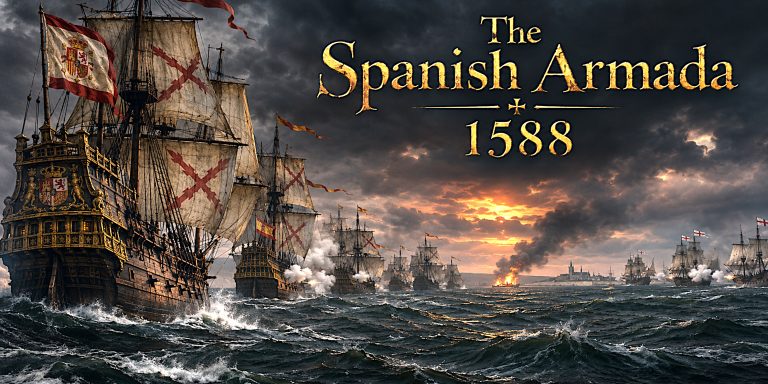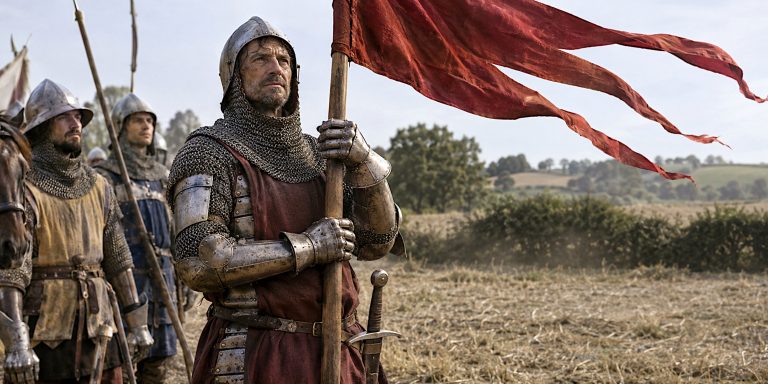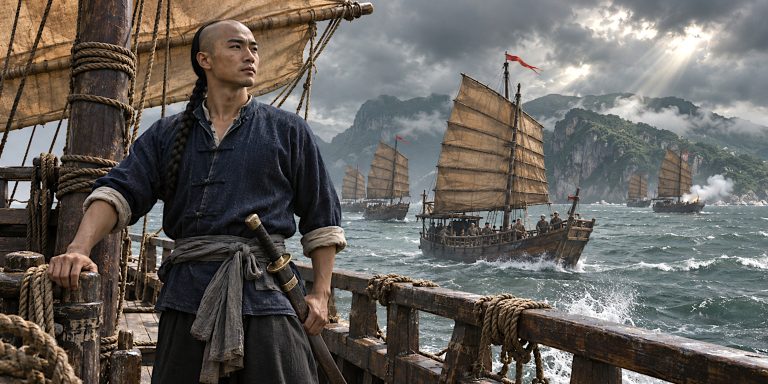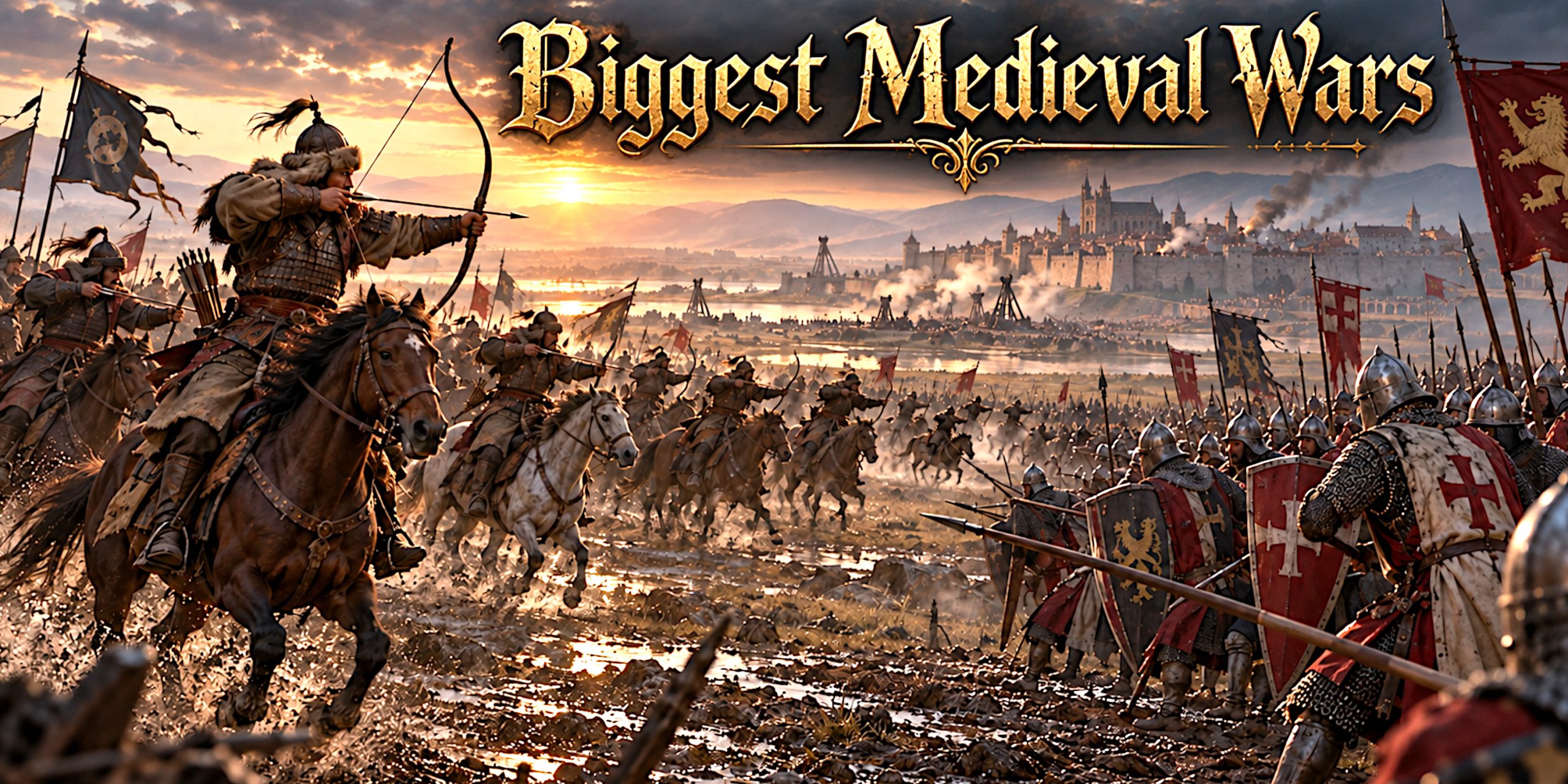
The Middle Ages were not one long war, though some maps from the period can make them look that way. Across Europe, Asia and North Africa, rulers fought over thrones, faith, territory, trade routes and survival. Some conflicts lasted a few years. Others stretched across generations or bundled several distinct campaigns into a single historical label.
There is no reliable medieval casualty leaderboard. Records are incomplete, chroniclers used numbers for effect, and famine or disease could kill more people than combat. This guide therefore treats “biggest” as a question of duration, geographic reach and political consequences, not a precise ranking by deaths.
The list includes wars, invasions and long-running struggles. Some overlap. The Mongol conquests, for example, included separate campaigns against the Khwarazmian Empire, in Europe and against Japan. Those episodes appear separately here because each had its own opponents and outcome.
At a glance
| Conflict | Dates | Main regions | Major consequence |
|---|---|---|---|
| Mongol conquests | 1206–1368 | Eurasia | Created the largest contiguous land empire in history |
| An Lushan Rebellion | 755–763 | China | Weakened Tang authority and transformed imperial politics |
| Byzantine–Arab wars | 7th–11th centuries | Eastern Mediterranean | Redrew control of the Levant, North Africa and Anatolia |
| Crusades | 1095–1291, with later campaigns | Europe, the Levant and North Africa | Joined religious warfare with political and commercial ambitions |
| Jin–Song wars | 1125–1234 | China | Ended Northern Song rule and reshaped China |
| Reconquista | c. 718–1492 | Iberia | A long process of conquest, settlement and shifting alliances |
| Mongol invasions of Europe | 1236–1242 | Eastern and Central Europe | Defeated regional armies and devastated several states |
| Northern Crusades | 12th–15th centuries | Baltic region | Expanded Christian rule and created new political powers |
| Hundred Years’ War | 1337–1453 | France and England | Changed royal government and the balance of power in western Europe |
| Scottish Wars of Independence | 1296–1357 | Scotland and England | Preserved Scotland as an independent kingdom |
| Timurid conquests | 1370–1405 | Central and western Asia | Built a vast but short-lived empire |
| Ottoman–Byzantine wars | c. 1265–1453 | Anatolia and the Balkans | Ended Byzantine rule in Constantinople |
| Wars of the Roses | 1455–1487 | England | Settled a dynastic struggle and brought the Tudors to power |
| Hussite Wars | 1419–1434 | Bohemia | Challenged religious authority and reshaped military tactics |
| War of the Breton Succession | 1341–1364 | Brittany and France | Turned a succession dispute into a theatre of Anglo-French rivalry |
| Mamluk–Ilkhanid War | 1260–1323 | Egypt, Syria and Persia | Checked Mongol expansion into the Levant |
| Byzantine–Bulgarian wars | 680–1018, in phases | Balkans | Ended with the Byzantine conquest of Bulgaria |
| Mongol conquest of the Khwarazmian Empire | 1219–1221 | Central Asia and Persia | Destroyed a major regional empire |
| Mongol invasions of Japan | 1274 and 1281 | Japan and Korea | Two large, unsuccessful overseas expeditions |
| Tripartite struggle for Kannauj | 8th–10th centuries | Northern India | Reflected rivalry among three major Indian powers |
1. The Mongol conquests, 1206–1368
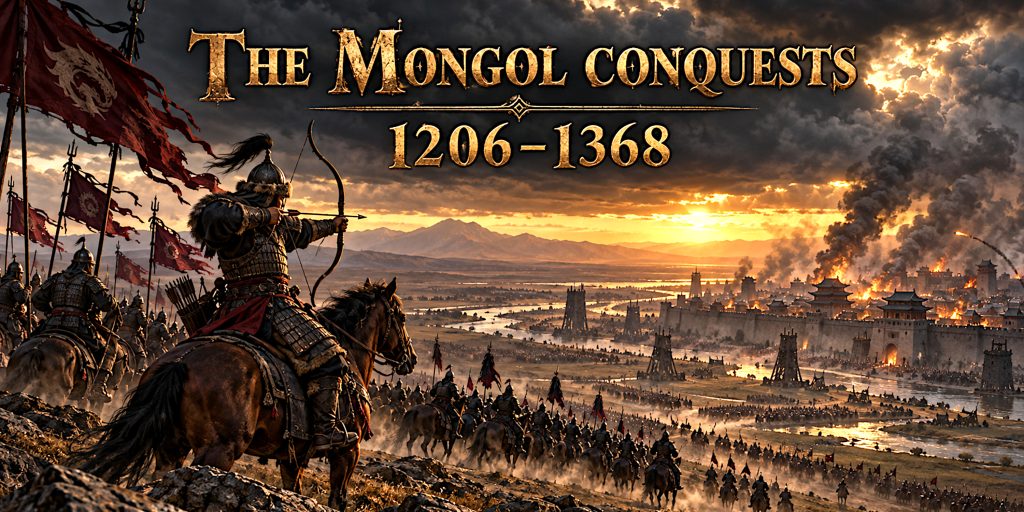
The Mongol Empire took shape under Temüjin, known as Genghis Khan, who united Mongol groups in 1206. Mongol armies then expanded across much of Asia and into eastern Europe. At its height, the empire connected territories from China to the Black Sea.
Their success depended on more than mounted archery. Mongol commanders used discipline, intelligence, mobility and siege expertise, often drawing on specialists from conquered peoples. The conquests devastated many communities, while Mongol rule also connected trade routes across Eurasia.
The dates here cover the rise of the empire through the fall of the Yuan dynasty in China, founded by Kublai Khan. They do not describe one continuous war. The empire divided into successor states, which pursued their own campaigns. Popular casualty totals are highly uncertain because the sources and population records do not support precise calculations.
Major Battles
- Battle of Yehuling, 1211: A major Mongol victory during the war against the Jin dynasty.
- Battle of Mohi, 1241: Mongol forces defeated the Hungarian army during the invasion of Europe.
- Siege of Baghdad, 1258: Mongol forces captured the Abbasid capital, marking the end of the Abbasid Caliphate’s political power there.
2. The An Lushan Rebellion, 755–763
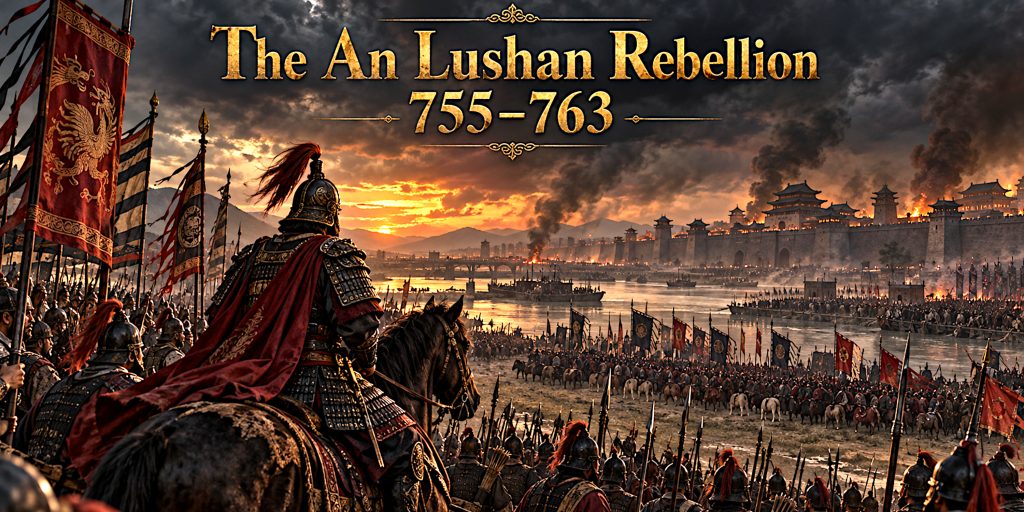
The general An Lushan rebelled against China’s Tang dynasty in 755. The uprising became a devastating civil war that spread across northern China. The rebels captured both imperial capitals, Chang’an and Luoyang, before Tang forces gradually regained control.
The dynasty survived, but the rebellion weakened imperial authority. Regional military governors gained greater independence, and Tang power never returned to its earlier strength. The death toll is difficult to establish. Census declines reflect deaths, displacement and the breakdown of government records, so they cannot simply be read as a count of people killed. The Oxford Bibliographies overview discusses the rebellion’s different historical interpretations.
Major Battles
- Battle of Yongqiu, 756: Tang forces resisted the rebel advance and slowed its movement through Henan.
- Siege of Suiyang, 757: Tang defenders held out under extreme conditions before the city fell.
- Recapture of Luoyang, 762: Tang and allied forces recovered the eastern capital during the rebellion’s final phase.
3. The Byzantine–Arab wars, 7th–11th centuries

The rise of the early Islamic caliphates brought them into conflict with the Byzantine Empire, then the principal power in the eastern Mediterranean. Arab armies took Syria and Palestine, Egypt and much of North Africa. Constantinople survived two major sieges, while the frontier in Anatolia shifted repeatedly.
These were not one uninterrupted war. The fighting consisted of campaigns, raids, sieges and truces under changing rulers. Its consequences were lasting: Byzantine territory contracted, new political powers emerged, and the Mediterranean’s balance of power changed.
Major Battles
- Battle of Yarmouk, 636: A decisive victory for the Rashidun Caliphate over Byzantine forces in Syria.
- Siege of Constantinople, 717–718: The Byzantines repelled an Umayyad land and sea assault on their capital.
- Battle of Akroinon, 740: A Byzantine victory in western Anatolia that helped check a major Umayyad campaign.
4. The Crusades, 1095–1291 and beyond
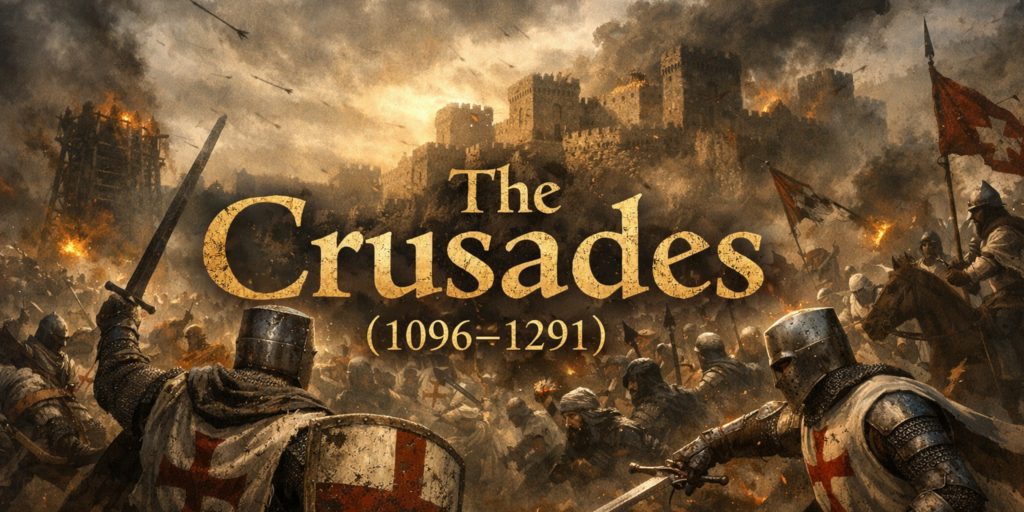
The Crusades were a series of campaigns, not a single war. The best-known expeditions were directed towards the eastern Mediterranean. Crusader armies captured Jerusalem in 1099 and established states in the Levant. Muslim rulers later recovered much of this territory, and the fall of Acre in 1291 ended the last major crusader stronghold on the mainland.
Crusading also reached Iberia, the Baltic region and other parts of Europe. Religious conviction mattered, but so did political ambition, dynastic rivalry and material interests. The consequences included massacres, displacement, new political arrangements and intensified contact across the Mediterranean.
Fulcher of Chartres, who took part in the First Crusade and later lived in the Levant, wrote: “For we who were Occidentals now have been made Orientals.” The line reflects the lives of Latin settlers in the East, though it is one Christian chronicler’s perspective. In his account of Urban II’s call for a crusade, Fulcher also records the appeal: “Let those who have been robbers, now become knights.” The Medieval Sourcebook’s text of Fulcher preserves both passages.
Major Battles
- Siege of Nicaea, 1097: The First Crusade captured the city with Byzantine assistance.
- Siege of Antioch, 1097–1098: Crusaders took the city after a long siege, then had to defend it against a relief army.
- Battle of Hattin, 1187: Saladin’s victory led to the loss of Jerusalem by the Kingdom of Jerusalem.
- Siege of Acre, 1291: Mamluk forces captured the city, ending the main crusader presence on the Levantine mainland.
5. The Jin–Song wars, 1125–1234
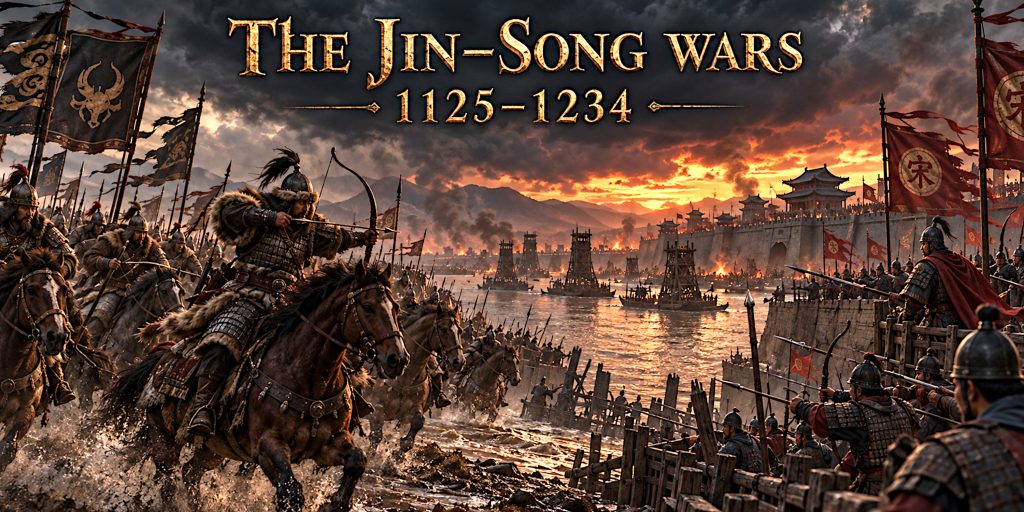
The Jurchen Jin dynasty conquered northern China from the Song in the early twelfth century, forcing the Song court south. The struggle lasted for generations. The Southern Song remained wealthy and powerful, but failed to recover the north before the Mongols destroyed the Jin in 1234.
This conflict later intersected with the Mongol campaigns in China. Treating every war in the region as one “Mongol conquest” risks obscuring the different states, aims and populations involved.
Major Battles
- Sieges of Bianjing, 1126–1127: Jin forces captured the Northern Song capital, ending Northern Song rule.
- Battle of Yancheng, 1140: Song commander Yue Fei defeated a Jin force in a major engagement.
- Battle of Caishi, 1161: Song forces used the Yangtze River to repel a Jin invasion.
- Siege of Caizhou, 1233–1234: Mongol and Song forces captured the last Jin stronghold.
6. The Reconquista, c. 718–1492

The term Reconquista describes the long expansion of Christian kingdoms into territories ruled by Muslim states in the Iberian Peninsula. It began after the early eighth-century conquest of much of Iberia and ended with the surrender of Granada in 1492.
It was not a single war fought by two fixed sides. Christian kingdoms fought one another, and Muslim and Christian rulers sometimes allied against rivals. The term is useful, but it can make a complicated history look tidier than it was. Granada’s fall was followed by the conversion and expulsion of many Muslims and Jews under the new monarchy.
Major Battles
- Battle of Covadonga, traditionally dated to 722: Later tradition made it a symbolic starting point, though the details and significance remain debated.
- Battle of Las Navas de Tolosa, 1212: A coalition of Iberian Christian forces defeated the Almohad army.
- Battle of the Salado, 1340: Castilian and Portuguese forces defeated a Marinid invasion force.
- Siege of Granada, 1491–1492: The surrender of the city ended Nasrid rule in Granada.
7. The Mongol invasions of Europe, 1236–1242

The Mongol invasions of Europe formed one phase of the wider imperial expansion. Mongol forces conquered the Volga Bulgars and Rus’ principalities before invading Poland and Hungary in 1241. They defeated European armies at Legnica and Mohi, while cities across the region suffered siege and destruction.
The Mongols withdrew in 1242, but the reason is debated. The death of Great Khan Ögedei and the succession crisis are often cited, along with strategic and logistical factors. The withdrawal was not a European battlefield victory. The campaigns had already transformed eastern Europe.
Major Battles
- Siege of Kyiv, 1240: The Mongols captured and devastated the city after a siege.
- Battle of Legnica, 1241: Mongol forces defeated a coalition army in Silesia.
- Battle of Mohi, 1241: The Mongols inflicted a major defeat on the Hungarian army near the Sajó River.
8. The Northern Crusades, 12th–15th centuries
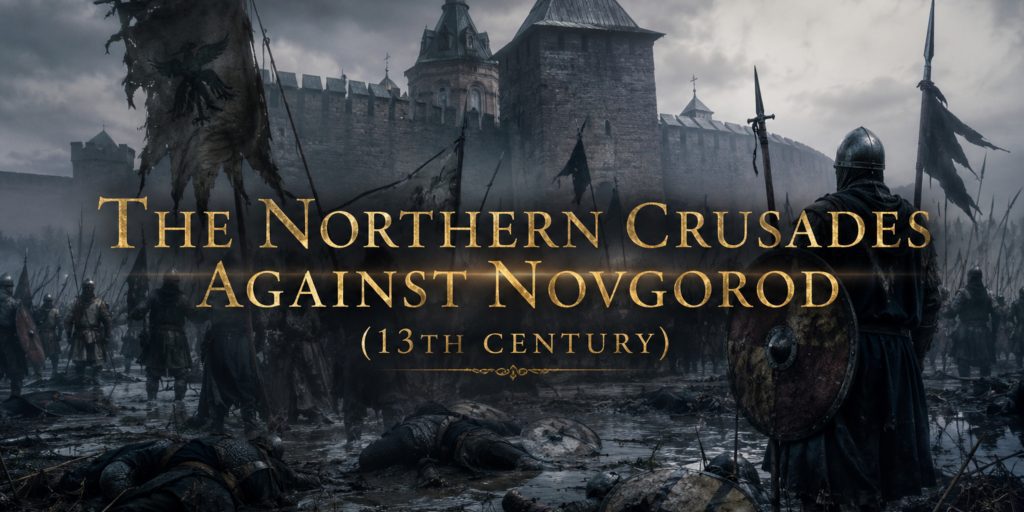
Northern crusading campaigns targeted pagan communities around the Baltic Sea and expanded the power of Christian rulers and military orders. Danish, Swedish and German forces fought local peoples in territories that now include Estonia, Latvia, Lithuania, Finland and parts of Russia.
The campaigns combined conversion with conquest and settlement. They created new political structures, including lands controlled by the Livonian and Teutonic orders. Resistance was persistent, and victories could be reversed. Lake Peipus in 1242, for example, checked the Livonian Order’s eastward advance, although later accounts have often enlarged the battle’s scale and drama.
Major Battles
- Battle of Saule, 1236: Samogitian forces defeated the Livonian Brothers of the Sword.
- Battle of Lake Peipus, 1242: Novgorodian forces under Alexander Nevsky defeated the Livonian Order and its allies.
- Battle of Durbe, 1260: Samogitian forces defeated the Teutonic and Livonian orders, triggering wider resistance in the region.
9. The Hundred Years’ War, 1337–1453
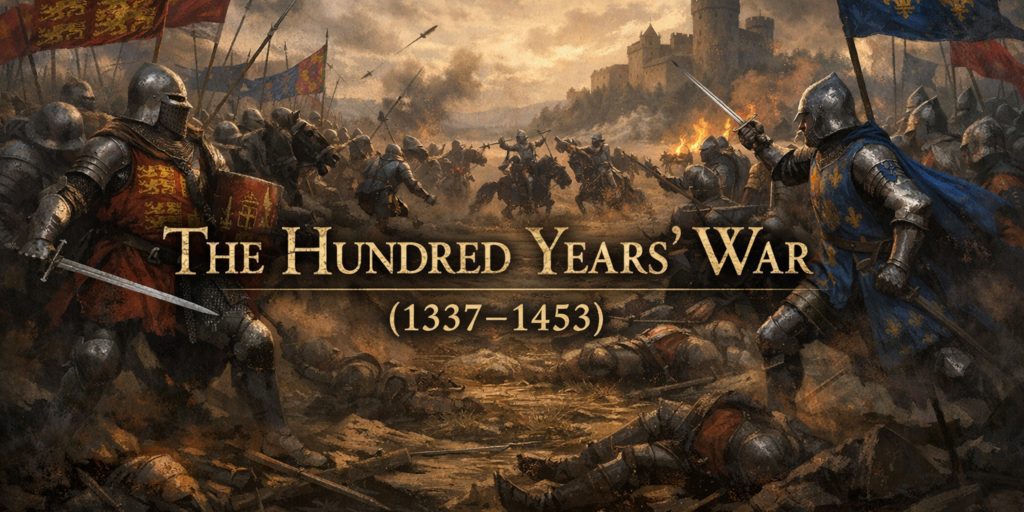
The Hundred Years’ War was a series of linked conflicts between the English and French crowns, driven by dynastic claims and territorial disputes. English forces won famous victories at Crécy, Poitiers and Agincourt, but the French eventually recovered most of the territory England had taken.
Joan of Arc helped revive French fortunes during the siege of Orléans in 1429. By the war’s end, England had lost almost all its continental possessions. The conflict strengthened royal governments and changed how both kingdoms raised money and soldiers. Its traditional dates are useful, though the fighting came in distinct phases. The Royal Armouries’ overview emphasises its intermittent character.
Major Battles
- Battle of Sluys, 1340: An English naval victory helped secure control of the Channel early in the war.
- Battle of Crécy, 1346: English forces defeated a larger French army in northern France.
- Battle of Poitiers, 1356: The English captured King John II of France.
- Battle of Agincourt, 1415: Henry V’s army defeated a larger French force.
- Battle of Castillon, 1453: French artillery helped defeat the English, bringing the war’s final campaign to an end.
10. The Scottish Wars of Independence, 1296–1357

Edward I of England invaded Scotland in 1296, beginning a series of wars over the kingdom’s independence. Scottish resistance under leaders including William Wallace and Robert the Bruce culminated in Bruce’s victory at Bannockburn in 1314.
Bannockburn did not instantly settle the question. Fighting and diplomacy continued for years, until the Treaty of Edinburgh–Northampton in 1328 recognised Scotland’s independence. The wars resumed after Edward III invaded in 1332, so 1357 marks a later settlement rather than the end of all Anglo-Scottish warfare.
Major Battles
- Battle of Stirling Bridge, 1297: Wallace and Andrew Moray’s forces defeated an English army.
- Battle of Falkirk, 1298: Edward I defeated Wallace’s army, though Scottish resistance continued.
- Battle of Bannockburn, 1314: Robert the Bruce’s forces won a decisive victory over Edward II.
- Battle of Halidon Hill, 1333: Edward III defeated a Scottish army during the renewed conflict.
11. The Timurid conquests, 1370–1405
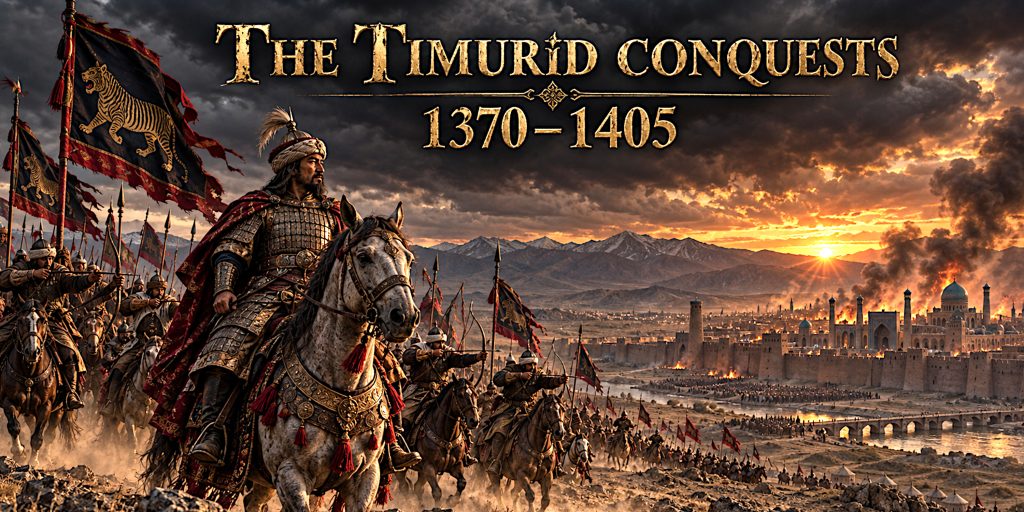
Timur, known in Europe as Tamerlane, built a vast empire through campaigns in Central Asia, Persia, the Caucasus, India and the Middle East. His forces defeated major powers and sacked cities, including Delhi in 1398.
The empire was large but short-lived. Timur’s death in 1405 left his successors to contend with one another, and the unity he had imposed weakened. His campaigns were remembered for their destruction, as well as for the art and architecture later patronised by Timurid rulers.
Major Battles
- Battle of the Terek River, 1395: Timur defeated Tokhtamysh of the Golden Horde.
- Sack of Delhi, 1398: Timur’s forces captured the city during his Indian campaign.
- Battle of Ankara, 1402: Timur defeated and captured the Ottoman sultan Bayezid I.
12. The Ottoman–Byzantine wars, c. 1265–1453
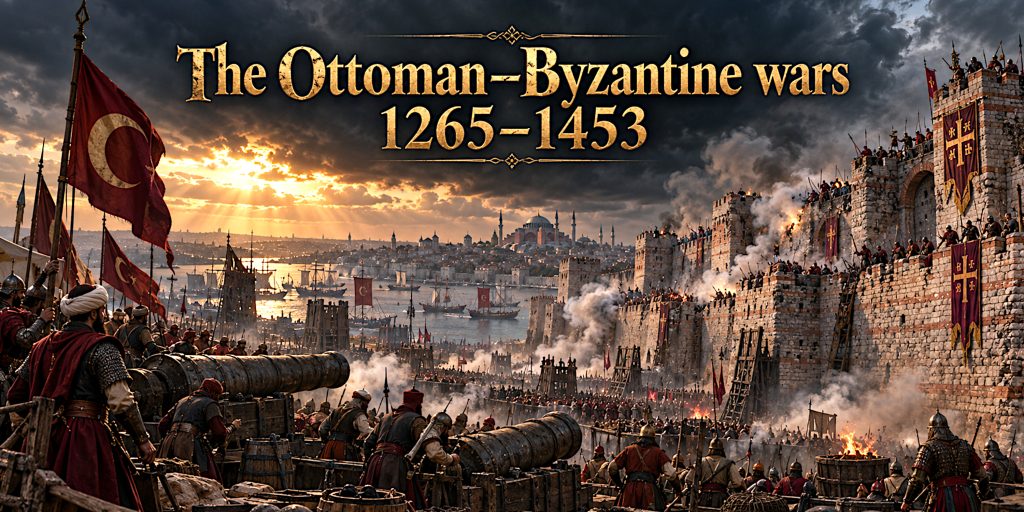
The Ottoman state grew from a small principality in north-western Anatolia into a major power in Anatolia and the Balkans. Its expansion came at the expense of Byzantine territory, already weakened by internal conflict and the sack of Constantinople during the Fourth Crusade in 1204.
The fall of Constantinople to Mehmed II in 1453 ended the Byzantine Empire. It was the culmination of a long process, not a sudden clash between equally powerful states. By the fifteenth century, the Ottomans held the strategic and military advantage.
Major Battles
- Battle of Pelekanon, 1329: Ottoman forces defeated a Byzantine army near the Sea of Marmara.
- Battle of Kosovo, 1389: Ottoman forces fought a Serbian-led coalition; the battle marked a major stage in Ottoman expansion in the Balkans.
- Battle of Nicopolis, 1396: Ottoman forces defeated a large crusading army on the Danube.
- Siege of Constantinople, 1453: Ottoman forces captured the city after a prolonged siege.
13. The Wars of the Roses, 1455–1487

The Wars of the Roses were a series of civil conflicts between rival branches of the English royal family, the houses of Lancaster and York. The name is a later shorthand. Contemporaries did not use it as a neat label for every battle and change of allegiance.
The fighting included major battles at Towton, Barnet and Bosworth. Henry Tudor’s victory at Bosworth in 1485 brought him to the throne as Henry VII, but conflict continued until the defeat of the Yorkist claimant Lambert Simnel’s supporters at Stoke Field in 1487. The wars damaged noble families and helped the new Tudor regime consolidate royal authority.
Major Battles
- First Battle of St Albans, 1455: Yorkist forces defeated the Lancastrians and captured Henry VI.
- Battle of Towton, 1461: A major Yorkist victory secured Edward IV’s claim to the throne.
- Battles of Barnet and Tewkesbury, 1471: Yorkist victories restored Edward IV and ended the main Lancastrian challenge.
- Battle of Bosworth, 1485: Henry Tudor defeated Richard III, who died in the fighting.
- Battle of Stoke Field, 1487: Henry VII defeated a Yorkist force, usually treated as the final major battle of the wars.
14. The Hussite Wars, 1419–1434

The Hussite Wars began after the execution of the reformer Jan Hus and the growth of religious dissent in Bohemia. The movement resisted repeated crusading expeditions and developed the wagenburg, a defensive formation of armoured wagons supported by handguns, crossbows and artillery.
The Hussites were not united. Moderate and radical factions eventually fought one another, and the defeat of the radical Taborites at Lipany in 1434 ended the main phase of the wars. The conflict showed how disciplined infantry, firearms and field fortifications could frustrate mounted forces.
Major Battles
- Battle of Sudoměř, 1420: Hussite forces used wagons and difficult terrain to resist a royalist attack.
- Battle of Vítkov Hill, 1420: Hussite defenders helped prevent crusading forces from taking Prague.
- Battle of Tachov, 1427: Hussite forces defeated an invading crusader army.
- Battle of Lipany, 1434: Moderate Hussites and their allies defeated the radical Taborites.
15. The War of the Breton Succession, 1341–1364

The War of the Breton Succession was a struggle over who would rule Brittany after the death of Duke John III. The rival claimants, Charles of Blois and John of Montfort, each had powerful outside supporters. France backed Charles, while England backed John.
The war became entangled with the Hundred Years’ War and brought sieges, raids and battles to Brittany. John of Montfort’s side won at Auray in 1364, securing the duchy for his family. The conflict shows how a local succession dispute could become a proxy struggle between larger powers.
Major Battles
- Battle of Morlaix, 1342: English-backed forces defeated a French army supporting Charles of Blois.
- Battle of Auray, 1364: John of Montfort’s forces defeated Charles of Blois, who died in the battle.
16. The Mamluk–Ilkhanid War, 1260–1323
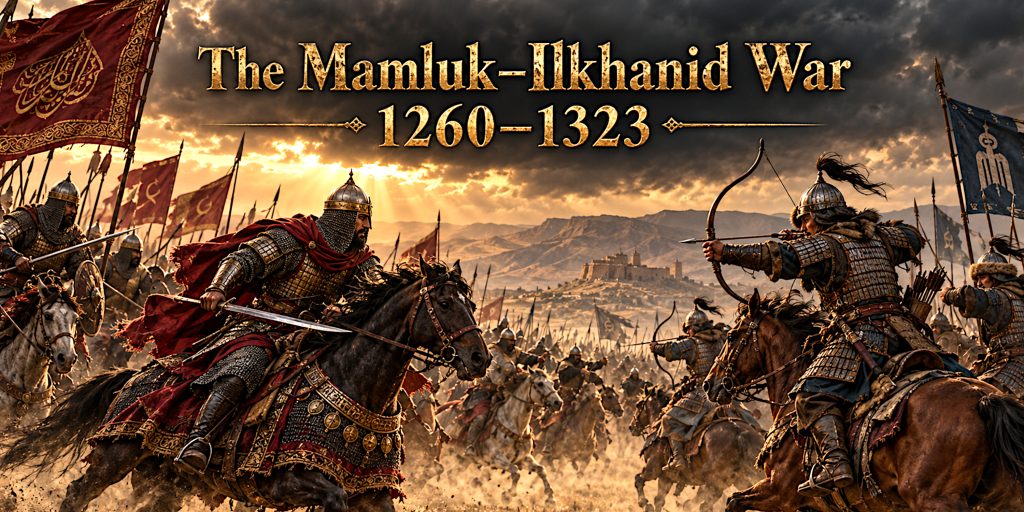
After the Mongol Empire divided into successor states, the Ilkhanate in Persia clashed repeatedly with the Mamluk Sultanate of Egypt and Syria. The Mamluks’ victory at ʿAyn Jālūt in 1260 halted a Mongol advance into the Levant, but it did not end the conflict. Raids, campaigns and diplomacy continued for decades.
This was a war between powerful states with changing alliances, rather than one decisive contest. The Mamluks protected their position in Syria, while the Ilkhans sought to extend their influence westwards. The Cambridge study of the Mamluk–Ilkhanid war describes the conflict’s long duration and regional context.
Major Battles
- Battle of ʿAyn Jālūt, 1260: Mamluk forces defeated an Ilkhanid Mongol army in Palestine.
- Battle of Homs, 1281: Mamluk forces repelled another Ilkhanid campaign into Syria.
- Battle of Wadi al-Khaznadar, 1299: The Ilkhanids defeated the Mamluks and briefly occupied Damascus.
- Battle of Marj al-Saffar, 1303: The Mamluks defeated an Ilkhanid invasion near Damascus.
17. The Byzantine–Bulgarian wars, 680–1018
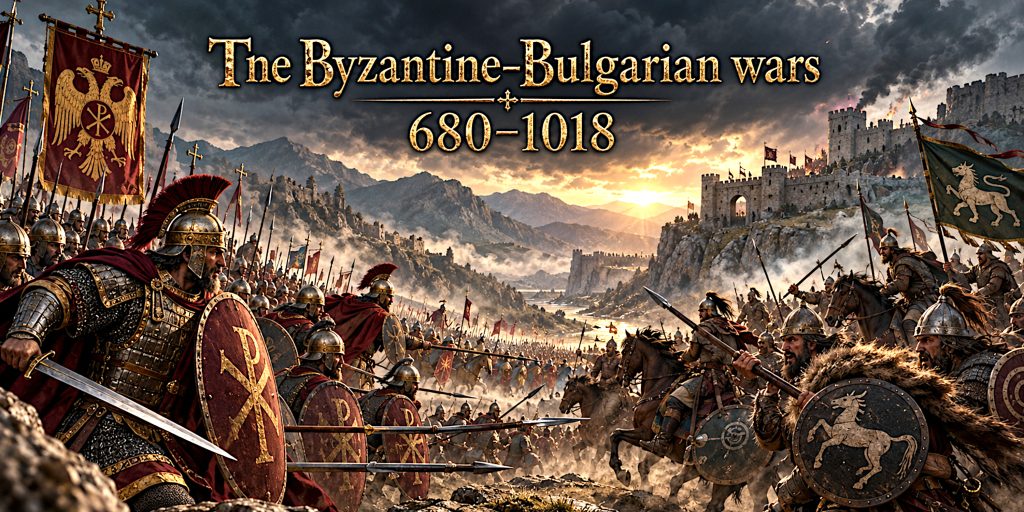
The Byzantine and Bulgarian states fought a series of wars over power in the Balkans. Their rivalry included invasions, treaties, shifting borders and long stretches of uneasy peace. Bulgaria became a major regional power, at times threatening Byzantine control of the peninsula.
The first Bulgarian Empire was eventually conquered by the Byzantines in 1018, after a prolonged campaign under Emperor Basil II. These were separate phases of conflict, not one continuous war lasting more than three centuries. A recent academic study examines Byzantine campaigns against Bulgaria across this period.
Major Battles
- Battle of Pliska, 811: Bulgarian forces defeated the Byzantine army and killed Emperor Nikephoros I.
- Battle of Anchialus, 917: Tsar Simeon I’s forces inflicted a major defeat on the Byzantines.
- Battle of Kleidion, 1014: Basil II’s army defeated Bulgarian forces during the final phase of the conflict.
18. The Mongol conquest of the Khwarazmian Empire, 1219–1221
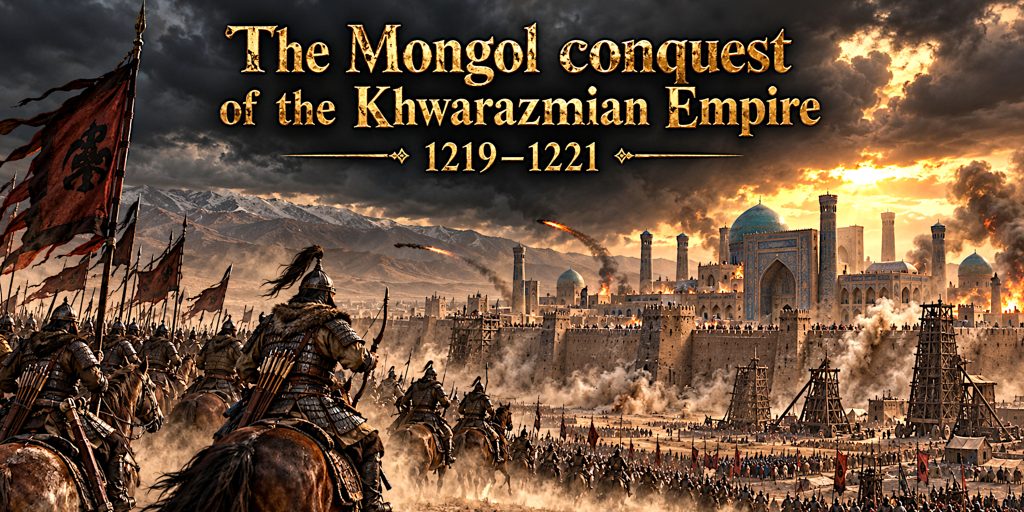
The Khwarazmian Empire controlled territory across parts of Central Asia, Persia and present-day Afghanistan. Conflict with the Mongols escalated after a Mongol trade mission was killed at Otrar. Genghis Khan’s forces invaded, capturing major cities including Bukhara, Samarkand and Urgench.
The campaign devastated Khwarazmian rule and drove survivors, including the ruler Jalal al-Din, into further resistance. It forms part of the wider Mongol conquests, but is worth treating separately because it destroyed a major state in a concentrated campaign. The Higher School of Economics overview outlines the extent of the Khwarazmian territories affected.
Major Battles
- Siege of Otrar, 1219–1220: Mongol forces captured the city after a prolonged resistance.
- Capture of Bukhara, 1220: Mongol forces took one of the empire’s major cities.
- Siege of Urgench, 1221: The Mongols captured the Khwarazmian capital after difficult urban fighting.
- Battle of the Indus, 1221: Genghis Khan’s forces defeated Jalal al-Din, who escaped across the river.
19. The Mongol invasions of Japan, 1274 and 1281
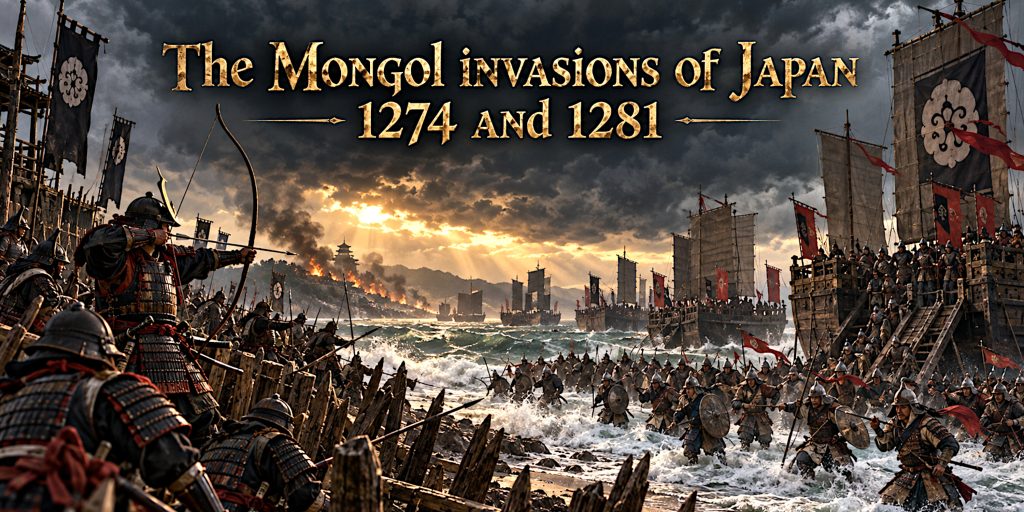
Kublai Khan’s Yuan dynasty launched two expeditions against Japan, using forces drawn from the Mongol Empire and its Korean ally. The first invasion landed in northern Kyushu in 1274. A much larger second expedition followed in 1281.
Japanese defenders resisted at the coast, while storms and logistical problems damaged the invading fleets. Later Japanese tradition called the storms kamikaze, or “divine winds”. That story is memorable, but it can make the outcome sound more inevitable than it was. Defence, timing and the difficulty of sustaining a large overseas force mattered too. Japan’s National Archives records the two attacks and the Yuan–Goryeo forces involved. www.archives.go.jp
Major Battles
- Battle of Hakata Bay, 1274: Japanese forces met the first invasion near Hakata before the fleet withdrew.
- Defence of Hakata Bay, 1281: Japanese troops and coastal defences resisted the second invasion during a prolonged campaign.
- Battle of Takashima, 1281: Fighting around Takashima formed part of the second invasion’s final phase, before the invading fleet was destroyed by a storm.
20. The Tripartite Struggle for Kannauj, 8th–10th centuries
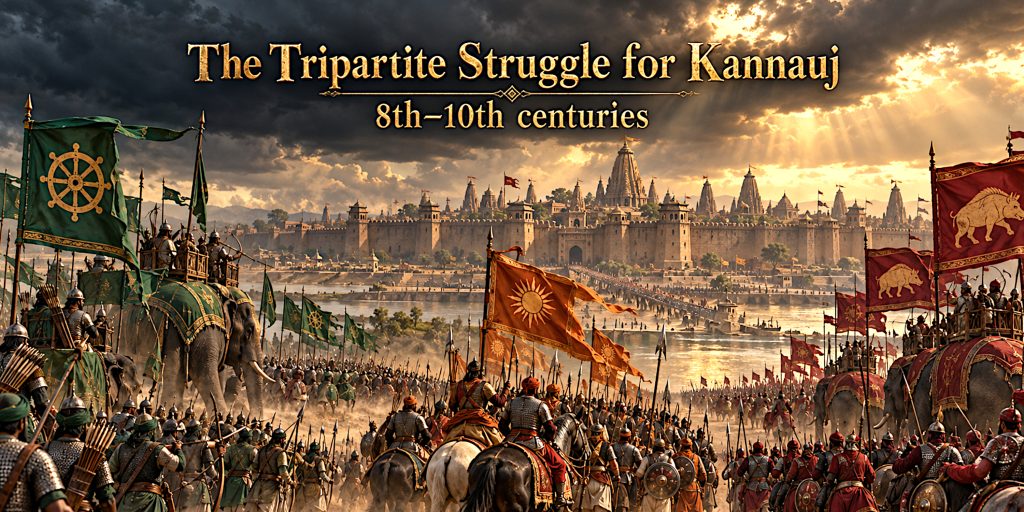
The Tripartite Struggle was a long contest among the Pala dynasty of eastern India, the Gurjara-Pratiharas of northern and western India, and the Rashtrakutas of the Deccan. The prize was Kannauj, a strategically important city whose control carried political prestige across northern India.
It was not one war with a clear beginning or final settlement. The rivals fought in successive campaigns while alliances and control of the city shifted. “Tripartite Struggle” is a useful label, but it should not suggest three fixed sides fighting without interruption. The surviving record also makes it difficult to identify a neat sequence of major pitched battles.
Major Battles and Campaigns
- Nagabhata II’s capture of Kannauj, early 9th century: The Pratihara ruler took the city and strengthened his position in northern India.
- Rashtrakuta campaign under Govinda III, c. 800: Govinda III campaigned north and briefly asserted Rashtrakuta power in the region.
- Pala–Pratihara campaigns, 9th century: The two dynasties repeatedly contested control of Kannauj and the surrounding Ganges plain. The evidence is less precise than for many European wars, so specific battlefield claims should be treated carefully.
What contemporary accounts can and cannot tell us
Medieval chroniclers are invaluable, but they were not neutral reporters. They wrote to praise rulers, defend religious causes or explain political disasters. Their accounts tell us how people understood a conflict, while their numbers and moral judgements need careful handling.
Fulcher of Chartres was a participant in the First Crusade and later lived in the Levant. His phrase, “we who were Occidentals now have been made Orientals,” conveys cultural change, but it also reflects the viewpoint of a Latin Christian settler. Read against the events around it, a contemporary account can illuminate both experience and bias.
Why casualty figures are uncertain
Medieval governments did not keep consistent population registers. Surviving figures may count households, taxpayers or soldiers rather than everyone affected. Chroniclers might report enormous numbers to express horror or celebrate victory. Famine and disease also blur the line between deaths caused directly by fighting and deaths caused by the disruption that followed.
Exact casualty rankings therefore suggest more certainty than the evidence allows. It is more responsible to describe the regions affected, the conflict’s duration and its consequences, while identifying numerical estimates as disputed.
The legacy of the biggest medieval wars
These twenty conflicts reshaped states and borders from China to Iberia. They helped build empires, ended dynasties, spread new religious and political institutions, and changed the balance between cavalry, infantry, siegecraft and gunpowder weapons.
Their costs reached far beyond the people who fought. Civilians faced siege, flight, taxation, famine and disease, while survivors rebuilt under new rulers. Kings and commanders dominate many accounts, but the scale of medieval warfare is often clearest in what it did to people who had little say in starting it.
Sources and further reading
Royal Armouries: The Hundred Years’ War Royal Armouries
Oxford Bibliographies: An Lushan Rebellion academic.oup.com
Fulcher of Chartres, History of the Expedition to Jerusalem sourcebooks.web.fordham.edu
Cambridge: Mongols and Mamluks www.cambridge.org