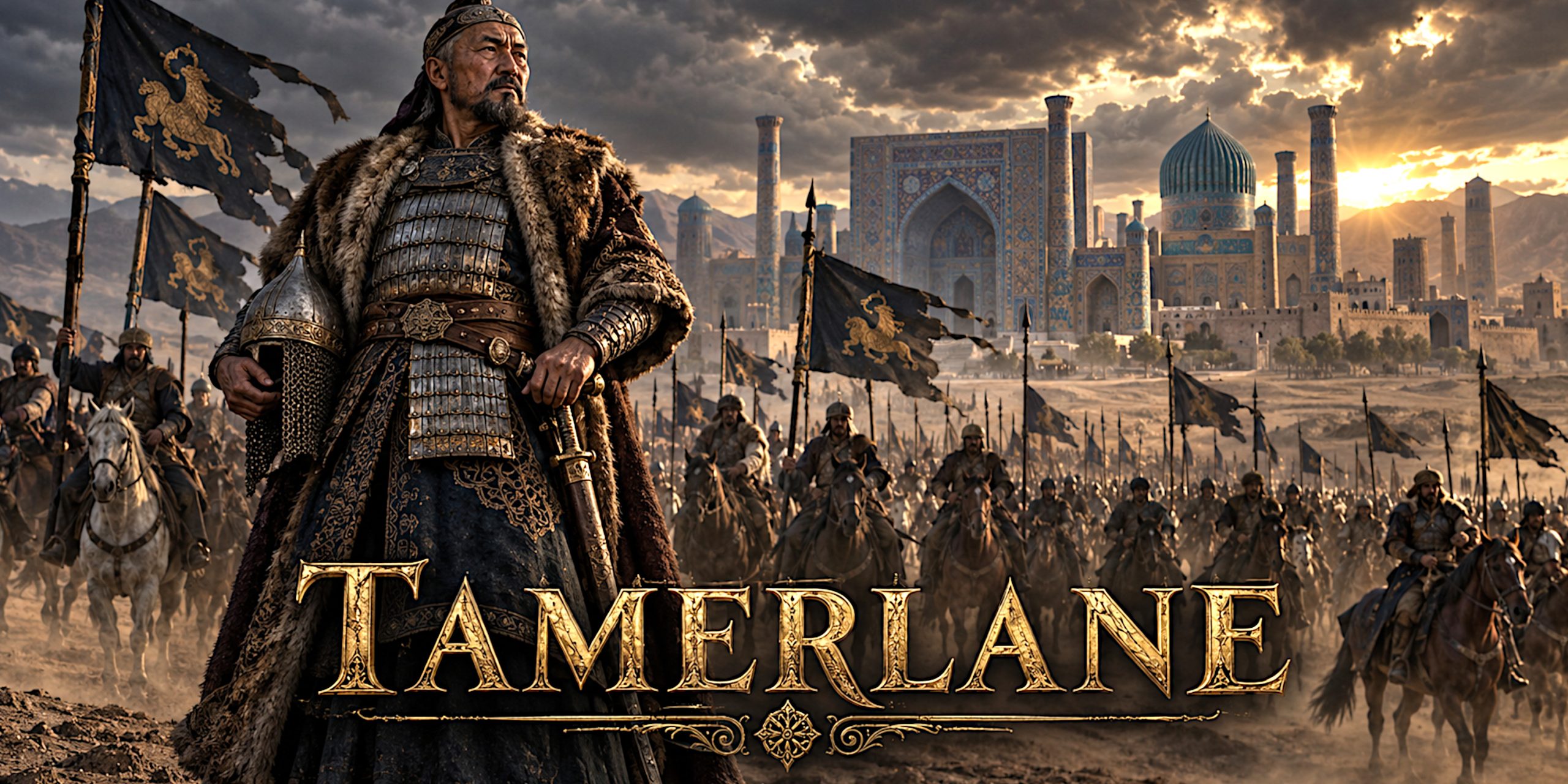
Tamerlane, better known in his own world as Timur, was one of the most successful and destructive conquerors of the late medieval age. From a relatively modest position among the Turco-Mongol clans of Central Asia, he built an empire stretching across much of modern Uzbekistan, Iran, Iraq, Afghanistan, the Caucasus and beyond. His armies defeated the Golden Horde, shattered the Delhi Sultanate and captured the Ottoman sultan Bayezid I.
He was also responsible for massacres, mass enslavement and the deliberate ruin of cities. Yet the dynasty he founded became a major patron of Persian literature, architecture, astronomy and manuscript art. Few rulers make moral judgement quite so uncomfortable. Timur was a gifted commander and a political vandal on an imperial scale, often within the same campaign.
Tamerlane at a Glance
| Detail | Information |
|---|---|
| Full name | Timur ibn Taraghai Barlas |
| Common Western name | Tamerlane |
| Name meaning | Timur means “iron” in Turkic languages |
| Born | 1336, near Kesh in Transoxiana, traditionally identified with the area of modern Shahrisabz |
| Died | 18 February 1405, Otrar |
| Dynasty | Timurid |
| Capital | Samarkand |
| Religion | Sunni Islam |
| Principal title | Amir, rather than khan |
| Notable victories | Kondurcha River, Terek River, Delhi and Ankara |
| Burial place | Gur-e Amir, Samarkand |
Was He Timur or Tamerlane?
Timur was his name. The familiar European form, Tamerlane, developed from the Persian Timur-i Lang, meaning “Timur the Lame”. Contemporary and near-contemporary writers associated the name with lasting injuries to his right leg and arm.
Later stories offered colourful explanations, usually involving theft, arrows and livestock. They should be handled cautiously. Hostile chroniclers had every incentive to give a humiliating origin to the disability, while Timurid court historians preferred a more dignified silence. Soviet researchers who examined Timur’s remains in 1941 reported injuries consistent with serious physical impairment. The limp was real, even if the sheep-stealing tale may have acquired a little polish in the telling.
Early Life in a Fractured Mongol World
Timur was born in 1336 into the Barlas, a clan of Mongol origin that had become culturally Turkic and Islamic. His homeland lay in Transoxiana, the region between the Amu Darya and Syr Darya rivers. It had once formed part of the Chagatai Khanate, but by Timur’s youth political authority had splintered among rival amirs and tribal groupings.
He was not a direct descendant of Genghis Khan. This mattered because Chinggisid descent still carried enormous political legitimacy. Timur therefore ruled as amir and placed compliant Chinggisid khans on the throne. He strengthened his position by marrying Saray Mulk Khanum, a Chinggisid princess, and adopting the title gurgan, or royal son-in-law.
This was more than decorative genealogy. Timur understood that conquest required a legal and dynastic language. He could command the army, but a descendant of Genghis Khan remained useful for the paperwork.
The Rise to Power
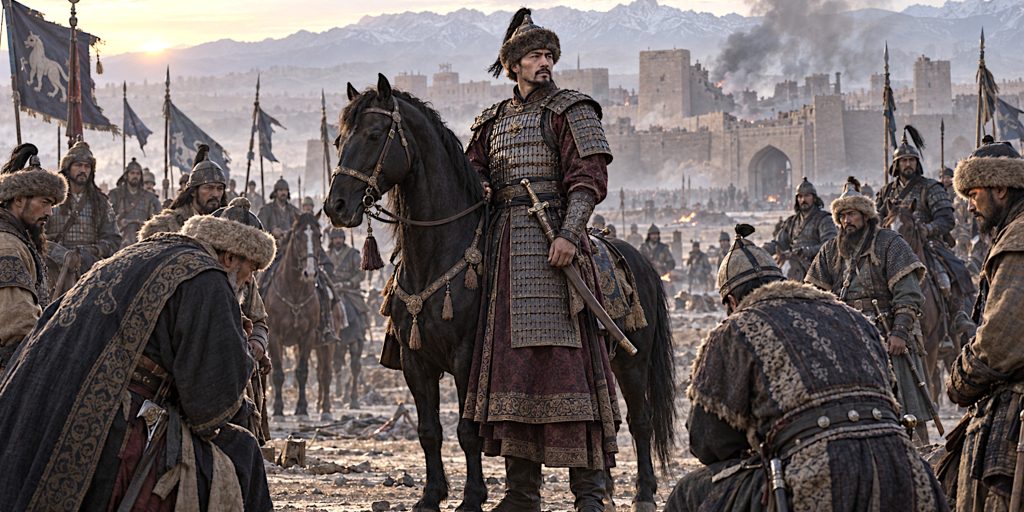
During the 1360s Timur alternately cooperated and competed with Amir Husayn, his brother-in-law and eventual rival. The two fought amid the collapse of effective Chagatai rule, opposed outside intervention and struggled for dominance around Balkh and Samarkand.
Their partnership ended in 1370. After the fall of Balkh, Husayn was killed and Timur emerged as the dominant ruler of Transoxiana. A formal assembly confirmed his authority. Samarkand became the centre of his state, although his court remained mobile and his political habits retained much of the steppe tradition.
Timur then spent decades campaigning almost continuously. His empire was not created through a steady outward expansion from secure borders. It was held together through repeated demonstrations of force, personal loyalties, marriage alliances and the distribution of plunder.
How Timur’s Army Fought
Timur inherited the military culture of the Mongol world but adapted it to the varied terrain and opponents of Central and Western Asia. His core strength lay in highly mobile cavalry, disciplined command structures and an excellent intelligence network.
His armies were commonly organised through decimal groupings, although actual formations could be more flexible than the tidy figures in chronicles suggest. Mounted archers screened advances, harassed enemy formations and opened gaps. Heavier cavalry then delivered close attacks with lances, swords and maces. Feigned retreats, wide flanking movements and attacks on communications remained central tools.
Timur also used infantry, engineers, siege specialists and locally recruited troops. His campaigns required bridge builders, miners, stone-throwing engines and experts who could deal with fortified cities. He moved skilled personnel between conquered regions, sometimes through patronage and often by compulsion.
Command was rarely improvised. Scouts mapped routes and water sources, messengers maintained contact across dispersed forces, and columns could travel separately before concentrating for battle. Timur’s willingness to operate across deserts, mountains and severe winters repeatedly caught opponents unprepared.
Arms and Armour
The Timurid army drew equipment from the interconnected military traditions of the Eurasian steppe, Iran and the Islamic world.
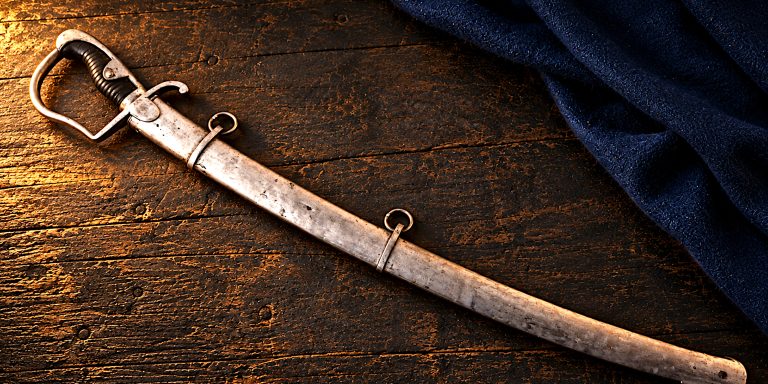
Composite reflex bows were among its most important weapons. Compact and powerful, they could be used from horseback and supported the mobile archery on which Timurid tactics depended. Cavalry also carried lances for the charge and sabres for close combat. Straight, double-edged swords remained in circulation, so it would be misleading to imagine every Timurid warrior carrying one standard curved blade.
Maces and axes offered useful striking power against armoured opponents. Elite warriors might wear mail, lamellar or plated armour, sometimes with protective coats incorporating metal elements. Conical helmets, neck protection and small round shields were common in the broader region. Horses could also receive armour, particularly among wealthier heavy cavalry.
By the end of Timur’s career, gunpowder weapons were becoming more significant across Asia, but they were not the foundation of his battlefield success. Mobility, coordination and relentless operational planning did the harder work.
Conquest of Persia and the Destruction of Cities
From the 1380s Timur pushed into Khurasan, Iran, Azerbaijan, Iraq and neighbouring territories. Herat submitted in 1381, while later campaigns broke the Kartids, Muzaffarids and other regional powers. Cities that surrendered might receive negotiated terms, although those terms were never especially comforting. Resistance or revolt could provoke exemplary violence.
At Isfahan in 1387, an uprising against Timurid troops was followed by a massacre. Chroniclers give enormous casualty totals and describe towers built from severed heads. Their numbers cannot be verified and medieval authors often used numerical excess to express horror or grandeur. The underlying event, however, should not be softened into a literary misunderstanding. Mass killing formed part of Timur’s coercive strategy.
Shiraz was treated more leniently after submission. The famous story in which Timur rebukes the poet Hafez for offering Samarkand and Bukhara in exchange for a beloved’s beauty is delightful, but it is a later anecdote rather than secure contemporary evidence. Historians must occasionally spoil a good dinner-party story. It is part of the job.
War with Tokhtamysh and the Golden Horde
Tokhtamysh had risen to power in the Golden Horde with Timur’s assistance. Gratitude proved brief. Once established, Tokhtamysh pursued his own ambitions in the Caucasus and northern Iran, bringing the two rulers into open conflict.
Timur defeated him at the Kondurcha River in 1391 and again near the Terek River in 1395. The second campaign was followed by attacks on major commercial centres including Sarai, Astrakhan and Azov. These operations weakened Tokhtamysh and inflicted lasting damage on the Golden Horde’s political and economic networks.
The campaign demonstrates Timur’s strategic reach at its most impressive. His troops covered immense distances through difficult country and defeated another army rooted in steppe warfare. It also shows the limits of his statecraft. He could devastate a rival system more easily than replace it with stable administration.
The Invasion of India and Sack of Delhi
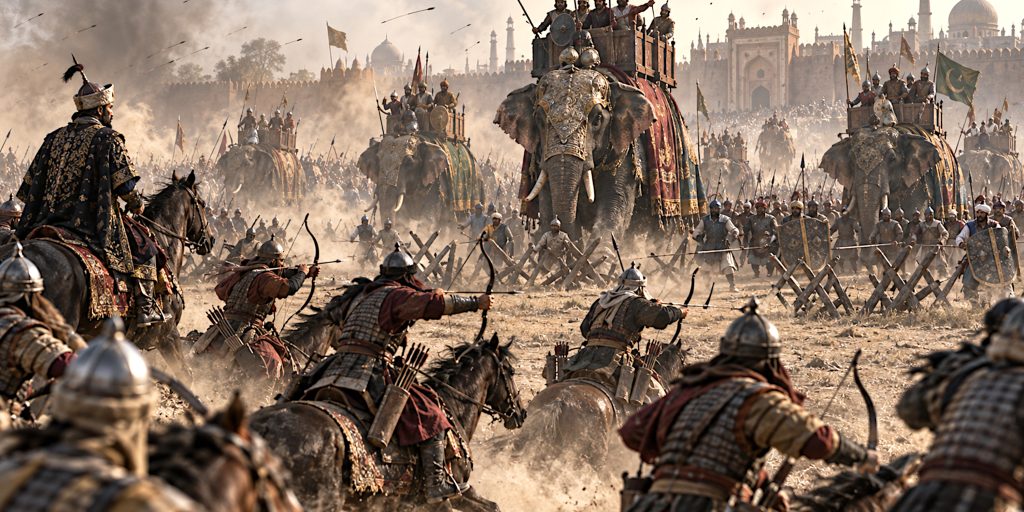
In 1398 Timur invaded northern India, presenting the expedition in religious language while pursuing wealth, prestige and strategic advantage. The Delhi Sultanate was divided and vulnerable under the later Tughlaqs.
Before the decisive confrontation outside Delhi, Timurid forces held a large number of captives. Timurid accounts state that Timur ordered their killing because he feared rebellion during the battle. The reported total of 100,000 may be conventional or exaggerated, but the mass execution itself belongs firmly within the narrative tradition closest to his court.
Sultan Mahmud Tughlaq’s army deployed war elephants. Timur’s forces countered them through missile fire, field obstacles and disciplined manoeuvre. Delhi fell and was subjected to several days of killing, enslavement and plunder. The invasion did not create durable Timurid rule in India. It extracted resources and left devastation behind.
More than a century later, Timur’s descendant Babur founded the Mughal Empire. The dynastic connection was important to Mughal legitimacy, but Babur’s conquest should not be treated as the delayed completion of Timur’s Indian campaign. History is untidy and rarely respects the convenience of a family tree.
The Campaign in Syria and Iraq
In 1400 Timur entered the Middle East and confronted the Mamluks. Aleppo was captured after a battle outside the city. Damascus then surrendered following negotiation and resistance within parts of the city.
The historian Ibn Khaldun was present during the crisis and met Timur outside Damascus. In his autobiographical account, he recalled Timur telling him:
“I am half the world.”
The wording depends on translation, but the sentiment suits the occasion. Ibn Khaldun’s testimony is especially valuable because it comes from a formidable scholar who actually stood before the conqueror, not from a later writer arranging thunderbolts around his memory.
Damascus suffered looting, fire and the deportation of craftsmen. Baghdad, which had rebelled after an earlier Timurid occupation, was stormed in 1401 and subjected to another massacre. Once again, accounts of tens of thousands killed resist exact confirmation, but the pattern is clear.
The Battle of Ankara
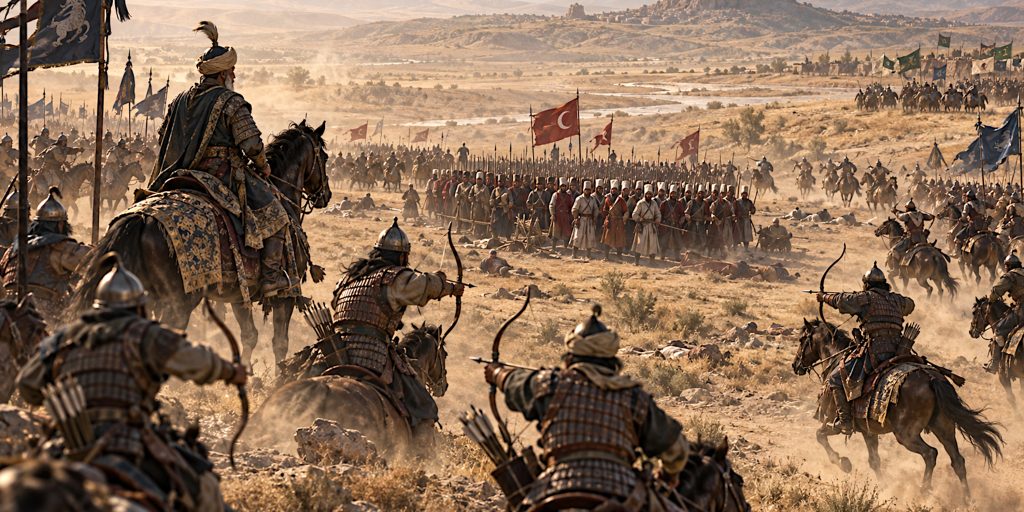
Timur’s most celebrated victory came against the Ottoman sultan Bayezid I in 1402. Tensions had grown over disputed Anatolian rulers, frontier politics and the exchange of increasingly insulting letters. Neither man was burdened by excessive modesty.
Before the battle, Timur manoeuvred around the Ottoman position near Ankara, disrupted access to water and exploited his opponent’s strained supply situation. During the fighting, some Anatolian contingents in Bayezid’s army defected. Timurid cavalry and mounted archers pressed the advantage, while Bayezid’s remaining troops were encircled.
Bayezid was captured. Later European traditions claimed that Timur kept him in an iron cage and used him as a footstool. These stories became immensely popular but are poorly supported. Bayezid remained a royal captive and died in 1403. His defeat triggered an Ottoman civil war known as the Interregnum, delaying further Ottoman expansion but not ending it.
Terror as a Weapon
Timur’s violence was neither random nor merely the ordinary brutality of medieval war. He used terror deliberately. Cities were offered examples of what submission might preserve and what resistance might invite. Massacre, enslavement, deportation and the construction of skull towers broadcast political messages to the next target.
That does not mean every atrocity report can be read as a modern statistical return. Court historians magnified victories, hostile writers emphasised monstrosity, and numbers passed through repeated copying. Ibn Arabshah, a Syrian scholar carried away from Damascus, portrayed Timur as a calamity and described him as:
“the lord of the fortunate conjunction.”
The title was one Timur’s regime actively cultivated, connecting his rule to astrological favour. In Ibn Arabshah’s hostile narrative it carries an unmistakably bitter edge.
The safest historical judgement holds two ideas together. Precise totals are often unreliable, while large-scale organised killing is beyond serious doubt.
Government, Religion and Legitimacy
Timur was a Sunni Muslim who patronised religious institutions and presented campaigns through Islamic forms of legitimacy. He also attacked Muslim states, destroyed Muslim cities and cooperated with whichever local powers served his interests. Piety and power were not mutually exclusive in his world, though power tended to win close decisions.
His administration combined Turco-Mongol political custom with Persian bureaucratic practice. Chinggisid princes supplied formal legitimacy, tribal and military elites commanded forces, and Persian secretaries managed taxation, correspondence and provincial government.
Timur distributed territories among sons and grandsons but prevented them from developing entirely independent authority while he lived. The system depended heavily on his personal command. That dependence became painfully obvious after his death.
Samarkand and the Timurid Cultural Legacy
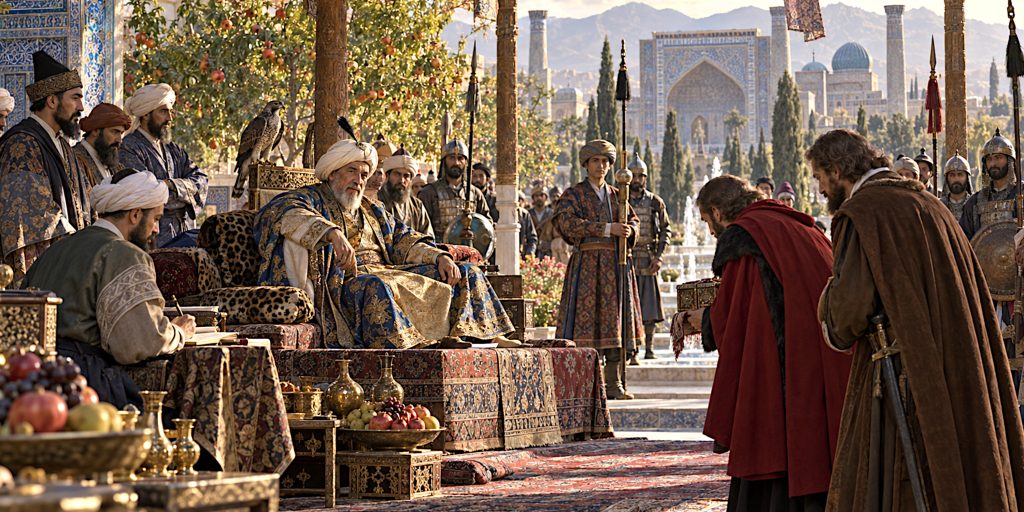
Timur transformed Samarkand into an imperial capital intended to embody the reach of his conquests. Architects, tile makers, metalworkers, calligraphers and other specialists were brought from across the empire. Some came willingly to a wealthy court. Many did not.
The Bibi-Khanym Mosque, the Ak-Saray palace at Shahrisabz and the early development of the Shah-i Zinda complex reflect the monumental ambitions associated with his reign. The surviving structures have been heavily restored, so they must be read as historic buildings with long afterlives rather than untouched snapshots of 1400.
The finest flourishing of Timurid culture came under his descendants, particularly Shah Rukh and Ulugh Beg. Herat and Samarkand became major centres of Persian art, scholarship and book production. Ulugh Beg’s observatory and astronomical tables belong to this later phase. Timur created the dynasty and concentrated resources, but crediting him personally with every Timurid intellectual achievement would be rather like crediting a quarry owner with writing the books in a library.
Contemporary Accounts and What They Tell Us
The sources for Timur are rich, partisan and frequently contradictory.
Nizam al-Din Shami composed a Zafarnama, or Book of Victory, with access to Timur’s court. It offers crucial detail but was written under the conqueror’s patronage. Sharaf al-Din Ali Yazdi produced a more elaborate Zafarnama for the Timurid dynasty after Timur’s death, turning conquest into polished imperial memory.
Ibn Arabshah wrote from the perspective of a man displaced by Timur’s conquest of Damascus. His hostility is obvious, yet his knowledge of languages and regions makes him indispensable. Ruy González de Clavijo, ambassador of Henry III of Castile, visited Samarkand in 1404 and recorded the splendour, ceremony and international reach of Timur’s court. He observed that:
“The city of Samarkand stands in a plain and is surrounded by a wall.”
The sentence sounds modest beside the more theatrical chronicles, but Clavijo’s careful descriptions of gardens, palaces, audiences, trade and construction give us something precious: the texture of the imperial capital as a visitor encountered it.
Ibn Khaldun’s account of meeting Timur at Damascus offers another rare personal view. None of these sources is neutral. Taken together, however, they allow a more credible portrait than either courtly celebration or demonology alone.
Archaeology and Surviving Monuments
Timur’s physical legacy is most visible in Samarkand and Shahrisabz. The Gur-e Amir contains his tomb beneath the famous fluted dome, alongside members of the Timurid family. The Ak-Saray’s surviving entrance at Shahrisabz conveys the extraordinary scale of a palace whose original fabric is now largely lost.
Archaeological investigation, architectural study and conservation work have clarified how Timurid builders combined local Central Asian traditions with expertise transferred from Iran, Khwarazm and other conquered regions. Glazed tile, monumental portals and carefully organised ceremonial space helped turn architecture into a statement of universal rule.
In 1941 Soviet anthropologist Mikhail Gerasimov’s team opened the Gur-e Amir burials and examined the remains attributed to Timur and members of his family. The skeleton identified as Timur’s belonged to a powerfully built older man and showed injuries consistent with lameness. Gerasimov later produced a facial reconstruction. The identification is persuasive within the burial context, but a reconstruction from a skull is still an interpretation, not a medieval photograph in scientific clothing.
Death and the Unfinished China Campaign
In late 1404 Timur began assembling an army for an invasion of Ming China. The project was ambitious even by his standards. He travelled east during a severe winter but fell ill at Otrar and died on 18 February 1405.
His body was taken to Samarkand and buried in the Gur-e Amir. He had designated heirs at different points, but no succession arrangement could reproduce his personal authority. Rival princes fought for control until his son Shah Rukh established a measure of stability.
The empire contracted and changed, yet the Timurid dynasty endured in Central Asia and Iran for a century. Through Babur, its dynastic tradition continued in Mughal India.
Timeline of Timur’s Life
| Date | Event |
|---|---|
| 1336 | Timur born near Kesh in Transoxiana |
| 1360s | Rises amid conflict in the Chagatai lands |
| 1370 | Defeats Amir Husayn and becomes dominant ruler of Transoxiana |
| 1381 | Captures Herat |
| 1387 | Isfahan revolt followed by massacre |
| 1391 | Defeats Tokhtamysh at the Kondurcha River |
| 1395 | Defeats Tokhtamysh near the Terek River |
| 1398 | Invades northern India and sacks Delhi |
| 1400 | Captures Aleppo and campaigns against Damascus |
| 1401 | Baghdad stormed after rebellion |
| 1402 | Defeats and captures Bayezid I at Ankara |
| 1404 | Castilian ambassador Clavijo visits the court at Samarkand |
| 1405 | Dies at Otrar while preparing to invade Ming China |
Was Tamerlane a Great Commander?
By any strictly military measure, yes. Timur repeatedly defeated strong opponents across radically different environments. He coordinated huge movements, understood intelligence and logistics, manipulated rivalries and adapted steppe warfare to sieges and settled states. Ankara alone would have secured his reputation. His victories over Tokhtamysh and the Delhi Sultanate make the case overwhelming.
Yet conquest was not the same as durable government. Timur’s political system relied upon his own prestige, movement and capacity to reward followers. Many regions were raided or subordinated rather than integrated. His empire began fragmenting almost immediately after his death.
Great commander is therefore an accurate description, not a moral compliment.
Tamerlane’s Legacy
Timur’s legacy resists a clean verdict. In parts of Central Asia, particularly modern Uzbekistan, Amir Temur has been celebrated as a state builder and national figure. In Iran, India, Syria, Iraq and the Caucasus, historical memory more often centres on invasion and destruction.
Both views contain evidence, but neither is complete alone. He built a court of extraordinary reach while depopulating cities. He enabled a brilliant dynasty while leaving it an unstable political inheritance. He used Islamic legitimacy while waging ruinous war against Muslim populations. His campaigns connected regions through diplomacy, forced migration and trade, though the phrase “connected regions” sounds rather genteel when the connection sometimes arrived with a siege engine.
Timur should neither be reduced to a cartoon monster nor polished into a visionary modern founder. He was a ruler of the late medieval Turco-Mongol world, exceptionally capable in war, sophisticated in political presentation and responsible for suffering on an immense scale. The contradiction is not an obstacle to understanding him. It is the central fact of his career.
Frequently Asked Questions
Was Tamerlane related to Genghis Khan?
Not by direct male descent. Timur married into the Chinggisid family and ruled through nominal khans descended from Genghis Khan, which gave his government dynastic legitimacy.
Why was Timur called Tamerlane?
Tamerlane derives from Timur-i Lang, meaning “Timur the Lame”. He had lasting injuries to his right leg and arm.
What empire did Tamerlane rule?
He founded the Timurid Empire, centred on Samarkand and extending across much of Central Asia, Iran, Afghanistan, Iraq and adjoining regions at its greatest reach.
Did Tamerlane defeat the Ottoman Empire?
He defeated the Ottoman army and captured Sultan Bayezid I at Ankara in 1402. The Ottoman state survived, although it entered a damaging civil war.
Where is Tamerlane buried?
He is buried in the Gur-e Amir mausoleum in Samarkand, Uzbekistan.
Was Timur a Mongol?
He came from the Barlas, a clan of Mongol origin that had become Turkic-speaking and Muslim. “Turco-Mongol” is generally the most useful description of his cultural and political world.
Suggested Further Reading
- Beatrice Forbes Manz, The Rise and Rule of Tamerlane
- Ruy González de Clavijo, Embassy to Tamerlane, 1403–1406
- Ibn Arabshah, Tamerlane, or Timur, the Great Amir
- Nizam al-Din Shami, Zafarnama
- Sharaf al-Din Ali Yazdi, Zafarnama
- Ibn Khaldun, autobiographical account of his meeting with Timur