Joan of Arc lived for perhaps nineteen years, held public power for little more than two, and spent only about one year campaigning. That ought to have made her a vivid footnote. Instead, she became one of the best documented and most disputed people of the Middle Ages.
The contrast is extraordinary. Joan was a farmer’s daughter who could not read, yet she dictated letters to kings and commanders. She entered a war already more than eighty years old, helped change its direction, saw Charles VII crowned at Reims, was captured, tried for heresy and burned at Rouen. Twenty-five years later, another court declared that the proceedings against her had been corrupt and invalid.
Much of what we know comes from the records of those trials. They preserve Joan’s words, though usually through clerical transcription and Latin translation. They are exceptionally rich sources, but they are not a medieval recording device. The first court wanted a conviction; the second wanted rehabilitation. A historian must therefore listen closely while keeping one eyebrow raised. Medieval legal paperwork, like modern legal paperwork, was never innocent of purpose.
Joan of Arc at a Glance
| Detail | What the evidence tells us |
|---|---|
| French name | Jeanne d’Arc, though spelling varied and Joan herself used forms such as Jehanne |
| Born | Probably around 1412 |
| Birthplace | Domrémy, on the frontier of the kingdom of France and the Duchy of Bar |
| Parents | Jacques d’Arc and Isabelle Romée |
| Social background | A farming household of some local standing, not destitute peasants |
| Known titles | La Pucelle, meaning the Maid; later the Maid of Orléans |
| Allegiance | Charles VII and the Armagnac or Valois cause |
| Active military period | 1429 to 1430 |
| Captured | 23 May 1430 at Compiègne |
| Executed | 30 May 1431 at Rouen |
| Rehabilitation | Original conviction annulled on 7 July 1456 |
| Canonised | 16 May 1920 by Pope Benedict XV |
France Before Joan
Joan arrived during a particularly bleak phase of the Hundred Years’ War. Henry V of England had defeated the French at Agincourt in 1415. The Treaty of Troyes in 1420 recognised Henry as heir to Charles VI of France, excluding Charles VI’s own son, the Dauphin Charles. When Henry V and Charles VI both died in 1422, the infant Henry VI was proclaimed king of England and France by the Anglo-Burgundian party.
The realm was divided. English government controlled Normandy and much of northern France. The dukes of Burgundy, whose power stretched across eastern France and the Low Countries, were allied to England after the murder of Duke John the Fearless in 1419. The Dauphin held substantial territory south of the Loire, but his authority was contested and he had not been crowned.
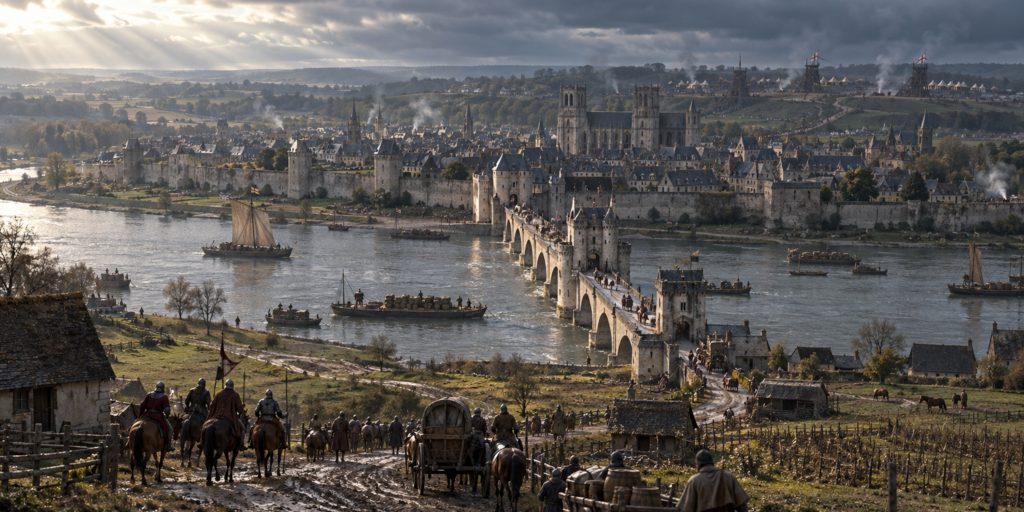
Orléans mattered because it guarded the Loire and the approaches into Charles’s remaining lands. The English siege begun in October 1428 therefore threatened more than a single city. If Orléans fell, the political and military position of the Valois cause could become very ugly indeed. It was already far from cheerful.
Childhood at Domrémy

Joan was born at Domrémy, now Domrémy-la-Pucelle, probably in 1412. She later said she was about nineteen at her trial in 1431, but no baptismal record survives. Her father, Jacques d’Arc, farmed land, kept livestock and held minor responsibilities in the village. The family was neither noble nor impoverished. “Peasant girl” is broadly accurate, although it can suggest a degree of helpless poverty that the evidence does not support.
Joan did not learn to read or write. She knew the prayers expected of a practising Catholic and acquired a reputation for devotion. Witnesses questioned during the rehabilitation proceedings remembered her attending church, giving alms, working with wool and helping with household tasks. Such testimony was collected decades later and under favourable conditions, so it should not be treated as an untouched childhood portrait. Even so, it places her firmly within ordinary village life.
Domrémy stood near a contested political frontier. The village generally supported the Valois cause, while nearby communities could favour Burgundy. Raiding was a real threat. In 1428, villagers fled temporarily to Neufchâteau when hostile troops approached. Joan did not grow up in a secluded pastoral painting. War was present in ruined fields, frightened neighbours and news carried along the roads.
The Voices and Joan’s Mission
Joan told her judges that she first heard a voice at about thirteen, in her father’s garden. She identified her principal heavenly advisers as St Michael the Archangel, St Catherine of Alexandria and St Margaret of Antioch. The voices instructed her to live piously and, eventually, to go to France, raise the siege of Orléans and bring Charles to Reims for his coronation.
What were these experiences? A historian can describe what Joan said, how consistently she defended it and how people around her responded. Proving a divine or medical explanation lies beyond the surviving evidence. Retrospective diagnoses, from epilepsy to psychiatric illness, often say more about modern appetites for a tidy answer than about a fifteenth-century woman examined at a distance of six centuries.
Her certainty is less doubtful than its cause. At Rouen she refused to give her judges every detail, especially anything she regarded as belonging to Charles. She could be direct, cautious and unexpectedly nimble under hostile questioning. When asked whether she knew herself to be in God’s grace, a trap in which either answer could be used against her, she replied:
“If I am not, may God put me there; and if I am, may God so keep me.”
The exchange can be read in the translated record of the 1431 trial. It remains one of the most impressive answers in any medieval courtroom.
From Vaucouleurs to Chinon
Joan first approached Robert de Baudricourt, the captain at Vaucouleurs, in 1428. He dismissed her and reportedly told a relative to take her home. She returned early in 1429. By then her determination, local support and perhaps news that she had predicted a French reverse near Orléans persuaded Baudricourt to help.
She set out for Chinon in February 1429 with a small escort. For the journey through dangerous territory, she cut her hair and wore male clothing. This was practical riding and military dress, but it later became central to the prosecution at Rouen.
At Chinon, she met Charles. The familiar story that she immediately identified him while he hid among courtiers appears in later testimony and may contain truth, but its theatrical details are difficult to verify. She was then questioned by clerics at Poitiers. Their full conclusions have not survived. Later summaries indicate that they found no obvious heresy and advised Charles that she could be tested through the relief of Orléans.
This was not a simple case of a credulous prince handing an army to a mysterious teenager. Charles’s advisers examined her, the court assessed the political opportunity, and experienced captains retained military command. Joan entered a functioning war machine. What she brought was a new claim to divine legitimacy, an urgent offensive spirit and a striking ability to make other people believe that defeat was not inevitable.
The Relief of Orléans
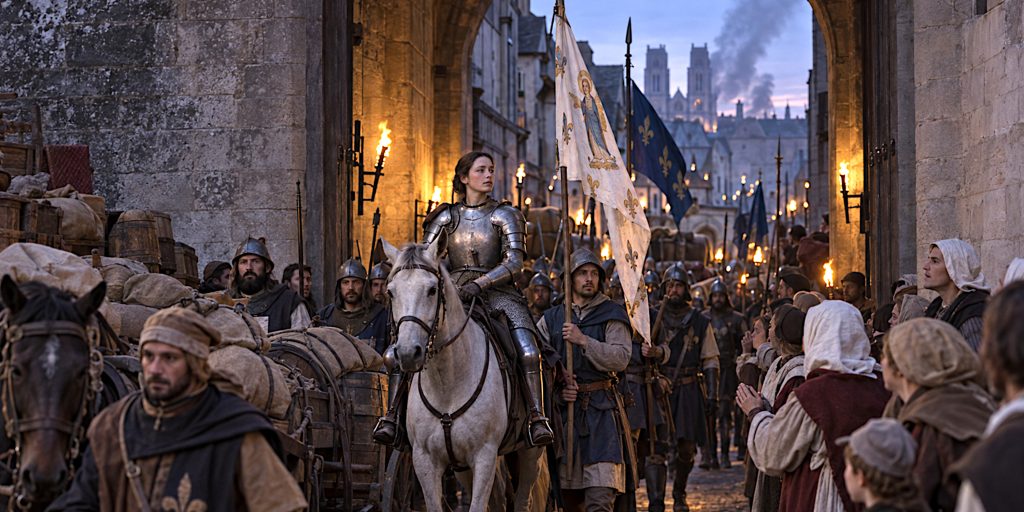
Joan entered Orléans on 29 April 1429 with supplies and troops. The city had endured months of siege, with English forces occupying a chain of fortified positions around it. She was welcomed with enthusiasm, but relations with the French commanders were not always smooth. They did not simply obey every instruction she gave.
French forces attacked the outlying English bastilles in early May. St Loup fell on 4 May. Further fighting followed on the south bank of the Loire, culminating in the assault on Les Tourelles on 7 May. Joan was wounded by an arrow between the neck and shoulder. She returned to the fighting after treatment, while her banner’s reappearance helped rally the attackers. The English abandoned the siege the following day.
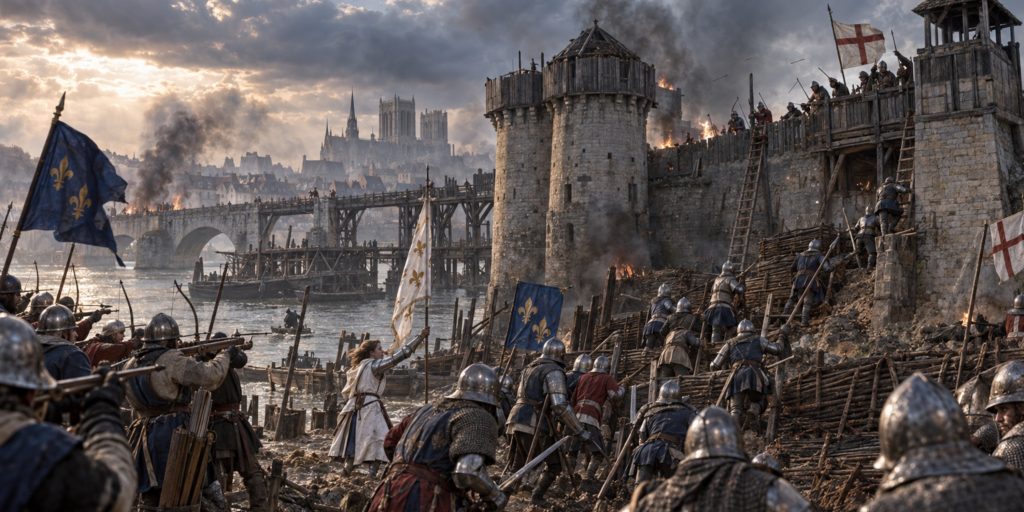
Joan did not single-handedly command every tactical movement, nor did she personally defeat an army with a sword. The victory depended upon commanders, artillery, soldiers, civic resources and English vulnerability. Yet reducing her to a mascot goes too far in the other direction. She pressed for action, took part in councils, remained close to assaults and became the visible focus of renewed confidence. Morale is not a decorative extra in warfare. At Orléans it had practical force.
The city’s municipal institutions preserve and interpret this history today. The Maison de Jeanne d’Arc in Orléans occupies a reconstruction of the house where she stayed during the siege.
The Loire Campaign and Patay
The relief of Orléans was followed by a swift campaign along the Loire:
| Action | Date | Result and Joan’s involvement |
|---|---|---|
| Jargeau | 12 June 1429 | French victory; Joan took part in the assault and survived a blow to her helmet |
| Meung-sur-Loire | 15 June 1429 | French forces secured the bridge |
| Beaugency | 17 June 1429 | English garrison surrendered |
| Patay | 18 June 1429 | French cavalry broke the English field army before its archers were properly established |
Patay was especially important. English longbowmen had helped destroy French armies at Crécy, Poitiers and Agincourt, but at Patay their position was exposed before defensive stakes and formations were ready. The French vanguard struck rapidly. The victory removed a major English force and opened the route north.
Joan was present during the campaign, although the tactical victory at Patay belonged principally to experienced captains and the French cavalry. Her wider strategic insistence mattered: after Orléans, she urged that Charles travel through potentially hostile territory to Reims. It was a political gamble disguised as a pilgrimage, and a rather good one.
The Coronation at Reims
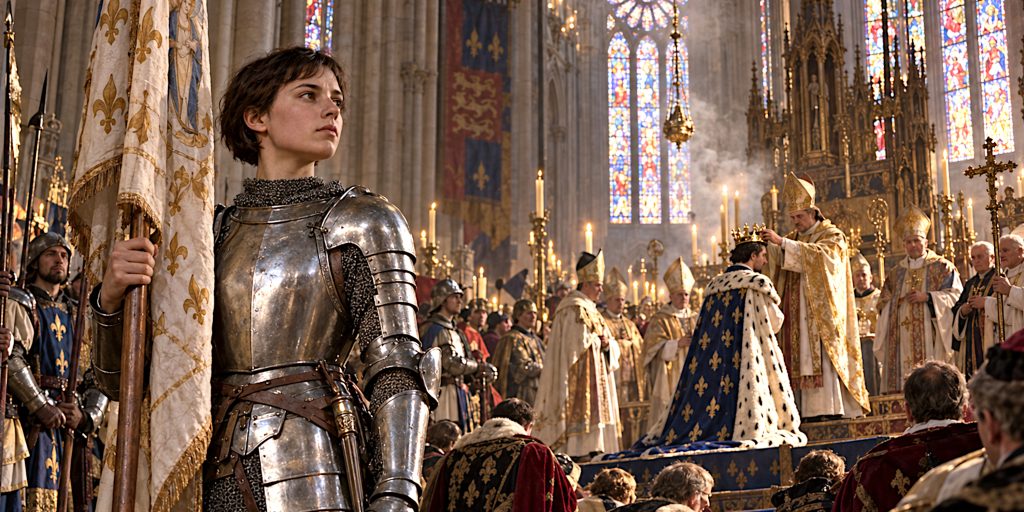
Towns including Auxerre, Troyes and Châlons negotiated or submitted as the royal army advanced. Charles was crowned at Reims Cathedral on 17 July 1429, with Joan nearby holding her banner.
The ceremony did not legally create Charles’s claim, but it gave that claim sacred and public force. French coronations traditionally took place at Reims, where the king was anointed with holy oil. The event answered the Anglo-Burgundian image of Charles as a disinherited pretender and fulfilled the central political objective Joan had announced.
In a letter dictated after the ceremony, Joan urged Philip the Good, Duke of Burgundy, to make peace with Charles. Her political language combined calls for reconciliation with absolute confidence in the legitimacy of her king. She was no detached visionary floating above court politics. She understood symbols, allegiance and the value of making a rival choose in public.
Paris, Court Politics and a Slowing Campaign
The momentum did not last. Joan favoured an advance on Paris, then held by the Anglo-Burgundian side. Charles’s court also pursued negotiation with Burgundy and did not share her appetite for relentless attack.
French forces assaulted Paris on 8 September 1429. Joan was wounded in the thigh by a crossbow bolt near the Porte Saint-Honoré and remained in the ditch urging the attack until she was removed. The assault failed. Charles ordered a withdrawal, and a temporary bridge over the Seine was destroyed.
The failure exposes the limits of Joan’s influence. She could inspire soldiers and press a course of action, but she did not control royal strategy. Later in 1429, she campaigned at Saint-Pierre-le-Moûtier and La Charité-sur-Loire with mixed results. Charles granted nobility to Joan and her family in December, but her political position had weakened.
Claims that Charles simply betrayed or abandoned her are too neat. Medieval government was constrained by money, supply, faction and diplomacy. Still, the contrast is hard to miss: the court had embraced her when her mission produced victories and became much more cautious when it did not. Courts have rarely been sentimental institutions.
Capture at Compiègne
In May 1430 Joan went to assist Compiègne, which was threatened by Burgundian forces. During a sortie on 23 May, her troops were driven back towards the town. The drawbridge was raised before she could escape, and she was pulled from her horse and captured by men serving John of Luxembourg.
She was held at several castles and attempted escape more than once. At Beaurevoir, she jumped from a tower, later explaining that she feared Compiègne would be destroyed. She survived but was injured.
The Burgundians eventually transferred her to English custody for 10,000 livres tournois. The sum reflected her political value. The English needed more than imprisonment. As long as Joan’s victories appeared divinely authorised, Charles VII’s coronation carried the aura of providence. A church court that condemned her as a heretic would attack the legitimacy of everything she had helped accomplish.
The Trial at Rouen
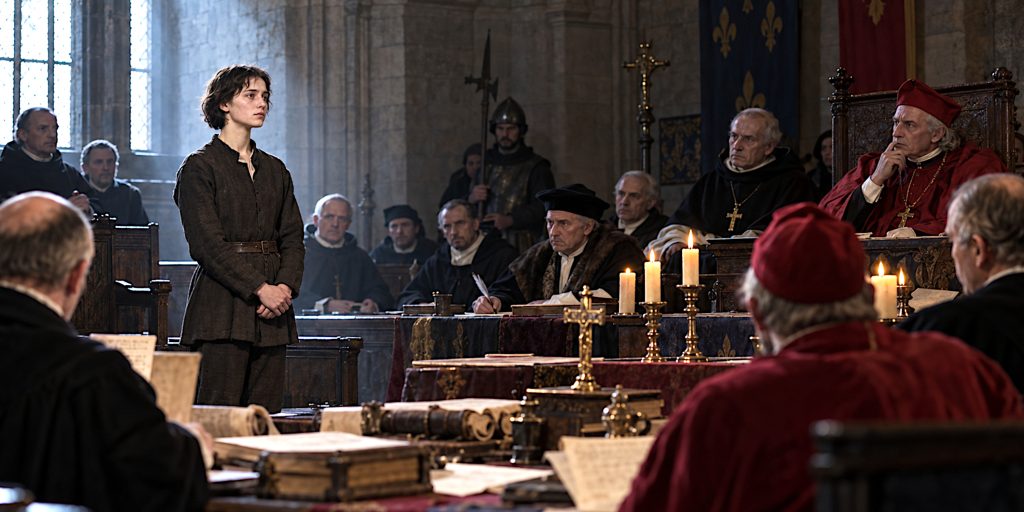
Joan’s trial opened at Rouen in early 1431 under Pierre Cauchon, bishop of Beauvais. Cauchon was aligned with the Anglo-Burgundian cause, and the English financed the proceedings. Joan was held in a secular prison guarded by English soldiers rather than in an ecclesiastical prison attended by women. She lacked a legal advocate. These were not small procedural blemishes.
The court questioned her about her childhood, voices, clothing, military actions, banner and obedience to the Church. A long set of accusations was eventually reduced to twelve articles. The prosecution concentrated on alleged false revelations, refusal to submit fully to ecclesiastical authority and the wearing of male dress.
The trial record nevertheless shows Joan resisting leading questions and drawing careful distinctions. She acknowledged obedience to the Church but maintained that God came first. She would not disclose what she regarded as private signs given to Charles. She corrected her interrogators. For an illiterate prisoner facing educated clerics, she was formidably composed.
On 24 May at Saint-Ouen, threatened with immediate execution, Joan signed or marked an abjuration. The precise text read to her and the document entered into the record may not have been identical. She was sentenced to perpetual imprisonment.
Within days, she resumed male clothing. Why she did so remains debated. Joan said her female clothes had been taken and also complained that a “great English lord” had entered her cell and attempted to force himself upon her. Male clothing could be fastened securely and may have offered protection from guards. She also renewed her claims about the voices. The court classified her as a relapsed heretic, a status punishable by death.
The case cannot fairly be summarised as a trial merely for wearing trousers. Dress mattered because the judges treated it as evidence of disobedience and relapse, within a much larger political and theological prosecution. That context makes the proceedings more sinister, not less.
Execution at Rouen
Joan was burned in the Place du Vieux-Marché at Rouen on 30 May 1431. Contemporary accounts and later testimony report that she asked for a cross and repeatedly invoked the name of Jesus. She was about nineteen.
Her remains were burned again and disposed of in the Seine, preventing the preservation of a grave or bodily relics. A supposed jar of her remains kept at Chinon was examined in the modern period and found to contain material including an Egyptian mummy fragment and cat bone. Joan’s authentic armour, sword and banner have also disappeared. She attracts relics with the same ease that she attracts legends, which is not always convenient for museums or historians.
The often repeated quotation, “We have burned a saint”, supposedly spoken by an English witness, should be handled cautiously. Variants appear in favourable testimony collected during the rehabilitation trial decades later. It may preserve a genuine reaction, but it is not a secure verbatim statement recorded at the execution.
The Rehabilitation Trial
Charles VII did not immediately overturn Joan’s conviction. Political conditions changed after the French recovery of Normandy and the capture of Rouen in 1449. Preliminary investigations were held in 1450 and 1452. In 1455, Pope Callixtus III authorised a formal review after a petition from Joan’s mother, Isabelle Romée, and her brothers.
The rehabilitation or nullification trial heard testimony from more than one hundred witnesses, including people from Domrémy, soldiers, clerics and residents of Orléans. On 7 July 1456, the court annulled the 1431 judgement, declaring it tainted by fraud, legal error and malice. The decision restored Joan’s name and removed the stain of heresy from Charles VII’s cause.
The witness statements are indispensable, but they were gathered twenty-five years after Joan’s death. Memory, politics and reverence had been at work. The translated nullification proceedings let readers compare those later recollections with the harsher record produced at Rouen.
Joan’s Armour
Charles VII paid for Joan’s armour in 1429. A surviving royal account records 100 livres tournois for a complete harness. No technical description or confirmed piece survives.
As a mounted military figure of status, she probably wore a fitted plate harness broadly comparable to those used by French men-at-arms of the period. Likely components included:
- A helmet, perhaps a sallet or another contemporary form, although its exact type is unknown
- A breastplate and backplate protecting the torso
- Plate defences for the arms and legs
- Gauntlets
- Mail protecting gaps that plate could not cover
- Spurs and riding equipment suitable for campaigning
Images showing Joan in bright white armour are artistic convention, not evidence. The armour may have been polished steel, but claims that she wore a white surcoat or a particular blackened helmet cannot be established from reliable contemporary description.
Joan was wounded at Orléans and Paris, and a stone or projectile struck her helmet at Jargeau. She was not watching battles from an upholstered viewing platform. Her armour was working equipment, and she repeatedly entered zones of direct danger.
Her Swords
Joan possessed more than one sword during her career. The most famous was found at the church of Sainte-Catherine-de-Fierbois. At her trial, she said her voices told her that a sword lay behind the altar. Clergy searched and found a rusty weapon marked with five crosses. It was cleaned and supplied with scabbards.
Nothing in the surviving evidence securely identifies its maker, age, dimensions or blade type. It was probably a contemporary or older European double-edged sword, but precise modern reconstructions are speculative. Stories connecting it to Charles Martel are later tradition.
Joan also referred to a sword given to her at Vaucouleurs and to weapons taken in military action. She denied that she used the Fierbois sword to kill anyone. During her trial she made her preference clear:
“I loved my banner forty times better than my sword.”
The statement is important. Joan carried arms and operated within a violent campaign, yet her public identity rested on the banner rather than personal swordsmanship. The sword from Fierbois functioned as a sign of providential discovery. The banner made her mission visible to an entire army.
Banner, Standard and Heraldry

Accounts indicate that Joan had several flags, and later descriptions do not agree in every detail. Her great standard was described as white, decorated with fleurs-de-lis and religious imagery, with the words “Jhesus Maria”. Trial testimony also refers to Christ in judgement and angels presenting a fleur-de-lis. A smaller pennon reportedly showed the Annunciation.
These were not merely personal decorations. A large standard marked a commander’s position, rallied troops and communicated identity across the confusion of a battlefield. Joan said she carried hers to avoid killing anyone, but holding it also placed her in a conspicuous and dangerous position.
In December 1429, Charles VII granted arms to Joan’s family featuring a sword supporting a crown, flanked by fleurs-de-lis. The imagery joined martial service, royal authority and Valois symbolism with unusual directness.
Did Joan Personally Command Armies?
The answer depends on what “command” means. Joan was not a formally trained captain operating alone above veteran soldiers. Men such as Jean de Dunois, the Duke of Alençon, La Hire and Gilles de Rais exercised important commands. Plans emerged from councils, negotiations and the realities of supply.
Yet contemporary and rehabilitation testimony shows that Joan did more than wave a flag. She argued for offensive action, participated in strategic discussions, directed demands to enemies, accompanied assaults and sometimes challenged the caution of commanders. At Orléans and during the march to Reims, her judgement influenced the course of operations.
It is safest to describe her as a charismatic military and political leader embedded within a larger command structure. “General” can mislead if it suggests a modern rank. “Mascot” is worse, because it erases her agency. Medieval leadership was personal, symbolic and religious as well as administrative. Joan was powerful in precisely those terms.
What Did Joan Look Like?
No authenticated portrait made from life survives. The only known contemporary image is a marginal sketch drawn in 1429 by Clément de Fauquembergue, a clerk of the Parlement of Paris who had not seen her. It shows a long-haired woman in a dress holding a sword and banner, so it tells us more about the artist’s assumptions than Joan’s appearance.
She wore her dark hair cut short in a rounded style associated with male fashion. Witnesses variously remembered her as strong, well formed or modest in appearance, but none gives us a dependable facial portrait. Modern paintings, statues and films must invent what the sources withhold.
Her clothing attracted intense attention because it crossed expected gender boundaries. She wore male dress while travelling, campaigning and imprisoned. Joan defended it as necessary and divinely permitted. The choice was practical, protective and symbolic at once. Trying to force it into a single modern category risks flattening a genuinely medieval set of circumstances.
Contemporary Voices
Joan’s own dictated letters and trial responses give her an unusually direct presence. In March 1429 she warned the English commanders before Orléans to leave France and return the towns they held. The tone was neither shy nor diplomatic. She wrote in the name of “the Maid” and promised action if they refused.
Christine de Pizan, the celebrated poet and political writer, completed The Tale of Joan of Arc in 1429. She hailed Joan’s success as evidence that fortune had turned for France and marvelled that a young woman had achieved what armed men had not. Christine wrote before the capture and trial, which makes the poem especially valuable as evidence for Joan’s immediate impact.
Not every contemporary admired her. Anglo-Burgundian writers called her a witch, heretic or deceiver. The Burgundian chronicler Enguerrand de Monstrelet acknowledged her reputation and military presence while remaining hostile to her cause. Such divisions remind us that Joan did not enter history as a universally recognised saint. She entered it as a dangerous political fact.
Evidence, Myths and Persistent Questions
| Claim | Historical assessment |
|---|---|
| Joan was a shepherd girl | Possible occasional work, but the classic shepherdess image is largely later legend |
| She was extremely poor | Misleading; her family were farmers with property and local standing |
| She personally commanded every battle | No; experienced captains retained major roles |
| She never fought | Too simple; she carried weapons and joined assaults, though she denied killing anyone |
| Her sword belonged to Charles Martel | Later legend without firm evidence |
| Charles hid at Chinon and she recognised him instantly | Based largely on later recollection and elaboration, not a secure contemporary account |
| She was tried only for wearing men’s clothes | False; clothing became crucial, but the prosecution covered revelation, authority, obedience and alleged heresy |
| Charles VII abandoned her without any rescue attempt | No substantial royal rescue is documented, but the political and military circumstances were more complex than simple betrayal |
| She was immediately viewed as a French national heroine | Anachronistic; her meaning changed greatly over later centuries |
The richest sources are unusually close to Joan, but uncertainty remains. We cannot verify the nature of her voices. We do not know exactly how much authority she exercised in every engagement. We cannot reconstruct her face, armour or sword with confidence. Good history does not make those gaps disappear. It marks them clearly and carries on.
Canonisation and Changing Legacy
Joan’s religious cult grew over centuries rather than appearing fully formed in 1431. She became increasingly important to French memory, especially during periods of invasion, political division and national anxiety. Royalists, republicans, Catholics and nationalists all claimed her, sometimes in mutually incompatible ways. Being dead did not spare her from political recruitment.
The Catholic Church beatified Joan in 1909 and canonised her in 1920. In 1922 she was declared a secondary patron saint of France. Her feast day is 30 May.
Writers and artists have continually remade her. Shakespeare presented a hostile English version in Henry VI, Part 1. Friedrich Schiller, Mark Twain, George Bernard Shaw, Carl Theodor Dreyer and countless later filmmakers found different Joans in the same short life. She can appear as saint, patriot, mystic, soldier, feminist symbol, victim of institutional power or troubling zealot. None quite contains her.
For those visiting the places associated with her, the Musées d’Orléans provide collections and exhibitions connected with the city’s memory of Joan, while Rouen’s Place du Vieux-Marché marks the location of her execution.
Timeline of Joan of Arc’s Life
| Date | Event |
|---|---|
| Around 1412 | Born at Domrémy |
| Around 1425 | Later said she first heard her voices at about thirteen |
| May 1428 | First known approach to Robert de Baudricourt at Vaucouleurs |
| February 1429 | Left Vaucouleurs for Chinon |
| March 1429 | Met Charles and underwent examination at Poitiers |
| 29 April 1429 | Entered besieged Orléans |
| 8 May 1429 | English siege of Orléans ended |
| 12 to 18 June 1429 | Loire campaign and victory at Patay |
| 17 July 1429 | Charles VII crowned at Reims |
| 8 September 1429 | Wounded during failed attack on Paris |
| December 1429 | Joan and her family ennobled |
| 23 May 1430 | Captured at Compiègne |
| Late 1430 | Transferred to English custody |
| 21 February 1431 | Public trial examinations began at Rouen |
| 24 May 1431 | Abjured under threat of execution |
| 30 May 1431 | Burned at the stake |
| 7 July 1456 | Conviction annulled |
| 16 May 1920 | Canonised by Pope Benedict XV |
Where to Follow Joan’s Story Today
- Domrémy-la-Pucelle: Joan’s traditionally identified birthplace and the nearby basilica of Bois-Chenu
- Chinon: The royal fortress where she met Charles in 1429
- Sainte-Catherine-de-Fierbois: The church associated with the discovery of her sword
- Orléans: The reconstructed Maison de Jeanne d’Arc, city collections and annual commemorations
- Reims Cathedral: The setting of Charles VII’s coronation
- Rouen: The trial city and execution site at the Place du Vieux-Marché
Visitors should be alert to the difference between an authentic medieval site, a later memorial and a reconstructed building. All can be historically meaningful, but they do not offer the same kind of evidence.
Joan of Arc’s Historical Significance

Joan did not end the Hundred Years’ War. Fighting continued for more than two decades after her death, and French recovery depended on political reconciliation, military reform, artillery, taxation and the weakening of the English position. A single heroic figure cannot carry that entire explanation.
She did, however, transform a critical moment. The relief of Orléans broke an English offensive. The Loire campaign opened the road to Reims. The coronation strengthened Charles VII’s legitimacy. Her presence gave a battered cause a language of divine favour and renewed possibility.
What stays with me is not the polished saint of later statues, but the voice in the trial record. It belongs to a young prisoner who understood that nearly everyone in the room had more institutional power than she did, yet still corrected their wording, resisted their traps and refused to let them define her experience. Her military career was brief. Her argument with authority has never really ended.
Watch the documentary: