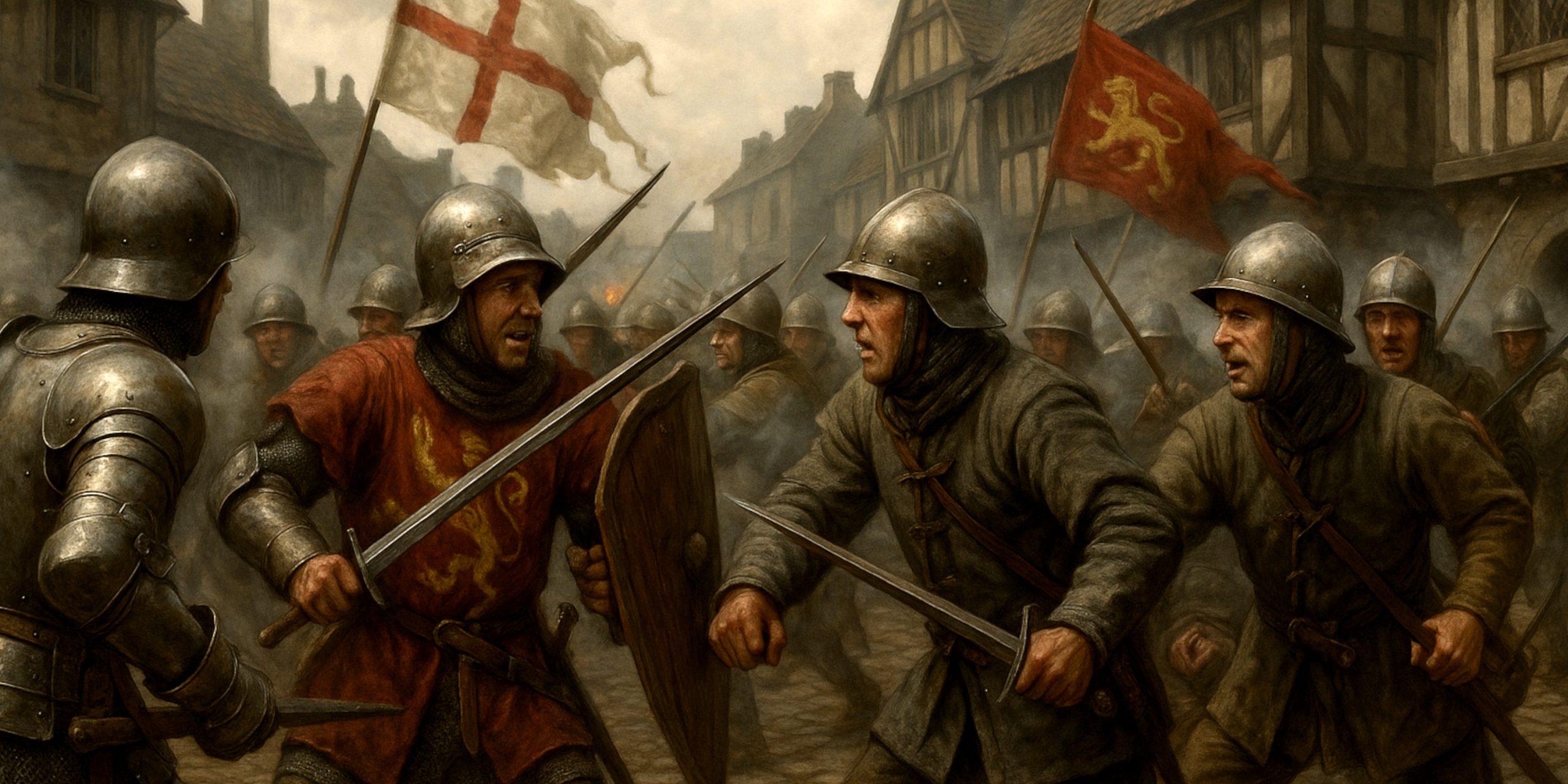
The First Battle of St Albans was fought on 22 May 1455 between supporters of King Henry VI and an armed alliance led by Richard, Duke of York. Although the fighting lasted perhaps an hour and involved only a few thousand men, its political consequences were immense.
This was not yet a straightforward contest between two rival kings. Richard of York publicly claimed that he remained loyal to Henry VI. His stated aim was to remove Edmund Beaufort, Duke of Somerset, and other royal advisers whom he blamed for England’s military failures and his own exclusion from government.
Yet when noblemen arrive with several thousand armed retainers and begin breaking through gardens, the distinction between loyal petition and rebellion becomes rather academic.
York’s victory placed Henry VI in his custody and eliminated three prominent opponents: Somerset, Henry Percy, Earl of Northumberland, and Thomas Clifford, Lord Clifford. The battle exposed the weakness of royal government and established a pattern of political disputes being settled with arrows, bills and sharpened steel.
First Battle of St Albans at a Glance
| Detail | Information |
|---|---|
| Date | 22 May 1455 |
| Location | St Albans, Hertfordshire, England |
| Wider conflict | Wars of the Roses |
| Belligerents | Yorkist alliance and the royal, conventionally Lancastrian, party |
| Yorkist commander | Richard, Duke of York |
| Royal commanders | King Henry VI, Duke of Buckingham and Duke of Somerset |
| Estimated Yorkist strength | Approximately 3,000 men, though some estimates are higher |
| Estimated royal strength | Approximately 2,000 to 2,500 men |
| Result | Decisive Yorkist victory |
| Duration | Probably around one hour, following lengthy negotiations |
| Notable deaths | Duke of Somerset, Earl of Northumberland and Lord Clifford |
| Political consequence | Henry VI taken into Yorkist custody and York restored to power |
Why Was the Battle Fought?
The causes of the First Battle of St Albans lay in the failing authority of Henry VI and the increasingly personal rivalry between Richard of York and Edmund Beaufort, Duke of Somerset.
England had lost almost all its territories in France during the final stages of the Hundred Years’ War. Somerset, who had held important commands in France, became closely associated with these failures. York accused him of incompetence, corruption and manipulating access to the king.
The situation became more dangerous when Henry VI suffered a prolonged mental collapse in 1453. He became unable to govern or respond coherently even to the birth of his son, Edward of Westminster.
York was appointed Protector of the Realm during the king’s incapacity. Somerset was imprisoned, while York and his Neville allies gained control of government.
Henry recovered late in 1454. York’s protectorate ended, Somerset returned to favour and Queen Margaret of Anjou emerged as a determined defender of her husband’s government and her son’s inheritance.
A great council was summoned at Leicester for May 1455. York and his allies were either excluded or feared that they would be accused of treason when they attended. York therefore gathered an armed force and marched south with Richard Neville, Earl of Salisbury, and Salisbury’s son, Richard Neville, Earl of Warwick.
The competing parties met at St Albans before the royal force could reach Leicester.
Was This Really the Beginning of the Wars of the Roses?

The First Battle of St Albans is conventionally described as the opening battle of the Wars of the Roses. That description is useful, but it can also be misleading.
Neither side marched under the familiar red and white rose symbolism later attached to the conflict. Nor was Richard of York openly attempting to replace Henry VI as king in May 1455. He continued to present himself as Henry’s loyal subject.
The immediate dispute concerned control of royal government, the security of York and the destruction of Somerset’s political influence. It was only later that the struggle developed into an open contest for the crown.
St Albans nevertheless crossed a decisive boundary. Leading members of the English nobility had used private armies against the king’s household, killed royal councillors and taken possession of the monarch. Political violence among the aristocracy was hardly new, but this particular violence proved exceptionally difficult to contain.
The March to St Albans

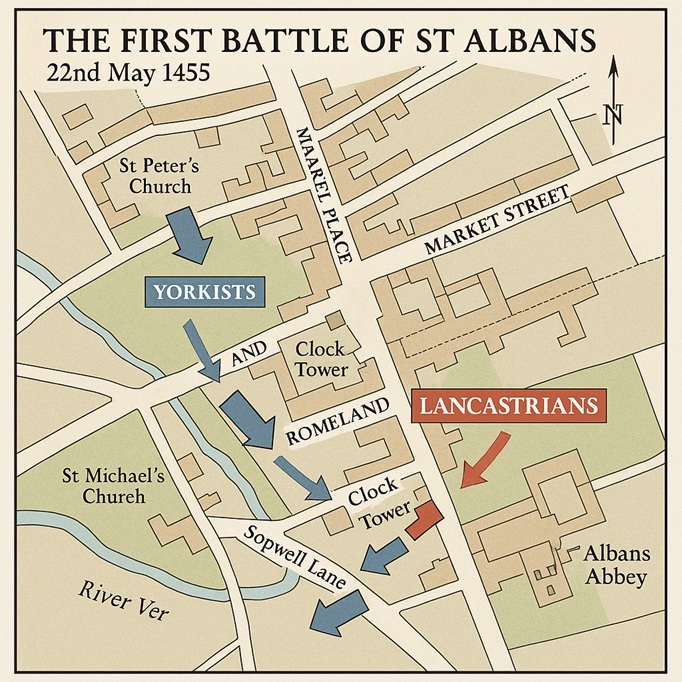
York and his allies approached from the east after travelling through Royston and Ware. The royal party left London and moved north, apparently intending to continue towards Leicester.
Henry’s force reached St Albans first and occupied the town centre. The Yorkists assembled at Keyfield, an open area outside the eastern approaches.
The royal commanders blocked the narrow streets leading into the town. Barricades were established around the approaches corresponding broadly with modern Sopwell Lane, Victoria Street and Hatfield Road.
This was a sensible defensive decision. The narrow roads prevented York from using his superior numbers effectively. They also forced attackers into confined spaces where defenders could meet them with arrows and polearms.
What the plan lacked was depth. Once Warwick found a route behind the barriers, the entire defensive arrangement began to fold in upon itself.
Forces and Troop Composition
Exact troop numbers cannot be established. Contemporary and later accounts offer conflicting totals, while medieval writers were rarely shy about improving a figure when a larger one made the story more impressive.
The Battlefields Trust gives an estimate of approximately 3,000 Yorkists against roughly 2,000 royal troops. Other reconstructions place the royal force nearer 2,500 and suggest a larger Yorkist army. The more conservative figures are generally the safest.
| Army | Estimated strength | Probable composition |
| Yorkist alliance | Approximately 3,000 | Noble retainers, men-at-arms, household troops, mounted retainers fighting on foot and large bodies of archers |
| Royal party | Approximately 2,000 to 2,500 | Royal household troops, noble affinities, men-at-arms, archers and local or hastily assembled retainers |
| Warwick’s contingent | Possibly several hundred archers with supporting troops | Neville retainers used in the decisive penetration of the town |
| Casualties | Possibly 100 to 400 killed or wounded | Disproportionately suffered by the royal army, with an unusually high concentration of noble deaths |
Many of the soldiers were not permanent professionals in the modern sense. They were drawn from noble households and regional networks of retainers connected by wages, service, family loyalty and the system later called bastard feudalism.
The Yorkist army was heavily influenced by Neville retainers from northern England. The royal army included members of the Percy affinity, bitter regional rivals of the Nevilles. National politics had become entangled with private feuds, which seldom improves the prospects for a restrained discussion.
Leaders and Commanders
Yorkist leaders
| Leader | Position and role |
| Richard Plantagenet, Duke of York | Principal Yorkist leader. Ordered the assault after negotiations failed |
| Richard Neville, Earl of Salisbury | York’s brother-in-law and a senior figure within the Neville family |
| Richard Neville, Earl of Warwick | Led the decisive attack through gardens and properties into the market area |
| Sir Robert Ogle | Experienced northern retainer associated with the Yorkist and Neville forces |
| Sir John Wenlock | Yorkist supporter and veteran soldier who later changed allegiance more than once |
Royal leaders
| Leader | Position and role |
| Henry VI | King of England. Present with the royal standard and wounded during the fighting |
| Humphrey Stafford, Duke of Buckingham | Senior royal nobleman who appears to have held overall military responsibility |
| Edmund Beaufort, Duke of Somerset | York’s principal political enemy and a central target of the campaign |
| Henry Percy, Earl of Northumberland | Head of the Percy family and a bitter opponent of the Nevilles |
| Thomas Clifford, Lord Clifford | Defended one of the eastern approaches and was killed during the battle |
| Jasper Tudor, Earl of Pembroke | Henry VI’s half-brother and a supporter of the royal government |
| Thomas Courtenay, Earl of Devon | Royal supporter who was wounded or captured during the fighting |
It is tempting to divide these men neatly into Lancastrians and Yorkists. In 1455 the reality was less tidy. Many were defending personal interests, regional alliances or control of the king’s government rather than supporting a fully developed dynastic programme.
Arms and Armour
The armies at St Albans were equipped in the late medieval English military tradition shaped by decades of warfare in France. Men-at-arms commonly fought on foot, supported by archers and troops carrying bills or other polearms.
Swords used at St Albans
No sword can be securely attributed to the battle, but several types would have been appropriate for English soldiers in the 1450s.
| Weapon | Likely users | Battlefield role |
| Arming sword | Men-at-arms, knights and wealthier retainers | One-handed cut-and-thrust weapon used with a buckler or as a sidearm |
| Type XV sword | Armoured men-at-arms | Stiff, sharply tapered blade intended primarily for thrusting into gaps in armour |
| Type XVIII sword | Knights and professional retainers | Balanced cut-and-thrust blade with a strong point |
| Longsword | Wealthier men-at-arms | Two-handed weapon suited to armoured combat and close fighting |
| Falchion | Retainers and some men-at-arms | Single-edged cutting sword, less common than the conventional arming sword |
| Dagger | Almost all equipped fighting men | Close combat, grappling and penetrating weak points in armour |
The Oakeshott classifications used for medieval swords are modern scholarly categories. A soldier at St Albans would not have asked for a Type XV from the armourer. He would, however, have recognised the advantage of a rigid point when attempting to thrust into an armpit, visor or other vulnerable opening.
Other weapons
- English longbow: Used at short range during Warwick’s breakthrough. In the confined streets, even a brief volley could cause panic and severe casualties.
- Bill: A hooked polearm developed from agricultural tools. Bills could strike, thrust or drag an opponent from his feet.
- Poleaxe: Favoured by heavily armoured men-at-arms. Its hammer, axe head and spike made it effective against plate armour.
- Spear: A common and comparatively inexpensive weapon suited to organised formations.
- Lance: Carried by mounted retainers during movement, although many men-at-arms probably dismounted before fighting.
- Mace and war hammer: Compact weapons capable of delivering concussive blows through armour.
- Rondel dagger: A stiff-bladed dagger used at extremely close quarters, particularly during armoured grappling.
Armour
Leading nobles and men-at-arms would have worn plate armour, often in a style influenced by English, Italian or German manufacture. A well-equipped combatant might possess:
- A sallet or another form of plate helmet
- A bevor protecting the throat and lower face
- A breastplate and backplate
- Plate protection for the arms and legs
- Mail at the joints
- Gauntlets
- A padded arming garment beneath the armour
Archers and less wealthy retainers generally wore lighter protection. This might include a jack of plate, brigandine, mail shirt, sallet or kettle hat.
Some royal troops were reportedly still putting on their armour when Warwick entered the town. Armour is remarkably effective when worn, somewhat less so when resting on a bench across the room.
Negotiations Before the Battle

Several hours of negotiation preceded the fighting. York insisted that he remained loyal to Henry VI and directed his accusations towards Somerset and other advisers.
The Yorkists wanted access to the king and the removal of Somerset. Henry’s government refused to surrender a leading royal councillor to an armed political rival.
Both parties issued statements intended to justify their conduct. This matters because the conflict was fought with parchment as well as steel. York needed to portray his actions as necessary self-defence, while the royal government needed to demonstrate that resistance to the king’s authority was treason.
When the talks collapsed, York ordered an attack on the eastern entrances to St Albans.
How the Battle Unfolded
The attack on the barricades

York’s and Salisbury’s men advanced against the defended streets. The confined approaches allowed the royal troops to resist effectively, and the first Yorkist attacks failed.
Lord Clifford appears to have played an important part in holding one of the barriers. York’s numerical advantage counted for little when only a limited number of men could fight at the front.
Had the battle continued as a series of frontal assaults, the royal army might have held the town or forced York to negotiate again.
Warwick finds another route
Warwick recognised the problem and led part of the Yorkist force away from the barricades. His men crossed or broke through property boundaries, gardens and buildings between the defended approaches.
This was the decisive movement of the battle. Warwick’s contingent entered the commercial centre from an unexpected direction, probably near the area now occupied by Chequer Street and the market.
The defenders in the centre were taken by surprise. Some had not completed putting on their armour, while others remained focused upon the eastern barricades.
Warwick’s archers loosed at short range. In an open field, archers required space and preparation to achieve their full effect. In St Albans, the short distance and crowded target area created a different but equally unpleasant calculation.
Collapse in the town centre
The sudden Yorkist appearance behind the defensive line caused confusion. Royal troops at the barricades faced the possibility of being attacked from both directions, while those around the king were exposed to archery and close combat.
Henry VI was struck in the neck by an arrow, although the injury does not appear to have been serious. The Duke of Buckingham and several other nobles were also wounded.
Somerset attempted to escape or make a final stand near the Castle Inn. He was killed in the street. Northumberland and Clifford also died during the fighting.
The royal army then broke apart. Some men fled through the streets and gardens, while others sought shelter. Henry was taken into a nearby tanner’s property, where his wound was treated.
York approached the king respectfully and presented himself as a loyal subject restoring proper government. It was an elegant political performance, provided one ignored the dead councillors outside.
Battle Timeline
| Time | Event |
| Before 20 May 1455 | York, Salisbury and Warwick gather armed supporters and march south |
| 20 May | Yorkist leaders write from Royston, declaring loyalty to Henry VI |
| 21 May | The royal party leaves London and moves towards St Albans |
| Early morning, 22 May | Henry’s force occupies central St Albans and blocks the eastern streets |
| Morning | Yorkists assemble at Keyfield, east of the town |
| Morning to approximately 10am | Heralds carry demands and replies between the two forces |
| Around 10am | Negotiations fail and York orders an assault |
| Shortly afterwards | Frontal attacks against the barricades are repelled |
| Late morning | Warwick leads men through gardens and properties between the defended roads |
| Late morning | Yorkist archers enter the market area and attack the surprised royal troops |
| Within roughly an hour | The royal defence collapses; Somerset, Northumberland and Clifford are killed |
| After the fighting | Henry VI is treated for an arrow wound and taken into Yorkist custody |
| Following day | York escorts the king back towards London |
| July 1455 | Parliament formally clears York and his allies of responsibility for the conflict |
| November 1455 | York is appointed Protector of the Realm for a second time |
The precise times remain uncertain. Medieval accounts agree more readily about the sequence than the clock, which is usually the sensible way to approach a fifteenth-century battle.
Casualties
Casualty estimates range from fewer than 100 deaths to several hundred killed and wounded. The Battlefields Trust suggests that no more than 400 casualties were sustained, almost all among the royal force.
The most important feature was not the overall number but the status of those killed.
Notable royal casualties
- Edmund Beaufort, Duke of Somerset, killed
- Henry Percy, Earl of Northumberland, killed
- Thomas Clifford, Lord Clifford, killed
- King Henry VI, wounded by an arrow
- Humphrey Stafford, Duke of Buckingham, wounded
- Humphrey Stafford, Earl of Stafford, wounded
- Henry Beaufort, Earl of Dorset, wounded
- Jasper Tudor, Earl of Pembroke, reportedly wounded
- Thomas Courtenay, Earl of Devon, wounded or captured
The deaths of Somerset, Northumberland and Clifford conveniently removed three of York’s most determined opponents. They also created a younger generation of heirs with strong reasons to seek revenge.
This personal inheritance of grievance became one of the most corrosive features of the Wars of the Roses. Political settlements might reconcile factions on paper, but parchment could not persuade a son to forget a father killed in a street.
Contemporary Accounts and Quotes
Contemporary accounts are partisan, sometimes contradictory and frequently shaped by political necessity. They remain invaluable, but they should not be treated as neutral battlefield reports.
Abbot John Wheathampstead described the aftermath in St Albans:
“The whole place filled with corpses of the slain.”
The wording reflects the horror experienced by the religious community and townspeople, even if the total casualties were modest beside later battles such as Towton.
A surviving account among the Paston papers placed the royal position firmly in the centre:
“The enemy’s battle was in the Market-place, and the King’s standard was pitched.”
The account identifies leading royal nobles and gives a total of approximately 3,000 men fighting, although medieval numerical estimates require caution.
Yorkist declarations before and after the battle repeatedly insisted that York, Salisbury and Warwick were the king’s “true liegemen”. This was more than polite phrasing. Their survival depended upon presenting armed rebellion as loyal resistance to corrupt advisers.
The July Parliament adopted the victorious faction’s interpretation, recognising York and the Nevilles as faithful subjects while placing responsibility upon Somerset and his associates. Victory did not merely control the streets. It helped determine which version of events became official.
Archaeology and the Urban Battlefield

The First Battle of St Albans presents an unusual archaeological problem because it was fought within a living town rather than across open fields.
The battlefield is securely located around the modern centre of St Albans, including St Peter’s Street, Market Place, Chequer Street, Sopwell Lane and the eastern approaches. Many of the medieval street lines remain recognisable.
However, there is currently no authenticated archaeological collection that can be confidently associated with the battle. Nor are there securely provenanced weapons, arrowheads or pieces of armour known to have been recovered from the fighting.
This lack of material evidence has several explanations:
- The battle was short.
- Much of the fighting occurred on established streets and occupied properties.
- Weapons and armour were valuable and would have been recovered.
- The dead were removed and buried relatively quickly.
- Centuries of construction disturbed medieval ground levels.
- Later rebuilding makes the original combat landscape difficult to investigate.
- Finds without a secure archaeological context cannot be reliably connected to the battle.
Around 40 prominent royal casualties were reportedly buried in or near the abbey’s Lady Chapel. Others were buried at St Peter’s Church. Subsequent religious destruction, structural work and the movement of burials have complicated the physical record.
Claims of objects discovered in gardens or cellars should therefore be treated cautiously. An isolated medieval arrowhead found in St Albans may be interesting, but without a secure context it does not arrive carrying a label that reads “Warwick was here”.
The Battle Site Today
St Albans retains one of the most accessible urban battlefields in England. The principal locations can be explored on foot.
| Location | Historical significance |
| Keyfield Terrace area | Approximate Yorkist assembly position |
| Sopwell Lane | One of the defended eastern approaches |
| Victoria Street and Hatfield Road | Routes associated with the blocked entrances |
| Chequer Street | Probable area of Warwick’s penetration into the town |
| Market Place | Centre of the royal position |
| Clock Tower | Traditionally associated with the warning bell |
| St Peter’s Street | Scene of intense fighting and noble casualties |
| Site of the Castle Inn | Associated with Somerset’s death |
| St Peter’s Church | Burial place of a number of combatants |
| St Albans Cathedral | Connected with Henry’s reception and the burial of leading casualties |
| St Albans Museum and Gallery | Local interpretation of the battle and the medieval town |
Modern commercial buildings now occupy many of these sites. The contrast is rather striking. One can follow the route of a bloody medieval breakthrough and then stop for coffee, which is probably an improvement in civic planning.
Immediate Aftermath
Henry VI was escorted to St Albans Abbey and subsequently taken back to London under Yorkist supervision. York continued to treat him as king, but possession of the royal person gave the victors control over government.
Somerset was dead, while York’s principal Neville allies had removed important Percy and Clifford opponents. Parliament later accepted the Yorkist explanation that the battle had been caused by the misconduct of the king’s advisers.
York became Protector again in November 1455 when Henry’s health deteriorated. His dominance proved temporary. Henry recovered, Queen Margaret rebuilt the royal faction and the families of the dead demanded redress.
An attempted reconciliation followed in 1458, complete with a public procession in which rival nobles walked together through London. It was a fine piece of theatre. Unfortunately, the cast remained armed and disliked one another.
Open warfare resumed in 1459.
Why the Yorkists Won
Several factors explain the Yorkist victory:
- Numerical advantage: York probably commanded the larger army.
- Experienced retainers: Many Yorkist and Neville troops came from established military affinities.
- Flexible leadership: Warwick abandoned an unsuccessful frontal attack and sought another route.
- Weak defensive depth: The royal barricades were effective from the front but vulnerable once bypassed.
- Surprise: Warwick entered the centre while some royal troops were still preparing for battle.
- Short-range archery: Yorkist archers attacked dense and poorly prepared targets.
- Political uncertainty: Some royal soldiers may have been reluctant to fight leading nobles who still proclaimed loyalty to the king.
- Concentrated leadership losses: The deaths of Somerset, Northumberland and Clifford accelerated the collapse.
Warwick deserves credit for recognising the tactical opportunity, although his later reputation as “the Kingmaker” can distort how we view the event. In 1455 he was an important young magnate, not yet the commanding political figure he would become.
Historical Significance
The battle did not settle the question of who should govern England. It did, however, establish several dangerous precedents.
Richard of York demonstrated that an armed noble faction could defeat the king’s household, eliminate ministers and seize control of Henry VI without immediately replacing him.
The battle also transformed political rivalry into inherited blood feud. The sons and relatives of Somerset, Northumberland and Clifford would carry their grievances into later campaigns.
Perhaps most importantly, St Albans revealed the central problem of Henry VI’s reign. The king could neither impose a stable government nor reconcile the magnates competing around him. His personal piety was genuine, but medieval kingship demanded political judgement, military authority and the ability to frighten powerful relatives into behaving themselves. Henry was painfully unsuited to the position.
The First Battle of St Albans was small compared with the slaughter at Towton, Barnet or Tewkesbury. Its importance lies elsewhere. It proved that violence worked, at least in the short term. Once England’s magnates learned that lesson, they proved reluctant to forget it.
Legacy of the First Battle of St Albans
The First Battle of St Albans occupies an essential place in English history. It began as an armed confrontation over access to the king and ended as the traditional opening engagement of a dynastic civil war.
Its legacy included:
- The destruction of Somerset’s political faction
- The capture and political control of Henry VI
- The renewed dominance of Richard of York
- The rise of Warwick as a significant military leader
- Intensification of the Neville-Percy feud
- Personal demands for revenge by the Beaufort, Percy and Clifford families
- Normalisation of private armies as instruments of national politics
- A continuing cycle of reconciliation, mistrust and renewed warfare
St Albans did not make the Wars of the Roses inevitable. There were repeated opportunities for compromise after 1455. Yet the battle ensured that future negotiations took place beneath the shadow of noble bloodshed.
That shadow proved longer than anyone present in the market streets can have anticipated.
Frequently Asked Questions
Who won the First Battle of St Albans?
Richard, Duke of York, and his Neville allies won a decisive victory over the royal army supporting Henry VI.
When was the First Battle of St Albans?
The battle was fought on 22 May 1455.
Why was the First Battle of St Albans important?
It is traditionally regarded as the first battle of the Wars of the Roses. It placed Henry VI under Yorkist control and resulted in the deaths of several leading royal nobles.
Was Henry VI captured?
Henry was wounded by an arrow and taken into Yorkist custody. York continued to recognise him as king while assuming control of his government.
How long did the battle last?
The fighting probably lasted around an hour, although several hours of negotiation preceded it.
How many people died?
Estimates vary. Perhaps 100 people were killed, although broader estimates allow for several hundred killed and wounded. Most casualties were suffered by the royal army.
Where did the fighting take place?
The battle was fought in the streets and properties of central St Albans, particularly around the eastern approaches, Chequer Street, Market Place and St Peter’s Street.
What swords were used at St Albans?
Men-at-arms probably carried arming swords and longswords with stiff, pointed blades suited to armoured combat. Type XV and Type XVIII forms were characteristic of the period, although no surviving sword has been conclusively linked to the battle.
Sources and Further Reading
- Battlefields Trust: First Battle of St Albans
- St Albans and Hertfordshire Architectural and Archaeological Society
- Richard III Society: The First Battle of St Albans
- The Paston Letters, Volume III
- Andrew Boardman, The First Battle of St Albans
- Peter Burley, Michael Elliott and Harvey Watson, The Battles of St Albans
- Michael Hicks, “Propaganda and the First Battle of St Albans, 1455”
- A. J. Pollard, “The First Battle of St Albans”