The Tang Dynasty sits comfortably among the most admired periods in Chinese history, and not without reason. It produced poetry that still feels sharp and alive, cities that dwarfed anything in Europe at the time, and a court culture that could switch from refined elegance to ruthless intrigue in the space of a single afternoon.
From my perspective, the Tang era has always carried a certain duality. It dazzles at a distance, yet the closer you look, the more human it becomes, full of ambition, misjudgement, brilliance, and the occasional spectacular collapse.
Origins and Rise to Power
The dynasty was founded in 618 after the fall of the short lived but important Sui Dynasty. The Sui had overreached, exhausting both treasury and people. Into that vacuum stepped the Li family.
The founding emperor, Emperor Gaozu of Tang, established control, but it was his son, Emperor Taizong, who truly shaped the dynasty’s character. Taizong combined military skill with political awareness in a way that feels almost suspiciously competent. He listened to criticism, employed capable ministers, and stabilised the empire.
One cannot help but suspect he knew exactly how rare that combination was.
The Capital and Urban Life
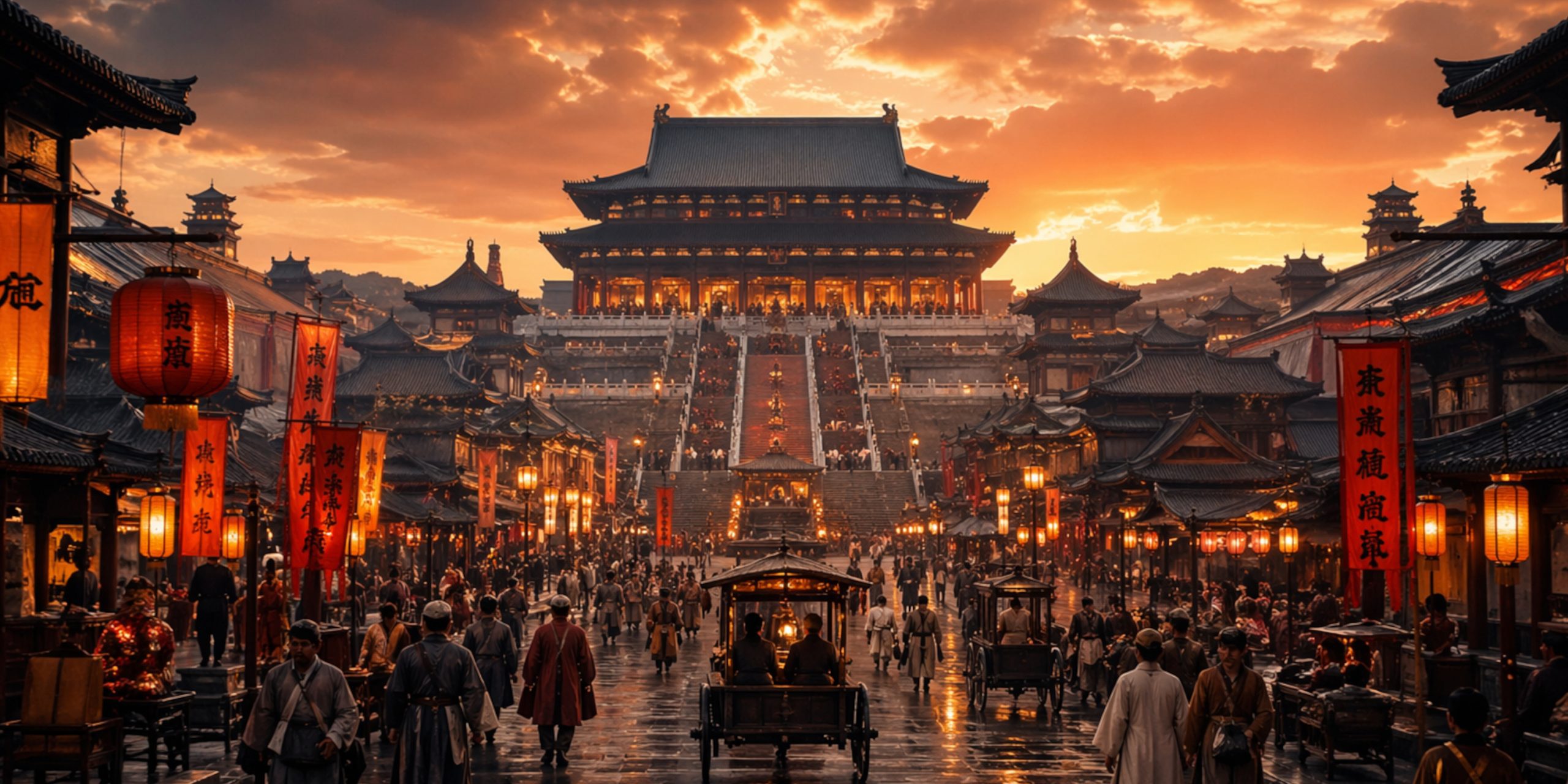
At its height, the Tang capital of Chang’an was one of the largest cities in the world. It was meticulously planned, with wide avenues, markets separated by strict regulations, and districts that housed merchants from across Asia.
Walking through Chang’an, had we the chance, would have meant hearing Persian, Sogdian, Turkic, and Chinese spoken in quick succession. Silk, spices, horses, and ideas all passed through its gates. It was not just a capital, it was a statement of confidence.
And like most confident societies, it occasionally mistook that confidence for permanence.
Government and Society
Tang governance refined earlier systems rather than reinventing them. The civil service examination system expanded, allowing talented men, at least in theory, to rise through merit rather than birth.
In practice, family connections still mattered. They always do.
Society was structured yet flexible. Women, particularly in the earlier Tang period, enjoyed relatively greater freedom compared to later dynasties. The example of Wu Zetian, the only woman to rule China in her own name, is often cited. Her reign was controversial, ambitious, and effective, depending on which chronicler you trust.
Personally, I find her fascinating precisely because she unsettles neat narratives.
Culture, Poetry, and Art
If the Tang Dynasty has a soul, it is found in its poetry.
Figures like Li Bai and Du Fu captured everything from drunken joy to quiet despair. Li Bai feels like a man perpetually chasing the moon, while Du Fu watches the world with a tired, almost modern clarity.
Art flourished alongside literature. Buddhist sculpture, landscape painting, and ceramics reached new levels of refinement. The famous Tang horses, with their rounded forms and expressive posture, carry a surprising sense of movement.
It is difficult not to admire a civilisation that could produce both administrative efficiency and poetry about loneliness in the same breath.
Military Power and Expansion
The Tang military was formidable. It relied on a mix of conscription and professional forces, supported by frontier garrisons.
At its peak, the empire extended deep into Central Asia. Campaigns brought Tang influence into contact, and sometimes conflict, with powers such as the Battle of Talas.
The army was effective, but like all large military systems, it depended heavily on competent leadership and steady funding. When either faltered, cracks began to show.
The An Lushan Rebellion
No discussion of the Tang Dynasty can avoid the devastating An Lushan Rebellion.
Led by the general An Lushan, this uprising nearly destroyed the dynasty. It exposed weaknesses in the military system and shattered the illusion of stability.
The human cost was immense. Some estimates suggest tens of millions perished, though exact figures remain debated. What is certain is that the rebellion permanently weakened central authority.
From this point on, the Tang never fully recovered its earlier confidence. It continued, certainly, but with a sense that something vital had slipped.
Religion and Philosophy
The Tang period saw the flourishing of Buddhism, alongside Daoism and Confucianism.
Buddhist monasteries accumulated wealth and influence, which eventually drew suspicion from the state. Periodic suppressions followed, most notably under Emperor Wuzong of Tang.
Religion during the Tang was not simply a matter of belief. It was tied to power, economics, and legitimacy. The balance between these forces was delicate, and often strained.
Trade and the Silk Road
The Silk Road reached a high point under Tang rule. Trade routes connected China to Central Asia, the Middle East, and beyond.
Merchants brought not only goods but ideas. Music, religion, clothing styles, and even cuisine reflected these exchanges. Foreign influences were not merely tolerated, they were woven into the fabric of Tang life.
It is one of the reasons the period feels so vibrant even now. It was outward looking in a way that many later eras struggled to maintain.
Decline and Fall
After the An Lushan Rebellion, regional military governors gained increasing autonomy. The central government weakened, court politics grew more fractious, and economic strain became more pronounced.
By the late ninth century, rebellions multiplied. The most notable, led by Huang Chao, dealt further damage.
In 907, the dynasty finally collapsed. It did not fall in a single dramatic moment, but rather faded under the weight of accumulated pressures.
A rather fitting end, perhaps. Empires rarely explode. They erode.
Legacy
The Tang Dynasty left an enduring legacy. Later Chinese dynasties looked back to it as a model of cultural and administrative excellence.
Its poetry remains central to Chinese literature. Its cosmopolitan outlook continues to fascinate historians. Its failures, particularly the dangers of decentralised military power, were studied just as closely as its successes.
For me, the Tang Dynasty is compelling not because it was perfect, but because it was not. It reached extraordinary heights, then struggled to sustain them. That arc feels familiar, almost uncomfortably so.
History, after all, has a habit of repeating its rhythms, even when the setting changes.