What We Know About the Struggle That Reshaped the Mediterranean
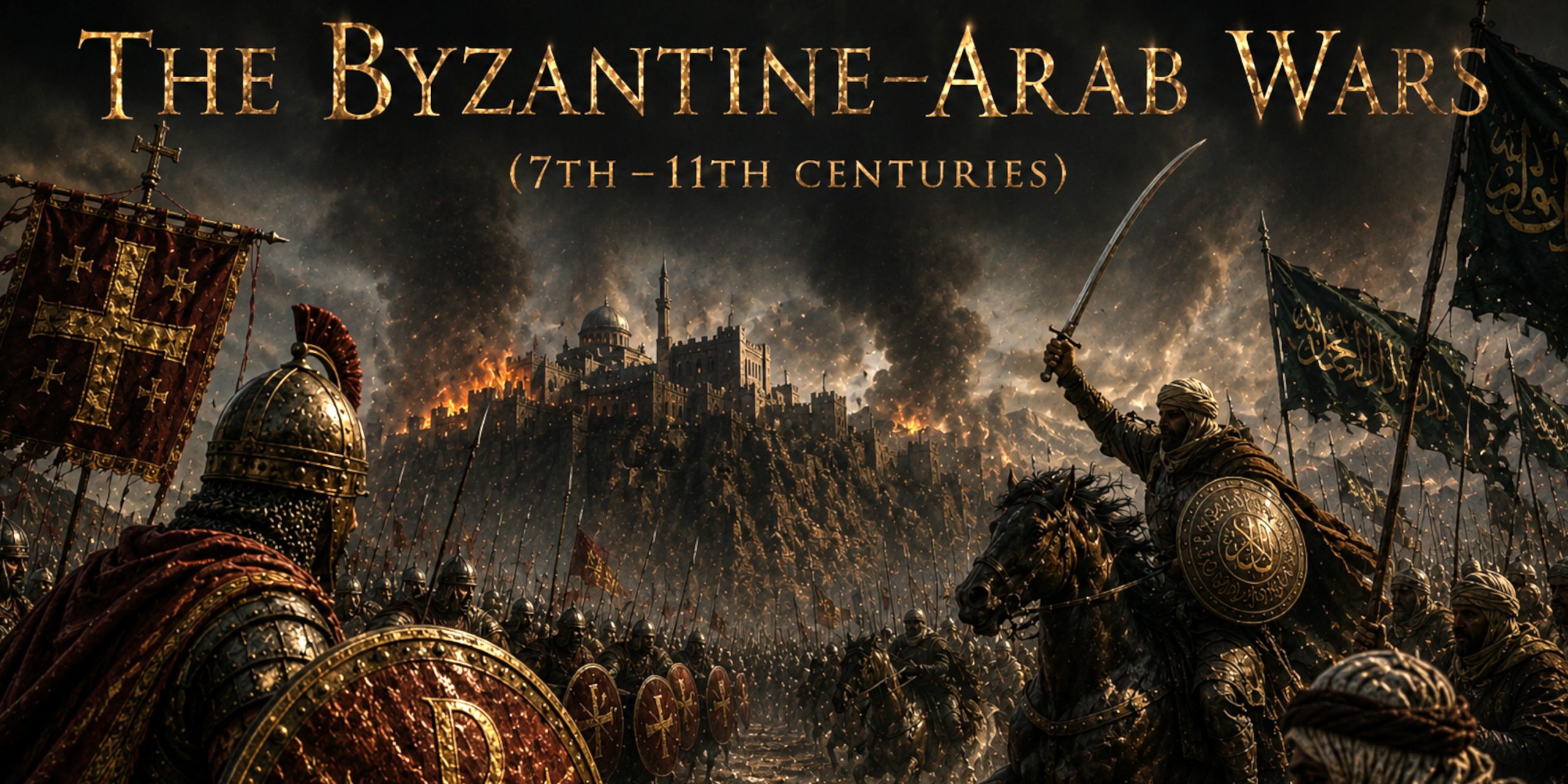
The Byzantine–Arab Wars were not a single war. They were centuries of raids, invasions, naval battles, sieges, betrayals, holy ambitions and exhausted tax collectors trying to keep the empire functioning while half the known world appeared to be on fire.
From the 630s onward, the Byzantine Empire faced the explosive rise of the early Islamic Caliphates. Within a generation, Syria, Egypt and much of North Africa were lost. Cities that had paid taxes to Constantinople for centuries suddenly answered to Damascus or Baghdad instead. The Mediterranean changed language, religion, trade patterns and political balance in what must have felt, to contemporaries, like the end of the world arriving at cavalry speed.
And yet Byzantium survived.
That is the remarkable part. Almost every historian who studies the seventh century eventually reaches the same conclusion. The empire should probably have collapsed. Instead, it adapted, hardened and learned how to fight a new kind of enemy.
The result was one of the longest and most important conflicts in medieval history.
Origins of the Conflict
The roots of the war lay in exhaustion.
By the early seventh century, the Byzantine Empire and the Sassanid Persian Empire had spent decades tearing chunks out of each other in catastrophic wars. Emperor Heraclius eventually defeated Persia in a dramatic counteroffensive, but victory came at a terrible cost. Provinces were ruined, armies depleted and frontier systems weakened.
Then came the Arab conquests.
Unified under Islam after the death of the Prophet Muhammad in 632, Arab armies moved with astonishing speed. They struck Byzantine Syria first, then Palestine and Egypt.
The Byzantines initially underestimated the threat. That mistake did not last long.
The Early Arab Conquests
Battle of Yarmouk (636)
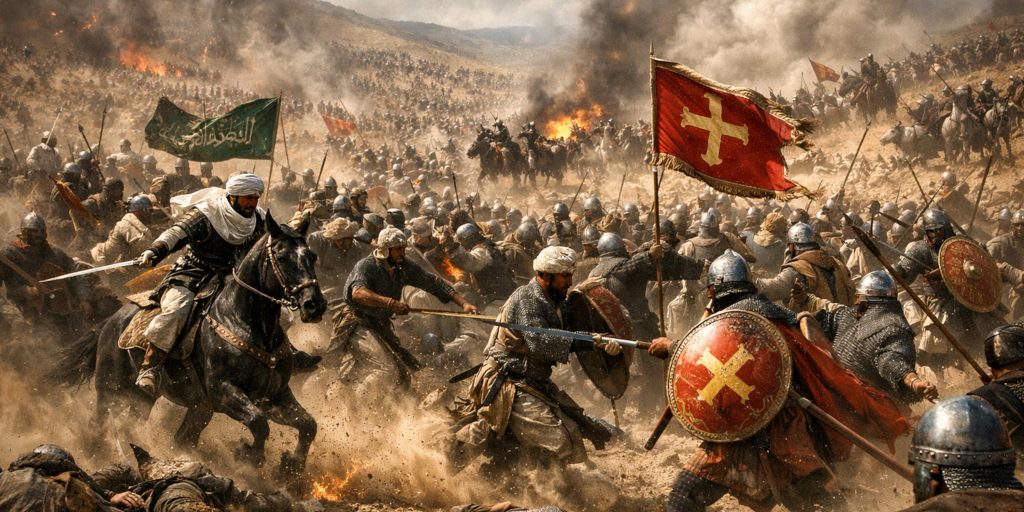
The Battle of Yarmouk was the defining catastrophe.
A Byzantine army under imperial commanders confronted the Rashidun Caliphate near the Yarmouk River. The result was a devastating defeat that shattered Byzantine control over Syria.
Contemporary chroniclers describe confusion, dust storms, collapsing formations and panicked retreats into ravines. Later Byzantine writers treated the defeat almost like divine punishment.
Syria was effectively lost after Yarmouk. Damascus, Antioch and Jerusalem eventually passed into Arab control.
The empire never fully recovered those territories.
Egypt and the Loss of the Grain Supply
Egypt fell shortly afterward.
The Arab conquest under Amr ibn al-As stripped Byzantium of one of its wealthiest provinces and a major grain source. Constantinople suddenly lost access to enormous agricultural revenues that had sustained imperial government for centuries.
One can almost hear Byzantine bureaucrats collectively sighing into their tax ledgers.
Alexandria eventually surrendered in 642. Byzantine attempts to retake Egypt failed.
The eastern Mediterranean was being remade.
Constantinople Under Threat
The First Arab Siege of Constantinople (674–678)
The Umayyad Caliphate pushed directly toward Constantinople in the late seventh century.
Arab fleets established forward bases and attempted to choke the Byzantine capital through repeated assaults. The Byzantines responded with one of the most famous weapons in medieval history: Greek Fire.
This incendiary substance, projected from ships and siphons, terrified enemy fleets. Its exact composition remains unknown, though historians suspect petroleum-based compounds mixed with chemical additives.
Arab chroniclers and Byzantine writers alike describe enemy ships erupting into flame across the sea.
The siege ultimately failed.
The survival of Constantinople mattered enormously. Had the city fallen in the seventh century, European history would likely look very different.
The Second Arab Siege of Constantinople (717–718)
The second great siege came under the Umayyads and was even more dangerous.
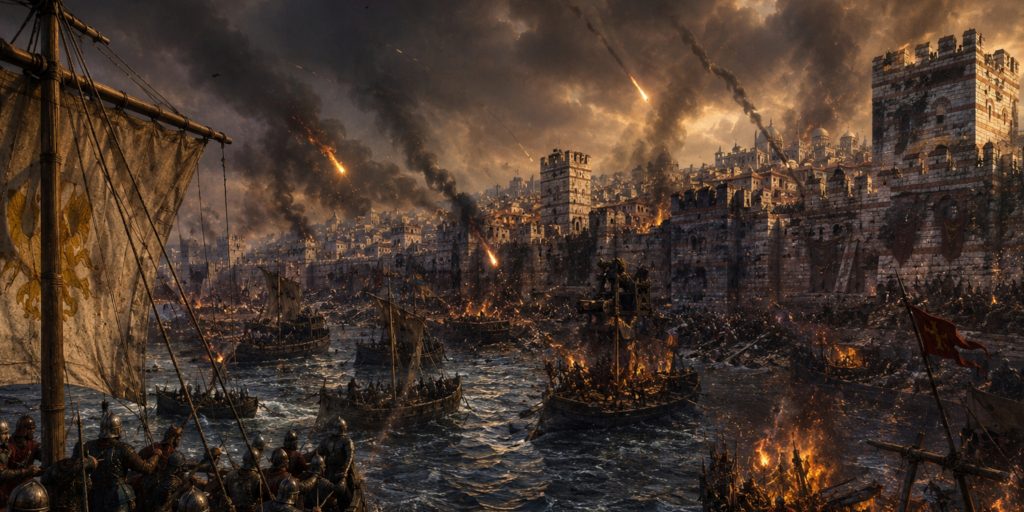
A massive Arab force under Maslama ibn Abd al-Malik surrounded Constantinople by land and sea. Emperor Leo III organised the defence while the city’s walls, fleets and harsh winter conditions punished the attackers relentlessly.
Bulgarian forces also struck the besieging army.
Famine, disease and naval losses destroyed the Arab campaign. The surviving forces withdrew in disaster.
The siege became one of the great defensive victories of medieval history.
Major Battles of the Byzantine–Arab Wars
Battle of Yarmouk (636)
| Aspect | Details |
|---|---|
| Location | Near the Yarmouk River |
| Byzantine Commander | Vahan and imperial generals |
| Arab Commander | Khalid ibn al-Walid |
| Outcome | Decisive Arab victory |
| Significance | Loss of Syria |
Battle of the Masts (655)
| Aspect | Details |
|---|---|
| Location | Eastern Mediterranean |
| Byzantine Commander | Emperor Constans II |
| Arab Commander | Muawiya ibn Abi Sufyan |
| Outcome | Arab naval victory |
| Significance | Rise of Islamic naval power |
The Battle of the Masts shocked the Byzantines because it demonstrated that Arab fleets could challenge imperial naval dominance directly.
For centuries, the Romans had treated the Mediterranean almost like a private lake. Suddenly somebody else had brought ships.
Siege of Constantinople (717–718)
| Aspect | Details |
|---|---|
| Byzantine Commander | Leo III |
| Arab Commander | Maslama ibn Abd al-Malik |
| Outcome | Byzantine victory |
| Significance | Preserved Byzantine survival |
Battle of Akroinon (740)
| Aspect | Details |
|---|---|
| Byzantine Commander | Leo III and Constantine V |
| Arab Commander | Umayyad generals |
| Outcome | Byzantine victory |
| Significance | Slowed Arab raids into Anatolia |
Akroinon marked an important psychological shift. The Byzantines were no longer simply surviving. They were beginning to fight back effectively.
Frontier Warfare and Raids
Much of the conflict consisted not of gigantic battles but seasonal raiding.
Arab and Byzantine armies crossed the Taurus Mountains repeatedly, burning settlements, seizing livestock, capturing prisoners and wrecking fortifications. Frontier life became brutal and militarised.
Entire regions of Anatolia were depopulated or reorganised into defensive military districts known as themes.
These themes became central to Byzantine survival. Soldiers were settled on military lands and expected to defend local territory directly. It was practical, cheaper than maintaining giant standing armies and rather less glamorous than old Roman parade culture.
Still, it worked.
Byzantine Military Adaptation
The Byzantine military transformed during these wars.
The old late Roman field armies evolved into more flexible regional forces. Cavalry became increasingly important, especially heavily armoured horsemen capable of rapid frontier response.
Common Byzantine Weapons
- Spathion swords
- Kontarion lances
- Composite bows
- Lamellar armour
- Round and kite shields
Common Arab Weapons
- Saif swords
- Spears and lances
- Composite bows
- Mail armour
- Light cavalry equipment
Arab armies proved highly mobile and effective in desert and frontier campaigning. Byzantine armies increasingly focused on defensive depth, fortified zones and strategic counterattacks.
Naval Warfare
The wars were also fought at sea.
Arab fleets challenged Byzantine control of the Mediterranean repeatedly. Cyprus, Rhodes, Crete and Sicily became battlegrounds.
The Byzantine navy remained formidable for centuries, particularly because of Greek Fire, but Arab naval power steadily expanded through shipyards in Egypt and Syria.
By the ninth century, Muslim naval raiders could strike deep into Byzantine territory.
Mediterranean coastal populations learned to fear sails appearing on the horizon.
The Abbasid Period
The rise of the Abbasid Caliphate shifted the nature of the conflict.
Large-scale invasions became less common than during the Umayyad era, though warfare never disappeared. Diplomacy, prisoner exchanges and limited campaigns became more frequent.
The Byzantines gradually stabilised their position.
By the tenth century, emperors such as Nikephoros II Phokas and John Tzimiskes launched major reconquests into Syria and northern Mesopotamia.
The balance of power had begun to change.
Byzantine Recovery in the Tenth Century
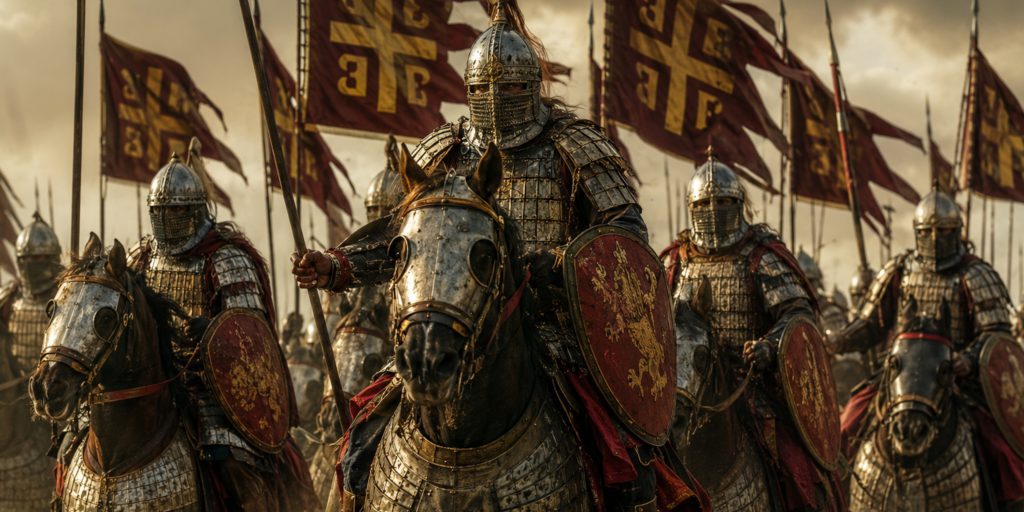
The tenth century saw a remarkable Byzantine resurgence.
Imperial armies recaptured territories, defeated frontier emirates and restored Byzantine prestige across parts of the eastern Mediterranean.
Important Byzantine Victories
- Recapture of Crete in 961
- Campaigns in Cilicia
- Recovery of Antioch in 969
- Victories against Hamdanid forces
The empire looked powerful again, though the recovery would not last forever.
History has a habit of charging interest on old victories.
Archaeology and What Survives
Archaeology has revealed enormous evidence for the Byzantine–Arab frontier wars.
Key Archaeological Discoveries
- Fortified frontier settlements in Anatolia
- Burn layers from raids and sieges
- Byzantine military seals and coins
- Arab and Byzantine weapon fragments
- Naval remains in eastern Mediterranean waters
- Rebuilt city walls from repeated invasions
Excavations at sites such as Amorium have revealed destruction layers associated with Arab attacks, including evidence of fire, collapsed fortifications and civilian displacement.
Coins from both empires found in frontier zones demonstrate how warfare and trade often existed side by side.
The frontier was violent, but it was also surprisingly interconnected.
Contemporary Quotes
Theophanes the Confessor
“The Saracens overran the land like a devouring flame.”
Theophanes wrote from a deeply Byzantine perspective, but his horror at the speed of the conquests remains striking.
Arab Tradition on Khalid ibn al-Walid
“I am the sword of Allah drawn against the unbelievers.”
Whether perfectly authentic or polished by later tradition, the quote captures how early Islamic commanders were remembered.
Emperor Leo III
“The City is guarded by God.”
Byzantine writers often framed Constantinople’s survival as divine favour. Given the scale of the sieges, one can understand why.
Religion and Ideology
Religion shaped every aspect of the conflict.
Both sides increasingly interpreted victories and defeats through spiritual language. Byzantine emperors portrayed themselves as defenders of Christian civilisation, while Islamic rulers viewed expansion through the framework of jihad and divine mission.
Yet reality was more complicated than simple religious war.
Trade continued. Diplomacy occurred constantly. Prisoners were exchanged. Mercenaries crossed cultural boundaries. Border regions developed mixed identities and shared customs.
Even during brutal warfare, medieval societies remained interconnected.
The End of the Long Conflict
By the eleventh century, the nature of the struggle changed again.
The rise of the Seljuk Turks gradually replaced the old Arab frontier dynamic. Byzantine attention shifted toward new threats in Anatolia.
The Arab caliphates themselves fragmented politically.
The Byzantine–Arab Wars never truly ended with a single treaty or final battle. They slowly evolved into different conflicts across a transformed medieval world.
Legacy
The wars shaped the medieval Mediterranean more than almost any other conflict of the era.
They determined:
- The survival of Byzantium
- The spread of Islam across the Middle East and North Africa
- The militarisation of Anatolia
- Mediterranean naval development
- Trade and cultural exchange routes
- The political map inherited by the Crusades
Without these wars, medieval Europe, the Islamic world and the eastern Mediterranean would have developed very differently.
The Byzantine Empire emerged scarred but astonishingly resilient. Arab civilisation emerged expansive, wealthy and intellectually vibrant.
Both sides changed each other permanently.
And somewhere along the Taurus frontier, exhausted soldiers on both sides probably spent centuries wondering whether this year’s raid might finally be the last one.