Swords are often presented as though they belong in a well-behaved family tree. They do not. Their history is closer to a crowded hedgerow: forms branch, overlap, disappear, return and acquire names that their original owners may never have recognised.
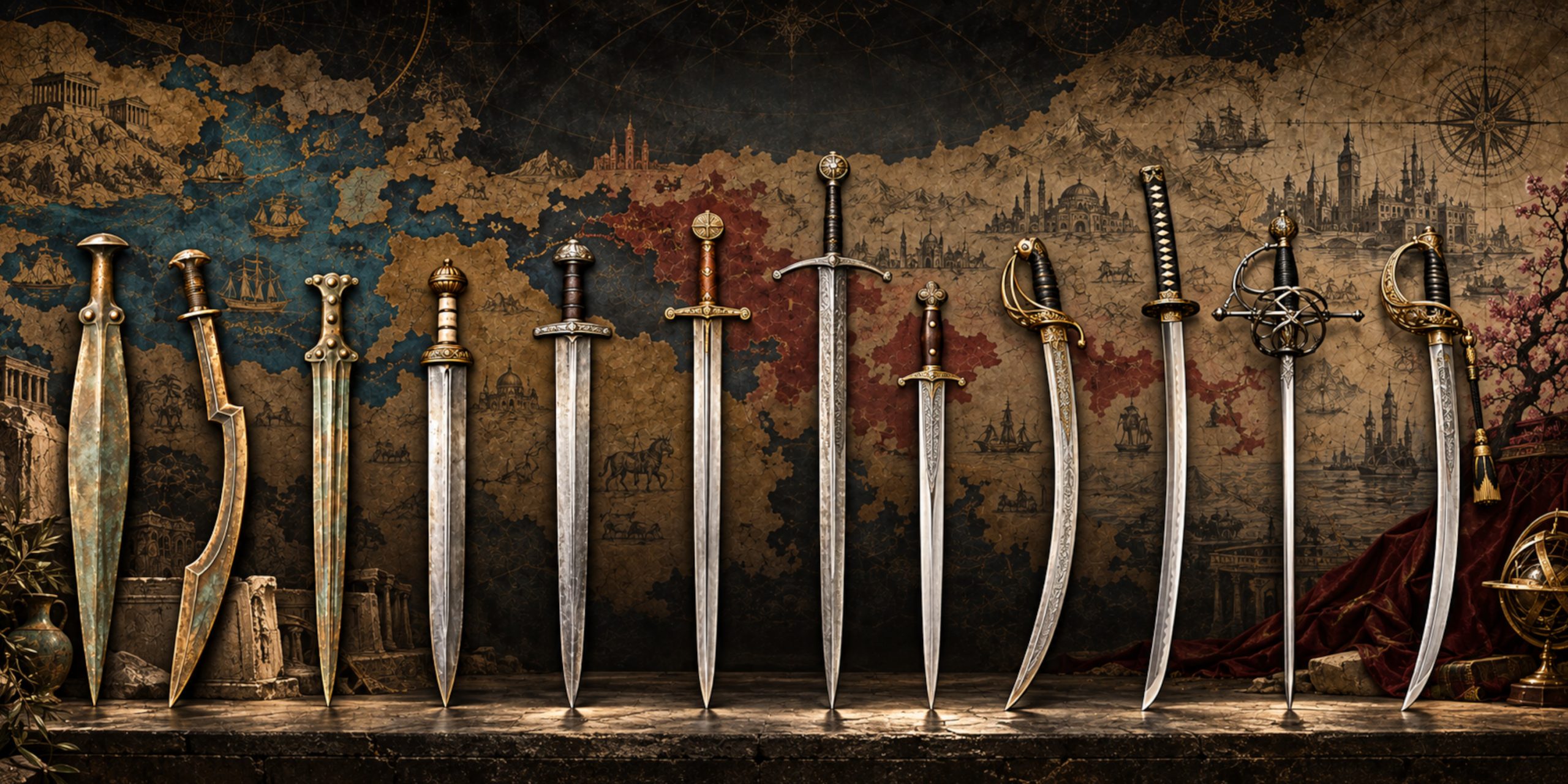
This guide is designed to accompany a visual sword types chart. It places major forms within broad periods and regions, while explaining what changed and why. The dates are necessarily approximate. A new sword did not arrive across an entire continent on a Tuesday morning, and older weapons did not vanish simply because a curator later gave the next century a different label.
The chart graphics can be added beneath each period heading, with regional colour coding carried consistently through the page.
How to read the sword types chart
A sword can be classified by its blade, hilt, intended use, place of manufacture or the culture that adopted it. These categories frequently overlap.
A longsword, for example, is chiefly defined by its long grip and two-handed use. A rapier is associated with a particular family of long, pointed civilian swords and fencing traditions. A tulwar is identified by a recognisable South Asian hilt form as much as by its blade. Meanwhile, the word broadsword has meant different things in different periods and is now used with cheerful imprecision online.
The chart therefore uses familiar historical and modern names, but it should be read as a guide rather than a set of iron laws. Original terminology is used where it is established. Later archaeological or collecting terms are identified as such.
Sword chart key
| Feature | What it indicates |
|---|---|
| Straight blade | Usually optimised for thrusting, cutting or both |
| Curved blade | Commonly favours a drawing cut, particularly from horseback |
| Single edge | One principal cutting edge, sometimes with a sharpened back edge |
| Double edge | Two sharpened edges meeting at the point |
| One-handed | Designed primarily for use in one hand |
| Hand-and-a-half | Long grip allowing one-handed or two-handed use |
| Two-handed | Intended mainly for both hands |
| Civilian | Worn for personal defence, duelling, status or dress |
| Military | Intended or widely issued for warfare |
| Ceremonial | Made principally as an emblem, honour or ritual object |
Bronze Age sword types, roughly 1600 to 800 BCE
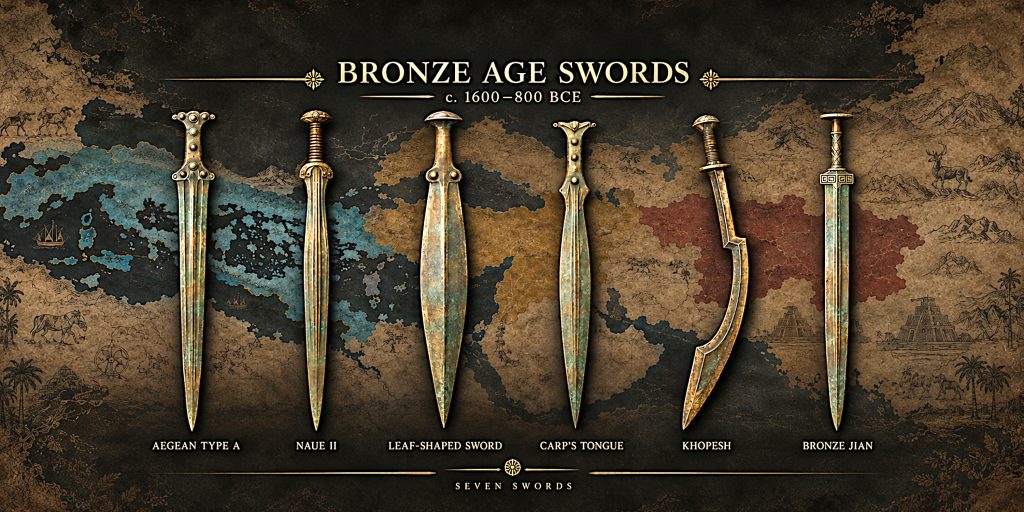
The first true swords emerged when metalworkers became capable of casting bronze blades long enough to function independently of the spear or dagger. Early examples could be vulnerable where blade met hilt, so changes in tang and grip construction mattered enormously. A sword that leaves its handle during a fight is an unusually direct critique of the smith.
Europe and the Mediterranean
Aegean Type A and Type B swords were long Bronze Age weapons associated with the Mycenaean world. Their narrow blades were capable of thrusting, although later Aegean forms became shorter and more robust.
Naue II swords, named through modern typology, appeared in the later Bronze Age and spread widely across Europe and the Mediterranean. Their flanged hilts held organic grip plates, while their comparatively practical blade form proved remarkably influential.
Leaf-shaped swords broadened around the middle of the blade before narrowing towards the point. Found in several European traditions, they offered useful cutting mass without abandoning the thrust. The British Museum’s Late Bronze Age sword shows the characteristic cast bronze blade and flanged grip construction.
Carp’s tongue swords belonged to the Atlantic Bronze Age, particularly western Europe. Their long, narrow points suggest an emphasis on thrusting alongside cutting.
Near East and Egypt
Khopeshes had sickle-shaped blades derived from earlier axes. The outer curve formed the cutting edge, while the hooked profile could also control shields or limbs. By the New Kingdom, the khopesh had become both a weapon and a potent royal emblem.
Straight bronze swords also existed across Anatolia, the Levant and Mesopotamia. Regional styles varied, and the familiar curved khopesh should not be allowed to represent every Bronze Age sword east of the Mediterranean.
South and East Asia
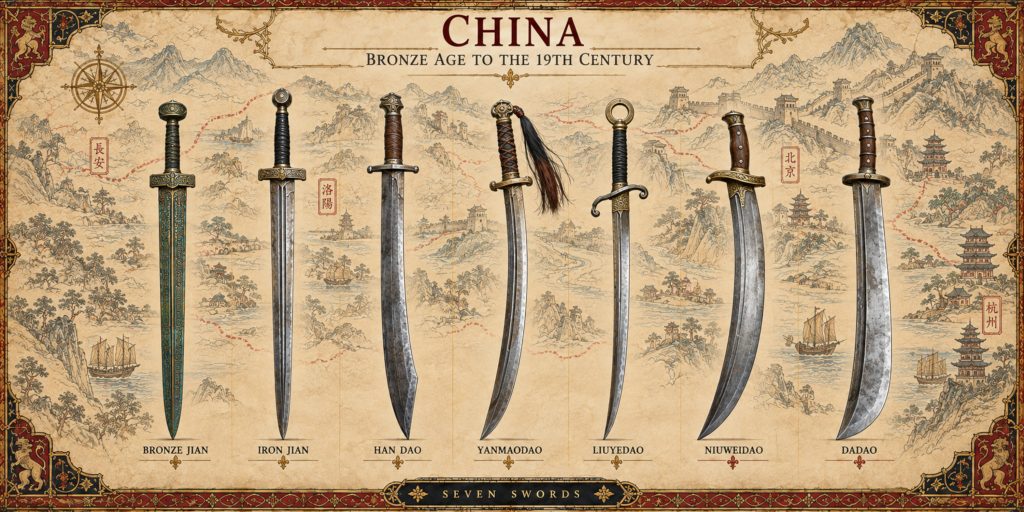
Bronze swords appeared in northern China during the Shang period and became more prominent under the Zhou. Early jian were straight and double-edged, initially short but increasingly refined as bronze casting reached a very high standard.
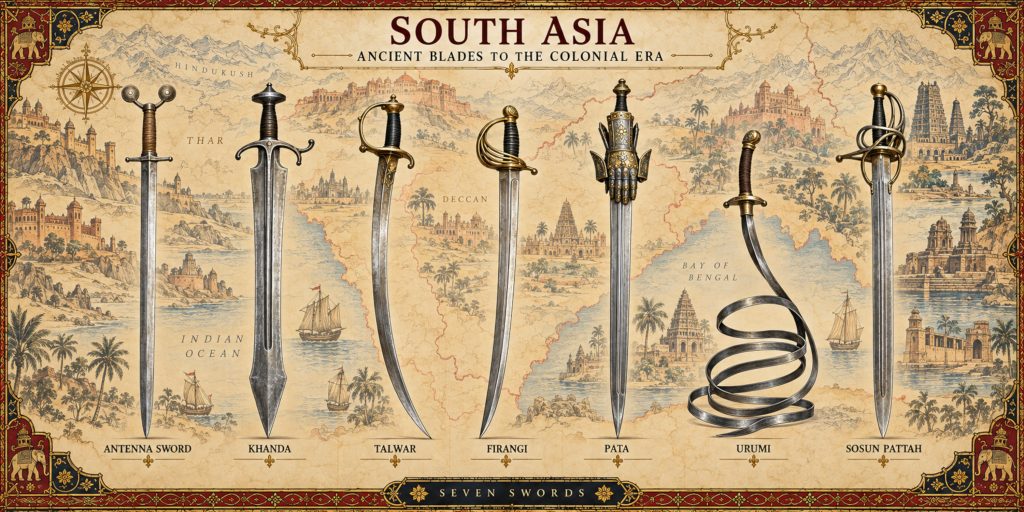
In South Asia, copper and bronze blades included weapons sometimes described as antenna swords, although classification and function remain debated. The surviving evidence is less obliging than a modern chart would like.
“The bronze-clad Achaeans closed in battle.”
Homer, Iliad, in translation
Homer’s poems were composed after much of the world they evoke, but their repeated attention to bronze weapons preserves the memory of an age in which metal, rank and heroic identity were closely bound.
Iron Age and Classical sword types, roughly 800 BCE to 500 CE
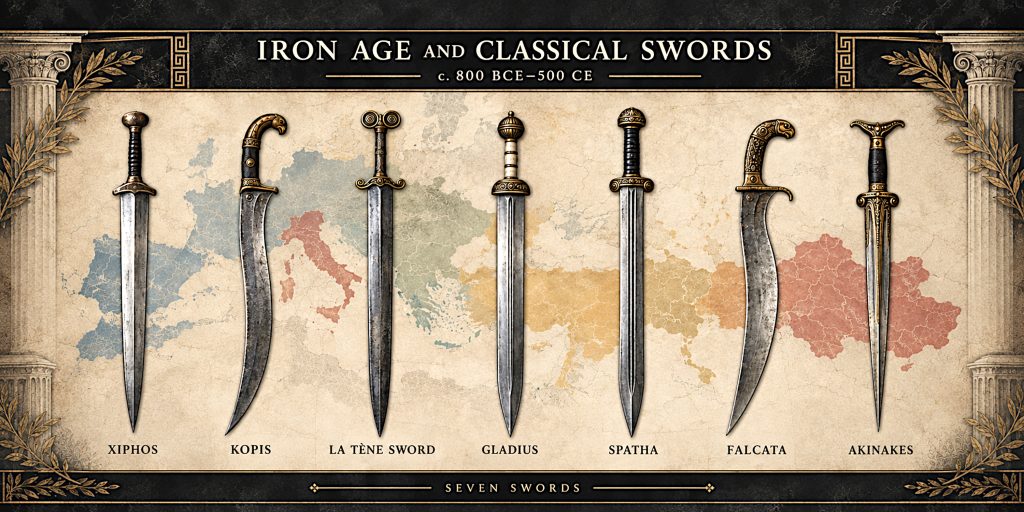
Iron did not instantly produce better swords than bronze. Early iron could be inconsistent, and the real advance lay in centuries of improving smelting, forging and heat treatment. By the Classical period, sword forms were increasingly tied to organised military systems.
Greece, the Balkans and the eastern Mediterranean
Xiphos: A short, straight, double-edged Greek sword with a leaf-shaped or gently tapering blade. It served as a secondary weapon for hoplites when the spear was lost or fighting became too close for comfort, which in a phalanx was often very close indeed.
Kopis: A forward-curving, single-edged cutting sword. Its weight sat towards the front of the blade, giving it a forceful chopping action.
Machaira: An ancient Greek term applied to large knives and single-edged swords. Modern writers often treat the machaira and kopis as neatly separate forms, but ancient usage was not so disciplined.
Thracian rhomphaia: A long, curved, single-edged weapon used with one or two hands. Closely related to the shorter Dacian falx, it delivered formidable downward cuts and helped prompt Roman modifications to armour during the Dacian Wars.
The Celtic world and Iron Age Europe
La Tène swords were straight, usually double-edged weapons associated with Celtic-speaking societies across Iron Age Europe. Their length and construction changed over time. Many were effective cutting swords, while decorated scabbards reveal that display and identity mattered alongside function.
Anthropoid-hilted swords had grips shaped in stylised human form. They were often short and richly made, suggesting prestige as well as practical use.
Rome and Iberia
Gladius Hispaniensis: The early Roman sword associated by ancient writers with Iberian influence. It combined cutting edges with a strong point.
Mainz and Fulham gladii: Modern archaeological categories for early imperial Roman short swords. Both had tapered points, with variation in waist and blade profile.
Pompeii gladius: A later form with straighter parallel edges and a shorter triangular point. Its simple geometry was well suited to large-scale military production.
Spatha: A longer straight sword first associated strongly with cavalry and later adopted widely by infantry. By late antiquity it had displaced the gladius as the dominant Roman sword and helped shape early medieval European weapons.
Falcata: An Iberian single-edged sword with a forward-curving blade, though some examples carried a second edge near the point. Its inward curve concentrated force in the cut.
Polybius described Roman soldiers carrying a sword that was “excellent for thrusting, and has two cutting edges”, a concise reminder that Roman swordsmanship cannot be reduced to the thrust alone.
Persia, Central Asia and the steppe
Akinakes: A short sword or long dagger used across the Achaemenid world and neighbouring steppe cultures. It was usually straight and worn suspended at the thigh. Court reliefs show that it also carried political and social meaning.
Parthian and Sasanian long swords: Long, straight blades suited to mounted warfare became important among Iranian cavalry elites. Their suspension systems influenced weapons across Eurasia.
China, Korea and Japan
Jian: The straight, double-edged Chinese sword matured in bronze and iron. It was capable of cut and thrust and later gained strong scholarly and cultural associations.
Dao: Initially a straight or only slightly curved single-edged weapon, the dao became particularly important for cavalry under the Han. The name covers a very broad family rather than one fixed profile.
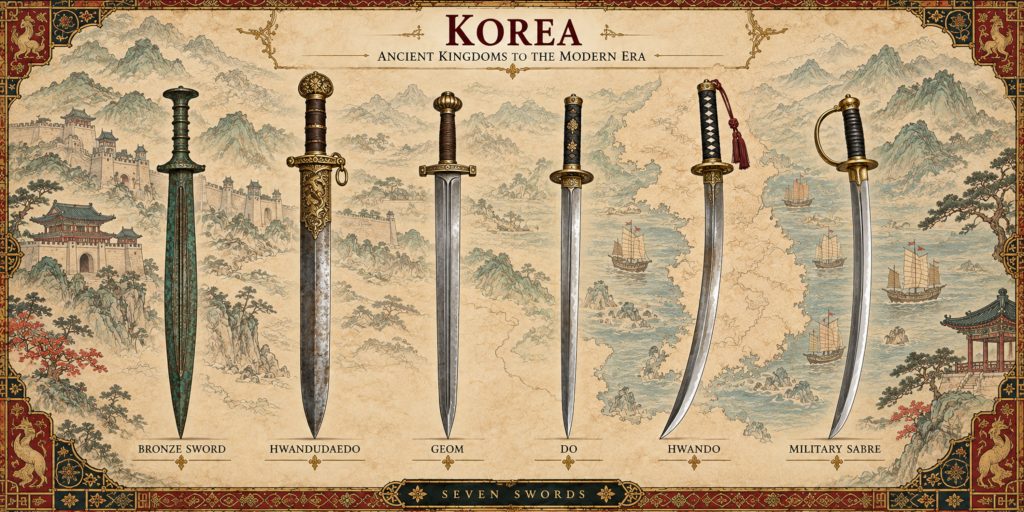
Hwandudaedo: Korean swords with ring pommels, used especially during the Three Kingdoms period. Some were functional military weapons; elaborate examples advertised rank.
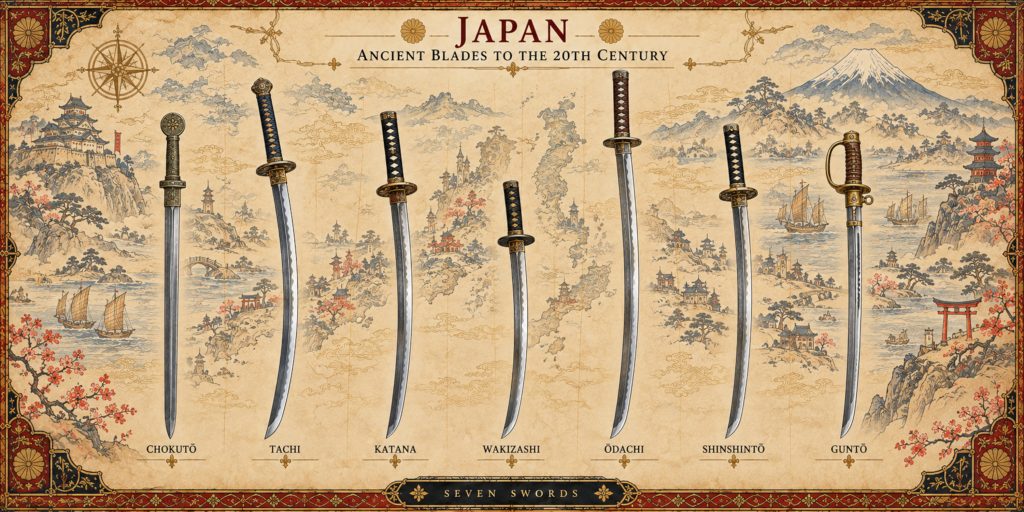
Chokutō: A modern Japanese term for straight, single-edged swords made before the widespread development of the curved tachi. Many show continental Asian influence in form and construction.
Early medieval sword types, roughly 500 to 1000
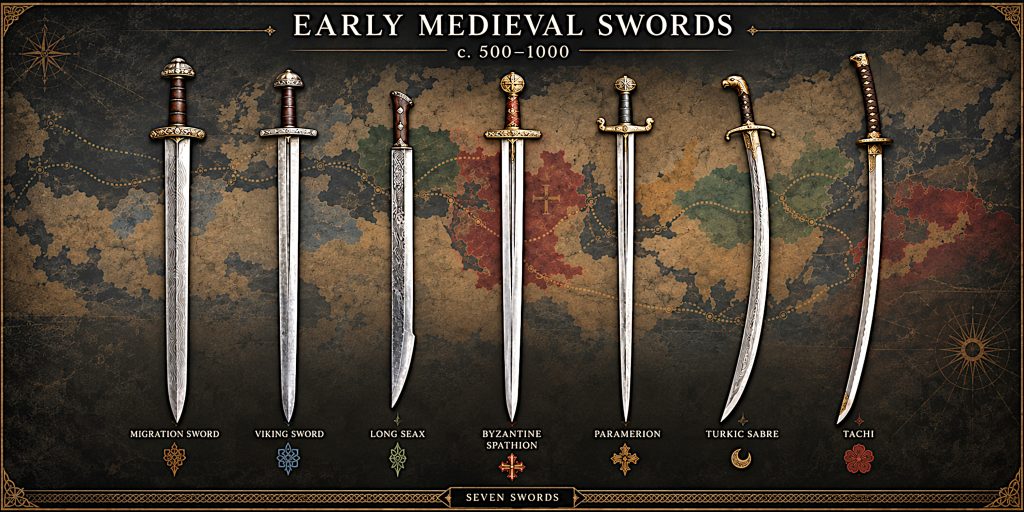
Across Eurasia, the early medieval sword was often an expensive object with a biography of its own. Blades travelled between regions, hilts were replaced, inscriptions advertised workshops or belief, and a fine weapon might outlive several owners.
Northern and western Europe
Migration-period swords: Developed from the late Roman spatha, these were straight, double-edged weapons with relatively short guards and often ornate hilts.
Viking Age swords: Broad-bladed, double-edged swords designed chiefly for one-handed use with a shield. Modern typologies divide their pommels and guards into many categories. The popular name is convenient, though these swords were used well beyond Scandinavia.
Ulfberht swords: Blades carrying variants of the inscription +VLFBERH+T. The name probably referred to a workshop tradition or brand rather than a single heroic smith hammering away for several centuries. Their metallurgy varies, and imitation inscriptions demonstrate that medieval branding attracted counterfeiters too.
Seaxes: Single-edged blades ranging from utility knives to sword-length weapons. The long seax belongs on a sword chart, while shorter examples sit more naturally among knives.
Byzantium and eastern Europe
Byzantine spathia: Straight, double-edged swords continuing Roman traditions.
Paramerion: A single-edged, usually curved Byzantine sidearm associated particularly with cavalry. It reflects the growing influence of steppe and eastern forms.
Islamic lands and Central Asia
Early Islamic swords were commonly straight and double-edged. The popular picture in which every medieval Muslim warrior carries a deeply curved scimitar belongs more to later art and stage costume than to the early caliphates.
Arab and Persian straight swords: Broad category for straight blades used during the first Islamic centuries, often with simple crossguards.
Turkic sabres: Curved, single-edged cavalry swords developed across the Eurasian steppe. Mobile warfare encouraged blades that cut efficiently from horseback, and these traditions would influence much of eastern Europe and the Islamic world.
South and East Asia
Khanda: An Indian straight, double-edged sword, often broadening towards the point. Later examples commonly have reinforced edges and distinctive basket hilts, but the tradition has deeper roots.
Tachi: A curved Japanese sword worn edge-down, strongly associated with mounted warriors. Its curvature and mounting differed from the later katana, although surviving blades were sometimes remounted in later centuries.
Chinese dao: Forms diversified, with cavalry sabres developing through contact among Chinese states and steppe peoples.
High and late medieval sword types, roughly 1000 to 1500
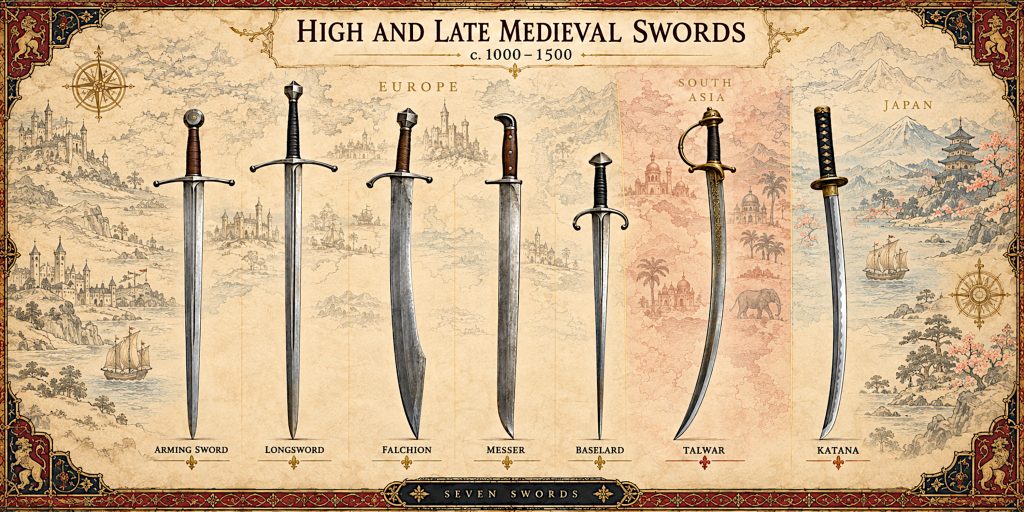
This period produced some of the most recognisable European sword forms, but the usual progression from arming sword to longsword is too simple. They coexisted, served different needs and changed alongside armour.
Western and central Europe
Arming sword: A one-handed, straight, double-edged sword normally used with a shield or buckler. Earlier examples tend towards broad cutting blades; later forms often carry more acute points for use against gaps in armour.
Longsword: A straight, double-edged sword with a grip long enough for two hands. It appeared in several proportions and blade types from the later thirteenth century onwards. Some were agile cut-and-thrust weapons; others were relatively stiff thrusters suited to armoured combat.
Bastard sword or hand-and-a-half sword: Flexible historical terms for swords whose grips and proportions sat between conventional one-handed and fully two-handed forms. Modern catalogues often draw firmer lines than medieval writers did.
Great sword: A broad description for unusually large swords. It should not automatically be treated as a synonym for every longsword or the later two-handed sword.
Falchion: A European single-edged sword, usually with a broad cutting blade. Surviving forms range from cleaver-like profiles to more slender curved examples.
Messer: A single-edged Central European weapon with knife-style hilt construction, typically including a slab grip and a side projection called a Nagel. The larger Kriegsmesser could be used with two hands.
Baselard: A short sword or long dagger recognised by its H-shaped hilt. It was widely carried in parts of western and central Europe from the thirteenth to fifteenth centuries and deserves more attention than it usually receives. Its position between dagger and sword is precisely why it belongs in a serious chart.
Cinquedea: A broad-bladed Italian civilian sidearm of the late fifteenth and early sixteenth centuries. Its name refers to a blade said to be five fingers wide at the base. Subtle it was not.
The Italian master Fiore dei Liberi wrote that he had studied the art of arms for “forty years and more”. His Fior di Battaglia, composed around 1409, shows the longsword used in and out of armour, with thrusts, cuts, grappling and half-sword techniques all belonging to the same martial system.
Iberia, the Balkans and eastern Europe
Jineta: An Iberian sword type with Islamic-influenced hilt forms, associated particularly with Nasrid Granada and Christian adoption of Andalusi style.
Conyers falchion and related cleaver forms: English survivals demonstrate that heavy single-edged swords were not confined to continental Europe.
Sabres: Curved cavalry swords grew increasingly common in Hungary, the Balkans, Rus territories and neighbouring regions through steppe and Ottoman influence.
Middle East and North Africa
Mamluk and Persian swords: Straight swords remained in use, while curved sabres became increasingly prominent among mounted forces.
Kilij: An Ottoman sabre with a curved blade, frequently widening near the point into a yelman. Mature forms offered powerful cutting ability without making the whole blade excessively heavy.
Nimcha: A North African sabre distinguished chiefly by its hilt, commonly with downturned quillons and protective side bars. Blades could be imported and rehilted locally.
South Asia
Talwar or tulwar: A broad family of South Asian swords, typically with a curved blade and disc pommel. Blade shape varied greatly, and European blades were sometimes fitted to Indian hilts.
Firangi: An Indian sword, usually with a long straight blade of European manufacture or style mounted in an Indian basket hilt. Its name is related to a term for foreigners, though the finished weapon was thoroughly embedded in South Asian use.
Khanda: Continued as an important straight sword, especially in elite and religious contexts.
East and Southeast Asia
Katana: A curved, single-edged Japanese sword generally worn edge-up through the sash. It developed from earlier tachi traditions and became especially prominent from the Muromachi period. “Samurai sword” is not a useful type name, since samurai used several kinds of sword.
Wakizashi: A shorter companion sword worn with the katana in later periods. Its legal and social role became particularly defined under the Tokugawa shogunate.
Ōdachi or nodachi: Exceptionally long Japanese swords. Some were battlefield weapons, while very large examples could be votive offerings.
Korean geom and do: Broad terms for double-edged swords and single-edged blades. Korean weapons drew upon local needs and exchanges with China, the steppe and Japan.
Dha or daab: A diverse family of mainland Southeast Asian single-edged swords, used across areas including modern Myanmar and Thailand. The term covers considerable regional variety.
Kampilan: A long, single-edged sword of the southern Philippines, recognisable by its flared point and elaborate hilt traditions.
Renaissance and early modern sword types, roughly 1500 to 1700
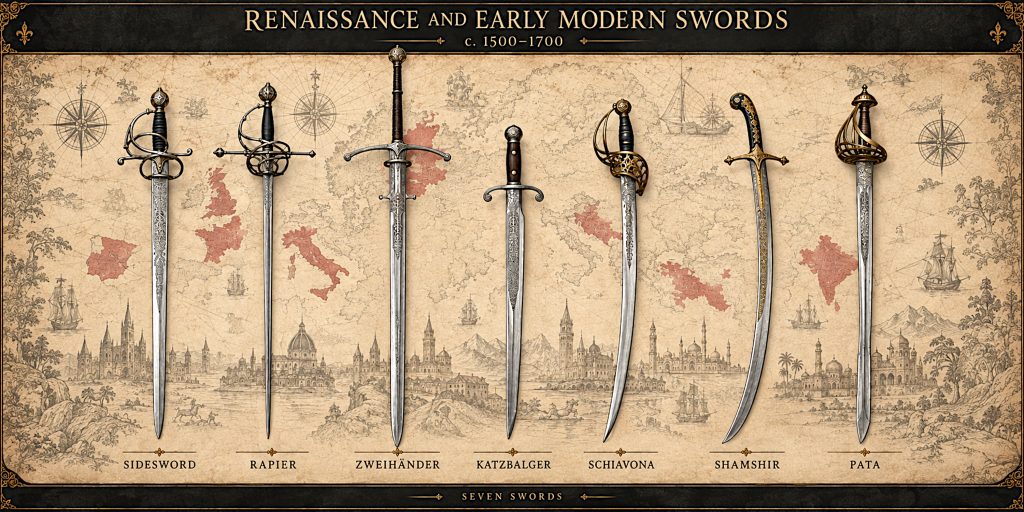
Firearms did not make the sword obsolete. Instead, swords became more specialised. Some served infantry formations, some cavalry, and others an increasingly elaborate culture of civilian fencing.
Europe
Sidesword: A modern English label for Renaissance cut-and-thrust swords known in Italy as spada da lato. They combined an effective edge and point with increasingly complex hand protection.
Rapier: A long, slender sword with a strong point and elaborate guard, worn chiefly as a civilian sidearm during the sixteenth and seventeenth centuries. Many rapiers could cut, even if the thrust dominated mature fencing systems. The Metropolitan Museum of Art describes the rapier as the principal civilian sidearm of the period and notes the variety and decoration of its guards.
Pappenheimer rapier: A form associated with pierced shell guards linked by bars, popular in the early seventeenth century.
Two-handed sword: Large infantry swords included the German Zweihänder, Iberian montante and Italian spadone. The terms belong to distinct traditions, although the weapons share scale and two-handed use. They could guard spaces, protect standards, oppose several attackers or serve in specialised battlefield roles.
Katzbalger: A short, broad sword associated with Landsknecht infantry. Its S-shaped or figure-eight guard is immediately recognisable.
Schiavona: A basket-hilted sword associated with troops from the eastern Adriatic in Venetian service. Its broad blade and intricate guard made it suitable for military use and impressive portraiture.
Mortuary sword: An English basket-hilted sword associated especially with the mid-seventeenth century. The name was applied later and may refer to supposed faces on the hilt, sometimes romantically linked with Charles I.
Scottish basket-hilted broadsword: A robust cut-and-thrust sword enclosed by a protective basket guard. The familiar form belongs largely to the seventeenth and eighteenth centuries rather than the age of William Wallace, however determined souvenir shops may be on the point.
George Silver argued in 1599 that “the sword hath the vantage against the rapier”. He was not an impartial observer, but his irritation reveals a genuine dispute about fashionable fencing, personal defence and foreign influence.
Ottoman, Persian and Arab regions
Kilij: Continued to develop as a powerful Ottoman cavalry sabre.
Shamshir: A deeply curved Persian sabre with a narrow blade and no pronounced widening near the tip. Its curvature favoured the drawing cut.
Saif: The Arabic word for sword rather than a single blade shape. Museum labels sometimes use it for Arab sabres, but historical examples include straight and curved weapons.
Yatagan: A short, forward-curving Ottoman blade without a conventional guard. It was used across the Balkans and Anatolia, especially from the later early modern period.
South Asia
Talwar: Remained one of the most widespread South Asian sword families.
Pata: A gauntlet sword in which the blade attaches to an arm-enclosing hilt. It was especially associated with western India and could be used on foot or horseback.
Urumi: A flexible, whip-like sword tradition from southern India. Its unusual blade demanded considerable skill and is best understood within its regional martial context, not as a fantasy weapon that somehow wandered into a museum.
Sosun pattah: A recurved South Asian sword whose blade bends forward near the point, combining distinctive geometry with varied hilt forms.
East and Southeast Asia
Katana and wakizashi: Became socially codified under Tokugawa rule, with mountings and wearing conventions expressing status as well as martial purpose.
Chinese jian: Continued as a straight double-edged sword associated with martial practice, officers and elite culture.
Chinese dao: Included the yanmaodao, with a mostly straight blade curving near the tip, and the more curved liuyedao, or willow-leaf sabre.
Niuweidao: The ox-tail sabre is strongly associated with the nineteenth century rather than the high age of imperial armies. It should be placed late on the chart, despite its frequent appearance in vaguely historical cinema.
Kris: A dagger or short sword from maritime Southeast Asia, with straight or wavy blades and deep ceremonial significance. Longer examples qualify for a broad sword chart, although the kris is normally treated as its own weapon category.
Cavalry, naval and regulation swords, roughly 1700 to 1900
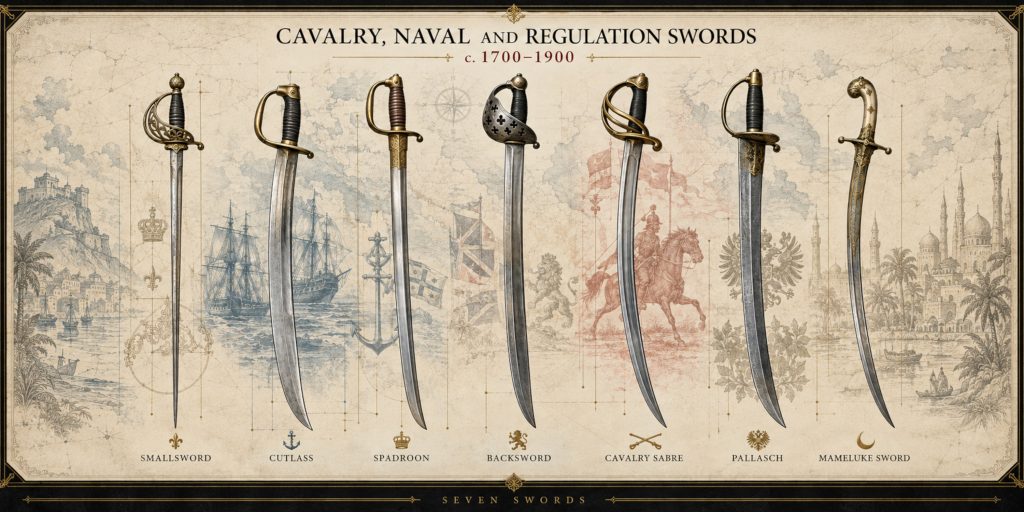
By the eighteenth century, European states increasingly regulated military sword patterns. Civilian smallswords became lighter and more refined, while cavalry demanded blades suited to mounted cuts, thrusts or a compromise between the two.
Europe and the Atlantic world
Smallsword: A light, stiff thrusting sword that developed from the rapier and became central to eighteenth-century gentlemanly dress and fencing. The Metropolitan Museum’s overview traces this shift towards a lighter weapon by about 1700.
Hanger: A short, usually curved sword used by infantry, hunters and sailors. Naval forms are often called cutlasses, although period naming was not perfectly consistent.
Cutlass: A short, broad-bladed naval sword with substantial hand protection. Its compact reach suited crowded decks and boarding actions.
Spadroon: A light, straight military sword with a cut-and-thrust blade, widely carried by officers. It is much abused by later commentators, sometimes fairly.
Backsword: A straight sword with one main cutting edge and a thick back. Basket-hilted examples were widely used in Britain.
Cavalry sabre: A broad category of curved, single-edged mounted swords. Light cavalry patterns generally favoured agility and cutting, while heavy cavalry weapons were often longer, straighter and designed to deliver a forceful thrust or cut.
Pallasch: A long, relatively straight single-edged cavalry sword associated with heavy cavalry in central and eastern Europe.
Mameluke sword: A European military fashion based loosely on Ottoman and North African sabres. It became particularly associated with senior officers and survives in ceremonial use.
Briquet: A short infantry sabre issued across several European armies, recognisable in many forms by its cast brass hilt.
The growth of pattern weapons makes dating easier, at least in theory. Official models were modified, copied, retained after replacement and carried far from their country of issue. Bureaucracy did not eliminate variety; it merely stamped numbers on it.
Africa
Africa contained many independent sword traditions as well as forms shaped by Mediterranean, Islamic and European exchange.
Kaskara: A straight, double-edged sword used in Sudan and neighbouring regions, with a crossguard and often a disc-shaped pommel. Its form recalls earlier Islamic straight swords, though surviving examples commonly date from the nineteenth century.
Takouba: A straight, double-edged sword associated particularly with Tuareg and other Saharan peoples. Its guard and hilt were often covered in leather, and imported European blades could be incorporated.
Shotel: An Ethiopian sword with a deeply curved blade, sharpened on one or both edges. Its pronounced curve supported hooking attacks around a shield.
Gurade: An Ethiopian curved sabre influenced in part by wider nineteenth-century military forms.
Ida and related Yoruba swords: West African single-edged swords existed in military, chiefly and ceremonial forms, often with regionally distinctive blades and scabbards.
Asia
Traditional sword families remained in use alongside imported blades and regulation military models. Japanese swords, Chinese dao, Indian talwars and Ottoman kilij did not freeze in time. Makers responded to new fashions, colonial armies, trade networks and changing forms of violence.
Modern and ceremonial swords, 1900 to the present
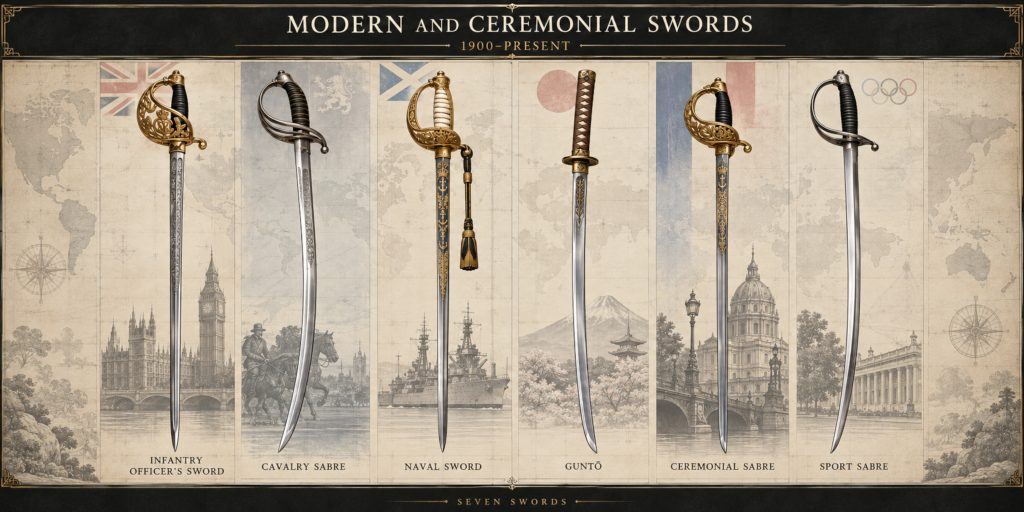
By the twentieth century, firearms had removed the sword from most front-line combat, but not from military life. Swords remained badges of commission, instruments of ceremony and, on occasion, weapons used in close combat.
Officer’s swords: Regulation patterns survived for parade and formal dress, including British infantry swords, cavalry sabres and naval swords.
Japanese guntō: Military swords carried by officers of imperial Japan. Some contained traditionally made blades, including older family blades remounted for service, while others were mass-produced military weapons. They should not all be described simply as katana.
Ceremonial sabres: Used by armed forces, academies and state guards across the world. Their design often preserves eighteenth- or nineteenth-century military fashion long after its practical purpose has faded.
Sporting weapons: The modern épée, foil and sabre descend from historical fencing traditions but are sporting implements governed by specialised rules. They belong on a descendant branch of the chart, not among battlefield swords.
The sword survives because it communicates authority with extraordinary efficiency. A pistol may be more practical, but it does rather spoil a parade uniform.
Sword types by region at a glance
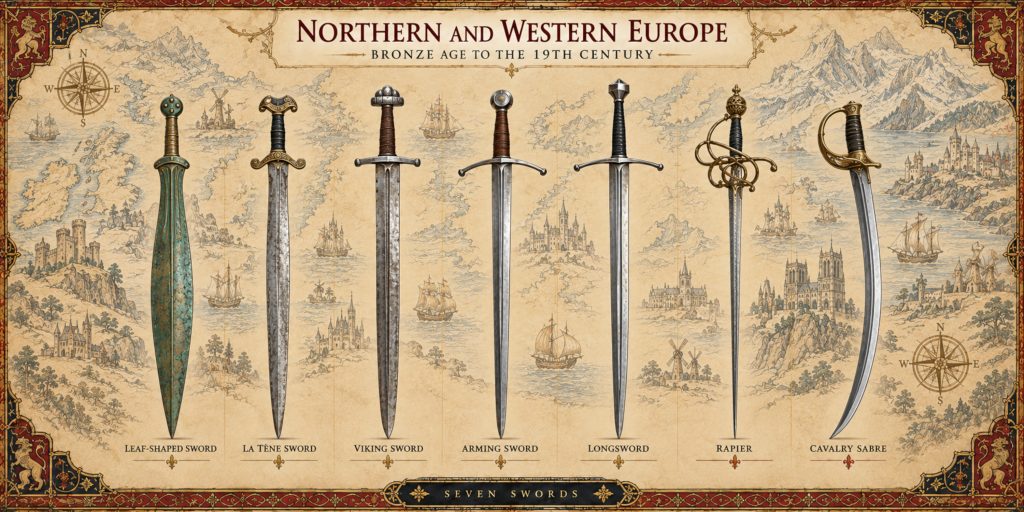
Northern and Western Europe
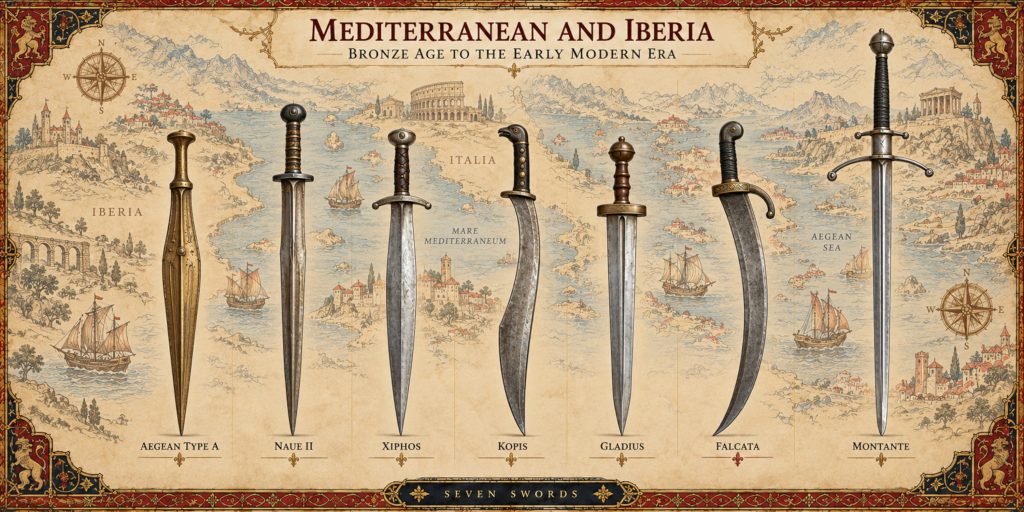
Mediterranean and Iberia
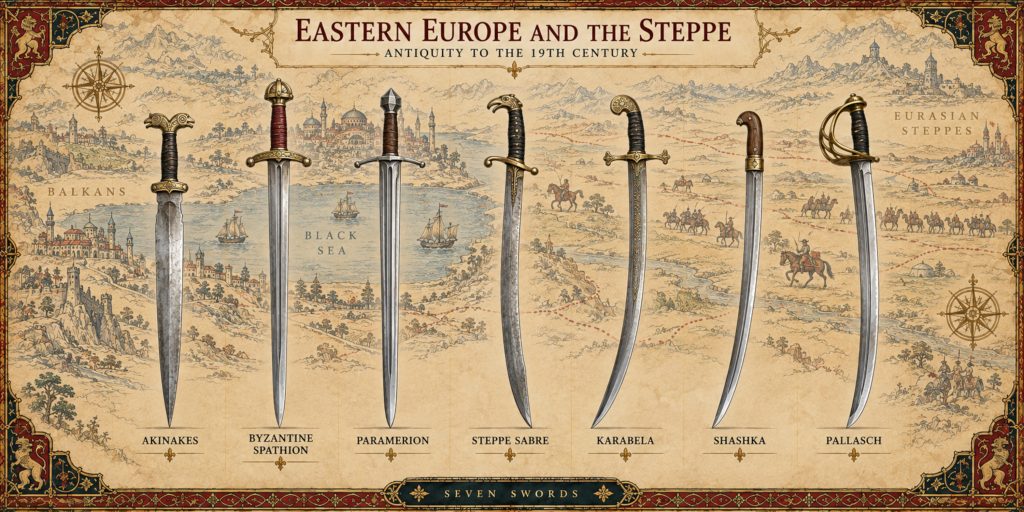
Eastern Europe and the Steppe
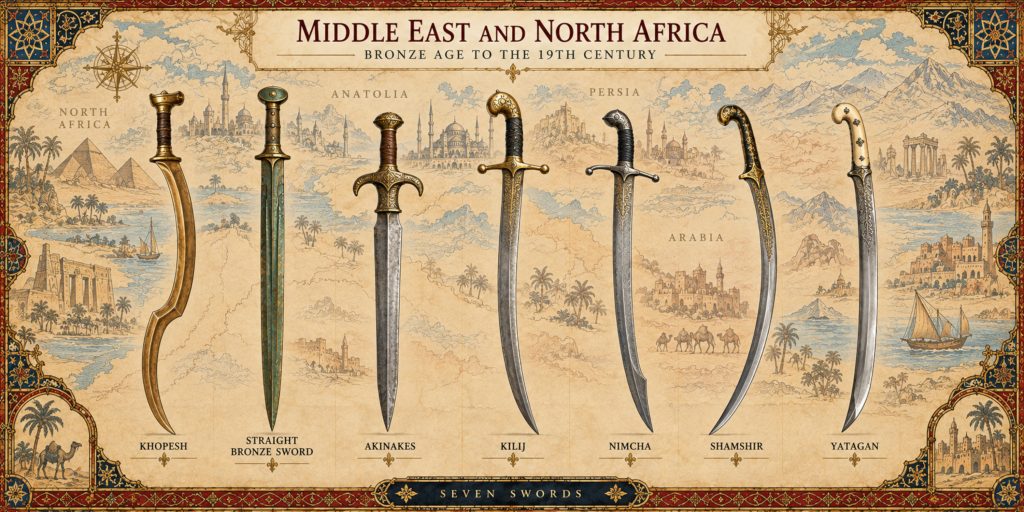
Middle East and North Africa
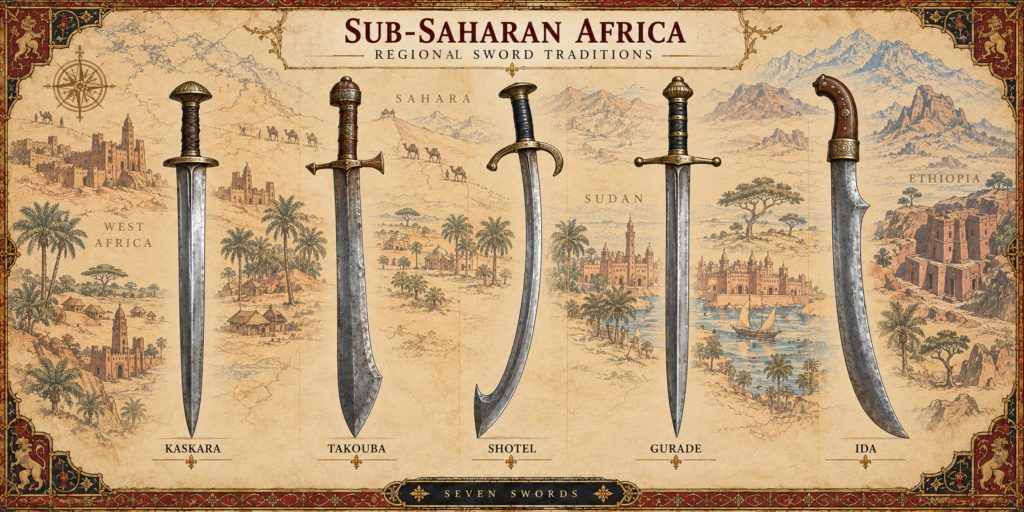
Sub-Saharan Africa
South Asia
China
Korea
Japan
Southeast Asia
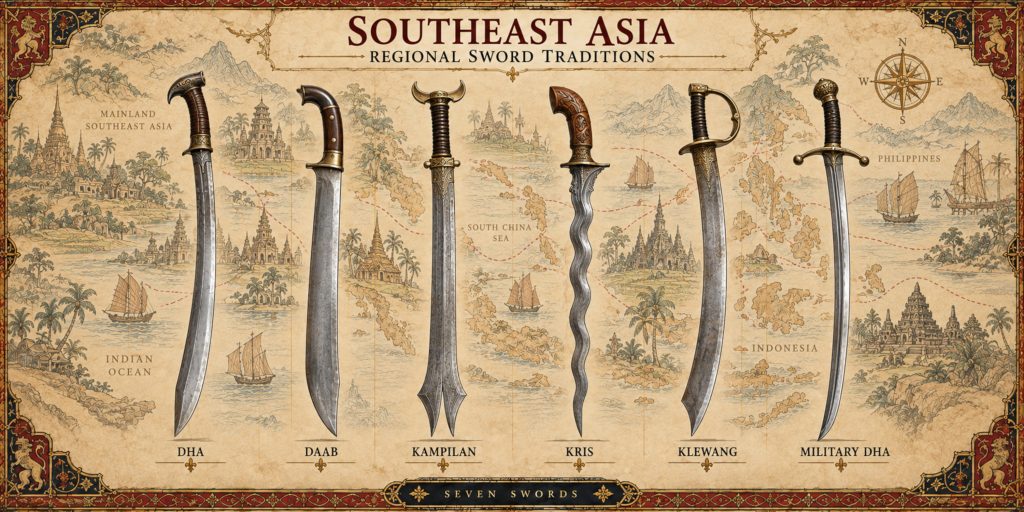
This condensed table is intended as the textual companion to the main graphic. Dates indicate broad periods of prominence, not the full lifespan of every surviving example.
| Region | Bronze and Iron Age | Classical and early medieval | High and late medieval | Early modern | Eighteenth and nineteenth centuries |
|---|---|---|---|---|---|
| Northern and western Europe | Leaf-shaped sword, carp’s tongue sword | La Tène sword, spatha, Migration sword, Viking sword, seax | Arming sword, longsword, falchion, Baselard | Sidesword, rapier, two-handed sword, basket-hilt | Smallsword, backsword, spadroon, cavalry sabre, cutlass |
| Mediterranean and Iberia | Aegean swords, Naue II, khopesh | Xiphos, kopis, gladius, falcata | Jineta, arming sword, falchion | Montante, rapier, sidesword | Smallsword, briquet, regulation sabre |
| Eastern Europe and the steppe | Bronze straight swords | Akinakes, long sword, early dao and sabre forms | Steppe sabre, Byzantine paramerion | Polish and Hungarian sabres, karabela | Shashka, pallasch, cavalry sabre |
| Middle East and North Africa | Khopesh, straight bronze sword | Akinakes, Persian long sword, early Islamic straight sword | Kilij, early curved sabres, nimcha | Shamshir, kilij, saif, yatagan | Kilij, shamshir, nimcha, military sabres |
| Sub-Saharan Africa | Regional iron blades emerge at different dates | Local straight and curved blades | Sahelian and Ethiopian traditions | Kaskara, takouba, shotel, ida | Kaskara, takouba, gurade, imported military swords |
| South Asia | Copper and bronze sword forms | Early iron swords, straight blades | Khanda, talwar, firangi | Talwar, pata, urumi, sosun pattah | Talwar, firangi, colonial regulation swords |
| China | Bronze jian | Jian, straight dao, Han cavalry dao | Jian, dao families | Yanmaodao, liuyedao, jian | Niuweidao, dadao, military sabres |
| Korea | Bronze and early iron swords | Hwandudaedo, geom, do | Geom and do traditions | Hwando and military sabres | Traditional and regulation swords |
| Japan | Bronze and iron imported forms | Chokutō, early tachi | Tachi, katana, wakizashi, ōdachi | Katana, wakizashi | Shinshintō swords, military and police sabres |
| Southeast Asia | Bronze blades and regional precursors | Early single-edged swords | Dha, kampilan, kris traditions | Dha, daab, kampilan, kris | Klewang, dha, military and local swords |
Regions without a conventional metal sword tradition
A global chart should also acknowledge where the category fits poorly.
In pre-Columbian Mesoamerica, the macuahuitl used obsidian blades set into a wooden body. It could deliver terrible cuts, but it was not a metal sword and worked according to a different material logic. Calling it an “Aztec sword” is convenient for comparison, provided the distinction is stated.
Across Oceania, cultures developed formidable wooden clubs, paddle clubs and edged weapons using stone, bone or shark teeth. These may occupy a similar tactical space to short swords, but forcing them into a European-derived category conceals more than it reveals.
In North America, metal swords largely arrived through European colonisation and trade. Indigenous edged weapon traditions were shaped by different materials and combat systems. The absence of a local sword family is not an absence of sophisticated weaponry.
Why sword shapes changed
Armour
Broad cutting blades worked well against lightly protected targets. As mail and plate armour developed, stronger points and stiffer blade sections became increasingly valuable for attacking gaps. This did not make cuts irrelevant. It changed where, when and how they were used.
Mounted warfare
Curved blades can maintain contact through a drawing cut and are less likely than some straight forms to catch during a mounted strike. Yet cavalry also used straight thrusting swords to excellent effect. Horsemen disagreed about the ideal blade for centuries, often in print and at exhausting length.
Shields and secondary weapons
One-handed swords worked naturally with shields, bucklers, daggers or reins. When armour reduced dependence on the shield, longer grips and two-handed methods became more practical in parts of Europe. Elsewhere, shields and one-handed swords remained successful for very good reasons.
Civilian carry
Urban life and duelling encouraged long thrusting rapiers, then lighter smallswords. Fashion mattered. A sword was a weapon, but it was also something worn in public, judged by one’s peers and liable to collide with the furniture.
Metallurgy and trade
Blade forms depended on available materials and expertise. They also travelled. German blades entered African and Indian hilts; Japanese smiths absorbed continental techniques; steppe sabres influenced states from China to Hungary. A sword’s blade and hilt might have different geographical histories.
What the chart cannot show
No single illustration can capture differences in balance, distal taper, edge geometry, heat treatment or flexibility. Two swords with similar outlines may handle very differently. Nor can a regional label establish where every component was made.
The Royal Armouries collection is useful precisely because thousands of objects can be compared rather than reduced to one ideal example. Typologies help organise that evidence, but the object should always have the final word.
The chart is therefore a starting point. It shows the large families and historical relationships. Individual sword articles can then examine construction, use and surviving evidence in the detail each weapon deserves.
Frequently asked questions
How many types of sword are there?
There is no agreed total. The answer changes according to whether variants, local names, hilt forms and official military patterns are counted separately. Hundreds of named forms exist, but many overlap or describe branches within a broader family.
What is the oldest type of sword?
The earliest objects generally accepted as swords are long bronze blades from the fourth and third millennia BCE, including examples from Arslantepe in Anatolia. Whether every early long blade should be called a sword remains a matter of definition.
What is the difference between a longsword and a broadsword?
A longsword normally has a grip made for two-handed use. “Broadsword” has been used historically and popularly for several broad-bladed swords, especially basket-hilted military weapons. The terms describe different features and are not opposites.
Is a katana a type of sabre?
In very broad morphological terms, a katana is a curved, single-edged sword and can be compared with sabres. Historically, however, it belongs to a distinct Japanese tradition with its own construction, mountings and methods of use. Calling it simply a sabre loses useful information.
Were medieval swords heavy?
Most practical swords were carefully balanced and lighter than film props suggest. Weight varied by type, but a typical one-handed medieval sword often weighed around one to one and a half kilograms. Large two-handed swords could be heavier, though still made to move.
Did curved swords cut better than straight swords?
Curvature can assist a drawing cut, but cutting performance also depends on edge geometry, mass distribution, sharpness, technique and target. Straight swords can be excellent cutters, while curved swords can possess effective points. Shape creates tendencies, not magical rules.
A final note from the historian’s desk
Sword history becomes more interesting once the neat evolutionary ladder is discarded. The rapier did not “improve” the longsword in any universal sense, nor did the sabre replace every straight blade because curvature was inherently superior. Each answered a particular mixture of armour, tactics, law, status, riding practice and fashion.
That is what a good sword types chart ought to reveal. Across four thousand years, smiths repeatedly solved similar problems in different ways. Some produced blades of austere efficiency. Others added gold, inscriptions, animal heads and enough guard furniture to alarm a chandelier. Both belong to the history.