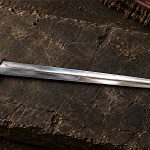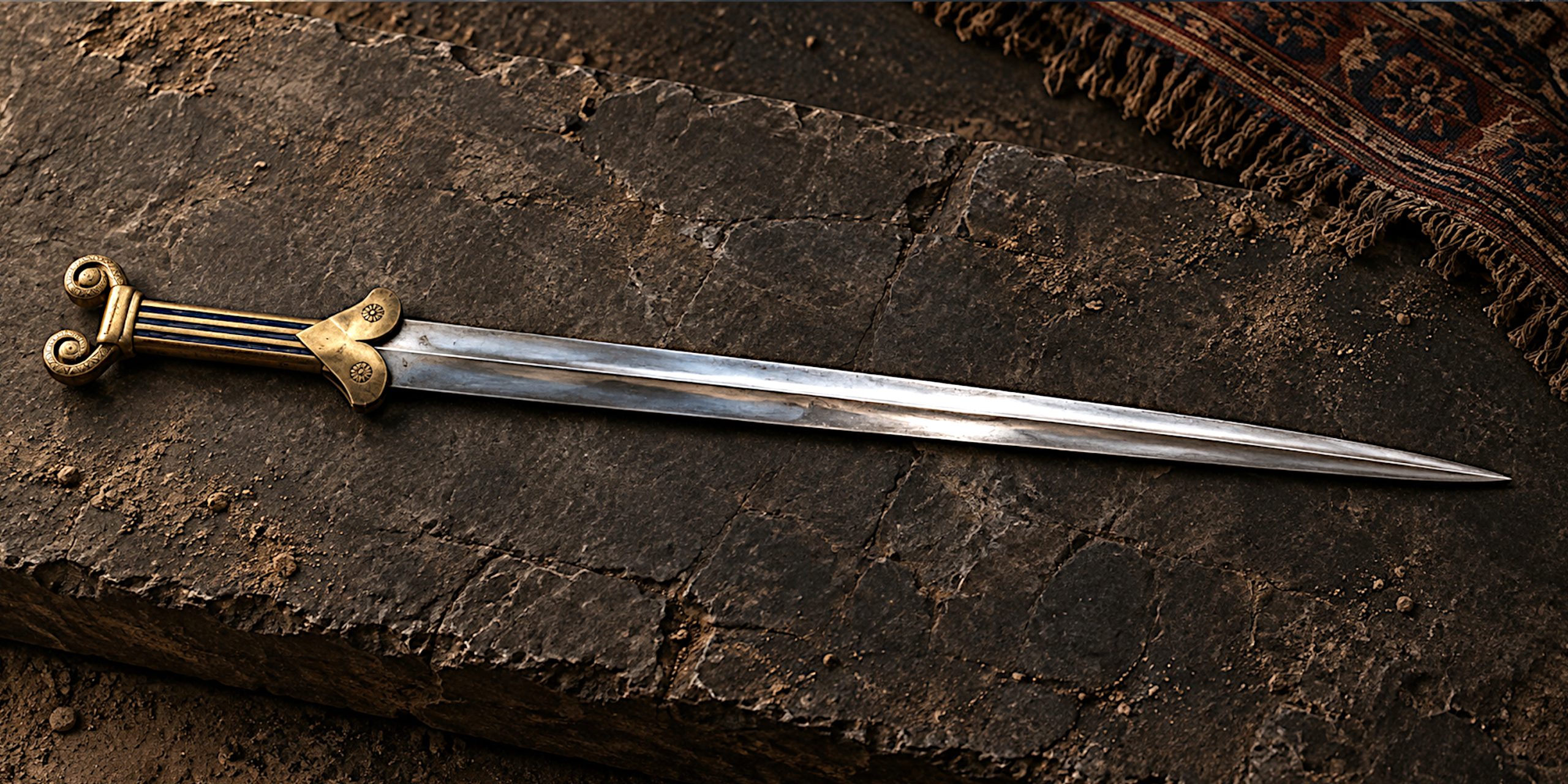
The akinakes, also written acinaces or akinak, was a compact edged weapon associated with the horse-riding cultures of the Eurasian steppe and the armies of the Achaemenid Persian Empire. Usually classed somewhere between a long dagger and a short sword, it combined a straight double-edged blade with a distinctive guard and pommel. Its modest length suited warriors who needed a sidearm that would not become an iron nuisance while riding.
The name is Greek rather than the weapon’s original native term. Greek and Roman authors used forms of akinakes for eastern short swords and daggers, but surviving artefacts show considerable regional variation. There was no single regulation model stamped out for every Scythian or Persian soldier.
What makes the weapon important is its reach. Versions appear across a broad territory stretching from the northern Black Sea and Central Asia into Iran and the western provinces of the Persian Empire. In Achaemenid art, the akinakes could also carry social and political meaning. A richly mounted weapon was not merely a useful blade. It was an object worn at court, presented as a gift and displayed as evidence of rank.
Akinakes Specifications
Dimensions varied by date, culture and intended use. The figures below describe common archaeological examples rather than a rigid standard.
| Feature | Typical form |
|---|---|
| Weapon class | Long dagger or short sword |
| Overall length | Commonly about 35 to 60 cm |
| Blade length | Often about 25 to 50 cm |
| Blade form | Straight, tapered and usually double-edged |
| Point | Acute point suited to thrusting |
| Blade material | Bronze in some early forms, with iron increasingly dominant |
| Guard | Compact bar, lobed, heart-shaped or animal-influenced forms |
| Grip | Short, designed for one-handed use |
| Pommel | Bar-shaped, antenna-like, crescentic or regionally distinctive |
| Scabbard | Wood, leather or metal components, sometimes richly decorated |
| Usual suspension | At the belt, commonly on the right side in Achaemenid imagery |
| Principal users | Scythians, Medes, Persians and other Iranian or steppe peoples |
Identifying features
- A short, straight blade with two cutting edges
- A narrow or triangular blade profile ending in a strong point
- A compact guard that protects the hand without projecting far from the body
- A short grip and clearly formed pommel
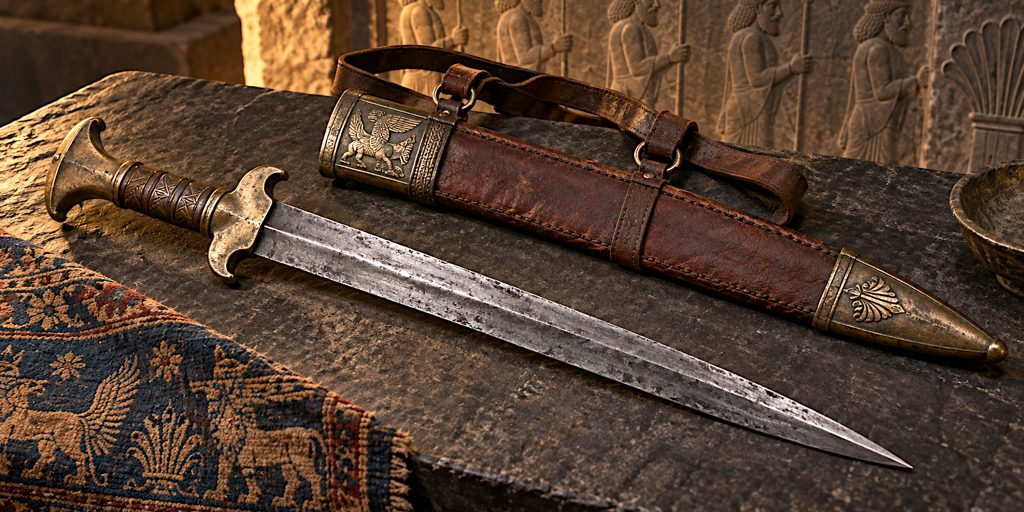
- A fitted scabbard, sometimes with a broad upper lobe or decorative terminal
- Animal-style ornament on some Scythian pieces
- Gold, silver or elaborate relief decoration on elite and ceremonial Persian examples
The famous Persian form is often recognised as much by its scabbard as by the blade. Reliefs show it suspended close to the body, with a broad decorative upper section and a lower end that could be tied to the thigh. That arrangement reduced movement while walking or riding.
History and Evolution

Origins on the Eurasian steppe
The early development of the akinakes is closely connected with mounted communities of the Eurasian steppe during the early first millennium BC. Short swords were well suited to cavalry and mobile warfare. A rider could carry one without the scabbard striking the horse or tangling with other equipment.
Early forms included bronze and iron weapons. Iron gradually became the more practical choice for combat blades, although bronze remained useful for fittings and decorative components. Scythian examples frequently have visually emphatic guards and pommels, sometimes shaped with paired lobes, antennae or stylised animal heads.
The term Scythian covers a wide and culturally varied world. It should not be treated as a single nation with one royal armoury and a standard sword pattern. Archaeologists classify several akinakes types according to blade, guard, grip and pommel design, and their distribution reveals contact between communities rather than simple ownership by one people.
Adoption by the Medes and Achaemenid Persians
Iranian peoples adopted and adapted steppe weapon forms before and during the rise of the Achaemenid Empire in the sixth century BC. Under the Achaemenids, the akinakes became especially visible in royal art.
Figures on reliefs from Persepolis wear short swords at the belt. The weapon appears among members of the royal entourage, guards and representatives of imperial peoples. Its presence in formal imagery suggests more than battlefield utility. It had become part of the visual language of service, status and proximity to power.
The Greek historian Herodotus repeatedly uses akinakes when discussing Persian weapons and royal gifts. He records that Xerxes cast an akinakes into the Hellespont as an offering after ordering the waters punished. Whatever one thinks of the story’s theatrical detail, it shows that a Greek audience could recognise the weapon as distinctly Persian and suitably valuable for a king.
Regional variation across the empire
The Achaemenid Empire incorporated people with their own military traditions. Consequently, weapons identified as akinakes can differ substantially:
- Plain iron examples were functional sidearms.
- Scythian pieces often carried strong steppe design features.
- Persian court weapons could have ornate scabbards and precious-metal fittings.
- Provincial versions blended local workmanship with imperial fashion.
- Some short weapons labelled akinakes by dealers may belong to another dagger or short-sword tradition.
This last point deserves emphasis. The name is commercially attractive, and not every ancient-looking short blade with a T-shaped pommel is securely identified.
Decline and transformation
The akinakes did not disappear on a single date. Weapon forms altered as political power, armour and cavalry practice changed. Longer swords and different dagger types became prominent in the Hellenistic and later Iranian worlds. The short eastern sidearm nonetheless remained an influential concept, while the old name survived in Classical literature.
How the Akinakes Was Used
The blade geometry supports both thrusting and cutting, although surviving corroded weapons cannot tell us precisely how every example handled. The acute point and compact length made close thrusts practical. Double edges also allowed short cuts without rotating the wrist to present a particular edge.
Likely roles included:
- A secondary weapon when a spear, bow or longer weapon was lost or impractical
- A close-combat sidearm for mounted warriors
- A personal defence weapon worn at the belt
- A status object in courtly or ceremonial settings
- A diplomatic or royal gift
It should not be imagined as the main weapon of every Persian infantryman. Achaemenid forces relied heavily on bows, spears and shields, while equipment varied across an exceptionally diverse empire. The akinakes was one part of that system.
Advantages and Disadvantages
| Advantages | Disadvantages |
|---|---|
| Compact and comfortable to carry on foot or horseback | Considerably less reach than a full-length sword |
| Quick to draw in confined conditions | Limited authority in the cut compared with longer, heavier blades |
| Strong thrusting potential at close range | Small guard provides modest hand protection |
| Double edge permits attacks from either direction | Short grip leaves little room for changes of hand position |
| Useful as a dependable secondary weapon | Poor choice against an opponent who can maintain distance |
| Could serve as both weapon and symbol of rank | Elaborate elite fittings could add cost without improving combat value |
The akinakes made sense as part of a wider set of weapons. It did not need to out-reach a spear or out-cut a longer sword. Its job was to remain conveniently at the warrior’s side until close-range trouble arrived, which trouble had an unfortunate habit of doing.
Akinakes Compared with Similar Weapons
| Weapon | Typical length | Blade character | Principal distinction |
|---|---|---|---|
| Akinakes | About 35 to 60 cm overall | Straight and usually double-edged | Steppe and Iranian sidearm closely associated with Scythian and Achaemenid cultures |
| Greek xiphos | Often about 45 to 60 cm blade | Double-edged, commonly leaf-shaped | Longer infantry sword designed for thrusts and forceful cuts |
| Persian kopis | Commonly longer than an akinakes | Single-edged and forward-curving | More powerful chopping weapon with different handling |
| Roman pugio | Often about 20 to 30 cm blade | Broad, pointed and double-edged | Military dagger of the Roman world, generally shorter and differently hilted |
| Parazonium | Short sword or long dagger | Straight and double-edged | Greco-Roman weapon strongly linked with rank and artistic symbolism |
| Sica | Variable short blade | Single-edged and curved | Curved Balkan and Thracian weapon suited to attacks around a defence |
Akinakes and xiphos
The xiphos offered greater reach and, in its broader forms, a more authoritative cut. The akinakes was easier to wear while mounted and occupied less space. The comparison reflects different tactical priorities rather than a simple contest with one obvious winner.
Akinakes and kopis
The kopis placed mass forward and favoured powerful cuts. The lighter, straighter akinakes was handier in close quarters and better aligned for a direct thrust. A mounted warrior could value either, but they solved different problems.
Akinakes and pugio
Both were compact military sidearms, yet they belonged to different periods and visual traditions. The Roman pugio often had a broad blade and elaborate scabbard, while the akinakes generally retained a short-sword profile and eastern suspension system.
The Akinakes in Art and Written Sources
Achaemenid reliefs are essential evidence because many excavated iron blades survive in poor condition. At Persepolis, short swords appear carefully positioned at the wearer’s side. The scabbards, suspension arrangements and decorative details tell us how the weapon formed part of elite dress.
Classical authors provide the name and occasional context, but their accounts need care. Greek writers described Persian customs for Greek readers and did not produce modern technical catalogues. A reference to an akinakes does not always reveal the exact length, metallurgy or hilt form of the weapon concerned.
Useful evidence comes from combining:
- Excavated blades and fittings
- Secure archaeological context
- Relief sculpture and other visual art
- Ancient written references
- Metallurgical and conservation analysis
- Comparison with weapons from neighbouring regions
Legacy
The akinakes remains one of the most recognisable weapons of the ancient Iranian and Scythian worlds. Its legacy rests in several areas:
- It demonstrates how weapons travelled between steppe societies and settled empires.
- It reveals the practical influence of mounted warfare on sidearm design.
- It became a visible badge of office, loyalty and elite identity in Achaemenid art.
- Its decorated scabbards preserve important examples of Persian and Scythian craftsmanship.
- It provides evidence for the movement of artistic motifs, metalworking methods and military fashions across Eurasia.
Modern illustrations often turn every Persian warrior into a scimitar-wielding figure. The akinakes is a useful correction. Achaemenid swords could be straight, compact and closely related to the military traditions of the steppe.
Where to See an Akinakes
Displays rotate and objects may be removed for conservation, so check with the museum before travelling specifically to see one.
| Museum or site | Location | What to look for |
|---|---|---|
| British Museum | London, UK | An Achaemenid iron sword identified by the museum as an akinakes, plus reliefs and material from ancient Iran |
| National Museum of Iran | Tehran, Iran | Achaemenid and Iron Age weapons, including exceptionally rich Persian material |
| The State Hermitage Museum | St Petersburg, Russia | Scythian weapons and elite grave goods from the Eurasian steppe |
| National Museum of Kazakhstan | Astana, Kazakhstan | Saka and steppe weaponry relevant to the wider akinakes tradition |
| Persepolis | Fars Province, Iran | Relief sculpture showing members of the Achaemenid court and guards wearing short swords |
| J. Paul Getty Museum, Getty Villa | Pacific Palisades, USA | Ancient Mediterranean and Near Eastern material, with relevant weapons appearing in the collection or changing displays |
The British Museum’s Achaemenid sword record is particularly useful because the object is explicitly identified as the type the Greeks called an akinakes. Its Ancient Iran gallery provides the broader cultural setting.
Collectors’ Guide
What can be bought?
The market falls into three very different categories.
| Category | Broad price guide | What the buyer receives |
|---|---|---|
| Decorative reproduction | £80 to £300 | Display piece, often loosely based on an ancient design |
| Historically researched reproduction | £300 to £1,500 or more | Better materials, documented model and potentially functional construction |
| Genuine ancient example | Commonly several thousand pounds and potentially far more | Archaeological object requiring rigorous provenance and legal documentation |
These bands are indicative rather than a valuation. Reproduction prices depend on the maker and specification. Ancient-object prices can vary sharply according to condition, provenance, rarity, decoration and legal history.
Published auction evidence
Publicly accessible results are inconsistent, and many databases conceal the hammer price behind a subscription. One documented auction listing for a Scythian iron akinakes with a bronze scabbard carried an estimate of £4,000 to £6,500 in 2022. The listing described it as dating to approximately 600 to 400 BC. That figure was an estimate, not proof of the final sale price. View the archived auction listing.
Other iron examples have appeared in antiquities auctions, including weapons roughly 30 to 48 cm long, but publicly visible records often withhold both estimate and result. This makes confident market averages difficult. A buyer should be suspicious of any guide presenting a neat price curve for a market this small and opaque.
What determines value?
- A documented ownership history extending back before modern export restrictions
- A legal export licence where one was required
- Secure identification by an independent specialist
- Archaeological context, if lawfully documented
- Original blade, guard, grip and pommel surviving together
- An original scabbard or documented fittings
- Rare decoration, inscriptions or precious-metal work
- Stable condition with limited modern restoration
- Publication in a recognised catalogue or scholarly work
- An established auction house or reputable specialist dealer
Warning signs
- Provenance described only as an “old European collection” without names, dates or documents
- A certificate supplied solely by the seller, with no independent examination
- Heavy cleaning that removes patina or obscures restoration
- Perfectly sharp edges on a supposedly excavated iron weapon
- Style, corrosion and construction that do not agree with one another
- A rare royal or gold attribution offered at an implausibly low price
- Pressure to complete a private transaction quickly
- No clear account of when and where the object left its country of origin
Legal and ethical checks
Ancient weapons are cultural objects, not simply antiques with an unusually pointed profile. Laws vary by source country, destination and date of export. Before buying:
- Ask for the full provenance in writing.
- Request copies of export and import documents.
- Check the relevant national cultural-property laws.
- Search stolen-art and law-enforcement databases.
- Obtain an independent condition and authenticity report.
- Confirm the auction house’s return policy if attribution is challenged.
- Keep every invoice, catalogue entry and piece of correspondence.
The UNESCO 1970 Convention is an important reference point, but a date before 1970 does not automatically make an object lawful. National ownership laws may be older, and the burden remains on the buyer to establish a clean history.
Buying a reproduction
For most collectors, a good reproduction offers more pleasure and considerably less legal peril. Ask the maker:
- Which museum object or archaeological publication was used as the model?
- Are the dimensions taken from a specific original?
- Is the blade bronze, mild steel or hardened high-carbon steel?
- Is the construction suitable for display, controlled cutting or reenactment?
- Is the scabbard historically based or a modern improvisation?
- Are the edge and point supplied blunt under UK law and event rules?
Avoid swinging an antique, and do not conduct cutting tests with a valuable reproduction unless the maker designed it for that purpose. Even a short sword can make a very long visit to Accident and Emergency.
Frequently Asked Questions
Was the akinakes Persian or Scythian?
Both labels are relevant, but neither tells the whole story. The weapon family has strong roots in the steppe world and was adopted, adapted and given new status within Median and Achaemenid Persian culture.
Was it a sword or a dagger?
It could occupy either category. Short examples function as daggers, while longer specimens qualify as short swords. Ancient terminology did not always observe modern museum classifications.
Was every akinakes made of iron?
No. Bronze examples and bronze fittings are known, while iron became widely used for practical blades. Elite weapons could incorporate gold, silver and richly decorated scabbards.
Which side was it worn on?
Achaemenid art often shows the weapon on the right side. Suspension arrangements held it close to the body, sometimes with a lower attachment to control the scabbard.
Did Persian cavalry use it?
Mounted warriors could use it as a convenient secondary weapon, but it should not be presented as the sole or universal cavalry sword of the Persian Empire.
Are genuine examples legal to own in the UK?
Ownership may be legal when the object was lawfully acquired and imported, but each item’s history matters. Cultural-property, import, export and criminal laws can apply. Obtain professional legal and specialist advice before purchasing an excavated weapon.