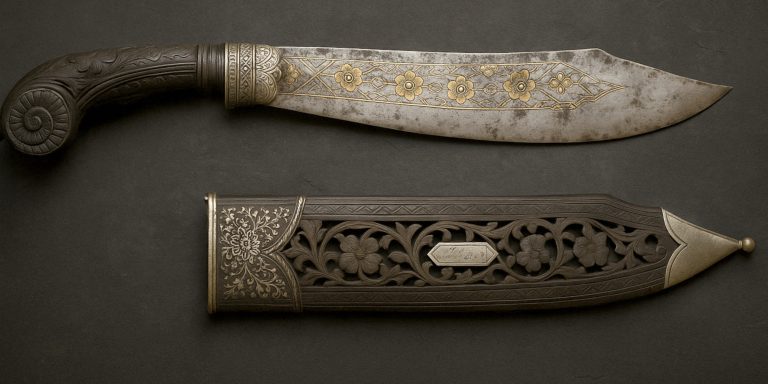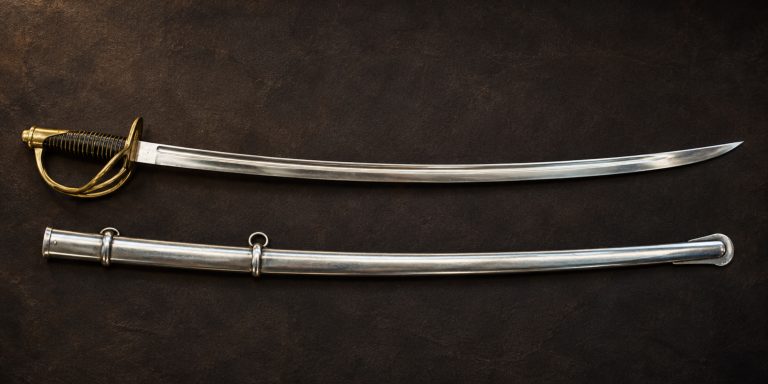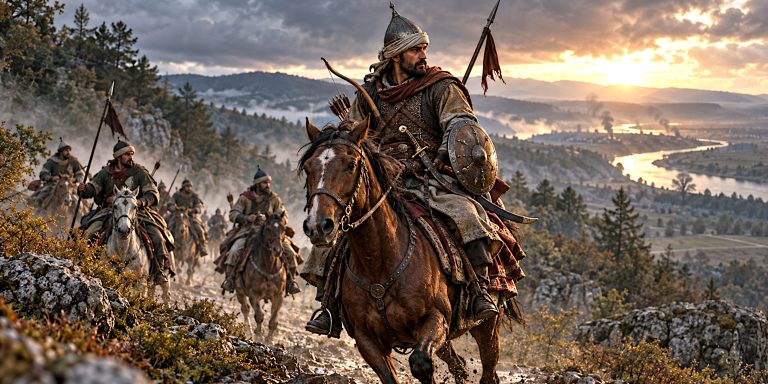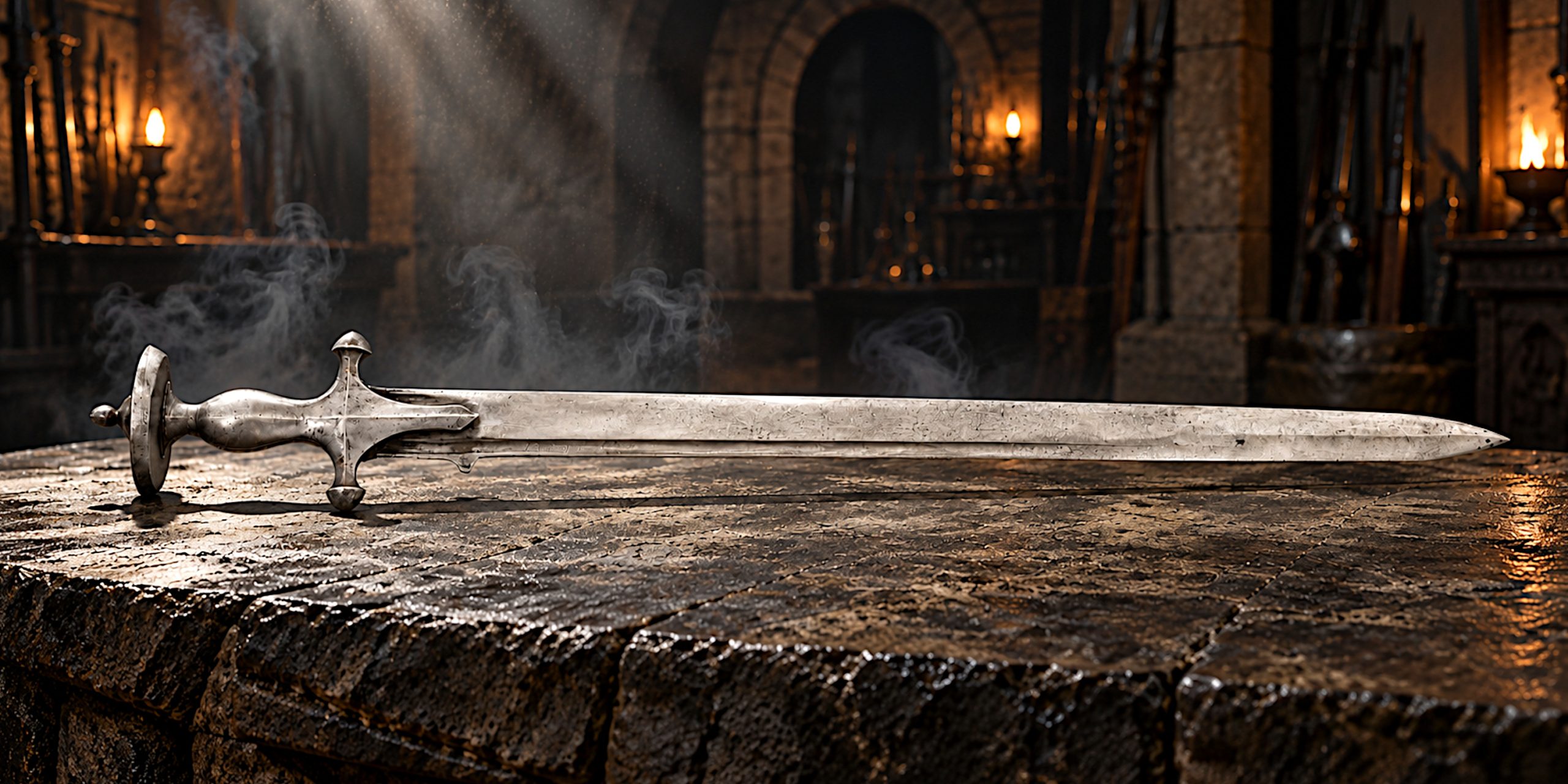
The firangi is one of the most revealing swords produced in early modern India. Its blade was commonly imported from Europe, or copied from a European form, while its hilt was made and mounted in India. The result was neither simply European nor conventionally Indian. It was a practical hybrid shaped by maritime trade, regional warfare and the demands of mounted combat.
The name comes from words related to “Frank” or “foreigner”, which were widely used across the Islamic world and South Asia for Europeans. In the context of arms, firangi came to describe a sword fitted with a long, straight blade of European type. Many such blades reached India through Portuguese and other European trading networks, although Indian-made blades of similar form were also used.
Firangis are particularly associated with Maratha cavalry, but they were not exclusively Maratha weapons. Mughal, Rajput, Sikh and Deccani warriors also carried them. Their long blades gave horsemen useful reach, while their substantial Indian guards protected the hand far more thoroughly than a simple medieval crossguard.
There is something wonderfully direct about the design. Indian armourers encountered a useful foreign product, mounted it according to local preferences and turned it into a weapon with a distinct identity of its own. Military culture has rarely respected neat modern categories, whatever museum labels may suggest.
Firangi Sword Specifications

There was no official firangi pattern, so dimensions and construction varied considerably. Surviving examples include broad double-edged blades, single-edged backsword blades and a smaller number of narrow thrusting blades.
| Feature | Typical characteristics |
|---|---|
| Place of manufacture | Indian subcontinent, often using European or European-style blades |
| Main period of use | Approximately the 16th to 19th centuries |
| Overall length | Commonly around 100 to 115 cm, with longer examples known |
| Blade length | Often about 85 to 105 cm |
| Blade form | Straight; single-edged or double-edged; sometimes with a reinforced or spear-shaped point |
| Fullers | One or more fullers are common, depending on the blade type |
| Hilt | Iron Indian basket hilt, sometimes described as a khanda or Hindu basket hilt |
| Guard | Quillons, side bars and a broad knuckle bow enclosing much of the hand |
| Pommel | Disc or domed form with a long projecting spike |
| Decoration | Plain iron, silvering, gilding, chiselling or gold koftgari |
| Primary role | Cutting and thrusting from horseback, with some infantry use |
The Metropolitan Museum of Art holds a 17th to 18th-century Deccani example with an East European blade. It measures 106.7 cm overall and weighs 1.304 kg. That is a useful documented example, but it should not be treated as a universal template.
The blade
The defining feature was a long, straight blade. Some blades were imported from centres such as Solingen, Genoa and other European manufacturing regions. Others were locally produced in European styles. Marks found on the blade can suggest an origin, but they require care: European makers’ marks were copied, repeated and sometimes added for prestige.
Blades may be:
- Double-edged, resembling European broadsword blades
- Single-edged, in the manner of a backsword
- Broad and cut-oriented
- Relatively narrow and better adapted to thrusting
- Marked with European names, symbols, running wolf devices or orb-and-cross motifs
The broad claim that imported blades always possessed superior metallurgy is too simple. European blades were prized, but their appeal also came from availability, reputation, length and commercial value. Indian armourers already possessed sophisticated steelworking traditions.
The hilt
The mature firangi usually has an Indian basket hilt closely related to that of the khanda. Its bars surround the hand, while a broad knuckle guard protects the fingers. Langets extend down the base of the blade and may be riveted through it, strengthening the junction between blade and hilt.
A long spike projects from the pommel. This could help secure the grip and could be grasped by the second hand when extra leverage was required. Calling the firangi a fully two-handed sword would be misleading, however. It was principally a one-handed weapon, especially when used from horseback.
History and Evolution
European blades arrive in India
European swords and loose blades reached India before the firangi acquired its familiar mature form. Trade across the Indian Ocean expanded sharply during the 16th century, particularly after the establishment of Portuguese maritime power. Blades were portable, valuable and easily incorporated into local weapons.
The trade was not a simple story of Europe exporting finished swords to passive customers. Indian armourers selected foreign blades, modified them and fitted them with hilts designed around South Asian fighting practices. Local workshops also made blades that followed imported forms.
Development of the Indian basket hilt
Early weapons combining foreign blades with Indian fittings did not all possess the elaborate basket guard now associated with the firangi. Over time, stronger hand protection became common. The resulting guard combined quillons, side bars, a knuckle bow and a pommel extension in a compact iron structure.
This design made sense for cavalry. The hand was vulnerable during close passes, and a long blade could deliver cuts without requiring the rider to lean dangerously far from the saddle. The straight point also retained a credible thrusting ability.
Mughal, Rajput and Deccani use
Firangis appear in elite portraiture and armoury collections across Mughal and regional courts. Their presence in paintings could communicate martial authority as much as everyday battlefield use. An ornate sword held by a ruler was political theatre in steel, though admittedly subtler than a modern campaign billboard.
The type was used across northern, western and central India. Surviving examples vary in decoration and blade form, reflecting different workshops, owners and regional preferences rather than one centrally controlled design.
The firangi and the Marathas
The sword became closely associated with the Marathas, whose military power expanded during the 17th and 18th centuries. Maratha forces relied heavily on mobility, raiding and cavalry operations. A long, versatile sword was well suited to mounted warriors able to choose the moment and direction of attack.
The association should not be exaggerated into exclusivity. The firangi was part of a broad South Asian weapons culture in which blades, craftsmen and stylistic ideas travelled between courts and armies.
Survival into the 19th century
Firangis continued to be carried after European-style military sabres became increasingly common in India. Photographic evidence from the uprising of 1857 shows Indian cavalrymen still equipped with traditional swords, including firangi-type weapons.
Their battlefield importance declined as firearms, standardised military equipment and colonial procurement systems reshaped warfare. Even so, firangis survived as heirlooms, status objects and ceremonial weapons. The better examples preserved family associations that could matter as much as their physical construction.
How the Firangi Was Used
The firangi combined reach, cutting authority and a serviceable point. Its precise handling depended heavily on the blade fitted to it.
Common uses included:
- Sweeping cuts delivered from horseback
- Downward blows against infantry or another rider
- Thrusts with narrower or sharply pointed blades
- Defensive actions using the enclosed guard
- Powerful close-range cuts supported briefly by the second hand on the pommel spike
A broad backsword blade would behave differently from a narrow double-edged blade, so it is unwise to describe every firangi as though it handled identically. The hilt family created a recognisable weapon type, but the blade determined much of its actual performance.
Advantages and Disadvantages
Advantages
- Excellent reach: Long blades gave mounted users a valuable striking distance.
- Versatile blade forms: Depending on its blade, a firangi could cut strongly while retaining useful thrusting ability.
- Substantial hand protection: The basket hilt protected the fingers and knuckles better than an open crossguard.
- Strong hilt construction: Long langets and riveted reinforcement helped secure the blade.
- Adaptable manufacture: Imported, reused and locally copied blades could all be fitted to a familiar Indian hilt.
- Status value: Fine blades and gold decoration made prestigious examples suitable for nobles and senior officers.
Disadvantages
- Awkward in confined spaces: Exceptional reach becomes less charming inside a doorway, tent or crowded formation.
- Variable handling: Blade weight, profile and balance differed greatly between individual swords.
- More hand-restrictive than an open hilt: A basket guard can limit changes of grip and wrist movement.
- Potentially forward-weighted: Broad or very long blades could tire the arm during extended use.
- Complex identification: Composite construction and later remounting make many surviving examples difficult to date accurately.
- Decoration could compromise practicality: Highly ornate courtly weapons were not always intended for hard service.
Firangi Compared with Similar Swords
| Weapon | Main design | Typical strengths | How it differs from the firangi |
|---|---|---|---|
| Talwar | Curved, single-edged blade with disc-pommel hilt | Fast draw cut and compact cavalry handling | Usually shorter, curved and fitted with a less enclosing guard |
| Khanda | Broad, straight Indian blade with reinforced edges and basket hilt | Heavy cuts and strong blade presence | Defined by its indigenous blade form rather than a European or European-style blade |
| Shamshir | Deeply curved Persian sabre | Efficient slicing cuts from horseback | Far more curved and less suited to direct thrusting |
| European backsword | Straight, single-edged blade with guarded hilt | Balanced cut-and-thrust performance | European hilt construction and handling conventions differ from the Indian basket hilt |
| Pata | Straight blade fixed to a gauntlet hilt | Strong alignment between forearm and blade | Much more restrictive grip and a very different method of control |
Firangi versus talwar
The talwar was generally shorter and more curved, favouring cuts that draw the edge through the target. The firangi offered greater reach and, with the right blade, a more direct thrust. The talwar was often handier in a crush; the firangi had the advantage when distance could be maintained.
Firangi versus khanda
The two can share almost identical basket hilts, which causes understandable confusion. The distinction rests mainly in the blade. A khanda normally has a characteristically Indian broad blade, often widening towards the tip and reinforced along one or both edges. A firangi uses an imported European blade or one made in a recognisably European form. In practice, museum and auction terminology is not always consistent.
Decoration, Marks and Symbolism
Plain military firangis survive alongside richly decorated court weapons. Common decorative techniques include:
- Gold koftgari applied to the iron hilt
- Silver or gilt surfaces
- Chiselled floral and geometric ornament
- Inscriptions naming an owner or invoking religious protection
- European blade marks, whether genuine, copied or misunderstood
- Velvet-covered grips and textile liners within the guard
Imported blade marks can be historically important, but a familiar European symbol is not an authentication certificate. Marks were copied across generations and continents. A running wolf, for example, may indicate a Passau or Solingen tradition, an imitation of that tradition or a later attempt to make an unremarkable blade more exciting.
Legacy of the Firangi
The firangi is sometimes described as evidence of European influence on Indian arms. That is true, but incomplete. It is better understood as evidence of Indian selection and adaptation. A foreign blade was not preserved as a European sword. It was dismantled, reinterpreted and made to serve local needs.
This makes the firangi valuable well beyond the history of fencing. It records the movement of materials through Portuguese and later European trade, the prestige attached to foreign blades, the skill of Indian armourers and the martial identities of several powerful states.
Its modern reputation remains especially strong in Maharashtra because of its association with Maratha warriors. Yet the surviving objects resist ownership by any single tradition. Mughal, Rajput, Sikh, Deccani and Maratha contexts all form part of the firangi’s history.
Where to See a Firangi Sword
Displays change, and not every catalogued object is permanently on view. Check with the museum before making a special journey.
- The Metropolitan Museum of Art, New York: Holds a documented 17th to 18th-century Deccani firangi with an East European blade, object 36.25.1316.
- Victoria and Albert Museum, London: Its South Asian arms collection contains Indian basket-hilted swords and related weapons. Search the online catalogue before visiting.
- National Museum, New Delhi: Holds major collections of Indian arms and armour covering Mughal and regional traditions.
- Mehrangarh Museum, Jodhpur: The armoury preserves swords and other weapons associated with Marwar’s rulers and warriors.
- Central Museum, Nagpur: A historically associated firang-style sword of Raghuji Bhonsle I, repatriated by the Maharashtra government in 2025, was announced for display here. Confirm its current location before travelling.
Collector’s Guide to Firangi Swords
Firangis occupy a difficult area for collectors because many are composite by nature. An old European blade in an Indian hilt is not automatically suspicious. That combination is the point. The real questions concern when the components were joined, whether either part has been altered and whether the description is supported by evidence.
What to examine
- Blade profile: Check whether the form is consistent with the claimed period and origin.
- Blade marks: Compare stamps and inscriptions with documented examples, but do not rely on a mark alone.
- Hilt construction: Inspect the guard, langets, rivets and pommel spike for later welding or replacement parts.
- Hilt-to-blade fit: Gaps, fresh resin, modern adhesive or disturbed rivets can indicate remounting.
- Patina: Genuine age should appear coherent across recesses and exposed surfaces. Uniform artificial rust deserves suspicion.
- Decoration: Gold koftgari should be examined for wear, technique and consistency with the base metal.
- Scabbard: Original scabbards are scarce. Check whether the curvature, throat and length actually fit the blade.
- Provenance: Old collection labels, photographs, invoices and export records are more valuable than a colourful family story supplied verbally.
Common collecting problems
- Composite swords assembled for the antiques market
- European-style blades incorrectly advertised as European imports
- Copied or spurious Solingen and Toledo marks
- Restored baskets with replaced bars
- Newly applied gold decoration
- Shortened blades or reshaped points
- Incorrect claims of ownership by famous rulers
Verified auction examples and price context
Auction prices vary according to date, blade, decoration, provenance, condition and the accuracy of the catalogue description. Older results should be treated as market history, not present-day valuations.
| Sale | Description | Price realised |
|---|---|---|
| Bonhams, 2003 | Firangi, 17th or 18th century, with a 16th-century European blade measuring 101.5 cm | £1,116.25 including premium |
| Bonhams, 2011 | Indian firangi, 18th century | £1,104 including premium |
| Bonhams, 2012 | Two firangis sold as one lot | £375 including premium |
| Bonhams, 2013 | Indian firangi, late 18th century | US $491.40 including premium |
| London auction, 2025 | Inscribed firang-style sword associated with Raghuji Bhonsle I and acquired for repatriation | Reported at ₹47.15 lakh |
The 2025 Bhonsle result is exceptional and should not be used as a baseline for an anonymous weapon. Its inscription, claimed royal association and cultural importance placed it in a different market from an ordinary collector’s example.
As a broad guide, plain or compromised examples may sell in the high hundreds, while sound period swords with attractive hilts often reach the low thousands of pounds. Exceptional decoration, secure provenance or an important inscription can raise the price dramatically. Always compare the estimate with the final price including buyer’s premium, taxes and shipping.
Before buying
- Request high-resolution photographs of the entire sword and close-ups of all marks.
- Ask for the blade length, overall length, weight and point of balance.
- Obtain a written condition report.
- Check whether the sword has been cleaned, repatinated, welded or remounted.
- Confirm the seller’s return policy and the auction house’s attribution language.
- Review current laws governing purchase, possession, import, export and transport in every relevant jurisdiction.
- Seek an independent specialist opinion before spending heavily.
Avoid aggressive cleaning. Polishing can erase patina, inscriptions, tool marks and traces of decoration. Active red rust should be stabilised by a qualified arms conservator, particularly on a weapon with koftgari or a historically important blade.
How to Identify a Firangi
A sword is likely to be described as a firangi when it combines most of the following features:
- A long, straight blade of European manufacture or European form
- An Indian basket hilt with extensive hand protection
- Long langets gripping the base of the blade
- A projecting pommel spike
- A blade suited to both cuts and thrusts
- Indian construction or decoration dating broadly from the early modern period
Not every straight Indian sword with a basket hilt is a firangi. If the blade is a characteristic khanda form, khanda may be the more accurate term. Classification sometimes remains uncertain, particularly when a weapon was remounted during its working life.
Frequently Asked Questions
What does firangi mean?
The word derives from terms connected with “Frank” and came to mean a European or foreigner in several languages. Applied to the sword, it refers to the foreign origin or style of its blade.
Was the firangi a Maratha sword?
It was strongly associated with Maratha cavalry, but it was also used in Mughal, Rajput, Sikh and Deccani contexts.
Was every firangi blade made in Europe?
No. Many blades were imported, while others were made in India in European forms. Even genuine European marks require expert interpretation.
Is a firangi the same as a khanda?
No, although they can use closely related basket hilts. The firangi is distinguished principally by its European or European-style blade. The khanda has a characteristic Indian blade form.
Could a firangi be used with two hands?
The pommel spike could be grasped by the second hand for extra leverage, but the sword was principally designed for one-handed use.
How much is an antique firangi worth?
Values range from hundreds of pounds for plain, damaged or poorly documented examples to several thousand for strong period pieces. Swords with exceptional decoration, inscriptions or reliable historical provenance can sell for much more.
Final Assessment
The firangi was a successful military hybrid, not a curiosity assembled from mismatched parts. Its makers joined long European or European-style blades to protective Indian hilts and produced a sword particularly effective for cavalry. Its history connects workshops in Europe with ports, armouries and courts across India.
For historians, it is material evidence of trade and adaptation. For collectors, it is a rewarding but complicated field in which construction and provenance matter far more than an exotic label. For anyone interested in swords, it is a useful reminder that weapons evolve wherever people find a good idea and decide, quite sensibly, to improve it.
Sources and Further Reading
Bonhams archived arms and armour sale records
The Metropolitan Museum of Art, Sword (Firangi), object 36.25.1316
George Cameron Stone, A Glossary of the Construction, Decoration and Use of Arms and Armor
Lord Egerton of Tatton, Indian and Oriental Arms and Armour
Robert Elgood, Hindu Arms and Ritual: Arms and Armour from India 1400–1865