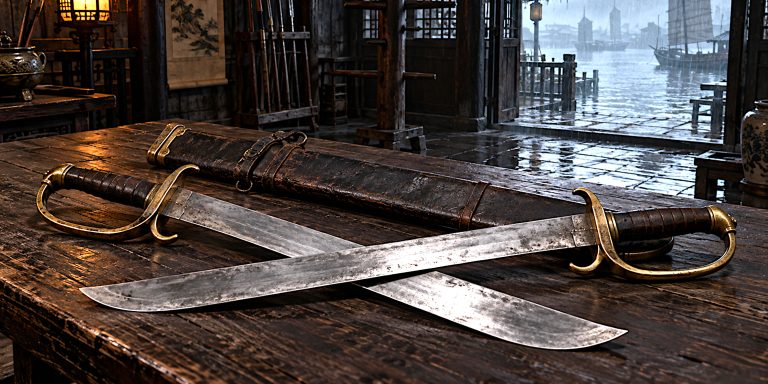
The dha is not one precisely defined sword. It is a broad family of single-edged weapons found across mainland Southeast Asia, particularly in Myanmar, Thailand, Laos and neighbouring regions. Forms range from compact working blades to long fighting swords and lavishly decorated ceremonial pieces.
That variety is precisely what makes the dha fascinating, and occasionally infuriating. Museum labels and auction catalogues often apply the word to almost any guardless Southeast Asian sword with a cylindrical hilt. Local names, regional traditions and intended uses were rather more complicated.
Most dha share a recognisable profile: a single-edged blade, little or no hand guard, a round grip and a wooden scabbard. Beyond that basic arrangement, almost everything can change. Blades may be straight or curved, narrow or broad, sharply pointed or almost square at the tip. A village working weapon and a silver-mounted court sword can belong to the same family while having led very different lives.
What Does the Name Dha Mean?
“Dha” is most commonly associated with Myanmar, although Western collectors use it rather loosely for related swords and knives from across Southeast Asia. In Thailand, the corresponding sword is generally called a daab or darb. Related forms appear among Shan, Kachin, Karen, Tai, Lao and other communities.
The term can describe both swords and shorter knives. Museums therefore sometimes distinguish between a sword dha and a knife dha, rather than treating blade length alone as a fixed definition.
It is safer to think of the dha as a regional weapon family rather than a single standardised military pattern. There was no Southeast Asian official sitting at a desk insisting that every blade conform to the approved dimensions. Frankly, the surviving swords are much more interesting because nobody did.
Dha Sword Specifications

Dha dimensions vary considerably according to region, date and purpose. The figures below describe common historical examples rather than a rigid standard.
| Feature | Typical characteristics |
|---|---|
| Overall length | Approximately 65 to 100 cm |
| Blade length | Usually 45 to 75 cm |
| Blade construction | Single-edged steel blade |
| Blade profile | Straight or gently curved, often widening or maintaining its width towards the tip |
| Point | Rounded, upswept, clipped, spear-like or nearly square |
| Blade thickness | Commonly around 4 to 8 mm at the base, tapering towards the point |
| Hilt length | Approximately 15 to 35 cm, sometimes longer |
| Grip | Cylindrical wood, horn, ivory or metal-covered core |
| Guard | Usually absent or reduced to a small collar |
| Tang | Commonly a narrow tang secured inside the hilt |
| Scabbard | Two-piece wooden construction, often bound with rattan or metal bands |
| Weight | Frequently between 500 g and 1 kg, although heavier examples exist |
| Primary use | Cutting, warfare, personal defence, ceremony and practical work |
Surviving museum pieces demonstrate the extent of this variation. A 19th-century Burmese dha in the Metropolitan Museum of Art measures 85.1 cm without its scabbard but weighs only 592.5 g. Another example from Mindan measures 86.4 cm and weighs 876 g. These are comparatively light swords for their length.
Blade design
Most dha blades are optimised for cutting. Common features include:
- A single sharpened edge
- A relatively thick spine near the hilt
- Gradual distal taper towards the point
- Little or no ricasso
- A blade that is straight or only moderately curved
- A centre of balance placed forward of the hand
- Decorative grooves, inscriptions or metal inlay on higher-status examples
Some blades end in a narrow point suitable for thrusting. Others possess rounded, upswept or abruptly clipped tips that clearly favour the cut. It is unwise to describe the entire family as either pointed or blunt-ended.
Hilt and guard
The long cylindrical hilt is one of the dha’s most recognisable features. It was usually made from wood and might be:
- Left plain
- Wrapped with rattan, cord or braided material
- Fitted with brass or copper collars
- Covered partly or completely in silver
- Carved from horn or ivory on prestigious weapons
- Finished with a flared or capped pommel
Most examples have no substantial crossguard. A small disc, ferrule or raised collar may sit between the blade and grip, but it provides little protection for the fingers.
The long grip does not automatically make every dha a two-handed sword. It offers room to adjust the hand position, improves leverage and can help control a forward-weighted blade. Longer examples could, however, be used with both hands.
Scabbard
Traditional scabbards were commonly made from two shaped pieces of wood. These could be secured with rattan bindings, cord or metal bands. Decorated examples might carry silver fittings or carved surfaces.
Suspension arrangements vary. Some swords were carried at the waist, while others could be slung by a cord or baldric. An intact original scabbard substantially increases both historical interest and collector value.
History and Evolution of the Dha
The dha’s early development is difficult to reconstruct. Organic hilt and scabbard materials decay, archaeological blades are often heavily corroded, and early visual sources do not always provide enough detail for confident classification.
Claims that the dha appeared at a precise date in the first millennium should therefore be treated cautiously. Its design probably developed gradually from older cutting tools and weapons used across the region. Similarities between neighbouring sword traditions are evidence of prolonged contact, migration and exchange, not necessarily proof that one culture simply copied another.
Regional origins
Single-edged blades were well suited to the conditions of mainland Southeast Asia. Communities needed tools capable of cutting vegetation, preparing timber and performing agricultural work. The same qualities that made a blade useful in the forest could make it effective in close combat.
Over time, specialist fighting swords developed alongside practical blades. Political and military exchange connected the kingdoms and communities of Burma, Siam, Lan Xang, Cambodia, Yunnan and the surrounding uplands. Soldiers, craftsmen and weapons crossed borders rather more readily than tidy modern classifications suggest.
Warfare in Burma and Siam
By the early modern period, dha and daab-type swords were established military weapons. They were carried by infantry, palace guards and some mounted troops during the long series of wars involving Burmese and Siamese kingdoms.
A sword was only one component of the regional arsenal. Spears, bows, firearms and polearms often offered greater reach or battlefield utility. The dha was particularly valuable once formations closed, during assaults, in broken terrain or when a longer weapon became awkward.
Its absence of a substantial guard reduced weight and allowed freedom of wrist movement. It also left the hand exposed, a compromise that mattered less when fighting styles emphasised movement, distance and decisive cuts rather than prolonged blade-on-blade fencing.
Local and ethnic traditions
Dha were produced and carried by numerous peoples, including communities identified in older sources as Burmese, Shan, Kachin, Karen, Lao and Thai. Each developed characteristic combinations of blade shape, grip construction, decoration and scabbard design.
Attribution is not always straightforward. Weapons were traded, inherited, repaired and remounted. A blade forged in one area might receive a new hilt elsewhere decades later. Confident tribal labels in sales catalogues should consequently be examined with some suspicion, especially when no provenance accompanies them.
The colonial period
Large numbers of dha entered European collections during the 19th and early 20th centuries. British soldiers, officials and travellers acquired them during and after the Anglo-Burmese Wars. Some were battlefield trophies, but many were bought, presented or collected as ethnographic objects.
This period accounts for a substantial portion of the examples now found in British, European and American museums. It also created some enduring problems. Early collectors frequently recorded very little about a weapon’s maker, original owner or precise place of manufacture.
Ceremonial and presentation swords
Not every ornate dha was intended for regular combat. High-status swords could be fitted with:
- Repoussé silver mounts
- Gilded decoration
- Ivory or carved horn hilts
- Inlaid blade designs
- Elaborate inscriptions
- Finely worked silver scabbards
Such weapons communicated rank, wealth, authority or diplomatic favour. A decorated sword might remain entirely functional, but its social role extended well beyond its cutting edge.
How Was the Dha Used?
Dha fighting methods varied between cultures and periods, so there is no single universal system. The design generally favours fast, committed cuts supported by active footwork.
Likely methods included:
- Diagonal cuts to the limbs or upper body
- Horizontal cuts delivered with wrist and forearm rotation
- Draw cuts using the length of the edge
- Thrusts with sharply pointed examples
- Deflections made with the blade rather than a large guard
- Rapid changes in grip along the extended hilt
- Two-handed blows with longer weapons
Thai sword traditions preserve daab methods within krabi-krabong, while Burmese martial systems include dha work within broader armed practices. Modern demonstrations can illuminate handling principles, but they should not automatically be treated as exact survivals of battlefield methods from several centuries ago.
Advantages of the Dha
Fast handling
Many historical dha are surprisingly light. Their narrow blades and limited guards reduce unnecessary mass, allowing rapid changes of direction.
Powerful cutting action
A degree of forward balance places authority behind the edge. Combined with an efficient blade profile, this produces strong cuts without requiring the weight of a European cavalry sabre.
Adaptable grip
The elongated cylindrical hilt allows the wielder to alter leverage and hand position. Some larger forms can be gripped with one or two hands.
Effective in confined or broken terrain
A moderately sized cutting sword is practical in forests, settlements and close fighting where long spears become cumbersome.
Straightforward construction
A functional dha does not require an elaborate guard or complex pommel assembly. Local smiths could produce and maintain serviceable examples using established materials and techniques.
Cultural versatility
The form could serve as a weapon, working blade, status object or ceremonial emblem. This adaptability helps explain its wide geographical and social distribution.
Disadvantages of the Dha
Minimal hand protection
The lack of a developed guard exposes the hand to sliding blades, accidental impacts and close-range cuts. Good technique becomes rather important when the sword has made no architectural provision for keeping one’s fingers attached.
Limited thrusting ability
Dha with rounded or broad tips are poor thrusting weapons compared with sharply pointed swords. Even pointed examples may lack the stiffness and protective guard associated with thrust-centred designs.
Modest reach
Many examples are shorter than European cavalry sabres or Japanese katana. Reach varies, but compact dha require the wielder to enter close cutting distance.
Reduced performance against armour
The dha is best suited to cutting lightly protected targets. It cannot be expected to slice through substantial metal armour, regardless of what certain enthusiastic online demonstrations may imply.
Wide variation in quality
Dha were made for customers ranging from farmers to aristocrats. Steel quality, heat treatment and structural strength vary accordingly. Appearance alone is a poor guide to performance.
Vulnerable organic fittings
Wooden scabbards, rattan bindings and natural adhesives deteriorate in damp conditions. Many surviving weapons have been rewrapped, shortened or repaired.
Dha Compared with Similar Weapons
| Weapon | Region | Main design | Guard | Typical strengths | Key difference from the dha |
|---|---|---|---|---|---|
| Dha or daab | Mainland Southeast Asia | Straight or curved single-edged blade | None or minimal | Speed, cutting and adaptable handling | Broad regional family with long cylindrical grip |
| Katana | Japan | Curved single-edged blade with defined point | Disc guard | Controlled two-handed cutting and thrusting | More standardised mounting and stronger hand protection |
| Chinese dao | China | Single-edged blade in numerous military and civilian forms | Usually present | Cutting versatility and military adaptability | Generally has a more developed guard |
| Talwar | Indian subcontinent | Curved blade with disc pommel | Knuckle bow or crossguard | Powerful draw cuts from horseback or foot | Restrictive one-handed hilt and substantial guard |
| Golok | Indonesia and Malaysia | Broad, forward-weighted chopping blade | Usually minimal | Heavy cutting and practical work | Commonly shorter and more tool-like |
| Parang | Maritime Southeast Asia | Broad working blade | Usually absent | Vegetation clearing and utility cutting | Primarily a working blade rather than a sword form |
| Machete | Global | Simple broad cutting blade | Small or absent | Low-cost utility and vegetation cutting | Usually simpler, shorter and less culturally associated with elite arms |
Dha and katana
The dha is sometimes lazily described as a Southeast Asian katana. Both are single-edged cutting weapons, but the similarity does not go much further. The katana has a distinctive guard, carefully defined mounting system and a strongly established two-handed grip. Dha construction is more varied, and many examples were designed for one-handed use.
Dha and Chinese dao
Trade and cultural contact undoubtedly connected southern China with mainland Southeast Asia. Some dha resemble southern Chinese dao, particularly in blade shape. Nevertheless, the dha’s long guardless hilt and wooden bound scabbard usually provide useful points of distinction.
Dha and golok
The boundary between weapon and working tool can be decidedly blurred. A golok is normally shorter and broader, with an emphasis on chopping. Dha swords tend to provide greater reach and a blade proportion more suited to combat, although intermediate examples resist comfortable labelling.
The Dha’s Cultural Legacy
The dha survives as more than an obsolete military weapon. It remains part of martial demonstrations, ceremonial dress, dance, community identity and the visual language of authority across parts of Southeast Asia.
Its cultural significance differs between groups. A sword may represent martial ancestry, political rank, adulthood, protection or ceremonial responsibility. Treating every ornate dha as merely a weapon overlooks much of what made it valuable to its original owner.
The sword has also become important to students of Southeast Asian martial arts. Thai daab practice is particularly visible internationally, while Burmese and regional systems retain their own approaches to sword use.
For historians, the dha offers a useful corrective to rigid weapon classification. It shows how one underlying form can be adapted by different communities without ever settling into a single official pattern.
Where to See Historical Dha Swords
Metropolitan Museum of Art, New York
The Met holds several documented 19th-century Burmese examples in its Arms and Armor collection. These include plain fighting weapons and more elaborate silver-mounted swords.
Its online catalogue includes:
- A silver and sharkskin-mounted Burmese dha
- A silver-mounted example from Mindan
- A plain 19th-century Burmese dha
- A short Burmese knife dha
Check gallery status before visiting, since collection ownership does not guarantee that an object is currently displayed.
British Museum, London
The British Museum holds swords and scabbards collected in Myanmar and neighbouring regions. Its collection includes an example with a tanged iron blade, wooden handle, metal fittings and rattan binding.
Display arrangements change, so consult the museum’s online collection or contact the relevant department before travelling specifically to see one object.
Victoria and Albert Museum, London
The V&A possesses arms and decorative metalwork from South and Southeast Asia, including Burmese material. As with other large museum collections, only a proportion is displayed at any one time.
Royal Armouries, Leeds
The Royal Armouries holds an extensive international collection of edged weapons. Enquire in advance about Southeast Asian swords currently displayed or accessible through study arrangements.
Museums in Southeast Asia
National and regional museums in Myanmar and Thailand provide the strongest cultural context for dha and daab traditions. Collections may include weapons associated with royal courts, warfare, ethnic identity and ceremonial life.
Collector’s Guide to the Dha
Dha remain comparatively accessible historical swords, but identification is often difficult. A plain antique may be entirely genuine yet lack the documentation needed for close regional attribution. Conversely, an ornate sword may have been assembled for the tourist or export trade.
What to inspect before buying
- Blade profile: Check whether the form is consistent with known Southeast Asian examples.
- Tang security: Movement between blade and hilt may indicate internal damage or failed adhesive.
- Edge condition: Look for deep chips, aggressive modern sharpening and loss of the original profile.
- Blade surface: Active orange corrosion requires attention. Stable dark patination is not necessarily a fault.
- Hilt materials: Examine wood, horn, ivory substitutes, wire and metal coverings for repairs.
- Scabbard fit: Original wooden scabbards should fit securely without trapping moisture against the blade.
- Rattan binding: Old binding may be fragile. Bright, uniform wrapping can indicate replacement.
- Inscriptions: Do not assume that script proves age, ownership or magical significance.
- Provenance: Old collection labels, military records and dated photographs are far more useful than a seller’s confident guess.
- Restoration: Ask whether the blade has been polished, etched, rehandled or chemically cleaned.
- Legal status: Confirm the law governing purchase, possession, importation, transport and sale in your jurisdiction.
Warning signs
Be cautious when a seller uses descriptions such as:
- “Ancient temple sword” without evidence
- “Royal presentation weapon” without documented provenance
- “Shan chief’s sword” based only on decoration
- “Battle-used” with no associated records
- “Damascus steel” applied to ordinary surface staining
- “Ceremonial” simply because the sword is impractical or poorly made
The vocabulary of the antique arms trade occasionally possesses more imagination than restraint.
Condition and restoration
Heavy polishing can erase inscriptions, patination and tool marks. Replacing damaged rattan or cleaning silver mounts may make a sword look smarter while reducing its historical integrity.
Basic conservation principles include:
- Keep the blade clean and dry
- Apply a very light coat of suitable conservation oil
- Avoid abrasive metal polish
- Do not sand wooden fittings
- Do not glue a loose hilt without understanding its construction
- Store the sword in a stable, low-humidity environment
- Inspect beneath the scabbard periodically for trapped moisture
- Consult a qualified arms conservator before substantial restoration
Dha Sword Auction Prices
Values depend on age, condition, decoration, provenance and the confidence of the attribution. Auction estimates are not guarantees, while dealer asking prices are generally higher than open-market results.
| Type | Indicative price range |
|---|---|
| Modern decorative or tourist example | £50 to £150 |
| Modern functional reproduction | £150 to £400 |
| Plain late 19th or early 20th-century dha | £150 to £450 |
| Complete antique example with original scabbard | £300 to £750 |
| Well-decorated silver-mounted dha | £600 to £1,500 |
| Fine presentation or high-status example | £1,500 to £4,000 or more |
| Exceptional documented royal or historic weapon | Highly variable, potentially far higher |
These ranges should be treated as market guidance rather than formal valuations. As a useful real-world comparison, a 19th-century Burmese dha sold through Galerie Zacke for €303 including buyer’s premium, while a silver-mounted example was offered by a specialist British dealer at £600. At the lower end, unattributed swords can sell for very little when condition or authenticity is uncertain.
Prices quoted by auction houses may exclude:
- Buyer’s premium
- VAT
- Shipping
- Insurance
- Import charges
- Specialist handling fees
What adds value?
- Secure and specific provenance
- Original matching scabbard
- Fine silver or gilt mounts
- Unusual but authentic blade decoration
- Legible inscriptions with reliable translation
- Strong condition without excessive restoration
- Documented association with a historical collection
- Regional characteristics that can be confidently identified
What reduces value?
- Loose or replaced hilt
- Missing scabbard
- Severe corrosion
- Shortened or reshaped blade
- Modern machine polishing
- Invented provenance
- Composite construction from unrelated parts
- Tourist-market decoration presented as antique craftsmanship
Buying a Dha in the UK
Dha swords can fall within UK legislation governing offensive weapons, particularly where a blade is curved and exceeds the relevant length threshold. Exemptions may apply to qualifying antiques, traditionally made swords and certain permitted activities, but the precise position depends on the object and circumstances.
Before purchasing or importing one:
- Check the current legislation and official government guidance
- Ask the seller for the blade length and method of manufacture
- Obtain a dated invoice and written description
- Retain provenance and age documentation
- Confirm the courier will legally transport edged weapons
- Never carry the sword in public without a lawful reason
- Seek specialist legal advice if the classification is uncertain
Ownership inside a private collection does not make casual public transport lawful. Historical enthusiasm is not generally accepted as a reason for wandering around with a sword.
Is the Dha a Good Collector’s Sword?
A well-preserved dha offers considerable historical interest for less money than many comparable Japanese, European or Indian swords. The field remains accessible, but buyers must accept that exact attribution can be difficult.
The best purchase is usually a complete, honestly described example with sound construction and documented provenance. Decorative silver is attractive, but an unadorned working sword with an old scabbard and a reliable collecting history may reveal far more about how these weapons were actually made and carried.
The dha deserves to be understood on its own terms. It was neither a crude machete nor an imitation of better-known Asian swords. It was a flexible regional design shaped by warfare, practical work, ceremony and the preferences of many different communities. Its lack of standardisation is not a flaw in the historical record. It is the history.