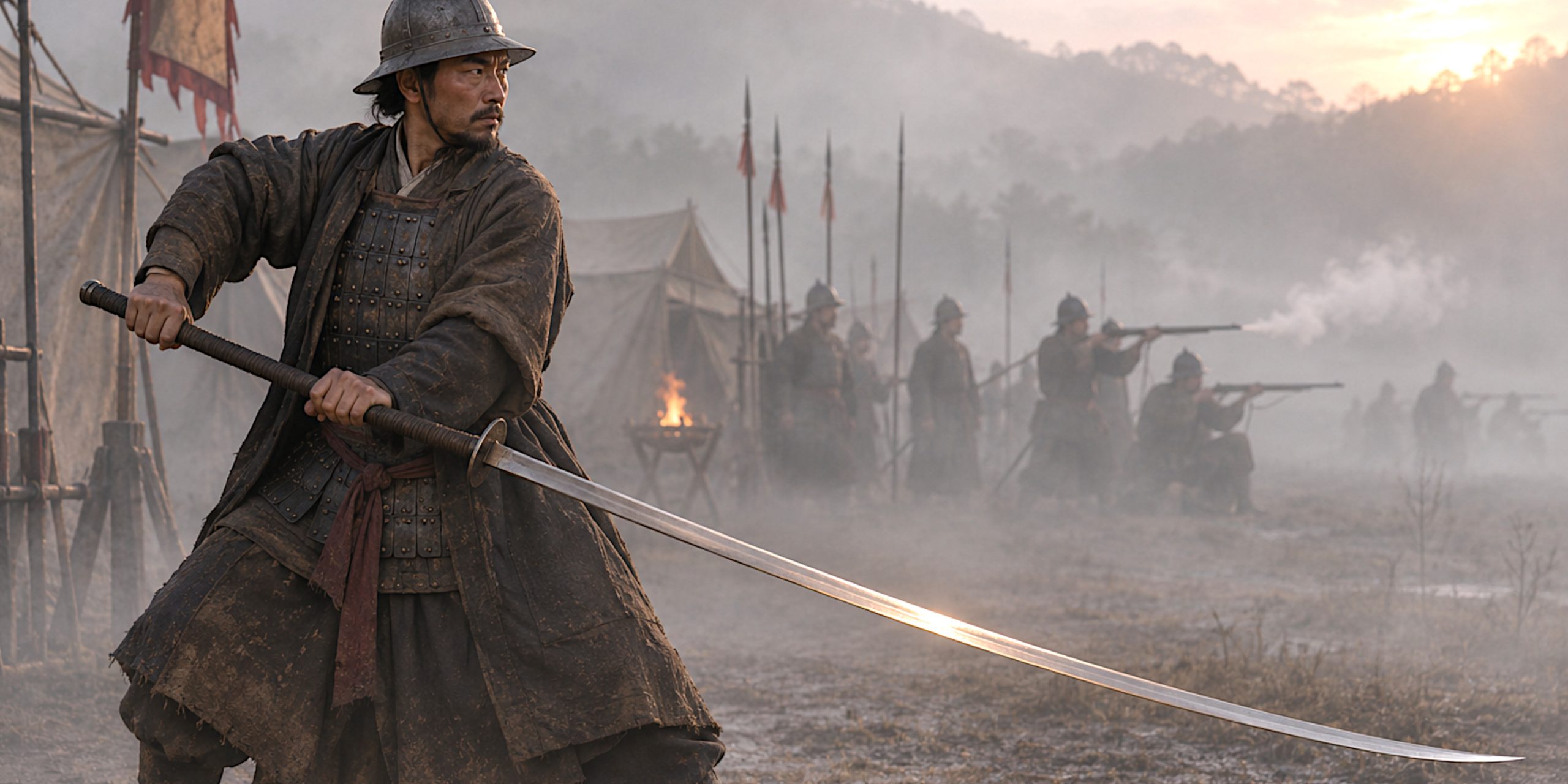
The changdao was a Chinese long sabre wielded with both hands, best known from Ming military writing. Its long grip and extended, single-edged blade offered reach and powerful cutting, but using it well demanded considerably more than enthusiasm and a large clearing.
Its history is particularly revealing because Ming commanders were willing to learn from dangerous opponents. Japanese swordsmanship helped shape the long-sabre methods recorded in Chinese military literature. The changdao belongs to that exchange, alongside the practical business of training infantry to survive close combat.
There is a complication worth settling immediately. Changdao means “long sabre”, rather than one fixed pattern of sword. A Ming manual’s specification, a Qing auction catalogue’s description and a modern martial arts weapon can refer to related objects without describing identical weapons.
Changdao Specifications
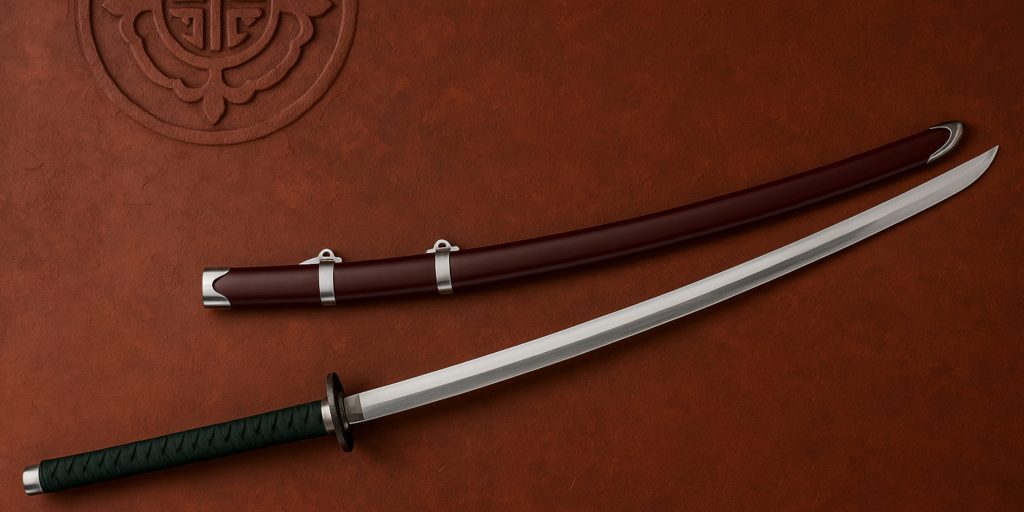
For a historical specification, the most useful starting point is the long sabre described in the fourteen-volume version of Qi Jiguang’s Jixiao Xinshu. Traditional measurements should take priority over deceptively precise modern conversions.
| Feature | Historical description |
|---|---|
| Chinese name | 長刀, chángdāo, “long sabre” |
| Weapon type | Long, two-handed, single-edged sword |
| Principal historical context | Ming military writing, especially the sixteenth century |
| Blade | Long and relatively narrow, generally with modest curvature |
| Recorded blade length | Five chi |
| Recorded grip length | One chi, five cun |
| Recorded overall length | Six chi, five cun |
| Approximate metric equivalent | Around two metres overall if a chi of roughly 31–32 cm is used |
| Recorded weight | Two jin, eight liang, approximately 1.5 kg under a commonly used conversion |
| Additional feature | A copper protective section at the blade’s base |
| Construction | Steel blade with a long mounted grip; details vary between examples |
These figures describe a textual model, not a universal production standard. Historical units varied, and later swords described as changdao can be substantially shorter. The original page’s 2.5–3.5 kg “typical” weight should not be retained without measurements from identified examples.
The grip matters as much as the blade. Separating the hands gives the wielder leverage for controlling the point, accelerating a cut and recovering from it. A long sword that cannot be brought back under control is a fairly elaborate liability.
History and Evolution
Earlier Chinese long blades
Chinese single-edged swords have a history extending far beyond the Ming dynasty. That background matters, but it does not establish an uninterrupted, unchanged changdao tradition from the Han period onwards.
Similar names and silhouettes are insufficient evidence for direct descent. A convincing history needs dated objects, contemporary descriptions and some account of how the weapon was actually used.
Japanese influence and the Ming response
The clearest setting for the familiar changdao story is the sixteenth-century conflict with wokou raiding forces. These groups were more complicated than the convenient label “Japanese pirates” suggests, although Japanese weapons and fighting methods were an important part of the encounter.
Qi Jiguang treated enemy swordsmanship as a military problem worth studying. His writing connects the long sabre with the fighting encountered during the coastal raids and records its intimidating reach.
This was a practical response. Commanders could condemn raiders while borrowing useful ideas from them. Military necessity has rarely been troubled by intellectual property.
Long sabres and firearms
The changdao should not be presented simply as a specialised cavalry-killing sword. Ming discussions also place long sabres alongside firearms, including as close-combat weapons for soldiers whose principal task involved shooting.
That combination complicates the familiar story that firearms immediately made large swords obsolete. A gunner could need a blade precisely because an enemy had survived the shooting and reached him.
Nor should every weapon discussed by Qi be placed indiscriminately into his famous mandarin duck formation. His writings cover different circumstances, equipment arrangements and stages of his career.
Seventeenth-century swordsmanship
Cheng Zongyou’s Dandao Faxuan, published in 1621, provides another important record of Chinese two-handed sabre practice. Its illustrated methods help establish that long-sabre fighting involved organised instruction, rather than indiscriminate swinging.
The terminology needs care. In this context, dandao, or “single sabre”, can describe one weapon used with both hands. It does not necessarily mean a one-handed sword.
Qing weapons and the modern miaodao
Long, two-handed Chinese sabres continued beyond the Ming. Later surviving weapons and Qing catalogue descriptions demonstrate persistence, although they should not all be treated as copies of Qi’s prescribed sword.
The modern miaodao belongs in this discussion as a related two-handed sabre tradition. Its modern identity and teaching history deserve their own treatment. Calling it merely a lighter replacement for the changdao conceals more than it explains.
How the Changdao Worked
The changdao combined an extended cutting edge with two-handed control. Its tactical possibilities depended on spacing, timing and the ability to manage the distance between opponents.
A trained user could threaten with the point as well as the edge. Single-edged does not mean incapable of thrusting. Equally, the sword’s length did not guarantee superiority over a spear, whose reach could be greater still.
Several practical considerations shaped its use:
- Distance: The blade could threaten an opponent before a shorter sword reached striking range.
- Footwork: Closing or withdrawing at the right moment mattered more than simply possessing the longer weapon.
- Recovery: A committed cut needed to finish in a position from which the wielder could defend or attack again.
- Support: Other soldiers, missile weapons and formation discipline affected what a swordsman could safely attempt.
Claims that it routinely sliced through armour or severed horses should be treated cautiously. Cutting power is not the same as dependable penetration of military protection.
Advantages and Disadvantages
| Advantages | Practical limitations |
|---|---|
| Greater reach than many ordinary sidearms | Awkward to carry and draw in confined spaces |
| Two hands provide leverage and control | Prevents normal simultaneous use of a separate shield |
| Strong cutting potential against exposed targets | Does not reliably defeat armour |
| Point allows thrusting as well as cutting | Longer polearms can still outrange it |
| Useful close-combat option alongside missile weapons | Requires dedicated training and sufficient working space |
Its appeal lay in the combination of reach and control. Its weakness was that neither came free. Fatigue, poor timing or cramped ground could quickly make the weapon’s size inconvenient.
Comparison with Similar Weapons
These comparisons concern broad characteristics. Historical examples vary too much for one neat length to define each family.
| Weapon | Main distinction | Relationship to the changdao |
|---|---|---|
| Miaodao | Chinese two-handed sabre associated with modern martial traditions | Related in form and historical discussion; not a universal synonym |
| Wodao | Term associated with Japanese swords or Japanese-influenced sabres | Overlaps with the changdao’s history, but describes a different aspect of identity |
| Ōdachi or nodachi | Japanese long sword | Important comparison for Japanese influence and extended two-handed blades |
| Yanmaodao | Chinese “goose-quill” sabre, generally a one-handed sidearm | More compact and suited to a different carrying and handling arrangement |
| Zweihänder | European two-handed sword, normally double-edged with a substantial crossguard | Comparable demands of reach and leverage, without implying a shared fighting system |
| Dadao | Broad Chinese cutting sword, especially familiar from later military use | Usually a much broader-bladed weapon, rather than the same design under another name |
A comparison with a European greatsword is useful when discussing leverage. It becomes less useful when used to invent an identical battlefield role on the other side of Eurasia.
Surviving Evidence and Archaeology
The changdao’s history rests on a combination of military texts, illustrations and surviving blades. None is sufficient on its own.
Manuals describe what an author recommended or wished to teach. They do not prove that every unit received matching weapons. Surviving swords reveal construction and handling, but their original mounts may have been replaced and their later collecting histories can obscure their origins.
For an archaeological attribution, the strongest evidence would include:
- A recorded findspot and securely dated context.
- Clear photographs and measurements of the blade and tang.
- Documentation of conservation and later alterations.
- Inscriptions assessed alongside the weapon’s construction.
- Comparison with dated texts and securely attributed objects.
An old blade without a findspot is still an old blade. It is not automatically evidence from a particular battlefield or one of Qi Jiguang’s units.
Where to See Changdao and Related Swords
There is no reliable basis here for promising a permanently displayed Ming changdao at a named museum. Collection ownership and public display are different things.
| Collection or resource | What it offers |
|---|---|
| Metropolitan Museum of Art, New York | Chinese Two-handed Sword with Scabbard, seventeenth to eighteenth century, accession 36.25.1628a, b |
| The Met’s online collection | A documented starting point for comparing Chinese two-handed swords and ordinary military sabres |
| Digitised Ming military manuals | Contemporary descriptions and illustrations, especially the Jixiao Xinshu and Dandao Faxuan |
The Met lists its two-handed sword as not on view at the time of checking in November 2026. Its catalogue title should be preserved: it is a related Chinese two-handed sword, not a museum-certified example of Qi’s precise changdao model.
Before travelling, ask a museum about the specific accession number and current display status.
Collectors’ Guide and Auction Prices
What is actually being sold?
“Changdao” is used loosely in the market. A sword offered under that name might be a Qing long sabre, an old blade with replacement fittings, a modern reproduction or a weapon whose dating remains uncertain.
Start with the object’s evidence, rather than the most impressive version of its sales description.
Documented auction results
The following are published auction-house results. They are not a price guide for securely authenticated Ming changdao.
| Auction and lot | Catalogue description | Published result |
|---|---|---|
| Olympia Timed, Spring 2025, lot 597 | Chinese two-hand sword, changdao, Qing dynasty | £1,100 |
| Olympia Timed, June 2026, lot 503 | Chinese two-handed sword, shuang shou dao, Qing dynasty, nineteenth century | £95 |
| Olympia Timed, June 2026, lot 504 | Large Chinese two-hand sword, shuang shou dao, Qing dynasty, nineteenth century | £220 |
The two June entries are comparative sales of later Chinese two-handed weapons. Their inclusion does not establish that they match the Ming long sabre in design or quality.
These are the amounts displayed as “Sold for” in the auction records. Confirm whether buyer’s premium, tax and other charges are included before comparing them with an invoice or another auction house’s result.
Three results cannot establish a stable market range. Attribution, condition, completeness and provenance can produce very different prices. The earlier page’s untraceable five-figure sales should be removed.
What to check before buying
- Provenance: Seek earlier catalogues, invoices and dated photographs.
- Blade condition: Look for cracks, deep corrosion, heavy grinding and altered tips.
- Mounts: Establish whether the grip, guard and scabbard belong together.
- Tang: Ask whether it has been shortened, repaired or otherwise altered.
- Dimensions: Request blade length, overall length, grip length and weight.
- Attribution: Ask why the seller considers it Ming, Qing or modern.
- Restoration: Obtain a clear account of replacement parts and recent work.
Radiocarbon dating is not a routine way to authenticate a steel sword. Organic fittings may be testable in suitable circumstances, but their date does not automatically establish the date of the blade.
Metallurgical examination can answer particular questions about construction. It does not ordinarily provide a precise calendar date by itself. A specialist assessment should bring several kinds of evidence together.
Caring for an example
Avoid abrasive polishing or attempts to make an antique blade look newly forged. Surfaces can preserve evidence that is much easier to remove than recover.
Handle carefully, keep storage conditions stable and seek conservation advice for active corrosion, damaged grips or deteriorating scabbards.
Legacy
The changdao is a useful reminder that Chinese military culture was capable of borrowing, testing and adapting. Ming writers studied foreign methods because soldiers needed workable answers to immediate problems.
Its modern appeal is understandable. The long blade is visually striking, and the surviving manuals offer unusually engaging material for martial study. The more interesting history, though, lies in how swordsmanship fitted into an army that also depended on firearms, polearms, organisation and training.
The sword deserves attention. So do the less photogenic arrangements that allowed its wielder to survive long enough to use it.
Sources and Further Reading
- Qi Jiguang, Jixiao Xinshu, especially the fourteen-volume version’s long-sabre specification. Historical measurements require cautious conversion.
- Cheng Zongyou, Dandao Faxuan, 1621, collected in Gengyu Shengji. Manual and translation information.
- Metropolitan Museum of Art: Two-handed Sword with Scabbard, 36.25.1628a, b.
- Olympia Auctions: Spring 2025 results, lot 597.
- Olympia Auctions: June 2026 results, lots 503–504.
- Macau Cultural Affairs Bureau: historical discussion reproducing Qi Jiguang’s remarks on long sabres.