Zack Snyder’s 300 is what happens when ancient history drinks six energy drinks, discovers slow motion and refuses to put on a shirt.
Based on the graphic novel by Frank Miller and Lynn Varley, the film retells the Battle of Thermopylae as a violent military legend. King Leonidas leads 300 Spartans against the enormous invading army of Xerxes, turning a doomed defensive stand into an argument about freedom, sacrifice and the value of an extremely committed gym routine.
It is visually striking, endlessly quotable and historically questionable. Nearly twenty years after its cinema release, 300 remains one of the defining action films of the 2000s. Whether it deserves that status is more complicated.
| Film details | Information |
|---|---|
| Director | Zack Snyder |
| Screenplay | Zack Snyder, Kurt Johnstad and Michael B. Gordon |
| Source | 300 by Frank Miller and Lynn Varley |
| Principal cast | Gerard Butler, Lena Headey, David Wenham, Rodrigo Santoro, Dominic West |
| Running time | 117 minutes |
| Genre | Historical fantasy, action, war |
| Setting | Greece during the Persian invasion of 480 BC |
| US cinema release | 9 March 2007 |
| Seven Swords rating | 8 out of 10 |
Although commonly described as a 2006 film because of its production and early premiere history, 300 received its major theatrical release in 2007.
What Is 300 About?
The film opens with the brutal Spartan upbringing of Leonidas, who survives the agoge and grows into the warrior king played by Gerard Butler.
When a Persian messenger demands that Sparta submit to King Xerxes, Leonidas responds with the sort of diplomatic restraint for which the film is famous. He kills the messenger and prepares to resist the invasion.
Sparta’s religious authorities refuse to support a full military campaign. Leonidas therefore takes 300 members of his personal guard north, technically going for a walk rather than starting a war. They are joined by other Greek forces before occupying the narrow coastal pass at Thermopylae.
The pass restricts the number of Persian soldiers who can engage at once. Leonidas and his allies use this terrain, their shields and disciplined formation fighting to resist a much larger army.
Their position becomes impossible after Ephialtes reveals a mountain path that allows the Persians to outflank the defenders. Leonidas dismisses most of the surviving Greek troops and remains with his Spartans for a final stand.
This is not really a spoiler. The battle happened roughly 2,500 years ago. There has been time to catch up.
300 Is an Adaptation of a Comic, Not a History Book
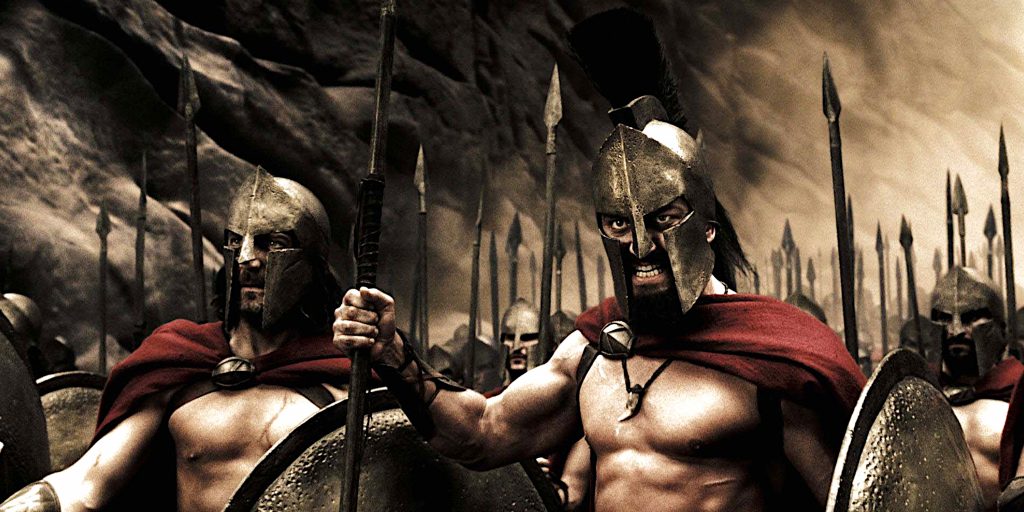
The most important thing to understand about 300 is that it does not directly adapt the account of Thermopylae given by the Greek historian Herodotus.
It adapts Frank Miller’s graphic novel, which had already turned the battle into a heavily stylised warrior myth. Snyder then pushed that visual and dramatic exaggeration even further.
The film also gives itself a useful excuse for its wildest inventions. The story is narrated by Dilios, a Spartan survivor sent away by Leonidas. He later recounts the battle to inspire the Greek army.
We are therefore watching propaganda delivered by a talented storyteller. Dilios is not giving a lecture on Achaemenid administration. He is preparing soldiers to fight. His enemies become monsters, his king becomes superhuman and every Spartan death acquires the glow of destiny.
That framing does not excuse every distortion, particularly the film’s treatment of the Persians. It does, however, explain why realism was never the main objective.
The Visual Style That Changed Action Cinema
300 still looks unlike most historical epics. Large sections were filmed on indoor stages against blue and green screens, with environments, skies and colour added during post-production.
Instead of disguising that artificiality, Snyder embraces it. Landscapes resemble painted panels. Bodies become bronze statues. Blood travels through the air in carefully arranged digital arcs. Even the clouds look as though they have been briefed about the mood.
The restricted colour palette does much of the work:
- Bronze and ochre give the Spartans a sculpted, legendary quality
- Deep reds draw attention to cloaks, blood and sacrifice
- Grey skies make the world feel suspended outside ordinary history
- Harsh contrast separates figures from the digital backgrounds
- Slow motion allows individual movements to resemble comic-book panels
The technique could easily have produced something lifeless. Instead, cinematographer Larry Fong and the visual-effects teams created a remarkably consistent world. It looks unreal, but it looks unreal on purpose.
The visual language became widely copied after the film’s success. Speed-ramped action, desaturated battlefields and digitally enhanced bodies appeared everywhere. Few imitators understood that the style worked because every element belonged to the same exaggerated universe.
Combat and Choreography
The battles in 300 are designed for clarity rather than realism. Movements slow down at the moment of impact, accelerate through transitions and pause long enough for the audience to appreciate each shield strike or spear thrust.
One early sequence follows Leonidas as he moves through several Persian soldiers without an obvious cut. He alternates between spear, shield and sword while the camera changes speed around him. It remains an exceptional piece of action choreography because the geography is always readable.
The film also understands something that many screen battles forget: shields are weapons. Spartans use their aspis shields to hold the line, control distance, knock enemies off balance and protect the man beside them.
Formation fighting matters during the opening clashes. The Spartans survive because they maintain a wall of overlapping shields and projecting spears. As the film progresses, however, discipline gives way to individual heroics. Leonidas and his men begin fighting like ancient superheroes, often abandoning the formation that gave hoplite warfare its strength.
It looks fantastic. Any real Spartan commander would still have several concerns.
The Weapons and Armour of 300
The filmmakers drew upon genuine Greek equipment but reshaped it to fit Frank Miller’s designs.
| Weapon or equipment | Use in the film | Historical basis |
|---|---|---|
| Dory | Primary Spartan thrusting spear | The principal weapon of the Greek hoplite |
| Xiphos | Straight, double-edged short sword | Used as a secondary weapon when the spear was lost or broken |
| Kopis | Forward-curving cutting sword | Known in the Greek world, although not carried by every warrior |
| Aspis | Large round Spartan shield | Essential to hoplite formation fighting |
| Corinthian-style helmet | Worn by Leonidas and the Spartans | Based on genuine Greek helmet forms |
| Red cloak | Visual marker of Spartan identity | Ancient sources associate Spartans with crimson military dress |
The greatest departure is the near-total absence of body armour. Historical Spartan hoplites did not normally enter major battles wearing leather briefs and confidence. Depending on period and status, warriors could use bronze cuirasses, linen armour, greaves and helmets.
The exposed bodies serve a visual purpose. They make every Spartan immediately recognisable and present the warriors as idealised heroic nudes in the tradition of Greek art. They are not practical battlefield clothing.
The film’s swords are also enlarged and roughened for the screen. Leonidas carries a short, broad blade resembling a stylised kopis or machaira rather than a precise reproduction of one surviving weapon type. It looks suitably brutal, though museum curators are unlikely to use it as an identification guide.
Gerard Butler as Leonidas
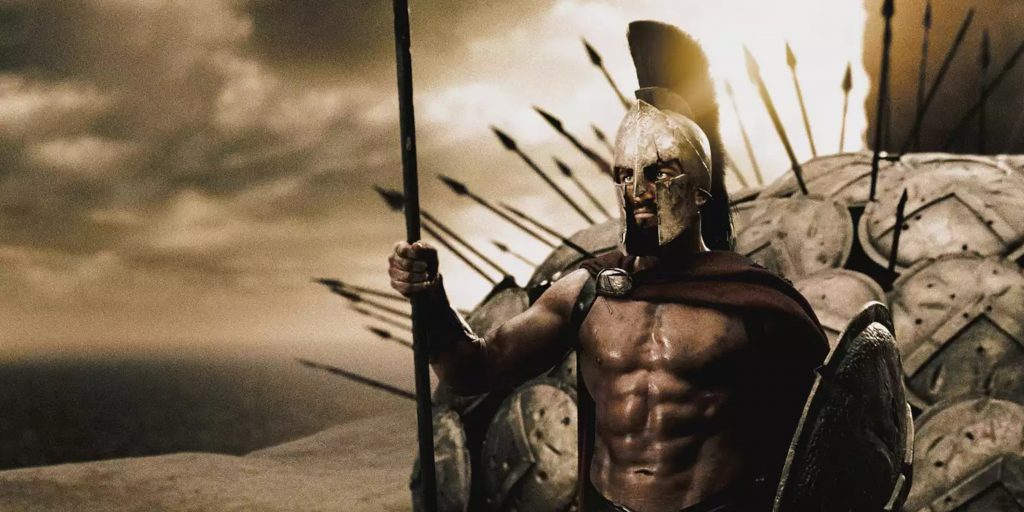
Gerard Butler’s performance holds the film together through force of conviction. His Leonidas communicates primarily through growls, speeches and prolonged eye contact. Understatement has been ordered to retreat.
It works because Butler never behaves as if the material is ridiculous. He gives complete emotional weight to dialogue that could have collapsed into parody. Even the film’s most famous lines feel believable within its heightened world.
Leonidas is less a rounded individual than an ideal of kingship. He is decisive, physically dominant and willing to die beside his soldiers. His doubts appear briefly and privately, particularly in his scenes with Queen Gorgo, but the public figure remains almost impossibly certain.
That limited characterisation suits the film’s mythic structure. Leonidas is already becoming a legend while we watch him.
Queen Gorgo and the Spartan Political Plot
Lena Headey gives Queen Gorgo more intelligence and authority than the role might initially suggest. While Leonidas fights at Thermopylae, Gorgo attempts to secure political support in Sparta.
Her storyline provides a necessary change of pace, but it also feels attached to a different film. The council scenes use familiar palace intrigue, corruption and sexual coercion to create conflict away from the battlefield.
Gorgo’s historical counterpart was a notable figure. Herodotus records a young Gorgo correctly warning her father, Cleomenes I, against accepting a bribe. He also credits her with understanding a hidden message sent beneath the wax of a writing tablet.
The film turns that reputation for intelligence into a more conventional political subplot. Headey makes it compelling, even when the writing gives her much less space than Leonidas.
Xerxes and the Representation of Persia
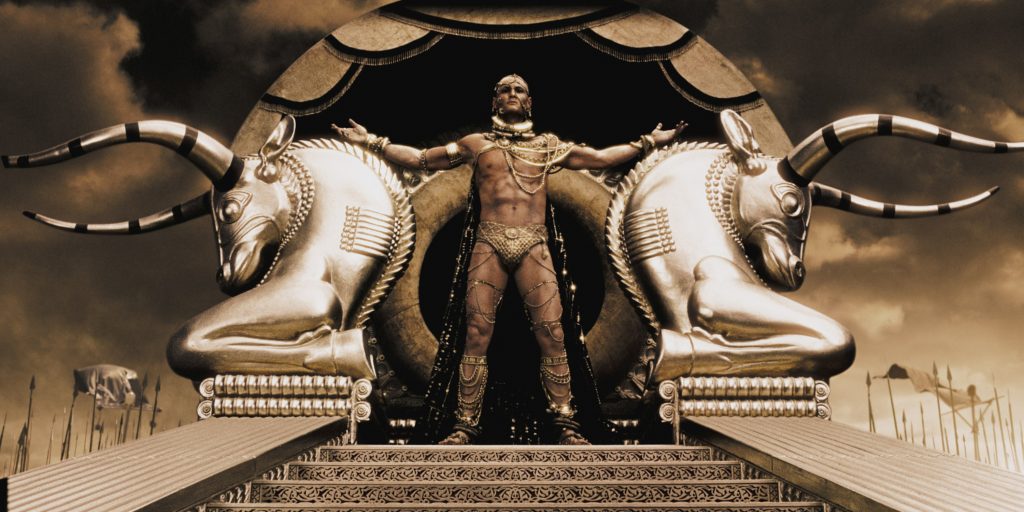
Rodrigo Santoro plays Xerxes as a towering, otherworldly ruler surrounded by gold, luxury and ritual. His altered voice and enormous scale make him feel more like a supernatural temptation than a historical king.
As fantasy, the character is memorable. As a depiction of a Persian ruler, he is deeply misleading.
The Achaemenid Empire was administratively sophisticated, culturally diverse and capable of governing an enormous territory through regional systems of authority. Its armies contained experienced troops drawn from across the empire. Xerxes was not a jewellery-covered giant who travelled with monsters and demanded worship in the manner shown here.
The film repeatedly contrasts muscular, masculine and supposedly free Greeks with feminised, scarred or physically altered Persians. Disability, sexuality and cultural difference become visual signs of corruption. That choice has rightly attracted criticism.
There is a possible defence within the story. Dilios is demonising an enemy before another battle. Yet the images still shape how modern audiences imagine ancient Persia, particularly when many viewers know little about the real empire.
The film is clever enough to show us how propaganda works, but not always careful enough to separate itself from that propaganda.
How Historically Accurate Is 300?
The broad structure of the story comes from the real Persian invasion of Greece in 480 BC. King Leonidas did lead a Greek force at Thermopylae, and a local man named Ephialtes reportedly revealed a route around the pass.
Beyond that framework, the film takes considerable liberties.
What the film gets broadly right
- Thermopylae offered a narrow position where Greek troops could limit Persia’s numerical advantage
- Leonidas was one of Sparta’s two kings
- The Spartan contingent consisted of 300 selected men
- Other Greek forces joined the defence
- Ephialtes revealed a path around the Greek position
- Leonidas remained for a final stand after the position was compromised
- Spears and large shields were fundamental to hoplite combat
- The battle became a powerful symbol of resistance
What the film changes or omits
- The 300 Spartans were accompanied by several thousand Greek allies
- Thespians remained during the final stand and suffered heavily
- Theban troops were also present, although their precise circumstances are debated
- Spartan warriors generally used more armour than the film suggests
- Ephialtes was not recorded as a rejected, disabled Spartan
- The Persian army was not composed of monsters, mutants and masked executioners
- Sparta depended upon the exploitation of the helot population
- Spartan society was not a modern democracy defending universal freedom
- The naval campaign occurring alongside Thermopylae is barely acknowledged
The estimated size of Xerxes’ army remains debated. Ancient figures reaching into the millions are generally treated with caution by modern historians. The force was clearly immense by Greek standards, but the film is interested in emotional scale rather than logistical probability.
The Freedom Problem
The central argument of 300 is that the Spartans are free men resisting enslavement. That works cleanly as heroic cinema and rather less cleanly as history.
Spartan citizens enjoyed political status within their own society, but their way of life depended upon the helots, an unfree population compelled to work the land. Spartan power also rested on severe social control, military conditioning and the exclusion of most residents from citizenship.
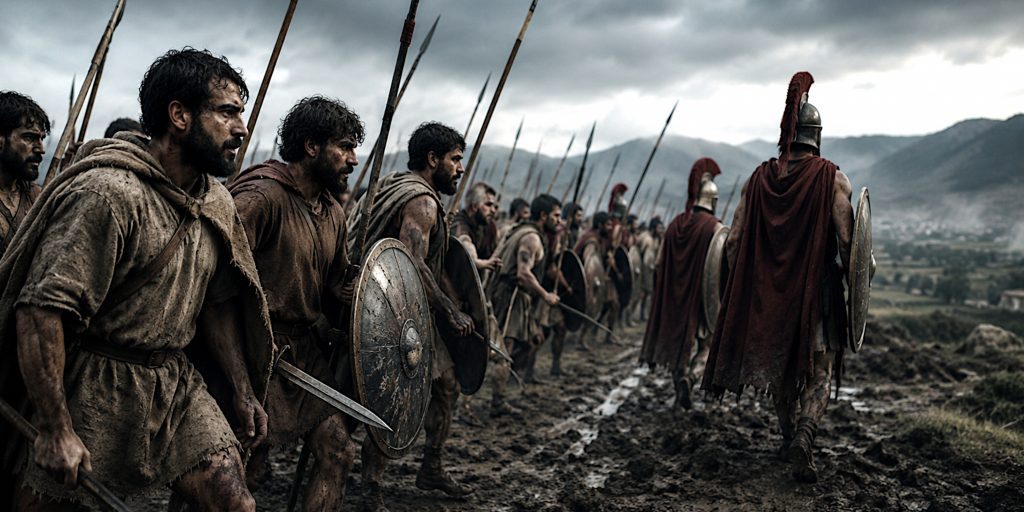
The film briefly acknowledges Spartan brutality through the agoge and the disposal of supposedly “unfit” infants. It never allows those facts to complicate Leonidas’s speeches about freedom.
This contradiction is worth discussing because it makes the film more interesting. 300 shows how nations build usable versions of their past. Uncomfortable details are removed, enemies are simplified and sacrifice becomes proof of moral superiority.
Dilios is creating the version of Thermopylae that Greece needs before Plataea. Zack Snyder is creating the version that a 2000s action audience wants to watch. Neither version has much time for tax records or agricultural labour.
The Supporting Cast
David Wenham’s Dilios is essential because his narration gives the film its grand, oral quality. He does not merely explain events. He actively turns them into legend.
Michael Fassbender brings alarming cheerfulness to Stelios, a Spartan who seems genuinely delighted by increasingly dangerous situations. Vincent Regan gives Captain Artemis some of the film’s limited emotional weight, particularly through his relationship with his son Astinos.
Andrew Tiernan’s Ephialtes is more troubling. The fictional character is defined by physical difference, resentment and betrayal. His exclusion by Leonidas may make military sense within the film, but the association between disability and moral corruption has aged badly.
Dominic West plays Theron with such concentrated unpleasantness that the character might as well enter each scene carrying a sign marked “future betrayal”. He is effective, though hardly mysterious.
The Soundtrack and Sound Design
Tyler Bates’s score combines heavy percussion, orchestral themes and vocal elements to support the film’s ritualistic atmosphere. The music rarely asks permission before becoming enormous.
Sound effects give the fighting much of its physical force. Shields strike with deep metallic crashes, spears cut through the air and arrows arrive in dense, almost environmental waves. The violence is heavily processed, but that suits a film in which everything has been polished into myth.
The score later became the subject of controversy over uncredited material resembling music composed by Elliot Goldenthal for Titus. Warner Bros acknowledged the issue on later home-media releases. It remains an uncomfortable footnote to an otherwise influential soundtrack.
Why 300 Became a Cultural Phenomenon
The film arrived at exactly the right point in internet culture. Its dialogue was short, theatrical and very easy to separate from context.
“This is Sparta!” became a meme almost immediately. Scenes were remixed, parodied and recreated across early video platforms. The film provided reaction images before reaction images had fully conquered online communication.
Its influence spread beyond jokes:
- Action films adopted speed ramping and digitally treated colour
- Television adverts copied its booming narration and heroic compositions
- Video games borrowed its Spartan aesthetic and execution-heavy combat
- Fitness marketing embraced the physiques of its cast
- Historical documentaries increasingly used dramatic digital reconstructions
- The film renewed popular interest in Thermopylae and Spartan warfare
It also helped establish Snyder’s reputation as a director capable of translating comic-book imagery directly to the screen. That approach later shaped Watchmen, Man of Steel and his other superhero films.
Not every influence was beneficial. The image of the shirtless Spartan became so dominant that historically armoured hoplites can now look wrong to audiences. Cinema invented the misconception, then trained viewers to defend it.
Has 300 Aged Well?
Visually, mostly yes. The deliberately artificial backgrounds prevent the effects from dating in the same way as early attempts at photorealistic digital environments. The film still has a coherent aesthetic identity, which matters more than whether every digital wolf looks convincing.
The action also remains impressively readable. Modern blockbusters sometimes bury choreography beneath rapid editing and weightless visual effects. 300 lets us see bodies move through space, even if those bodies are performing impossible feats.
Its politics and cultural stereotypes have aged less comfortably. The depiction of Persia is reductive, while the connection between physical perfection and moral worth now feels particularly blunt.
The political material in Sparta is weaker than the Thermopylae sequences, and the endless solemnity can become exhausting. Everyone speaks as though they know their dialogue will appear on a poster.
Still, there is something refreshing about the film’s commitment. It knows precisely what kind of spectacle it wants to create and pursues it without embarrassment.
300 Compared with the Real Battle of Thermopylae
| Subject | In the film | Historical picture |
|---|---|---|
| Greek force | Primarily 300 Spartans | Several thousand Greeks initially defended the pass |
| Final defenders | The Spartans | Spartans, Thespians and Thebans remained |
| Spartan equipment | Helmet, shield, spear and minimal clothing | Hoplites could wear cuirasses, greaves and other armour |
| Persian troops | An almost inhuman mass | A diverse imperial army with organised specialist units |
| Ephialtes | Rejected Spartan who seeks revenge | Local Greek who reportedly revealed the mountain path |
| Xerxes | Giant divine tyrant | Achaemenid king ruling through a complex imperial system |
| Spartan society | A community of free warriors | A militarised citizen elite supported by an oppressed population |
| Purpose of the battle | Defence of freedom | Part of a wider Greek defensive strategy on land and sea |
Is 300 Worth Watching Today?
Yes, provided you know what you are watching.
300 is a poor introduction to Achaemenid Persia and an unreliable guide to Spartan society. It is, however, a fascinating example of modern mythmaking and one of the most visually confident action films of its decade.
Gerard Butler gives the performance exactly the conviction it requires. The battle choreography remains excellent, and Snyder’s translation of illustrated panels into moving images still feels bold.
The film’s greatest strength is also its central weakness. Everything has been simplified into instantly recognisable opposites: freedom and slavery, strength and weakness, beauty and corruption, Greece and Persia. That clarity makes the story powerful, but it also makes the history smaller.
Final Verdict
| Category | Rating |
|---|---|
| Visual design | 9 out of 10 |
| Action choreography | 9 out of 10 |
| Performances | 8 out of 10 |
| Historical accuracy | 4 out of 10 |
| Cultural sensitivity | 4 out of 10 |
| Entertainment value | 9 out of 10 |
| Overall | 8 out of 10 |
300 is excessive, politically awkward and completely captivated by its own muscles. It is also inventive, beautifully composed and far more intelligent about mythmaking than its shouting suggests.
Watch it as a historical fantasy told by an unreliable narrator, then read about the real Thermopylae and the Achaemenid Empire afterwards. Leonidas would probably approve of the first part. Xerxes may have notes.
Frequently Asked Questions
Is 300 based on a true story?
The film is loosely based on the Battle of Thermopylae in 480 BC, but its direct source is the graphic novel by Frank Miller and Lynn Varley. Characters, equipment, troop numbers and events are heavily stylised.
Did only 300 Spartans fight at Thermopylae?
No. The Spartans formed part of a much larger Greek force. Several thousand Greek troops initially defended the pass. Thespians and Thebans were also present during the final phase.
What sword does Leonidas use in 300?
Leonidas carries a fictionalised short sword with a forward-weighted blade. Its design resembles an exaggerated Greek kopis or machaira. Historical Spartans also used the straight, double-edged xiphos as a secondary weapon.
Why do the Spartans fight without body armour?
The choice comes from the visual style of Frank Miller’s comic. It presents the warriors as idealised heroic figures and makes them immediately recognisable. Historical Spartan hoplites used considerably more protection.
Was Xerxes really like his portrayal in 300?
No. The film presents Xerxes as a fantastical god-king. The historical Xerxes I ruled the sophisticated and culturally diverse Achaemenid Empire.
Is 300 suitable for younger viewers?
The film contains frequent graphic violence, sexual material and disturbing imagery. It was classified 15 in the UK.
Watch the trailer:
Image Credit: Copyright Warner Bros. Pictures