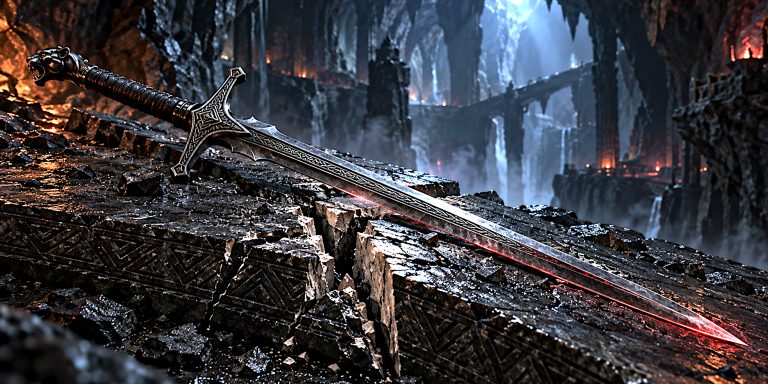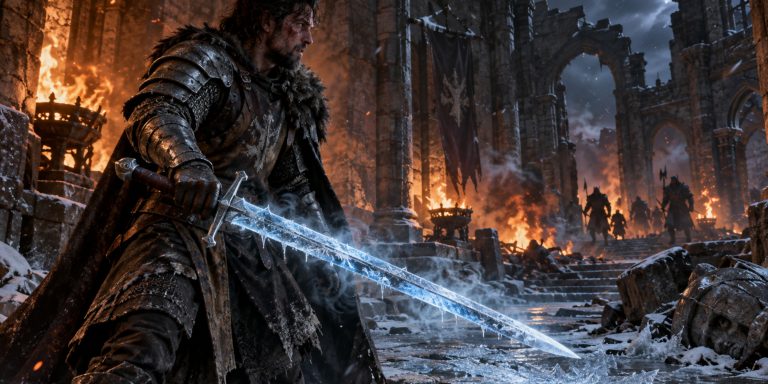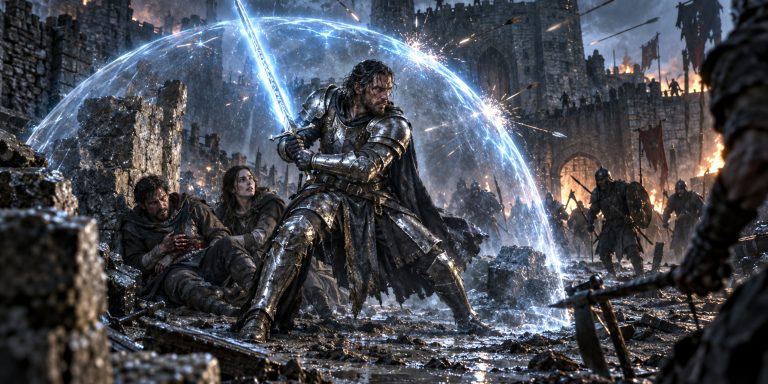
Herugrim is one of those weapons in The Lord of the Rings that gets surprisingly little page time considering who carries it. It has no reforging sequence, no ancient prophecy attached to it and, as far as Tolkien tells us, no convenient ability to glow whenever Orcs are nearby.
Yet Herugrim matters.
It is the sword of Théoden, King of Rohan, and its return marks one of the most important changes in his character. When Théoden takes up Herugrim again, the exhausted old king sitting beneath Gríma Wormtongue’s influence becomes a warrior-king once more.
That makes Herugrim interesting for reasons beyond blade statistics. Tolkien uses the sword as a physical expression of recovered authority, identity and courage.
And, naturally, the films gave it a horse on the pommel. Because this is Rohan. There was always going to be a horse somewhere.
Herugrim at a Glance
| Detail | Herugrim |
|---|---|
| Owner | Théoden, King of Rohan |
| Culture | Rohirrim |
| Type | Long sword |
| Period | Third Age |
| Location | Rohan |
| Associated battles | Battle of the Hornburg, Battle of the Pelennor Fields |
| Known decoration | Gold fittings and green gems on the scabbard |
| Name origin | Old English |
| Film appearance | The Lord of the Rings: The Two Towers and The Return of the King |
| Film wielder | Bernard Hill as Théoden |
Tolkien provides relatively little technical information about the weapon itself. We know considerably more about its significance than its dimensions, construction or history.
That distinction matters because replicas and film props have made the cinematic Herugrim so familiar that it is easy to assume Tolkien described the same object in detail. He did not.
What Does Herugrim Mean?
Like much of the language surrounding Rohan, the name Herugrim has its roots in Old English.
The word is associated with fierceness or savagery and can be understood along the lines of “very fierce” or “fell”. Tolkien’s choice was not random fantasy vocabulary. A related form, heorugrim, appears in Beowulf, a work Tolkien knew rather better than most people know their own Wi-Fi password.
The connection is particularly fitting.
Rohan is deliberately presented through an Anglo-Saxon linguistic and literary framework. Names including Théoden, Éomer and Éowyn are drawn from or constructed through Old English vocabulary, while the culture of the Rohirrim evokes the heroic societies Tolkien encountered in early medieval literature.
Herugrim therefore sounds ancient because, linguistically speaking, it rather is.
Théoden and Herugrim
Herugrim belongs to Théoden, the seventeenth King of Rohan.
By the events of The Two Towers, Théoden has ruled for decades but has fallen into physical and psychological decline while Gríma Wormtongue manipulates his court on behalf of Saruman.
The sword has effectively disappeared with him.
When Gandalf arrives at Meduseld and breaks Gríma’s hold over the king, Théoden begins recovering the things that define him. He stands. He goes outside. He looks upon his people. He takes up a sword.
The progression is beautifully simple.
Théoden’s recovery is therefore not represented by some enormous magical spectacle. Tolkien instead gives us the restoration of ordinary physical actions associated with kingship and warrior culture.
Herugrim is central to that transformation.
Herugrim in Gríma Wormtongue’s Chest
One of the more revealing details about Herugrim is where it has been kept.
Not hanging honourably in Théoden’s hall.
Not beside the king.
Not stored ceremonially among the treasures of his ancestors.
Gríma has it.
After Théoden recovers, Háma retrieves Herugrim from Wormtongue’s locked chest. He describes it simply as the king’s “ancient blade”. The weapon is presented as a long sword carried in a scabbard decorated with gold and green gems.
The implication is rather unpleasant for Gríma.
Other missing possessions are apparently found among his belongings as well.
So alongside treason, manipulation and generally making Meduseld an absolutely miserable place to work, Wormtongue appears to have been quietly accumulating things that did not belong to him.
The theft or concealment of Herugrim is particularly significant because this is the king’s weapon. Gríma has effectively removed one of the symbols of Théoden’s ability to act.
When Háma returns it, the symbolism is difficult to miss.
The king has his sword again.
Why the Return of Herugrim Matters
Herugrim’s restoration comes at precisely the moment Théoden chooses action over paralysis.
He has spent much of his decline being told that he is too old, too weak and too vulnerable to govern effectively. Gríma’s political strategy depends upon making inactivity appear sensible.
Then Théoden takes his sword.
Soon afterwards, he orders the mobilisation of Rohan.
This is why I find Herugrim considerably more interesting than its relatively small role might suggest. Tolkien’s famous weapons often carry enormous histories. Narsil breaks beneath Elendil. Glamdring comes from Gondolin. Sting was forged by the Elves and eventually passes from Bilbo to Frodo.
Herugrim works differently.
Its most important story happens during Théoden’s lifetime.
It represents a man recovering himself.
Was Herugrim an Ancient Heirloom?
Háma calls Herugrim Théoden’s “ancient blade”, but Tolkien never gives us a detailed history of its manufacture.
We do not know who forged it.
We do not know which previous kings carried it.
We cannot confidently say when it was made.
This is one area where Tolkien fans need to resist filling in the gaps simply because the answer feels obvious.
Herugrim may have been an inherited royal weapon, and the description certainly suggests age and status. However, Tolkien does not provide anything comparable to the extensive histories of Narsil, Glamdring or Orcrist.
Sometimes an ancient sword is allowed to remain mysterious.
Frankly, Middle-earth could use a few more objects without a twelve-generation family tree attached.
What Did Tolkien’s Herugrim Look Like?
The canonical physical description is limited.
Herugrim is described as a long sword. Its scabbard is clasped with gold and decorated with green gems.
Beyond that, Tolkien leaves considerable room for interpretation.
There is no detailed description of:
- blade geometry
- fuller construction
- guard shape
- pommel design
- grip material
- blade length
- weight
- inscriptions
- maker
- exact age
This becomes particularly important when discussing the film weapon.
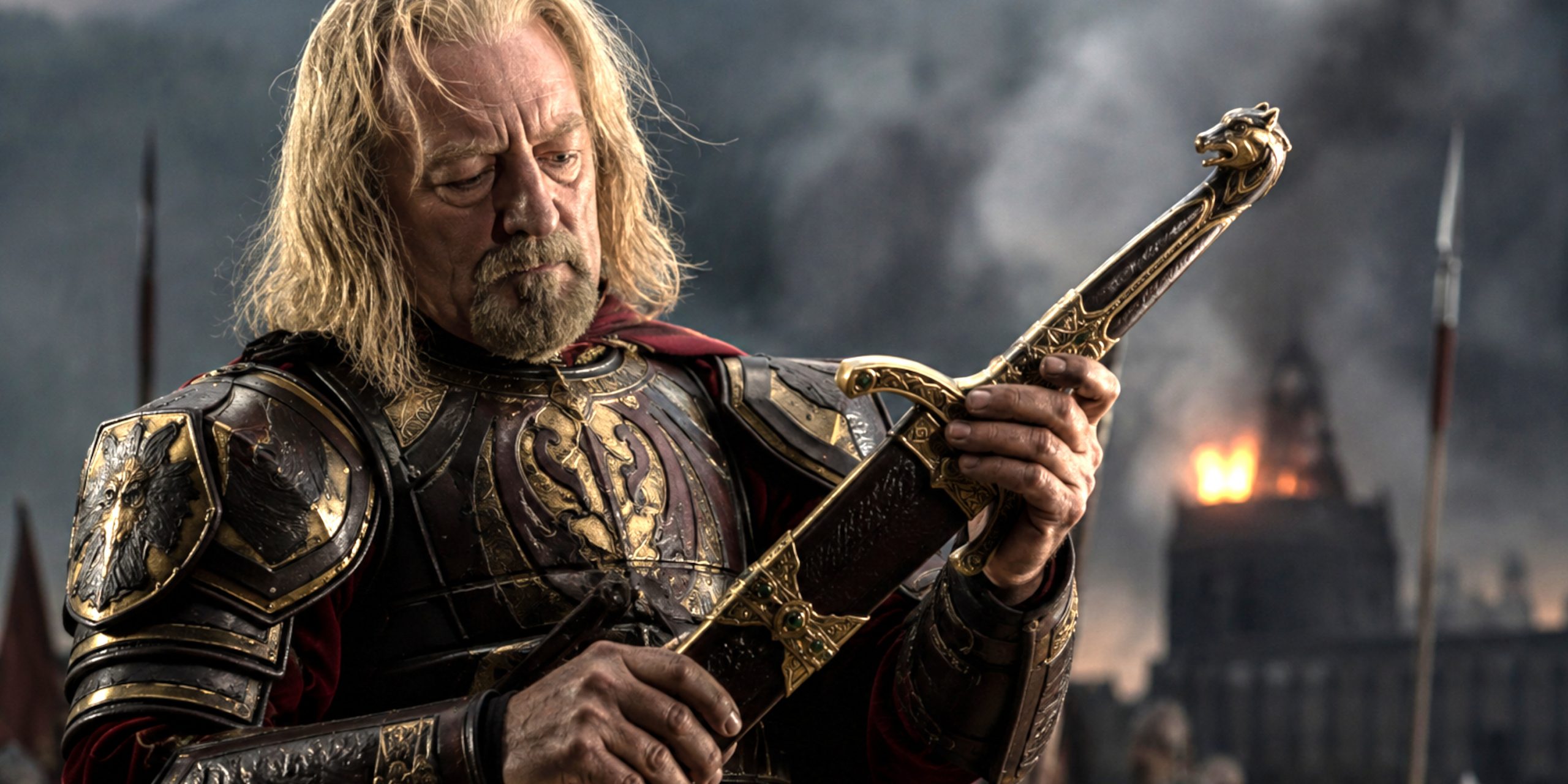
The famous horse-headed Herugrim seen in Peter Jackson’s trilogy is an adaptation design rather than a detailed recreation of a sword exhaustively described by Tolkien.
Herugrim in Peter Jackson’s Films
The cinematic Herugrim is considerably more elaborate.
Created for Peter Jackson’s The Lord of the Rings trilogy, the weapon incorporates the visual language established for Rohan throughout the films.
Its most recognisable feature is the horse-head pommel.
The horse imagery is hardly subtle, but subtlety would probably have been stranger. Rohan’s political identity, military power, art and mythology are all closely associated with horses.
The film sword also features rich decoration and a curved guard, giving it a distinctive silhouette without turning it into an implausibly enormous fantasy weapon.
That last point deserves some credit.
Fantasy cinema has occasionally treated swords as though the primary requirement was the ability to double as railway infrastructure.
Herugrim still looks like something a mounted warrior might reasonably carry.
How Historically Plausible Is the Film Sword?
The film version is fantasy, but its designers drew heavily from historical visual traditions.
Rohan’s material culture in the Jackson films borrows particularly from Anglo-Saxon, Migration Period and Scandinavian art.
The sword therefore combines recognisable historical ideas with deliberate fantasy exaggeration.
Historical influences
The decorated fittings resemble the prestige weapons of early medieval elites, where swords could function as displays of status as much as practical weapons.
Animal ornament is also entirely appropriate to the visual traditions influencing Rohan. Germanic and Scandinavian metalwork frequently incorporated stylised beasts, interlaced forms and zoomorphic decoration.
Richly decorated scabbards and fittings likewise have archaeological precedents.
What is less historical is the precise combination of these elements into the cinematic Herugrim. It should be viewed as historical fantasy design rather than an attempted archaeological reconstruction.
That is probably exactly what it should be.
Herugrim at Helm’s Deep
After reclaiming his sword, Théoden rides west with his forces and eventually makes his stand at the Hornburg.
Herugrim consequently becomes part of Théoden’s return to active warfare.
Interestingly, early material connected with Tolkien’s development of the battle gives the sword a more explicit moment, describing Herugrim effectively returning to battle after a long silence.
The idea fits Théoden perfectly.
An old sword is drawn again.
An old king rides again.
Both have been inactive for too long.
In the finished story, Théoden fights among his people and survives the siege before riding out from the Hornburg.
For someone who was barely getting out of his chair a few chapters earlier, the career turnaround is fairly dramatic.
Herugrim at the Pelennor Fields
Herugrim’s most important battlefield association comes with Théoden’s final campaign.
Rohan rides to the relief of Gondor after the beacons are lit and the Red Arrow reaches Théoden.
At the Battle of the Pelennor Fields, Théoden leads the charge personally.
This matters enormously to his character.
He could have remained behind. He is an ageing king whose only son, Théodred, has already been killed. Instead he rides at the head of the Rohirrim.
Théoden’s transformation is now complete.
The man introduced to us as a diminished ruler controlled by another man’s whispers becomes a king leading thousands of horsemen directly into Mordor’s army.
Herugrim belongs to that final version of Théoden.
Is Herugrim a Magical Sword?
Probably not.
At least, Tolkien never identifies it as one.
Herugrim has no stated magical abilities. It does not glow near enemies like Sting. It is not associated with supernatural craftsmanship comparable to some Elvish blades, nor does it carry the extraordinary dynastic importance of Andúril.
That does not make it ordinary.
Named swords in Tolkien frequently carry significance through ownership, history and reputation rather than RPG-style magical properties.
Herugrim is valuable because it is Théoden’s sword.
That is enough.
Herugrim vs Andúril
The contrast between Herugrim and Aragorn’s Andúril is particularly interesting.
| Feature | Herugrim | Andúril |
| Owner | Théoden | Aragorn |
| Cultural association | Rohan | Númenor and Gondor |
| Known magical properties | None stated | Exceptional lineage and supernatural associations |
| Earlier identity | Unknown | Narsil |
| Famous former owner | None recorded | Elendil |
| Symbolism | Restored kingship | Returned kingship |
| Battlefield role | Hornburg and Pelennor | War of the Ring campaigns |
The swords actually perform similar narrative jobs.
Both represent kingship.
The difference is direction.
Andúril points forward towards the crown Aragorn will claim.
Herugrim reconnects Théoden with the kingship he already possesses but has temporarily lost control of.
One sword announces a king who is coming.
The other reminds a king who he already is.
Herugrim vs Other Famous Tolkien Swords
| Sword | Wielder | Origin | Defining Feature |
| Herugrim | Théoden | Rohan, exact origin unknown | Symbol of Théoden’s restored authority |
| Andúril | Aragorn | Reforged from Narsil | Sword of the returning King |
| Glamdring | Gandalf | Gondolin | Ancient Elvish blade |
| Orcrist | Thorin | Gondolin | Famous Goblin-cleaver |
| Sting | Bilbo and Frodo | Gondolin | Glows near Orcs |
| Guthwinë | Éomer | Rohan | Sword of Rohan’s future king |
Herugrim lacks the mythology surrounding several of these weapons, but within Rohan it occupies an important place.
It belongs to the king who leads the Rohirrim during their greatest intervention in the War of the Ring.
That gives it a fairly respectable CV.
Herugrim and the Culture of Rohan
Herugrim also fits Tolkien’s wider portrayal of the Rohirrim.
Rohan is a society in which personal weapons matter.
Warriors fight in close proximity to their leaders. Kings ride with their households. Swords are named. Horses are named. Lineage is remembered through songs and burial mounds.
Weapons therefore become extensions of reputation.
Éomer carries Guthwinë. Théoden carries Herugrim.
Neither weapon receives anything like the elaborate mythological background of Andúril because Rohirric heroic culture operates on a more immediate human scale.
The kings of Rohan are not descendants of Númenórean monarchs living for centuries.
They grow old.
Their sons die.
Their horses fall.
Their kingdoms survive because people choose to ride when they are needed.
Herugrim belongs perfectly within that world.
The Sword and Théoden’s Death
Théoden is killed during the Battle of the Pelennor Fields after his horse Snowmane falls upon him.
His death is one of Tolkien’s most deliberately heroic moments.
Théoden has already achieved what matters. Rohan has answered Gondor’s call, broken into the besieging armies and transformed the battle.
His final campaign reverses everything associated with his introduction.
He was passive. Now he acts.
He was isolated. Now he rides surrounded by his people.
He was physically diminished. Now he leads a cavalry charge.
He was manipulated by Gríma. Now he chooses his own fate.
Herugrim accompanies that transformation from beginning to end.
Herugrim FAQ
Who owned Herugrim?
Herugrim was the sword of Théoden, King of Rohan.
What does Herugrim mean?
The name derives from Old English and carries the sense of something extremely fierce, savage or “fell”. A related form appears in Beowulf.
Did Gríma steal Herugrim?
Herugrim was discovered locked inside Gríma Wormtongue’s chest along with other objects that people had apparently been missing. Gríma claimed Théoden had entrusted the weapon to him.
Was Herugrim magical?
Tolkien gives Herugrim no explicit magical properties.
Who forged Herugrim?
Tolkien does not identify its maker.
How old was Herugrim?
It is described as Théoden’s ancient blade, but its exact age is unknown.
Did Théoden use Herugrim at Helm’s Deep?
Herugrim was restored to Théoden before he rode to war, and it is associated with his campaigns during the War of the Ring. Tolkien’s earlier drafting of the Hornburg battle explicitly placed Herugrim in Théoden’s hand during the fighting.
Is the film version accurate to Tolkien?
Only partly. Tolkien describes a long sword with an ornate scabbard featuring gold and green gems. The detailed horse-themed design familiar from Peter Jackson’s films was developed for the adaptation.