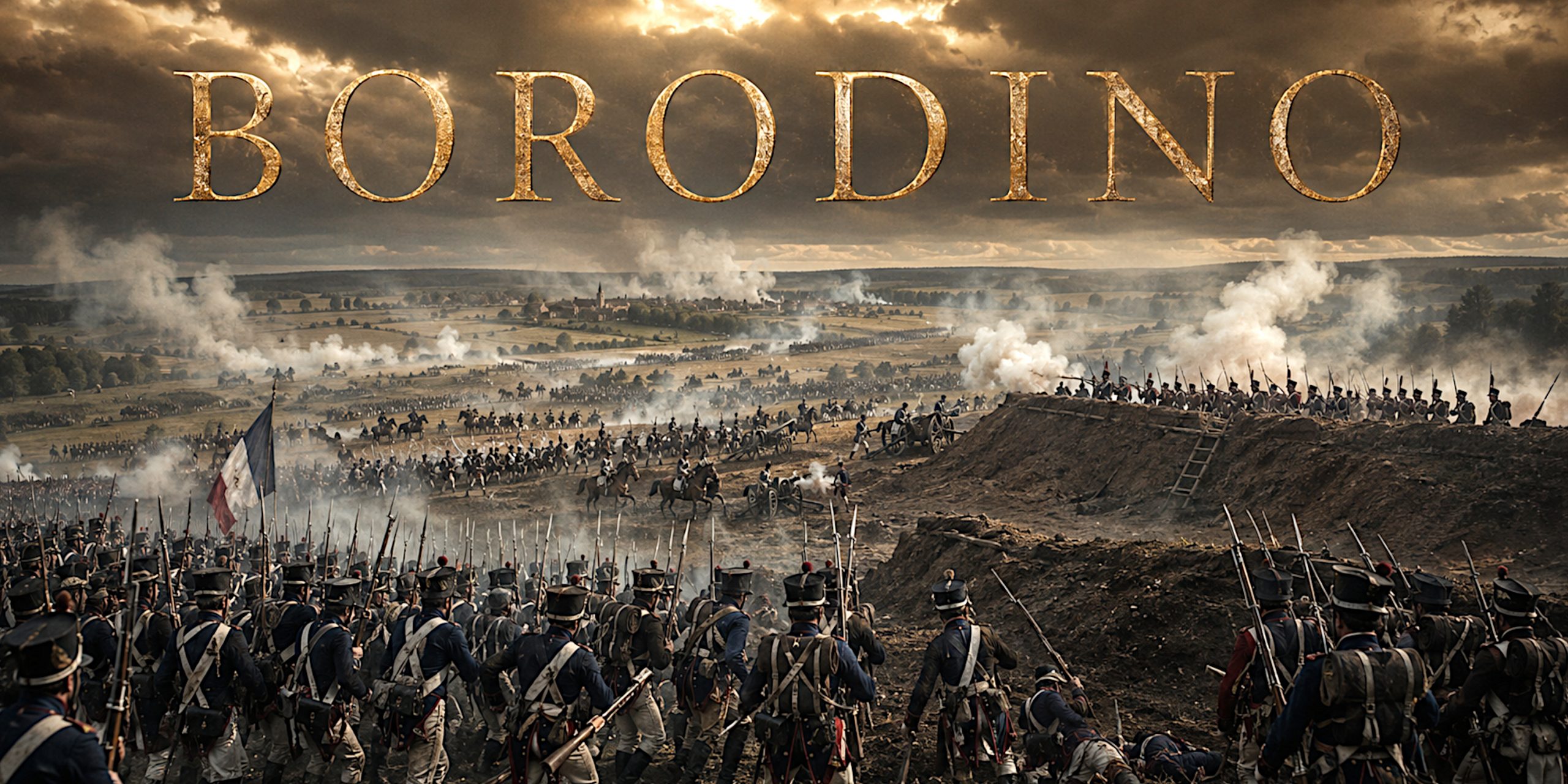
On 7 September 1812, roughly a quarter of a million soldiers met near the village of Borodino, around 120 kilometres west of Moscow. By nightfall, perhaps 70,000 or more had been killed, wounded or gone missing. The French held the battlefield, the Russians withdrew and both empires immediately began arguing about what the result meant.
The simplest description is that Napoleon won a tactical victory without gaining the decision he needed. His Grande Armée captured the principal Russian fieldworks and opened the road to Moscow, but it did not destroy Mikhail Kutuzov’s army. That distinction matters. Napoleon had marched deep into Russia to force a political settlement, not merely to acquire another blood-soaked patch of ground.
Borodino remains one of the most difficult Napoleonic battles to judge. French troops achieved almost every immediate objective placed before them. The Russian army nevertheless survived, rebuilt and helped turn Napoleon’s retreat into a catastrophe. It was a victory, certainly, but one with an unusually convincing Russian accent.
Battle of Borodino at a Glance
| Detail | Summary |
|---|---|
| Date | 7 September 1812, or 26 August under the Russian calendar then in use |
| Location | Borodino, west of Moscow, Russian Empire |
| War | French invasion of Russia, part of the Napoleonic Wars |
| Main commanders | Napoleon Bonaparte and Field Marshal Mikhail Kutuzov |
| French-led strength | About 128,000 troops and roughly 587 guns |
| Russian strength | About 120,000 to 150,000 troops and roughly 624 to 640 guns, depending on whether militia and irregulars are counted |
| Estimated losses | Approximately 30,000 to 35,000 French-led casualties and 40,000 to 50,000 Russian casualties, although estimates vary considerably |
| Immediate result | French tactical victory and Russian withdrawal |
| Strategic result | The Russian army survived; Napoleon occupied Moscow but failed to obtain peace |
Why Was the Battle of Borodino Fought?
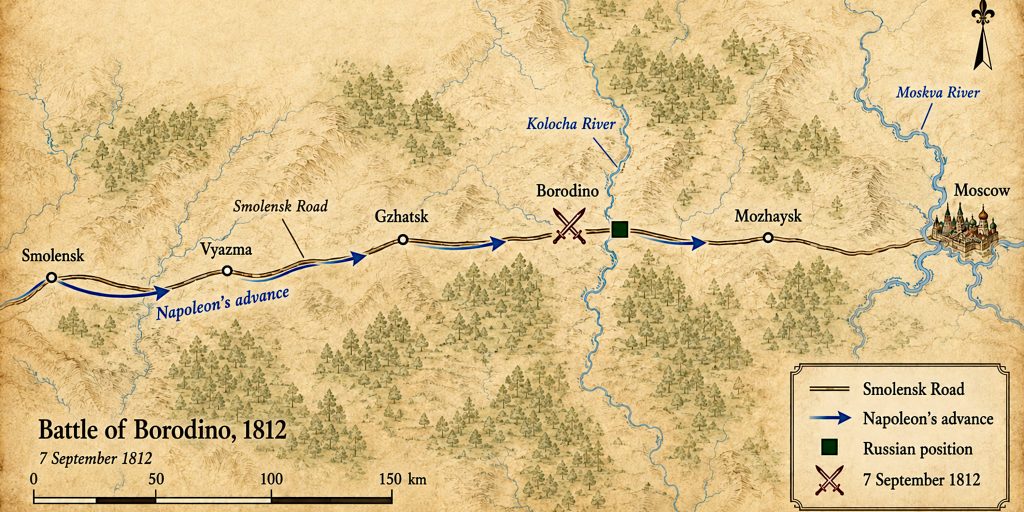
Napoleon invaded Russia in June 1812 with an army drawn from across his empire and allied states. His political aim was to compel Tsar Alexander I to return to the Continental System, the economic blockade intended to isolate Britain. The campaign depended upon forcing the Russians into a decisive battle and securing a settlement before distance, hunger and disease dismantled the Grande Armée.
The Russians repeatedly withdrew. Generals Mikhail Barclay de Tolly and Pyotr Bagration preserved their armies, though their refusal to gamble everything in an early battle was unpopular at court and within the army. Barclay’s strategy was militarily sensible and politically miserable, a familiar combination in Russian command history.
After the fall of Smolensk, Alexander appointed the veteran Mikhail Kutuzov as commander-in-chief. Kutuzov continued the retreat but understood that Moscow could not be abandoned without a major effort. The Russian army therefore occupied a position near Borodino, astride the New Smolensk Road.
The ground offered rivers, ravines and open fields across which French formations would have to advance under artillery fire. The Russians strengthened it with hastily built earthworks. These included the Great Redoubt, also called the Raevsky Redoubt, near the centre, and three arrow-shaped fieldworks known as the Bagration flèches on the more vulnerable left.
On 5 September, the French captured the advanced Shevardino Redoubt after severe fighting. The action revealed Napoleon’s probable line of attack and cost both armies several thousand men before the main battle had even begun.
Forces at Borodino
Exact totals remain disputed because historians count militia, Cossacks, non-combatants and troops held out of the main action differently. Rounded figures are more honest than suspiciously tidy precision.
| Army | Troops present or available | Artillery | Character of the force |
| French-led Grande Armée | About 128,000 | About 587 guns | French, Polish, Italian, German and other allied contingents; tactically experienced but depleted by the march into Russia |
| Imperial Russian Army | About 120,000 to 150,000 | About 624 to 640 guns | Regular infantry and cavalry, Cossacks and militia; strongly supported by artillery |
Napoleon’s Imperial Guard, perhaps 18,000 men, remained largely uncommitted. Some Russian militia were present but lacked the training and equipment to be treated as equivalent to regular infantry. Numbers alone therefore give a rather blunt impression of combat power.
Leaders and Troop Composition
French-led Grande Armée
- Emperor Napoleon I: Commander-in-chief. He directed the battle from near the Shevardino position but showed less tactical energy than in his finest campaigns.
- Marshal Louis-Nicolas Davout: Commanded I Corps and led the first major attacks against the Russian left.
- Marshal Michel Ney: Commanded III Corps and became heavily engaged around the Bagration flèches and Semyonovskaya.
- Prince Eugène de Beauharnais: Commanded IV Corps, including Italian troops, against Borodino village and the Great Redoubt.
- Marshal Joachim Murat: Directed the cavalry reserve in repeated attacks against the Russian centre and left.
- Prince Józef Poniatowski: Commanded the Polish V Corps on the southern flank near Utitsa.
The army included:
- French line and light infantry, grenadiers and voltigeurs
- Polish, Italian, Bavarian, Württemberg, Westphalian and other allied formations
- Cuirassiers, carabiniers, dragoons, lancers, hussars and chasseurs à cheval
- Foot and horse artillery using guns and howitzers
- The Imperial Guard, retained as the army’s final reserve
Imperial Russian Army
- Field Marshal Mikhail Kutuzov: Commander-in-chief. His principal achievement was preserving cohesion at army level, although much tactical control fell to subordinates.
- General Mikhail Barclay de Tolly: Commanded the 1st Army of the West and responded energetically to crises around the Great Redoubt.
- Prince Pyotr Bagration: Commanded the 2nd Army of the West on the exposed Russian left until he was mortally wounded.
- General Nikolay Raevsky: His VII Corps defended the Great Redoubt that later took his name.
- General Dmitry Dokhturov: Assumed responsibility on the Russian left after Bagration was wounded.
- Ataman Matvei Platov and General Fyodor Uvarov: Led the Cossack and regular cavalry raid against Napoleon’s northern flank.
The Russian army contained:
- Musketeer, grenadier and jäger infantry regiments
- Cuirassiers, dragoons, hussars and uhlans
- Cossack irregular cavalry armed principally with lances, sabres and firearms
- Foot and horse artillery, including distinctive licorne guns
- Opolchenie militia, whose battlefield value was limited but who could perform support duties
The Russian Position

The Russian line extended from the Kolocha River and the village of Borodino in the north to wooded ground around Utitsa in the south. Its strongest natural protection lay on the right, while the left was comparatively exposed. Kutuzov placed a large part of his army on the right because he feared an advance along the New Smolensk Road.
Napoleon instead concentrated against the centre and left. The Bagration flèches became the focus of repeated infantry assaults, cavalry charges and artillery bombardments. They were field fortifications rather than permanent forts: packed earth, timber and gun positions thrown together under pressure. Their importance came from their location, not their architectural glamour.
Farther north, the Great Redoubt formed the main anchor of the Russian centre. It contained artillery and was protected by infantry behind and around it. Capturing it required the French to cross open ground under fire, enter the earthwork and then withstand Russian counter-attacks.
Arms and Armour at Borodino
Borodino was decided primarily by muskets and artillery, but swords remained important weapons of cavalry combat and potent marks of rank.
| Troops | Principal weapons and protection |
| French infantry | Model 1777 corrigé An IX flintlock musket, socket bayonet, short infantry sabre for selected grenadiers, artillerymen and other troops |
| French light cavalry | AN IX and AN XI curved light cavalry sabres, carbines and pistols |
| French heavy cavalry | AN IX and AN XI straight cavalry swords; cuirassiers wore iron breastplates and backplates with helmets |
| French lancers | Lance, curved sabre and pistols; Polish lancers were particularly prominent |
| Russian infantry | Russian-pattern flintlock muskets, socket bayonets and short swords or hangers for some specialists |
| Russian heavy cavalry | 1798 and 1810 pattern straight broadswords or pallasches; cuirasses and metal helmets among cuirassier regiments |
| Russian light cavalry | Curved sabres used by hussars and light horse, with carbines and pistols |
| Russian Cossacks and uhlans | Lances, curved sabres and firearms, with little or no body armour |
| Artillery | French 6- and 12-pounder cannon and howitzers; Russian 6- and 12-pounder guns plus licornes |
Swords used in the battle
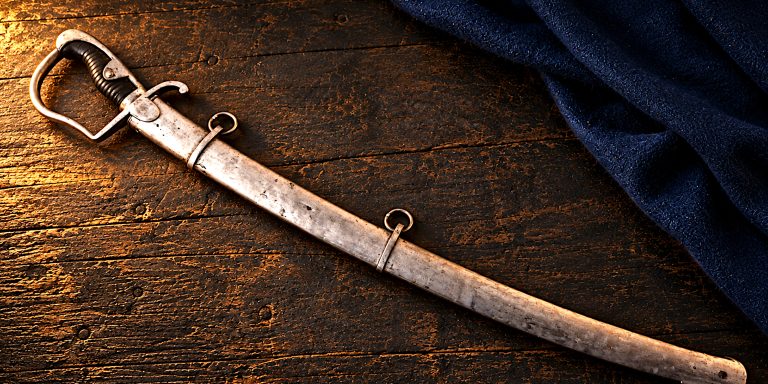
The French heavy cavalry sword was designed for forceful thrusts and cuts from horseback. Its long, straight blade suited massed cuirassier attacks. French light cavalry sabres had curved blades better adapted to slashing during fast-moving pursuit and skirmishing.
Russian cuirassiers carried straight-bladed pallasches, while hussars and other light cavalry used curved sabres. Officers on both sides carried regulation or privately purchased swords. These were functional weapons, but their quality and decoration varied according to rank and means.
Armour was largely confined to heavy cavalry. A cuirass could protect against some sword cuts and spent projectiles, but it did not make its wearer proof against close-range musket balls or cannon fire. Borodino was not kind to anyone who mistook polished metal for invulnerability.
Battle Timeline
| Time | Event |
| 5 September | French troops seize the Shevardino Redoubt after a hard preliminary action. The Russian left withdraws to the main position. |
| Before dawn, 7 September | Both armies prepare in dense formations. French batteries move into position opposite the Russian centre and left. |
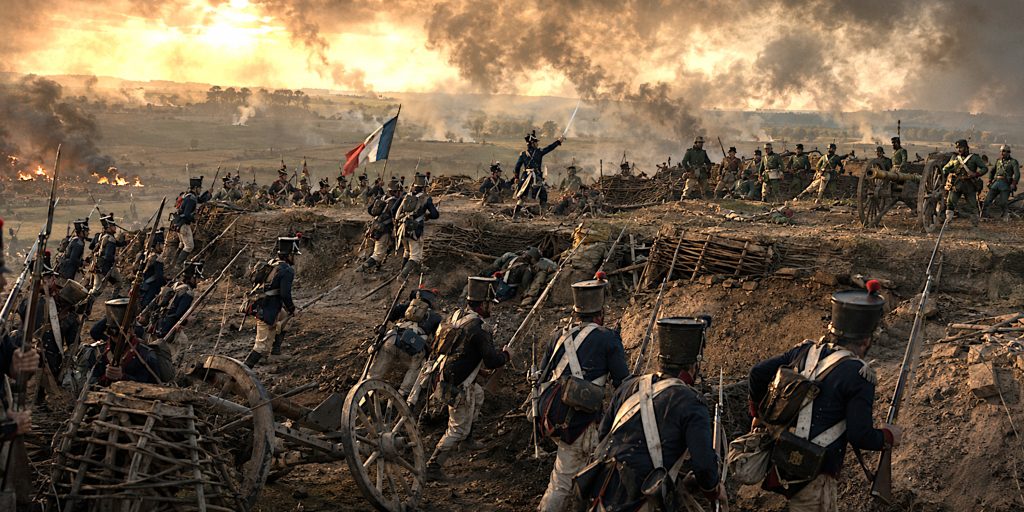
| Around 6.00 am | French artillery opens fire. Eugène’s troops attack Borodino village while Davout advances towards the southern flèche. |
| Early morning | Borodino village falls, though French troops crossing the Kolocha are checked beyond it. Repeated attacks begin against the Bagration flèches. |
| Around 7.00 to 10.00 am | Davout, Ney and Murat commit more infantry and cavalry. The flèches change hands several times amid close-range artillery and musket fire. |
| Late morning | Russian counter-attacks briefly recover parts of the position. Fighting expands around Semyonovskaya and the Great Redoubt. |
| Around midday | Bagration is struck by a shell fragment and carried from the field. His removal damages command and morale on the Russian left. |
| Early afternoon | Platov and Uvarov raid the French northern flank. The attack achieves little tactically but delays French operations and unsettles Napoleon. |
| Around 3.00 pm | French infantry and cavalry mount a major converging assault on the Great Redoubt. General Auguste de Caulaincourt is killed as his cuirassiers break into the position. |
| Late afternoon | The French hold the principal Russian earthworks. The Russians establish a new line farther east rather than collapsing. |
| Evening | Fighting fades. Napoleon declines to commit the Imperial Guard to a final attack. Kutuzov orders a withdrawal during the night. |
Timings differ between accounts, partly because smoke, confusion and the scale of the battlefield made precise observation difficult. Anyone who claims to know exactly what every corps was doing at every minute is enjoying a confidence unavailable to most of the men present.
The Fight for the Bagration Flèches
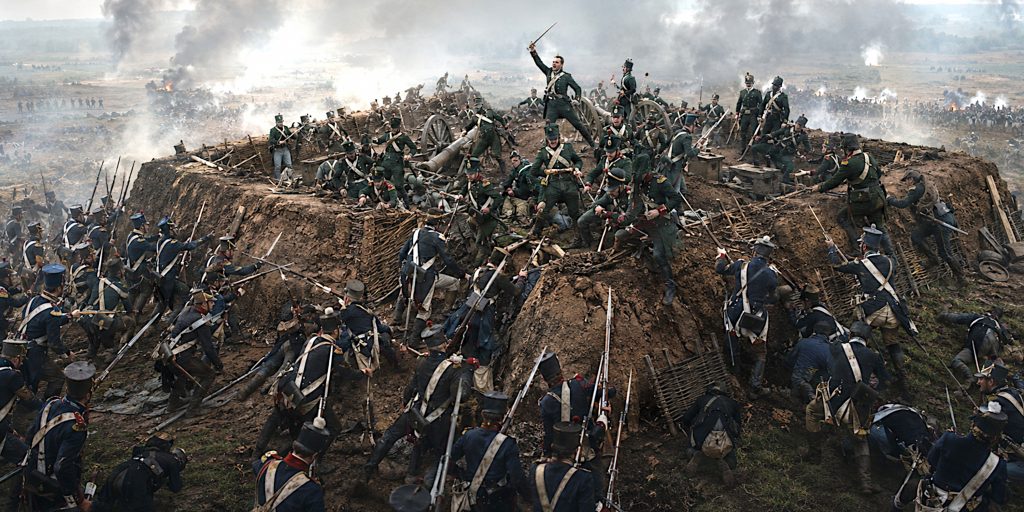
Davout’s corps attacked the flèches at the opening of the battle. The first assaults met devastating artillery and musket fire. Davout was injured when his horse fell, while division and brigade commanders became casualties at an alarming rate.
Ney and Murat reinforced the attack. Russian infantry repeatedly counter-attacked, supported by cavalry and batteries firing at close range. Possession of the earthworks shifted several times. The fighting was less a neat sequence of manoeuvres than an extended struggle in which battered formations were fed back into smoke and noise.
Bagration remained close to the fighting until he was wounded in the leg by a shell fragment. He died later that month. His removal created confusion, although Dokhturov restored a degree of control. The Russians eventually abandoned the flèches and drew back behind Semyonovskaya, but they had forced the French to pay dearly for a few hundred metres of ground.
The Great Redoubt
Eugène’s corps attacked the Russian centre. An early French penetration into the Great Redoubt was reversed by a Russian counter-attack associated with generals Alexey Yermolov and Alexander Kutaisov. Kutaisov was killed, and the loss of the Russian artillery chief contributed to poor coordination among batteries later in the battle.
The decisive assault came in the afternoon. French infantry pressed the front while cavalry moved against the position from its flanks and rear. Caulaincourt’s cuirassiers entered the redoubt, though their commander was killed. The interior became the scene of close combat among guns, horses and infantry. The French finally secured the work, but the Russian army withdrew to another line rather than disintegrating.
This was the central frustration of Borodino for Napoleon. The fortifications fell, yet the enemy did not.
Why Did Napoleon Hold Back the Imperial Guard?
Napoleon’s refusal to commit the Guard has generated two centuries of argument. Several commanders urged him to use it after the fall of the Great Redoubt. A final assault might have broken the Russian line, but it might equally have consumed the last intact reserve far inside hostile territory.
Napoleon understood that Borodino was not the end of the campaign. His army was more than 1,000 kilometres from its principal bases and had already suffered severe attrition. The Russians still possessed reserves and had not begun a general rout. Committing the Guard therefore offered a possible decisive victory at the risk of leaving the Grande Armée without its most reliable formation.
With hindsight, holding it back looks timid because the campaign ended disastrously anyway. In the conditions of 7 September, the decision was defensible. The larger failure was that Napoleon’s operational plan required one battlefield victory to solve a political problem that Alexander had decided not to negotiate away.
Casualties and Human Cost
Casualty returns from Borodino are incomplete and were shaped by different accounting methods. French estimates commonly range from about 28,000 to more than 35,000 killed, wounded and missing. Russian losses are usually placed between 40,000 and 50,000, with some estimates higher.
The losses among senior officers were extraordinary. Bagration was mortally wounded. French generals Louis-Pierre Montbrun and Auguste de Caulaincourt were killed. Dozens of generals across the two armies were killed, wounded or concussed.
The official totals cannot convey conditions among the wounded. Medical services were overwhelmed. Men lay for hours or days without adequate water, food or treatment. Many French wounded later died during the occupation of Moscow or the retreat. A battlefield return might classify a man as wounded, but that was often only the opening entry in a much uglier story.
Contemporary Accounts and Quotes
Napoleon later offered the most famous judgement on the battle:
“Of the fifty battles I have fought, the most terrible was that before Moscow. The French showed themselves worthy of victory, and the Russians can rightly call themselves invincible.”
The wording varies between translations, and the statement comes from Napoleon’s later recollections rather than a report written on the battlefield. It nevertheless captures the ambiguity of the result rather neatly, perhaps more neatly than events usually allow.
Barclay de Tolly described advancing under the concentrated fire near the Great Redoubt as:
“A walk into hell.”
French officer César de Laugier remembered the ground around the redoubt in terms that stripped away any lingering romance:
“The redoubt and its approaches presented nothing but a heap of dead and dying men.”
Such accounts must be read with care. Memoirs were often written years later, translations differ and participants naturally saw only fragments of a vast battlefield. Their value lies in experience and perception, not minute-by-minute omniscience.
Who Won the Battle of Borodino?
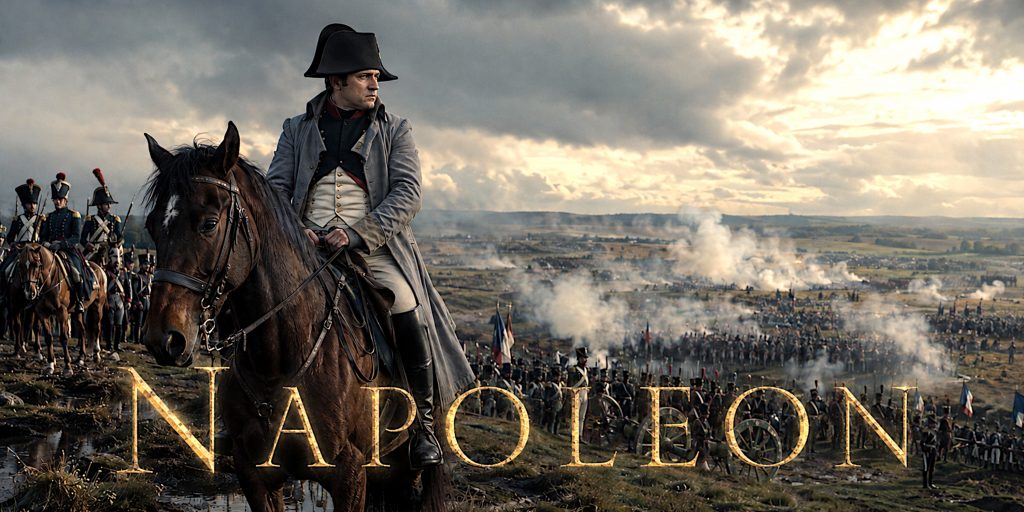
By the conventional rules of battlefield judgement, Napoleon won. The French captured the principal Russian positions, remained on the field and compelled Kutuzov to retreat. The road to Moscow was open.
Strategically, the verdict is less flattering. Napoleon needed to destroy the Russian army or force Alexander to negotiate. He achieved neither. Kutuzov’s battered force withdrew, absorbed reinforcements and remained a military threat. Napoleon entered Moscow a week later, only to find much of the city abandoned and soon burning. No peace offer came.
Calling Borodino a Russian battlefield victory bends the evidence too far. Calling it a decisive French triumph ignores what the battle was supposed to accomplish. It was a costly French tactical victory within a campaign Russia was increasingly positioned to win.
Archaeology and the Borodino Battlefield
The battlefield survives as a large cultural landscape rather than a single excavated site. Archaeological investigations and chance discoveries have produced:
- Lead musket balls, including concentrations that help identify zones of intense firing
- Iron cannonballs, shell fragments and artillery fittings
- Regimental buttons, buckles, badges and uniform fittings
- Coins, religious crosses, tools and personal objects
- Weapon fragments and military equipment
- Human and horse remains associated with battlefield burials
These objects can illuminate where units fought, but interpretation is complicated. The field was occupied, farmed, commemorated and fought over again during the Second World War. Metal was also salvaged after the 1812 battle. An artefact’s location is evidence, though rarely an answer by itself.
The State Borodino War and History Museum-Reserve protects the battlefield and holds collections of recovered objects, uniforms, weapons, standards and artwork. The landscape contains hundreds of monuments and reconstructed or preserved features. The Spaso-Borodinsky Convent stands near the former Russian left and grew from the memorial efforts of Margarita Tuchkova, whose husband, General Alexander Tuchkov, was killed in the battle.
Visitors should also recognise that commemoration has shaped the site. Monuments often express regimental, imperial or national memory as strongly as they explain the physical battle. Borodino has never been merely old ground. It has been recruited repeatedly into Russia’s understanding of sacrifice and invasion.
Borodino in Memory and Culture
Borodino occupies a central place in Russian historical memory. Mikhail Lermontov’s poem Borodino helped turn the battle into a story of collective courage. Leo Tolstoy made it one of the great set pieces of War and Peace, using the confusion of combat to challenge the idea that commanders control history through will alone.
The battle also became associated with Tchaikovsky’s 1812 Overture, although the work commemorates the campaign as a whole rather than providing a literal musical account of Borodino. Franz Roubaud’s vast Borodino panorama, created for the centenary in 1912, gave later generations one of the battle’s defining visual interpretations.
French memory has been more ambivalent. Borodino demonstrated the courage and endurance of the Grande Armée, but it also exposed the shrinking value of Napoleon’s victories. He could still take positions, shatter formations and dominate a battlefield. What he could no longer do in Russia was turn those achievements into peace.
Historical Assessment
Borodino was not a clever battle. Napoleon relied heavily on frontal attacks against prepared positions, supported by immense artillery concentrations. Kutuzov’s original deployment placed excessive strength on the Russian right, while the left bore the main French assault. Both commanders were less tactically impressive than some of their subordinates.
Yet battles are not staff-college exercises performed on clean maps. Smoke concealed formations, couriers vanished, commanders were killed and units fought until their organisational structure became largely theoretical. Barclay, Bagration, Dokhturov, Raevsky, Davout, Ney, Eugène and Murat all played critical roles in sustaining their armies through repeated crises.
What stays with me is the mismatch between cost and consequence. Tens of thousands of casualties gave Napoleon Moscow, but not victory in the war. The Russian army lost the field, but retained the one thing Napoleon most needed to take from it: the capacity to continue fighting.
Frequently Asked Questions
When was the Battle of Borodino?
It was fought on 7 September 1812 according to the modern Gregorian calendar, or 26 August under the Julian calendar then used in Russia.
Where was Borodino fought?
The battlefield lies near the village of Borodino, about 120 kilometres west of Moscow.
How many soldiers fought at Borodino?
Approximately 250,000 to 280,000 troops were present across both armies, although totals vary according to the treatment of militia, irregulars and reserves.
How many people died at Borodino?
The number killed outright cannot be established with certainty. Combined killed, wounded and missing probably exceeded 70,000. Many wounded soldiers died later from trauma, infection, exposure or lack of treatment.
Did Napoleon win at Borodino?
Napoleon won a tactical victory because he captured the main Russian positions and held the battlefield. He failed to destroy the Russian army or compel Tsar Alexander I to make peace, so the battle did not deliver a decisive strategic result.
Why is the battle also called the Battle of Moscow?
French accounts often called it the Battle of the Moskova, referring to the river system and the approach to Moscow. Napoleon later granted Marshal Ney the title Prince of the Moskova.