Ancient historians adored enormous armies. Herodotus gave Xerxes an invasion force so vast that modern historians have spent generations politely explaining why it probably could not have fitted on the roads. Roman writers were hardly immune to similar temptations.
That makes ranking the biggest battles of the ancient world more complicated than comparing troop totals.
For this list, I have considered the probable scale of the armies, casualties, political consequences, military importance and the extent to which the battle changed what happened next. The precise numbers remain disputed in many cases, sometimes enormously so.
What matters is that these were genuinely major encounters. Some destroyed armies. Others destroyed kingdoms. A handful changed the political geography of the Mediterranean and Near East for centuries.
22. Battle of Watling Street, c. 60 or 61 CE
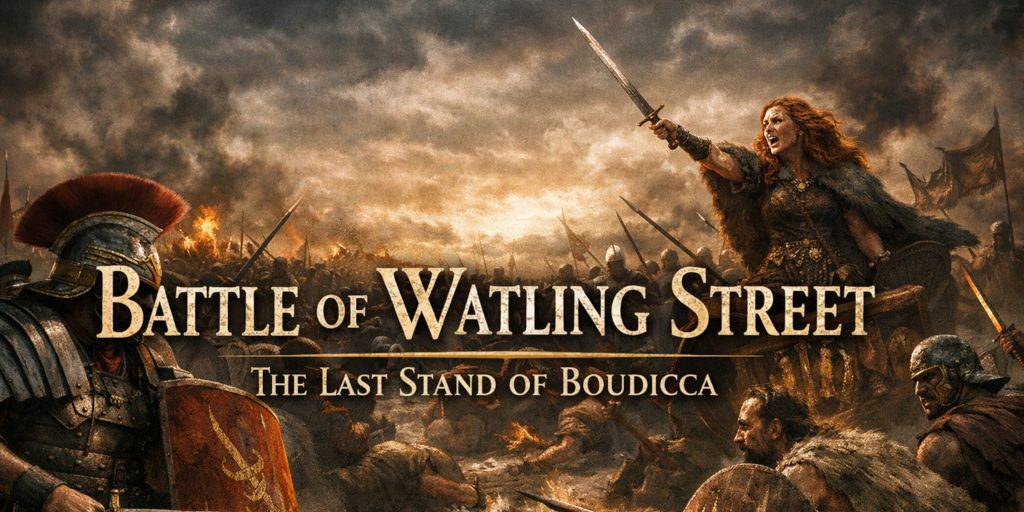
Combatants: Roman Empire vs Boudica’s rebel coalition
Location: Uncertain, probably the English Midlands
Commanders: Gaius Suetonius Paulinus vs Boudica
Estimated forces: Romans perhaps 10,000; British forces unknown and almost certainly exaggerated in Roman accounts
Result: Roman victory
Tacitus presents Boudica’s rebellion as a genuine crisis for Roman Britain. Camulodunum, Londinium and Verulamium had been devastated before Suetonius finally forced a decisive battle.
The Roman commander chose his ground carefully, positioning his smaller army where the Britons could not exploit their numerical advantage. The legionaries absorbed the initial attack before advancing in disciplined formations.
Tacitus claimed an astonishing 80,000 British dead against only 400 Romans. I would treat those figures with considerable suspicion. Ancient historians were rarely at their most restrained when counting dead barbarians.
Arms and armour
Roman troops carried the gladius, pilum and scutum, with many legionaries protected by mail or segmented armour. Boudica’s warriors relied heavily upon spears, shields and iron swords.
Contemporary voice
Tacitus records Boudica declaring before the battle:
“It is not as a woman descended from noble ancestry, but as one of the people that I am avenging lost freedom.”
The speech was written down decades later, so it should be treated as Tacitus’ literary reconstruction rather than a transcript.
Why it ranks here
The victory secured Roman control of Britain after one of the most dangerous revolts the province ever experienced.
21. Battle of the Sabis, 57 BCE
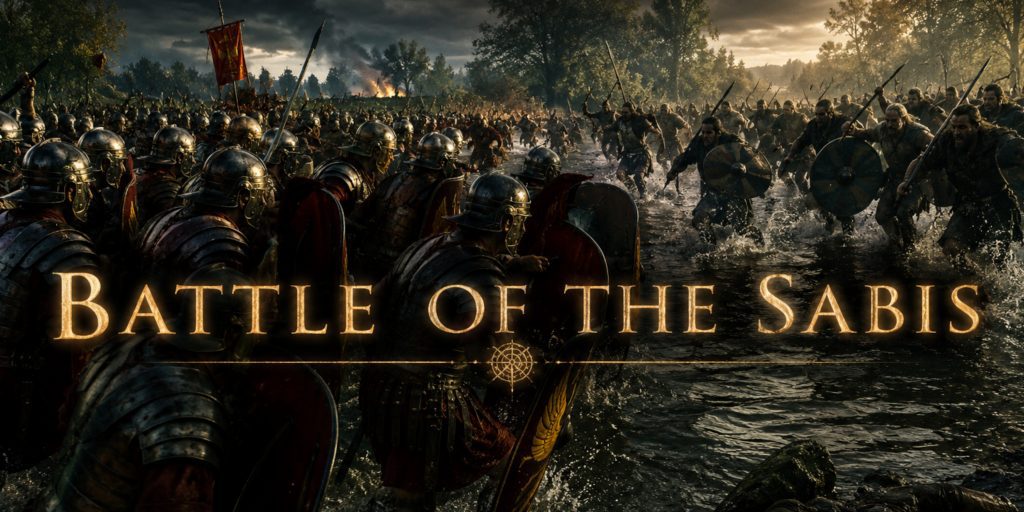
Combatants: Roman Republic vs Nervii and allied Belgic peoples
Location: Probably near the River Selle in modern France
Commanders: Julius Caesar vs Nervian leaders including Boduognatus
Result: Roman victory
The Sabis deserves more attention than it normally receives. Caesar’s army was caught at an awkward moment while fortifying its camp, and the Nervii launched an exceptionally aggressive attack before the Roman deployment was complete.
For once, Caesar’s legions were not calmly executing a textbook battle plan. They were scrambling.
Arms and armour
Roman legionaries fought with pila, gladii, large shields and mail armour. The Nervii and their allies relied on spears, shields and iron swords, with armour less widespread than among the Roman professionals.
Contemporary voice
Caesar, who was present, wrote that:
“Everything had to be done at one moment.”
That is probably the most revealing description of the battle. Roman survival depended upon officers and soldiers reacting quickly without waiting for elaborate instructions.
Why it ranks here
The victory shattered one of the strongest coalitions opposing Caesar in northern Gaul and demonstrated the resilience of the late Republican legion.
20. Battle of Marathon, 490 BCE
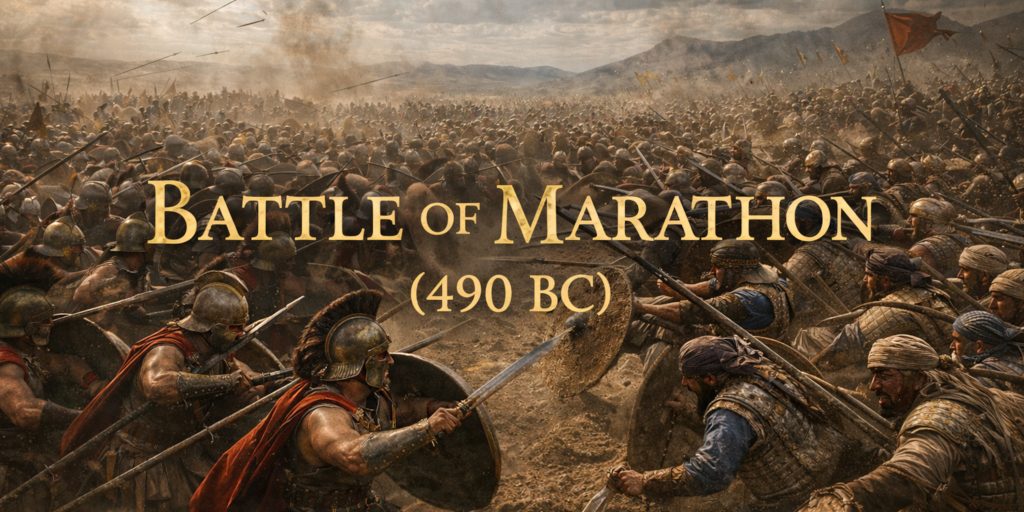
Combatants: Athens and Plataea vs Achaemenid Persia
Location: Marathon, Attica
Commanders: Miltiades among the Athenians; Datis and Artaphernes for Persia
Estimated forces: Greeks roughly 10,000 to 11,000; Persian numbers uncertain
Result: Greek victory
Marathon has acquired so much legend that finding the battle underneath it can be surprisingly difficult.
The important point is not that a tiny band of Greeks somehow defeated the entire Persian Empire. They did not. An Athenian-led hoplite army defeated a Persian expeditionary force and then hurried back towards Athens before the Persians could exploit the situation.
Arms and armour
Greek hoplites relied upon the doru spear, aspis shield and secondary xiphos. Better-equipped men wore bronze helmets, cuirasses and greaves.
Persian infantry made greater use of bows, spears and lighter shields, while the akinakes served as a secondary blade.
Why it ranks here
Marathon helped preserve Athenian independence during a formative period in the city’s political development. Its cultural importance later became almost as significant as the battle itself.
19. Battle of the Hydaspes, 326 BCE

Combatants: Macedonian Empire vs Kingdom of Porus
Location: Hydaspes River, modern Pakistan
Commanders: Alexander the Great vs Porus
Result: Macedonian victory
Alexander had crossed rivers before. Crossing one while an Indian king watched the opposite bank with cavalry, infantry and war elephants was a rather less inviting proposition.
Through deception and repeated movements, Alexander concealed the location of his eventual crossing. His army then defeated Porus after a hard battle in difficult conditions.
Arms and armour
The Macedonians combined the sarissa phalanx, Companion cavalry, javelin troops and swords such as the xiphos and kopis.
Porus fielded infantry, cavalry, chariots and, most famously, war elephants. Indian archers also used powerful longbows.
Why it ranks here
Hydaspes was one of Alexander’s most difficult victories and demonstrated the adaptability of the Macedonian system far beyond the Mediterranean military environment in which it had developed.
It was also close to the end of the road. Alexander’s troops soon refused to march farther east.
18. Battle of the Trebia, 218 BCE
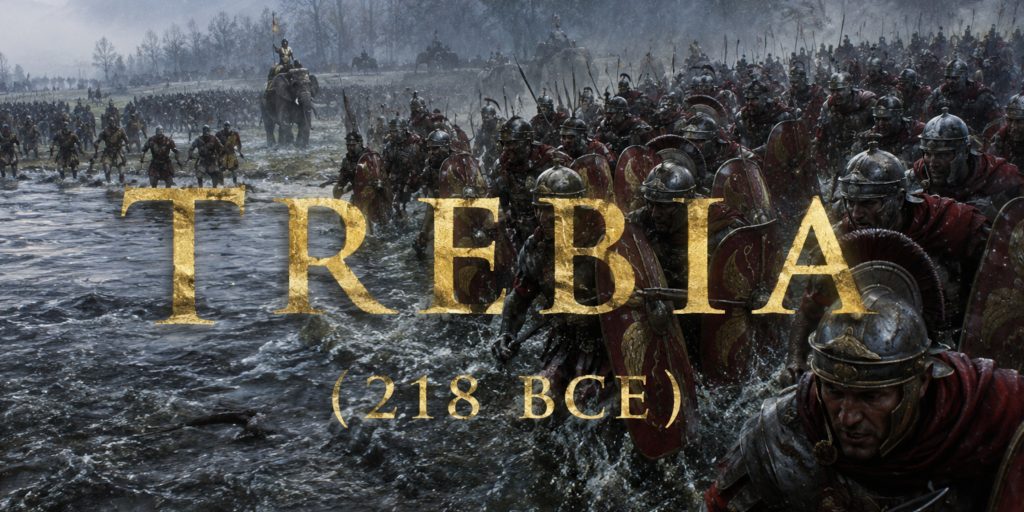
Combatants: Carthage vs Roman Republic
Commanders: Hannibal vs Tiberius Sempronius Longus
Result: Carthaginian victory
Trebia was Hannibal’s first great demonstration in Italy of how thoroughly he understood Roman aggression.
He encouraged Sempronius to attack across the freezing river before the Romans had eaten properly. Hannibal’s men were fed, prepared and waiting.
Then Mago’s concealed troops appeared behind the Roman army.
It was not subtle once it happened. Getting the Romans into precisely that situation was the clever part.
Arms and armour
The Roman army used pila, gladii, scuta and mail armour. Hannibal commanded a much more varied force of African infantry, Iberians, Gauls, Numidian cavalry and other contingents.
Iberian troops included warriors armed with distinctive curved and straight swords, while Celtic warriors carried longer iron blades.
Why it ranks here
Trebia demonstrated that Hannibal could defeat consular armies inside Italy. Unfortunately for Rome, it was merely the beginning.
17. Battle of Teutoburg Forest, 9 CE
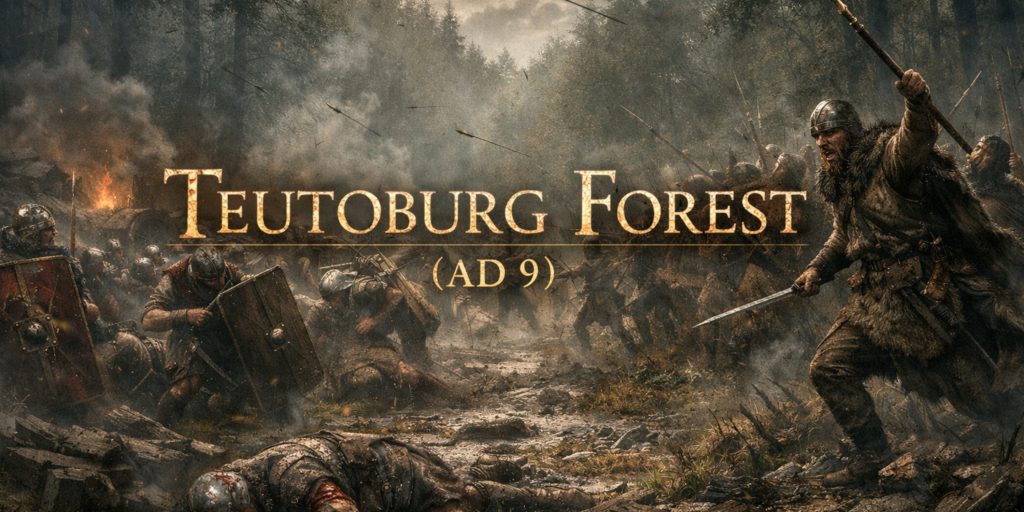
Combatants: Roman Empire vs Germanic coalition
Commanders: Publius Quinctilius Varus vs Arminius
Result: Germanic victory
Three Roman legions, XVII, XVIII and XIX, disappeared as effective military formations.
Arminius had served Rome and understood its army. He used that knowledge ruthlessly, drawing Varus into difficult country where the marching column became stretched and vulnerable.
Over several days the Roman force disintegrated under repeated attacks.
Arms and armour
Roman legionaries carried pila, gladii and large shields, supported by auxiliary troops.
Germanic warriors primarily used spears and shields, although swords were carried by wealthier fighters. The popular image of hordes of Germans charging about with enormous swords owes rather more to later imagination than archaeology.
Ancient voice
According to Suetonius, Augustus reacted to the disaster with the famous cry:
“Quinctilius Varus, give me back my legions!”
Whether he repeatedly shouted those exact words is impossible to establish, but the story captures the shock in Rome.
Why it ranks here
Rome later campaigned beyond the Rhine, but permanent imperial expansion deep into Germania never resumed.
16. Battle of Magnesia, 190 BCE
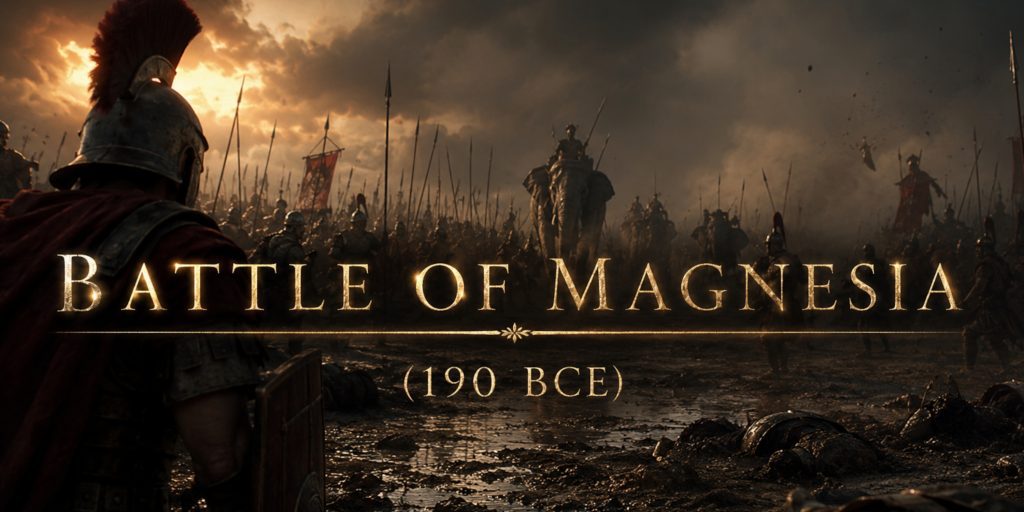
Combatants: Rome and Pergamon vs Seleucid Empire
Commanders: Lucius Cornelius Scipio, Eumenes II and Antiochus III
Result: Roman-led victory
Magnesia was enormous by Hellenistic standards and spectacularly complicated.
Antiochus III fielded phalangites, cavalry, elephants, light infantry and scythed chariots. The Romans and their Pergamene allies faced what must have looked like a travelling catalogue of Hellenistic warfare.
It did not save Antiochus.
Arms and armour
Seleucid phalangites carried sarissas and secondary swords. The army also contained armoured cavalry, archers, elephants and chariots.
Roman legionaries fought with pila, shields and swords, supported by allied formations.
Why it ranks here
Magnesia broke Seleucid power in western Asia Minor and confirmed that Rome had become a major force in the Greek east.
15. Battle of Carrhae, 53 BCE
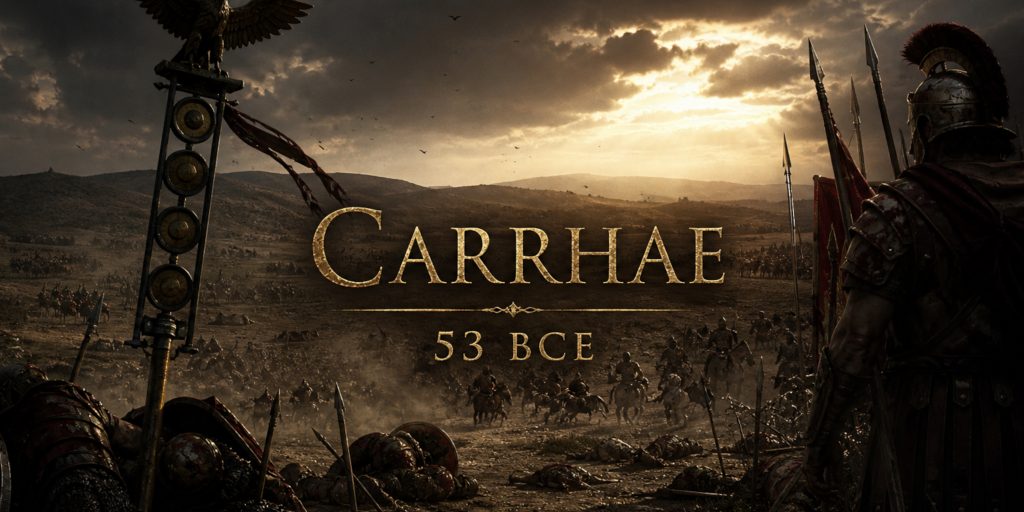
Combatants: Roman Republic vs Parthian Empire
Commanders: Marcus Licinius Crassus vs Surena
Result: Parthian victory
Carrhae is what happens when a wealthy Roman politician assumes military prestige can simply be acquired alongside everything else.
Crassus invaded Parthian territory and encountered an army built around horse archers and heavily armoured cataphracts.
The Romans struggled to bring either type of opponent to decisive close combat. Parthian archers repeatedly showered the legions with arrows, while camels carried additional ammunition to maintain the bombardment.
Arms and armour
Roman legionaries carried gladii, pila and large shields.
Parthian horse archers used powerful composite bows. Cataphracts carried long kontos lances and were protected by extensive armour.
Why it ranks here
Carrhae destroyed a Roman invasion army, killed Crassus and exposed how badly legionary infantry could struggle against a highly mobile mounted enemy on suitable terrain.
14. Battle of Cynoscephalae, 197 BCE

Combatants: Roman Republic vs Macedon
Commanders: Titus Quinctius Flamininus vs Philip V
Result: Roman victory
Cynoscephalae has often been reduced to “legion beats phalanx”, which is convenient but rather too neat.
The battle developed chaotically across broken ground. Parts of Philip’s phalanx performed effectively, while others had not properly deployed when Roman troops attacked.
Arms and armour
Macedonian phalangites carried the formidable sarissa, supported by cavalry and lighter infantry.
Roman legionaries possessed shorter pila and swords but operated in formations better suited to independent movement over uneven terrain.
Why it ranks here
The battle severely weakened Macedonian power and became an important stage in Rome’s domination of the Greek world.
13. Battle of Kadesh, c. 1274 BCE

Combatants: New Kingdom Egypt vs Hittite Empire
Location: Near Kadesh in modern Syria
Commanders: Ramesses II vs Muwatalli II
Result: Strategically inconclusive
Kadesh presents historians with a wonderful problem. Ramesses II left us an enormous quantity of material explaining how brilliantly Ramesses II behaved.
According to the Egyptian royal presentation, the pharaoh was virtually a one-man army. Modesty was not among the standard equipment of a New Kingdom monarch.
The reality appears less flattering. The Hittites surprised the Egyptians and inflicted serious damage, while Ramesses recovered sufficiently to avoid catastrophe. Neither side achieved a decisive strategic victory.
Arms and armour
Both armies relied heavily upon chariots.
Egyptian warriors used composite bows, spears, axes and khopesh-type curved blades. Hittite forces fielded large numbers of chariots alongside infantry armed with spears and bronze weapons.
Contemporary voice
The Egyptian account has Ramesses declaring:
“I found that no chief was with me, no charioteer, no soldier of the army.”
It is royal propaganda, certainly, but unusually useful propaganda.
Why it ranks here
Kadesh was among the largest chariot battles known from antiquity and forms part of the struggle that eventually produced the famous Egyptian-Hittite peace treaty.
12. Battle of Ipsus, 301 BCE
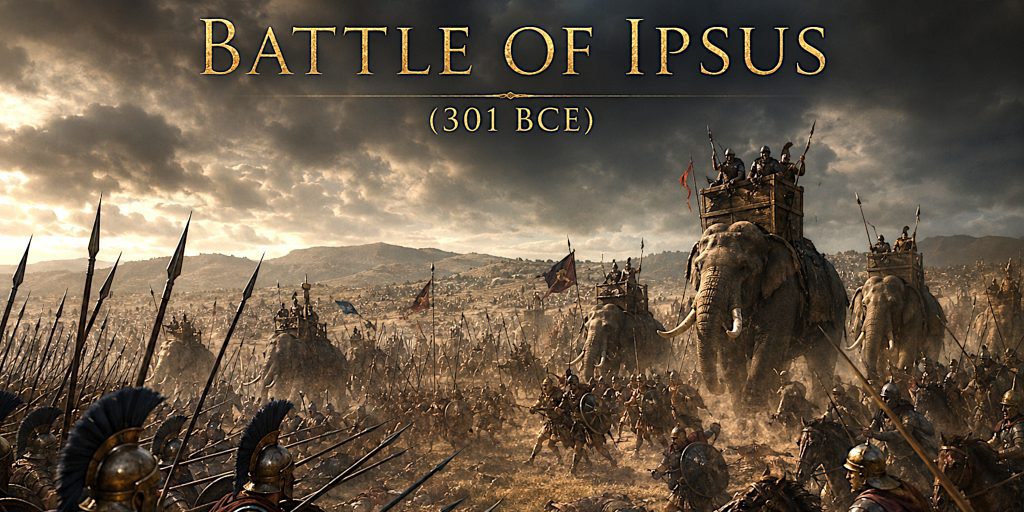
Combatants: Antigonus and Demetrius vs Seleucus, Lysimachus and their allies
Location: Phrygia
Result: Coalition victory
By 301 BCE Alexander the Great had been dead for more than two decades, yet his successors were still trying to decide who should own the pieces.
At Ipsus, Antigonus Monophthalmus made the strongest remaining attempt to dominate the old Macedonian empire.
The battle involved phalanxes, cavalry and an extraordinary concentration of war elephants. Seleucus used his elephants to prevent Demetrius’ cavalry from returning to support Antigonus’ infantry.
Antigonus, now in his eighties, was killed.
Why it ranks here
Ipsus effectively ended the possibility that Alexander’s empire might be reconstructed under a single successor.
The Hellenistic world would remain divided.
11. Battle of the Catalaunian Plains, 451 CE
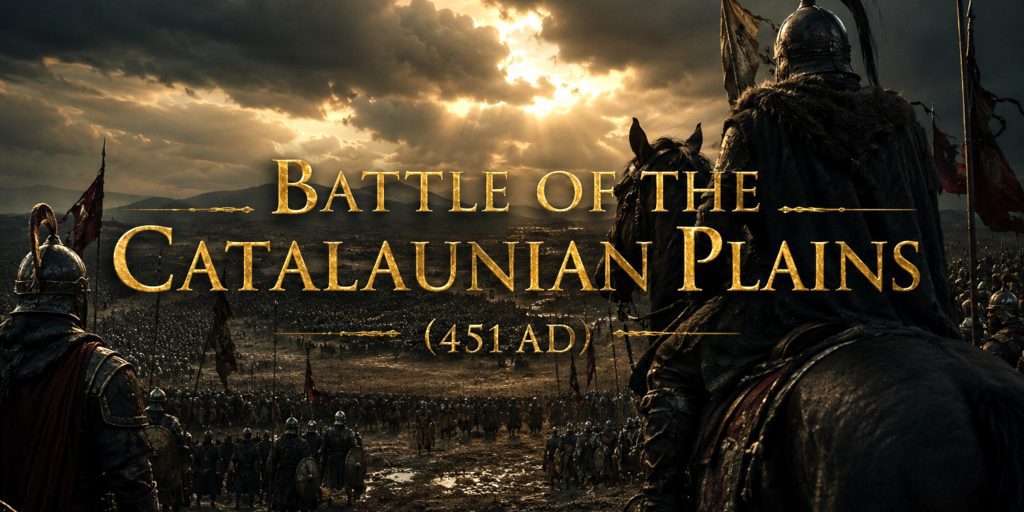
Combatants: Coalition led by Aetius and the Visigoths vs Attila’s coalition
Location: Gaul
Commanders: Flavius Aetius, Theodoric I and Attila
Result: Attila checked and withdrew
Few late Roman battles are surrounded by more exaggeration.
Later tradition sometimes presents the Catalaunian Plains as a heroic defence of Western civilisation against the Huns. Reality was considerably messier. Both armies were multi-ethnic coalitions, and the Roman commander Aetius depended heavily upon Visigothic military power.
Arms and armour
Late Roman and allied warriors used spathae, spears, bows and shields, with mail and scale armour among better-equipped soldiers.
Hunnic forces were strongly associated with mounted archery, but Attila’s army also contained numerous Germanic allied troops.
Why it ranks here
The battle checked Attila’s invasion of Gaul, although it did not destroy Hunnic power. Attila invaded Italy the following year, which rather spoils claims that 451 permanently saved the Roman world.
10. Battle of Chaeronea, 338 BCE
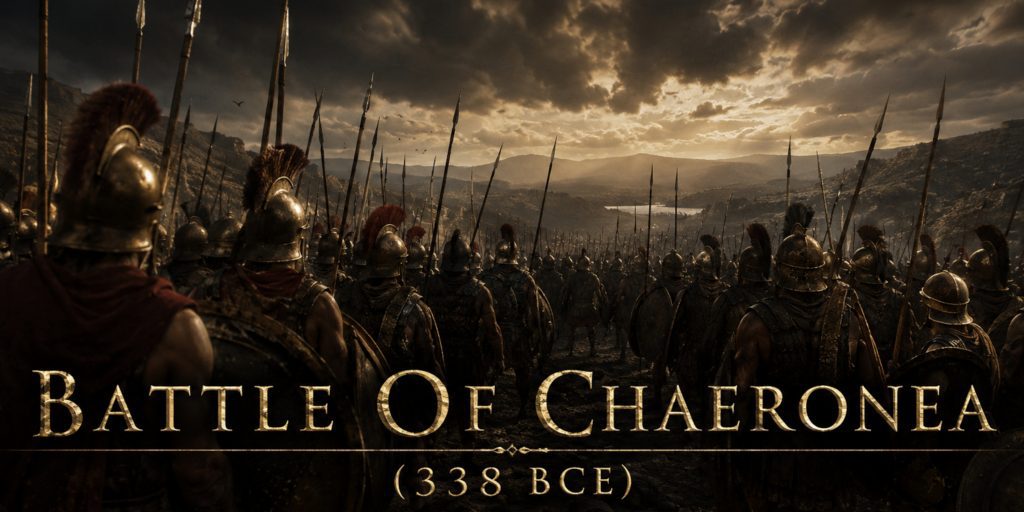
Combatants: Macedon vs Athens, Thebes and allies
Commanders: Philip II and Alexander vs the Greek coalition
Result: Macedonian victory
Chaeronea created the political and military conditions for Alexander’s later invasion of Persia.
Philip II’s reformed Macedonian army combined the sarissa phalanx with effective cavalry and lighter troops. The Greek coalition fought hard, but the Macedonians achieved a decisive victory.
The celebrated Theban Sacred Band was virtually destroyed.
Arms and armour
Macedonian phalangites carried sarissas, while elite cavalry used long thrusting spears and swords.
Greek hoplites remained formidable heavy infantry, armed with spears, shields and xiphos swords.
Why it ranks here
Independent resistance by the major southern Greek states was broken. Philip subsequently established the League of Corinth and prepared an invasion of Persia.
Alexander would inherit both the army and the ambition.
9. Battle of Zama, 202 BCE
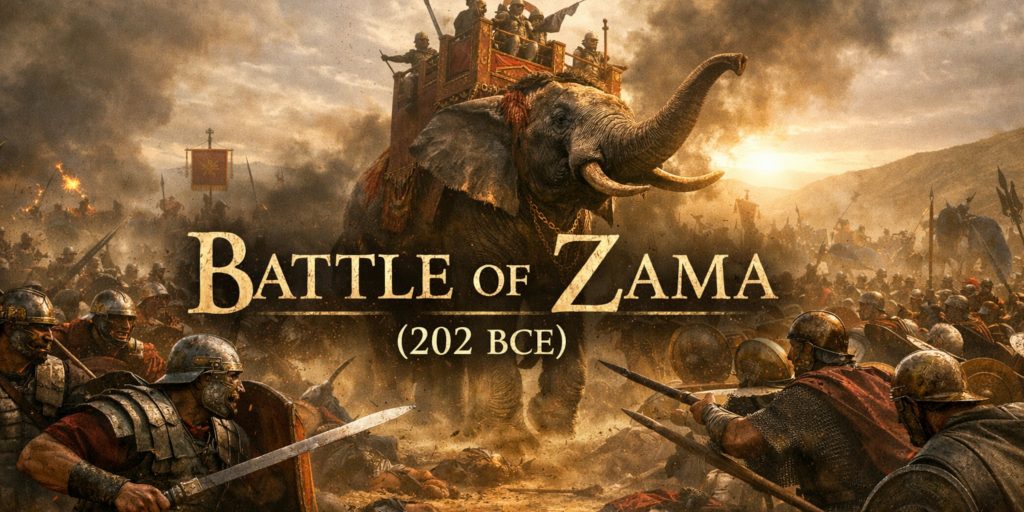
Combatants: Roman Republic vs Carthage
Commanders: Scipio Africanus vs Hannibal
Result: Roman victory
The temptation is to describe Zama simply as Scipio versus Hannibal, the final duel between two great commanders.
It was more complicated than that, but the drama is admittedly difficult to resist.
Hannibal deployed war elephants and a multi-layered infantry force. Scipio arranged lanes through his formations that helped reduce the disruption caused by the elephant attack, while Roman and Numidian cavalry eventually returned to strike Hannibal’s army from behind.
Arms and armour
Roman troops used pila, scuta and gladii.
Hannibal’s army included African, Carthaginian and veteran troops carrying a mixture of spears, shields and swords.
Why it ranks here
Zama ended the Second Punic War. Carthage survived, but Rome emerged as the dominant power of the western Mediterranean.
8. Battle of Adrianople, 378 CE
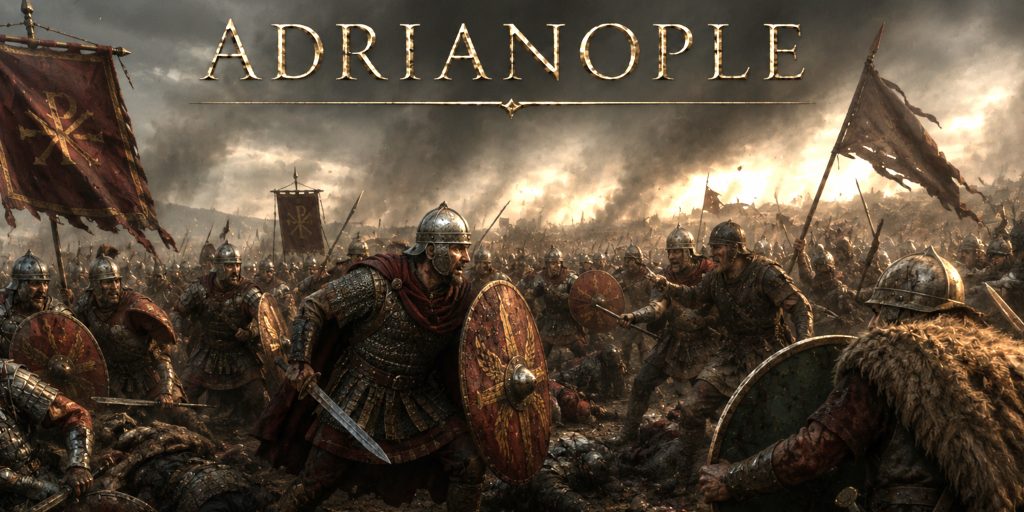
Combatants: Eastern Roman Empire vs Gothic forces
Commanders: Emperor Valens vs Fritigern
Result: Gothic victory
Adrianople was a catastrophe, although describing it as the battle that caused the fall of Rome goes too far.
Valens attacked without waiting for reinforcements commanded by the western emperor Gratian. The resulting engagement became confused, exhausting and ultimately disastrous.
Valens was killed and a large portion of the eastern field army was destroyed.
Arms and armour
Roman soldiers used spears, spathae, shields and bows, with mail and scale armour still common.
Gothic warriors employed spears, swords, shields and missile weapons. Their returning cavalry played an important role as the battle developed.
Why it ranks here
The destruction of an imperial army and death of an emperor demonstrated the severity of Rome’s military problems in the late fourth century.
Yet the Eastern Empire survived Adrianople by more than a thousand years. History occasionally refuses to fit the dramatic headline.
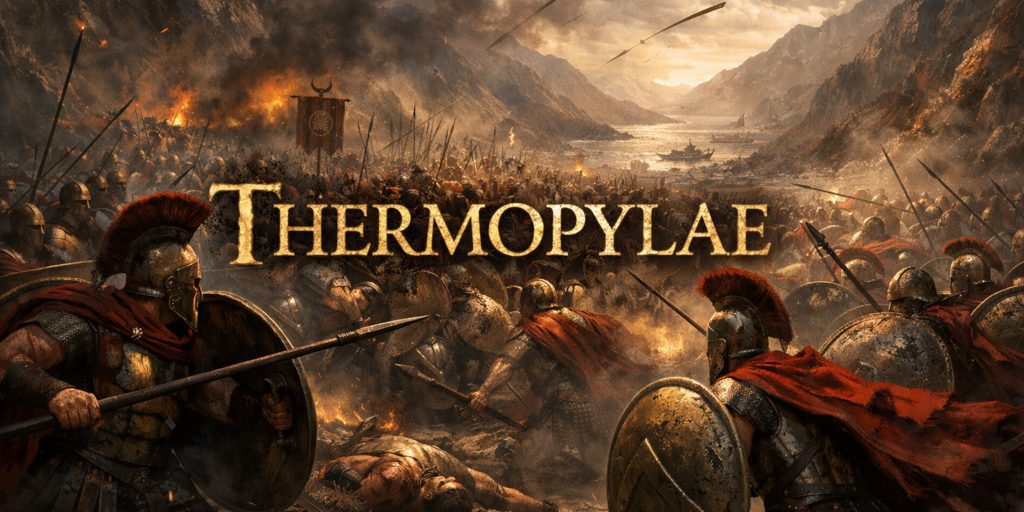
7. Battle of Thermopylae, 480 BCE
Combatants: Greek coalition vs Achaemenid Persia
Commanders: Leonidas I vs Xerxes I
Result: Persian victory
Thermopylae may be the most famous defeat in military history.
It was also considerably larger than the popular story of “300 Spartans” suggests. Leonidas commanded several thousand Greek troops at the beginning of the action. The famous 300 were his Spartan contingent, accompanied by other Greeks and helots.
The narrow pass restricted Persian numbers until a route around the Greek position was revealed.
Arms and armour
Greek hoplites carried long spears, large aspides and swords including the xiphos.
Persian forces included archers, spearmen, cavalry and elite infantry drawn from across the empire.
Ancient voice
Herodotus preserves the famous epitaph associated with the Spartan dead:
“Stranger, tell the Lacedaemonians that we lie here, obedient to their commands.”
Why it ranks here
Thermopylae did not stop Xerxes. Persia advanced into central Greece and occupied Athens.
Its importance lies in the wider campaign and in the extraordinary cultural memory that grew around the defence of the pass.
6. Battle of Plataea, 479 BCE

Combatants: Greek alliance vs Achaemenid Persia
Commanders: Pausanias vs Mardonius
Result: Greek victory
If Thermopylae gets the legend, Plataea deserves more of the military attention.
The battle involved one of the largest Greek armies assembled during the Persian Wars. After a difficult period of manoeuvring and supply problems, parts of the Greek army began repositioning.
Mardonius interpreted the movement as a retreat and attacked.
It proved a disastrous mistake.
Arms and armour
Greek hoplites possessed heavy shields, spears and swords, while Persian forces included infantry, archers and cavalry.
Once the fighting developed at close quarters, Greek heavy infantry had important advantages.
Why it ranks here
Plataea effectively ended Xerxes’ attempt to conquer mainland Greece. Together with the naval victory at Mycale, it transformed the strategic situation.
I would rank it comfortably above Thermopylae. Heroic last stands make excellent stories. Winning the war is generally more useful.
5. Battle of Gaugamela, 331 BCE
Combatants: Macedonian Empire vs Achaemenid Persia
Location: Near modern Mosul, Iraq
Commanders: Alexander the Great vs Darius III
Result: Macedonian victory
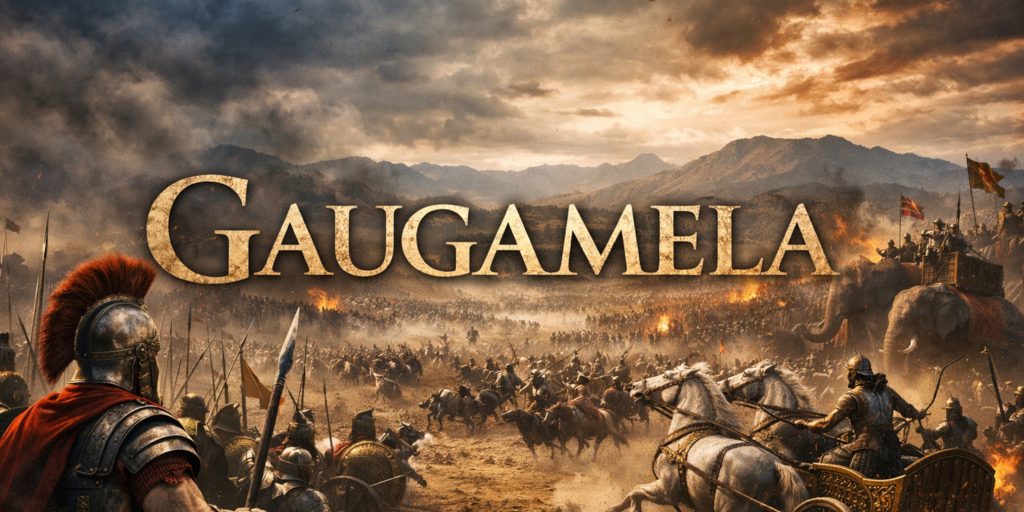
Gaugamela was Alexander’s masterpiece, although ancient claims about Persian numbers should not be accepted literally.
Darius prepared open ground suitable for his cavalry and scythed chariots. Alexander responded with an unusual deployment designed to cope with the wider Persian line.
His movement towards the right helped create an opening. Alexander then led the Companion cavalry towards the Persian centre.
Darius fled. His empire never recovered.
Arms and armour
The Macedonian system combined sarissa phalangites, Hypaspists, light infantry and Companion cavalry.
Persian forces included cavalry, archers, infantry and scythed chariots drawn from across the empire.
Ancient voice
Arrian describes Alexander driving directly towards Darius as the Persian line began to fail, capturing the aggression at the heart of Macedonian tactics.
Why it ranks here
Gaugamela destroyed Darius’ ability to defend the heartlands of the Achaemenid Empire. Babylon, Susa and Persepolis subsequently fell to Alexander.
One of the great imperial systems of antiquity had effectively been broken in a single campaign.
4. Battle of Cannae, 216 BCE
Combatants: Carthage vs Roman Republic
Commanders: Hannibal vs Lucius Aemilius Paullus and Gaius Terentius Varro
Estimated forces: Roughly 50,000 Carthaginian troops against perhaps 80,000 Romans and allies, although exact totals remain debated
Result: Carthaginian victory
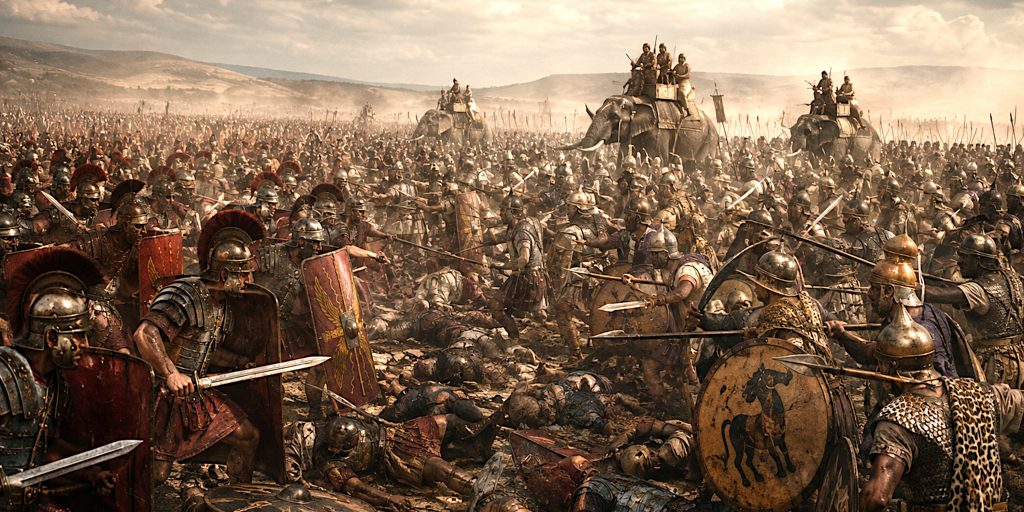
Cannae deserves its reputation.
Hannibal deliberately allowed his centre to give ground while stronger African infantry remained positioned on the wings. His cavalry defeated the Roman horsemen and eventually attacked the Roman rear.
The Roman infantry found itself compressed into an increasingly confined space.
The resulting encirclement was devastating.
Polybius gives Roman losses of around 70,000 killed, although modern estimates vary. Whatever the exact total, the destruction was extraordinary. Polybius explicitly attributed much of Hannibal’s success to superiority in cavalry.
Arms and armour
Roman legionaries fought with pila, scuta and gladii.
Hannibal’s army was much more varied, including Libyan heavy infantry, Iberians, Celts, Balearic slingers and Numidian cavalry.
Ancient voice
Polybius wrote that the battle demonstrated:
“the superiority in cavalry”
as a decisive factor in Hannibal’s victory.
Why it ranks here
Cannae annihilated one of the largest armies Rome had ever assembled.
Yet Rome refused to negotiate.
That is what makes Cannae fascinating. Hannibal achieved one of history’s greatest tactical victories and discovered that even this was insufficient to force Rome out of the war.
3. Battle of Salamis, 480 BCE

Combatants: Greek coalition vs Achaemenid Persia
Location: Straits of Salamis
Commanders: Themistocles and allied Greek commanders vs Persian fleet under Xerxes
Result: Greek victory
The original version of this ranking omits Salamis, which is difficult to justify when considering the most consequential battles of antiquity.
Following Thermopylae, Persian forces had occupied Athens. Greek survival increasingly depended upon their fleet.
Themistocles helped draw the Persian navy into the confined waters around Salamis, where its numerical advantage became much harder to exploit.
Greek triremes attacked in waters that favoured disciplined close-quarter naval fighting.
Weapons and warfare
The principal weapon was the bronze-sheathed ram mounted on the bow of the trireme.
Marines aboard the ships carried spears, shields and swords, while archers provided missile support.
Contemporary voice
The playwright Aeschylus actually fought in the Persian Wars and later described Salamis in The Persians:
“Advance, you sons of Greece, and free your fathers’ land.”
Unlike many famous ancient battle speeches, this comes from a writer who lived through the war.
Why it ranks here
Salamis crippled Persian naval power in Greek waters and helped make Xerxes’ position increasingly difficult to sustain.
Plataea completed the job on land the following year.
2. Battle of Actium, 31 BCE
Combatants: Forces of Octavian vs Mark Antony and Cleopatra VII
Location: Off western Greece
Commanders: Marcus Agrippa and Octavian vs Mark Antony and Cleopatra
Result: Octavian’s victory
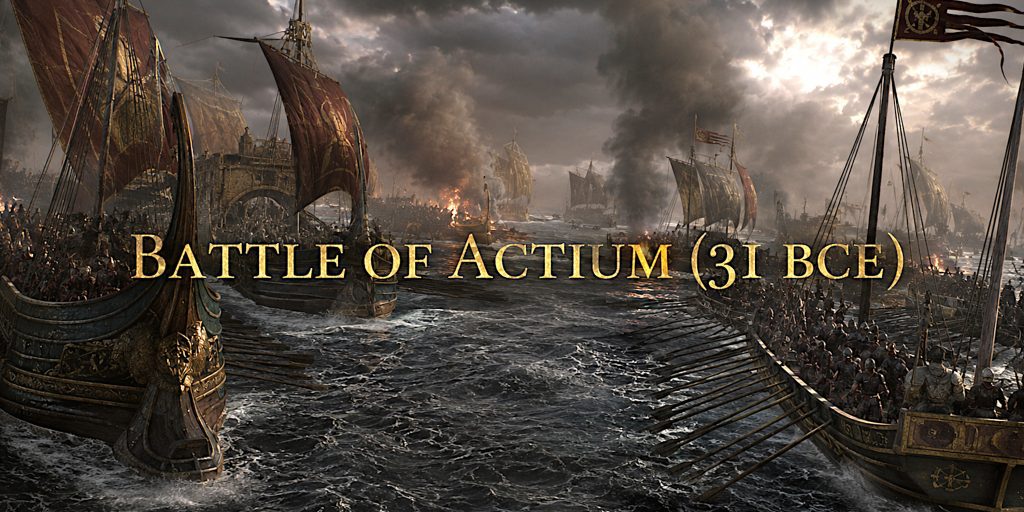
Actium was technically a battle within a Roman civil war, but its consequences reached far beyond Rome.
Octavian’s exceptionally capable admiral Marcus Agrippa had already placed Antony’s forces under considerable strategic pressure before the fleets met.
During the battle, Cleopatra’s squadron escaped through a developing gap. Antony followed.
The surviving fleet eventually surrendered.
Arms and warfare
Octavian relied heavily upon smaller, manoeuvrable vessels, while Antony possessed a number of larger warships.
Marines fought with bows, javelins, spears and swords when ships came within range.
Contemporary voice
Octavian later recorded in the Res Gestae that:
“The whole of Italy voluntarily took oath of allegiance to me.”
It is political self-presentation rather than neutral history, but that is precisely why it is valuable. Octavian understood Actium as part of his claim to legitimate control of the Roman world.
Why it ranks here
Antony and Cleopatra were defeated, Ptolemaic Egypt was absorbed into Roman control, and Octavian became the unchallenged master of the Roman world.
In 27 BCE he became Augustus.
The Roman Republic had effectively given way to imperial monarchy.
1. Battle of Changping, 260 BCE
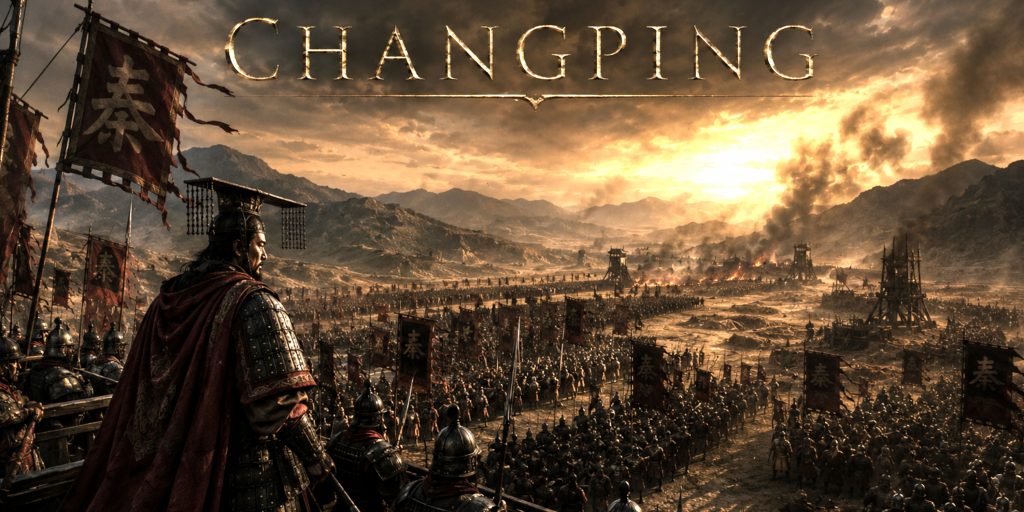
Combatants: Qin vs Zhao
Location: Northern China
Commanders: Bai Qi for Qin; Zhao Kuo for Zhao during the decisive phase
Result: Qin victory
A genuinely global list of ancient battles should not quietly become a list of Greek and Roman battles with the occasional Persian invited along.
Changping was fought during China’s Warring States period and appears to have involved armies on a scale comparable to, and possibly greater than, the largest Mediterranean engagements.
The surviving literary accounts were written later and their enormous casualty totals must be handled carefully. Nevertheless, the archaeological and historical importance of the campaign is substantial.
Qin forces eventually surrounded the Zhao army. After a prolonged crisis, Zhao resistance collapsed.
Later tradition claimed that hundreds of thousands of prisoners were executed. The precise figure remains disputed, but the defeat was catastrophic.
Arms and armour
Chinese armies of this period deployed mass infantry armed with spears, jian swords, crossbows and polearms alongside cavalry.
The increasing importance of the crossbow was particularly significant in Warring States warfare.
Why it ranks first
Changping combined exceptional scale with enormous political consequences.
Zhao never fully recovered its former military strength. Qin continued eliminating its rivals and in 221 BCE Qin Shi Huang completed the conquest of the competing kingdoms, creating the first unified imperial Chinese state.
If “biggest” means more than whichever ancient author supplied the most extravagant number, Changping has a serious claim to first place.
The Largest Ancient Battles at a Glance
| Rank | Battle | Date | Main Powers | Result | Historical Importance |
|---|---|---|---|---|---|
| 1 | Changping | 260 BCE | Qin vs Zhao | Qin victory | Helped establish Qin supremacy |
| 2 | Actium | 31 BCE | Octavian vs Antony and Cleopatra | Octavian victory | Cleared the path for Augustus |
| 3 | Salamis | 480 BCE | Greeks vs Persia | Greek victory | Major turning point in Persian invasion |
| 4 | Cannae | 216 BCE | Carthage vs Rome | Carthaginian victory | Destruction of a huge Roman army |
| 5 | Gaugamela | 331 BCE | Macedon vs Persia | Macedonian victory | Broke Achaemenid imperial power |
| 6 | Plataea | 479 BCE | Greeks vs Persia | Greek victory | Ended Persian invasion of mainland Greece |
| 7 | Thermopylae | 480 BCE | Greeks vs Persia | Persian victory | Famous delaying action |
| 8 | Adrianople | 378 CE | Rome vs Goths | Gothic victory | Destroyed major Roman field army |
| 9 | Zama | 202 BCE | Rome vs Carthage | Roman victory | Ended Second Punic War |
| 10 | Chaeronea | 338 BCE | Macedon vs Greek coalition | Macedonian victory | Established Macedonian domination of Greece |
Which Ancient Battle Had the Most Soldiers?
This is one of those questions for which a confident answer is usually a warning sign.
Ancient writers regularly provide enormous army totals, particularly for Persian armies. Herodotus’ figures for Xerxes’ invasion are no longer accepted literally by most modern historians. Similar problems affect Chinese sources describing Warring States campaigns and Roman accounts of barbarian armies.
Changping, Plataea, Cannae, Gaugamela and several battles of the Persian Wars are all plausible candidates for exceptionally large land engagements.
Kadesh, meanwhile, has a strong claim among the greatest concentrations of chariot forces known from the Bronze Age.
The sensible answer is therefore a range of possibilities rather than an imaginary league table accurate to the last unfortunate spearman.
Which Ancient Battle Had the Highest Casualties?
Changping traditionally occupies a grim position near the top, with later Chinese sources claiming that approximately 400,000 Zhao prisoners were killed after the campaign.
That number remains disputed.
Cannae provides one of the strongest cases for extraordinarily heavy losses within a single well-documented Mediterranean battle. Polybius claimed approximately 70,000 Roman deaths, although modern reconstructions often produce lower totals.
Ancient casualty figures should almost never be accepted without qualification. Victorious writers had political and literary reasons to inflate the enemy dead, and nobody was wandering around the battlefield afterwards with a clipboard and a reliable census.
What Was the Most Important Battle of the Ancient World?
I am wary of declaring any single battle the most important in ancient history. History does not behave quite so conveniently.
Gaugamela destroyed the military position of the Achaemenid monarchy and allowed Alexander to conquer its imperial heartlands.
Salamis and Plataea prevented Persia from maintaining its invasion of mainland Greece.
Cannae demonstrated perhaps the most famous battlefield encirclement of antiquity, although it failed to win Hannibal the war.
Changping helped establish Qin dominance during the wars that eventually produced imperial Chinese unification.
And Actium deserves special consideration because its consequences were so durable. Octavian’s victory eliminated his final major rivals and helped establish the political order we call the Roman Empire.
If forced to choose on long-term political consequence, I would probably choose Actium. It was hardly the bloodiest battle here, but body counts are a rather crude measure of historical importance.
How Reliable Are Ancient Accounts of These Battles?
Not very, if what we want is modern military reporting. Extremely valuable, if we understand what ancient writers were actually doing.
Herodotus, Thucydides, Polybius, Caesar, Arrian, Plutarch, Tacitus and other ancient authors remain indispensable, but they wrote within particular literary and political traditions.
Numbers are especially troublesome.
Armies become suspiciously enormous. Enemy casualties become conveniently catastrophic. Speeches become suspiciously eloquent.
Even eyewitnesses had agendas. Caesar’s Commentaries remain among our most important sources for the Gallic Wars, but Caesar was also writing about Caesar’s achievements for a Roman audience. He was hardly an impartial war correspondent.
Archaeology, topography, inscriptions, logistics and comparative military evidence therefore matter enormously when reconstructing these battles.
The trick is not to discard the ancient writers. It is to read them critically.
The Legacy of the Ancient World’s Greatest Battles
The most interesting thing about these battles is how often tactical brilliance and strategic success fail to line up neatly.
Hannibal annihilated the Romans at Cannae and eventually lost the war.
Leonidas lost at Thermopylae and became immortalised as a hero.
Alexander won at Gaugamela and destroyed an empire.
Octavian won at Actium and built a political system that would dominate the Mediterranean world for centuries.
At Changping, victory helped shift the balance between China’s competing kingdoms towards Qin and eventual unification.
That is why ranking ancient battles purely by troop numbers tells us surprisingly little. The larger question is what happened after the killing stopped.
Sometimes almost nothing changed.
Sometimes an empire disappeared.
And occasionally, as at Actium or Gaugamela, the political world that emerged afterwards was recognisably different from the one that had existed the morning before.