Alaric I is remembered as the barbarian king who sacked Rome. That description is accurate, but only in the way that describing Julius Caesar as a politician is accurate. It leaves rather a lot on the floor.
Alaric was a Gothic military leader shaped by the Roman world. He commanded warriors who had served in Roman armies, negotiated for Roman titles and repeatedly attempted to secure an accepted place within the empire. His objective was not to burn Rome into the ground or abolish Roman civilisation. He wanted land, supplies, authority and recognition for himself and his followers.
Rome refused, hesitated, negotiated and then refused again. Imperial politics managed to turn a potential Roman commander into the man who captured the Eternal City. It was not the administration’s finest decade.
When Alaric entered Rome on 24 August AD 410, the psychological effect travelled far beyond the physical damage. Rome was no longer the effective capital of the Western Empire, but it remained the symbolic centre of Roman history. Its capture forced contemporaries to confront a possibility that had once seemed absurd: Rome was not untouchable.
Alaric I at a glance
| Detail | Information |
|---|---|
| Born | Probably around AD 370 |
| Birthplace | Traditionally Peuce in the Danube Delta, although uncertain |
| People | Goths settled within the Roman Empire |
| Religion | Homoian Christianity, often described as Arian Christianity |
| Position | Gothic king and military commander |
| Reign | Traditionally dated from AD 395 to 410 |
| Principal opponents | Stilicho, Honorius and the eastern Roman government |
| Major campaigns | Balkans, Greece and Italy |
| Best known for | The sack of Rome in AD 410 |
| Died | Late AD 410 near Consentia, modern Cosenza |
| Successor | Ataulf |
Was Alaric really the first king of the Visigoths?
Alaric is commonly called the first king of the Visigoths. It is a useful description, particularly for readers trying to keep track of the many Gothic groupings of Late Antiquity, but it needs qualification.
The people led by Alaric were not necessarily a settled nation with a fixed Visigothic identity. His following probably included Gothic soldiers, their families, former slaves, refugees and other groups brought together by shared military and political interests. Its size and composition changed as Alaric campaigned.
The term Visigoth became more firmly associated with the Gothic kingdom later established in Gaul and Hispania. Applying it to Alaric’s entire following can make the group appear more unified and permanent than the evidence permits.
He was certainly a Gothic leader. Whether he ruled something recognisable as a Visigothic kingdom is another question. Historians enjoy such distinctions because history would apparently become dangerously straightforward without them.
Early life and uncertain origins
Very little reliable information survives about Alaric’s childhood or family.
Jordanes, writing in the sixth century, associated him with the prestigious Balti dynasty and placed his birth on Peuce, an island in the Danube Delta. These details may preserve earlier traditions, but Jordanes wrote more than a century after Alaric’s death. They should not be treated as the ancient equivalent of a birth certificate.
Alaric was probably born around AD 370 into the Gothic communities living close to the lower Danube. His youth unfolded during a period of upheaval.
In AD 376, large numbers of Goths crossed the Danube and entered Roman territory while fleeing the westward movement of the Huns. Roman officials exploited and mistreated some of the refugees, helping to provoke a Gothic revolt. Two years later, a Gothic army defeated Emperor Valens at the Battle of Adrianople.
The agreement reached with Emperor Theodosius I in AD 382 allowed Gothic communities to remain within imperial territory. They supplied troops to Rome while retaining a degree of internal leadership. This arrangement created opportunities, but also tensions over pay, command and status.
Alaric belonged to a generation of Gothic warriors who understood Roman military methods because they had fought inside Roman armies. The boundary between Roman and barbarian was already thoroughly untidy.
Service under the Roman Empire
Alaric probably served under Emperor Theodosius I during the civil wars of the 390s. He is commonly associated with the imperial campaign against the usurper Eugenius, which ended at the Battle of the Frigidus in AD 394.
Gothic troops suffered heavily during the fighting. Later interpretations suggest that Alaric and his men believed they had been used as expendable assault troops. We cannot know precisely what Alaric thought, but he clearly emerged from Roman service with military experience, influential followers and considerable ambition.
The death of Theodosius in January AD 395 transformed the political situation. The empire was divided between his young sons:
- Arcadius ruled the Eastern Empire from Constantinople.
- Honorius ruled the Western Empire, eventually from Ravenna.
- Powerful generals and ministers competed to control both courts.
- Gothic agreements made under Theodosius suddenly appeared open to renegotiation.
Alaric emerged as the leader of a Gothic revolt in the Balkans. His authority came partly from Gothic support and partly from his ability to negotiate with Rome. He needed to deliver food, security and rewards to his followers. A Roman military command would help him do all three.
This is central to understanding Alaric. He was fighting the empire, but he also wanted a recognised position within it.
The campaigns in Greece
From AD 395, Alaric led his forces through Macedonia, Thessaly and Greece. Constantinople was threatened but not attacked, perhaps because its walls were too formidable and its government preferred negotiation.
The Goths moved south past Thermopylae and entered central Greece. Athens appears to have escaped serious destruction after reaching an agreement, while areas around Piraeus, Corinth, Argos and Sparta suffered more heavily.
Much of the surviving narrative comes from hostile Roman writers. Their accounts emphasise ruined cities, abandoned temples and imperial humiliation. The campaigning was certainly destructive, but poetic descriptions of devastation should not always be read as field reports. Late Roman authors could turn a damaged shrine into the collapse of civilisation before lunch.
The western general Stilicho crossed into Greece and manoeuvred against Alaric in the Peloponnese. He failed to eliminate the Gothic army. Whether Alaric escaped a military trap, reached an agreement or benefited from political interference remains disputed.
By around AD 397, the eastern government had apparently given Alaric a Roman military position in Illyricum. If so, rebellion had secured what service had not: official recognition.
The first invasion of Italy
Alaric entered northern Italy in AD 401. His precise intentions remain uncertain. He may have been seeking better land and supplies, responding to political pressure in the east or attempting to force the western government into a settlement.
Stilicho organised the Roman response. The two commanders met at Pollentia in AD 402, probably on Easter Day. Roman writers presented the battle as a victory, but Alaric’s army remained intact. He withdrew but was neither captured nor destroyed.
A further confrontation near Verona in AD 403 again placed Alaric under pressure. He eventually left Italy and returned towards the Balkans.
These campaigns revealed one of his strongest qualities. Alaric was exceptionally difficult to finish. He could lose ground, survive a battlefield setback and return to negotiation with enough military strength to remain relevant.
| Campaign | Approximate date | Result |
|---|---|---|
| Advance into northern Italy | AD 401–402 | Milan threatened |
| Battle of Pollentia | AD 402 | Roman tactical success, Gothic army survives |
| Battle near Verona | AD 403 | Alaric forced to withdraw |
| Return to the Balkans | After AD 403 | Renewed negotiations with Stilicho |
Alaric and Stilicho
The relationship between Alaric and Stilicho was more complicated than a simple rivalry.
Stilicho was the dominant military figure in the Western Empire and understood the usefulness of Gothic manpower. At some point, he appears to have reached an arrangement with Alaric. The Gothic leader may have received, or expected to receive, a Roman command connected with a proposed campaign in Illyricum.
The project stalled as the Western Empire faced invasions, rebellion and the collapse of the Rhine frontier. Alaric demanded payment for the expenses incurred while waiting for the campaign. Stilicho persuaded the Roman Senate to approve a substantial payment, although opposition was fierce.
According to the historian Zosimus, the senator Lampadius complained:
“This is not a peace, but a bond of servitude.”
The quotation captures elite Roman hostility, although Zosimus wrote in the early sixth century and his wording comes through a later translation. To Roman senators, paying Alaric looked humiliating. To Alaric, it was money owed under an agreement.
The dispute might still have been managed. Then the western government removed the one man capable of managing it.
The execution of Stilicho
Honorius ordered Stilicho’s execution in August AD 408 following accusations of treason and conspiracy. The charges remain disputed, but his death had immediate consequences.
Roman soldiers and civilians attacked the families of barbarian troops serving in Italy. Many surviving soldiers deserted and joined Alaric. The western government therefore managed to kill its most capable general, alienate thousands of trained troops and strengthen its principal enemy in quick succession.
Alaric demanded payment and permission to move his followers into Noricum, where they could settle closer to the Roman frontier. Honorius refused.
The emperor remained protected behind the marshes and fortifications of Ravenna. Rome itself was far more exposed.
The first siege of Rome
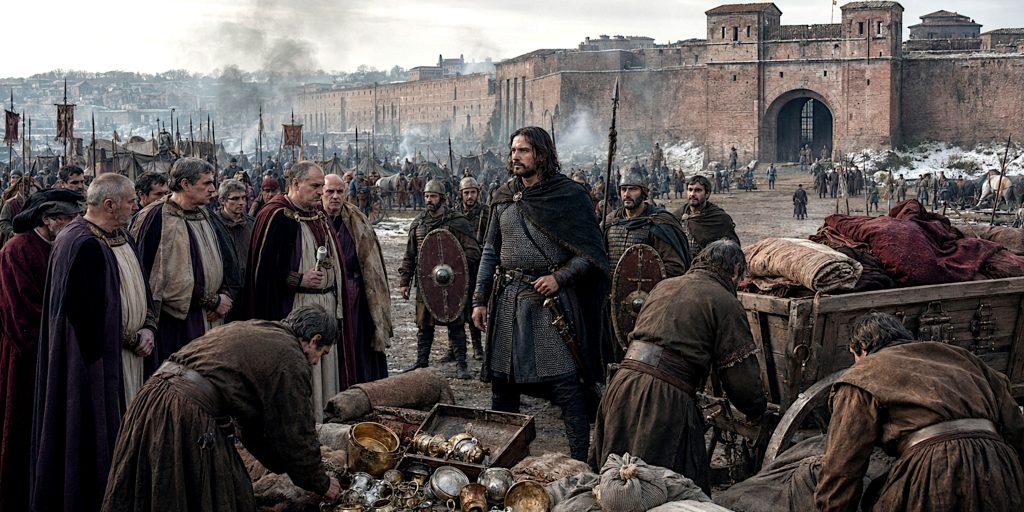
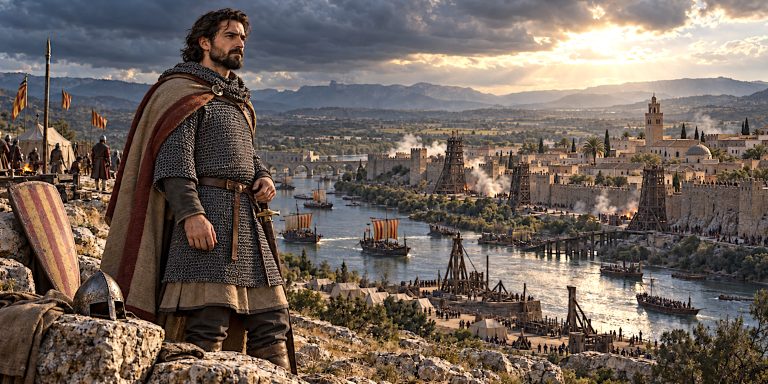
Alaric marched into Italy and surrounded Rome in late AD 408. He did not need to storm its enormous walls. By blocking roads and access to the Tiber, his army interfered with the food supply and allowed hunger to work on his behalf.
Roman envoys attempted to impress him with claims about the city’s large and warlike population. According to Zosimus, Alaric answered with a proverb:
“The thicker the hay, the easier it is mown.”
The exact wording differs between translations, but the point is wonderfully blunt. Rome’s population was only useful if it could fight and be fed.
Alaric demanded an immense ransom. The traditional list includes:
- 5,000 pounds of gold
- 30,000 pounds of silver
- 4,000 silk tunics
- 3,000 scarlet-dyed hides
- 3,000 pounds of pepper
When Roman representatives asked what he intended to leave them, he reportedly replied:
“Their lives.”
The city paid. Statues and ornaments were melted down to meet the demand, while enslaved people of non-Roman origin fled to Alaric’s camp. Zosimus gives their number as 40,000, although ancient figures of this kind should be approached cautiously.
Alaric lifted the siege and renewed negotiations. He was still trying to secure an agreement rather than occupy Rome permanently.
What Alaric wanted from Rome
Alaric’s demands changed as negotiations continued. At different stages they included money, grain, land for his followers and a senior Roman military command.
He initially sought territory across a wide section of the northern Balkans. When these demands were rejected, he reduced them. According to the surviving accounts, he was eventually prepared to accept settlement in the poorer provinces of Noricum, together with annual supplies of grain.
His willingness to reduce his territorial demands suggests that recognition and long-term security mattered more than possessing a particular region.
Honorius continued to resist. The imperial court at Ravenna was physically secure and politically detached from the suffering in Rome. This made compromise less urgent for the emperor than it was for everybody trapped inside the city.
Attalus and the second siege
In AD 409, Alaric again placed Rome under pressure. This time he encouraged the Senate to proclaim Priscus Attalus as a rival emperor.
Attalus appointed Alaric magister peditum, or master of infantry, while Ataulf, Alaric’s kinsman, received a cavalry command. Alaric had finally obtained the Roman office he had pursued, although it came from an emperor of his own making.
The arrangement soon failed. Attalus could not secure North Africa, the principal source of Rome’s grain. He also resisted some of Alaric’s advice and proved more interested in asserting imperial authority than in acknowledging who had placed him on the throne.
Alaric publicly deposed him in AD 410 and reopened discussions with Honorius.
For a moment, an agreement appeared possible. Then Sarus, another Gothic commander and a personal enemy of Alaric, attacked his forces near Ravenna. Alaric interpreted the assault as proof that Honorius could not be trusted or could not control his own supporters.
He turned back towards Rome.
The sack of Rome in AD 410
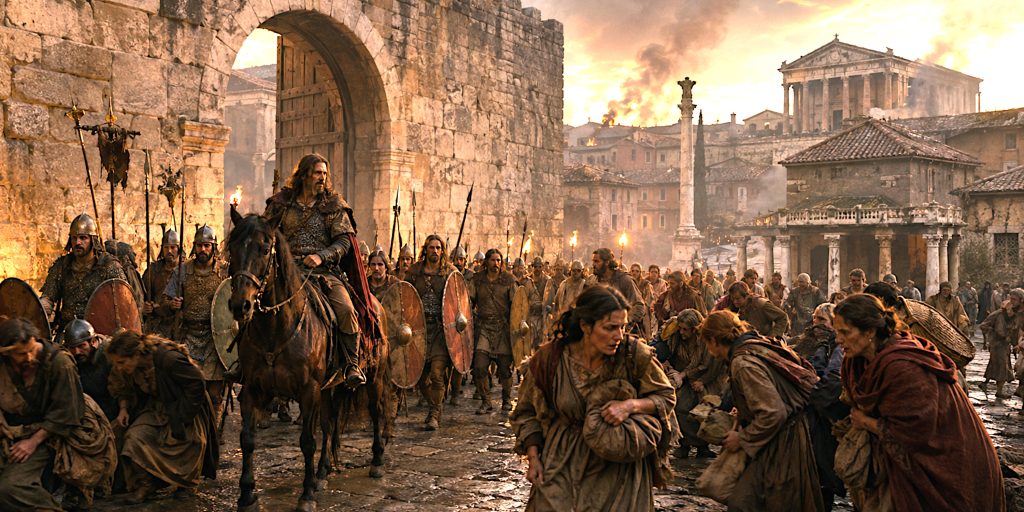
Alaric’s army entered Rome on 24 August AD 410. The precise method is uncertain.
One account claimed that enslaved people opened the Salarian Gate. Another blamed an aristocratic woman named Proba, who supposedly acted to end the suffering caused by famine. These stories may reflect attempts to explain how such a heavily fortified city could fall without a conventional assault.
The Goths plundered Rome for three days.
Palaces, wealthy homes and public buildings were stripped of portable valuables. Prisoners were taken, including Galla Placidia, the sister of Honorius. Some residents were killed, assaulted or tortured in attempts to uncover hidden wealth.
Christian writers claimed that Alaric ordered churches, particularly the basilicas of St Peter and St Paul, to be respected as places of sanctuary. There is evidence that some people found protection in Christian buildings. This did not make the sack peaceful. Jerome’s account of the treatment of the Roman ascetic Marcella records beatings, threats and terror even while describing her eventual escort to sanctuary.
The fairest conclusion is that Alaric imposed some limits on his army, but could not or did not prevent extensive violence and looting. Calling the sack restrained without qualification risks making the experiences of its victims disappear behind a favourable comparison with worse atrocities.
Contemporary reactions to the fall of Rome
The capture of Rome caused an intellectual and emotional crisis across the Roman world.
Jerome, writing from Bethlehem, struggled to describe the news:
“The City which had taken the whole world was itself taken.”
His words were not a neutral assessment. Jerome wrote as a Christian moralist grieving for friends and for a city central to his cultural identity. Even so, the sentence conveys the scale of the shock rather better than a table of damaged buildings ever could. His account appears in Letter 127, written in AD 412.
The Christian historian Orosius attempted to show that the sack had been limited by divine protection. He emphasised the safety offered in churches and argued that earlier pagan disasters had been worse. His purpose was apologetic, not investigative. He was answering claims that Rome had fallen because it abandoned its traditional gods.
Augustine approached the crisis more profoundly in The City of God. He separated the spiritual community of Christianity from the fate of any earthly state. Rome could fall without Christianity falling with it.
The different reactions are revealing. Jerome mourned, Orosius defended and Augustine reinterpreted. Alaric had captured a city, but the argument over what that capture meant lasted for centuries.
How destructive was the sack?
The sack of AD 410 was severe but not an attempt to destroy Rome completely.
Archaeology does not reveal a single city-wide layer of destruction corresponding neatly to Alaric’s attack. Some buildings were damaged or burned, while many others remained in use. The Goths stayed for only three days and lacked any obvious reason to raze a city they could exploit for wealth and hostages.
The human cost is harder to reconstruct. Ancient writers were interested in providence, moral decline and dramatic suffering rather than producing reliable casualty returns. People were killed, displaced, enslaved and stripped of their possessions, but no credible total survives.
Rome also remained inhabited and politically significant after AD 410. The event did not cause the immediate fall of the Western Roman Empire, which continued until AD 476. Nor did it mark the end of Roman culture.
Its greatest effect was symbolic. An army led by a Gothic king had entered a city that had not fallen to a foreign enemy for nearly eight centuries. Rome survived, but the belief in its invulnerability did not.
Alaric’s army
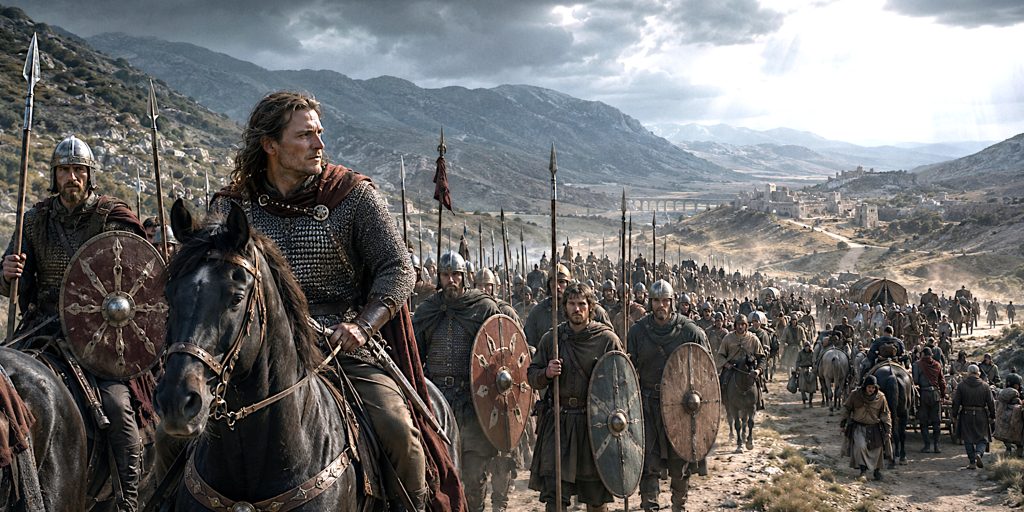
Alaric’s forces cannot be understood as a single ethnic tribe moving untouched through Europe.
His following probably included:
- Gothic warriors and their families
- Veterans of Roman military service
- Enslaved people who escaped from Roman households
- Other displaced groups from the Balkans
- Followers attracted by food, protection or the prospect of plunder
- Reinforcements brought into Italy by Ataulf
It was therefore both an army and a mobile community. Alaric had to feed non-combatants, reward warriors and maintain the loyalty of competing leaders. His demands for land and grain were practical necessities as well as political ambitions.
Estimates of the army’s size vary widely. Ancient figures are unreliable, and modern reconstructions depend on assumptions about how many non-combatants travelled with it. Claims of precisely 40,000 warriors should be treated with caution.
Arms and armour
No sword, helmet or shield can be connected personally with Alaric. Reconstructions must draw upon late Roman military evidence and finds associated with Gothic communities of the period.
| Equipment | Likely form and use |
|---|---|
| Sword | Long, double-edged spatha derived from Roman military forms |
| Spear | Used for thrusting or throwing and probably the most common battlefield weapon |
| Javelin | Lighter throwing weapons used before close combat |
| Bow | Used by some foot and mounted troops |
| Shield | Oval or round wooden shield with a central iron boss |
| Body armour | Mail or scale armour among wealthier and better-equipped warriors |
| Helmet | Late Roman ridge helmets and related composite forms |
| Cavalry equipment | Spears, swords and shields, with armour varying by status |
The sword most plausibly associated with Alaric’s warriors was the late Roman spatha. It had a straight, double-edged blade and was suitable for both cutting and thrusting. Gothic soldiers did not arrive with an entirely separate arsenal. Roman and Gothic equipment had influenced one another through decades of recruitment, trade and warfare.
Mail shirts and helmets were valuable items and unlikely to have been worn by every warrior. Many fighters probably relied on shields, thick clothing and mobility. The image of a uniformly armoured Gothic host belongs more comfortably to cinema than to the evidence.
Alaric’s army also understood siege warfare, supply routes and Roman command structures. Its effectiveness did not depend upon exotic weapons. It depended upon experience.
Alaric as a military commander
Alaric was not an undefeated battlefield genius. Stilicho checked him at Pollentia and Verona, and some of his strategic ambitions were never realised.
His strengths lay elsewhere:
- He preserved his army after reverses.
- He exploited divisions between the eastern and western courts.
- He used sieges and control of food supplies effectively.
- He combined military pressure with repeated negotiation.
- He adapted his demands when circumstances changed.
- He maintained a large, mobile following for many years.
His career was built on endurance and political leverage. He remained dangerous because Roman governments could neither defeat him decisively nor offer terms that lasted.
Alaric also understood the symbolic and political value of Rome. Controlling the city allowed him to pressure Honorius, manipulate the Senate and create a rival emperor. The sack came after these methods failed, not before they were attempted.
Alaric’s march into southern Italy
After leaving Rome, Alaric moved south through Campania, Lucania and Bruttium. His next objective may have been Sicily and then Roman North Africa.
Africa was the economic foundation of the Western Empire. It supplied grain, tax revenue and oil. Control of the region would have given Alaric the secure base that years of campaigning had failed to obtain.
His forces reached the Strait of Messina, but the crossing never happened. Ancient accounts claim that a storm wrecked some of the ships prepared for the expedition.
Whether Alaric intended to conquer Africa, negotiate from a stronger position or simply secure supplies remains uncertain. Whatever the plan, his death ended it.
Death and the legend of the Busento
Alaric died near Consentia, modern Cosenza, late in AD 410. Disease is usually suggested, although no contemporary medical account survives. He was probably about 40 years old.
Jordanes later recorded an extraordinary burial story. According to his account, Gothic captives diverted the River Busento, buried Alaric and his treasures beneath its bed, and then restored the river’s course. The labourers were killed so that nobody could reveal the location.
It is a magnificent story, full of gold, water and conveniently silenced witnesses. It is also unsupported by archaeology.
No confirmed grave of Alaric has been discovered. Searches around the Busento have produced no convincing evidence for the burial described by Jordanes. The tradition remains part of Alaric’s legend rather than an established historical event.
What happened to the Goths after Alaric?
Ataulf succeeded Alaric and led the Goths out of Italy into Gaul. He later married Galla Placidia, the Roman princess taken during the sack.
Under later leaders, the Goths reached an agreement with the imperial government and established power in south-western Gaul. From this base developed the Visigothic kingdom, which later expanded into Hispania.
Alaric did not found that kingdom in a formal sense. He never secured a permanent homeland and died only months after his most famous victory. Yet he kept his following together long enough for his successors to achieve the settlement he had pursued.
His importance lies partly in this continuity. The sack of Rome was spectacular, but the survival of his political and military coalition had greater long-term consequences.
How reliable are the sources?
No surviving autobiography, official archive or Gothic history allows Alaric to speak directly to us.
The main literary evidence comes from authors with strong political or religious agendas:
| Source | Perspective | Main limitation |
|---|---|---|
| Claudian | Court poet supporting Stilicho | Highly rhetorical and hostile to Alaric |
| Priscus Attalus and Olympiodorus fragments | Political history close to events | Survives only incompletely |
| Orosius | Christian historian writing soon afterwards | Determined to defend Christianity |
| Jerome | Contemporary Christian scholar | Emotional, moralising and distant from Rome |
| Augustine | Christian theologian | Concerned with the meaning of the sack |
| Zosimus | Pagan historian writing later | Hostile to Christian emperors |
| Jordanes | Sixth-century Gothic historian | Wrote long after Alaric and preserved legends |
These sources are invaluable, but none offers a plain record of events. Even famous conversations between Alaric and Roman envoys may have been sharpened by later storytellers.
A balanced account has to preserve uncertainty. Alaric’s life is well documented by ancient standards, but his private motives, appearance, childhood and personality remain mostly beyond reach.
Timeline of Alaric’s life
| Date | Event |
|---|---|
| Around AD 370 | Probable birth |
| AD 394 | Likely serves in Theodosius I’s army at the Frigidus |
| AD 395 | Emerges as leader of a Gothic revolt |
| AD 395–397 | Campaigns through the Balkans and Greece |
| Around AD 397 | Receives a Roman command in Illyricum |
| AD 401 | Invades Italy |
| AD 402 | Fights Stilicho at Pollentia |
| AD 403 | Checked again near Verona |
| AD 405–407 | Becomes involved in Stilicho’s plans for Illyricum |
| August AD 408 | Stilicho is executed |
| Late AD 408 | Alaric begins the first siege of Rome |
| AD 409 | Second siege and elevation of Priscus Attalus |
| AD 410 | Alaric deposes Attalus and renews talks with Honorius |
| 24 August AD 410 | Gothic forces enter and sack Rome |
| Late AD 410 | Alaric dies near Consentia |
| After AD 410 | Ataulf succeeds him and leads the Goths towards Gaul |
Alaric’s historical legacy
Alaric did not destroy the Roman Empire. He did not depose Honorius, establish a lasting kingdom or conquer the western provinces. Judged solely by his stated political ambitions, his career ended unfinished.
Yet he changed how Rome was imagined.
The sack demonstrated that imperial prestige could no longer compensate for weak leadership, fragmented command and a shrinking ability to control military forces. Rome possessed formidable walls, immense cultural authority and centuries of accumulated confidence. None of these could repair a government that repeatedly undermined its own defenders.
Alaric also represents the complicated relationship between Rome and the peoples it labelled barbarian. He was an enemy of the empire, a former imperial soldier, a seeker of Roman office and a Christian ruler commanding men familiar with Roman warfare. He cannot be placed neatly outside the Roman world because that world had helped create him.
I find this the most compelling part of his story. Alaric spent years attempting to obtain a place within the empire. Rome finally gave him a place in its history instead, although not quite the one either side would have chosen.
The Seven Swords verdict
Alaric I was neither a mindless destroyer nor a misunderstood humanitarian with unusually enthusiastic methods of negotiation. He was an ambitious and adaptable war leader responsible for campaigns that caused real suffering.
His greatest success came from recognising Rome’s political weaknesses. He survived military reverses, held together a diverse following and repeatedly forced imperial governments to negotiate. When those negotiations collapsed, he captured the city at the centre of Roman identity.
The Western Empire continued for another 66 years, but AD 410 exposed how fragile it had become. Rome had survived generals, civil wars and invasions before. This time, the world noticed that survival was no longer guaranteed.
Suggested sources and further reading
- Jerome, Letter 127
- Zosimus, New History, Book V
- Orosius, Histories Against the Pagans
- Peter Heather, The Fall of the Roman Empire
- Michael Kulikowski, Rome’s Gothic Wars
- Guy Halsall, Barbarian Migrations and the Roman West
- Douglas Boin, Alaric the Goth