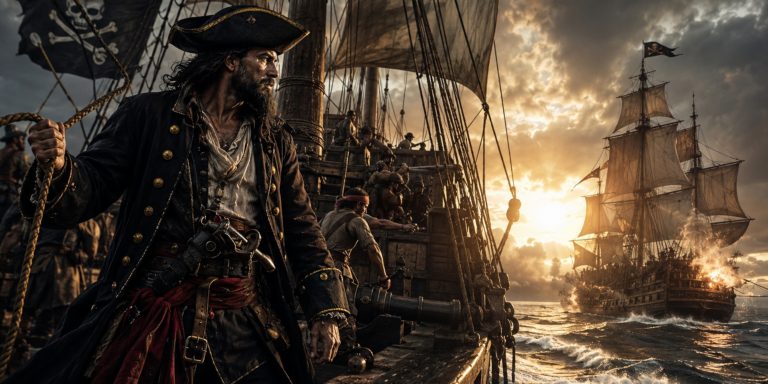
Black Sails begins as a treasure hunt and gradually reveals itself as something far more ambitious. Across four seasons, the series combines the fictional world of Treasure Island with real pirates, colonial politics, naval warfare and a surprisingly thoughtful argument about who gets to write history.
Created by Jonathan E. Steinberg and Robert Levine, the drama is set around Nassau in 1715, during the latter years of the Golden Age of Piracy. Captain James Flint is pursuing the treasure aboard the Spanish galleon Urca de Lima, while John Silver is doing what John Silver does best: lying to everyone within conversational distance.
The first season can be slow and occasionally too fond of premium-cable excess. Stick with it. Once the characters, rivalries and political stakes are established, Black Sails develops into one of television’s finest historical adventures.
Black Sails at a glance
| Detail | Information |
|---|---|
| Creators | Jonathan E. Steinberg and Robert Levine |
| Original broadcaster | Starz |
| Original run | 2014 to 2017 |
| Seasons | 4 |
| Episodes | 38 |
| Setting | Nassau and the Caribbean, beginning in 1715 |
| Genre | Historical drama, adventure and political thriller |
| Source material | A prequel to Robert Louis Stevenson’s Treasure Island |
| Principal location | Cape Town, South Africa |
| Composer | Bear McCreary |
| Recommended for | Fans of historical drama, naval warfare and complicated antiheroes |
What is Black Sails about?
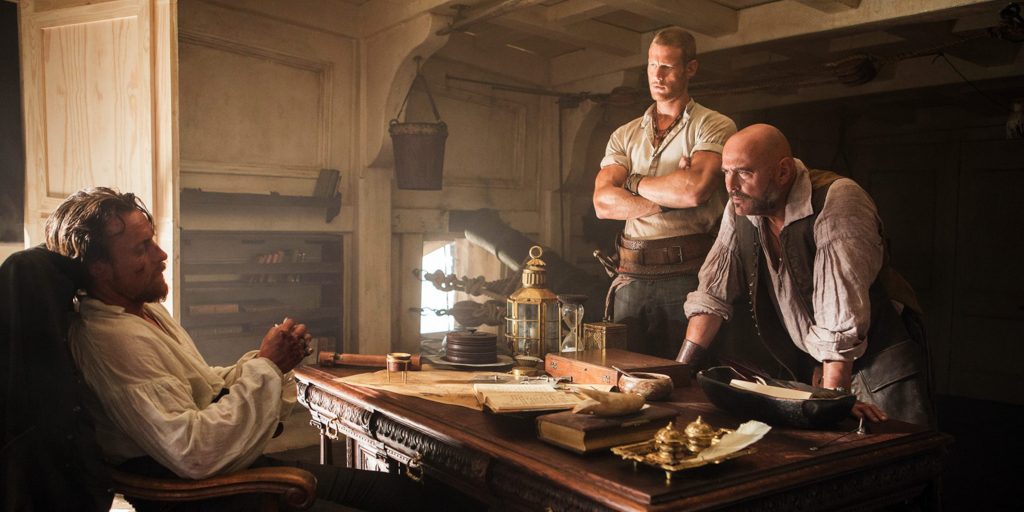
The story opens on New Providence Island, where Nassau has become a centre of pirate trade beyond effective British control. Captains bring stolen cargo into port, merchants turn it into profit and crews decide whether their commanders remain in office.
Flint believes the pirates cannot survive indefinitely as scattered bands of thieves. Britain will eventually return, restore colonial authority and hang anyone unable to produce a convincing career change. His answer is to secure the Urca de Lima treasure and use its wealth to defend Nassau.
Standing inconveniently between Flint and that fortune is John Silver, a fast-talking opportunist who possesses valuable information and almost no loyalty. Their uneasy relationship becomes the spine of the series.
The plot soon expands beyond buried wealth. Nassau’s survival is tied to competing visions of freedom, civilisation and power. Every alliance carries a price, every captain needs the confidence of a volatile crew and nearly everyone is keeping at least one ruinous secret.
This is technically a pirate adventure. It is also a political drama in which the politicians happen to carry cutlasses.
Is Black Sails a prequel to Treasure Island?
Yes, although it is not a direct adaptation.
The series imagines the events that might have created the characters and legends later encountered in Robert Louis Stevenson’s 1883 novel. Flint, John Silver and Billy Bones come from Treasure Island, while figures including Charles Vane, Jack Rackham, Anne Bonny, Edward Teach and Woodes Rogers belonged to real history.
That mixture gives the writers considerable freedom. Historical records determine some outcomes, while Stevenson’s novel establishes where certain fictional characters must eventually end up. The pleasure lies in watching the series connect those points without making the route obvious.
You do not need to have read Treasure Island before watching. Knowing the book adds another layer, particularly when familiar names, phrases and objects begin to acquire meaning.
Main cast and characters
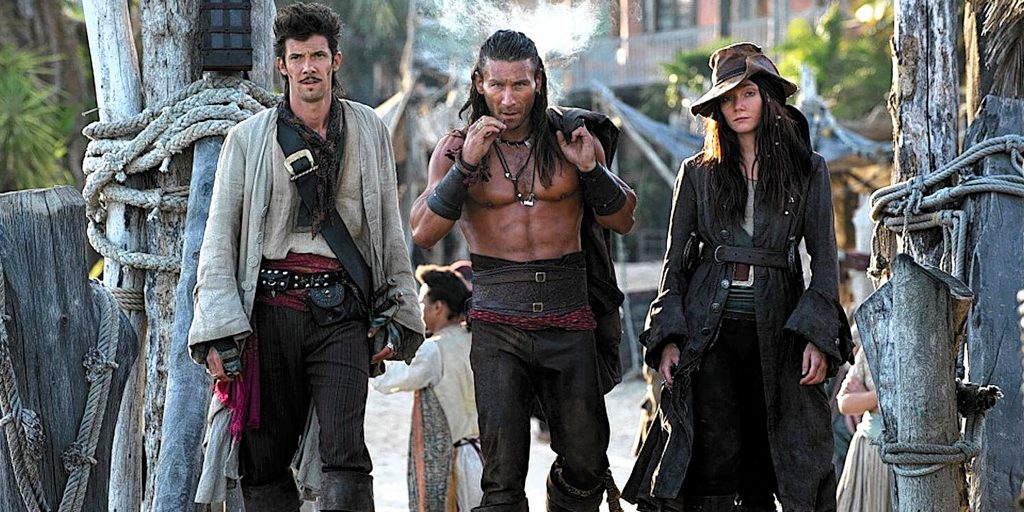
| Actor | Character | Role in the story |
|---|---|---|
| Toby Stephens | Captain James Flint | Captain of the Walrus and the driving force behind the struggle for Nassau |
| Luke Arnold | John Silver | A gifted liar whose usefulness gradually becomes influence |
| Hannah New | Eleanor Guthrie | The merchant who controls much of Nassau’s illicit trade |
| Jessica Parker Kennedy | Max | A survivor who learns to turn information into authority |
| Zach McGowan | Charles Vane | A dangerous captain fiercely committed to pirate independence |
| Toby Schmitz | Jack Rackham | An intelligent, theatrical schemer determined to build a legacy |
| Clara Paget | Anne Bonny | Rackham’s formidable partner and one of Nassau’s deadliest fighters |
| Tom Hopper | Billy Bones | A dependable sailor increasingly troubled by Flint’s leadership |
| Hakeem Kae-Kazim | Mr Scott | Eleanor’s adviser, whose loyalties are more complex than they first appear |
| Luke Roberts | Woodes Rogers | The governor sent to restore British rule in Nassau |
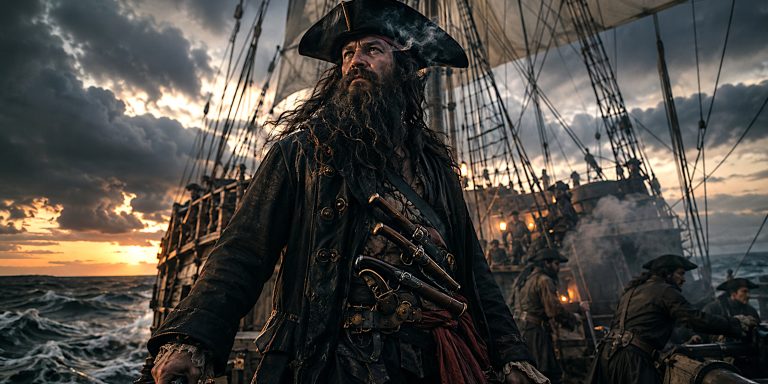
| Ray Stevenson | Edward Teach | Blackbeard, an ageing pirate captain who remains terrifyingly capable |
Why Captain Flint is such a compelling character

Flint initially appears to be the familiar ruthless captain: intelligent, secretive and willing to spend other people’s lives in pursuit of an objective he has not fully explained.
Toby Stephens gradually exposes the grief, anger and political conviction beneath that hard exterior. Flint is neither a simple villain nor a romantic freedom fighter. He can describe a persuasive vision of resistance and then commit something appalling before the speech has entirely settled.
His conflict with Britain is personal, but it grows into a wider rejection of the social order Britain represents. Flint understands that civilisation is partly a story told by the powerful about themselves. Pirates become monsters because the empire requires monsters against which it can appear lawful.
The problem, and it is quite a significant one, is that Flint often behaves exactly like the monster described.
John Silver and the creation of a legend
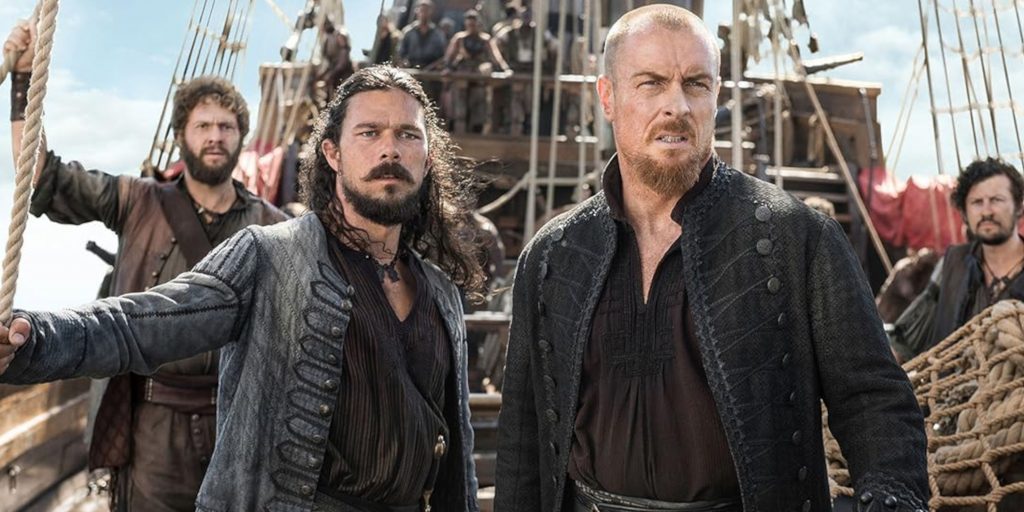
Luke Arnold’s John Silver enters the story as a cook, thief and professional improviser. He has no grand cause. His main political belief is that John Silver should remain alive.
His transformation is one of the show’s greatest achievements. Silver learns that stories can command people as effectively as weapons. A reputation repeated across taverns and ships eventually develops a life beyond the person who inspired it.
The series treats Long John Silver as a deliberately constructed legend. His authority depends upon what people believe he has done, what they fear he might do and what his allies need him to represent.
Watching that identity take shape is more interesting than receiving a tidy origin story. Silver does not wake up one morning with a parrot and a completed personal brand.
The women of Black Sails
Eleanor Guthrie, Max and Anne Bonny are central to the struggle for Nassau rather than ornamental figures placed beside it.
Eleanor derives power from commerce. She can make piracy profitable by arranging buyers for stolen cargo, giving her influence over captains who would otherwise dismiss a young woman’s authority. Her position remains precarious because it depends upon maintaining several hostile relationships at once.
Max begins with little formal power but understands the value of information, negotiation and ownership. Her rise occasionally feels too smooth, yet Jessica Parker Kennedy gives the character a convincing mixture of calculation and vulnerability.
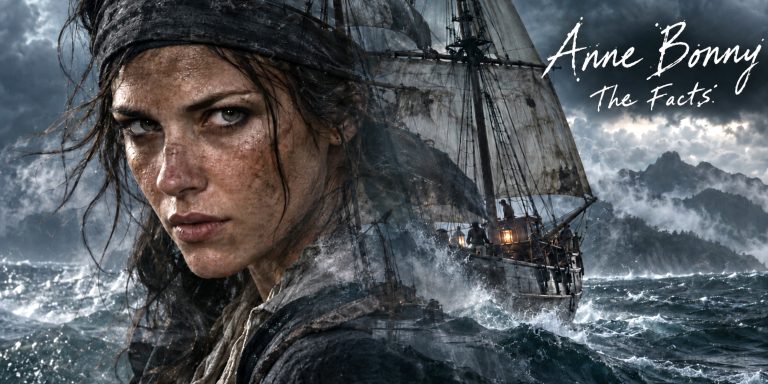
Anne Bonny is written as more than a silent weapon, although the show initially enjoys presenting her that way. Her relationships with Rackham and Max force her to confront questions of identity, loyalty and desire that she has spent years burying beneath a hat and an extremely hostile stare.
Their stories broaden the series beyond shipboard conflict. Nassau is controlled as much by trade, intelligence and personal leverage as it is by cannon.
How historically accurate is Black Sails?
Black Sails captures the politics and atmosphere of the pirate world more successfully than it reproduces every physical detail.
Nassau really did become a pirate base during the early eighteenth century. The breakdown of effective colonial government allowed crews to use New Providence as a place to repair ships, recruit sailors and sell captured goods. Woodes Rogers arrived as royal governor in 1718 with pardons for those willing to surrender and force for those who were not.
Several major characters were real:
- Charles Vane resisted the royal pardon and continued operating as a pirate.
- Jack Rackham, better known as Calico Jack, sailed with Anne Bonny and Mary Read.
- Edward Teach, or Blackbeard, was active during this period.
- Benjamin Hornigold became one of Nassau’s leading pirate captains before accepting a pardon and hunting former associates.
- Woodes Rogers played a decisive role in ending Nassau’s pirate republic.
The chronology is compressed and relationships are extensively fictionalised. Flint and Silver are literary creations, while the real pirates are reshaped to serve the drama. Certain costumes, firearms and props also come from later periods.
The series should therefore be treated as intelligent historical fiction rather than reconstructed history. It understands the economic and political conditions that produced piracy, even when it rearranges the people caught within them.
Pirate democracy and life aboard ship

One of the show’s strongest ideas is that a pirate captain did not rule with unlimited authority. Crews could elect captains, agree articles governing conduct and remove leaders who no longer served their interests.
Black Sails uses these arrangements to create tension. Flint may be captain during combat, but he still needs support from the crew. Political persuasion aboard the Walrus can be as important as seamanship.
The system was hardly modern democracy. Pirate ships remained violent, hierarchical workplaces in which punishment could be severe. Yet sailors often had a greater voice and a fairer share of profits than they received aboard naval or merchant vessels.
This helps explain why piracy attracted experienced seamen despite its obvious occupational disadvantages, including battle, disease, drowning and an eventual appointment with the gallows.
Ships and naval warfare
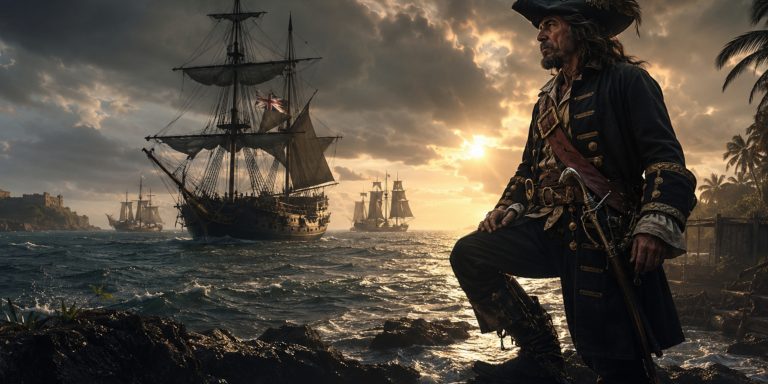
The ships give Black Sails much of its physical weight. Production took place in Cape Town, where large sets and ship replicas allowed actors to work within convincing maritime environments.
Naval engagements usually follow a recognisable tactical logic:
- Captains consider wind direction before committing to battle.
- Crews use different ammunition against hulls, rigging and personnel.
- Cannon fire prepares an enemy ship for capture rather than simply destroying it.
- Boarding actions are chaotic, compressed and brutally personal.
- Damage to masts, sails and steering can decide an engagement before either crew boards.
The action remains dramatised. Real naval combat could be slower, smokier and far more confusing than television permits. Characters also survive situations that would cause a sensible insurer to leave the Caribbean entirely.
Even so, the series conveys the labour involved in operating a sailing vessel. Ships feel like machines worked by large crews rather than decorative platforms waiting for the important actors to arrive.
Swords, firearms and pirate weapons
The programme features a broad selection of weapons inspired by the early eighteenth century.
| Weapon | Use | Historical assessment |
|---|---|---|
| Cutlass and hanger | Close combat aboard ships and in confined spaces | Appropriate general type, though individual designs vary |
| Smallsword | Duelling and personal defence among gentlemen and officers | Well suited to the period and social setting |
| Flintlock pistol | Short-range personal firearm used before boarding | Historically appropriate, although reliability is sometimes generous |
| Musket | Volley fire and fighting on land or from a ship’s deck | Correct for military and maritime use |
| Blunderbuss | Close-range defence and crowd control | Plausible aboard ships, but not a universal pirate weapon |
| Boarding axe | Cutting rope, damaging woodwork and fighting at close range | A practical maritime tool as well as a weapon |
| Naval cannon | Damaging hulls, rigging or crews at range | Tactics are broadly convincing but adjusted for dramatic pace |
The cutlass dominates popular pirate imagery, but it was not the only sword available. Short naval hangers, hunting swords and personal blades acquired through trade or capture would all have been plausible.
Flint’s refined swordsmanship also tells us something about his background. Fighting style in Black Sails is often used as character writing. Vane fights with raw aggression, Flint appears more formally trained and Rackham generally prefers to win before anyone reaches for steel. On balance, Jack may have the healthiest attitude.
The best seasons of Black Sails ranked
| Rank | Season | Verdict |
|---|---|---|
| 1 | Season 2 | The characters deepen, Flint’s past is revealed and the political plot becomes gripping |
| 2 | Season 3 | A larger war develops without sacrificing the personal conflicts |
| 3 | Season 4 | A powerful and unusually thoughtful conclusion, though some stories feel compressed |
| 4 | Season 1 | Essential groundwork, but uneven pacing and early excess make it the weakest season |
Season 2 is where the show becomes the series people enthusiastically recommend. Earlier conversations gain new meaning, Flint becomes vastly more complicated and Nassau’s future feels genuinely uncertain.
Season 3 broadens the conflict and introduces Woodes Rogers and Blackbeard without turning either into a cartoon antagonist. The final season delivers a satisfying conclusion built around the difference between truth, memory and useful fiction.
Season 1 is better on a second viewing because so much of its apparently fussy political detail matters later. On a first viewing, however, it can feel like attending several pirate committee meetings before being allowed near the treasure.
The best battles and action sequences
The attack on the Spanish Man O’ War
The series establishes its scale early by showing how much preparation, discipline and desperation are required to attack a larger vessel. Victory depends upon timing and crew coordination, not heroic sword waving.
The defence of Charleston
Flint’s confrontation with colonial authority brings personal history and military action together. The sequence marks the point at which the treasure hunt develops into open political war.
The storm
The hurricane episode in Season 3 is a technical highlight. It places the crew against something that cannot be threatened, bribed or outmanoeuvred through an inspiring speech.
Blackbeard’s final confrontation
Edward Teach’s last stand is among the series’ most disturbing sequences. It strips away the romantic image of piracy and presents state violence as deliberate theatre.
The battle for Nassau
The later fighting for the island combines shore assaults, fortifications, naval movement and competing political objectives. It feels like the culmination of a conflict the series has been building from its opening episodes.
What Black Sails is really about
Beneath the treasure maps and cannon fire, Black Sails is concerned with stories.
Britain maintains power partly by defining pirates as enemies of civilisation. Flint responds by trying to create a competing story in which Nassau represents freedom from imperial control. Silver discovers that a frightening legend can protect him more effectively than the truth.
The series repeatedly asks whether people control their reputations or become trapped inside them. Real people are turned into villains, heroes and symbols according to the needs of those telling the tale.
This theme connects the programme neatly to Treasure Island. Stevenson’s adventure becomes the sanitised legend left after the blood, politics and inconvenient motives have been removed.
LGBTQ+ representation and identity
The treatment of sexuality becomes increasingly important as the story progresses. Flint’s history provides essential context for his hatred of the civilisation pursuing him, while Max, Anne and Eleanor negotiate relationships shaped by both affection and survival.
These elements are woven into the political argument rather than presented as detached subplots. British society does not merely oppose piracy. It imposes a narrow definition of acceptable identity, family and public behaviour.
The writing is not flawless, and some early scenes lean heavily on sexualised spectacle. As the series matures, however, queer identity becomes fundamental to its examination of power, secrecy and historical erasure.
Where Black Sails occasionally struggles
The series deserves praise, but not canonisation.
- Season 1 takes time to find its balance between political drama and adult spectacle.
- The opening episodes contain a large amount of exposition and several characters competing for attention.
- Certain plans depend upon people making extraordinarily convenient decisions.
- The historical setting is convincing in broad terms but inconsistent in its material detail.
- Some final-season developments move faster than their emotional weight deserves.
- The dialogue can become extremely polished for people making urgent decisions while surrounded by cannon fire.
None of these problems ruins the series. They do explain why some viewers abandon it before reaching the much stronger second season.
Is Black Sails worth watching?
Yes, particularly if you enjoy historical dramas that allow characters to develop over several seasons.
This is not a light adventure in the style of Pirates of the Caribbean. The story contains graphic violence, sexual content, slavery, torture and political betrayal. It also expects viewers to remember alliances, commercial arrangements and grievances rather than merely wait for the next ship to explode.
Watch it if you enjoyed:
- The Last Kingdom
- Rome
- Spartacus
- Game of Thrones
- The Terror
- Master and Commander: The Far Side of the World
The closest comparison is probably Rome. Both shows use a turbulent historical setting to explore power through intimate relationships, while allowing historical figures and invented characters to occupy the same world.
Where to watch Black Sails
Streaming availability changes regularly by country. At the time of writing, Starz carries all four seasons in the United States, while UK availability has included ITVX. Digital purchase options and DVD or Blu-ray box sets may also be available.
Check the relevant service before subscribing, as licensing agreements possess the same dependable loyalty as a Nassau pirate council.
Critical reception and awards
The first season received mixed reviews, with critics praising its scale while questioning its pacing and character development. Reception improved considerably once the longer story began to reveal itself. Rotten Tomatoes records a 100 per cent score for Season 2 and 80 per cent for the final season, although these figures are based on different numbers of reviews. Rotten Tomatoes
The production received recognition for the technical work that made its maritime world convincing. According to the Television Academy, Black Sails won three Emmy Awards, including honours for visual effects and sound editing. Television Academy
Its reputation has continued to grow since the finale. That makes sense. The slow opening is less frustrating when all 38 episodes are available, and the completed story rewards viewers who pay attention to its early political groundwork.
Verdict
Black Sails is one of the rare prequels that strengthens its source material without behaving as though every familiar object requires a dramatic origin scene.
Its ships look formidable, its battles carry weight and its cast is excellent. More importantly, it understands that piracy was bound up with trade, empire, labour and control of the historical record. The series romanticises its outlaws, then repeatedly questions the romance it has created.
The first season asks for patience. Seasons 2 and 3 repay it handsomely, while the final season brings the story to an ending that feels deliberate rather than merely discontinued.
Overall rating: 9 out of 10
Frequently asked questions

Is Black Sails based on a true story?
Partly. It combines fictional characters from Treasure Island with historical pirates and events from the Golden Age of Piracy.
Is Captain Flint a real pirate?
No. Captain Flint was created by Robert Louis Stevenson for Treasure Island. The television series invents his earlier life.
Was Charles Vane a real person?
Yes. Vane was an English pirate who resisted Woodes Rogers and continued operating after a royal pardon was offered.
How many seasons of Black Sails are there?
There are four seasons containing 38 episodes.
Was Black Sails cancelled?
The fourth season was announced as the final chapter before it aired. The story therefore received a planned conclusion.
Does Black Sails improve after Season 1?
Considerably. Season 1 establishes the characters and political structure, while Season 2 turns that groundwork into a much stronger drama.
Do I need to read Treasure Island first?
No. The series works independently, although familiarity with the novel adds meaning to several characters and plot details.