Fritigern remains one of the most elusive and fascinating figures of late antiquity. He appears suddenly in the sources, changes the course of Roman history in a few violent years, then disappears almost as quickly. We do not know what he looked like. We do not know exactly when he was born, where he died, or even whether he ruled all the Goths or only part of them. Yet for a brief moment in the 370s, he became the most dangerous man on Rome’s northern frontier.
As a historian, I have always found Fritigern oddly compelling because he does not fit the neat image of a barbarian warlord charging blindly at civilisation. He was patient, calculating and politically astute. He understood Roman weakness better than many Roman emperors did. By the end of his career he had not merely won a battle. He had exposed the fragility of the late Roman Empire.
Who Was Fritigern?
Fritigern was a leader of the Tervingi, one of the major Gothic peoples living north of the Danube in what is now Romania and parts of Ukraine. The Tervingi would later be known as the Visigoths.
He first appears in the historical record during a power struggle among the Goths in the 370s. At the time, another Gothic leader, Athanaric, dominated much of the Tervingi. Athanaric was deeply hostile to Rome and to Christianity. Fritigern, by contrast, appears to have been more willing to work with the Roman Empire when it suited him.
Around 376, pressure from the advancing Huns forced huge numbers of Goths to flee south towards the Roman frontier on the Danube. Fritigern led a substantial portion of these refugees. The Roman emperor Valens allowed them to cross into the empire and settle in the Balkans.
It was supposed to be a managed migration. Instead, it became a catastrophe.
Roman officials extorted, starved and abused the Gothic refugees. Ammianus Marcellinus, our best source, paints a grim picture of Roman greed. Gothic families sold children into slavery in exchange for dog meat. Roman officers grew rich while thousands of desperate people gathered in armed camps.
Fritigern emerged as the leader of the resulting revolt.
Fritigern and the Gothic Revolt
The revolt began in 377 after Roman commanders attempted to isolate and control the Gothic leaders at a banquet near Marcianople. The situation collapsed into violence and Fritigern escaped.
From that moment, he transformed a desperate refugee movement into a dangerous military coalition. He united different Gothic groups, drew in runaway slaves, recruited miners and peasants from the Balkans, and eventually allied with Hunnic and Alan cavalry.
This was one of his greatest strengths. Fritigern was not simply a battlefield commander. He was a political operator. He could persuade rival groups to cooperate, at least long enough to fight a common enemy.
Roman armies repeatedly tried to trap or destroy him during 377 and early 378. They failed. Fritigern avoided battles when conditions were poor, withdrew when necessary, and struck when the Romans were divided.
That alone marks him out as more than a conventional tribal chief. Plenty of Gothic leaders were brave. Far fewer were disciplined enough to avoid fighting until the odds improved.
Battle of Adrianople
The defining moment of Fritigern’s life came on 9 August 378 at Adrianople.
The emperor Valens marched against the Goths with perhaps 15,000 to 20,000 men. He was impatient to win a victory before reinforcements from the western empire arrived. It was the sort of decision that looks foolish in hindsight, though Roman emperors had an unfortunate habit of making exactly this sort of mistake.
Fritigern positioned his people behind a wagon laager, probably on rising ground near Adrianople in modern Turkey. He knew his cavalry was still away foraging and needed time to return.
So he delayed.
He sent envoys. He opened negotiations. He talked about peace. He stretched out the hours while the Roman army stood in the summer heat, exhausted, thirsty and increasingly disorganised.
When the Gothic cavalry finally arrived, the battle changed instantly.
The Roman army was attacked on the flanks and rear. The infantry collapsed into confusion. Emperor Valens disappeared in the chaos and was probably killed on the field or burned alive in a nearby farmhouse.
The defeat was one of the worst in Roman history.
Perhaps two thirds of the eastern Roman field army was destroyed. Entire units vanished. Senior officers were killed. The empire lost not only men but confidence.
As a historian, I think Adrianople is often misunderstood. It was not the fall of Rome. The empire survived for another century in the west and much longer in the east. But it was a warning. The old Roman assumption that barbarian armies would always break before disciplined legions suddenly looked painfully outdated.
Battles and Military Acumen
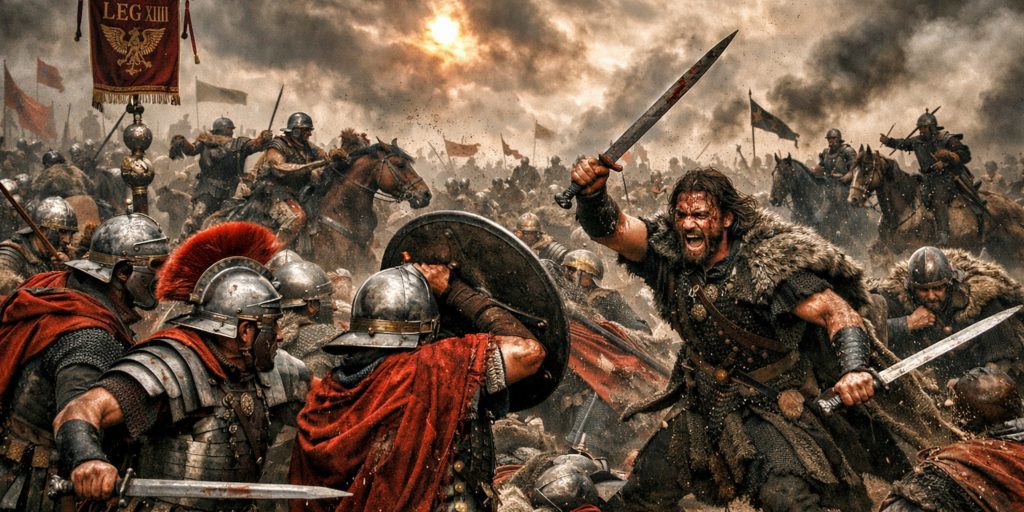
Fritigern’s military reputation rests primarily on Adrianople, but his wider campaign reveals much about his abilities.
Strengths as a Commander
- He excelled at defensive warfare and refused battle unless conditions favoured him.
- He understood the value of terrain, especially high ground and defensive wagon circles.
- He made effective use of diplomacy and delay.
- He coordinated infantry, cavalry and allied contingents better than many Roman commanders expected.
- He maintained a coalition of Goths, Alans and Huns despite internal tensions.
Major Engagements
| Year | Battle or Campaign | Result | Fritigern’s Role |
|---|---|---|---|
| c. 376 | Crossing of the Danube | Gothic migration into the empire | Led refugees and negotiated with Rome |
| 377 | Battle of Marcianople | Gothic victory | Escaped Roman trap and launched revolt |
| 377 | Battle of Ad Salices | Indecisive | Fought Roman forces and withdrew in good order |
| 377-378 | Campaign in Thrace | Gothic raiding and manoeuvre | Avoided destruction and expanded alliances |
| 378 | Battle of Adrianople | Decisive Gothic victory | Outmanoeuvred and destroyed Valens’ army |
The Battle of Ad Salices in particular is often overlooked. It was not a glamorous victory. It was a brutal, messy fight in which neither side achieved much. Yet Fritigern survived when a less capable commander might have lost everything. He withdrew, regrouped and came back stronger.
That is usually the mark of a serious commander. Great generals do not only win glorious victories. They also survive the difficult days.
Arms and Armour
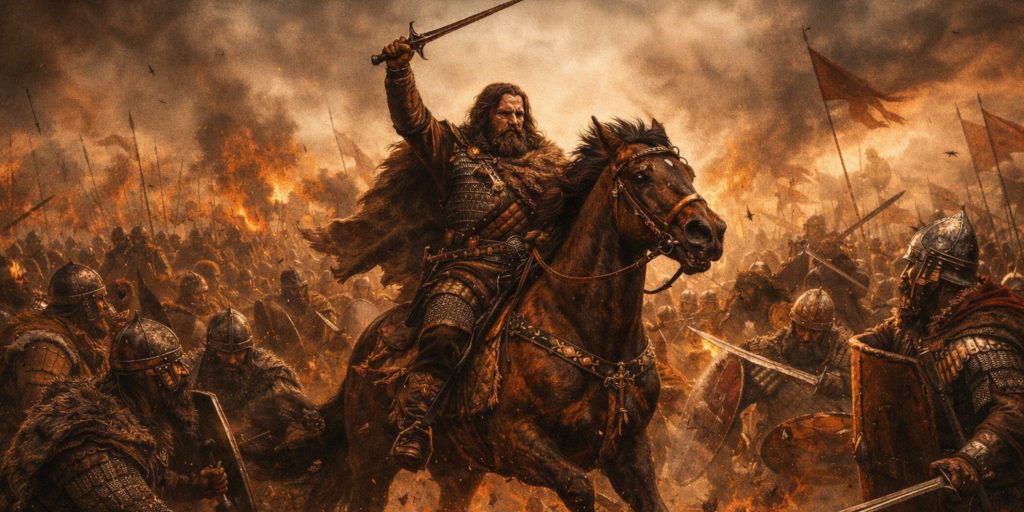
The Goths under Fritigern were not a uniform army. They included noble warriors, poorer infantry, cavalry, allied Huns and Alans, and armed refugees. Equipment varied enormously.
Still, archaeology and written accounts give us a reasonably clear idea of what Fritigern’s followers would have used.
Weapons
Common Gothic weapons included:
- Long iron spears for infantry and cavalry
- Throwing spears and javelins
- Long swords of Germanic style, often pattern-welded
- Roman spathae acquired through trade, service or plunder
- Axes and fighting knives
- Bows used particularly by Hunnic and Alan allies
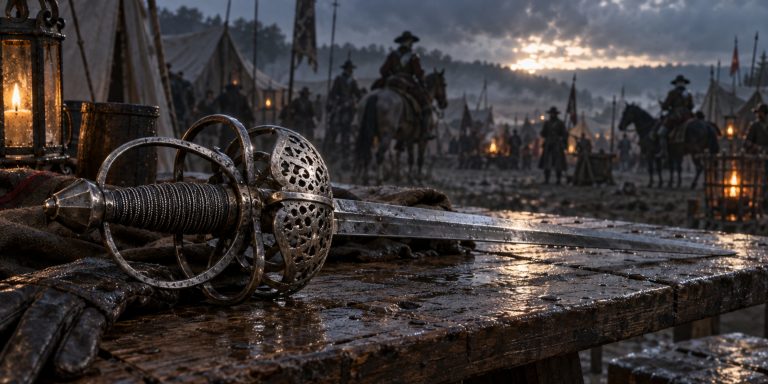
Many Gothic nobles carried long double-edged swords similar to the Roman spatha. These were prestige weapons as much as practical ones. Several richly decorated sword fittings from Gothic graves suggest that elite warriors valued elaborate hilts, silver mounts and decorated scabbards.
The Gothic infantry probably relied heavily on spear and shield. A sword was useful, but a spear was cheaper and easier to produce. Human nature has not changed much in sixteen centuries. If you are feeding a large army on the move, there are never enough swords to go around.
Armour
Most Gothic warriors probably wore little armour beyond thick clothing, cloaks and perhaps leather jerkins. Wealthier warriors and nobles had access to:
- Mail shirts
- Scale armour
- Roman helmets captured or purchased from the empire
- Iron or bronze helmet fittings
- Large round or oval shields with iron bosses
Some Gothic leaders may have worn Roman military equipment almost indistinguishable from that of imperial officers. This was especially true among Gothic elites who had served in Roman armies or traded extensively with the empire.
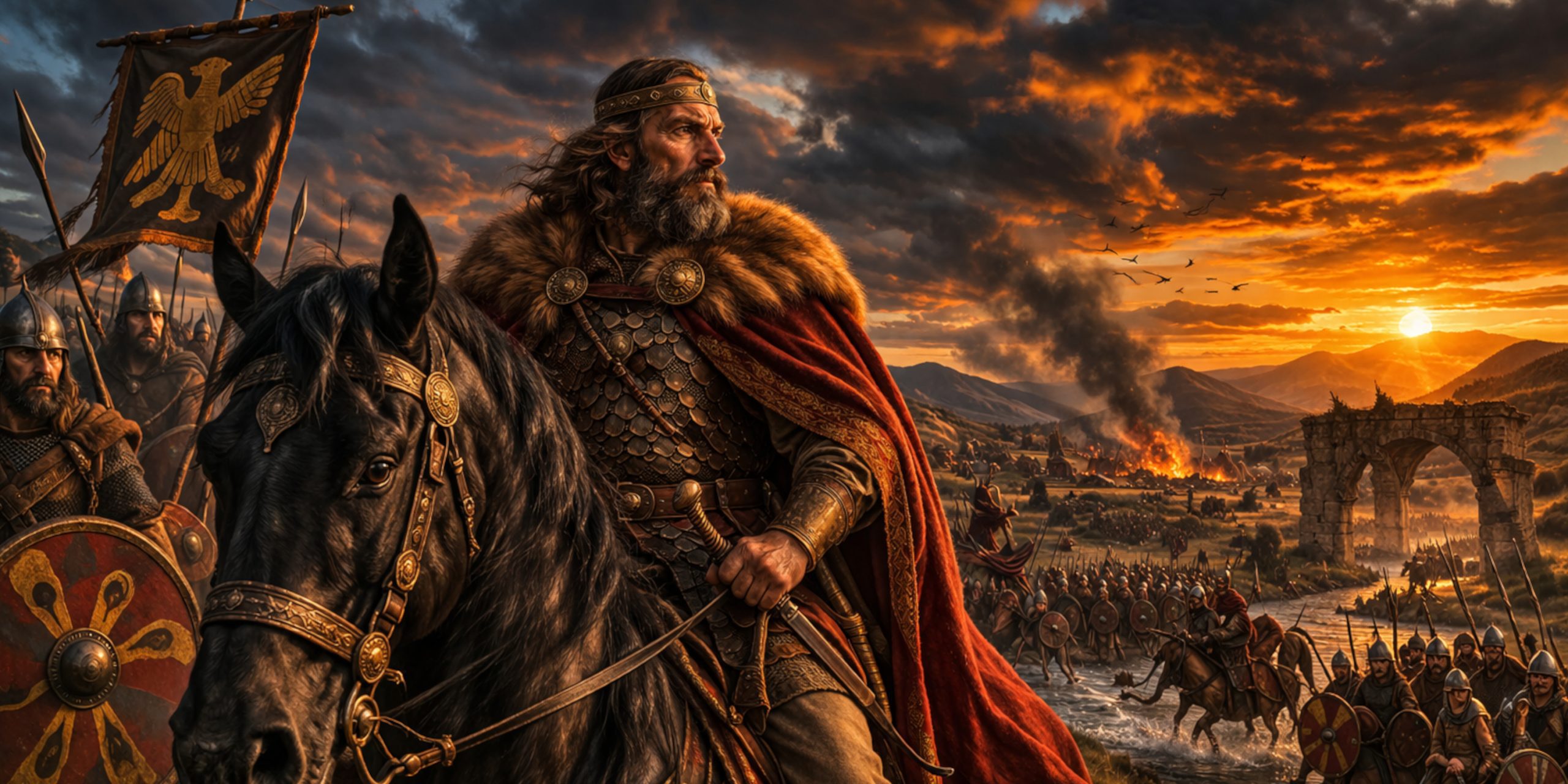
Fritigern himself may well have appeared less like a wild barbarian from Victorian paintings and more like a heavily armed frontier aristocrat with Roman and Gothic influences mixed together. History is often much less tidy than popular imagination would like.
Appearance of Fritigern
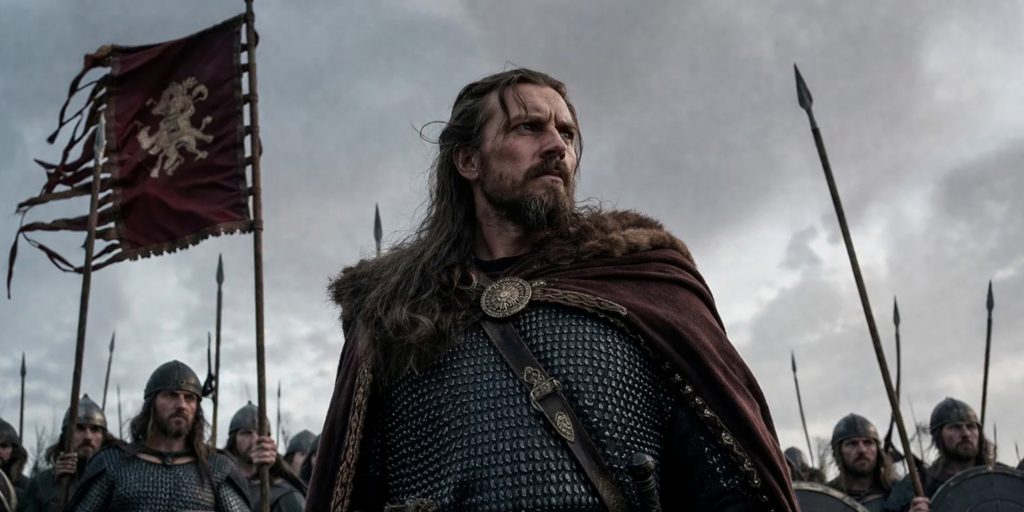
No contemporary description survives. However, he was probably:
- Bearded, as many Gothic nobles were
- Wearing a long tunic, cloak and decorated belt
- Armed with a spear and sword
- Mounted during major engagements
- Possibly wearing Roman-style armour or a decorated mail shirt
Religion and Politics
Fritigern was probably an Arian Christian. This distinguished him from Athanaric, who had persecuted Christians among the Goths.
According to some sources, Fritigern converted with Roman support during his earlier rivalry with Athanaric. The emperor Valens was also an Arian Christian, which may have encouraged closer ties.
There is a certain irony here. Valens may once have supported Fritigern as a useful ally. A few years later, the two men met on the battlefield and one of them ended up dead.
Fritigern’s Christianity may also have helped him appeal to Gothic groups who had already been influenced by Roman missionaries. Religion in late antiquity was rarely simple. It was bound up with politics, alliances and survival.
What Happened to Fritigern?
After Adrianople, Fritigern fades from the sources.
He probably continued leading Gothic forces in the Balkans for a short time, but by the early 380s he disappears completely. He may have died in battle, from illness, or been replaced by another leader.
By 382 the Goths reached a settlement with the empire under Emperor Theodosius I. They were allowed to settle within Roman territory as federate allies.
It is tempting to imagine Fritigern living long enough to see that agreement, though there is no evidence for it. More likely, he died before the treaty and left others to profit from the world he had helped create.
Artefacts and Where to See Them
There are no surviving artefacts that can be linked directly to Fritigern himself. No helmet labelled “Property of Fritigern” has yet emerged from a Bulgarian field, much to the disappointment of historians and museum curators everywhere.
However, many Gothic objects from his period survive and help us understand the world in which he lived.
Museums and Collections
National Museum of Romanian History, Bucharest
This museum contains Gothic grave goods, weapons, jewellery and belt fittings from the fourth century. These artefacts come from regions associated with the Tervingi.
National Archaeological Museum, Sofia
The museum in Sofia preserves finds from late Roman Thrace, including weapons and military equipment from the period of Adrianople.
Archaeological Museum of Edirne
Near the site of ancient Adrianople, the museum contains late Roman and Gothic material from the surrounding region, including weapon fragments and everyday objects.
Kunsthistorisches Museum, Vienna
The museum has several late Roman and Migration Period artefacts, including Gothic-style weapons and jewellery.
British Museum, London
The British Museum holds examples of Gothic belt fittings, weapon fragments and Migration Period objects that illustrate the appearance of Gothic elites.
Latest Archaeology and Research
Recent archaeology has reshaped how historians view Fritigern and the Goths.
The Battlefield of Adrianople
The precise site of the battle remains uncertain, though several candidate locations near modern Edirne have been proposed. Archaeologists have discovered Roman military remains, weapon fragments and coins from the late fourth century in the area.
Unfortunately, Adrianople is one of those battles where the evidence remains frustratingly incomplete. Ancient writers were vague, later landscapes changed, and modern roads have not helped matters. Historians spend a remarkable amount of time staring at maps and arguing about hills.
Gothic Cemeteries in Romania and Bulgaria
Excavations at fourth-century Gothic cemeteries have uncovered:
- Decorated belt buckles
- Swords and spearheads
- Horse equipment
- Imported Roman goods
- Jewellery showing both Roman and Gothic styles
These finds support the idea that Gothic elites were closely connected to the Roman world long before Adrianople.
Hunnic Pressure and Migration
Archaeologists increasingly believe that the arrival of the Huns caused a far larger movement of peoples than earlier historians realised. This supports the view that Fritigern was responding to a genuine crisis rather than merely leading a raid into Roman territory.
The Goths who crossed the Danube were not simply warriors. They included women, children, wagons, livestock and entire communities. Fritigern was therefore leading something closer to a nation on the move.
Legacy
Fritigern left no kingdom and founded no dynasty. Yet his impact was immense.
He proved that a so-called barbarian coalition could defeat a Roman emperor in open battle. He exposed the weaknesses of the late Roman military system. He accelerated the transformation of the Roman world into the medieval one.
Without Adrianople, the history of Europe might have looked very different.
There is also something strangely modern about Fritigern’s story. He was a refugee leader, a negotiator, a rebel and a military commander all at once. He understood that survival sometimes required compromise and sometimes required force.
The Romans called him a barbarian. Yet when one reads the sources carefully, it is often the Roman officials who appear more brutal, more foolish and less capable.
Fritigern remains difficult to pin down. Perhaps that is why he endures. He is not a figure wrapped neatly in certainty. He stands at the edge of the Roman world, half seen through smoke and confusion, watching an empire begin to realise that it is no longer invincible.