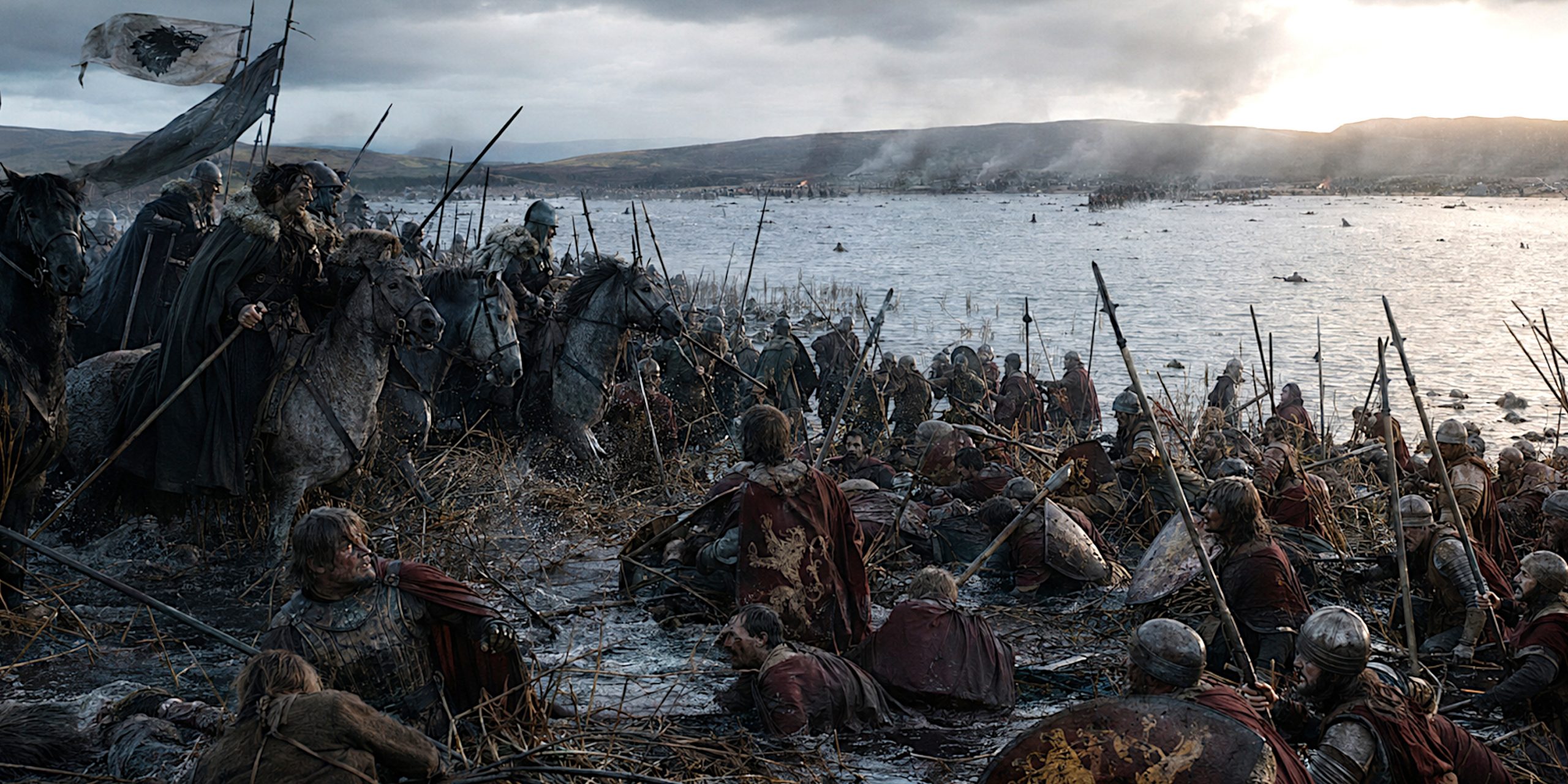
The Fishfeed was the bloodiest land battle of the Dance of the Dragons, a savage confrontation that destroyed the main Lannister army and left even the victors appalled by what they had done.
Official histories call it the Battle by the Lakeshore. The soldiers who survived gave it a rather less dignified name. Hundreds of men were driven into the Gods Eye, where they drowned or died among the reeds. Their bodies became food for the lake’s fish, hence “the Fishfeed”.
It was a decisive victory for Queen Rhaenyra Targaryen’s Blacks, but this was no elegant tactical masterpiece followed by cheering and tasteful banners. The Blacks repeatedly threw men against disciplined spearmen, suffered dreadful casualties and eventually crushed the enemy through pressure, aggression and encirclement.
In other words, they won. Nobody looking across the battlefield felt particularly cheerful about it.
This article contains spoilers for Fire & Blood and House of the Dragon.
What was the Fishfeed?
The Fishfeed was fought in 130 AC on the western shore of the Gods Eye, the enormous lake beside Harrenhal in the Riverlands.
The battle pitted the western army of House Lannister, fighting for King Aegon II and the Greens, against a coalition supporting Queen Rhaenyra and the Blacks. The Black force included Northmen, Freys, Blackwoods and several smaller Riverlands houses.
Its formal name was the Battle by the Lakeshore, although virtually everyone remembers the nickname.
| Detail | Information |
|---|---|
| Conflict | Dance of the Dragons |
| Date | 130 AC |
| Location | Western shore of the Gods Eye |
| Green commander | Lord Humfrey Lefford |
| Principal Black commander | Lord Roderick Dustin |
| Result | Decisive Black victory |
| Green losses | The western army was effectively destroyed |
| Black losses | Severe, including two-thirds of the Winter Wolves killed or wounded |
| Dragons involved | None |
The absence of dragons is important. The battle demonstrates that the Dance was not exclusively decided by Targaryens turning the sky into a family argument with wings. Conventional armies still mattered, and ordinary soldiers often paid for decisions made by people sitting comfortably inside castles.
Why were the Lannisters in the Riverlands?
House Lannister supported Aegon II’s claim to the Iron Throne. Lord Jason Lannister therefore raised a large western army and marched east, intending to support the Green campaign in the Riverlands.
The broader plan was sensible enough. Green forces would place pressure on Rhaenyra’s supporters from different directions and threaten the Black position around Harrenhal. A successful junction between the Lannister army and the forces commanded by Prince Aemond Targaryen and Ser Criston Cole could have transformed the military situation.
The Riverlands had other ideas.
Jason Lannister encountered fierce resistance while attempting to cross the Red Fork. Although his army eventually forced a passage, Jason was mortally wounded by Pate of Longleaf, a squire who earned the nickname Longleaf the Lionslayer and was knighted after the battle.
The Lannister host had won its crossing but lost its commander. It continued east under Lord Humfrey Lefford, who was elderly, wounded and reportedly in poor health.
That was not an ideal leadership profile for a rapid campaign through hostile country.
How the Lannister army became trapped
The westermen’s advance became painfully slow after the death of Jason Lannister. Riverlords loyal to Rhaenyra harassed the column, while local opposition made supplies and intelligence increasingly difficult to secure.
By the time Lord Lefford reached the western shore of the Gods Eye, several Black forces were moving against him.
From the north came Lord Roderick Dustin, better known as Roddy the Ruin, with two thousand Winter Wolves. These were older Northmen who had marched south expecting to die in Rhaenyra’s service rather than consume food needed by their families during the coming winter.
They were not tourists.
Lord Forrest Frey joined Dustin with two hundred knights and six hundred infantry. Red Robb Rivers brought three hundred Blackwood archers from Raventree Hall. More Riverlands troops approached from other directions, including forces associated with Houses Bigglestone, Chambers, Charlton, Grey and Perryn.
Pate of Longleaf also arrived with survivors of earlier fighting. Young Lord Benjicot Blackwood, known as Bloody Ben despite still being a boy, joined the growing coalition.
Lefford was now caught between hostile forces and the lake.
The armies at the Fishfeed
The precise size of the armies is difficult to establish. Fire & Blood is written as a historical chronicle assembled from incomplete and sometimes contradictory accounts. Conveniently vague troop numbers are a Westerosi tradition almost as reliable as disastrous royal marriages.
The western host had originally included around one thousand knights and seven thousand men-at-arms, with a much larger body of sellswords and levies possibly accompanying them. It had already suffered casualties during its march, particularly at the Red Fork.
The combined Black army may have numbered at least twelve thousand trained or identified troops, with additional levies potentially raising its strength considerably.
These larger totals should be treated cautiously. What matters is that the Lannisters faced enemies on multiple fronts, had poor communications and lacked a healthy, dynamic commander.
The Blacks
- Lord Roderick Dustin and two thousand mounted Winter Wolves
- Lord Forrest Frey with two hundred knights and six hundred infantry
- Red Robb Rivers with three hundred Blackwood archers
- Lord Benjicot Blackwood and additional Riverlands troops
- Pate of Longleaf and survivors from earlier battles
- Forces from Houses Bigglestone, Chambers, Charlton, Grey and Perryn
The Greens
- Lord Humfrey Lefford
- The main field army of House Lannister
- Knights and soldiers from Houses Lefford, Reyne, Swyft and Crakehall
- Sellswords and western levies
- Survivors of the Red Fork campaign
The Greens may still have possessed considerable numbers, but their tactical position was rapidly becoming horrible.
Why did Humfrey Lefford put his back to the lake?
At first glance, deploying with a lake behind the army looks like the sort of choice made shortly before a historian writes the word “annihilated”.
Lefford did have a reason.
The Lannister force was threatened from several directions. By placing his army against the Gods Eye, he shortened the line that needed defending and prevented the Blacks from completely surrounding his position. Disciplined ranks of western pikemen formed a formidable defensive front.
A lake cannot charge your rear. Unfortunately, it cannot provide an escape route either.
Lefford sent ravens to Harrenhal asking Prince Aemond for assistance. If Aemond arrived with Vhagar, the entire battle would change in moments. The Black commanders knew this perfectly well.
Red Robb Rivers and his archers reportedly shot down a dozen ravens, cutting the Lannisters off from help.
Whether every single bird was intercepted or the chronicle has polished the story is impossible to prove. Either way, the essential point remains. The message did not reach Aemond in time.
Why did Roddy the Ruin attack?
The Black commanders faced an ugly choice.
They could wait and attempt to starve the Lannisters into surrender. That might reduce the immediate cost of an assault, but every day increased the possibility that Aemond would realise something had gone wrong and come searching.
Aemond did not travel alone. He rode Vhagar, the largest living dragon in Westeros.
The Blacks therefore had to destroy the western army before Green reinforcements arrived. Roddy the Ruin reportedly summarised the situation with brutal clarity:
“Best make an end to these lions before the dragons come.”
Waiting was safer for the next few hours and potentially fatal thereafter. Attacking promised terrible casualties but offered a chance to remove an entire Green army from the war.
Roddy chose the attack.
How the Battle by the Lakeshore unfolded
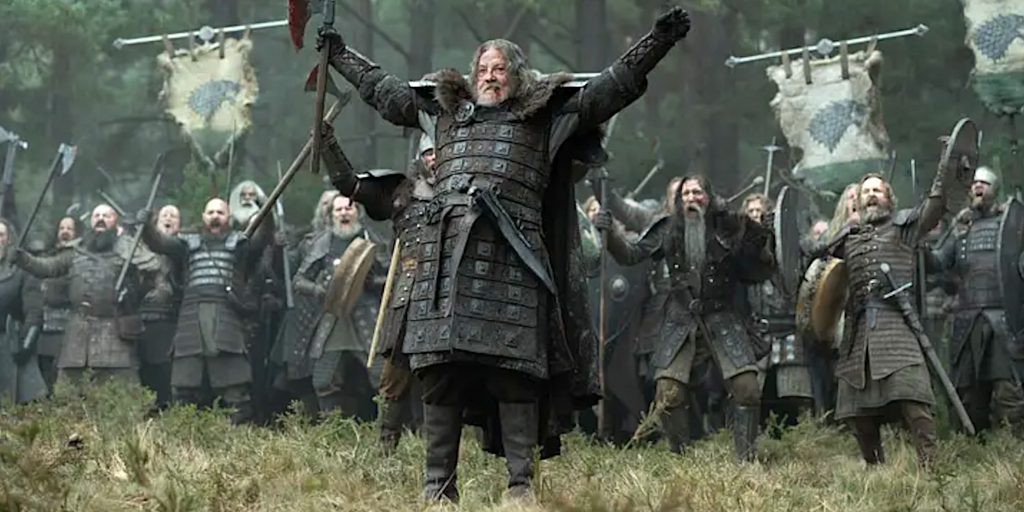
The Blacks attacked at dawn.
The Winter Wolves led the assault, charging the Lannister spearmen five times. Mounted men attacking ordered ranks of spears and pikes is rarely a gentle business, and the Northmen suffered heavily.
These charges were not necessarily attempts to smash through with one glorious impact. Repeated attacks could pin the western infantry, disrupt its formation and prevent it from responding effectively to threats elsewhere.
While the Winter Wolves kept pressure on the front, Riverlands troops attacked from additional directions. The Lannister formation was gradually compressed towards the lake.
The western soldiers continued to resist. This was not an instant collapse, and the scale of the Black losses shows how hard the Lannisters fought. Their defensive line eventually began to buckle under pressure from three sides.
Once the formation broke, the battle ceased to resemble an organised contest.
Men were pushed backwards into the shallows. Armour dragged some beneath the water. Others became trapped in mud and reeds. Soldiers attempting to escape collided with comrades still trying to hold the line. Hundreds were killed along the shore, while hundreds more drowned.
The lake that had protected the Lannister rear became the wall of their execution ground.
Why was it called the Fishfeed?
The name was soldiers’ slang, born from the condition of the lakeshore after the fighting.
So many bodies ended up in or beside the Gods Eye that survivors imagined the dead feeding its fish. Archmaester Gyldayn later distinguished between the respectable title used by the Citadel and the name remembered by the people who were actually there:
“In the annals of the Citadel it is known as the Battle by the Lakeshore, but to those men who lived to tell of it, it was always the Fishfeed.”
That contrast matters. “Battle by the Lakeshore” sounds like something painted on a campaign map. “Fishfeed” tells us how the soldiers experienced it.
The nickname strips away banners, claims and royal ceremony. What remained was blood in the water.
Who won the Fishfeed?
The Blacks won a decisive military victory.
The Lannister field army was destroyed as an effective force. Lord Humfrey Lefford was killed, along with Lords Reyne and Swyft. Ser Clarent Crakehall and Ser Emory Hill also died, as did many of the finest knights and men-at-arms of the Westerlands.
The Blacks paid dearly for that victory.
Lord Forrest Frey, Lord Bigglestone and Lord Jon Charlton were among the dead. Two-thirds of the Winter Wolves were killed or wounded. The Blackwood and Riverlands forces also suffered heavily.
Young Benjicot Blackwood reportedly wept when he saw the heaps of bodies.
It was not a Pyrrhic victory in the strictest strategic sense. The Blacks gained far more than they lost, destroying a major enemy army and opening the Westerlands to attack. Yet on the battlefield itself, the distinction between winner and loser must have felt rather academic.
Why was the Fishfeed so bloody?
Several factors turned the battle into a massacre.
The Lannisters could not retreat
The Gods Eye blocked their rear. Once the defensive formation collapsed, there was no clear route of withdrawal.
The Blacks attacked from several directions
Lefford’s position reduced the threat of complete encirclement, but it also compressed his army into a confined area. The advancing Black forces gradually squeezed the westermen against the shore.
Both sides had reasons to finish the battle quickly
The Blacks feared the arrival of Aemond and Vhagar. The Lannisters knew that survival depended upon holding long enough for help to arrive. Neither side had much incentive to disengage.
The Winter Wolves accepted extreme casualties
Roddy’s Northmen had marched south expecting death. Their willingness to continue charging helped break the Lannister position, although it cost them dearly.
The terrain magnified the rout
Retreating through water, reeds and mud destroyed unit cohesion. Heavy equipment became a liability, and panic did the work of another army.
The battle was not unusually deadly because of dragons. It was deadly because thousands of men were trapped in a shrinking pocket with nowhere useful to run.
Arms and armour used at the Fishfeed
Fire & Blood does not provide an inventory for every contingent, but the armies broadly reflect the military traditions of Westeros.
Lannister and western troops
The western host contained wealthy knights, disciplined men-at-arms, pikemen and levies.
Likely equipment included:
- Long pikes and thrusting spears
- Arming swords
- Longswords used by wealthier knights
- Maces, axes and war hammers
- Mail beneath plate or reinforced surcoats
- Helmets ranging from open-faced steel caps to enclosed helms
- Large shields carried by infantry
- Lances used by mounted knights
The density of western spearmen explains why the Winter Wolves required repeated charges. A formed body of pikes presented a lethal barrier to cavalry.
Winter Wolves and Riverlands forces
The northern cavalry would have carried a mixture of lances, spears, axes and swords. Northern equipment may have been less uniform than that of the wealthiest Lannister knights, but these were experienced and determined fighters.
The Blackwood archers used bows to harass the enemy and intercept communications. Riverlands infantry probably carried spears, shields, axes and comparatively simple swords, depending upon wealth and status.
Armour offered protection during the close fighting, but it became dangerous once men were driven into deep water. Plate does not automatically drag a trained wearer straight to the bottom, despite popular myth, but exhaustion, injury, mud and panic make swimming in armour an atrocious proposition.
The destruction of the Lannister war effort
The Fishfeed removed the main Lannister army from the Dance.
This had consequences far beyond the Gods Eye. With so many western soldiers and nobles dead, the Westerlands were left with only limited forces for local defence. Dalton Greyjoy, the Red Kraken, recognised the opportunity immediately.
The Greyjoys declared for Rhaenyra and attacked the western coast. Ironborn forces sacked Lannisport and raided deeply into Lannister territory. They could not capture Casterly Rock, but they inflicted enormous damage while the surviving western leadership struggled to respond.
Rhaenyra had gained an ally, although Dalton’s loyalty was mostly directed towards whatever he could carry back to his ships. The Red Kraken was less a devoted partisan and more an armed weather event.
How the Fishfeed changed the war
The battle shattered the Green strategy in the Riverlands.
Aemond and Criston Cole could no longer count on joining forces with the Lannister host. They abandoned Harrenhal, after which their paths separated.
Aemond began a destructive campaign across the Riverlands with Vhagar. His attacks burned settlements and punished Rhaenyra’s supporters, but they did not rebuild the coordinated Green war effort.
Cole marched south in search of Lord Ormund Hightower’s army. Riverlands forces avoided offering him the conventional battle he wanted. Instead, they harassed his column, destroyed supplies and wore down his men through ambushes and scorched-earth tactics.
Bodies from the Fishfeed were reportedly arranged in gruesome displays to intimidate the passing Green soldiers. Desertion increased as Cole’s army weakened.
That retreat eventually led towards the Butcher’s Ball, another catastrophe for the Greens.
The Fishfeed therefore did more than destroy one army. It broke the possibility of a major Green concentration in the centre of Westeros and pushed Aemond and Cole into increasingly desperate campaigns.
Was Roddy the Ruin a brilliant commander?
Roderick Dustin deserves credit for recognising that delay favoured the Greens. His decision to attack before Aemond could intervene was strategically sound.
His tactics were brutally expensive.
Five cavalry charges against formed spearmen cost the Winter Wolves two-thirds of their strength in killed or wounded men. A more cautious commander might have attempted a blockade, constructed field defences or waited for further reinforcements.
The trouble was Vhagar. Traditional caution becomes much less attractive when the enemy possesses an ancient dragon capable of setting your entire position on fire.
Roddy understood that the Lannisters had to be destroyed immediately. His solution was not elegant, but elegance is a luxury rarely found in the Riverlands during wartime.
Why were there no dragons at the Fishfeed?
No dragon took part because the battle happened before Aemond learned that the Lannister army was in danger.
This absence gave the Black commanders their narrow opportunity. Had Vhagar reached the battlefield, the exposed coalition attacking along the lakeshore would have been extremely vulnerable.
The battle therefore turned on communication. Red Robb Rivers shooting down Lefford’s ravens may have mattered as much as the repeated charges of the Winter Wolves.
It is a neat reminder that even in a war involving dragons, a bow, a bird and a well-positioned archer could alter the fate of thousands.
The Fishfeed in House of the Dragon
House of the Dragon handles the battle very differently from Fire & Blood.
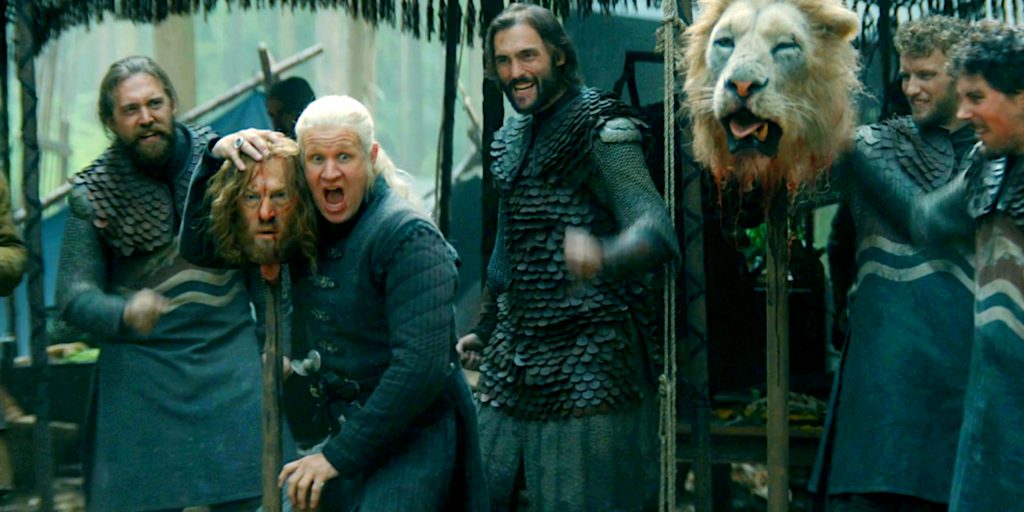
In Season 3, Episode 2, the victory is referenced after the event rather than presented as a complete battle sequence. Daemon and his followers celebrate the destruction of the Lannister force, while a song tells viewers about the Fishfeed. Roddy the Ruin receives credit for the victory, but the fighting itself happens off-screen.
That is a substantial adaptation choice. In the book, the Fishfeed is the bloodiest land engagement of the entire Dance and one of the clearest demonstrations of how the war consumes conventional armies.
The likely practical reasoning is understandable. The battle would require thousands of soldiers, extensive cavalry action, large sets, water work and a considerable effects budget. It also lacks a dragon and, in the book, does not place one of the central Targaryen characters directly in the fighting.
Still, reducing it to a reported victory loses some of the battle’s thematic weight. The Fishfeed shows that the Dance is no longer a dispute among royals. It has become an industrial process for feeding young men into mud, spear points and lakes.
The programme gives us the outcome. The book makes us consider the price.
Book and television differences
| Element | Fire & Blood | House of the Dragon |
|---|---|---|
| Presentation | Described as a major battle | Occurs largely off-screen |
| Scale | Bloodiest land battle of the Dance | Conveyed through dialogue and celebration |
| Roddy the Ruin | Leads the Winter Wolves in the assault | Credited with the victory |
| Winter Wolves | Suffer devastating casualties | Their losses receive less emphasis |
| Lannister destruction | Described in graphic strategic detail | Reported after the event |
| Importance | Major turning point in the Riverlands war | Background to wider political developments |
The television version preserves the strategic outcome but greatly reduces the audience’s direct experience of the battle.
Was the Fishfeed the bloodiest battle in Westeros?
The Fishfeed is described as the bloodiest land battle of the Dance of the Dragons. That does not necessarily make it the bloodiest battle in the entire history of Westeros.
Other conflicts, including the Field of Fire, the Battle of the Trident and battles fought during the Long Night, may have involved enormous losses. Westerosi chroniclers rarely provide figures reliable enough to create a neat casualty league table, which is probably for the best.
Within the Dance, however, its position is clear. No other land battle produced such a concentrated slaughter of conventional troops.
The Battle of the Gullet was catastrophic at sea. Tumbleton became infamous for dragonfire, betrayal and the destruction of a town. The Fishfeed was something more grimly familiar: armies pushing against each other until one ran out of ground.
Why the Fishfeed matters
The Fishfeed captures the central horror of the Dance of the Dragons.
The war began as a dynastic dispute between two branches of House Targaryen. By 130 AC, men from the North, the Westerlands and the Riverlands were killing each other beside a lake for rulers most had never met.
There was courage at the Fishfeed. The Winter Wolves repeatedly charged a wall of spears. The Lannister infantry held its formation while enemies closed from several sides. Archers cut communications, commanders made urgent decisions and local houses committed everything they had.
None of that made the outcome noble.
The Blacks won because they accepted appalling losses long enough to force the westermen into an even worse position. The Greens lost an army. The North lost much of the Winter Wolves. The Riverlands gained another field of corpses.
That is why “Fishfeed” is the perfect name. It does not celebrate the winner or preserve the dignity of the dead. It remembers what the battle reduced them to.