Naval combat is the feature that turned Assassin’s Creed IV: Black Flag from a good open-world adventure into the closest thing gaming has produced to a playable pirate fantasy. You begin by bullying gunboats and finish by picking fights with floating fortresses capable of deleting half the Jackdaw’s health bar before the chorus of a sea shanty is over.
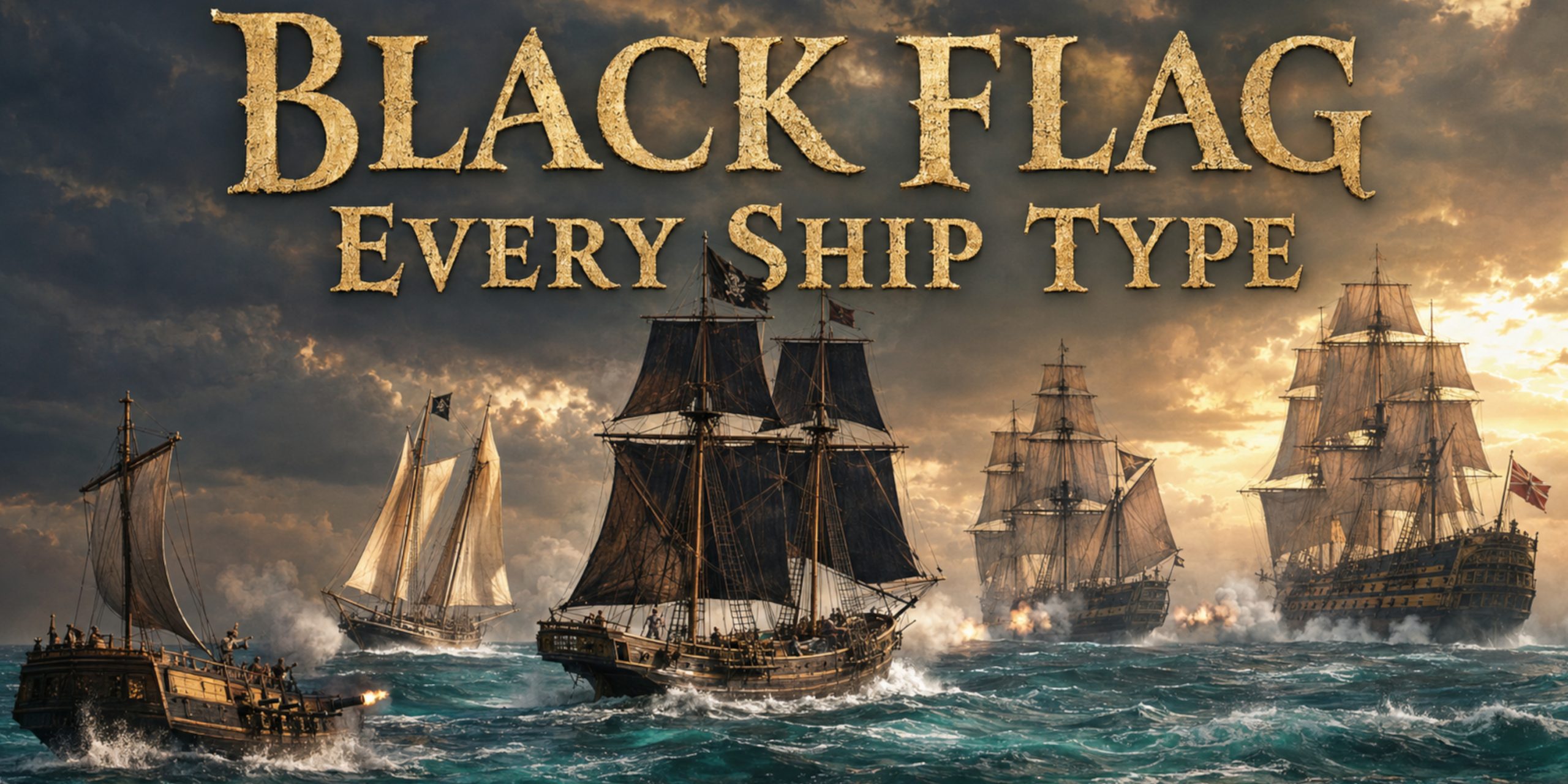
There are five principal ship classes roaming the Caribbean: gunboats, schooners, brigs, frigates and men-of-war. Each occupies a distinct place in the game’s naval food chain, although individual levels, armament and cargo can vary considerably.
This guide explains every standard ship type, the Jackdaw, important story vessels and the five Legendary Ships encountered across four battles.
Ship Classes at a Glance
| Ship type | Typical threat | Main strengths | Main weakness | Best reason to attack |
|---|---|---|---|---|
| Gunboat | Very low | Fast and manoeuvrable | Minimal armour and firepower | Ammunition and easy wanted-level reduction |
| Schooner | Low | Speed, fire barrels and agility | Weak hull | Rum, sugar and quick fleet missions |
| Brig | Moderate | Balanced speed, armour and guns | Outclassed by larger warships | General resources and fleet versatility |
| Frigate | High | Powerful broadsides and strong hull | Wide turning circle | Metal, wood and fleet combat |
| Man-of-war | Very high | Heavy armour, mortars and enormous broadsides | Slow and cumbersome | Large cargo loads and elite fleet strength |
| Legendary Ship | Extreme | Unique weapons and battle behaviour | Exploitable tactical patterns | Money, rewards and bragging rights |
Ship levels rise as Edward enters more dangerous waters. The southern regions contain the strongest frigates and men-of-war, so sailing there in an under-upgraded Jackdaw is less piracy and more an elaborate method of donating timber to the Spanish Navy.
The Jackdaw
The Jackdaw is Edward Kenway’s ship and the centre of naval gameplay. It is technically a brig, captured during the early stages of the story, but upgrades can transform it into something far more dangerous than an ordinary vessel of that class.
Its greatest advantage is versatility. A fully developed Jackdaw can chase schooners, outmanoeuvre frigates and survive sustained combat with men-of-war.
Jackdaw weapons
| Weapon | Firing position | Best use |
|---|---|---|
| Round shot | Port and starboard | Standard broadside attacks |
| Heavy shot | Port and starboard at close range | Devastating damage against large ships |
| Chain shot | Forward | Damaging sails and slowing targets |
| Ram | Bow | Opening attacks and finishing weakened vessels |
| Mortar | Long range | Striking large or slow targets before broadsides begin |
| Fire barrels | Stern | Punishing pursuing ships |
| Swivel guns | During combat and boarding | Hitting exposed weak points and enemy crew |
The Jackdaw begins relatively fragile. Early upgrades to hull armour and broadside cannons provide the greatest immediate benefit. Mortars become increasingly important later because they allow Edward to damage frigates and men-of-war before entering their preferred firing range.
Heavy shot is particularly vicious at close quarters. It lacks the visible aiming arc of ordinary round shot, but once the distance feels uncomfortably intimate, it can tear through an enemy hull.
In Black Flag Resynced, Ubisoft expanded the ship systems with recruitable officers, revised upgrades and additional Jackdaw customisation. The fundamental role of the vessel remains the same: a fast brig steadily modified into a highly improbable Caribbean superweapon. Ubisoft’s naval gameplay overview details the revised arsenal.
Gunboats
Gunboats are the smallest armed vessels in the game. They are fast, lightly crewed and equipped with only a handful of cannons.
Against an upgraded Jackdaw, they are barely more threatening than floating furniture. Early in the game, however, several gunboats attacking together can become irritating, particularly when a larger ship is already occupying Edward’s attention.
Gunboat characteristics
- Very low hull strength
- Limited cannon fire
- High speed and tight turning
- Common around ports, convoys and restricted waters
- Usually destroyed before a formal boarding action becomes worthwhile
Gunboats are useful for replenishing ammunition or reducing Edward’s wanted level without undertaking a difficult boarding operation. They can also be removed quickly with a ram, a short broadside or a swivel-gun shot against an exposed weak point.
The danger comes from ignoring them. One gunboat is an inconvenience. Four gunboats firing while a frigate lines up a broadside become a surprisingly organised committee dedicated to ruining your afternoon.
Best tactic
Do not waste mortar ammunition on them. Use chain shot to line up a ram, or destroy them with a quick broadside while keeping your attention on larger threats.
Schooners
Schooners are small, quick sailing vessels that form the first meaningful enemy ship class. They are more durable than gunboats but remain vulnerable to a reasonably upgraded Jackdaw.
Their manoeuvrability makes them difficult to hit when they cross the Jackdaw’s bow or stern. They also drop fire barrels, which can punish careless pursuit.
Schooner characteristics
- Fast acceleration
- Sharp turning circle
- Light armour
- Small broadsides
- Fire-barrel attacks
- Low boarding requirements
Schooners are regularly used as merchant vessels and may carry rum, sugar, cloth or smaller quantities of upgrade materials. The spyglass should always be used before attacking because cargo varies between individual ships.
They are also valuable additions to Kenway’s Fleet during its early development. Their speed makes them suitable for shorter trade missions, even after heavier ships become available.
Best tactic
Hit the sails with chain shot, ram the stern or flank, then finish the schooner with a controlled broadside. Avoid following directly behind it unless you enjoy sailing through burning barrels.
Brigs
Brigs occupy the middle of the naval hierarchy. They combine good speed with respectable armour and enough firepower to threaten an unprepared player.
The Jackdaw belongs to this class, although Edward’s extensive upgrades eventually push it well beyond the capabilities of ordinary brigs.
Brig characteristics
- Balanced speed and durability
- Stronger broadsides than schooners
- Effective ramming attacks
- Moderate crew and boarding difficulty
- Common in medium and high-risk regions
Enemy brigs are aggressive. They frequently attempt to close the distance, ram and deliver broadsides while the ships remain alongside one another. This makes them dangerous in confined water or during battles involving several vessels.
Captured brigs are useful in Kenway’s Fleet because they offer a sensible balance of speed, cargo space and firepower. A fleet composed entirely of men-of-war looks magnificent, but waiting for them to complete easy trade routes can feel like shipping molasses by geological process.
Best tactic
Use chain shot to interrupt an approaching brig, turn across its stern and fire heavy shot at close range. A well-timed brace will reduce damage if it manages to ram.
Frigates
Frigates are the point at which naval combat becomes genuinely serious. They carry multiple gun decks, possess strong hulls and can inflict substantial damage through heavy broadsides.
They are faster and more manoeuvrable than men-of-war, making them difficult to escape once combat begins.
Frigate characteristics
- Heavy broadside fire
- Strong hull armour
- Good speed for their size
- Large crews
- Access to powerful naval weapons
- Frequently carry valuable wood and metal
Metal is required for some of the Jackdaw’s most important upgrades, making frigates attractive targets. Unfortunately, the people aboard tend to object to Edward taking it.
Boarding a frigate involves more than defeating its crew. Additional objectives may include destroying the enemy flag, detonating powder reserves or eliminating officers. Swivel-gun fire can remove several defenders before Edward crosses onto the deck.
Best tactic
Attack from long range with mortars, then use chain shot to restrict movement. Try to remain behind the frigate or cross its bow rather than exchanging full broadsides.
If you sit alongside a high-level frigate and trade cannon fire, you are accepting a test of armour rather than demonstrating tactics. Sometimes it works. Sometimes the sea acquires another decorative wreck.
Men-of-War
The man-of-war is the largest standard ship class in Black Flag. These vessels are heavily armoured, carry enormous crews and mount enough cannon to turn a weak Jackdaw into loose carpentry.
Higher-level examples patrol the most dangerous southern waters and accompany major naval convoys. Some reach level 60, placing them among the strongest capturable vessels in the game.
Man-of-war characteristics
- Exceptional hull strength
- Enormous broadsides
- Mortar capability
- Heavy shot and stern weapons
- Large boarding crews
- High cargo capacity
- Slow acceleration and turning
Men-of-war commonly carry substantial quantities of metal, wood and cloth. They are therefore essential targets when completing the Jackdaw’s later upgrades.
Capturing one also provides a powerful ship for Kenway’s Fleet. Its combination of firepower, durability and cargo capacity makes it ideal for dangerous trade routes, although smaller vessels remain faster.
Best tactic
Begin with mortar fire and approach from the stern. Chain shot can slow the vessel, allowing the Jackdaw to remain outside its broadside arc. Use heavy shot when passing close, then accelerate away before the enemy can answer.
Never approach the side of a man-of-war in a straight line. Its broadside is not a warning. It is the naval equivalent of closing the application.
Once the vessel is disabled, use the Jackdaw’s swivel guns to reduce the boarding party before crossing over. Complete secondary objectives quickly and use smoke bombs if Edward becomes surrounded on deck.
Merchant Ships and Naval Convoys
Merchant traffic uses the same basic schooner, brig, frigate and man-of-war classes found elsewhere. A vessel’s class describes its size and combat ability, while its cargo determines whether it is worth attacking.
Common resources include:
- Sugar, sold directly for reales
- Rum, also sold for reales
- Cloth, used for storage and armour upgrades
- Wood, required for hull and weapon improvements
- Metal, needed for advanced armour and armament
- Ammunition, used to replenish naval weapons
Naval convoys place a cargo ship under armed escort. Defeating the convoy provides a large financial reward, but the escort may include powerful frigates or men-of-war.
Use the spyglass before committing. It reveals the ship’s level, cargo and armament. Attacking every sail on the horizon is certainly authentic pirate behaviour, but it is not particularly efficient.
Hunter Ships
Hunter ships appear as Edward’s wanted level rises. The more trouble he causes, the stronger the ships sent to collect his bounty become.
Lower wanted levels attract smaller hunters, while serious notoriety can bring heavily armed vessels. These ships actively pursue the Jackdaw rather than following ordinary patrol routes.
Hunter ships are not a separate construction class. They are specialised enemy versions of existing classes, distinguished by their pursuit behaviour and greater combat focus.
How to remove the wanted level
Edward can lower his notoriety by:
- Boarding a ship and choosing to reduce the wanted level
- Bribing an official ashore
- Avoiding further crimes until the immediate search ends
Boarding is usually the better option because it also allows the Jackdaw to repair, gain crew or send the captured vessel to Kenway’s Fleet.
Legendary Ships
Five Legendary Ships appear across four naval encounters. These are heavily modified boss vessels with abilities that exceed those of normal men-of-war.
They cannot be captured or added to Kenway’s Fleet. The Jackdaw should be close to fully upgraded before challenging them.
In both the original and Black Flag Resynced, the five vessels remain El Impoluto, La Dama Negra, HMS Prince, HMS Fearless and Royal Sovereign. The remake revises their battle phases and rewards, but does not introduce additional Legendary Ships. Ubisoft’s current overview confirms the renewed focus on the Jackdaw and naval experience.
El Impoluto
El Impoluto is built around speed and ramming. It behaves less like a conventional man-of-war and more like an enraged battering ram that has somehow acquired sails.
Its charge can inflict catastrophic damage, particularly if the Jackdaw is caught broadside.
Best tactic
- Keep El Impoluto within view
- Use chain shot as it begins a charge
- Turn the Jackdaw’s bow towards the incoming ship
- Brace if collision cannot be avoided
- Punish missed charges with heavy shot
- Use mortars while it circles for another attack
Trying to flee in a straight line gives El Impoluto the space needed to build speed. Control the distance and force it to turn.
La Dama Negra
La Dama Negra is a heavily armoured man-of-war fought in difficult weather. Its broadside protection greatly reduces damage against the sides of the hull.
Its mortar fire is particularly dangerous because the usual warning area is absent or harder to read, depending on the version being played.
Best tactic
Concentrate attacks on the bow and stern, where its armour is weaker. Chain shot helps keep the ship in position, while mortars can inflict steady damage from above.
Do not repeatedly fire ordinary broadsides into the protected sides. It looks dramatic, sounds expensive and achieves rather less than one would hope.
HMS Prince
HMS Prince is sometimes described as the ghost ship because it fights within thick fog. It relies on long-range mortar attacks and uses poor visibility to break contact.
The vessel is often considered the most manageable of the Legendary Ship encounters, although that description is relative. A tiger with a slight limp remains a tiger.
Best tactic
Close the distance quickly to limit its mortar advantage. Use chain shot to slow it, remain near the stern and deliver heavy shot whenever an opening appears.
When HMS Prince retreats into the fog, sail diagonally towards its likely course rather than following directly behind. This helps the Jackdaw intercept it while avoiding mortar zones.
HMS Fearless and Royal Sovereign
HMS Fearless and Royal Sovereign are fought simultaneously. Individually, either ship would be formidable. Together, they attempt to trap the Jackdaw between overlapping broadsides.
The encounter becomes more dangerous after one ship is destroyed because the survivor grows more aggressive.
Best tactic
- Never remain between the two ships
- Use chain shot to separate them
- Keep both vessels visible whenever possible
- Damage them relatively evenly
- Destroy one only when the other is already weakened
- Brace when caught inside overlapping firing arcs
Some players exploit the ships’ aggression by encouraging them to collide, but relying entirely on this is risky. Their enthusiasm for killing Edward does occasionally overcome professional seamanship.
Queen Anne’s Revenge
Queen Anne’s Revenge is Blackbeard’s famous flagship. In the game, it is represented as an imposing frigate or heavily armed warship, depending on how strictly one interprets the game’s compressed naval classifications.
Edward briefly commands it during a story sequence. Its firepower makes the mission memorable, but it cannot replace the Jackdaw or join Kenway’s Fleet.
The historical Queen Anne’s Revenge was probably a converted French slave ship named La Concorde. Blackbeard captured it in 1717, armed it heavily and used it as his flagship before it ran aground near Beaufort Inlet in 1718.
The Royal Fortune
The Royal Fortune is associated with Bartholomew Roberts, better known as Black Bart. Roberts used the name for several captured vessels during his career, which is mildly confusing but entirely consistent with a pirate treating ship registration as a flexible concept.
In Black Flag, his flagship is represented as a powerful man-of-war. Edward encounters it during the main story, but it cannot be retained as a permanent vessel.
The Experto Crede
The Experto Crede is Adéwalé’s ship in the Freedom Cry expansion. Like the Jackdaw, it is a brig built around a mixture of speed, manoeuvrability and upgradeable firepower.
Its arsenal includes:
- Broadside cannons
- Heavy shot
- Chain shot
- Mortars
- Fire barrels
- A naval ram
- Swivel guns
The Experto Crede serves the same mechanical purpose as the Jackdaw, although Freedom Cry places it within a shorter and more focused campaign. Its name can be translated approximately as “trust the expert” or “believe one who has experience”, which is a confident choice for a ship regularly aimed at other ships.
Fishing Boats, Rowboats and Minor Craft
Small civilian boats appear throughout the Caribbean, particularly around settlements, fishing grounds and larger vessels. These include rowing boats, canoes and small fishing craft.
They are not full combat classes and cannot be captured for Kenway’s Fleet. Their role is environmental, helping ports and coastal waters feel inhabited.
Rowboats also serve practical purposes during missions and boarding sequences. They move people between shore and ship without requiring Ubisoft to explain why every pirate apparently swims to work.
Which Ship Is Best for Kenway’s Fleet?
There is no single ideal fleet composition. Men-of-war provide the greatest power and cargo capacity, but schooners and brigs complete easier trade missions more quickly.
A balanced late-game fleet might include:
- Several high-level men-of-war for dangerous routes
- Frigates for strong all-purpose deployments
- Brigs for moderate missions
- One or two fast schooners for short journeys
Gunboats become largely unnecessary once better ships are available. Their low cargo capacity and limited combat strength make them poor long-term investments.
For raw strength, a level 60 man-of-war is the best capturable ship. For flexibility, high-level frigates and brigs remain useful because they combine respectable combat ratings with better speed.
The Best Ship Type to Attack for Each Resource
Cargo is not absolutely fixed by class, so always confirm it through the spyglass. Nevertheless, certain vessels tend to become more useful at different stages of progression.
| Resource or objective | Best target |
|---|---|
| Quick ammunition | Gunboats and schooners |
| Rum and sugar | Merchant schooners and brigs |
| Cloth | Brigs and frigates |
| Wood | Brigs, frigates and men-of-war |
| Metal | Frigates and men-of-war |
| Large fleet cargo capacity | High-level men-of-war |
| Fast fleet missions | Schooners and brigs |
| Repairing the Jackdaw | Any manageable boardable vessel |
Which Ship Type Is the Most Dangerous?
Among normal vessels, a high-level man-of-war is the greatest threat. Its armour, mortar range and broadside weight make a direct exchange extremely costly.
Among the Legendary Ships, HMS Fearless and Royal Sovereign present the most complicated battle because the player must manage two powerful enemies at once. El Impoluto may feel more immediately terrifying, especially when its ram is bearing down on the Jackdaw at full speed.
The real answer, though, is whichever ship you failed to notice while looking through the spyglass at something else.
Takeaway
The five standard ship classes give Black Flag a clear sense of naval progression. Gunboats teach basic aiming. Schooners introduce manoeuvring. Brigs demand more deliberate combat. Frigates punish poor positioning, and men-of-war test whether the Jackdaw has been properly upgraded.
The clever part is that larger does not always mean more useful. Schooners remain fast fleet vessels, brigs are excellent all-rounders and frigates offer a strong compromise between mobility and firepower. Men-of-war dominate through brute strength, but they are neither subtle nor quick.
That variety keeps the Caribbean interesting long after Edward becomes powerful enough to treat most patrols as travelling resource crates. Even then, the Legendary Ships are waiting in the corners of the map to remind him that confidence and buoyancy are not the same thing.