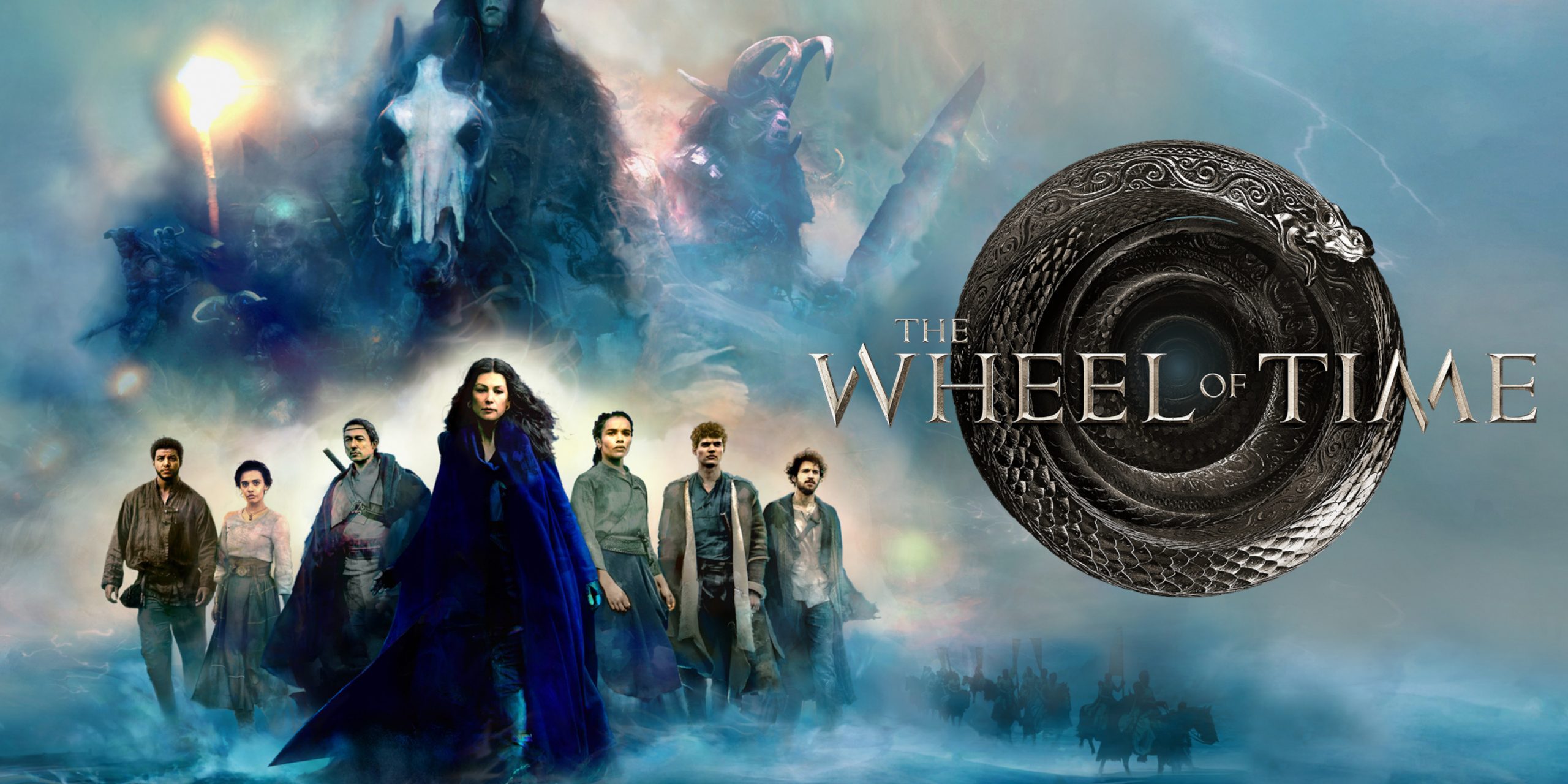
The Wheel of Time asks for patience before it earns your attachment. Its opening season delivers an alarming number of names, several ominous prophecies and the sense that everyone knows something they refuse to explain. Rosamund Pike looks magnificently concerned throughout. Fair enough, considering her workload.
But Prime Video’s adaptation of Robert Jordan’s novels does improve. Season two gives its characters sharper conflicts, while season three begins to find the confidence and strangeness that this world needs. The frustrating part is that the improvement leads to an unfinished story: Prime Video cancelled the series after three seasons in May 2025.
My verdict: worthwhile for viewers who enjoy ambitious fantasy, complicated loyalties and magic with dangerous consequences. Less appealing if a completed ending is essential to your viewing experience.
This review covers all three seasons, with light story spoilers.
What Is The Wheel of Time About?

The story begins with Moiraine, a member of the Aes Sedai, searching for the Dragon Reborn. This prophesied figure could defeat the Dark One, but could also bring catastrophe.
Her search takes her to the Two Rivers, where a group of young villagers becomes entangled in events far beyond home. Rand, Egwene, Nynaeve, Mat and Perrin are drawn towards different kinds of power, responsibility and danger.
The central complication is that male channellers face the threat of madness because the male half of the One Power is tainted. Being the potential saviour of humanity therefore comes with a fairly serious occupational hazard.
Developed for television by Rafe Judkins, the series draws on Jordan’s fourteen main novels, the final three of which were completed by Brandon Sanderson. That scale explains the need for adaptation. It does not automatically excuse every decision made along the way.
Season One: A Difficult Introduction
Season one has an effective premise and a strong lead performance, but its storytelling often feels caught between mystery and explanation.
Keeping the Dragon Reborn’s identity uncertain gives newcomers a question to follow. It also disperses attention across a large cast before the series has established why each person matters.
The early journey has familiar fantasy ingredients: an isolated community, monstrous attackers, a dangerous escape and a guide who is economical with the truth. Familiarity is not the problem. The problem is how quickly the show sometimes moves from one dramatic situation to another without allowing the emotional consequences to settle.
Perrin’s altered backstory is a particularly awkward example. The adaptation gives him an immediate source of trauma, but then struggles to turn that trauma into an engaging inner conflict. Silence can suggest depth. It can also leave a character standing at the edge of scenes.
The first season’s finale exposes the same weakness on a larger scale. Its shifting confrontations and apparent reversals make it harder to understand the limits of the magic or the lasting cost of what happens.
There is enough here to continue, especially in Moiraine and Lan’s partnership. I would still understand anyone who reached the end feeling more confused than invested.
Season Two: The Characters Become Worth Following
Season two improves because it gives several characters problems that feel specific to them.
Egwene’s experience under the Seanchan is the strongest example. The series explores control through humiliation, coercion and the systematic removal of choice. Madeleine Madden makes the emotional damage convincing without reducing Egwene to helplessness.
These scenes also give the magic clearer dramatic meaning. Power matters because someone else can exploit it, restrict it or make its use unbearable.
Zoë Robins brings similar force to Nynaeve, whose anger is bound up with protectiveness and fear. Her stubbornness can be exhausting, but it generally feels rooted in a recognisable person rather than a plot requirement.
Dónal Finn takes over as Mat from Barney Harris and brings a welcome mixture of vulnerability and humour. The transition requires adjustment, though Finn gives the role an appealing nervous energy.
The season remains uneven. Rand’s development sometimes feels less substantial than the importance everyone assigns to him, and the closing spectacle compresses a great deal of material. Nevertheless, the emotional stakes are stronger. By this point, there are people to care about beneath the prophecy.
Season Three: The Best Season, With the Biggest Frustration
Season three is the strongest because it gives the world’s history more weight.
Its Aiel material and journey to Rhuidean move beyond the familiar business of announcing that an ancient civilisation was important. The past becomes something that can disturb identities, expose uncomfortable truths and change what characters believe their future should be.
“The Road to the Spear” is the standout episode. Its treatment of memory, ancestry and possible futures makes the mythology feel personal. This is where the series most convincingly demonstrates why Jordan’s world deserves more than a standard chosen-one adventure.
The White Tower storyline benefits from a sharper sense of institutional conflict, too. Its members have immense power, but their authority does not make them immune to vanity, factionalism or disastrous judgement.
The season is still stretched by its competing locations and storylines. Some developments receive more attention than others, and the finale cannot supply the resolution that cancellation later made viewers need.
Even so, this is the version of The Wheel of Time I find most compelling: stranger, more assured and willing to let discovery be unsettling.
Rosamund Pike and the Cast: Who Makes It Work?

Rosamund Pike is the series’ most consistent strength.
Her Moiraine combines control with the suggestion that maintaining it takes considerable effort. She can be cold, manipulative and difficult to trust, while still making the burden of her mission believable.
Daniel Henney gives Lan a useful physical and emotional restraint. Their relationship works best when the show trusts a look, a pause or a practical gesture to communicate their bond.
Josha Stradowski’s Rand becomes more engaging as the series gives him room to express the fear beneath his importance. His challenge is partly structural: other characters spend so much time discussing what he represents that his personality occasionally has to fight for space.
Madden and Robins supply much of the younger ensemble’s emotional force. Marcus Rutherford is committed as Perrin, although the writing takes longer to give him a satisfying direction.
Among the antagonists, Natasha O’Keeffe’s Lanfear is especially entertaining. She brings glamour, menace and an unnerving sense that she considers everyone else’s moral objections rather provincial. Her scenes give the series a welcome edge.
World-Building, Magic and Visual Design
The Wheel of Time becomes more distinctive as its cultures begin to feel different in their beliefs and behaviour.
The White Tower, the Seanchan and the Aiel are compelling because each has its own assumptions about power, duty and acceptable sacrifice. Those differences create conflict that cannot be solved simply by identifying the nearest villain.
The visual presentation is less consistent. Landscapes and major locations can be impressive, while some interiors and costumes feel too pristine to suggest everyday life. Attractive production design does not always make a place feel inhabited.
The One Power has a similar problem. Visible weaves help explain that channelling requires deliberate action, but extended magical gestures can interrupt a scene’s urgency.
Magic works best when the audience understands a restriction or consequence. The Seanchan storyline supplies that clarity particularly well. Elsewhere, the show sometimes relies on spectacle before establishing why one feat should be harder, riskier or more surprising than another.
Sword Fights, Warders and Weapons
For a series so concerned with magic, The Wheel of Time still gives physical fighters a meaningful role.
Lan’s screen fighting suits his character: controlled, economical and focused on protecting someone else. The Warder relationship offers a useful tactical idea, with armed protectors buying their Aes Sedai time and space to channel.
The strongest action scenes make that division of labour readable. The weaker ones bury positioning beneath rapid cuts, effects and simultaneous threats.
Rand’s heron-marked sword also carries significance beyond its appearance. It connects him to questions of inheritance, skill and an identity he does not yet fully understand. The adaptation gives less attention to his developing swordsmanship than that symbolism might lead viewers to expect.
The weapons and choreography belong to a fictional setting with varied design influences. They are best judged for character, visual clarity and dramatic purpose rather than treated as demonstrations of a historical fencing system.
I would happily trade a little glowing spectacle for a longer, clearer exchange of blades. Lan generally looks capable of providing one.
How Faithful Is It to the Books?

The adaptation makes substantial changes to character histories, relationships, chronology and the distribution of important moments.
Some compression is unavoidable. Jordan’s novels contain extensive travel, internal reflection and an enormous supporting cast. Television needs its own structure.
Moving Moiraine towards the centre gives the opening a strong dramatic anchor. Combining material can also help the show maintain momentum.
Other changes are harder to defend when they create an emotional problem without providing enough time to explore it. Perrin’s opening storyline is one example. Reducing Rand’s training and reallocating pivotal moments also changes how his development feels.
My concern is less whether every scene matches the page than whether a change produces convincing television. A departure should earn its place through stronger characterisation, clearer stakes or better pacing.
Book readers should expect a reinterpretation. Newcomers can follow it without reading the novels, though the early episodes ask them to absorb a substantial amount of terminology.
Why the Cancellation Matters
Prime Video cancelled The Wheel of Time in May 2025, following its third season. Reporting linked the decision to the relationship between its production costs and audience performance.
The consequence for viewers is straightforward: the television adaptation does not complete the larger story.
Individual arcs contain satisfying moments, but the final season leaves major conflicts unresolved. Its ending functions as a stage in a continuing narrative.
That makes the recommendation conditional. There is considerable pleasure in the performances, political conflict and later world-building. There is also a reasonable argument for choosing the books if finishing the story matters more than seeing this particular interpretation.
Is The Wheel of Time Worth Watching?
Yes, provided you can accept an uneven opening and an unfinished ending.
The show is most rewarding for viewers interested in power that damages its users, institutions that confuse authority with wisdom, and characters whose loyalties become increasingly difficult to maintain.
It is less successful when it rushes emotional developments or expects impressive effects to explain the rules of a confrontation.
What keeps me interested is its growing willingness to explore the difficult parts of its world. By season three, history can be frightening, prophecy can feel oppressive, and heroism has become more complicated than accepting a grand title.
That improvement makes the cancellation frustrating. The series finally becomes something I would confidently recommend to a fantasy fan, then leaves that recommendation carrying a sizeable asterisk.