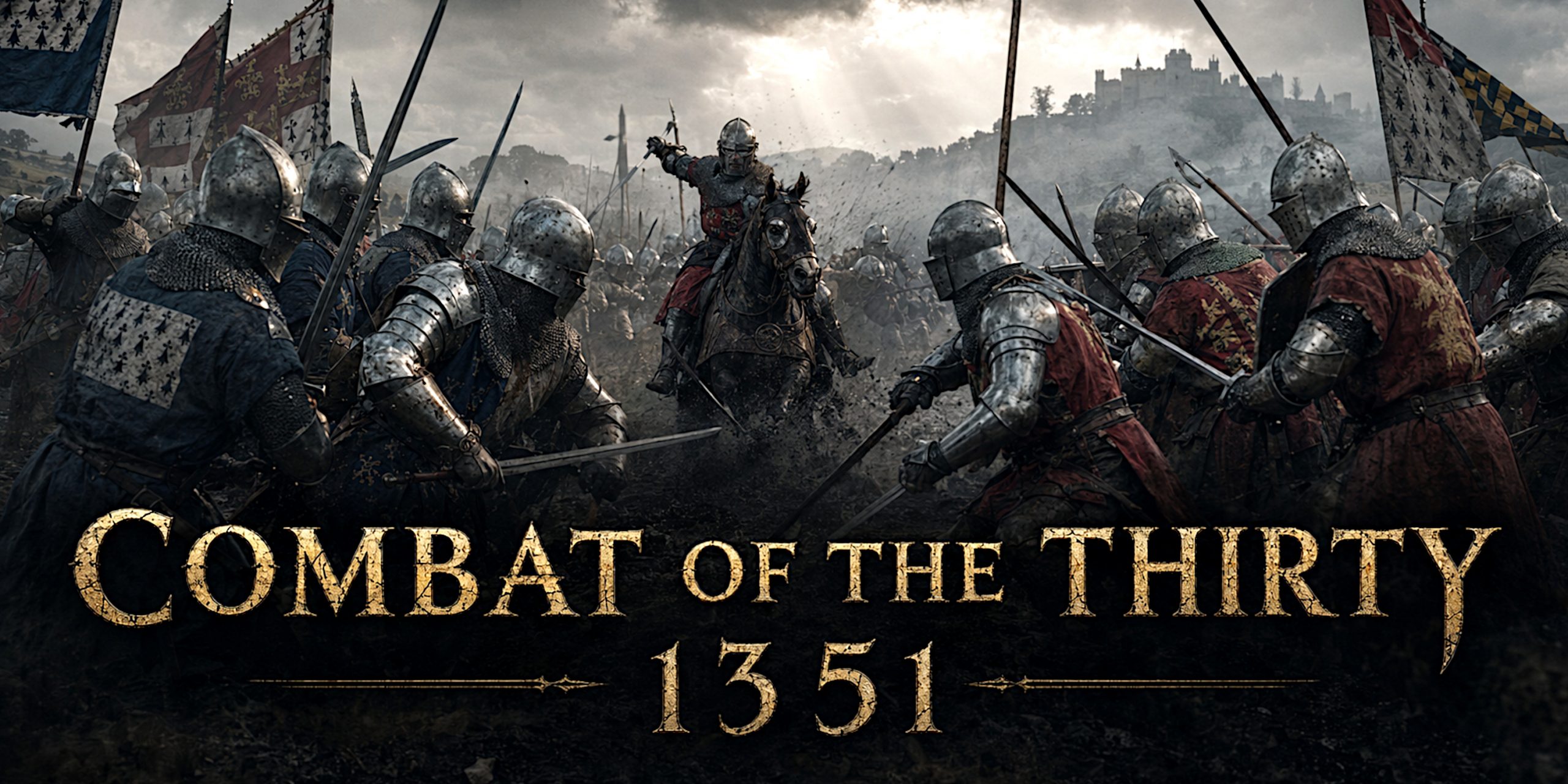
On a spring day in 1351, two groups of selected warriors met on a patch of heathland between the Breton strongholds of Josselin and Ploërmel. There were no great armies, siege engines or flights of arrows. Instead, approximately sixty knights, squires and professional men-at-arms agreed to settle their quarrel at close quarters.
The Combat of the Thirty, known in French as the Combat des Trente, was part battle, part formal deed of arms and part lethal public spectacle. It ended with shattered armour, numerous deaths and a mounted charge into a tightly packed formation of exhausted men.
Medieval chroniclers adored it. Militarily, it achieved very little. As a lesson in how fourteenth-century warriors understood courage, honour and personal reputation, however, it is difficult to beat.
Combat of the Thirty at a Glance
| Detail | Information |
|---|---|
| Date | Usually given as 26 March 1351, although 27 March appears in some traditions |
| Location | Mi-Voie, between Josselin and Ploërmel in Brittany |
| Wider conflict | Breton War of Succession |
| Blois commander | Jean de Beaumanoir |
| Montfort commander | Robert Bemborough, also recorded under several variant names |
| Strength | Traditionally 30 combatants on each side |
| Result | Victory for the Blois-aligned Franco-Breton force |
| Losses | Uncertain and disputed between the surviving accounts |
| Strategic effect | Minimal |
| Cultural importance | One of the most celebrated deeds of arms of the later Middle Ages |
The Breton War of Succession
The Combat of the Thirty emerged from the Breton War of Succession, a civil conflict which began after Duke John III of Brittany died without a direct heir in 1341.
Two rival claims divided the duchy:
- Jeanne de Penthièvre and her husband, Charles of Blois, received the support of the French Crown.
- John of Montfort and later his young son were supported by Edward III of England.
Brittany consequently became another theatre in the wider Hundred Years’ War. Breton families divided between the claimants, while French and English soldiers entered the duchy to defend strongholds, raid rival territory and make an honest living from ransom, assuming one applies a very flexible meaning to the word honest.
By 1351, neither party had secured a decisive advantage. Charles of Blois was an English prisoner following his capture at La Roche-Derrien in 1347. John of Montfort had died, leaving his cause to be continued in the name of his young son.
The Black Death had added its own particular misery to the situation. Fighting continued through fortified garrisons, raids and local confrontations rather than constant campaigning by large armies.
Two of these garrisons faced one another across southern Brittany:
- Josselin, held for the Blois-Penthièvre faction
- Ploërmel, controlled by the Montfortist faction and its English allies
Jean de Beaumanoir commanded at Josselin. Robert Bemborough held Ploërmel.
Why Did the Combat Take Place?
The precise cause is not certain because the surviving sources tell different stories.
The chroniclers Jean le Bel and Jean Froissart presented the encounter primarily as a formal test of martial honour. One commander challenged the other, and the proposed contest developed into a fight involving selected champions.
A contemporary or near-contemporary Breton poem gives the affair a more patriotic purpose. In this version, Bemborough’s soldiers had abused, imprisoned and exploited local peasants. Beaumanoir confronted him in defence of the population.
That story is memorable, but the poem is strongly partisan. It depicts the Blois faction as righteous Breton defenders and their opponents as foreign oppressors. It is therefore evidence for how the combat was remembered and promoted, rather than an impartial account of why it began.
More practical motives probably sat beneath the language of chivalry:
- Rival garrisons wanted to damage one another without mounting a full siege.
- Captured opponents could be held for ransom.
- Commanders needed to preserve their reputations.
- A public challenge was difficult to refuse without appearing cowardly.
- Professional warriors had both the means and cultural inclination to turn a local dispute into a lethal exhibition.
The combat was serious, but it was not spontaneous. A date, location, number of participants and broad rules were agreed in advance.
Forces
Calling the two parties simply “French” and “English” is convenient but misleading. The Breton civil war cut across nationality, family allegiance and personal interest.
Forces and troop composition
| Faction | Composition | Allegiance | Base |
|---|---|---|---|
| Blois-Penthièvre party | Predominantly Breton knights, squires and men-at-arms | Charles of Blois and Jeanne de Penthièvre, supported by France | Josselin |
| Montfortist party | English, Breton and German knights, squires and professional soldiers | The Montfort claimant, supported by England | Ploërmel |
The Breton poem claims that the Montfortist company contained:
- 20 Englishmen
- 6 Germans
- 4 Bretons
It presents Beaumanoir’s company as entirely Breton. Individual names and totals differ between manuscripts, so such figures should be treated with some caution.
The famous “thirty against thirty” formula may also conceal a minor numerical complication. Some versions appear to count each captain among the thirty, while others describe thirty companions in addition to a leader. Medieval writers were excellent at heroic symmetry and occasionally less devoted to administrative clarity.
Leaders and Notable Combatants
| Figure | Faction | Role and significance |
|---|---|---|
| Jean de Beaumanoir | Blois-Penthièvre | Captain of Josselin and leader of the Franco-Breton company |
| Robert Bemborough | Montfortist | Captain of Ploërmel; killed during the combat |
| Geoffroy du Bois | Blois-Penthièvre | Veteran combatant associated with the famous instruction to Beaumanoir to drink his own blood |
| Guillaume de Montauban | Blois-Penthièvre | Squire credited with mounting a horse and breaking the opposing formation |
| Alain de Keranrais | Blois-Penthièvre | Credited in the Breton poem with delivering a severe lance thrust to Bemborough |
| Alain de Tinténiac | Blois-Penthièvre | Prominent Breton knight named among Beaumanoir’s champions |
| Yves Charruel | Blois-Penthièvre | Survivor whose participation reportedly brought him considerable later honour |
| Robert Knolles | Montfortist | English soldier who later became a notable commander during the Hundred Years’ War |
| Hugh Calveley | Montfortist | English knight and future military commander |
| Richard de la Lande | Montfortist | Remembered in the poem as “the Fierce” |
| Croquart | Montfortist | German professional soldier who appears to have assumed command after Bemborough’s death |
Not every participant was a knight. The companies included squires and experienced men-at-arms, all equipped and trained for fighting in heavy armour. This was an elite confrontation, though not an exclusively aristocratic gathering.
Rules of the Combat
The encounter took place near the Chêne de Mi-Voie, or Halfway Oak, approximately midway between Josselin and Ploërmel.
The chosen field seems to have been bounded or marked, possibly with weapons driven into the ground. Spectators were present but forbidden from intervening. The combatants agreed not to flee and understood that the contest would end in death, surrender or capture.
Most accounts describe the men as fighting predominantly on foot. Horses were brought to the site, however, and the sources disagree over whether several warriors remained mounted from the beginning.
This disagreement matters because a mounted charge eventually decided the contest. If mounted action had been permitted, Guillaume de Montauban employed an accepted option with ruthless timing. If it had not, his charge was a remarkable bending of the rules.
Medieval opinion appears to have accepted the victory. Practicality, as ever, had found a small opening in the door marked honour.
Arms and Armour
The Combat of the Thirty occurred during an important period in the development of European armour. Mail still provided essential protection, but increasing amounts of plate were being fitted over the limbs and torso.
The precise equipment of every participant is unknown. The Breton poem, manuscript illustrations and surviving fourteenth-century arms allow a reasonable reconstruction, but later artwork should not be mistaken for eyewitness photography.
Weapons used
| Weapon | Likely form | Use in the combat |
|---|---|---|
| Lance | Heavy ash or similar wooden shaft with a steel head | Used for thrusting on foot and possibly from horseback |
| Arming sword | One-handed, double-edged sword | Cutting and thrusting at gaps in armour |
| Long sword or hand-and-a-half sword | Longer grip allowing one or two-handed use | Plausible for the period, although not securely assigned to named combatants |
| Pollaxe | Combined axe blade, hammer or beak and thrusting spike | Highly effective against armoured opponents |
| Dagger | Baselard or early rondel-type fighting dagger | Used at very close range and against openings in armour |
| Axe | One-handed or two-handed military axe | Delivered concussive and cutting blows |
| Mace | Flanged or solid-headed striking weapon | Designed to inflict trauma through armour |
Specific sword types
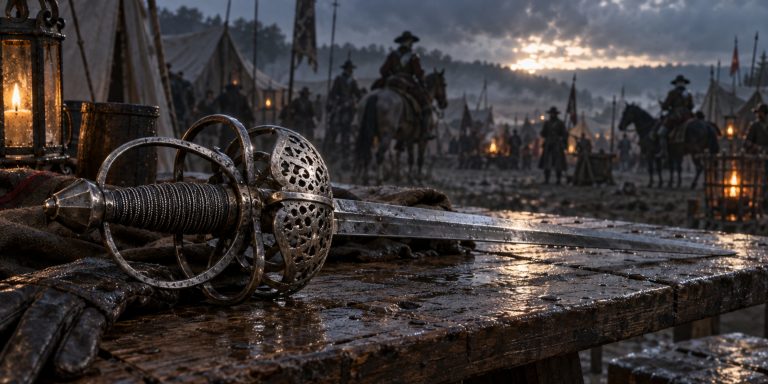
The most likely sword carried by many participants was the knightly arming sword. In Oakeshott’s modern typology, blades broadly comparable to Types XIII, XIIIa, XIV and XV were in use during the middle decades of the fourteenth century.
- Type XIII and XIIIa swords had relatively broad blades suited to powerful cuts. The longer XIIIa form could be used with two hands.
- Type XIV swords were shorter, strongly tapering weapons capable of both cutting and thrusting.
- Type XV swords had stiff, sharply tapering blades increasingly suited to attacking the gaps between plates.
It would be unwise to assign an exact Oakeshott type to Beaumanoir or Bemborough without a surviving weapon or a sufficiently detailed contemporary depiction. The terminology is modern, and medieval inventories were rarely thoughtful enough to anticipate the needs of future sword enthusiasts.
Armour worn by the combatants
A well-equipped man-at-arms in 1351 might have worn:
- A padded arming garment
- A mail haubergeon
- A coat of plates or early plate-covered torso defence
- Plate poleyns protecting the knees
- Plate greaves or splinted leg armour
- Plate arm defences
- Armoured gauntlets
- A bascinet with a mail aventail
- A visor, probably of pointed or rounded form
- A surcoat or jupon displaying personal or factional heraldry
The bascinet had become increasingly common by this period. Its close fit and optional visor offered better protection than the open-faced helmets of earlier centuries. Mail remained important around the neck, armpits, groin and other areas difficult to cover with rigid plate.
The extended duration of the combat shows the effectiveness of this equipment. Armour made men difficult to kill quickly, but it also trapped heat, restricted breathing and gradually exhausted its wearer. Being knocked to the ground in the middle of a crowded melee could be more dangerous than receiving a clean sword cut.
How the Combat Unfolded
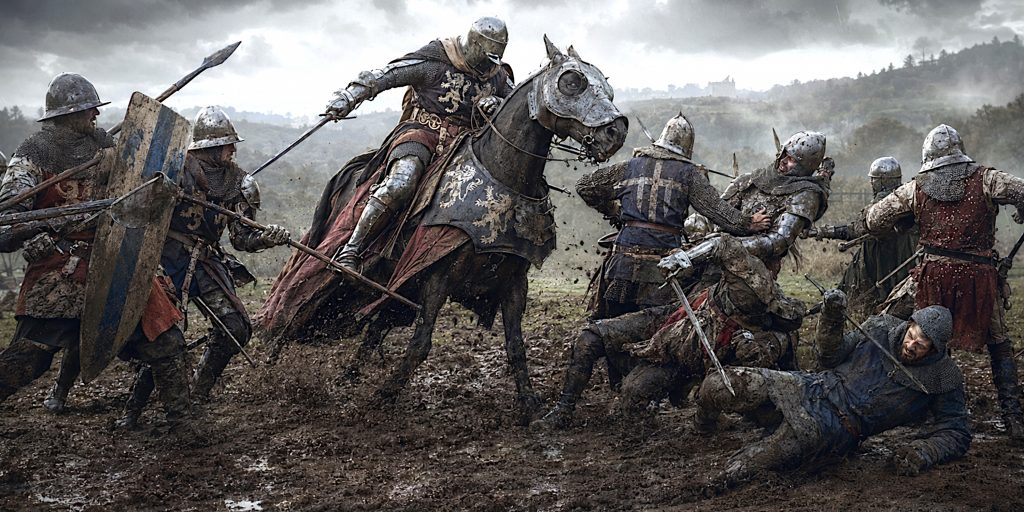
The two companies arrived at Mi-Voie after attending Mass, although the sources disagree over which side receives the greater share of religious devotion. Both groups entered the field and prepared for combat.
The first phase was a brutal hand-to-hand melee. Lances, swords, axes and other weapons were used at close range. Men were killed and many more injured, but neither company immediately broke.
Jean le Bel described the warriors as fighting with the courage of Roland and Oliver, the legendary heroes of medieval epic. Eventually both parties became so exhausted that they agreed to stop.
This pause is one of the strangest details in the story. The combatants drank wine, adjusted their armour and bandaged their wounds before returning to the business of attempting to kill one another. It was civilised in the narrowest possible sense.
When fighting resumed, Bemborough was killed. The Breton poem credits Alain de Keranrais and Geoffroy du Bois with striking him using lances. Other accounts place his death later in the action.
Croquart then appears to have taken command of the surviving Montfortists. He formed his men into a compact defensive group, protecting their flanks and presenting a wall of weapons to Beaumanoir’s attackers.
Beaumanoir was wounded and called for water. Geoffroy du Bois supposedly replied:
“Drink your blood, Beaumanoir, and your thirst will pass.”
It is an excellent line, if somewhat lacking in bedside manner. It also comes from the partisan poetic tradition and may have been improved in the telling.
Unable to break Croquart’s formation on foot, Guillaume de Montauban left the immediate fighting, mounted his horse and charged. His comrades initially thought he was fleeing. Instead, he drove into the Montfortist group, knocking men down and opening gaps in its defensive line.
Beaumanoir’s remaining fighters rushed into the broken formation. Bemborough and several of his companions were dead, while the surviving Montfortists surrendered and were taken to Josselin.
Battle Timeline
| Stage | Event |
|---|---|
| 1341 | John III of Brittany dies without a direct heir, beginning the succession dispute |
| 1347 | Charles of Blois is captured at La Roche-Derrien |
| Early 1351 | Tension intensifies between the garrisons of Josselin and Ploërmel |
| Before the combat | Beaumanoir and Bemborough agree to an arranged deed of arms |
| Morning | The selected companies hear Mass and travel to Mi-Voie |
| Opening phase | Both groups engage in a close, largely dismounted melee |
| Mid-combat | Exhausted fighters agree to pause, drink and treat their wounds |
| Second phase | Bemborough is killed and Croquart organises a compact defence |
| Decisive action | Guillaume de Montauban mounts and charges the Montfortist formation |
| Conclusion | The formation breaks and the surviving Montfortists surrender |
| Aftermath | Prisoners are taken to Josselin, but Ploërmel remains in Montfortist hands |
| 1352 | The Blois faction suffers a serious defeat at the Battle of Mauron |
| 1364 | The Battle of Auray decides the Breton War of Succession in favour of the Montfort cause |
Casualties
The casualty totals cannot be established with confidence.
| Account or tradition | Blois losses | Montfortist losses |
|---|---|---|
| Common modern summary | Between 3 and 6 killed | Bemborough and approximately 8 others killed |
| Jean le Bel tradition | 6 left dead, with further deaths from wounds | Bemborough and 8 companions killed |
| Later and regional traditions | Figures vary considerably | Figures vary considerably |
Some Breton accounts give substantially higher totals. The differences may reflect manuscript corruption, differing definitions of who died at the field, and the inclusion of warriors who succumbed to wounds later.
Almost every surviving combatant was reportedly injured. That is entirely believable given the duration and close-range nature of the fighting.
Contemporary and Medieval Accounts
The Combat of the Thirty survives through several narrative traditions rather than a neutral official report.
Jean le Bel
Jean le Bel provides one of the earliest prose accounts. He admired the conduct of both sides and compared their courage with heroic warriors from medieval literature.
“They held themselves as valiantly on both sides as if they had all been Rolands and Olivers.”
His account is comparatively restrained, although he was not present and acknowledged uncertainty over some details.
Jean Froissart
Froissart largely followed Le Bel but helped secure the combat’s international fame. He described it as:
“A most marvellous deed of arms which should never be forgotten.”
Froissart’s wording reveals what mattered most to his aristocratic audience. The combat was remembered less for its political outcome than for the behaviour of those involved.
The Breton poem
The anonymous Bataille de trente Anglois et de trente Bretons is much more dramatic. It supplies names, speeches and patriotic motivations while presenting Beaumanoir’s party as defenders of Brittany.
Its dialogue should not automatically be read as verbatim testimony. Medieval poets were quite willing to provide history with better lines.
Archaeology and the Battlefield
There is no widely accepted body of excavated weaponry, armour or human remains securely identified with the Combat of the Thirty. Our knowledge depends overwhelmingly upon written sources, commemorative tradition and comparison with surviving fourteenth-century military equipment.
This absence is not surprising. The engagement involved only around sixty combatants, survivors and bodies were removed, valuable equipment would have been recovered, and the landscape continued to be used for centuries.
The traditional location near Mi-Voie has nevertheless retained a strong physical connection with the event.
The Halfway Oak and memorial cross
The oak associated with the combat became an early local landmark. After it disappeared, a commemorative cross marked the site. The cross was damaged, replaced and reconstructed several times as Brittany’s political circumstances changed.
The Column of the Thirty
A granite memorial known as the Colonne des Trente was constructed in the nineteenth century at Guillac. Official French heritage records date the monumental column to 1819, with work continuing into the following years.
Its inscription honours the Breton champions of the Blois party. It is an important monument to the memory of the combat, but it also reflects the regional nationalism and politics of the period in which it was erected.
Visitors should therefore read it as evidence of two historical moments:
- The combat fought in 1351
- The nineteenth-century reshaping of the encounter as a Breton patriotic legend
Saint-Maudé Chapel
Local tradition also connects the nearby Saint-Maudé Chapel with three Breton combatants said to have been buried after the encounter. The chapel is historically significant, but the burial story has not provided firm archaeological confirmation of the men’s identities.
Did the Combat Change the War?
In strategic terms, almost nothing changed.
The Blois party won the field and gained valuable prisoners, but it did not capture Ploërmel. The Montfortist position in southern Brittany survived. In 1352, the Blois faction suffered a much more consequential defeat at Mauron.
The war continued until the Battle of Auray in 1364. Charles of Blois was killed, and the Montfort claimant became Duke John IV of Brittany.
The Combat of the Thirty therefore did not decide the succession, remove a major fortress or transform the military balance. Its fame came from its scale and structure. It offered chroniclers a compact story with named champions, agreed rules, memorable speeches and a decisive reversal.
Large battles are messy. Sixty selected warriors on a marked field are much easier to turn into legend.
Chivalry or Organised Brutality?
The combat is often described as the perfect expression of medieval chivalry. There is some truth in that interpretation.
The participants accepted agreed conditions, fought openly, allowed a mutual pause and showed extraordinary physical courage. They understood that their conduct would affect their honour and social standing.
Yet chivalry did not make the event humane. It gave elite violence a recognised structure and an admiring audience. Men were killed or maimed for an objective which had little strategic value, while the local population continued to endure the wider war.
The encounter also served practical interests. Captives meant ransom. Victory meant status. Reputation could produce employment, patronage and influence.
To medieval warriors, these motives were not necessarily contradictory. Honour, money, loyalty and ambition could all fit comfortably beneath the same heraldic surcoat.
Legacy of the Combat of the Thirty
The encounter became famous within a generation. Participants were honoured at court, while poets and chroniclers preserved their names.
Froissart later recalled seeing the scarred veteran Yves Charruel treated with exceptional respect at the court of Charles V of France. Whether every detail of that recollection is exact, it reflects the lasting prestige attached to participation.
The combat inspired:
- Medieval poems and chronicles
- Royal tapestries
- Heraldic displays
- Nineteenth-century history paintings
- Breton patriotic literature
- Re-enactments and modern historical studies
Octave Penguilly L’Haridon’s 1857 painting Le Combat des Trente helped shape the modern visual image of the event. Like many nineteenth-century historical paintings, it is dramatic, accomplished and not especially shy about turning the past into theatre.
The Combat of the Thirty remains compelling because it compresses the ideals and contradictions of medieval chivalry into a single day. Its warriors displayed courage, discipline and loyalty. They also risked their lives in an arranged bloodletting that settled almost nothing.
That may be why the story has endured. It is chivalry stripped of its polished courtly language and placed in a field, where armour buckles, men tire and reputation becomes a matter of survival.
Watch the video guide:
Frequently Asked Questions
Who won the Combat of the Thirty?
Jean de Beaumanoir’s Blois-aligned Franco-Breton company won. The surviving Montfortist combatants surrendered and were taken to Josselin.
When did the Combat of the Thirty take place?
The conventional date is 26 March 1351. Some sources and monuments give 27 March.
Where was it fought?
It took place at Mi-Voie, roughly halfway between Josselin and Ploërmel in Brittany.
Were there exactly thirty fighters on each side?
That is the traditional total, although some texts may count the commanders separately and provide slightly inconsistent lists.
Was it a tournament?
It was a formal deed of arms with agreed rules and spectators, but the weapons were real and numerous participants were killed. Calling it a tournament can make the event sound rather safer than it was.
What swords were used?
Arming swords were almost certainly present. Longer hand-and-a-half swords may also have been used. Blade forms comparable to Oakeshott Types XIII, XIIIa, XIV and XV were current in the mid-fourteenth century, although no particular surviving sword can be securely assigned to a named participant.
Did the combat decide the Breton War of Succession?
No. It had little strategic effect. The war continued until the Montfortist victory at Auray in 1364.
Reference sources
Morbihan Archives: La Colonne des Trente
Academic study of the combat’s arms and martial practices
French Ministry of Culture record for the Column of the Thirty