The Rings of Power takes place in Middle-earth’s Second Age, thousands of years before Bilbo finds the One Ring. Yet trying to match every episode to Tolkien’s calendar quickly becomes a small research project.
Isildur is already alive. Celebrimbor is still making rings. Gandalf has arrived rather earlier than readers might expect. Meanwhile, Númenor is approaching a political crisis with consequences considerably worse than an awkward election.
The explanation is timeline compression. Amazon’s series brings together events that Tolkien placed centuries, sometimes more than a millennium, apart. Understanding that choice makes the story easier to follow, even when you disagree with what the adaptation does with it.
This guide separates the television chronology from Tolkien’s original timeline, explains where the first two seasons fit, and shows how the Second Age leads towards The Lord of the Rings.
Spoiler warning: Major spoilers for Seasons 1 and 2, announced Season 3 information, and the later events of Tolkien’s Second Age.
When Does The Rings of Power Take Place?
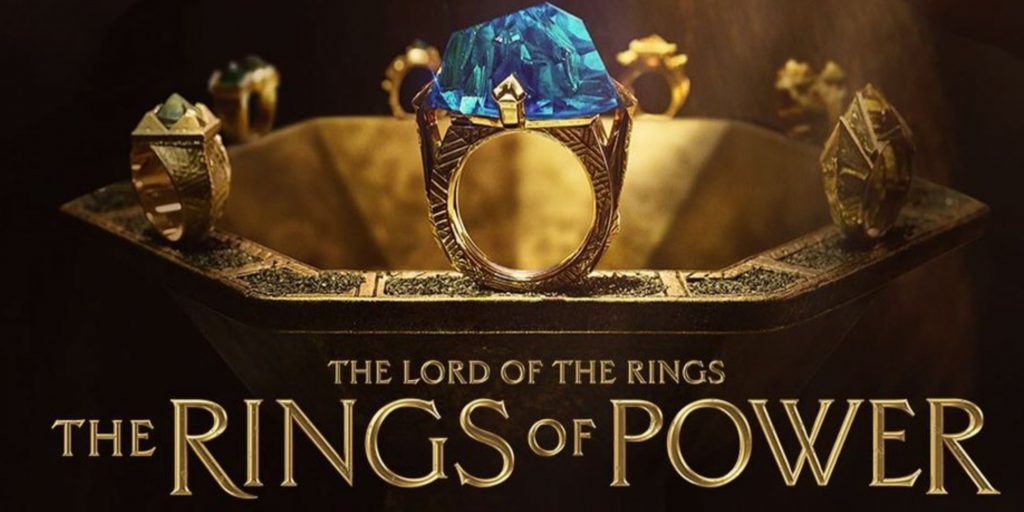
The Rings of Power is set during the Second Age, which lasts 3,441 years in Tolkien’s chronology. Its main story concerns Sauron’s rise, the making of the Rings of Power, Númenor’s decline and the conflicts that shape the world inherited by Frodo.
The important qualification is that the show does not occupy one neatly identifiable year from the books. It combines developments from the middle and late Second Age into a shorter dramatic timeline. Tolkien Gateway
That distinction matters. A date attached to Tolkien’s forging of the One Ring should not automatically be attached to the television version of the same event.
I find the series much easier to follow once I stop trying to make its calendar behave like Appendix B. The appendix has its own timetable. The show has a cast it would quite like to keep alive.
What Happened Before the Second Age?

The series begins with memories of an older world: Valinor, the destruction of the Two Trees and the wars against Morgoth.
Morgoth is the original Dark Lord. Sauron begins as his servant, rather than as the supreme enemy of Middle-earth. When Morgoth is defeated in the War of Wrath at the end of the First Age, much of Beleriand is destroyed. The surviving peoples enter a profoundly changed world.
That history helps explain the Elves’ behaviour. For Galadriel, evil is something she has already watched destroy homes and families. For other Elves, the possibility of peace is attractive precisely because the preceding wars were so ruinous.
Sauron survives Morgoth’s defeat. Removing the master does not remove everything he taught his followers. Middle-earth is left with the uncomfortable business of rebuilding while one particularly dangerous survivor remains unaccounted for.
Tolkien’s Second Age Timeline at a Glance
The following dates belong to Tolkien’s written chronology, rather than the television adaptation.
| Second Age date | Event |
|---|---|
| SA 1 | The Second Age begins; Lindon becomes a major Elven realm. |
| SA 32 | Númenor is established. |
| SA 750 | Eregion is founded. |
| Around SA 1500 | The Elven smiths begin making the Rings of Power. |
| SA 1590 | Celebrimbor completes the Three Elven Rings. |
| Around SA 1600 | Sauron forges the One Ring. |
| SA 1693 | The War of the Elves and Sauron begins. |
| SA 1697 | Eregion falls; Celebrimbor is killed and Elrond establishes Rivendell. |
| SA 1700 | Númenórean intervention helps defeat Sauron’s forces. |
| SA 2251 | The Nazgûl first appear. |
| SA 3261–3262 | Ar-Pharazôn’s expedition leads to Sauron being taken to Númenor. |
| SA 3319 | Númenor is destroyed. |
| SA 3320 | Arnor and Gondor are founded. |
| SA 3430 | The Last Alliance of Elves and Men is formed. |
| SA 3441 | Sauron is overthrown; the Second Age ends. |
The basic chronological reference is Tolkien’s The Lord of the Rings, Appendix B, “The Tale of Years”. Tolkien Gateway
Why Has the TV Series Changed the Timeline?

An adaptation following these dates closely would repeatedly replace its human cast as generations passed. Elven characters could remain, but Númenórean families would change long before the story reached its final conflicts.
The series instead allows characters such as Elendil, Isildur, Míriel and Pharazôn to share the period in which Celebrimbor makes the rings.
There is a practical benefit: viewers can follow continuing relationships rather than meet somebody’s distant descendant every few episodes.
There is also a cost. Tolkien’s long chronology gives political and cultural changes room to develop. Númenor’s decline unfolds over generations. Sauron’s influence grows through repeated victories, setbacks and acts of manipulation.
The television version makes those changes more immediate. Sometimes that creates urgency. Sometimes it makes a civilisation’s transformation feel suspiciously quick.
For me, the useful question is whether a change earns its place in the story. Compression can work. It still needs convincing cause and effect.
Season 1 Timeline: From Galadriel’s Search to the Three Rings

Season 1 establishes several parallel stories that gradually intersect.
| Storyline | Main developments |
|---|---|
| Galadriel and Halbrand | Galadriel searches for Sauron, encounters Halbrand and travels to Númenor. |
| Númenor | Míriel leads an expedition to Middle-earth, while divisions over the island’s future deepen. |
| The Southlands | Arondir, Bronwyn and Theo resist Adar’s forces; the eruption transforms the region into Mordor. |
| Eregion and Khazad-dûm | Elrond works with Celebrimbor and renews his friendship with Durin IV; mithril becomes central to the Elves’ plans. |
| The Harfoots | Nori helps the mysterious Stranger, whose presence draws dangerous attention. |
The crucial reveal is that Halbrand is Sauron. His involvement in Eregion helps lead towards the creation of the Three Elven Rings, which are completed at the end of the season.
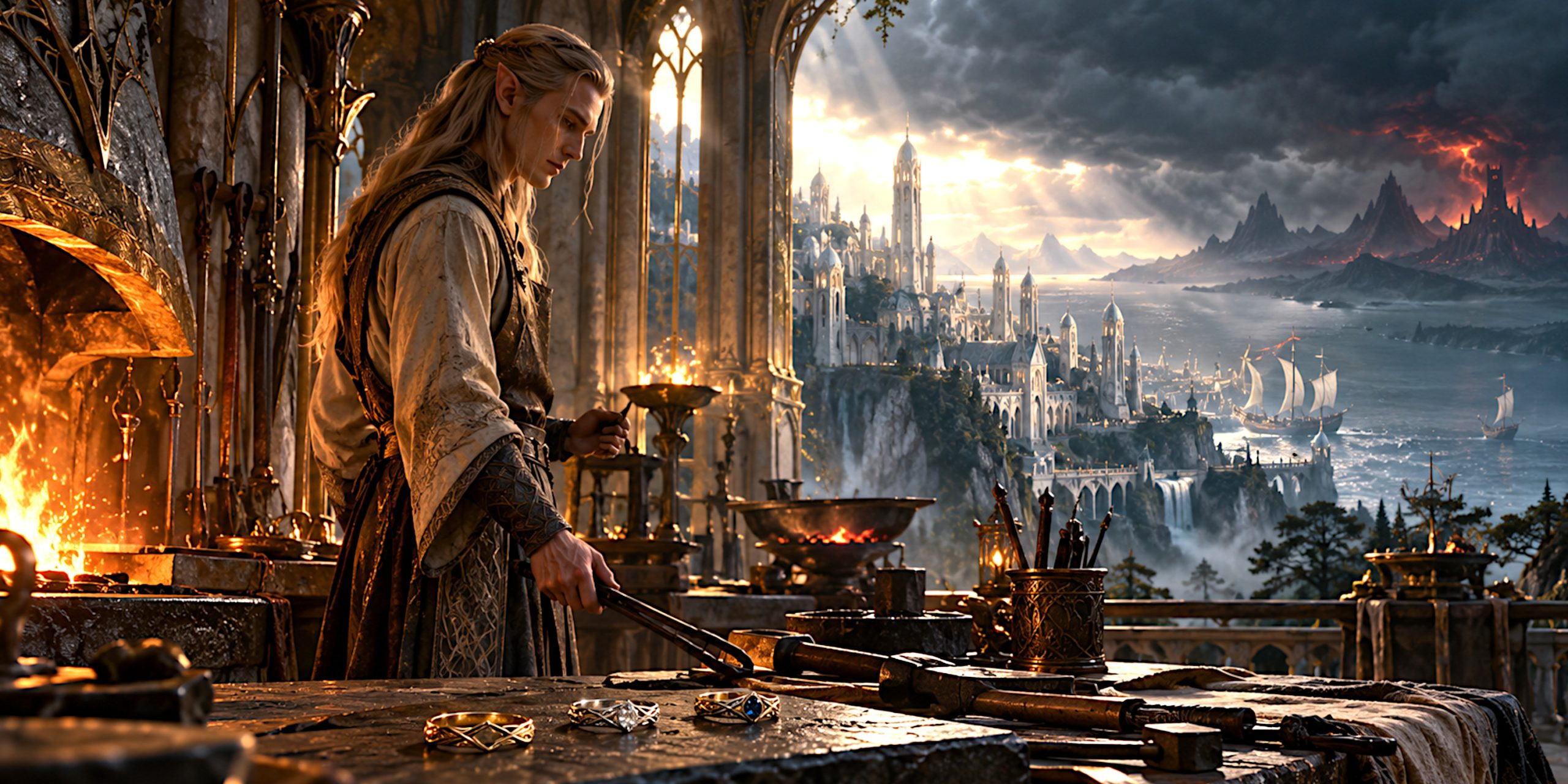
This already differs from Tolkien’s sequence. In the books, the Three are made after the other sixteen great Elven rings. The series places them first. Tolkien Gateway
The eruption that creates the show’s Mordor is another adaptation-specific event. It should not be assigned a Tolkien date simply because Mordor also exists in his Second Age history.
Season 2 Timeline: Annatar, the Rings and the Fall of Eregion

Season 2 moves Sauron’s manipulation into the foreground. Having lost his position as Halbrand among the Elves, he adopts the identity of Annatar, presenting himself to Celebrimbor as a source of divine guidance.
The name changes. The ability to make other people feel that his plans were their idea remains alarmingly consistent.
The season’s main chronological steps are:
- The Three Elven Rings come into use.
- Sauron returns to Eregion and gains Celebrimbor’s trust as Annatar.
- The Seven Rings for the Dwarves are forged.
- The Nine Rings intended for Men follow.
- Adar’s army attacks Eregion, believing it can eliminate Sauron.
- Celebrimbor is killed and Eregion falls.
- Sauron secures the Nine and consolidates his power.
Elsewhere, Pharazôn takes power in Númenor, Durin III’s ring intensifies his dangerous pursuit of wealth, and the Stranger is revealed as Gandalf. aboutamazon.com
By the end of Season 2, the One Ring has not yet been forged. That is a major difference from Tolkien’s chronology, where its creation precedes the war and destruction of Eregion.
Which Came First: the Three Rings or the One Ring?

This is the point where keeping two separate timelines becomes especially helpful.
| Event | Tolkien’s chronology | Television chronology through Season 2 |
|---|---|---|
| Other sixteen great rings | Made before the Three | The Seven and Nine are made after the Three |
| Three Elven Rings | Completed in SA 1590 | Forged at the end of Season 1 |
| One Ring | Forged around SA 1600 | Still unmade at the end of Season 2 |
| Fall of Eregion | SA 1697, after the One Ring exists | Occurs in Season 2 before the One Ring exists |
In Tolkien’s account, Celebrimbor makes the Three without Sauron directly participating. Nevertheless, their craft draws upon knowledge Sauron taught, leaving them vulnerable to the ruling Ring.
When Sauron first puts on the One, the Elves recognise his betrayal and remove their rings. Open conflict follows. Tolkien Gateway
The show rearranges this sequence substantially. It is adapting the struggle over the rings, rather than reproducing its original order.
Where Does Season 3 Fit in the Timeline?
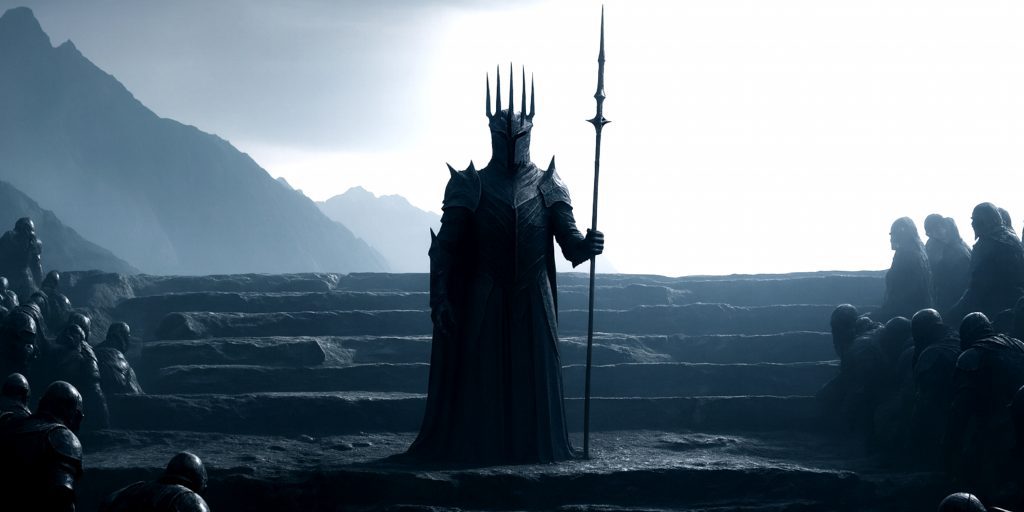
As of 3 October 2026, Season 3 has been announced but has not premiered. Amazon lists its release date as 11 November 2026.
The official synopsis places the new season five years after the fall of Eregion. Sauron’s armies have expanded their conquests, while surviving centres of resistance include Khazad-dûm, Lindon and Rivendell. His pursuit of the One Ring forms a central part of the announced story. aboutamazon.com
That five-year jump belongs to the show’s chronology. It does not turn the season into a straightforward adaptation of SA 1702, because the series has already moved major events out of Tolkien’s order.
The sensible distinction is between what Amazon has announced and what the episodes actually show. A synopsis establishes the starting position; it cannot settle every question about how the season will unfold.
Númenor’s Timeline: How a Great Kingdom Falls

Númenor’s story begins with a gift. The island is granted to the Men who stood against Morgoth, and Elros, Elrond’s brother, becomes its first king.
Its eventual disaster grows from fear of death, resentment towards the immortal Elves and the belief that power should entitle its rulers to escape the limits of being human.
In Tolkien’s later Second Age, Ar-Pharazôn brings such overwhelming force against Sauron that the Dark Lord submits. Taken to Númenor, Sauron turns apparent defeat into an opportunity to corrupt the king’s court.
He encourages Pharazôn to attack Aman in pursuit of immortality. Númenor is destroyed in SA 3319, while Elendil and his sons escape with the Faithful.
It is one of Tolkien’s most unsettling stories because military superiority proves useless against the threat already welcomed inside.
The series brings the island’s late political crisis into the ring-making period. That is why its Númenórean scenes cannot be dated by simply checking when Celebrimbor was alive.
The Last Alliance and the End of the Second Age
Major spoilers for the later book chronology follow.
After Númenor’s destruction, the survivors establish Arnor and Gondor. Sauron’s renewed aggression eventually leads Elendil and Gil-galad to form the Last Alliance.
The war culminates in a prolonged siege and a final confrontation in which both leaders die. Isildur cuts the One Ring from Sauron’s hand with a fragment of Narsil, Elendil’s broken sword.
Sauron loses his physical form, but the Ring survives. The Second Age ends in SA 3441.
There is an important distinction between Tolkien’s account and the familiar film scene. The written story gives Elendil and Gil-galad a decisive role in overthrowing Sauron before Isildur takes the Ring. Reducing everything to one fortunate sword stroke misses their sacrifice.
And Isildur’s death belongs to the Third Age, rather than the closing battle of the Second. Victory, the survival of the Ring and its eventual loss are separate events.
Why Is Gandalf in The Rings of Power?
The Stranger’s identification as Gandalf introduces another substantial chronological change.
In the familiar account of the Istari, Gandalf arrives in Middle-earth around Third Age 1000, long after the events that The Rings of Power depicts. His presence in the show’s Second Age is therefore an adaptation choice.
There is some nuance here. Gandalf is a Maia, known earlier as Olórin, and his existence does not begin when he appears as an elderly wizard. Tolkien also explored earlier activity by some of the Wizards in other writings.
Those details do not make the show’s Gandalf storyline a direct match for the standard chronology.
I can understand the appeal of including him. His relationship with the Harfoots gives the series a smaller, more intimate story alongside royal politics. Whether that benefit outweighs the change is a fair question, rather than something viewers need to pretend has no significance.
Why Is the Balrog Awake So Early?
Season 2 also brings the Balrog into the story of Khazad-dûm, where Durin III’s mining exposes the creature beneath the mountain.
In Tolkien’s chronology, the catastrophe that kills Durin VI and leads to the abandonment of Khazad-dûm occurs in Third Age 1980.
The distinction is between the Balrog’s presence and the fall of the kingdom. The creature can already be hiding beneath the mountains during the Second Age. The destruction remembered as the coming of Durin’s Bane happens much later.
An early encounter in the show therefore does not automatically mean that every part of Khazad-dûm’s later disaster has already occurred.
Still, putting a Balrog downstairs does rather change the atmosphere of a mining dispute.
How The Rings of Power Connects to The Lord of the Rings
The series explores the origins of things that Frodo’s world treats as ancient history.
| Second Age story | Connection to The Lord of the Rings |
|---|---|
| The making of the rings | Creates the objects at the centre of the later struggle |
| Sauron’s deception | Establishes his attempt to dominate other peoples through power they believe will help them |
| Númenor and its survivors | Provides the ancestry and political foundations of Aragorn’s world |
| Elendil and Isildur | Explains Aragorn’s lineage and his family’s connection to the Ring |
| Narsil | Becomes the sword later reforged as Andúril |
| The Last Alliance | Explains Sauron’s earlier defeat and why the Ring survives |
What interests me most is how differently the same characters experience this history. For mortals, it becomes inherited memory. For Elrond and Galadriel, much of it is personal.
When they fear another victory that leaves evil unfinished, they have reasons.
The Timeline Detail That Makes the Whole Series Clearer
The most useful approach is to keep Tolkien’s chronology and the television chronology separate.
Tolkien gives us a Second Age measured in generations: kingdoms grow, alliances weaken and old fears become political movements. The series draws selected events together so that a continuing cast can experience them.
That explains why Isildur can be young while Celebrimbor is still working, why Eregion falls before the show’s One Ring exists, and why Gandalf appears in a period earlier than his familiar arrival.
It also leaves room for a balanced view of the adaptation. Some changes create strong drama. Others make the history feel thinner or the connections harder to follow.
Knowing the original sequence helps us judge those choices on their merits. It also saves quite a lot of pausing the television to ask whether somebody is about 1,600 years early.