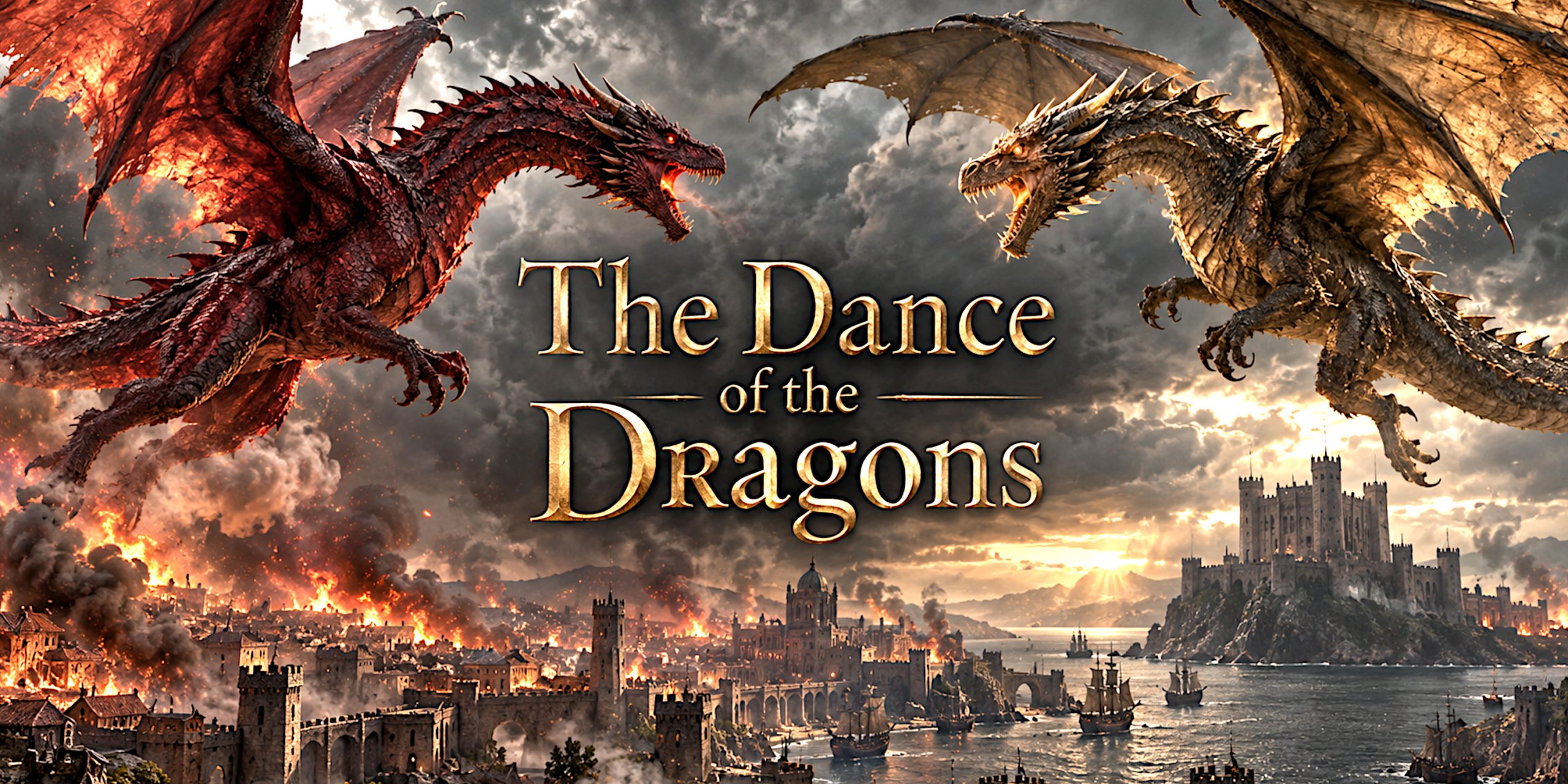
The Dance of the Dragons was the Targaryen civil war fought between Rhaenyra Targaryen and her younger half-brother, Aegon II, over the Iron Throne. Lasting from 129 to 131 AC, it killed both rival claimants, devastated Westeros and left the dynasty’s dragons dangerously close to extinction. Rhaenyra’s son eventually became King Aegon III, but calling that a happy ending requires some fairly creative accounting. A Wiki of Ice and Fire
What draws me to this story is how avoidable its beginnings feel. The family has wealth, dragons and decades to settle the succession. Somehow, it still arrives at two coronations and a civil war.
Spoiler warning: This guide covers the complete war as described in Fire & Blood, including its ending. It follows the book chronology rather than treating House of the Dragon as an identical account.
What Was the Dance of the Dragons?
The Dance was a struggle between two branches of House Targaryen, each claiming the right to succeed King Viserys I.
Rhaenyra had been publicly named his heir. Aegon was his eldest surviving son, born from his second marriage to Alicent Hightower. When Viserys died, their supporters moved to establish competing monarchies.
The fighting spread through Westeros, involving armies, fleets, assassins and dragonriders. Its consequences reached far beyond the royal household. Communities with no meaningful say in the succession paid for it through ruined harvests, burned homes and mass displacement.
The name sounds almost graceful. The actual war offers very little support for that branding.
Why Did Rhaenyra and Aegon Both Claim the Throne?
Rhaenyra’s claim rested on Viserys’s explicit choice of successor and the oaths sworn to uphold it. He did not formally replace her after Alicent bore him sons.
Aegon’s supporters appealed to male succession, earlier royal decisions and the precedent of the Great Council of 101 AC. They also feared the influence of Rhaenyra’s husband, Daemon, and argued that Alicent’s children would be unsafe under their half-sister’s rule.
This was more complicated than a straightforward contest between law and rebellion. Westeros had traditions, precedents and royal commands, but no universally accepted mechanism capable of resolving their contradictions.
Rhaenyra had a strong argument based on her father’s declared wishes. Aegon’s faction had an argument grounded in established expectations about male inheritance. Both sides also had powerful people whose position depended on the answer.
Viserys’s failure was leaving those competing interests unresolved while assuming his decision would survive him. Royal authority is considerably less persuasive once the king providing it is dead.
The Blacks and the Greens Explained
The faction names originated in the book account at a tournament in 111 AC. Alicent wore green, while Rhaenyra wore Targaryen red and black. Their supporters adopted the colours, which became political shorthand. A court wardrobe dispute acquiring military consequences feels painfully believable.
| Faction | Claimant | Principal supporters | Important advantages |
|---|---|---|---|
| Blacks | Rhaenyra Targaryen | Daemon, Corlys Velaryon, Rhaenys, Jacaerys and allies including the Arryns and Starks | Velaryon naval strength, access to numerous dragons and support for Viserys’s chosen heir |
| Greens | Aegon II Targaryen | Alicent, Otto Hightower, Criston Cole, Aemond, Daeron and major Hightower, Lannister and Baratheon forces | Initial control of the capital and royal government, powerful regional allies and Vhagar |
These were shifting coalitions rather than perfectly unified teams. Personal rivalries, marriage agreements and local interests influenced allegiance, and some supporters changed sides.
I find the conflict more interesting when those differences remain visible. Supporting Rhaenyra’s succession claim does not require defending every decision made in her name. Recognising the Greens’ political strengths does not excuse their conduct.
The Dragons That Shaped the War
The Blacks’ access to more dragons did not guarantee victory. Some were young, some lacked riders, and others were difficult to control. The Greens possessed Vhagar, whose size and experience made simple numerical comparisons misleading.
| Dragon | Rider during the war | Significance |
|---|---|---|
| Syrax | Rhaenyra | Closely associated with the Black claimant, although Rhaenyra was not a frequent battlefield dragonrider |
| Caraxes | Daemon | An experienced fighting dragon, central to Daemon’s campaigns |
| Meleys | Rhaenys | A formidable dragon lost at Rook’s Rest |
| Sunfyre | Aegon II | Survived terrible injuries and remained crucial to Aegon’s eventual capture of Rhaenyra |
| Vhagar | Aemond | The Greens’ greatest individual dragon advantage |
| Tessarion | Daeron | Strengthened the Green campaign in the Reach |
| Vermithor | Hugh Hammer | A powerful dragon whose rider’s betrayal helped transform the war |
| Silverwing | Ulf White | Another major addition to the Blacks that later passed into hostile hands |
The important question was never simply who owned the most dragons. It was who could deploy them effectively, keep their riders loyal and survive the consequences when another dragon fought back.
Storm’s End and Blood and Cheese: The War Becomes Personal
The death of Lucerys Velaryon destroyed much of the remaining space for compromise.
Sent to seek Baratheon support at Storm’s End, Lucerys encountered Aemond. After leaving the castle, he and his dragon Arrax were pursued and killed by Aemond and Vhagar.
The book gives this episode through its historical sources. The television adaptation’s presentation of Aemond losing control should not automatically be read back into the book account.
Revenge followed through the assassins known as Blood and Cheese, who murdered Aegon II and Helaena’s young son Jaehaerys. Daemon arranged the retaliatory operation through contacts in King’s Landing.
These killings changed the conflict’s emotional stakes. Each faction could point to an atrocity against its own family, making restraint harder to defend and revenge easier to demand.
Rook’s Rest: A Victory With a Terrible Price
At Rook’s Rest, Criston Cole’s campaign drew Rhaenys and Meleys into a confrontation with Aegon on Sunfyre and Aemond on Vhagar.
Rhaenys and Meleys were killed. Aegon suffered severe injuries, while Sunfyre was badly wounded. The Greens removed an important enemy dragonrider, but their king paid heavily for the victory.
The battle exposes the risk behind the dynasty’s greatest weapon. A dragon can overwhelm soldiers on the ground. Against another dragon, even a royal rider is horribly vulnerable.
The Gullet: Why Fleets Still Mattered
The Battle of the Gullet brought the Triarchy’s fleet against the Velaryons and their dragonrider allies.
The attackers suffered enormous losses, but the Blacks also endured a disaster. Jacaerys and Vermax died, the Velaryon fleet lost substantial strength, and settlements on Driftmark were devastated.
Jacaerys’s death mattered beyond the loss of another prince. He had helped secure alliances and strengthen his mother’s cause. Losing him damaged both the family and its political future.
Corlys Velaryon’s response captures the cost:
“If this be victory, I pray I never win another.”
The Gullet is a useful reminder that dragons could not make shipping, supply routes or coastal defences irrelevant. Controlling the sea still mattered, even when something enormous and flammable was happening overhead.
Rhaenyra Takes King’s Landing, Then Loses It
Rhaenyra eventually occupied King’s Landing and sat the Iron Throne. Securing the capital, however, did not give her a stable government.
Financial pressure, unpopular taxation, executions and growing suspicion weakened her position. Betrayals elsewhere intensified her distrust, including her treatment of dragonriders whose loyalty she questioned.
Her position deteriorated further after Helaena’s death. Rumours spread, unrest escalated and the city turned violently against its rulers.
Rhaenyra’s collapse is compelling because her original claim and her later performance are different questions. Being denied an inheritance does not automatically prepare someone to govern a hungry, frightened capital during a civil war.
Tumbleton: The Danger of Empowering New Dragonriders
The Blacks recruited new riders to make use of previously unclaimed dragons. The resulting military strength came with a problem: possessing a dragon did not guarantee loyalty to Rhaenyra.
At the First Battle of Tumbleton, Hugh Hammer and Ulf White changed sides with Vermithor and Silverwing. Their betrayal helped turn the fighting into a catastrophe for the town.
The Second Battle of Tumbleton brought further destruction. Addam Velaryon attacked with Seasmoke, and the fighting killed major dragons, including Seasmoke, Vermithor and Tessarion.
Tumbleton shows how quickly the conflict escaped the control of its original leaders. Giving ambitious people immense destructive power created threats that neither claimant could reliably contain.
The Gods Eye and the Storming of the Dragonpit
Two events made the destruction of Targaryen dragon power especially clear.
Above the Gods Eye, Daemon and Caraxes fought Aemond and Vhagar. Both dragons died. Aemond’s body was recovered later, while Daemon’s was not, although he was presumed dead.
It is an extraordinary confrontation, but its strategic meaning is grim: experienced riders and irreplaceable dragons were being consumed by the family’s struggle.
In King’s Landing, a crowd stormed the Dragonpit amid escalating unrest. Dreamfyre, Tyraxes, Shrykos and Morghul were killed inside. Syrax died outside during the same upheaval.
The attack cost many human lives as well. Its importance lies in the collapse of the assumption that dragons placed their owners beyond ordinary people’s reach. Confinement, chaos and overwhelming numbers made even these creatures vulnerable.
How Did the Dance of the Dragons End?
After fleeing King’s Landing, Rhaenyra returned to Dragonstone and found that Aegon II had gained control there. He ordered Sunfyre to kill her in front of her son, the future Aegon III.
Aegon outlived his rival, but he did not secure a lasting victory. His military position remained precarious, and he was poisoned in 131 AC as forces supporting Rhaenyra’s cause continued to threaten his rule.
Rhaenyra and Daemon’s son succeeded him as Aegon III. His marriage to Aegon II’s daughter Jaehaera helped represent a settlement between the surviving branches of the family.
| Question | Answer |
|---|---|
| Who survived longer? | Aegon II |
| Who inherited the throne after him? | Rhaenyra’s son, Aegon III |
| Was Rhaenyra recognised in the official royal succession? | Aegon II remained the recognised monarch |
| Did either claimant achieve lasting personal victory? | No. Both died before the settlement |
That is why “who won?” needs more than a faction colour. Aegon’s kingship remained in the official record, while the dynasty continued through Rhaenyra’s children. Neither lived to enjoy it.
Did the Dance Kill All the Dragons?
No. Some dragons survived the war. The Dance destroyed much of their population, but their disappearance was a longer process.
The last known Targaryen dragon died in 153 AC, during Aegon III’s reign, more than two decades after the war ended. Aegon’s nickname, “Dragonbane”, should not be treated as proof that he personally caused their extinction.
The distinction matters. The Dance crippled the dynasty’s dragon power; the remaining decline followed afterwards.
House Targaryen also survived and continued to rule for generations. Its advantage had changed, though. Without dragons, royal authority depended more heavily on alliances, armies and the cooperation of powerful houses.
Fire & Blood and House of the Dragon: Which Account Should You Follow?
Fire & Blood provides the main written account of the Dance. It presents Targaryen history through an in-world historian, drawing on sources that disagree about motives, conversations and responsibility. George R.R. Martin
That structure is part of the appeal. Readers have to consider who witnessed an event, who benefited from a particular version and which details might be gossip.
House of the Dragon dramatises the conflict and makes its own choices about those uncertainties. Its scenes and character motivations should be discussed as adaptation decisions, rather than automatic confirmation of what happened in the books.
For understanding the complete war, start with the book chronology. For discussing a particular television scene, stay within the show’s version. Combining the two without explanation creates a surprisingly confident account of events that belongs to neither.
Why the Dance is important
For me, the Dance works because its disasters grow out of recognisable decisions. People protect their children, defend their status, distrust rivals and convince themselves that one more act of violence will make them safe.
The original dispute never stops mattering. Rhaenyra was the named heir, and the challenge to her succession exposes the limits imposed on women in Westerosi politics. But the war also forces a harder question: what happens when defending a claim becomes more important than preserving the realm it would allow you to rule?
By the end, the throne survives. Much of the family, its power and the lives around it do not.
That is the part I find hardest to shake. Everyone spends the war arguing over who should inherit the kingdom, while steadily making it a worse kingdom to inherit.