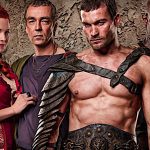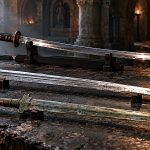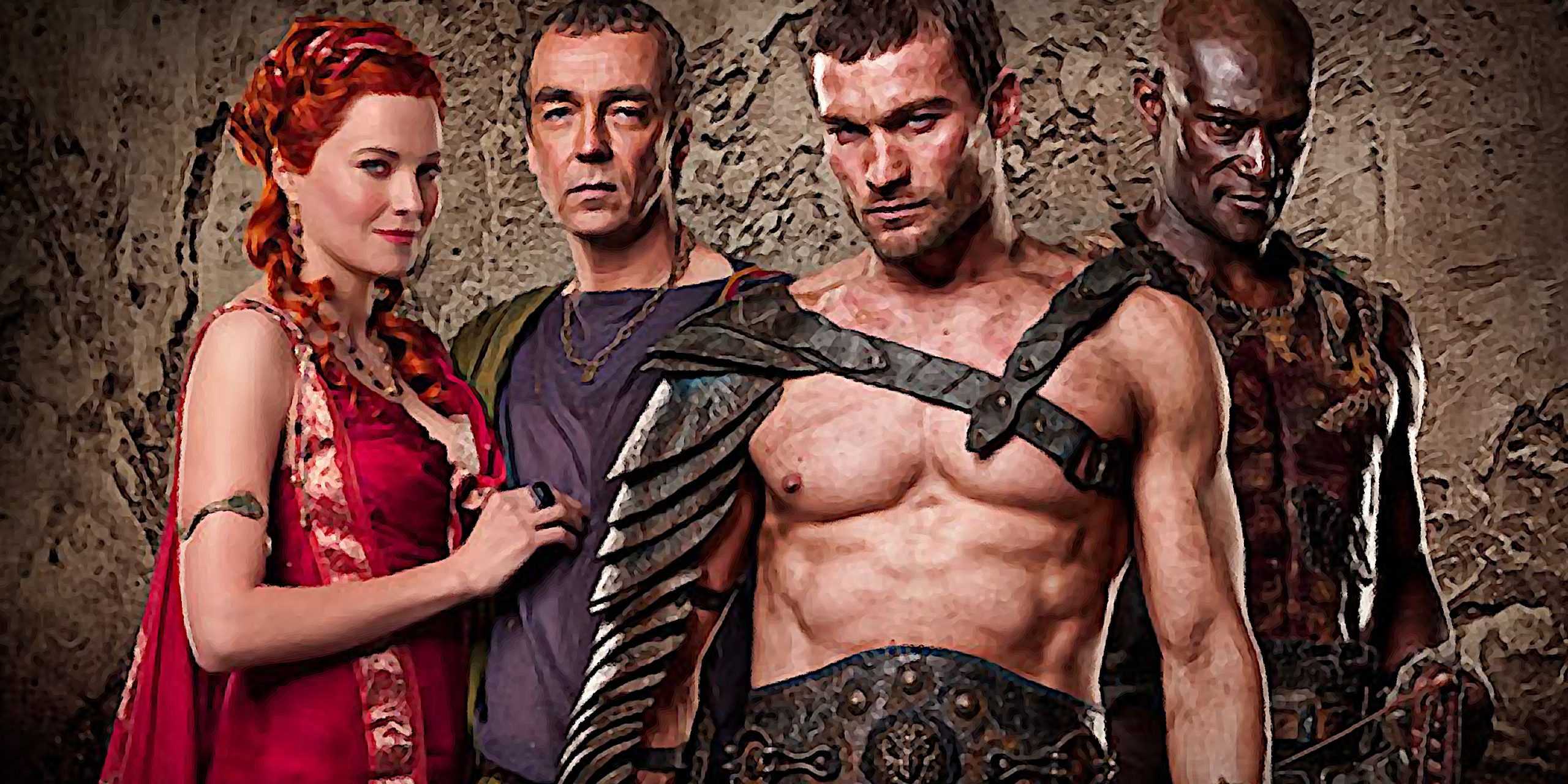
Spartacus makes a fairly aggressive first impression. Blood hangs in the air, bodies fly across the arena, and almost everyone seems one minor inconvenience away from committing murder. Subtlety occasionally visits Capua, but rarely stays for dinner.
Yet beneath the slow-motion carnage sits a remarkably effective drama about ownership, ambition and the difficult business of becoming free.
Beginning with Spartacus: Blood and Sand in 2010, the original run developed across three main seasons and the prequel Gods of the Arena, concluding with War of the Damned in 2013. Its story grew from the struggles of an enslaved gladiator into a rebellion capable of frightening Rome.
Calling it the series that invented adult historical television would be generous. Rome, Deadwood and The Tudors had already explored violence, sex and morally compromised power. What Spartacus offered was a distinctive combination: graphic-novel spectacle, theatrical dialogue and an unusually sustained interest in the people whose bodies made elite comfort possible.
That combination still gives it an identity of its own.
Ancient Rome Through the Eyes of the Enslaved

Historical dramas often gravitate towards rulers. Emperors get the speeches, generals get the maps, and everyone carrying the furniture becomes background scenery.
Spartacus shifts the centre of attention towards the people being bought, trained, punished and displayed.
The gladiatorial school, or ludus, is the key to that approach. Inside the House of Batiatus, a fighter can be celebrated as a champion while remaining someone else’s property. Applause brings privileges, but it does not bring control over his life.
That contradiction gives the early story much of its force. Spartacus initially tries to survive within the system. Success appears to offer a route towards recovering something of the life taken from him. Gradually, the limits of that bargain become impossible to ignore.
For me, this is where the series becomes more interesting than its reputation suggests. The arena offers the appearance of advancement while leaving the underlying relationship untouched. You can become the crowd’s favourite and still be sold tomorrow.
The show understands how easily admiration can coexist with exploitation.
Why the Visual Style Worked, Eventually
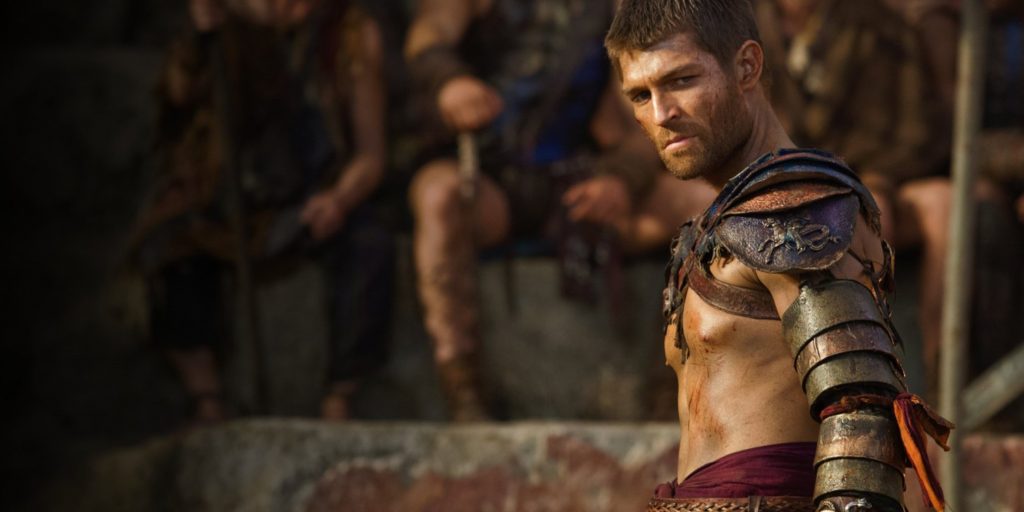
The opening episodes can be a difficult sell. Digital backgrounds, speed changes and extravagant blood effects sometimes make the action resemble a moving comic book with a serious grudge.
That artificiality is part of the series’ visual language. Spartacus presents combat as something heightened, public and emotionally charged. A decisive blow becomes an image to hold on screen, rather than an event that passes in a fraction of a second.
At its best, the style makes the arena feel like a machine for manufacturing celebrity. Fighters become recognisable bodies, signature moves and marketable rivalries. Their owners understand the value of a compelling performance.
At its weakest, the same approach makes suffering look decorative. Repeated slow-motion kills can lose their impact, particularly when the camera seems more interested in the effect than the person receiving the wound.
The series improves as relationships give those images consequences. Once a fight threatens someone whose loyalties and hopes we understand, spectacle carries more weight.
A flying limb can get your attention. It cannot sustain an entire drama.
Batiatus and Lucretia Make Ambition Feel Dangerous

Spartacus supplies the central struggle, but Batiatus and Lucretia give the first season much of its dramatic momentum.
John Hannah plays Batiatus with a marvellous combination of injured pride, social hunger and explosive resentment. He wants recognition from people who consider him useful but inferior. Every rejection becomes a personal insult, and every opportunity arrives with a growing list of people he is willing to sacrifice.
Lucy Lawless gives Lucretia a more controlled presence. She understands access, reputation and the uses of intimacy. Her decisions often reveal the distance between maintaining a respectable household and behaving respectably.
Together, they make domestic politics feel as threatening as the arena.
Their marriage also has enough affection and shared purpose to complicate an easy reading of them as monsters. They can care for each other while treating other people with appalling cruelty. The writing allows those qualities to coexist.
That is a stronger choice than giving every villain a convenient explanation that makes their behaviour easier to forgive.
The Dialogue Is Ridiculous, Until It Becomes Essential
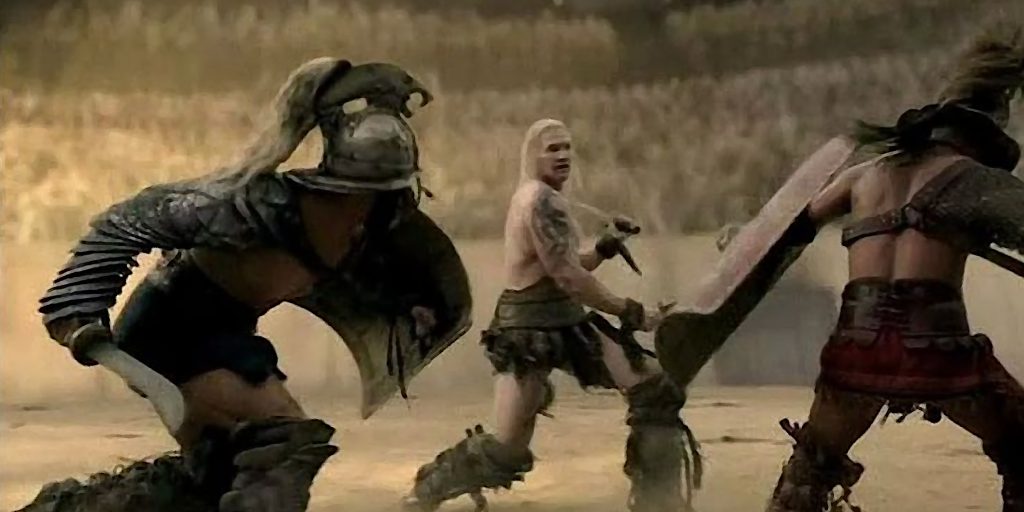
Nobody in Spartacus casually asks whether someone has had a difficult morning.
The dialogue is compressed, formal and full of threats that sound as though they have been engraved on a monument. Articles disappear. Ordinary requests acquire the weight of public declarations. Insults receive considerably more creative attention than most workplace emails.
Initially, it can feel awkward. Over time, its consistency helps build a world.
Characters speak as though status must be defended in every exchange. Batiatus turns conversation into a performance of importance. Gladiators speak through ideas of honour, brotherhood and reputation. Roman authority expresses itself through commands and assumptions about obedience.
The language also distinguishes the show from historical dramas that place modern conversational rhythms inside period costumes.
I would not defend every line. Some are gloriously overcooked. But the dialogue commits to a tone, and that commitment becomes part of the pleasure.
Violence, Sex and the Problem of Ownership
The explicit content deserves a more careful assessment than either blanket praise or automatic dismissal.
Violence shows how the gladiatorial business converts injury and death into entertainment. Sexual coercion exposes another aspect of the same system: enslaved people cannot reliably refuse those who control them.
The most effective scenes make that imbalance clear. They distinguish between chosen intimacy and access demanded by an owner, patron or customer.
However, the camera does not always maintain that distinction as carefully as the story does. Some sequences invite viewers to enjoy bodies and brutality even while the narrative condemns their exploitation.
That tension remains one of the series’ weaknesses. A critical interpretation does not make every lingering shot necessary.
Its treatment of consensual same-sex relationships offers a more convincing strength. Agron and Nasir’s relationship gives affection and loyalty room to develop within a story dominated by danger. Their bond matters beyond its ability to generate scandal.
Spartacus is often emotionally generous towards its characters, even when its visual habits are less disciplined.
How Historically Accurate Is Spartacus?
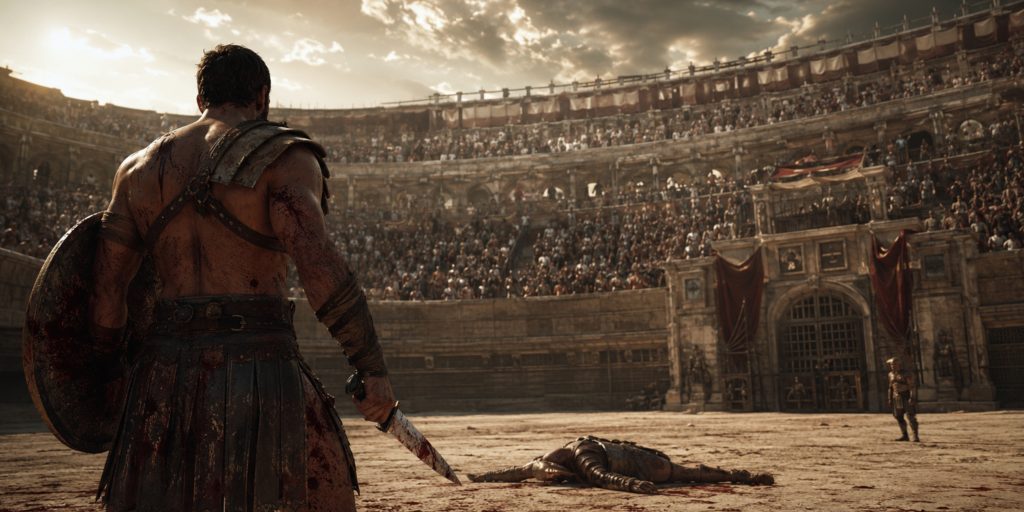
The series uses a real rebellion as its framework, then invents extensively within it.
The historical Spartacus led a revolt that began in 73 BCE and ended in defeat in 71 BCE. Ancient accounts connect the uprising to a gladiatorial school at Capua and identify figures including Crixus and the Roman commander Marcus Licinius Crassus. However, the surviving narratives were written from outside the rebels’ own perspective, and major accounts by Plutarch and Appian date from long after the events. Livius
That leaves substantial gaps. The programme fills them with personal relationships, private conversations and carefully arranged motivations.
| Element | Historical basis | What viewers should recognise |
|---|---|---|
| Spartacus and the revolt | A genuine uprising against Rome | His inner life is largely reconstructed |
| Capua and gladiatorial training | Present in ancient accounts | Household intrigues are dramatised |
| Crixus and Crassus | Historical participants | Characterisation goes beyond the evidence |
| Personal relationships | Limited surviving information | Much of the emotional narrative is invented |
The safest way to watch is to distinguish the broad historical framework from the programme’s explanations of individual behaviour.
Its moral clarity also needs qualification. The rebels become sympathetic protagonists pursuing recognisably modern ideals of freedom and solidarity. We cannot confidently recover the full range of aims held by the historical participants.
The drama offers an interpretation of rebellion. It cannot give us an unmediated account of what the rebels thought.
Gladiator Combat: Strong Drama, Limited Reconstruction

The fights work best as character scenes.
Crixus uses aggression and reputation to defend his position. Spartacus learns to adapt. Gannicus brings a different relationship with risk and performance. Rivalries shape how combat unfolds, so a contest can change a relationship as well as determine a winner.
That is good action storytelling.
As a reconstruction of ancient fighting, the series is much less dependable. Its acrobatics, exposed bodies and elaborate finishing moves serve visual excitement. Viewers should be cautious about treating its equipment combinations or techniques as a guide to historical gladiatorial practice.
The distinction matters because different gladiator categories were associated with particular weapons and protective equipment. Screen choreography often prioritises recognisable characters and dramatic movement over those constraints.
For a sword enthusiast, there is plenty to enjoy. There is also plenty that warrants a raised eyebrow.
Usually both within the same fight.
From Arena Rivalries to the Difficulties of Rebellion
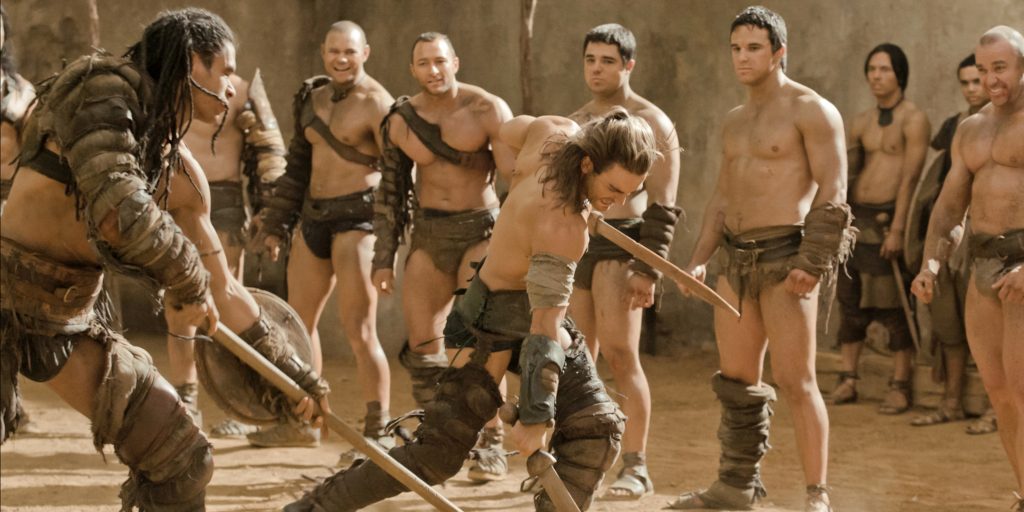
The expansion beyond the gladiatorial school gives the series a harder question to answer: what happens after people escape?
Within the ludus, objectives are relatively immediate. Survive, gain standing, protect someone, defeat a rival.
A rebellion introduces competing priorities. Fighters and civilians have different needs. Revenge can conflict with survival. Personal loyalties can obstruct collective decisions. A leader who inspires people must also make choices they may hate.
This is where the later story earns its scale. Freedom becomes something to organise and defend, rather than a single dramatic moment.
The transition is uneven. The enclosed tensions of the House of Batiatus are difficult to replace, and the wider conflict sometimes depends on convenient developments. Even so, the series retains an interest in disagreement among its protagonists.
Shared enemies do not automatically produce shared plans.
Andy Whitfield and Liam McIntyre Give the Story Different Centres
Andy Whitfield’s performance anchors Blood and Sand. His Spartacus carries grief, restraint and an underlying vulnerability that helps ground the more extravagant material.
Following Whitfield’s illness, Liam McIntyre took over the role for Vengeance and War of the Damned. Whitfield died in 2011.
McIntyre’s interpretation develops into a more outwardly authoritative figure. That suits a story increasingly concerned with leadership, responsibility and the consequences of commanding others.
Comparisons are inevitable, but a simple competition between the actors misses something useful. The early story needs a man trying to endure captivity. The later story needs a leader learning how much other people’s survival depends on him.
Both performances contribute to that progression.
Did Spartacus Influence Game of Thrones and Vikings?
There are clear similarities between Spartacus and later dramas such as Game of Thrones, Vikings and The Last Kingdom: explicit violence, unstable loyalties, ambitious rulers and characters whose survival is never guaranteed.
Similarity alone does not establish direct influence.
These programmes belong to a wider tradition of adult television and screen epics. Without specific evidence from their creators, claiming that Spartacus directly shaped each of them is too confident.
Its contribution is easier to assess on its own terms. It demonstrated how a historical setting could sustain a highly stylised action drama without abandoning serial plotting or emotional investment.
Its identity was also unusually cohesive. The dialogue, combat, performances and social hierarchy all belonged to the same heightened world. Even its excesses were recognisable.
You rarely mistake an episode of Spartacus for anything else.
The Best Order to Watch Spartacus
For a first viewing, I recommend release order.
| Series | Release year | Place in the story |
|---|---|---|
| Blood and Sand | 2010 | Introduces Spartacus and the House of Batiatus |
| Gods of the Arena | 2011 | Prequel exploring the school’s earlier history |
| Vengeance | 2012 | Continues the rebellion |
| War of the Damned | 2013 | Concludes the original story |
These were the four instalments of the original run, although Gods of the Arena is a prequel miniseries rather than another stage in Spartacus’s own journey.
Watching the prequel after Blood and Sand lets its relationships carry the significance intended by the release sequence.
Spartacus: House of Ashur is a separate alternate-timeline branch built around a changed outcome for Ashur. It should be approached after the original series, rather than inserted into its chronology.
Why Spartacus Still Deserves Attention
My strongest reason to recommend Spartacus is the way its emotional stakes develop beneath an initially overwhelming surface.
Its flaws remain visible. The effects can look dated. Some dialogue strains for grandeur. Its presentation of exploitation sometimes slips into the spectacle it wants to criticise.
But its best writing keeps returning to a difficult relationship between status and freedom. A champion can still be property. An ambitious owner can still feel excluded. A successful rebel can still struggle to protect the people who trust him.
Those tensions give the series substance.
Spartacus changed the possibilities of historical action television by committing to a particular vision of it: theatrical, bodily, angry and deeply invested in people whom Rome could buy and discard.
Come for the gladiators if you like. The household politics may be what persuades you to watch the next episode.