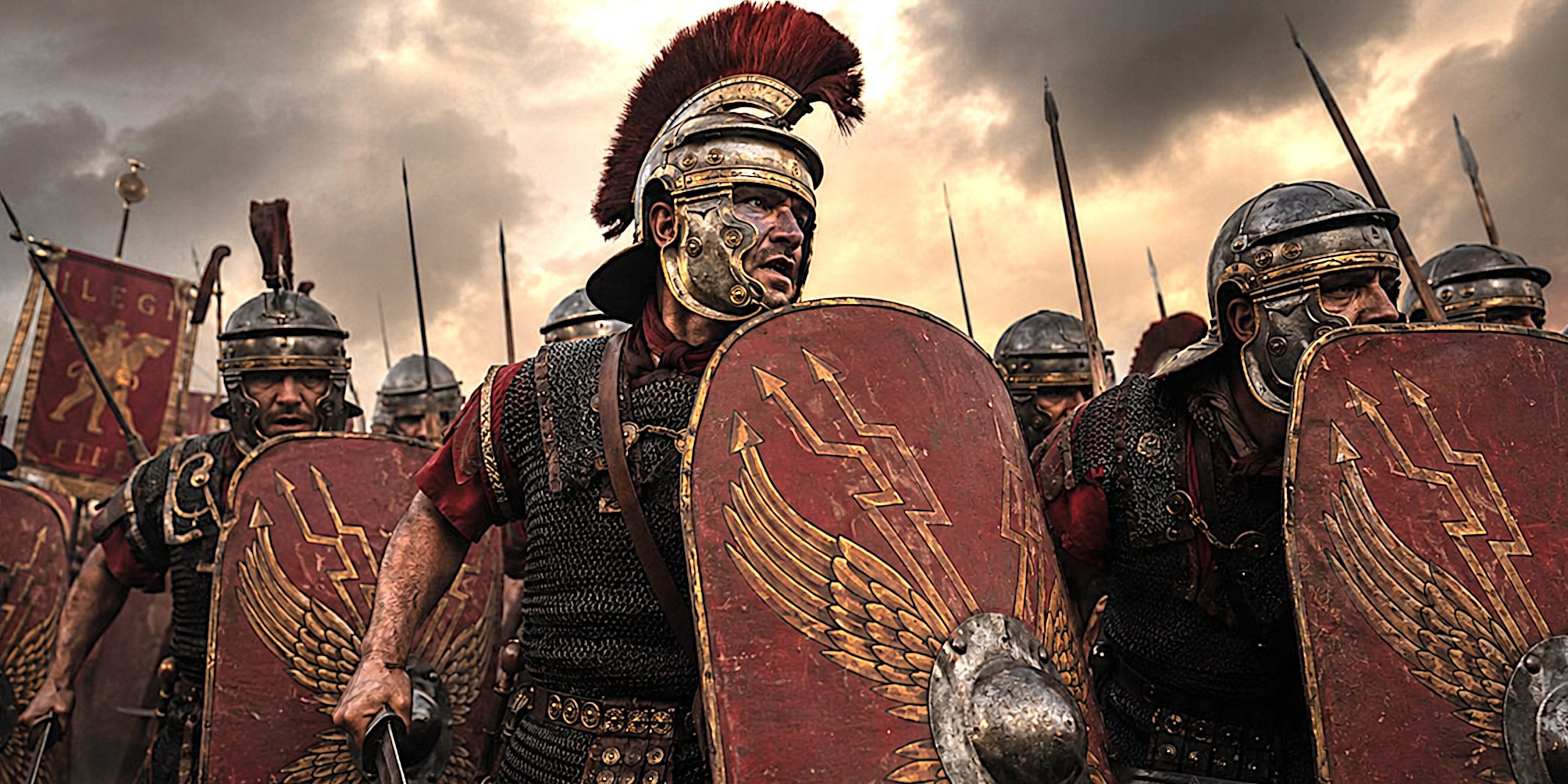
The Principes were the seasoned professionals of the Roman Republic’s famous manipular legion. Positioned behind the younger Hastati and ahead of the elite Triarii, they represented experience without yet reaching old age. If the first assault failed, it was the Principes who stepped forward to restore order and turn uncertainty into victory.
There is a tendency to imagine Roman armies as endlessly disciplined machines. Reality was rather more complicated. Republican warfare was noisy, confusing and deeply personal. Men fought face to face with swords and shields, often for hours. In that environment, experience mattered enormously, which explains why the Principes occupied such an important place within the legion.
They were neither the youngest nor the oldest soldiers. Instead, they were veterans who had survived enough campaigns to know exactly when to press an attack and when simply staying alive was the wiser choice.
Who Were the Principes?
The Principes formed the second battle line in the manipular legion used during the Middle Republic, particularly from the fourth to the second centuries BCE.
Roman society expected citizens to provide their own equipment according to wealth. The Principes generally belonged to the middle and upper property classes, allowing them to purchase better armour than many Hastati.
According to Polybius, they were selected from men in the prime of life.
Their role included:
- Reinforcing or replacing the Hastati
- Delivering decisive attacks
- Holding the centre of the Roman battle line
- Maintaining discipline during prolonged engagements
- Exploiting enemy weaknesses once the first clash had developed
If the Hastati succeeded quickly, the Principes might see relatively little combat. If the battle became difficult, they often became the army’s main striking force.
Organisation Within the Legion
During the manipular system, a standard Roman legion contained:
| Unit | Approximate Strength |
|---|---|
| Principes | 1,200 men |
| Maniples | 10 |
| Men per maniple | 120 |
| Centuries per maniple | 2 |
Each maniple fought with considerable independence.
Unlike the later imperial cohorts, maniples left deliberate gaps between formations. These spaces allowed the Hastati to withdraw if necessary, enabling the Principes to move forward in an orderly fashion.
To modern eyes, the arrangement can seem surprisingly flexible. Roman commanders understood that rigid formations break surprisingly quickly once people start throwing sharp objects.
Battlefield Role
The Principes represented Rome’s reserve of quality infantry.
Typical battle sequence:
- Velites skirmished with javelins
- Hastati launched the initial attack
- If resistance remained strong, the Hastati withdrew
- Principes advanced through the intervals
- Triarii remained in reserve for emergencies
The famous Roman expression “It has come to the Triarii” reflected a desperate situation.
Ideally, the Principes prevented matters ever reaching that point.
Training and Military Experience
Most Principes had already served several campaigns.
They possessed experience in:
- Shield formations
- Sword fighting
- Formation manoeuvres
- Camp construction
- Siege operations
- River crossings
- Forced marches
Roman military success depended less upon individual heroics than repeated discipline.
A Principes soldier had already learned painful lessons that a Hastatus had yet to discover.
Usually the expensive way.
Arms and Armour
The Gladius Hispaniensis
The primary weapon of the Principes during the later Middle Republic became the Gladius Hispaniensis.
Typical characteristics
| Feature | Details |
|---|---|
| Type | Gladius Hispaniensis |
| Blade length | Approximately 60 to 70 cm |
| Blade style | Double edged with pronounced point |
| Primary use | Thrusting with capable cutting ability |
| Material | Pattern forged iron or early steel edges |
The Romans adopted this design after encountering Iberian swords during campaigns in Spain.
Its deadly point proved exceptionally effective after an enemy shield had been displaced.
Earlier Principes may have carried longer straight Italian swords before widespread adoption of the Hispanic pattern.
Pilum
Every Principes carried heavy throwing spears known as Pila.
These served several purposes:
- Broke enemy formations
- Penetrated shields
- Bent upon impact, making shields difficult to use
- Created openings before close combat
The pilum remains one of history’s cleverer military inventions.
Ruining someone’s shield moments before trying to stab them proved remarkably effective.
Scutum
The large curved Scutum formed the centrepiece of Roman defence.
Features included:
- Curved rectangular or oval profile depending on period
- Wooden construction
- Leather covering
- Iron boss
- Reinforced rim
The shield absorbed tremendous punishment while allowing aggressive sword fighting behind its protection.
Armour
Principes generally possessed better armour than Hastati.
Common forms included:
Bronze Breastplate
The wealthy often wore:
- Bronze pectoral plate
- Bronze cuirass
- Muscle cuirass for officers
Chainmail
By the late Republic, many Principes wore the Lorica Hamata.
This consisted of thousands of interlinked iron rings providing excellent protection while remaining flexible.
Helmets
Common helmet types included:
- Montefortino helmet
- Coolus helmet in later periods
- Bronze cheek pieces
- Horsehair crests for some officers
Many helmets display evidence of repairs, indicating repeated battlefield use rather than ceremonial display.
Other Equipment
Principes also carried:
- Pugio dagger (later Republican period)
- Belt fittings
- Cloak
- Hobnailed sandals (caligae)
- Rations and cooking equipment
- Entrenching tools
Roman soldiers often marched carrying over 30 kilograms of equipment.
Modern infantry would recognise the complaint before recognising the equipment.
Battlefield Tactics
The Principes excelled in controlled aggression.
Their method generally followed a familiar sequence:
- Advance behind the shield wall
- Throw pila at close range
- Close rapidly
- Strike with the gladius
- Maintain formation
- Rotate exhausted soldiers where possible
Unlike Greek hoplites, Roman infantry relied upon continuous movement rather than static pushing contests.
The manipular system allowed impressive flexibility across broken terrain.
Famous Battles Involving the Principes
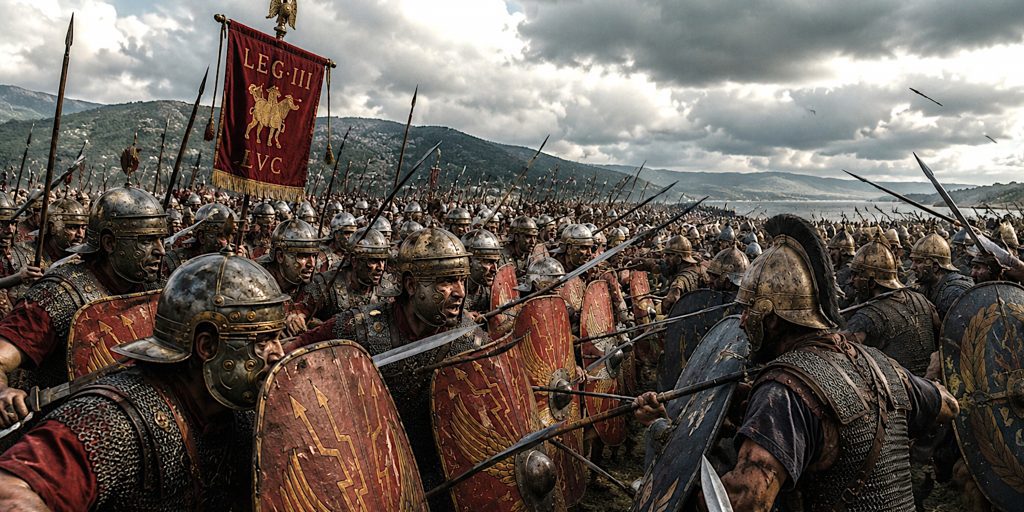
The Principes fought in virtually every major Republican campaign.
Notable examples include:
| Battle | Date |
|---|---|
| Battle of Sentinum | 295 BCE |
| Battle of Heraclea | 280 BCE |
| Battle of Cannae | 216 BCE |
| Battle of Zama | 202 BCE |
| Battle of Cynoscephalae | 197 BCE |
| Battle of Pydna | 168 BCE |
At Zama, experienced Roman infantry helped defeat Hannibal and secured Rome’s dominance over Carthage.
At Pydna, Roman flexibility overwhelmed the Macedonian phalanx once difficult ground disrupted the enemy formation.
Archaeology
The Principes themselves cannot easily be distinguished archaeologically from Hastati because equipment often overlapped.
Nevertheless, archaeology provides valuable evidence.
Important discoveries include:
Montefortino Helmets
Hundreds have been recovered across Italy and former Roman battlefields.
Many show:
- Sword cuts
- Spear damage
- Repairs
- Owner inscriptions
Pilum Heads
Iron pilum heads have been excavated across Republican military sites.
Several display deliberate bending, supporting ancient descriptions of their battlefield performance.
Chainmail
Fragments of Lorica Hamata have survived in:
- Italy
- Spain
- Southern France
- The Balkans
These finds demonstrate remarkably advanced ironworking techniques.
Camps and Battlefields
Excavations at Republican marching camps reveal:
- Defensive ditches
- Roads
- Barracks
- Weapon fragments
- Sling bullets
- Coins
- Animal bones
These sites illustrate the extraordinary organisational skill behind Roman campaigning.
Contemporary Sources
The Principes appear in several important ancient works.
Polybius
Writing in the second century BCE, Polybius described the Roman legion:
“The Principes are men in the full vigour of life.”
His account remains the single most valuable description of the manipular legion.
Livy
Livy frequently refers to the interaction between Hastati, Principes and Triarii during Republican battles.
Writing of Roman battle formations, he describes successive lines supporting one another in disciplined order.
Although writing centuries later, Livy drew upon earlier historical traditions that have since disappeared.
Sallust
Discussing Roman military virtues, Sallust praised discipline, endurance and experience as qualities that distinguished successful Roman armies.
His observations help explain why experienced soldiers such as the Principes occupied such an important role.
Decline of the Principes
The distinction between Hastati, Principes and Triarii gradually disappeared during the military reforms associated with Gaius Marius around 107 BCE.
The new cohort legion abandoned wealth based infantry classes.
Instead:
- Equipment became increasingly standardised
- Cohorts replaced maniples
- Veterans served throughout the legion
- Tactical flexibility shifted from maniples to larger formations
The title Principes vanished, although the experience they represented never truly disappeared.
Later Roman armies still depended heavily upon battle hardened professionals.
Legacy
The Principes embodied the strength of the Roman Republic during its rise to Mediterranean dominance.
Their combination of experience, discipline and practical battlefield skill helped defeat:
- Carthage
- Macedon
- The Seleucid Empire
- Numerous Gallic tribes
- Italian rivals
Although later overshadowed by the Imperial legionary, the Principes deserve recognition as one of history’s finest heavy infantry formations.
They occupied that reassuring middle ground between youthful enthusiasm and elderly caution. History often suggests that armies need both. Rome simply found an efficient way of organising them.
Frequently Asked Questions
What were the Principes?
The Principes were experienced heavy infantry who formed the second line of the Roman manipular legion during the Middle Republic.
What sword did the Principes use?
Most later Principes carried the Gladius Hispaniensis, a double edged thrusting sword adopted after Rome’s campaigns in Iberia. Earlier Principes may have used longer straight Italian swords before this became standard.
How were the Principes different from the Hastati?
The Hastati were younger and less experienced. The Principes were older veterans with superior equipment who entered battle after the Hastati if the fighting remained unresolved.
Did the Principes fight at Cannae?
Yes. The Principes formed the second line of the Roman army during the disastrous Battle of Cannae in 216 BCE, although Hannibal’s encirclement ultimately overwhelmed all three Roman battle lines.
Why did the Principes disappear?
The Marian reforms reorganised the Roman army into cohort based legions with more standardised equipment, removing the traditional distinctions between Hastati, Principes and Triarii.