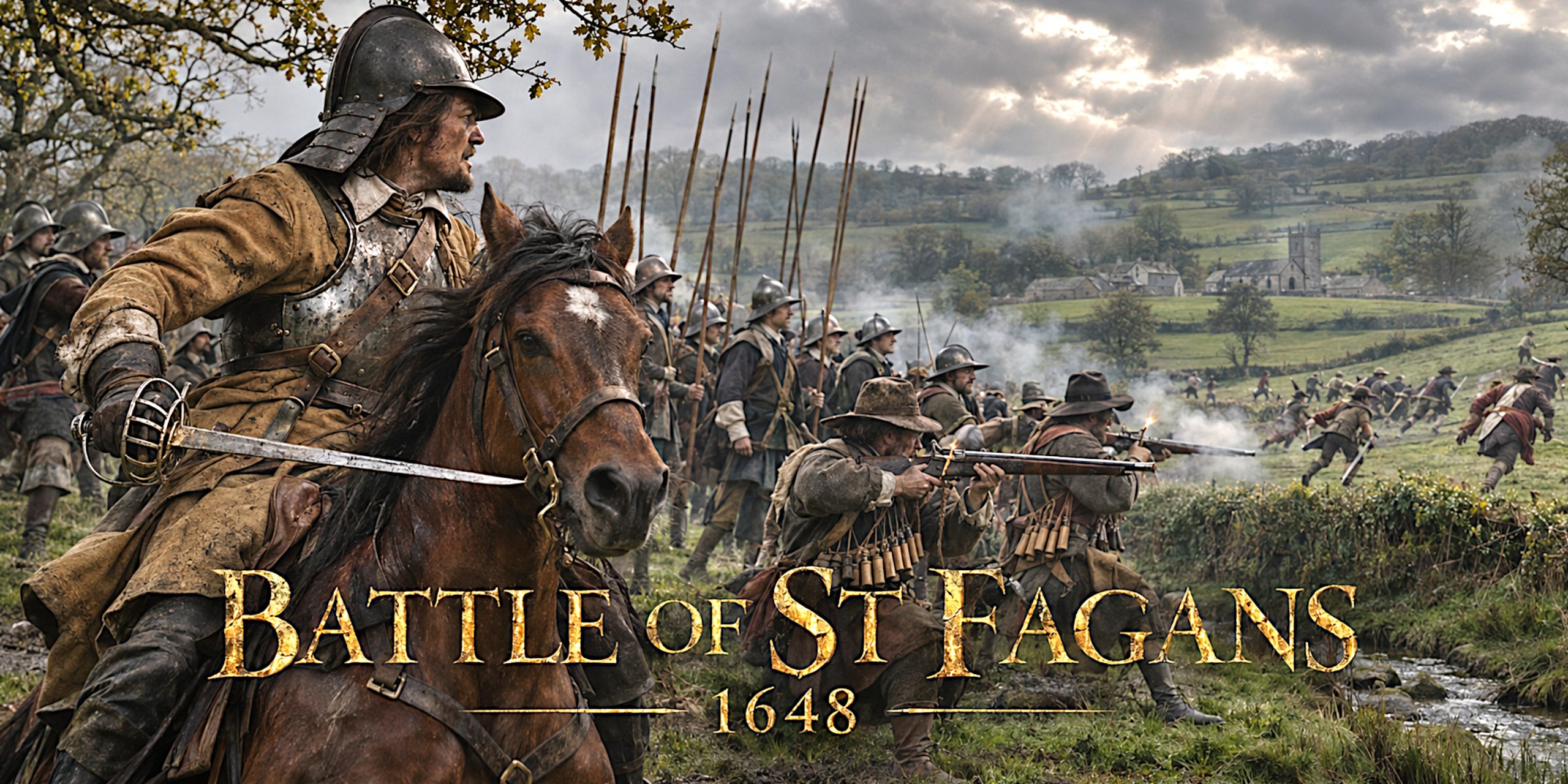
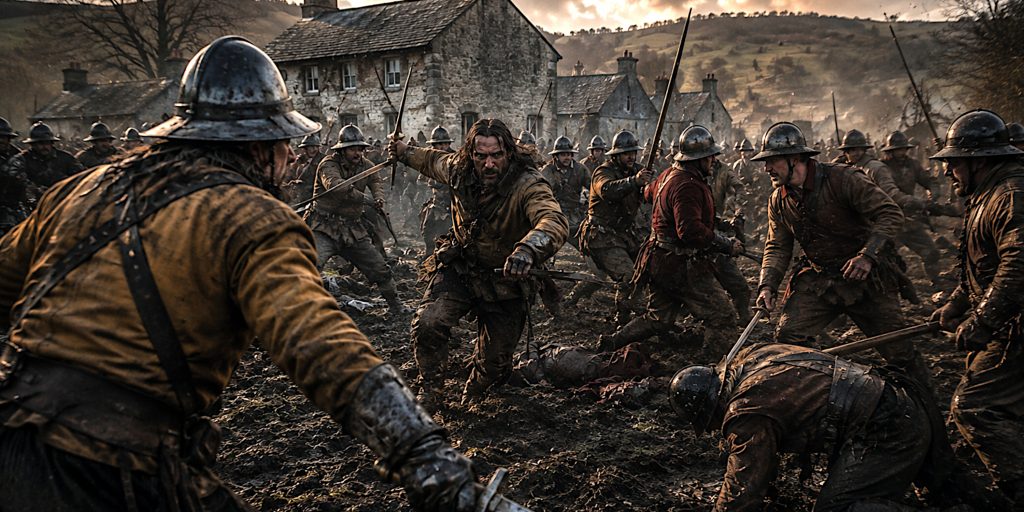
On 8 May 1648, an army fighting for Charles I was defeated outside St Fagans, west of Cardiff, by a smaller Parliamentarian force commanded by Colonel Thomas Horton. The engagement lasted roughly two hours. Its consequences reached considerably further.
This was one of the decisive encounters of the Welsh rising during the Second Civil War. It was also an awkward battle for anyone who prefers their civil wars neatly labelled. The defeated commander, Rowland Laugharne, had previously fought for Parliament. Some of his men had done the same. Unpaid wages, threatened disbandment and political distrust had helped turn former allies into enemies.
What interests me most about St Fagans is that uncomfortable mixture of conviction and grievance. Great causes could mobilise armies, but so could an empty pay chest.
Battle at a glance
| Detail | Summary |
|---|---|
| Date | Monday, 8 May 1648 |
| Location | Around St Fagans and the Nant Dowlais, west of Cardiff, Glamorgan |
| Conflict | Second Civil War, within the Wars of the Three Kingdoms |
| Parliamentarian commander | Colonel Thomas Horton |
| Rebel commander | Major-General Rowland Laugharne |
| Result | Decisive Parliamentarian victory |
| Duration | Approximately two hours of principal fighting |
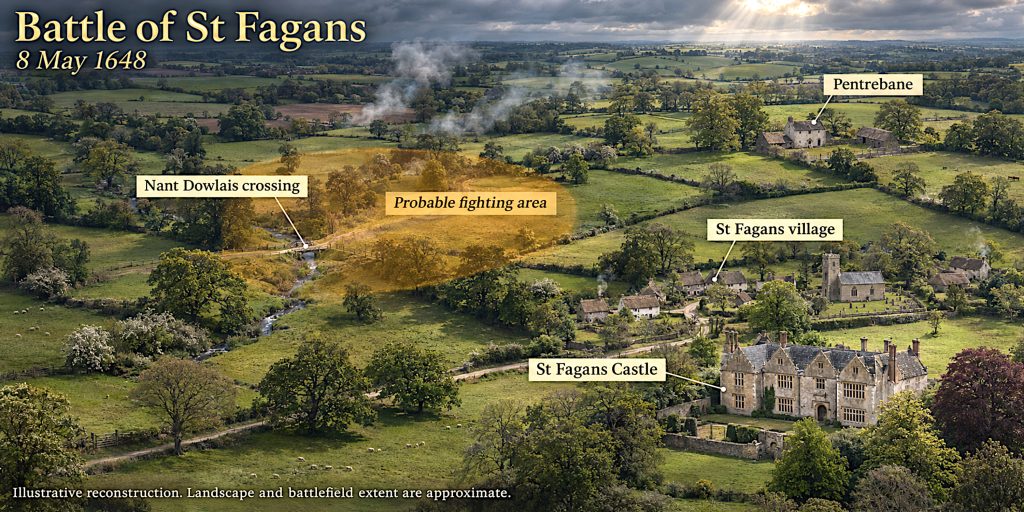
The date is given in the contemporary English and Welsh calendar. The battlefield’s precise extent remains uncertain.
Background: why former Parliamentarians rebelled
The First Civil War had ended without settling how the kingdom should be governed, what should happen to Charles I, or how its armies should be paid and reduced.
In south-west Wales, soldiers faced disbandment while still owed arrears. John Poyer, governor of Pembroke Castle, resisted being replaced. Rice Powell at Tenby and Laugharne joined the opposition. During March 1648, resistance developed into an explicitly royalist rising.
Calling these men simply “Royalists” is convenient, but conceals their recent service against the king. Their rebellion grew from military grievances as well as political allegiance. Civil war had supplied them with considerable experience of fighting their opponents, and then changed the opponents.
Laugharne assembled a substantial army and threatened Cardiff. Horton’s task was to contain the rising while Oliver Cromwell approached with reinforcements. Laugharne therefore had a reason to attack quickly: delay would strengthen Parliament’s position.
Forces
The conventional comparison is approximately 3,000 Parliamentarians against about 8,000 rebels. These figures are estimates, rather than reliable muster totals.
| Army | Estimated strength | Composition and limitations |
|---|---|---|
| Parliamentarian | About 3,000 | Experienced infantry, cavalry and dragoons |
| Laugharne’s army | Reportedly about 8,000 | A mixture of veteran soldiers and numerous local recruits |
| Rebel cavalry | Commonly estimated at about 500 | A relatively small mounted component within a predominantly foot army |
The larger total comes through Parliamentarian reporting, even where attributed to captured enemy officers. A victorious commander had little reason to make his opponent sound smaller.
The commissioned historical study suggests that several thousand rebels may have been irregularly armed local men. It also discusses reports of around 2,500 musketeers. Such figures help explain the army’s uneven equipment, but they should not be assembled into an apparently exact order of battle. The evidence will not bear that weight.
Numbers mattered. The ability to move, fire and remain together under pressure mattered more on this particular morning.
Leaders and troop composition
Parliament’s commanders
- Colonel Thomas Horton: commanded the victorious force and coordinated its response to Laugharne’s attack.
- Colonel John Okey: commanded dragoons, whose ability to move on horseback and fight on foot made them useful in enclosed country.
- Oliver Cromwell: approached with reinforcements but did not command at St Fagans. The victory belongs to Horton and the soldiers already there.
Horton’s force comprised a foot regiment, two horse regiments and Okey’s dragoons. This gave him a useful combination of infantry firepower and mounted mobility.
Laugharne’s army
- Major-General Rowland Laugharne: an experienced former Parliamentarian commander who took charge of the rising’s field army.
- Veteran soldiers: provided a core of military experience.
- Local recruits: increased the army’s size, although training and equipment varied.
- Mounted troops: offered some offensive capacity, but could not match the effectiveness of Horton’s horse.
Poyer and Powell were central figures in the wider rebellion. Their importance should not be confused with proof that they personally directed particular movements on this battlefield.
Arms and armour
St Fagans was a battle of pike, shot and cavalry. There is no surviving equipment return that allows every weapon to be assigned confidently to a particular regiment.
The following identifies appropriate Civil War equipment, distinguishing period practice from objects demonstrably recovered at the site.
| Weapon or protection | Main users | Battlefield purpose |
|---|---|---|
| Matchlock musket | Infantry musketeers | Delivered volleys and individual fire |
| Long pike | Pikemen | Supported infantry formations and offered protection against horse |
| Carbine or shorter firearm | Mounted troops and dragoons, depending on equipment | Portable firepower |
| Pistols | Cavalry | Close-range shooting |
| Swords | Cavalry, officers and infantry | Mounted combat and personal defence |
| Buff coat, helmet and back-and-breast armour | Especially cavalry; provision varied | Protection against cuts, fragments and some impacts |
Specific sword types
Mortuary-hilt swords belong firmly in this period. Their iron guards protected the hand, and surviving examples illustrate the military swords carried during the Civil Wars. The National Army Museum notes their use by officers on both sides. The name is a later collecting term, not evidence that every decorated hilt commemorated Charles I.
Basket-hilted cavalry swords offered hand protection during mounted fighting. Blade forms varied: the familiar image of a single uniform Civil War cavalry sword is tidier than the surviving weapons.
Infantry hangers were shorter sidearms, often with curved blades. They were practical weapons for close fighting, rather than substitutes for a musket or pike.
Simple pikemen’s swords provided a last means of defence. A surviving example in the National Army Museum represents this comparatively plain, mass-produced equipment.
None of these types should be presented as a securely identified sword excavated at St Fagans. Their relevance comes from contemporary military practice and surviving museum collections.
Terrain and the course of the battle
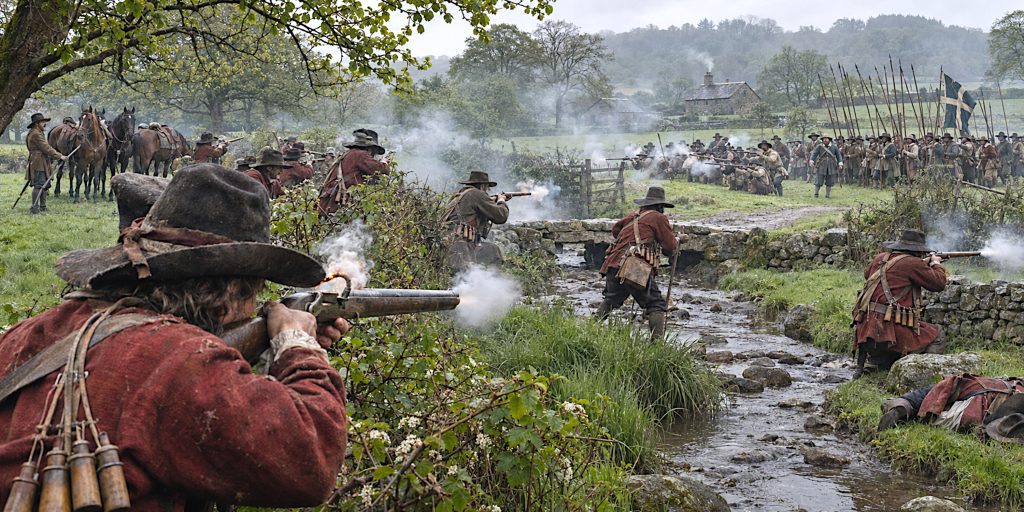
The fighting took place across a landscape of fields, watercourses, roads and enclosures. Modern investigation points towards the Nant Dowlais and a contested crossing, although the action and subsequent pursuit extended beyond a single compact site.
A stream or hedge could interrupt a formation, restrict movement or shelter musketeers. It did not automatically make cavalry useless. Mounted troops could move between openings, threaten exposed troops and exploit a retreat.
Laugharne attacked early on 8 May, hoping to defeat Horton before reinforcements arrived. The opening effort failed to dislodge the Parliamentarians. Horton then took the initiative, using Okey’s dragoons and bringing his horse and foot into the action.
Accounts describe the rebels falling back and Laugharne being wounded. Once the withdrawal became a rout, Parliamentarian cavalry could pursue and capture men who had lost the protection of an organised formation.
The broad sequence is convincing. Precise diagrams showing every unit’s position deserve more suspicion. Surviving accounts do not provide that degree of certainty.
Why Horton won
Horton’s victory is best understood through the relationship between experience, mobility and cohesion.
- Experienced troops could respond to an unexpected attack.
- Horse, foot and dragoons gave Horton several ways to apply pressure.
- The rebels’ uneven training made recovery from setbacks more difficult.
- A broken formation exposed fleeing infantry to mounted pursuit.
This does not mean Laugharne’s soldiers lacked courage. Courage and the ability to maintain a formation are different things, particularly when horses are approaching.
The battle demonstrates the danger of treating headcounts as a prediction. An army’s effective strength depended on what its soldiers could do together.
Casualties and prisoners
Parliamentarian accounts reported approximately 3,000 prisoners and substantial captures of firearms. Those claims indicate a major collapse, although exact totals remain difficult to verify.
The number killed is less secure. Frequently repeated death tolls should be labelled as estimates or contemporary claims, rather than settled facts. Horton reported comparatively light losses on his own side, but his dispatch was a victorious commander’s account.
Stories of local waters running red belong to battlefield tradition. They convey the remembered horror of the defeat, not a measurable casualty return.
Archaeology: what survives beneath the fields?
Investigations in 2012 and 2013 combined documentary research, landscape assessment and metal-detector survey. They recovered material that helps locate the fighting beyond later commemorative assumptions.
The recorded finds include:
- Lead shot of several sizes.
- Spurs and possible horse-harness fittings.
- Buckles and other dress accessories.
- Pewter fragments associated with domestic utensils.
- Thimbles and other small personal objects.
The survey identified larger shot, around 18–19 mm, consistent with muskets; smaller groups may relate to carbines or other firearms, and pistols. These identifications are cautious, as they should be.
A musket ball can indicate shooting. It rarely volunteers the name of the man who fired it.
LiDAR analysis and a site walkover did not identify definite surviving battle earthworks. Survey results also suggested that the battlefield exceeded the initial assessment area. Absence of visible defences therefore does not mean absence of fighting.
Older reports mention human remains, but these should not be promoted into a securely dated Civil War mass grave without supporting evidence. Finds from the modern surveys are recorded in Amgueddfa Cymru’s collections.
Battle timeline
| Date or stage | Event |
|---|---|
| March 1648 | Resistance to disbandment develops into a royalist rising in south-west Wales |
| Early May | Horton operates in south Wales while Cromwell approaches |
| 7 May | Laugharne moves to bring Horton to battle before reinforcements arrive |
| Early morning, 8 May | Rebel troops attack near St Fagans |
| During the engagement | Horton counterattacks, using dragoons, infantry and cavalry |
| After roughly two hours | Rebel cohesion collapses and retreat becomes a rout |
| Following the battle | Parliamentarian troops pursue fugitives and collect prisoners |
| May–July 1648 | Resistance continues in fortified strongholds, including Tenby and Pembroke |
Contemporary voices
The following short extracts appear in published transcriptions of contemporary correspondence. Their wording is presented through those transcriptions rather than as a diplomatic edition of the manuscripts.
Laugharne complained to Parliamentary commissioners on 4 May:
“the affronts put upon my men”
His words place soldiers’ grievances close to the centre of the dispute.
Horton’s victory report to Fairfax on 8 May stated:
“we took the best ground”
He also described the duration:
“about two hours”
These are brief fragments, but revealing ones. Laugharne justified resistance through mistreatment; Horton explained success through military advantage. Neither was writing for a future historian’s convenience.
Aftermath and historical significance
St Fagans destroyed the rising’s principal field army, but it did not immediately end resistance in Wales. Laugharne escaped to Pembroke, where the struggle continued. Parliament still had fortified positions to reduce.
The battle’s importance lies in removing an organised threat to Cardiff and allowing Parliamentarian commanders to concentrate on those remaining strongholds. It was a decisive regional victory, not the final battle of the Second Civil War.
For me, its wider lesson is how quickly a post-war settlement can unravel when military service is rewarded with uncertainty and unpaid wages. St Fagans was fought by men caught in that failure, some changing sides, others ordered to suppress former comrades.
The surviving shot is easier to classify than their loyalties.
Sources and further reading
- RCAHMW, Coflein: Battle of St Fagans.
- BCW Project: The Second Civil War in Wales.
- Heneb Historic Environment Record: battlefield survey.
- Heneb: landscape assessment.
- Amgueddfa Cymru: finds from St Fagans.
- Spartacus Educational: contemporary correspondence extracts.
- National Army Museum: English mortuary sword.
- Royal Armouries: British Civil Wars arms and armour.
- London Museum: hanger sword.