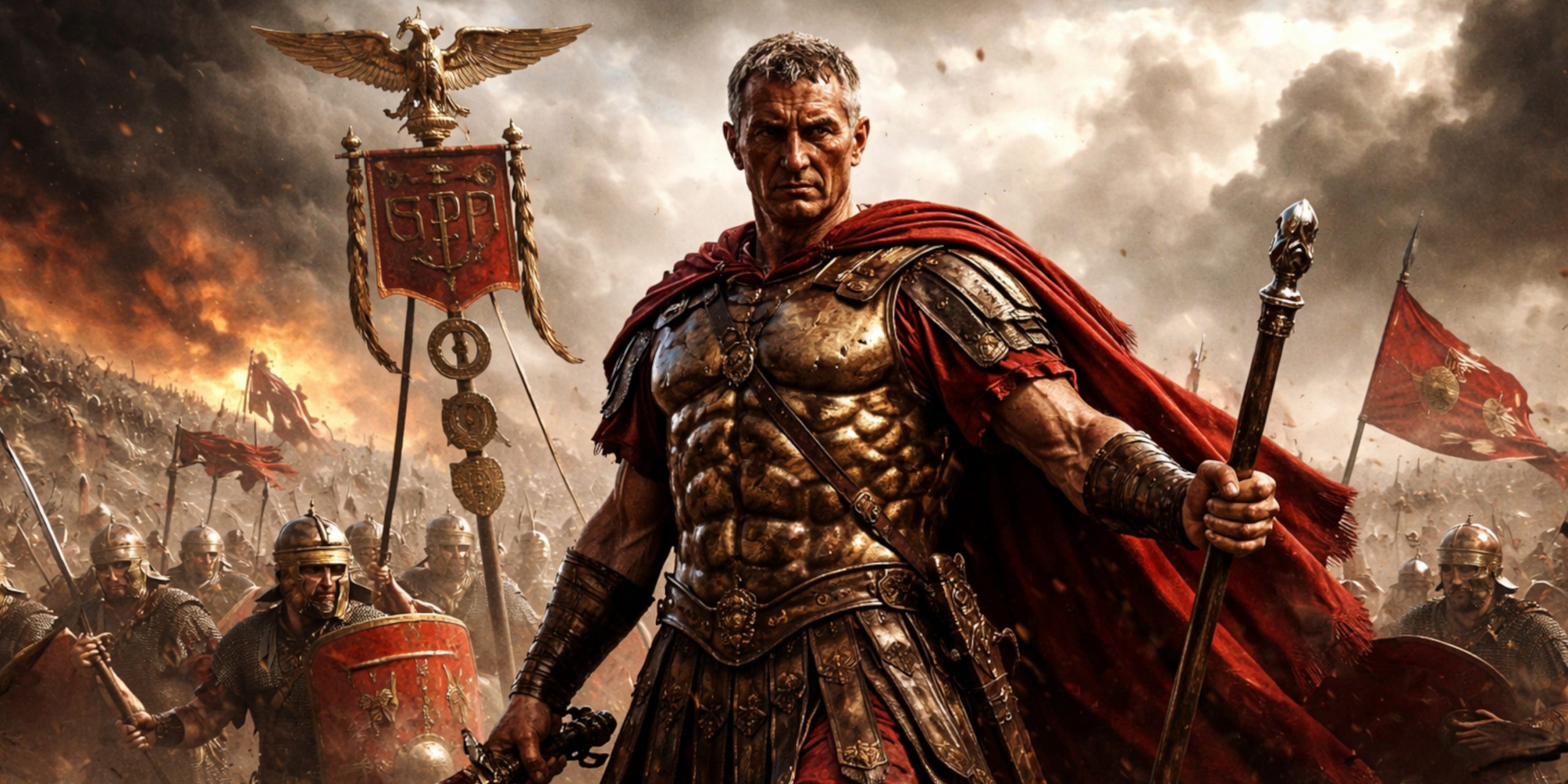
Gaius Marius remains one of the most fascinating and troubling figures in Roman history. He was the man who rescued Rome from disaster, defeated some of its most dangerous enemies, and transformed the Roman army into the machine that conquered the Mediterranean. He was also, perhaps without meaning to, one of the men who helped tear the Roman Republic apart.
Roman writers could never quite decide whether Marius was a hero, a brute, a genius or a warning. The truth is probably all four.
Born in relative obscurity and ending his life amid civil war and political bloodshed, Marius rose further than any Roman of his age thought possible. By the end of his career he had been elected consul seven times, a feat so outrageous that older Roman conservatives probably needed to lie down in a darkened room every time his name was mentioned.
Early Life and Rise to Power
Gaius Marius was born in 157 BC in the town of Arpinum, south-east of Rome. Arpinum produced several remarkable Romans, including Cicero a generation later, though unlike Cicero, Marius was no polished speaker. Ancient authors often portray him as blunt, stern and rather uncomfortable with the cultured manners of the Roman aristocracy.
He came from an equestrian family rather than the old senatorial elite. In Roman politics this mattered enormously. The Republic was dominated by ancient noble families who believed public office belonged to them by right. Marius was a novus homo, a “new man”, the first of his family to rise to the consulship.
That made him both admired and deeply resented.
Marius first distinguished himself during the Roman siege of Numantia in Spain under Scipio Aemilianus. Scipio reportedly remarked that Marius and his own son-in-law would one day be the most important men in Rome. It was an unusually accurate prediction by Roman standards. Roman statesmen generally predicted the future with all the success of a gambler convinced the next throw of the dice would finally work.
The Jugurthine War
The war that made Marius famous was the struggle against Jugurtha, king of Numidia, in North Africa.
Jugurtha had humiliated Rome through bribery, guerrilla warfare and political manipulation. Several Roman commanders failed to defeat him. The war dragged on, growing more embarrassing with every passing year.
Marius served under Quintus Caecilius Metellus, but relations between the two men quickly soured. Metellus was an aristocrat who looked down on Marius. Marius believed Metellus was moving too slowly and keeping the war going to preserve his own glory.
In 107 BC Marius returned to Rome, won election as consul and secured command in Numidia.
His campaign was vigorous and ruthless. He captured towns, disrupted Jugurtha’s support and relied heavily on his subordinate Lucius Cornelius Sulla. In the end it was Sulla who negotiated the betrayal of Jugurtha by King Bocchus of Mauretania.
That success planted the first seeds of the bitter rivalry between Marius and Sulla. Marius took the triumph, Sulla claimed the real credit, and neither man forgot it.
The Military Reforms of Marius
Marius is most famous for the reforms traditionally linked to his name. Modern historians debate how much he personally created and how much he simply accelerated existing trends. Even so, his name has become inseparable from the transformation of the Roman army.
Before Marius, Roman soldiers were usually property-owning citizens who supplied much of their own equipment. By the late second century BC this system was failing. Rome needed more soldiers than the old social order could provide.
Marius recruited men without property, the capite censi, the poorest citizens of Rome. The state increasingly supplied their equipment and training.
This had enormous consequences:
- The army became more professional
- Soldiers served for longer periods
- Commanders gained greater personal loyalty from their troops
- Military service became a route out of poverty
- Roman armies became more flexible and experienced
Marius also reorganised the legion into cohorts rather than maniples. Cohorts were larger, easier to command and more adaptable on the battlefield.
He is traditionally credited with standardising equipment and introducing the eagle, the aquila, as the chief legionary standard.
Perhaps most famously, Marius imposed strict marching discipline. Roman soldiers carried much of their own equipment, leading later writers to nickname them “Marius’ mules”. Roman soldiers complained bitterly about this, which is usually how one can tell a military reform was effective.
Arms and Armour of Marius’ Army
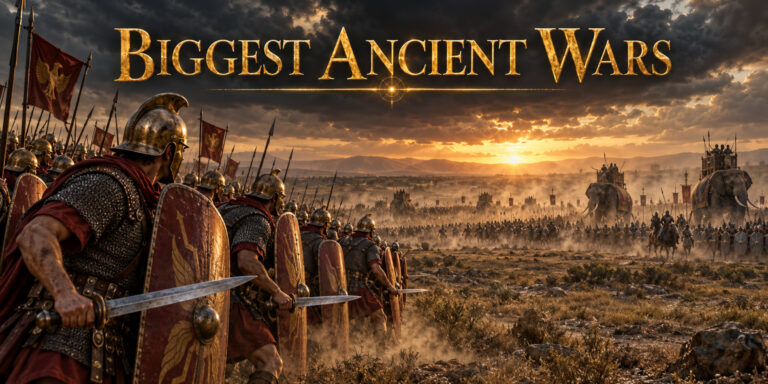
The armies of Marius stood at the transition between the old Republican military system and the more standardised Roman army of the later Republic.
Typical Arms
| Weapon | Description |
|---|---|
| Gladius Hispaniensis | The principal Roman short sword, ideal for stabbing in close combat |
| Pilum | Heavy throwing spear designed to bend after impact and make enemy shields useless |
| Pugio | A dagger carried as a sidearm |
| Hasta | Spear used particularly by triarii and some auxiliary troops |
| Sling and Javelins | Common among light infantry and auxiliaries |
The gladius Hispaniensis used in Marius’ time was slightly longer than the later imperial gladius. It had a leaf-shaped blade and was particularly deadly in the tight, brutal fighting favoured by Roman infantry.
Armour and Equipment
| Item | Description |
|---|---|
| Montefortino Helmet | Bronze helmet with cheek guards and a neck protector |
| Mail Armour (lorica hamata) | Chainmail shirt worn by wealthier legionaries and officers |
| Pectorale | Small bronze chest plate still used by poorer soldiers |
| Scutum | Large curved shield that protected most of the body |
| Caligae | Heavy military sandals with hobnailed soles |
Mail armour was increasingly common during Marius’ career. A Roman legionary in the late second century BC often looked less like the neat, standardised figure familiar from films and more like a veteran carrying whatever equipment years of campaigning had left him with.
Roman officers, meanwhile, favoured muscle cuirasses, decorated helmets and scarlet cloaks. Marius himself was often depicted wearing the traditional general’s cloak and carrying a decorated staff of command.
The Cimbrian and Teutonic Threat
Marius reached the height of his fame during the invasions of the Cimbri and Teutones.
These migrating peoples from northern Europe had repeatedly crushed Roman armies. Entire consular armies were wiped out. The disaster at Arausio in 105 BC was one of the worst defeats in Roman history. Ancient estimates are wildly exaggerated, but tens of thousands of Romans probably died.
Rome panicked and repeatedly elected Marius consul.
He spent years rebuilding and training the army. Rather than rushing into battle, he drilled his troops relentlessly. This restraint was unusual in Roman politics, where generals often preferred immediate action and dramatic speeches.
Marius finally defeated the Teutones at Aquae Sextiae in 102 BC.
Battle of Aquae Sextiae, 102 BC
At Aquae Sextiae in southern Gaul, Marius lured the Teutones into attacking a carefully chosen Roman position.
The Roman army held high ground while a hidden force waited in ambush. Once the Teutones attacked, the concealed Romans struck from behind.
The battle turned into a massacre.
Ancient sources claim over 100,000 Teutones were killed. The real number was almost certainly lower, but the scale of the victory was enormous.
Marius reportedly remarked after the battle that the shouting of the barbarians sounded like a river in flood. It is a memorable image, though Roman generals were never shy about improving a story after the event.
Battle of Vercellae, 101 BC
A year later Marius joined forces with Quintus Lutatius Catulus to face the Cimbri at Vercellae in northern Italy.
The battle was fought on an open plain. Marius deliberately positioned his troops to take advantage of the sun and dust blowing into the faces of the enemy.
The Roman infantry held firm while cavalry attacked the flanks. The Cimbri were annihilated.
Together, Aquae Sextiae and Vercellae saved Italy from invasion and made Marius the most celebrated man in Rome.
Roman crowds hailed him as the “third founder of Rome”, after Romulus and Camillus. It was praise of the highest order, though such grand titles had an unfortunate tendency to go to a Roman’s head.
Military Acumen
Marius was not a brilliant battlefield improviser in the style of Hannibal or Julius Caesar. His talent lay elsewhere.
He excelled in:
- Organisation
- Discipline
- Recruitment
- Training
- Choosing favourable ground
- Relentless preparation
He understood that an army wins long before the battle begins.
Marius preferred to wear down an enemy, strengthen his own troops and fight only when conditions favoured him. He could be ruthless and pragmatic. He avoided reckless heroics and had little patience for aristocratic vanity.
As a commander he had several notable strengths:
- He inspired fierce loyalty among common soldiers
- He understood logistics and supply
- He adapted quickly to new forms of warfare
- He rebuilt Roman military confidence after catastrophic defeats
Yet he also had weaknesses.
He could be jealous, suspicious and politically clumsy. His rivalry with Sulla became deeply personal. Marius struggled to control the political consequences of his own success. By encouraging soldiers to look to their generals rather than the Republic for rewards, he unintentionally helped create the armies that later destroyed the Republic.
Marius and Sulla
The conflict between Marius and Sulla dominated the final years of his life.
When the prestigious command against Mithridates of Pontus was awarded to Sulla, Marius tried to take it for himself through political manoeuvring. Sulla responded by marching his army on Rome in 88 BC.
It was an unprecedented act. No Roman general had ever done such a thing before.
Marius fled, returned later with his ally Lucius Cornelius Cinna, and seized Rome in 87 BC. The city descended into violence and political murder.
Ancient writers describe Marius in these final months as bitter, vengeful and increasingly unstable. Whether this is entirely fair is difficult to say. Much of our evidence comes from authors hostile to him.
He was elected consul for the seventh time in 86 BC but died only days later.
Contemporary Descriptions
Ancient writers left striking portraits of Marius.
The historian Sallust described him as a man of immense energy and ambition:
“He knew neither rest nor moderation.”
Plutarch wrote of his hard, intimidating appearance:
“His look was bitter and his voice harsh.”
Another Roman tradition claimed that when Marius heard himself called the saviour of Rome, he simply replied that Rome had saved itself through discipline.
Whether he really said this is impossible to know. Roman historians were very fond of inventing quotations for dramatic effect. They would have done splendidly in modern television documentaries.
Archaeology and Latest Discoveries
There is no confirmed tomb of Gaius Marius, though ancient tradition placed it near the river Anio outside Rome.
Archaeological discoveries from the late Republic have helped illuminate the world of Marius and his soldiers.
Recent excavations at sites associated with the Cimbrian Wars, particularly around modern Aix-en-Provence, have uncovered:
- Roman spearheads and pila fragments
- Montefortino helmets
- Republican coins dating to the age of Marius
- Camp ditches and temporary Roman fortifications
Excavations at Vercellae in northern Italy have also revealed weapon fragments and evidence of Roman military camps, though the exact battlefield remains debated.
In North Africa, archaeological work in Numidia has produced remains of fortified towns linked to the Jugurthine War. Roman siege works and camps have been identified near several sites.
One of the most interesting recent developments has been the study of Republican military camps through aerial photography and ground-penetrating radar. These techniques have revealed how Roman armies under commanders such as Marius built highly organised temporary camps with astonishing speed and precision.
As a historian, I find these traces strangely moving. The grand speeches of Roman authors are one thing. A rusted pilum head buried in a field is another. One is literature. The other is a Roman soldier dropping his weapon in panic or triumph more than two thousand years ago.
Where to See Artefacts from the Age of Marius
Several museums hold important artefacts from the period in which Marius lived and fought.
| Museum | Artefacts |
|---|---|
| Capitoline Museums, Rome | Republican armour, coins and sculptures from the late second century BC |
| National Roman Museum, Rome | Weapons, helmets and military artefacts from the Marian period |
| Museo Archeologico Nazionale di Napoli, Naples | Republican military equipment and artefacts from Italy and North Africa |
| Musée Granet, Aix-en-Provence | Finds linked to Aquae Sextiae and the Roman conquest of Gaul |
| Museo Civico Archeologico di Bologna | Republican arms and military equipment from northern Italy |
| British Museum, London | Roman Republican coins issued during the time of Marius |
The best surviving visual representation of Marius may be found on later Roman busts traditionally identified as him, though none can be proved with certainty. The famous marble bust in Munich is often labelled as Marius, but like many Roman portraits, identification is a polite archaeological argument that has lasted for generations.
Legacy
Gaius Marius changed Rome forever.
He saved the Republic from foreign enemies. He opened political power to men outside the old aristocracy. He created the foundations of the professional Roman army.
Yet he also helped create the conditions for the Republic’s collapse.
After Marius, Roman generals commanded armies that belonged more to them than to the state. Sulla, Pompey, Caesar and eventually Augustus all built upon the world Marius had created.
He was, in many ways, the last great hero of the old Republic and the first man of the new age that replaced it.
That is what makes him so compelling. Marius did not set out to destroy Rome. He simply wanted to win, to rise, and to prove that a man from outside the old noble families could stand above them all.
He succeeded. Rome paid the price.