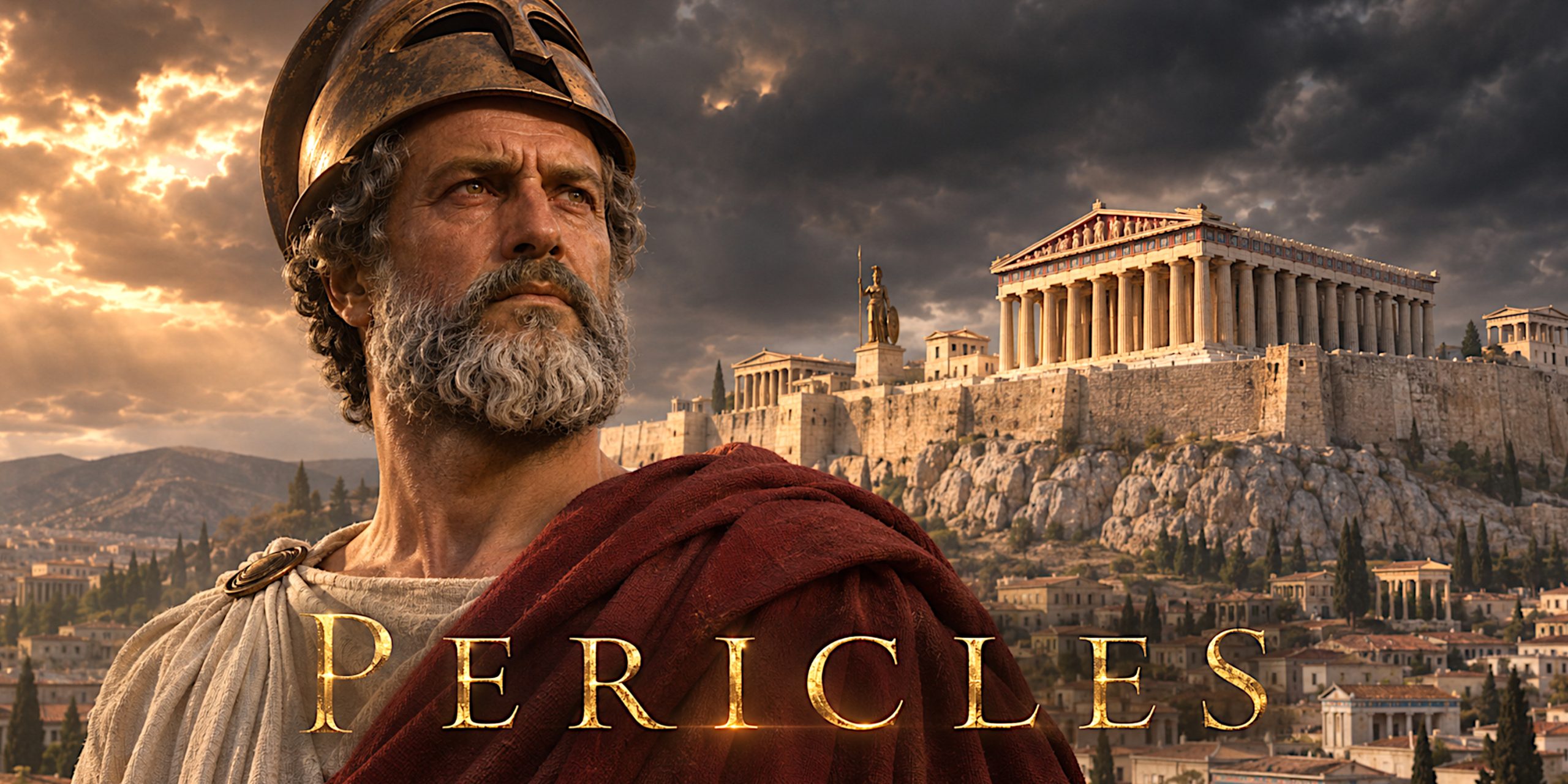
Pericles helped Athens become the city through which later generations would imagine ancient Greece. The Parthenon rose during his political ascendancy. Citizen participation widened. Athenian naval power reached across the Aegean. The same city that celebrated its own freedom expected other Greek communities to accept its authority.
That contradiction is where I find Pericles most interesting. The familiar portrait of a wise statesman beneath a bronze helmet is rather too comfortable. He was an effective democratic politician, an imperial commander and a persuasive advocate of a war whose opening years brought catastrophe to his own household.
Understanding him means keeping all of those roles in view.
Who Was Pericles?
Pericles, who lived approximately from 495 to 429 BCE, was an Athenian politician and general. He came from an aristocratic family: his father was Xanthippus, and his mother, Agariste, belonged to the influential Alcmaeonid family. His first securely recorded public activity was financing the chorus for Aeschylus’ The Persians in 472 BCE. Public generosity and political visibility were already close companions.
He became Athens’ most influential politician, but he was neither its king nor the holder of a permanent office equivalent to a modern prime minister. His authority depended on persuasion, alliances and repeated election as a strategos, or general.
Calling him the “first citizen” describes his influence. It was not an official title. Thucydides’ admiration for that influence also raises an awkward question: how much can a democracy depend on one unusually persuasive man before its character begins to change?
How Pericles Rose to Power
Pericles’ rise belonged to a larger struggle over who should exercise power in Athens. He worked alongside Ephialtes, whose reforms in 462/461 BCE curtailed the political authority of the aristocratic Areopagus council. After Ephialtes’ assassination, Pericles became an increasingly important figure in democratic politics.
He did not invent Athenian democracy. Its institutions developed through successive reforms, rivalries and compromises. Giving him sole credit would erase the work of earlier reformers and, rather more seriously, the citizens who made those institutions function.
The surviving accounts also encourage caution. His reputation attracted stories about his composure, education and personal discipline. Some may preserve useful memories; others fit the ancient biographer’s preference for making character explain everything. A well-told anecdote remains an anecdote.
Democracy for Whom?
Pericles is associated with the introduction of payment for jury service. This mattered because political rights are easier to exercise when participation does not mean losing essential income. Public pay helped poorer male citizens take part in the courts.
Yet the democracy had firm boundaries. Women lacked Assembly votes and access to political office. Enslaved people and resident foreigners stood outside the citizen electorate. Women of citizen families nevertheless mattered to civic identity, religious life and the transmission of citizenship.
The citizenship law of 451/450 BCE, proposed by Pericles, restricted eligibility to those with Athenian parentage on both sides. The precise motives and application remain debated. What is clear is that wider participation within the citizen body could coexist with tighter restrictions on entry to it. Athens was generous with the language of belonging while remaining decidedly selective about the guest list.
The Parthenon and the Building of Athens
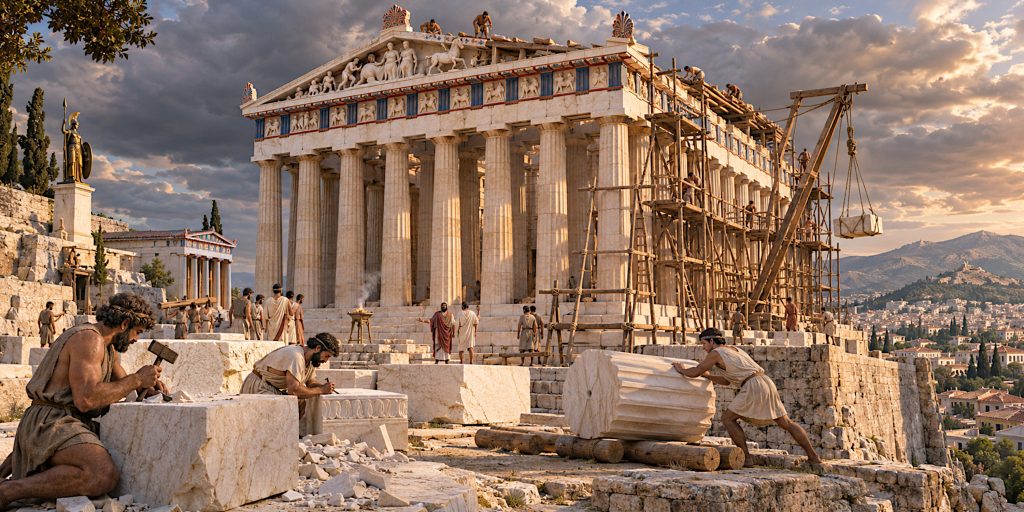
The great Acropolis building programme is the most visible part of Pericles’ legacy. The Parthenon was begun in 447 BCE, with work continuing into the 430s. Its surviving financial accounts run from 447/446 to 433/432 BCE and record a public undertaking managed through appointed supervisors.
This was religious architecture, civic display and organised expenditure on an extraordinary scale. Architects, sculptors, quarry workers, carriers and many other labourers made the buildings possible. Pericles’ political support mattered, but he did not design or build the Parthenon himself.
The accounts are especially valuable because they replace the solitary great man with a working institution. Marble required contracts, transport and payments. Even a celebrated golden age had invoices.
There is also a chronological trap here. The Acropolis was developed over time. Its famous monuments should not all be presented as buildings completed under Pericles.
Athens’ Empire and the Price of Its Splendour
Athens led an alliance originally formed against Persia, commonly called the Delian League. Over time, many allies became tribute-paying subjects with limited freedom to leave.
The relationship between imperial resources and Athenian building was controversial even in antiquity. Plutarch preserves accusations that Athens was adorning itself with money contributed by other Greeks. He also presents Pericles’ defence: Athens provided security and could use the remaining resources for its own works.
That account was written centuries later, and its speeches should not be treated as transcripts. It nevertheless captures a fundamental dispute. Did leadership entitle Athens to decide how allied resources were spent?
The distinction matters when admiring the monuments. Their artistic achievement is real. So is the unequal political system surrounding their construction. Neither fact becomes less interesting when the other is admitted.
Pericles as a General
Pericles’ military reputation rests chiefly on naval operations, sustained pressure and strategic calculation. He was capable of commanding force directly, but the evidence does not support inventing a career of spectacular personal sword fights.
His suppression of the Samian revolt in 440–439 BCE shows the coercive side of his leadership. Following a prolonged siege, Samos surrendered its fleet, lost its walls and faced a substantial indemnity. This was a warning about the limits of allied independence.
A correction is also necessary concerning Athenian expansion in the north. Amphipolis was founded in 437/436 BCE under Hagnon. Its foundation belongs to the wider history of Athenian power during Pericles’ lifetime, rather than to a personally led colonial expedition by Pericles.
Command is often judged through victories. With Pericles, I would also ask what his victories required other communities to surrender.
Arms and Armour in Pericles’ Athens
No securely identified personal sword, shield or suit of armour belonging to Pericles survives. His famous helmeted portraits express military identity; they cannot establish his complete campaigning equipment.
The following describes the wider military setting, rather than an authenticated personal inventory.
| Equipment | Role | Important qualification |
|---|---|---|
| Dory | Hoplite thrusting spear | The spear was the principal offensive weapon of the hoplite |
| Aspis | Large round shield | Essential to protection and formation fighting |
| Xiphos | Straight, double-edged sword | A secondary weapon for close combat |
| Kopis | Single-edged, forward-curving sword | Known in the Greek world; not identifiable as Pericles’ own sword |
| Bronze helmet | Protection for the head | Designs and levels of coverage varied |
| Body armour and greaves | Protection for torso and legs | Equipment varied with wealth, role and circumstances |
Athens’ military power also depended on people who rarely appear in heroic portraits: rowers, sailors, shipwrights and the crews maintaining its maritime communications. A helmet makes an excellent portrait accessory. Naval administration was harder to sculpt.
Why Pericles Favoured a Naval Strategy Against Sparta
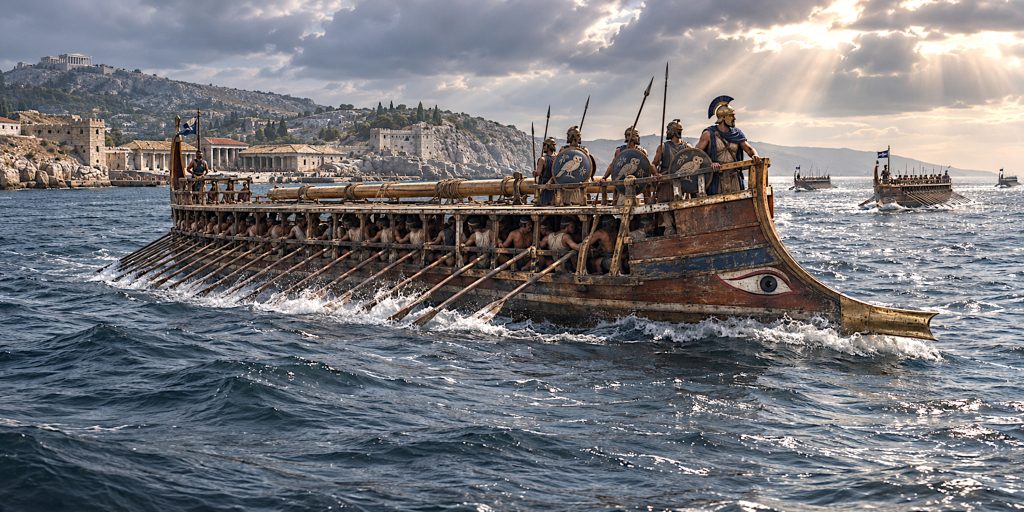
When the Peloponnesian War began in 431 BCE, Pericles urged Athens to avoid staking everything on a major land battle against Sparta’s army. Athens could draw on its walls, fleet and maritime resources while enemy forces ravaged the countryside of Attica.
Thucydides presents his strategy as requiring restraint: protect the navy, avoid unnecessary expansion and refuse engagements that endangered the city. This was a coherent assessment of Athens’ advantages, although coherence did not guarantee victory.
For rural Athenians, watching farms and homes destroyed made restraint a painful policy to support. Strategic patience is easier to recommend when the property burning belongs to somebody else.
Thucydides later judged Pericles more favourably than his successors. That is an important ancient interpretation, not proof that Athens would inevitably have won had it followed his advice indefinitely.
The Funeral Oration: Athens Describing Its Best Self
The Funeral Oration attributed to Pericles commemorated the dead from the war’s first year. In Thucydides’ account, it becomes a statement of Athenian civic identity: participation, courage, public service and confidence in the city’s way of life.
Its most famous democratic claim reads:
“the administration is in the hands of the many and not of the few.”
The wording here follows Benjamin Jowett’s translation of Thucydides, Book 2.37.
It deserves to be read as a persuasive wartime speech. Thucydides explains that the speeches in his history reproduce their general sense and what the circumstances required, rather than providing exact records.
I find the oration more revealing when read alongside the people excluded from its political promises. Civic ideals can be sincerely held and selectively applied. Athens offers an unusually eloquent example.
Aspasia, Family and the Limits of the Evidence
Aspasia of Miletus was Pericles’ partner and the mother of his son, Pericles the Younger. As a woman from outside Athens, she occupied a vulnerable position in a political culture ready to turn private relationships into public ammunition.
Ancient representations connect her with intellectual conversation and rhetorical ability, but they also contain hostile sexual allegations and comic distortion. Neither a confident reconstruction of her political power nor a dismissal of her as a scandalous distraction is justified by that evidence.
Their son’s status exposed a personal consequence of Pericles’ own citizenship law. The ancient tradition reports that an exception eventually secured his admission to citizenship after Pericles lost his legitimate sons. The legal details deserve care, but the irony requires very little assistance.
The Plague and Pericles’ Death
An epidemic struck Athens in 430 BCE. Thucydides describes severe illness, heavy mortality and the breakdown of ordinary expectations surrounding care, burial and behaviour. Its precise medical identity remains disputed.
The wartime concentration of people inside the defended city made an already difficult situation worse. A strategy intended to protect the population from invasion could not protect it from epidemic disease.
Pericles lost political support, was fined and subsequently returned to command. He died in 429 BCE during the epidemic. Ancient accounts also describe the deaths of his sons from his earlier marriage.
We cannot reconstruct his private grief with confidence. We can recognise the distance between the composed public figure and the losses endured by his household. That is enough without supplying an invented deathbed speech.
Archaeology: What Survives of His World?
The strongest material evidence concerns the Athens in which Pericles operated, rather than objects demonstrably owned by him.
The Acropolis monuments and their inscriptions illuminate religious priorities, public expenditure and craftsmanship. Building accounts preserve practical details that literary biographies often pass over. Material from the Agora helps reconstruct the civic and commercial setting of democratic life.
Portraits require particular care. The familiar helmeted head survives through Roman copies of a Greek portrait type. It is an idealised image of the mature soldier-citizen, not a reliable photographic likeness. We cannot confidently recover his exact face from it.
Research into Bronze Age Mycenaean armour should likewise remain in its own period. Whatever such experiments establish about earlier equipment, they cannot demonstrate what a fifth-century BCE Athenian general personally wore.
Pericles’ Life: Key Dates
| Date | Event |
|---|---|
| c. 495 BCE | Birth of Pericles |
| 472 BCE | Finances the chorus for Aeschylus’ The Persians |
| 462/461 BCE | Ephialtes’ reforms reshape Athenian political authority |
| 451/450 BCE | Pericles proposes the restrictive citizenship law |
| 447 BCE | Work begins on the Parthenon |
| 440–439 BCE | Pericles helps suppress the Samian revolt |
| 437/436 BCE | Hagnon leads the foundation of Amphipolis |
| 431 BCE | Peloponnesian War begins |
| Winter 431/430 BCE | Funeral Oration for the first year’s war dead |
| 430 BCE | Epidemic strikes Athens |
| 429 BCE | Pericles dies |
Where to Encounter Pericles’ Athens
The Acropolis and Acropolis Museum provide the clearest introduction to the building programme associated with his political ascendancy. The museum’s Parthenon accounts are particularly rewarding for anyone interested in how monumental ambition became organised work.
The Athenian Agora offers a different perspective: the spaces and institutions supporting civic life beyond the Acropolis.
The British Museum holds a Roman portrait bust of Pericles. It is valuable evidence for his later image, with the limitations of an idealised copy firmly in mind. Check current access and displays before planning a visit around any individual object.
How Should We Judge Pericles?
Pericles deserves his prominence. He helped make citizen participation more practical, supported exceptional public building and articulated a powerful vision of civic obligation. He also defended an empire that denied other communities the freedom Athens valued for itself.
The phrase “Golden Age” makes the period sound more settled than it was. Its achievements emerged from competition, compulsory payments, labour and war, alongside remarkable artistic and political invention.
My own judgement is that Pericles becomes more impressive, and more troubling, when the polished legend is set aside. He was a formidable politician operating within institutions he could influence but never entirely control. The marble survived him. The democracy still had to argue about what to do next.
Sources and Further Reading
- Thucydides, Funeral Oration, and History of the Peloponnesian War, Books 1 and 2.
- Plutarch, Life of Pericles, a much later biography drawing on varied earlier material.
- Aristotle or the Aristotelian school, The Athenian Constitution, for the institutional tradition concerning democratic reform and citizenship.
- Acropolis Museum, Parthenon building accounts.
- Museum of Classical Archaeology, Cambridge, Head of Perikles.