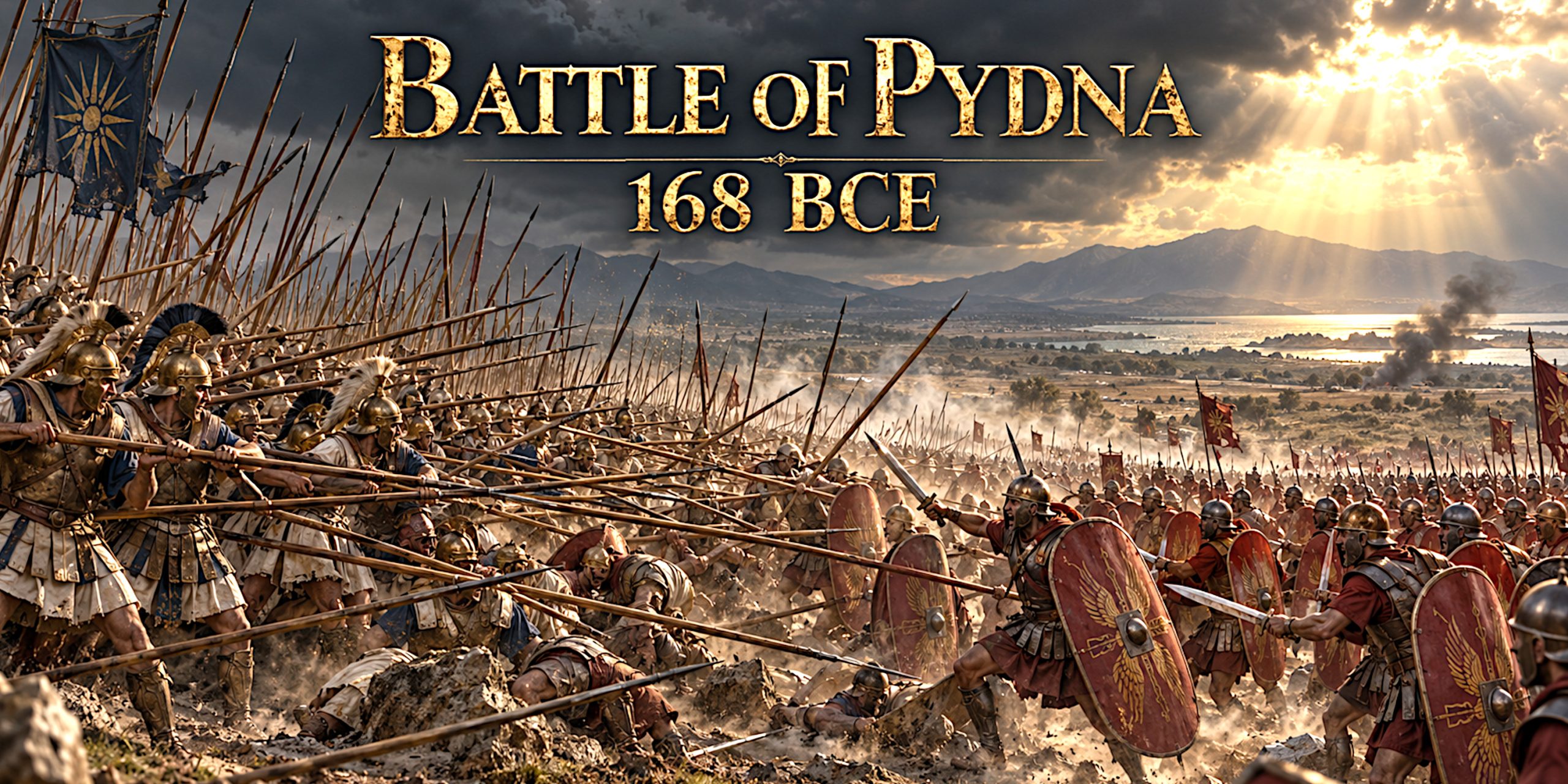
The Battle of Pydna, fought in 168 BCE during the Third Macedonian War, destroyed the army of King Perseus and ended the Antigonid kingdom as an independent great power. Rome did not annex Macedonia immediately, but from this point there was no serious doubt about which state held the stronger hand in the eastern Mediterranean.
Pydna is often reduced to a tidy military lesson: the flexible Roman legion defeated the rigid Macedonian phalanx. There is truth in that, but it is too neat. The phalanx was terrifying while its ranks remained aligned. It failed after broken ground opened gaps, Roman units attacked those gaps, the Macedonian wings gave way and Perseus failed to make effective use of his cavalry. Formations do not fight in diagrams. They fight on awkward ground, amid noise, fear and decisions made rather too late.
Battle of Pydna at a Glance
| Detail | Information |
|---|---|
| Conflict | Third Macedonian War |
| Traditional date | 22 June 168 BCE |
| Location | Plain near Pydna, Pieria, northern Greece |
| Combatants | Roman Republic and allies against the Kingdom of Macedon and its allies |
| Roman commander | Lucius Aemilius Paullus |
| Macedonian commander | King Perseus |
| Result | Decisive Roman victory |
| Wider consequence | End of the Antigonid monarchy and division of Macedonia into four republics |
The traditional date of 22 June is widely repeated, although reconstructing ancient calendars is rarely as obliging as a modern headline would like.
Why Rome and Macedon Went to War
The Third Macedonian War began in 171 BCE. Rome suspected Perseus of rebuilding Macedonian influence among the Greek states and disturbing the settlement imposed after the earlier wars with his father, Philip V. Perseus, for his part, inherited a kingdom expected to behave as though it were powerful while carefully avoiding any act Rome might interpret as proof that it was powerful. This was not a comfortable diplomatic position.
The early Roman campaigns were unimpressive. Commanders struggled with supply, discipline and the difficult approaches into Macedonia. Perseus won a cavalry action at Callinicus in 171 BCE but did not turn that success into a decisive strategic advantage.
The situation changed when Lucius Aemilius Paullus took command in 168 BCE. An experienced aristocrat in his sixties, Paullus restored discipline and examined the ground personally. A force led by Publius Cornelius Scipio Nasica crossed the mountain routes and threatened the Macedonian position near the River Elpeus. Perseus withdrew north towards Pydna, where the coastal plain appeared to offer excellent country for his phalanx.
It did, up to a point. That last qualification decided a kingdom.
Forces
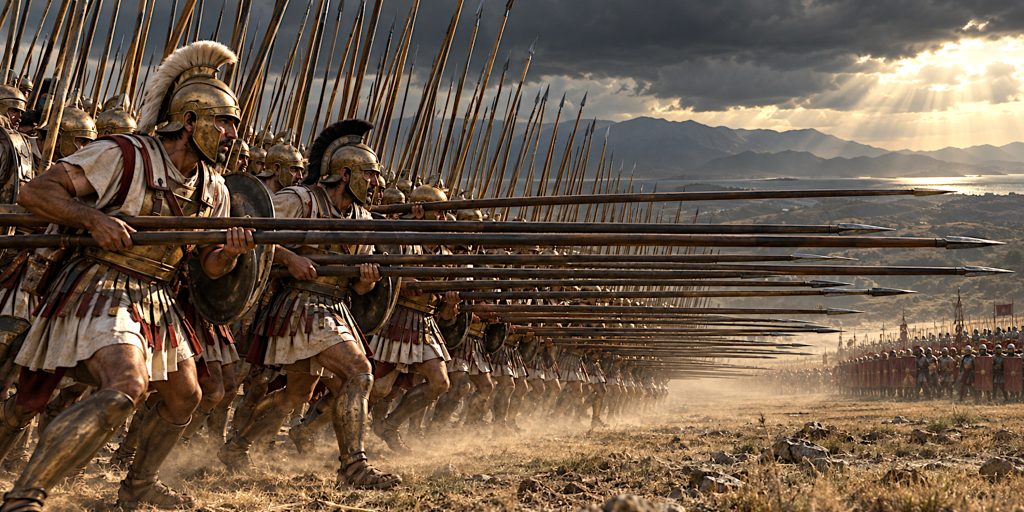
Ancient totals should be treated as estimates, not audited returns. Livy and Plutarch preserve useful figures, but their accounts do not always refer to precisely the same stage of the campaign. Detachments, garrisons and losses complicate any attempt to state exactly how many men stood in the battle line.
| Army | Probable strength | Main elements |
|---|---|---|
| Roman and allied | Roughly 29,000 to 38,000 | Two Roman legions, Italian allied infantry, Greek and other light troops, cavalry, Numidian elephants |
| Macedonian and allied | Perhaps 35,000 to 44,000 before detachments | Phalangites, elite peltasts, Thracians, mercenaries, light infantry and cavalry |
The higher Macedonian figure probably describes the army earlier in the campaign. Some troops had been detached before Pydna, which may have reduced the force actually present. What can be said with confidence is that both armies were large, experienced and composed of several troop types. This was not simply a meeting between identical blocks labelled “legion” and “phalanx”.
Roman forces
- Two Roman legions formed the heavy infantry core.
- Italian allied cohorts extended and supported the line.
- Paelignian troops were heavily involved in the first collision.
- Ligurians and other light infantry served in the advance and on the flanks.
- Roman and allied cavalry operated on the wings.
- A group of North African war elephants, often given as 22, supported the Roman right.
Macedonian forces
- The phalanx contained approximately 20,000 to 21,000 pikemen in its full campaign establishment.
- The elite royal guard, often identified with the agema or peltasts, numbered around 3,000.
- Thracian infantry under Cotys formed a conspicuous allied contingent.
- Mercenaries and lighter troops protected the main formation and contested the river line.
- Macedonian and allied cavalry, including the royal or Sacred Squadron, stood under Perseus on the right.
Leaders and Troop Composition
Lucius Aemilius Paullus
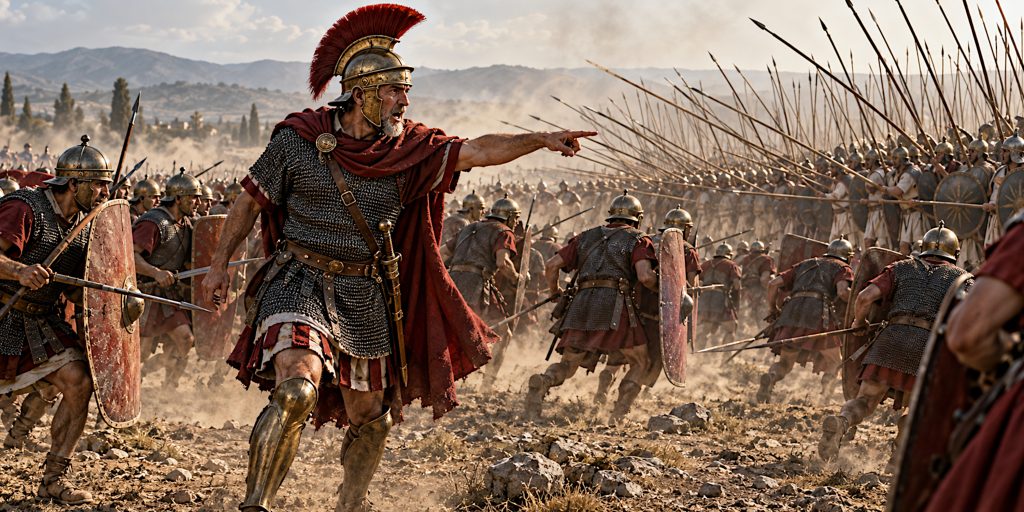
Paullus had held the consulship before and had fought in Spain and Liguria. Ancient writers present him as disciplined, pious and attentive to terrain. There is an element of Roman moral portraiture in this, especially when he is contrasted with Perseus, but his conduct during the campaign shows a commander who understood reconnaissance, logistics and timing.
His important contribution at Pydna was not an ingenious master plan prepared weeks in advance. It was his response when the battle became fragmented. He allowed or ordered smaller bodies of legionaries to exploit openings in the phalanx rather than continue a hopeless frontal struggle against levelled sarissas.
King Perseus of Macedon
Perseus was not the feeble caricature sometimes produced by victorious Roman accounts. He had restored finances, recruited a formidable army and sustained a difficult war for several years. At Pydna, however, his command failed at the crucial moment. The cavalry left the field largely intact, and Perseus fled while much of his infantry was still being killed.
Ancient explanations differ. One tradition accuses him of cowardice. Another claims he was injured. Roman sources had every reason to turn the defeated king into a moral failure, so judgement should be cautious. Even with that allowance, the non-commitment of the Macedonian cavalry remains difficult to defend.
Other important commanders
| Leader | Side | Role at Pydna |
|---|---|---|
| Publius Cornelius Scipio Nasica | Rome | Led the turning movement through the mountain passes before the battle |
| Lucius Postumius Albinus | Rome | Former consul associated with the Second Legion’s attack on the phalanx |
| Cotys IV | Macedon | Odrysian Thracian king and ally of Perseus |
| Marcus Porcius Cato Licinianus | Rome | Son of Cato the Elder, remembered for fierce close combat |
| Scipio Aemilianus | Rome | Young son of Paullus, later famous for destroying Carthage and Numantia |
How the formations differed
The Roman legion fought in sub-units able to change direction and operate with some independence. At Pydna the legionary system was still organised around maniples, although allied cohorts and specialist troops made the whole army more varied than the familiar textbook diagram suggests.
The Macedonian phalanx concentrated enormous striking power at its front. Several ranks projected their sarissas towards the enemy, making a direct approach extraordinarily dangerous. Its weakness was not stupidity or universal immobility. It was the difficulty of preserving alignment across uneven ground and responding to attacks arriving from several directions once the formation had opened.
Arms and Armour
The decisive contrast was between weapons designed for collective reach and weapons suited to close, individual combat. Neither set was inherently superior in every circumstance.
Roman weapons and protection
| Equipment | Use |
|---|---|
| Gladius Hispaniensis | A cut-and-thrust sword longer than some later Roman gladii, effective once legionaries entered the gaps |
| Pilum | Heavy throwing spear intended to disrupt shields and formations before contact |
| Scutum | Large, curved body shield offering strong protection in close fighting |
| Hasta | Thrusting spear retained by some troops, especially the triarii |
| Pugio | Dagger carried as a secondary weapon |
| Mail and pectoral armour | Protection varied by rank, wealth and unit |
| Montefortino-type helmet | Common bronze helmet form among Republican troops |
The gladius Hispaniensis deserves particular attention. Its exact form varied, but archaeological examples and literary evidence indicate a strong point and effective cutting edges. Against a compact phalanx it offered little comfort because the wielder first had to survive a forest of pikes. Inside a broken formation, however, the shorter weapon and large scutum became lethal advantages.
Macedonian weapons and protection
| Equipment | Use |
|---|---|
| Sarissa | Two-handed pike, probably around 5 to 6 metres long, which gave the phalanx its formidable reach |
| Xiphos | Straight, double-edged sword used when the pike was lost or close combat became unavoidable |
| Kopis or machaira | Forward-curving, single-edged cutting sword used by some Macedonian and allied troops, especially cavalry |
| Pelte | Smaller shield suspended and controlled to leave both hands available for the sarissa |
| Spear and javelin | Used by guards, light infantry, cavalry and allied contingents |
| Linen, composite or metal armour | Protection varied greatly between elite and ordinary soldiers |
| Hellenistic helmets | Included several regional and unit-specific forms rather than one universal pattern |
It is tempting to imagine every phalangite drawing a xiphos the moment the sarissas became useless. Some certainly carried swords, but a man trapped within a collapsing formation had very little room to draw one, still less to fence elegantly. Pydna was not a duel between sword designs. It was a violent change in fighting distance.
The Battlefield and the River
The battle was fought on the coastal plain near ancient Pydna, with low ridges, watercourses and increasingly irregular ground towards the foothills. The precise identification of the river mentioned in the sources and the exact positions of both camps remain debated.
The terrain mattered because a pike formation depended upon lateral order. On suitably level ground the Macedonian advance was immensely powerful. As the line moved over broken or sloping country, units travelled at slightly different speeds. Small separations widened. Sarissas that had formed a continuous barrier no longer covered every approach.
This is one reason the traditional slogan about Roman flexibility needs care. The legion did not stroll up and prove itself technically superior. Its front was driven back and some Romans were horrified by what they faced. The legion’s advantage appeared only after the Macedonian formation lost the conditions it required.
How the Battle Began
The sources offer more than one story. In the best-known version, a loose Roman pack animal crossed the river during the afternoon. Romans pursued it, clashed with Thracian guards and pulled more troops into an escalating skirmish. Another tradition says Paullus deliberately released an unbridled horse to provoke the enemy because the sacrificial omens favoured the side that did not attack first.
The mundane accident is more convincing. Battles often begin because local violence outruns command. A mule starting the decisive struggle for Macedonia may feel undignified, but history has never promised dignity.
The skirmish drew in reserves on both sides. Perseus brought forward the phalanx, while Paullus hurried to form his army. The action began in earnest during the afternoon, leaving only a few hours of daylight.
The Macedonian Advance
The opening phase belonged to the phalanx. Its levelled sarissas created a moving wall of points. Plutarch, drawing upon earlier material including the contemporary historian Polybius, says that Paullus was alarmed by the sight. The Romans and their Italian allies could not force a way through the intact front.
One famous episode concerns the Paelignians. Their commander is said to have thrown a standard into the Macedonian ranks, compelling his men to recover it. Whether literal event or polished battlefield anecdote, the story conveys the desperation of the fighting. The charge failed to shatter the pike wall.
The Roman line gave ground towards rougher country. Some reconstructions treat this as a deliberate withdrawal; others see it as pressure imposed by the Macedonian advance. The evidence does not let us watch Paullus’s intentions minute by minute. What matters is what followed.
How the Phalanx Broke Apart

As the Macedonian line crossed uneven terrain, its frontage became disordered. Paullus recognised that a single continuous battle had become a series of local fights. He ordered Roman units to enter the openings.
The tactical balance then reversed:
- Legionaries no longer had to attack through several projecting ranks of sarissas.
- Small Roman units could strike exposed sides and rear ranks.
- Phalangites struggled to turn or shorten their enormous pikes in crowded conditions.
- Roman shields and swords were more effective at arm’s length.
- The Roman right, supported by elephants and allied infantry, drove back the Macedonian left.
- Pressure spread across the centre as the phalanx lost cohesion.
The elite Macedonian guard reportedly stood and fought until it was annihilated. This matters. The army did not dissolve because every phalangite was helpless or unwilling. Some formations maintained cohesion longer than others, which suggests that training, leadership and local ground mattered alongside weapon design.
The cavalry escaped with relatively few losses. Perseus withdrew first towards Pella and then to Samothrace. Without mounted intervention to stabilise the flanks or cover the infantry, the phalanx was surrounded and cut down.
Casualties
Livy’s surviving account gives approximately 20,000 Macedonians killed and 11,000 captured, while reporting little more than 100 Roman dead, most of them Paelignians. Plutarch also presents the Macedonian losses as catastrophic.
These figures should not be accepted with false precision. Ancient casualty totals could serve literary and political purposes, and the Roman losses appear remarkably low. Yet a severe imbalance is entirely plausible. Once a dense infantry formation broke and was pursued towards the coast and river channels, men burdened by armour and long weapons became vulnerable. Most casualties in ancient battles were often suffered during flight rather than during the initial face-to-face struggle.
The safest conclusion is that the Macedonian infantry army was destroyed as an effective force, while the Roman army remained operational.
Battle Timeline
| Time or phase | Event |
|---|---|
| Before 168 BCE | Rome and Macedon fight two inconclusive campaigning seasons |
| Early 168 BCE | Paullus assumes command and restores Roman discipline |
| Days before Pydna | Scipio Nasica’s movement through the passes threatens Perseus’s position at the Elpeus |
| Macedonian withdrawal | Perseus falls back to the plain near Pydna |
| Morning of the battle | Armies remain near their camps; sacrifices and preparations take place |
| About mid-afternoon | A clash at the river, perhaps involving a loose pack animal, expands into a general engagement |
| Opening battle | The Macedonian phalanx advances and drives back Roman and allied troops |
| Decisive phase | Broken ground creates gaps; Roman units penetrate and attack at close quarters |
| Collapse | Roman right and elephants help rout the Macedonian left; the phalanx is attacked in separated bodies |
| Evening | Perseus and much of the cavalry escape; pursuit and killing continue until darkness |
| Following weeks | Perseus flees to Samothrace and eventually surrenders |
| 167 BCE | Rome abolishes the monarchy and divides Macedonia into four republics |
Contemporary and Ancient Accounts
Polybius is the most valuable near-contemporary witness. He was not present at Pydna, but he knew Paullus and moved among the Roman elite. Much of his relevant narrative is lost, although fragments and later authors preserve parts of it.
Plutarch quotes Polybius on the sight of the phalanx, saying that Paullus had never seen anything “more terrible and formidable” than its advancing front. That brief remark is important because it prevents the easy assumption that Roman victory was inevitable.
Livy, writing much later but using Polybius and other sources, explains why the broken phalanx became vulnerable:
“As long as it was compact, its front bristling with levelled spears, its strength was irresistible.”
Plutarch describes the Roman close-range attack in graphic terms and emphasises the wounds inflicted by Roman swords. His Life of Aemilius Paullus is biography rather than a modern campaign history, so moral contrast shapes the story. Paullus is composed and dutiful; Perseus is made to look evasive and unworthy. The military detail remains valuable, but the character portraits should not be swallowed whole.
No surviving account is a neutral transcript. Polybius was close to the victorious Roman commander, Livy wrote for Roman readers and Plutarch sought moral character through memorable episodes. Used together and checked against the landscape, however, they provide an unusually vivid account of an ancient battle.
Archaeology and the Search for the Battlefield
The archaeology of Pydna requires more restraint than it often receives online. There is no securely excavated battlefield spread that allows historians to map the action rank by rank. Claims that excavators have definitively recovered the battle’s swords, spearheads and arrows should therefore be treated cautiously unless accompanied by a precise excavation report and dating evidence.
What archaeology and topographical study can tell us is still valuable:
- Ancient Pydna has been identified on the coast of Pieria through settlement remains, fortifications and pottery.
- Surveys of the plain, ridges and river systems have tested competing reconstructions of the battlefield.
- Changes in coastlines and watercourses complicate attempts to project the modern landscape directly back to 168 BCE.
- Macedonian tombs and regional finds illuminate the arms, armour and elite culture of the kingdom, but they do not automatically belong to this battle.
The strongest material monument connected with victory stands not at the battlefield but at Delphi. Perseus had commissioned a monument there, apparently intended to carry his own image. Paullus appropriated its base and erected a victory monument topped by his own equestrian statue. Its sculpted frieze shows Romans and Macedonians fighting. Traces of the altered dedication confirm the political takeover in stone. It is one of history’s more pointed renovations.
The frieze cannot be read as a photographic report, yet its mixture of Roman and Macedonian equipment provides rare visual evidence produced close to the event. A riderless horse in the relief has sometimes been linked to the animal said to have started the battle, though that identification remains an interpretation rather than a certainty.
Did the Legion Prove It Was Better Than the Phalanx?
Pydna certainly exposed the phalanx’s vulnerability once cohesion had been lost. The Roman command structure and smaller tactical units were better able to exploit a battle that had fragmented. The legionary’s large shield and sword were also much more useful than the sarissa inside a broken formation.
But Pydna did not prove that every legion would defeat every phalanx. The Macedonian formation initially dominated the frontal contest. It required suitable ground, protected flanks and close coordination with cavalry and lighter troops. Perseus failed to preserve those conditions, while Paullus reacted effectively when opportunities appeared.
The better conclusion is narrower and more interesting: the Roman army tolerated disorder better. When the battle ceased to match either commander’s ideal arrangement, Roman units remained useful in smaller groups. The phalanx’s great strength depended on collective order, and once that order was gone its main weapon became an encumbrance.
What Happened to Perseus and Macedonia?

Perseus fled first to Pella and then to the sanctuary on Samothrace. He eventually surrendered to the Romans. Paullus displayed him in his triumph at Rome in 167 BCE, along with captured wealth and members of the royal household.
Rome abolished the Antigonid monarchy and divided Macedonia into four self-governing republics. Restrictions were imposed on political contact, intermarriage and property between the regions. Rome claimed to have liberated the Macedonians from kingship, which was an imaginative description of a settlement dictated by a victorious foreign army.
Macedonia was not immediately made a Roman province. A revolt led by Andriscus prompted another Roman victory near Pydna in 148 BCE, and provincial organisation followed. The battle of 168 BCE nevertheless ended the historic kingdom created by Philip II and carried to extraordinary heights by Alexander the Great.
Why the Battle of Pydna Mattered
Pydna changed the political balance of the Mediterranean. After the defeat of the Seleucid king Antiochus III at Magnesia and Perseus at Pydna, no major Hellenistic monarchy could ignore Roman power. Greek states might negotiate, flatter or resist, but their room for independent action had narrowed sharply.
The battle also remains one of the clearest ancient case studies in the relationship between weapons, formation and terrain. The sarissa was not a failed weapon. It was devastating within the system designed around it. The Roman sword did not win through some mystical national superiority. It became decisive after Roman soldiers reached a distance at which the pike could no longer function.
For me, that is what makes Pydna so compelling. The battle did not turn on a miraculous invention or a theatrical speech. It turned when small gaps appeared in a line of men and one commander understood their meaning more quickly than the other. Empires can depend on surprisingly narrow spaces.
Frequently Asked Questions
When was the Battle of Pydna fought?
The traditionally accepted date is 22 June 168 BCE, during the Third Macedonian War.
Who won the Battle of Pydna?
The Roman army commanded by Lucius Aemilius Paullus won a decisive victory over King Perseus of Macedon.
Why did the Macedonian phalanx lose?
The phalanx lost cohesion while advancing over uneven ground. Roman units entered the resulting gaps and fought at close range, where their shields and swords were more effective than the long Macedonian sarissas. Failures on the flanks and the limited role of Perseus’s cavalry also contributed.
Did Pydna end Macedonian independence?
It ended the Antigonid monarchy and Macedonia’s independence as a major kingdom. Rome divided the territory into four republics. Macedonia became a Roman province after further conflict in the following decades.
Where is the battlefield today?
It lay on the coastal plain near ancient Pydna in the Pieria region of northern Greece. Scholars continue to debate the exact deployment areas and the identification of ancient watercourses.
Sources and Further Reading
- Livy, History of Rome, Books 44 and 45
- Plutarch, Life of Aemilius Paullus
- Polybius, Histories, Book 29, surviving fragments
- N. G. L. Hammond, “The Battle of Pydna”, Journal of Hellenic Studies, Volume 104
- F. W. Walbank, A Historical Commentary on Polybius
- John D. Grainger, The Roman War of Antiochos the Great