Theseus is the man who killed the Minotaur, escaped the Labyrinth and became Athens’ great heroic king. He is also a kidnapper, an unreliable lover, a political symbol and, depending on which ancient source you happen to be reading, occasionally a spectacularly poor judge of what constitutes a sensible plan.
That contradiction is precisely what makes him interesting.
For ancient Athenians, Theseus became much more than the hero with the ball of thread. His legends explained political institutions, religious festivals and the supposed unification of Attica. By the Classical period, he had effectively become Athens’ answer to Heracles: a local hero whose adventures could be used to say something about the city itself.
Separating the mythical Theseus from any possible historical figure is difficult. There is no convincing evidence that the Theseus of legend actually existed. What we can trace is something arguably more useful: the development of his story and the increasingly important role it played in Athenian identity.
Who Was Theseus?
Theseus was traditionally regarded as the son of Aegeus, king of Athens, although Greek mythology rarely allows a straightforward family tree to remain straightforward for long.
His mother was Aethra, daughter of Pittheus, king of Troezen. In several versions of the myth, she slept with both Aegeus and the god Poseidon on the same night. Theseus could therefore be understood as having both mortal and divine paternity.
This ambiguity was useful. It connected him directly to the Athenian royal line while also giving him the semi-divine status expected of a major Greek hero.
Aegeus left a sword and sandals beneath a large rock at Troezen. Aethra was instructed to tell Theseus about them when he became strong enough to lift the stone.
When the young Theseus eventually succeeded, he took the objects and set out for Athens to claim his inheritance.
The sword is particularly significant. It was not merely a weapon. It acted as a token of recognition, establishing Theseus’ identity and legitimate connection to Aegeus.
Theseus at a Glance
| Detail | Tradition |
|---|---|
| Father | Aegeus of Athens and, in some traditions, Poseidon |
| Mother | Aethra |
| Birthplace | Troezen |
| Kingdom | Athens |
| Best-known enemy | The Minotaur |
| Famous companion | Pirithous |
| Major romantic figures | Ariadne, Antiope or Hippolyta, Phaedra |
| Principal weapon | Sword |
| Major achievements | Killing the Minotaur, defeating bandits, unifying Attica |
| Death | Traditionally on Skyros |
| Hero cult | Particularly important at Athens |
The Road to Athens
Theseus could have travelled to Athens safely by sea. Instead, he deliberately chose the dangerous land route across the Isthmus of Corinth.
Of course he did. Greek heroes rarely build reputations by taking the ferry.
The journey became a sequence of encounters with criminals and monsters. These stories appear to have been shaped partly to present Theseus as an Attic equivalent to Heracles.
Among his opponents were:
- Periphetes, the club-bearing robber
- Sinis, who killed travellers using bent pine trees
- The Crommyonian Sow, a monstrous animal terrorising the region
- Sciron, who forced travellers to wash his feet before kicking them from a cliff
- Cercyon, a wrestler who challenged and killed passing strangers
- Procrustes, who forced victims to fit his bed by stretching or mutilating them
A recurring theme is poetic punishment. Theseus frequently kills his enemies using the same methods they had employed against their victims.
The stories therefore present him as something more than a wandering strongman. He restores order by turning violence back upon those who have abused it.
Theseus Arrives in Athens
When Theseus reached Athens, Aegeus initially failed to recognise him.
The king was living with Medea, the formidable sorceress already famous from the story of Jason and the Argonauts. Medea recognised Theseus as a threat to her position and attempted to have him poisoned.
At the critical moment, Aegeus recognised the sword Theseus carried and realised that the young man was his son.
Medea fled.
Theseus was now established as Aegeus’ heir, but his most famous adventure was still ahead.
The Minotaur and the Labyrinth
The story of Theseus and the Minotaur became one of the defining myths of ancient Greece.
Athens was supposedly required to send young men and women to Crete as tribute to King Minos. The victims were placed inside the Labyrinth, where they were killed by the Minotaur, a creature with human and bovine characteristics.
The number and frequency of the tribute varies between traditions. The familiar version describes seven young men and seven young women.
Theseus volunteered to join them.
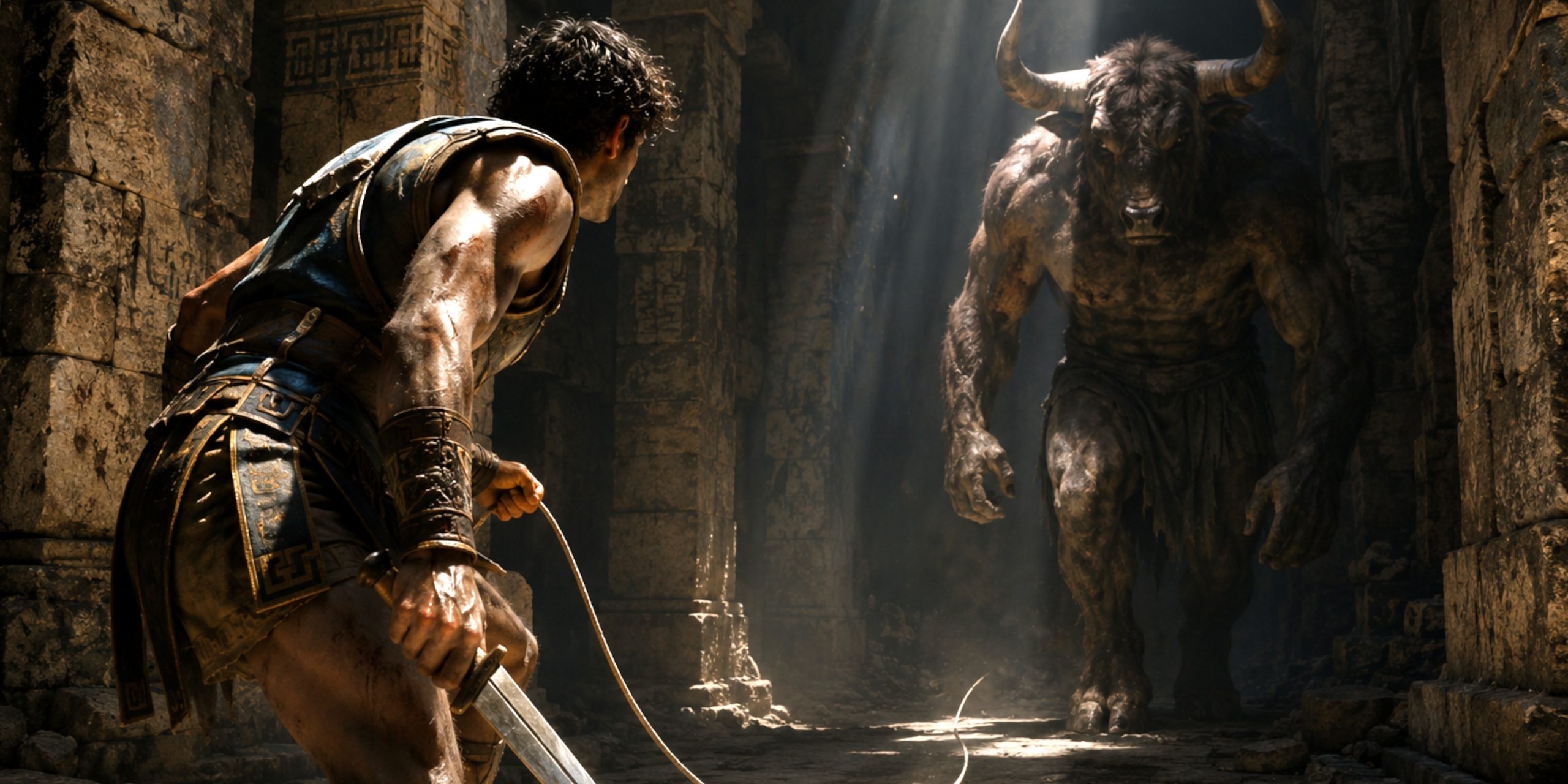
His intention was simple enough: enter the Labyrinth and kill the monster.
Getting back out required rather more thought.
Ariadne and the Thread
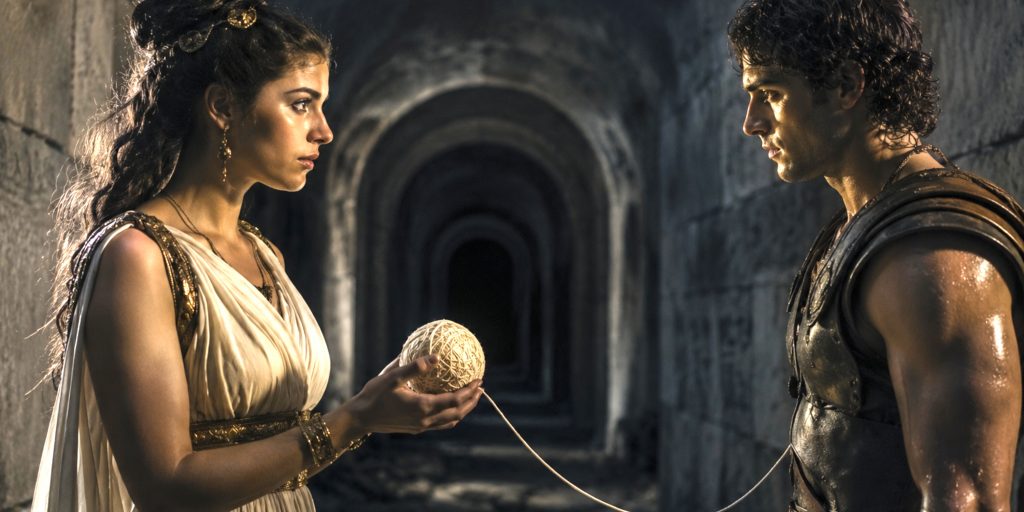
Ariadne, daughter of King Minos, fell in love with Theseus and agreed to help him.
She gave him a thread which could be unwound as he entered the Labyrinth. After killing the Minotaur, Theseus could follow it back to the entrance.
The famous “Ariadne’s thread” became one of the most enduring elements of the myth.
Some ancient traditions involve additional assistance, instructions or a crown rather than placing all emphasis on the thread. Greek myths evolved constantly across different regions and periods, so there is rarely a single canonical version.
Theseus confronted the Minotaur and killed it.
Ancient artistic representations frequently show the hero using a sword, although other traditions emphasise wrestling or physical strength. Vase paintings make the confrontation particularly vivid, with Theseus often appearing youthful, controlled and distinctly human beside the monstrous Minotaur.
What Sword Did Theseus Use?
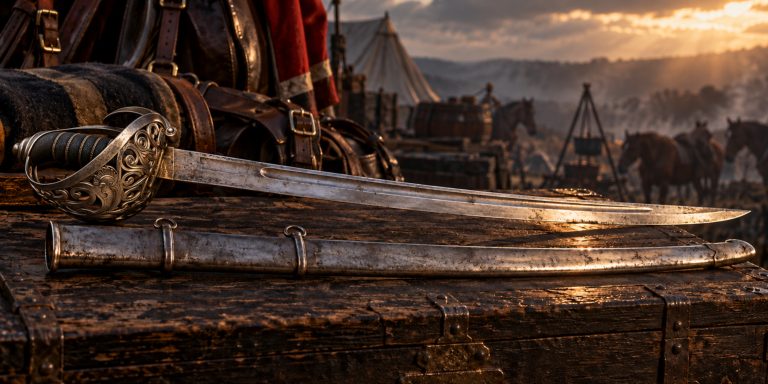
There is no securely identifiable historical “Sword of Theseus”.
Ancient literary and artistic traditions simply depict him with the sort of weapon expected of a Greek hero. Depending on the period of the artwork, this can resemble contemporary Greek swords rather than anything appropriate to a hypothetical Bronze Age Theseus.
If the legend preserves memories of the Late Bronze Age Aegean, a historically plausible weapon might have been a Mycenaean bronze sword. These included long, relatively narrow blades associated with elite warriors.
Later Greek artists naturally represented mythological heroes through the military culture familiar to their own audiences.
This creates an important distinction:
| Mythological tradition | Historical interpretation |
| Theseus carries his father’s sword | The sword acts as a recognition symbol |
| Theseus may use a sword against the Minotaur | Artistic depictions vary |
| The story belongs to a heroic past | Some settings recall Bronze Age Crete |
| Later art shows contemporary weapons | These should not automatically be treated as Bronze Age evidence |
Trying to assign Theseus a precise sword typology is therefore tempting but misleading. Mythology is not an archaeological catalogue, however much sword enthusiasts might wish otherwise.
Theseus and Ariadne
After escaping Crete, Theseus departed with Ariadne.
Then things became considerably less heroic.
Ariadne was abandoned on the island of Naxos. Ancient authors disagreed about why. Some versions blame Theseus directly. Others involve the god Dionysus, who desired or claimed Ariadne. In certain traditions Theseus was compelled to leave her rather than simply deciding that abandoning the woman who had just saved his life seemed reasonable.
The differences matter because they demonstrate how Greek storytellers repeatedly reworked Theseus’ character.
Ariadne eventually became associated with Dionysus and acquired her own substantial mythological tradition.
Theseus sailed onwards towards Athens.
The Black Sails and the Death of Aegeus
Before Theseus left Athens, Aegeus had arranged a signal with him.
If Theseus survived, his ship was supposed to return under a white sail rather than the dark sail associated with the doomed tribute.
Theseus forgot to change it.
Seeing the dark sail approaching, Aegeus believed his son was dead and threw himself into the sea.
According to tradition, the Aegean Sea took its name from him.
It is one of the great tragic moments in Greek mythology because no monster causes the catastrophe. Theseus wins his heroic adventure and still destroys his father through a simple human failure.
Theseus as King of Athens
Following Aegeus’ death, Theseus became king.
Later Athenian tradition credited him with the synoecism of Attica, the political unification of the communities of Attica under Athens.
Plutarch, writing centuries later, provides one of the fullest surviving accounts of this political Theseus. He portrays the hero as reorganising the population and establishing institutions associated with the development of Athens.
This should not be read as straightforward historical reporting.
The traditions surrounding Theseus allowed Athenians to project later political arrangements backwards into a legendary age. The hero became a convenient founder figure through whom the origins of Athenian society could be explained.
That made him politically useful as well as mythologically entertaining.
Theseus and the Amazons
Theseus was also connected with the Amazons.
The details vary considerably. His Amazon wife or lover may be named Antiope or Hippolyta depending upon the tradition. Theseus either abducts her, receives her or encounters her during another heroic expedition.
The relationship becomes associated with an Amazon attack on Athens.
This mythical invasion, often called the Amazonomachy, became a major subject in Greek art. Battles between Greeks and Amazons appeared on temples, pottery and monumental sculpture.
For Athenians, Theseus could therefore be shown defending the city itself against an exotic warrior enemy.
His Amazon partner was traditionally the mother of Hippolytus.
That family story ends badly too.
Phaedra and Hippolytus
Theseus later married Phaedra, another daughter of Minos and sister of Ariadne.
Phaedra became consumed by desire for Hippolytus, Theseus’ son.
In the version made famous by Euripides’ Hippolytus, the situation develops into catastrophe. Hippolytus rejects Phaedra, who ultimately leaves an accusation against him.
Theseus believes that his son has violated or attempted to violate Phaedra and calls upon Poseidon to punish him.
Hippolytus dies.
The truth emerges too late.
The episode transforms Theseus from monster-slayer into tragic father. His decisive action, so useful against robbers and monsters, becomes disastrous when applied without sufficient knowledge.
Theseus and Pirithous
One of Theseus’ closest companions was Pirithous, king of the Lapiths.
Their friendship began, appropriately enough, through confrontation. Pirithous supposedly stole cattle belonging to Theseus in order to test his strength. The two men were so impressed with one another that they became companions.
They later participated in adventures including the famous conflict between the Lapiths and Centaurs.
Eventually, however, the pair devised one of the more astonishingly ill-advised plans in heroic mythology.
Both decided that, as sons of gods, they deserved divine wives.
Theseus targeted Helen of Sparta, who in some versions was still extremely young. Pirithous chose Persephone.
Persephone was already married to Hades.
This should perhaps have been considered a warning sign.
The Journey to the Underworld
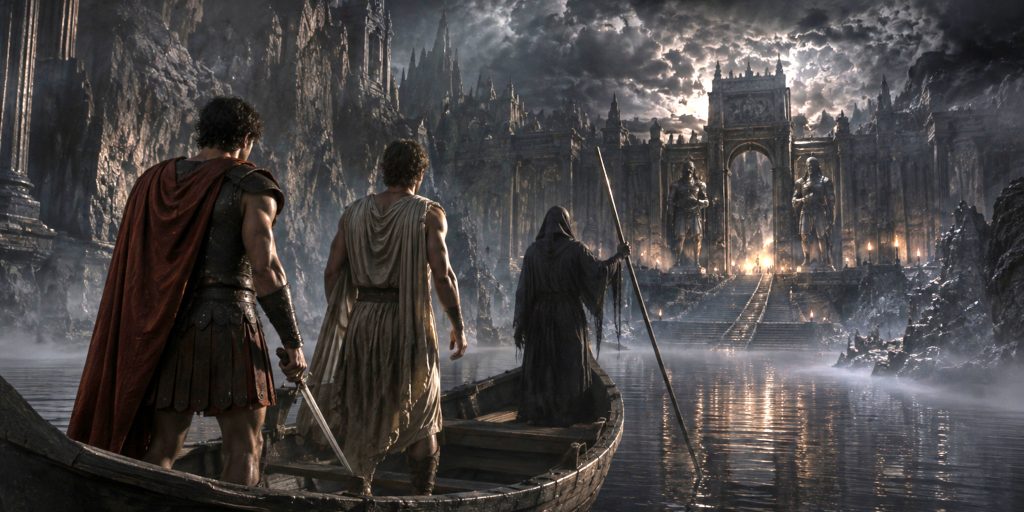
Theseus and Pirithous descended into the Underworld intending to abduct Persephone.
Hades welcomed them and invited them to sit.
They became trapped.
Heracles later entered the Underworld during his own adventures and managed to rescue Theseus. Pirithous was generally left behind.
The story is a classic example of heroic overreach. Theseus had progressed from killing criminals to believing that kidnapping the queen of the dead was a manageable afternoon project.
Greek mythology has a fairly consistent opinion about this sort of confidence.
The Death of Theseus
Theseus eventually lost political power in Athens.
He travelled to the island of Skyros, where King Lycomedes supposedly killed him by pushing him from a cliff, although traditions concerning the circumstances vary.
It was an inglorious end for the killer of the Minotaur.
Yet Theseus’ story did not finish with his death.
Centuries later, the Athenian statesman Cimon was credited with recovering bones believed to belong to Theseus from Skyros and returning them to Athens in the fifth century BCE.
The remains were installed in a sanctuary, and Theseus’ cult became deeply connected with Athenian civic identity.
Whether the bones actually belonged to an ancient king is another matter entirely.
Was Theseus a Real Person?
There is no reliable historical evidence proving that Theseus existed.
His stories contain elements that appear to preserve genuine geographical and cultural memories. Athens, Troezen, Crete and Knossos were real places. Bronze Age Crete possessed enormous palace complexes, maintained connections with mainland Greece and exercised considerable cultural influence across the Aegean.
That does not make the Minotaur historical.
Attempts to identify the Labyrinth directly with the palace at Knossos are attractive but remain speculative. The complicated architecture of the palace certainly fits modern expectations of a labyrinthine setting, yet archaeological resemblance cannot prove a specific mythological event.
A more cautious interpretation is that memories of Bronze Age Crete, later Greek storytelling and Athenian political ideology gradually combined in the Theseus tradition.
Theseus and Bronze Age Crete
The Cretan elements of the myth have generated enormous interest because several features appear tantalisingly compatible with what archaeology tells us about Minoan civilisation.
Bulls held major symbolic importance in Bronze Age Crete. Bull-leaping appears prominently in Minoan art, while horn imagery occurs throughout the archaeological record.
The palace at Knossos was also extraordinarily complex.
These parallels do not prove that a historical Minotaur legend originated directly from Minoan ritual. They do, however, demonstrate that the later Greek myth was situated within a landscape containing genuine Bronze Age traditions involving bulls, palatial power and connections across the Aegean.
That is enough to make the relationship worth investigating without forcing archaeology to do things it cannot.
Archaeology and the World Behind Theseus
Archaeology provides context rather than confirmation.
Important locations associated with the Theseus tradition include:
Knossos, Crete
The Bronze Age palace complex became inevitably associated with later ideas about the Labyrinth. Excavations revealed a sophisticated Minoan centre with extensive ceremonial, administrative and residential architecture.
Athens
Mycenaean remains demonstrate that Athens was occupied and politically significant during the Late Bronze Age. The Acropolis contained fortifications long before the great Classical monuments that dominate it today.
Troezen
The region was historically important and maintained traditions connecting it closely with Theseus.
Skyros
Ancient tradition identified the island as the place of Theseus’ death and later supposed recovery of his remains.
None has produced archaeological evidence that verifies the biography described in myth.
Theseus in Ancient Art
Theseus became increasingly prominent in Athenian visual culture, particularly during the Archaic and Classical periods.
Popular scenes included:
- Theseus fighting the Minotaur
- Theseus confronting Procrustes
- Theseus defeating Sinis
- Theseus battling the Amazons
- Theseus alongside Pirithous
- Episodes from his journey towards Athens
His growing prominence was not accidental.
Heracles was a Panhellenic hero whose myths were recognised across the Greek world. Theseus could perform a similar role specifically for Athens.
As Athenian political power expanded, so did the cultural usefulness of its local hero.
Theseus and Athenian Identity
Theseus became closely connected with the way Athenians imagined their own history.
He could be presented as:
- Unifier of Attica
- Founder or organiser of festivals
- Defender of Athens
- Champion against lawlessness
- Hero associated with civic institutions
- Protector of vulnerable people
- Symbol of Athenian political identity
These associations accumulated over centuries.
The result is a hero whose mythology became inseparable from the political culture that preserved and reshaped it.
For historians, this later development is at least as interesting as the Minotaur.
The Ship of Theseus
One of the most famous philosophical problems associated with Theseus concerns his ship.
According to Plutarch, Athenians preserved the vessel on which Theseus supposedly returned from Crete. As wooden components decayed, they were replaced.
Eventually this produced an obvious philosophical problem.
If every original plank is replaced, is it still the same ship?
Later thinkers developed the puzzle further. If the discarded original pieces were reconstructed into another ship, which vessel would genuinely be the Ship of Theseus?
The problem remains widely discussed in philosophy because it addresses identity through change.
It is an impressive afterlife for a boat whose most important passenger once forgot to change its sail.
How Ancient Writers Describe Theseus
Our understanding of Theseus comes from numerous ancient sources rather than a single definitive text.
Important writers include:
| Ancient source | Importance |
| Plutarch | Provides an extended biography in Life of Theseus |
| Euripides | Explores Theseus through tragedy, particularly Hippolytus |
| Sophocles | Uses Theseus prominently in Oedipus at Colonus |
| Apollodorus | Preserves numerous mythological traditions |
| Diodorus Siculus | Includes Theseus within broader mythological history |
| Pausanias | Records cults, monuments and local traditions |
These authors wrote at very different dates and for very different purposes.
Contradictions are therefore expected rather than problematic. Greek mythology functioned through repeated retelling, adaptation and local variation.
Theseus Compared with Heracles
The similarities between Theseus and Heracles are difficult to miss.
| Theseus | Heracles |
| Strongly associated with Athens | Associated across the Greek world |
| Defeats dangerous criminals | Completes the Twelve Labours |
| Kills the Minotaur | Kills numerous monsters |
| Travels to the Underworld | Travels to the Underworld |
| Associated with Amazons | Associated with Amazons |
| Possesses divine ancestry | Son of Zeus |
| Represents civic order | Often represents heroic strength and endurance |
Theseus’ adventures on the road to Athens may have developed partly in conscious imitation of Heracles.
Yet the heroes remain distinct. Heracles is frequently an outsider wandering across an enormous mythical geography. Theseus increasingly becomes a civic hero whose identity is tied specifically to Athens.
Hero, Villain or Something More Complicated?
Modern retellings often make Theseus a straightforward monster-slaying hero.
Ancient mythology is less generous.
He kills monsters and criminals, but he also abducts women. He saves Athenian youths, yet abandons Ariadne. He establishes order, but his impulsive judgement contributes to the death of Hippolytus. He enters the Underworld not to perform a noble rescue but to help abduct Persephone.
Trying to label him simply good or bad misses the character preserved by the myths.
Greek heroes were not superheroes in the modern moral sense. They possessed exceptional qualities alongside exceptional flaws. Their greatness could protect communities or destroy families.
Theseus fits that pattern extremely well.
Why Theseus Matters
The Minotaur remains the most recognisable part of his legend, but Theseus’ wider importance lies elsewhere.
His mythology demonstrates how ancient communities constructed relationships with an imagined past. Athens turned a wandering hero into a king, political founder, cult figure and embodiment of civic identity.
His stories also preserve recurring Greek concerns about legitimacy, violence, family, political order and the limits of heroic ambition.
Then there is the Ship of Theseus, which ensured that his name survived in philosophical discussions far removed from Greek heroic mythology.
Few legendary kings have managed to leave behind both a monster-slaying career and an argument about replacement parts.
That seems appropriately Thesean.