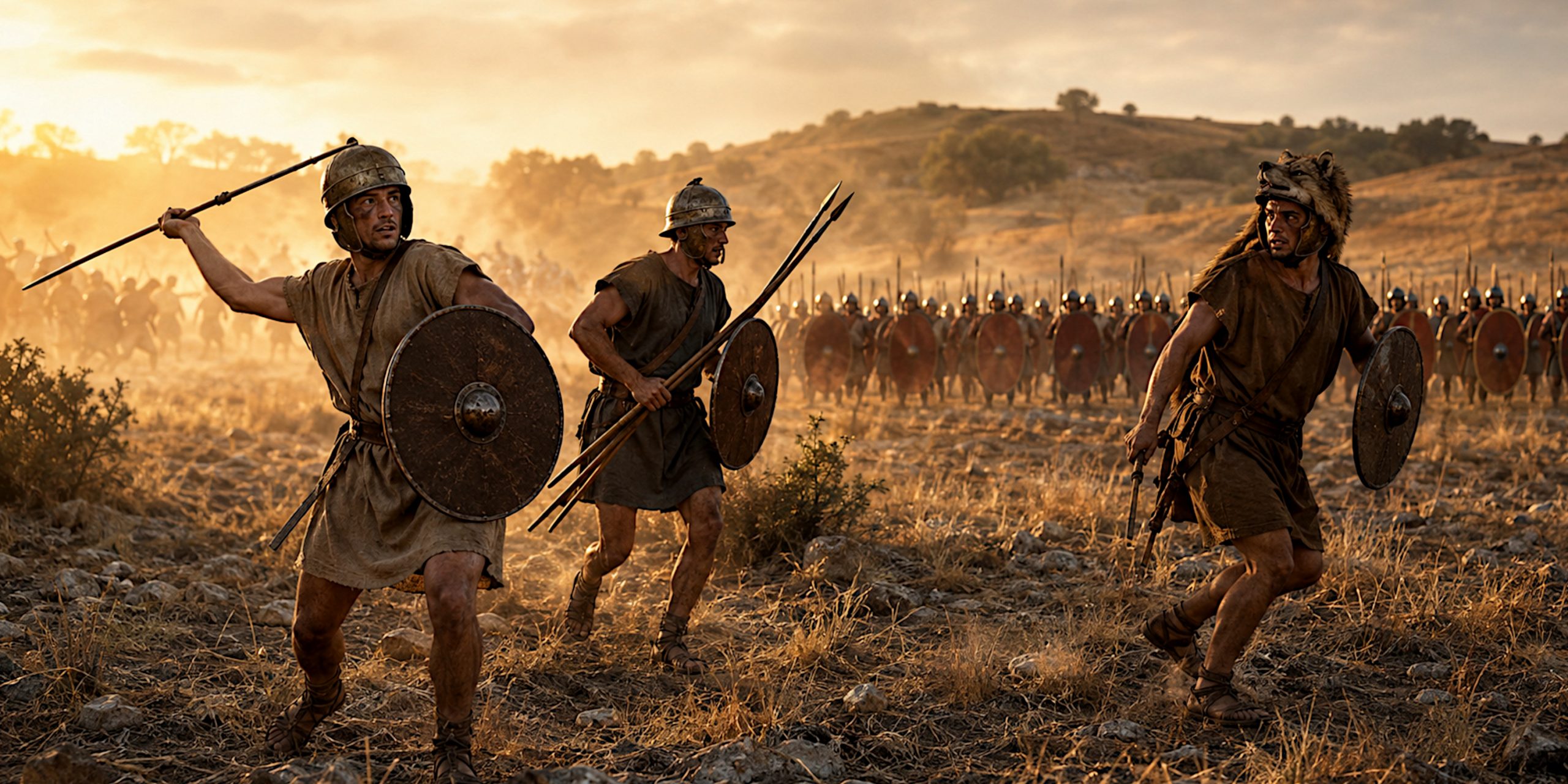
Roman velites were young, lightly equipped infantrymen who screened the Republican legion, harassed enemy formations and dealt with threats that heavier troops could not easily catch. They fought ahead of the main battle line with javelins, then withdrew through gaps between the maniples before the close fighting began.
That description is accurate, but only as a starting point. Velites were not simply inferior legionaries waiting to acquire better equipment. Their speed, loose formation and freedom of movement gave them a distinct tactical purpose. At battles such as Zama and Cynoscephalae, they performed work that the celebrated heavy infantry could not have done nearly as well.
They were also exposed, lightly protected and expected to confront cavalry, skirmishers and occasionally war elephants. Roman commanders apparently believed youth would compensate for this alarming job description.
Roman Velites at a Glance
| Category | Details |
|---|---|
| Period of greatest prominence | Third and second centuries BCE |
| Army | Roman Republic |
| Troop type | Light infantry and skirmishers |
| Position in the legion | Usually operated ahead of the main infantry lines |
| Typical number | About 1,200 in a standard Polybian legion |
| Recruitment | Primarily the youngest and least wealthy eligible infantrymen |
| Main weapon | Several light throwing javelins |
| Sword | A short sword, probably often a form of gladius Hispaniensis in the later third and second centuries BCE |
| Shield | Small round parma, approximately 90 cm across according to Polybius |
| Helmet | Plain helmet, sometimes covered with wolf skin or another animal hide |
| Body armour | Generally none |
| Principal roles | Screening, reconnaissance, skirmishing, disrupting formations and opposing elephants |
| Organisation | Distributed among the maniples rather than forming a permanently separate legionary line |
| Decline | Gradual disappearance during the late second and early first centuries BCE |
What Does Velites Mean?
The singular Latin form was veles, with velites used for the plural. The precise origin of the word remains uncertain, although Roman writers associated it with mobility and light equipment.
Livy offers an account in which a specially selected body of fast-moving infantry was created during the siege of Capua in 211 BCE. These men reportedly rode behind cavalrymen, dismounted quickly and attacked enemy horsemen on foot. Livy connects them with the name velites.
This passage is valuable, but it should not be read as a simple record of the unit’s invention. Light infantry had existed in Roman and Italian armies long before 211 BCE. Rome had previously used troops described as leves, rorarii and accensi, while its Italian allies fielded their own javelinmen and skirmishers.
The events at Capua may reflect the emergence of the name, a tactical experiment or a later Roman explanation for an institution whose development was more gradual.
When Did the Velites Serve?
Velites are most closely associated with the manipular legion of the middle Roman Republic, particularly during the Punic and Macedonian wars.
Their best description comes from the Greek historian Polybius, who wrote during the second century BCE and had close connections with leading Roman commanders. His account probably reflects Roman military practice in the later third or earlier second century BCE, although scholars continue to debate exactly how neatly his system worked in every campaign.
Velites appear frequently in accounts of:
- The Second Punic War
- The Roman conquest of Spain
- The Macedonian Wars
- Campaigns against Gallic armies
- Operations in Greece and Asia Minor
- The wars of the later second-century Republic
They did not belong to the Imperial Roman legion familiar from films, museums and endless menacing shots of rectangular shields. They were a product of an earlier military system.
Who Became a Veles?
Polybius describes the velites as the youngest soldiers enrolled in the legion. Wealth also mattered because Republican soldiers were generally expected to provide at least some of their own equipment.
Men unable to afford a large shield, substantial armour and the full equipment of a heavy infantryman were naturally suited to the lighter panoply of a veles. Their equipment was cheaper, but this did not necessarily mean that every veles belonged to the very poorest class in Roman society.
Age, property and available equipment all influenced allocation. Roman military categories were practical arrangements rather than perfectly rigid social castes.
The velites probably included many men in their late teens and early twenties. Service gave them battlefield experience before they entered the heavier ranks as they grew older and, ideally, acquired more wealth.
There was no guarantee that a soldier progressed neatly from veles to hastatus, then princeps and finally triarius. Life, income and survival rarely cooperate with tidy diagrams.
Organisation Within the Legion
Polybius gives a standard legion a strength of approximately 4,200 infantry and 300 cavalry. Of the infantry, 1,200 were velites.
The heavy infantry was divided into thirty maniples:
- Ten maniples of hastati
- Ten maniples of principes
- Ten maniples of triarii
The velites did not form a fourth continuous battle line. They were divided among the maniples, with roughly forty attached to each maniple if the legion contained 1,200 light infantrymen.
This arrangement allowed them to operate with considerable flexibility. Before battle they could gather in front of the legion. Once their skirmishing work was finished, they could retire through the intervals between the maniples and rejoin the units to which they belonged.
If a legion was expanded beyond its usual strength, Polybius says that the numbers of hastati and principes increased while the triarii remained fixed at 600. His account suggests that the velites normally remained a substantial element of the legion, although actual numbers must have varied through casualties, detachments and recruitment.
Arms and Armour
The fullest surviving description of velite equipment appears in Polybius’ Histories:
“The youngest soldiers or velites are ordered to carry a sword, javelins, and a target.”
He also describes their shield, helmet and distinctive animal-skin covering. This is unusually useful evidence, although it does not mean every veles looked identical across two centuries of warfare.
The Light Javelin
The principal weapon was a light javelin commonly called the hasta velitaris or verutum in modern discussions.
Polybius describes it as having:
- A wooden shaft about two cubits long
- A shaft roughly the thickness of a finger
- A narrow iron head
- An iron point approximately a span in length
- A fine shank designed to bend after striking
His measurements produce an overall weapon somewhere around 1.1 to 1.2 metres long, depending upon how the ancient units are interpreted.
This was lighter than the heavy infantryman’s pilum. A veles could carry several and throw them in succession. The weapon was intended to wound exposed men and animals, lodge in shields, disrupt formations and prevent easy reuse by the enemy.
Polybius claims that the thin point bent after impact. Archaeological and experimental work suggests that Roman javelin construction was more varied than this description implies. Some points may have bent, while others broke, remained straight or simply failed to penetrate. Ancient weapons were not always as obligingly theatrical as modern demonstrations suggest.
How Many Javelins Did a Veles Carry?
Polybius uses the plural but gives no precise number. Reconstructions sometimes show a veles carrying five, six or seven javelins, yet the ancient evidence does not establish a universal load.
A soldier needed enough missiles to sustain a skirmish without carrying so many that movement became awkward. The number may have varied according to campaign, tactical assignment and supply.
The Parma Shield
The veles carried a small round shield called a parma. Polybius gives it a diameter of about three Roman feet, close to 90 cm.
That is not a tiny buckler. A shield of this size could protect much of the torso while remaining lighter and easier to manage than the large oval scutum carried by heavy infantry.
Its construction probably involved wood, hide, glue and metal fittings. The exact form may have varied, and direct archaeological identification is difficult because wooden shields rarely survive intact.
Helmet and Animal Skin
Polybius says velites wore a plain helmet, sometimes covered with wolf skin or a similar material:
“They also wear a plain helmet, and sometimes cover it with a wolf’s skin or something similar.”
He explains that the covering helped officers identify individual soldiers and judge their conduct. The animal skin was therefore a recognition device as well as a modest form of protection and display.
The famous wolf-skin veles has become the standard modern reconstruction, but Polybius says only that such coverings were worn sometimes. Not every veles entered battle dressed like an unusually aggressive woodland mascot.
Helmets may have included simple bronze types related to the Montefortino tradition, although poverty, regional supply and the long period over which velites served make uniformity unlikely.
Body Armour
Velites generally fought without substantial body armour. They are not described as wearing mail or the square breastplate associated with some hastati and principes.
A soldier might have owned additional protection, but speed and low cost were central to the role. Heavy armour would have reduced mobility and undermined one of the principal advantages of light infantry.
What Sword Did the Velites Use?
Polybius explicitly gives the velites a sword, but he does not identify a separate sword pattern exclusive to them.
During the later third and second centuries BCE, the most likely weapon was a form of the gladius Hispaniensis, the Spanish-style sword adopted by Roman forces during or around the Second Punic War. It was a cut-and-thrust weapon with a strong point and a blade commonly reconstructed at roughly 60 to 70 cm long, although surviving Republican swords vary.
Earlier velites or their predecessors may have carried other Italo-Celtic or Mediterranean sword forms. The evidence does not support issuing every veles with one precisely standardised model.
| Sword type | Likelihood of use by velites | Notes |
|---|---|---|
| Gladius Hispaniensis | Strong for the later third and second centuries BCE | The principal Roman sword of the middle Republic |
| La Tène-influenced sword | Possible, particularly during transitional periods | Roman equipment drew heavily upon Celtic and Italian weapon traditions |
| Earlier Italic short sword | Possible for early light infantry | Relevant before the widespread adoption of the Spanish-style sword |
| Mainz or Pompeii gladius | Anachronistic for classic velites | These belong primarily to later Roman military contexts |
| Pugio dagger | Not established as standard velite equipment | Often added to reconstructions without firm evidence |
The sword was a secondary weapon. Velites were not supposed to stand in a dense line and trade blows with armoured infantry. If they had to draw swords during the opening skirmish, the plan had probably become unpleasantly personal.
How Velites Fought
Velites operated in open order ahead of the legion. Their immediate task was to deny the enemy an uncontested approach.
A typical sequence might involve:
- Advancing ahead of the hastati
- Throwing javelins at enemy skirmishers or formed troops
- Attempting to provoke a premature charge
- Screening Roman deployment from observation
- Contesting hills, streams and broken ground
- Withdrawing through gaps in the manipular formation
- Supporting cavalry or exploiting a disordered enemy
- Re-entering the fighting when circumstances demanded
Their formation had to be loose enough to allow individual movement. This made them less vulnerable to missiles and better able to use uneven terrain, but it left them poorly suited to resisting a determined charge by formed heavy infantry.
The velites were not expected to defeat the enemy army alone. Their purpose was to shape the opening stage of the battle so that the heavy infantry entered combat under favourable conditions.
Skirmishing Before the Main Battle
Ancient battles did not always begin with two immaculate infantry lines marching directly into one another. There could be prolonged movement, missile exchanges and contests over useful ground before the main formations met.
Velites might target:
- Enemy light infantry
- Officers and standard-bearers
- Unshielded troops
- Horses
- Elephants
- Men struggling across difficult terrain
- Dense formations vulnerable to missile disruption
Even when their javelins caused few fatalities, velites could force opponents to raise shields, slow their advance or break formation. A man did not need to be killed for a missile attack to spoil his afternoon.
Skirmishing also gathered information. By engaging the enemy screen, Roman commanders could judge numbers, morale and intentions before committing the main battle lines.
Reconnaissance and Outpost Duty
Velites were useful beyond formal battles. Their mobility made them suitable for reconnaissance, ambushes, outposts and operations in difficult country.
Before the Battle of Cynoscephalae in 197 BCE, the Roman commander Titus Quinctius Flamininus sent ten cavalry squadrons and 1,000 velites to reconnoitre. Heavy mist and broken hills turned this reconnaissance into an escalating engagement with Macedonian troops.
Livy records that Flamininus:
“Sent out ten squadrons of cavalry and a thousand velites to reconnoitre.”
The episode shows that velites could operate as a substantial independent screen alongside cavalry. It also demonstrates how quickly a reconnaissance fight could draw in larger forces and become a battle.
At Cynoscephalae, the flexible Roman formation eventually overcame Philip V’s Macedonian phalanx on uneven ground. The velites did not win the battle by themselves, but their initial contact helped determine where and how it began.
Velites Against War Elephants

War elephants presented a particular problem. Heavy infantry packed into close formation could be disrupted or trampled if the animals reached them at speed. Light infantry had more room to evade a charge while attacking the elephants and their crews with missiles.
Velites could:
- Shower elephants with javelins
- Target drivers and fighting crews
- Move aside rather than absorb the charge
- Funnel animals into prepared gaps
- Attack their less protected flanks
- Frighten or wound them until they became uncontrollable
At Zama in 202 BCE, Scipio Africanus arranged lanes through his army. When Hannibal’s elephants advanced, Roman skirmishers attacked them and withdrew into the spaces between the maniples.
Livy describes the velites moving aside and striking from both flanks:
“The skirmishers opened clear lanes between them and then caught them in cross fire by hurling spears against them from both sides.”
The manoeuvre did not make elephants harmless. Livy admits that some inflicted considerable losses among the velites. Their response nevertheless prevented the animals from smashing directly into a continuous Roman infantry line.
Zama is often presented as a perfectly executed Roman anti-elephant system. The reality was probably noisier, more dangerous and less geometrically satisfying. The system worked because Roman troops adapted under pressure, not because elephants politely followed arrows painted on the ground.
Velites and Roman Cavalry
Light infantry frequently cooperated with cavalry. They could protect horsemen from enemy skirmishers, occupy ground unsuitable for mounted troops and add missile power to cavalry engagements.
Livy’s story of the fighting near Capua describes selected infantrymen riding behind Roman cavalrymen before dismounting to attack. Whether this episode truly marks the creation of the velites or merely one stage in their development, it reveals a Roman willingness to combine troop types.
The relationship was tactically sensible. Cavalry offered speed and shock, while velites provided numbers and missile support. Against enemy horsemen, a cloud of javelins could upset a charge before Roman cavalry closed.
Famous Battles Involving Velites
Capua, 211 BCE
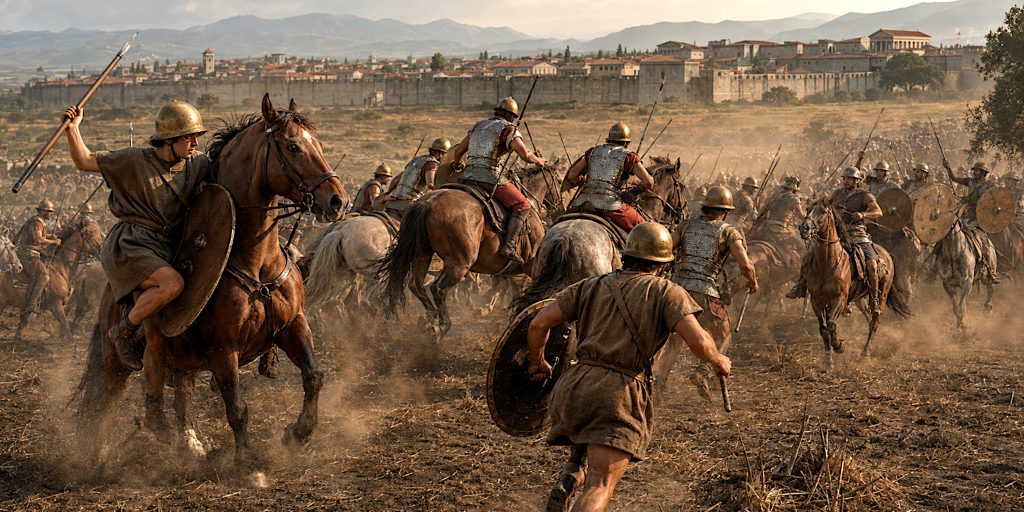
Livy connects the name and tactical identity of the velites with fighting around Capua during the Second Punic War. Light infantry reportedly cooperated closely with Roman cavalry against superior enemy horsemen.
The account may preserve a genuine tactical innovation, but it should not be treated as proof that Roman light infantry suddenly appeared in 211 BCE.
Ilipa, 206 BCE
At Ilipa in Spain, Scipio used his light infantry and cavalry aggressively during the opening stages of his victory over the Carthaginians. Skirmishers helped maintain pressure while Scipio altered the customary Roman deployment and attacked with his strongest troops on the wings.
Zama, 202 BCE
Velites screened the Roman army and played a central role in resisting Hannibal’s elephants. Their ability to scatter, withdraw through the formation and attack from the sides suited the carefully prepared Roman deployment.
Cynoscephalae, 197 BCE
A reconnaissance force including 1,000 velites became engaged with Macedonian troops in misty hill country. The ensuing battle demonstrated the adaptability of the manipular legion against a phalanx struggling on broken terrain.
Pydna, 168 BCE
Roman light troops took part in the confused fighting that preceded the collapse of Perseus’ Macedonian phalanx. As gaps opened in the Macedonian formation, Roman troops penetrated between the pikes and turned the battle into close combat.
Ancient descriptions do not always distinguish velites cleanly from allied light infantry, so their exact contribution should not be exaggerated.
Strengths and Weaknesses
| Strengths | Weaknesses |
|---|---|
| Fast and manoeuvrable | Poor protection against missiles and close combat |
| Effective on broken ground | Vulnerable to cavalry if caught in the open |
| Could screen the legion’s deployment | Unable to hold a firm battle line |
| Useful against elephants | Limited missile supply |
| Cheaper to equip than heavy infantry | Required discipline during withdrawal |
| Capable of reconnaissance and ambush | Difficult to control once widely dispersed |
| Could support infantry or cavalry | Depended upon heavier troops for protection |
The velites’ greatest defence was movement. Their small shields and helmets helped, but survival depended upon choosing when to approach and when to retreat.
A badly timed withdrawal could obstruct the hastati behind them. A retreat that began too late could become a rout. Effective skirmishing therefore demanded confidence and discipline, qualities sometimes obscured by the assumption that light troops were merely inexperienced youths.
What Archaeology Tells Us
Archaeology provides abundant evidence for Republican swords, helmets, shields and javelins, but identifying an object as specifically belonging to a veles is much harder.
Weapons do not normally come with a convenient label naming the owner’s tactical classification. The same general forms could be used by Roman heavy infantry, light troops, allied contingents and Rome’s enemies.
Javelin Heads
Iron javelin heads are found in graves, military deposits and battlefield assemblages across Italy and the western Mediterranean. Their shapes include:
- Narrow tanged points
- Socketed points
- Barbed heads
- Long, slender iron shanks
- Heavier forms associated with the pilum
Small points may have belonged to velite javelins, but size alone rarely proves this. A hunting spear, light infantry weapon or allied missile can look remarkably similar after two thousand years underground.
The weapon deposits from Talamonaccio, associated with the Roman victory over a Gallic army at Telamon in 225 BCE, include numerous javelin components. They demonstrate the variety of missile weapons used in Republican warfare, although assigning individual pieces to velites remains uncertain.
Montefortino Helmets
Bronze Montefortino-type helmets are among the most recognisable finds from the Republican period. Their use spread through Celtic, Italic and Roman military cultures.
Some could have been worn by velites, particularly the plain and relatively inexpensive examples. Yet these helmets also belonged to heavier infantry and other soldiers. Archaeology supports the general equipment context described by Polybius, but not a distinct velite uniform.
Swords
Republican sword finds from Iberia, Italy, Slovenia and other regions reveal considerable variation. Blades associated with the gladius Hispaniensis were longer than many later Imperial gladii and capable of both cutting and thrusting.
These finds support the presence of such swords in Roman armies during the period when velites are well documented. They cannot usually tell us whether a particular sword belonged to a veles, hastatus or allied soldier.
Shields
The parma is poorly represented archaeologically because its wooden and hide components were perishable. Metal bosses, edging and fittings survive more readily, but they are not always easy to connect with a complete shield shape.
Polybius remains the principal evidence for the velite shield’s dimensions.
Animal Skins
Wolf skins and similar organic materials almost never survive in ordinary Mediterranean archaeological conditions. Their use rests primarily upon literary testimony and artistic reconstruction.
No archaeological discovery justifies imagining wolf skins as compulsory velite equipment. Polybius’ cautious “sometimes” deserves to survive contact with the illustrator.
Problems With the Evidence
Most of what we know about velites comes from writers rather than soldiers.
Polybius is the strongest source because he understood military affairs and observed the Roman political and military system at close range. Even so, his account is schematic. It describes how the legion was supposed to be recruited and organised, not necessarily the precise condition of every army in every year.
Livy supplies many vivid battle narratives, but he wrote around two centuries after some of the events he described. His terminology may reflect later assumptions, and his accounts often depend upon earlier sources that no longer survive.
Several problems remain:
- The date at which velites became a clearly defined category is uncertain
- Their equipment probably varied by period and campaign
- Ancient writers sometimes use broad terms for light-armed troops
- Roman and allied skirmishers can be difficult to separate
- Archaeological weapons cannot usually be assigned to a troop class
- The disappearance of the velites cannot be tied securely to one reform or one year
Any reconstruction should therefore distinguish between Polybius’ idealised legion and the messier armies that marched, fought and replaced lost equipment in the field.
Did the Marian Reforms Abolish the Velites?
The traditional account claims that Gaius Marius abolished the velites as part of sweeping military reforms beginning in 107 BCE. This explanation is memorable, convenient and increasingly questioned.
There is little ancient evidence for a single programme in which Marius redesigned the Roman army at once. Recruitment, equipment and tactical organisation changed over several decades. Cohorts became increasingly important, property qualifications lost much of their force, and equipment grew more standardised, but the process was uneven.
Recent scholarship has also challenged the claim that velites simply vanished at the moment Marius recruited volunteers from the poorest citizens. Light-armed Roman troops continued to appear in late Republican warfare, although ancient authors used different descriptions and the formal Polybian categories became less visible.
It is safer to say that the velites gradually disappeared as a named legionary class during the late second and early first centuries BCE.
Their battlefield functions remained necessary. They were increasingly performed by:
- Legionaries operating in loose order
- Archers
- Slingers
- Local auxiliaries
- Cretan missile troops
- Balearic slingers
- Numidian infantry
- Other allied and specialist contingents
Marius may have contributed to changes in recruitment and organisation, but there was no morning on which Rome woke to discover that every veles had been made redundant by administrative decree.
Velites Compared With Other Ancient Skirmishers
| Troop type | Main weapon | Shield | Typical distinction |
|---|---|---|---|
| Roman veles | Light javelins and sword | Round parma | Integrated into the manipular legion |
| Greek peltast | Javelins | Crescent or round light shield | Flexible light infantry with a long Mediterranean history |
| Greek psilos | Bow, sling or javelin | Often little or no shield | Broad term for lightly armed missile troops |
| Balearic slinger | Sling | Minimal protection | Exceptional missile range and specialist training |
| Cretan archer | Composite or self bow | Usually limited | Highly valued mercenary missile infantry |
| Numidian light infantry | Javelins | Small shield | Particularly mobile and effective in dispersed warfare |
| Roman hastatus | Pilum and sword | Large scutum | Formed heavy infantry, not a dedicated skirmisher |
Velites belonged to a wider Mediterranean tradition of light infantry. What distinguished them was their close integration with the Roman manipular system.
They were citizen soldiers attached to the legion’s internal organisation, rather than a separate body of foreign specialists.
Were Velites Expendable?
Their youth, limited armour and exposed position have encouraged the idea that velites were treated as disposable troops. The evidence does not support so simple a conclusion.
Rome certainly placed them in danger. Screening the army meant being the first troops within missile range and often the first to meet an enemy attack. Yet the legion depended upon them to perform important tasks, and their withdrawal routes were built into the manipular formation.
They were not sent forward merely to absorb arrows. They were expected to fight intelligently, preserve themselves and return behind the heavy infantry when ordered.
Polybius’ remark that animal skins allowed officers to recognise soldiers who fought bravely suggests that individual conduct was observed and valued. Courage among the velites could bring reputation and perhaps future advancement.
They were vulnerable, but vulnerability is not the same as worthlessness.
The Historical Importance of the Velites
The velites reveal why the Republican legion was more adaptable than its popular image suggests. Roman armies did not consist only of close-packed swordsmen advancing behind large shields. They combined heavy infantry, cavalry, citizen skirmishers and allied troops in a flexible system.
Velites extended the legion’s reach. They could fight before the main line engaged, move across ground unsuitable for dense formations and respond to unusual threats. Their contribution is clearest when Roman commanders faced armies built around elephants, cavalry or the Macedonian phalanx.
They also embodied an important feature of Republican military service. A legion contained men of different ages, resources and levels of experience, each assigned a role that broadly reflected what he could provide and what commanders expected him to do.
The veles stood at the lightest end of that system, but he was still a Roman citizen soldier and an integral part of the legion.
Frequently Asked Questions
Were velites professional soldiers?
No. Most were citizen soldiers recruited through the Republican levy. Some men accumulated extensive experience during long wars, especially during the Second Punic War, but the velites did not form a permanent professional corps.
Did all velites wear wolf skins?
No. Polybius says they sometimes wore wolf skins or similar coverings. The practice was distinctive, not universal.
Did velites use bows?
Their standard weapon was the javelin. Rome employed archers, but these were usually separate allied, mercenary or auxiliary troops.
Did velites carry a gladius?
Polybius says they carried a sword. During the classic period of the velites, this was probably often a form of gladius Hispaniensis. The evidence does not prove that every veles carried an identical sword pattern.
Did velites use the pilum?
They carried lighter javelins than the heavy pila associated with hastati and principes. Terminology in ancient and modern sources can be inconsistent, but the distinction in weight and tactical use matters.
How many velites were in a legion?
Polybius gives approximately 1,200 in a standard legion of 4,200 infantry. Actual campaign strength undoubtedly varied.
Were velites the poorest Roman soldiers?
They were commonly drawn from younger and less wealthy recruits, but age, property and equipment all affected allocation. Describing every veles as a member of the landless poor goes beyond the evidence.
What happened to the velites?
They gradually disappeared as a named class during the transformation of the late Republican army. Their duties passed to other legionaries and specialist missile troops.
Takeaway
The Roman veles was lightly equipped, but not militarily insignificant. He screened the legion, contested difficult ground, supported cavalry, disrupted enemy formations and faced threats that heavily equipped soldiers were poorly placed to handle.
Polybius gives us a recognisable figure: a young soldier with several light javelins, a round shield, a sword and a simple helmet, occasionally made more conspicuous by an animal skin. Archaeology confirms the broader world of weapons and equipment in which he served, but it rarely allows an individual object to be labelled securely as velite equipment.
His disappearance was equally untidy. The velites were not abolished in one clean Marian reform. They faded as recruitment, equipment and battlefield organisation changed across the late Republic.
Rome’s heavy infantry won the lasting fame, understandably enough. It occupied the centre of the battle and usually decided the result. Yet before the hastati advanced, someone had to cross the open ground, test the enemy and irritate a war elephant with a handful of javelins. That someone was very often a veles.
Principal Sources
- Polybius, Histories, Book 6
- Livy, History of Rome, Book 30
- Livy, History of Rome, Book 33
- François Gauthier, “Did Velites Really Disappear in the Late Roman Republic?”, Historia
- Michael J. Taylor, “Panoply and Identity During the Roman Republic”, Papers of the British School at Rome
- Jeremy Armstrong, “The Origins of the Roman Pilum Revisited”, Journal of Roman Military Equipment Studies