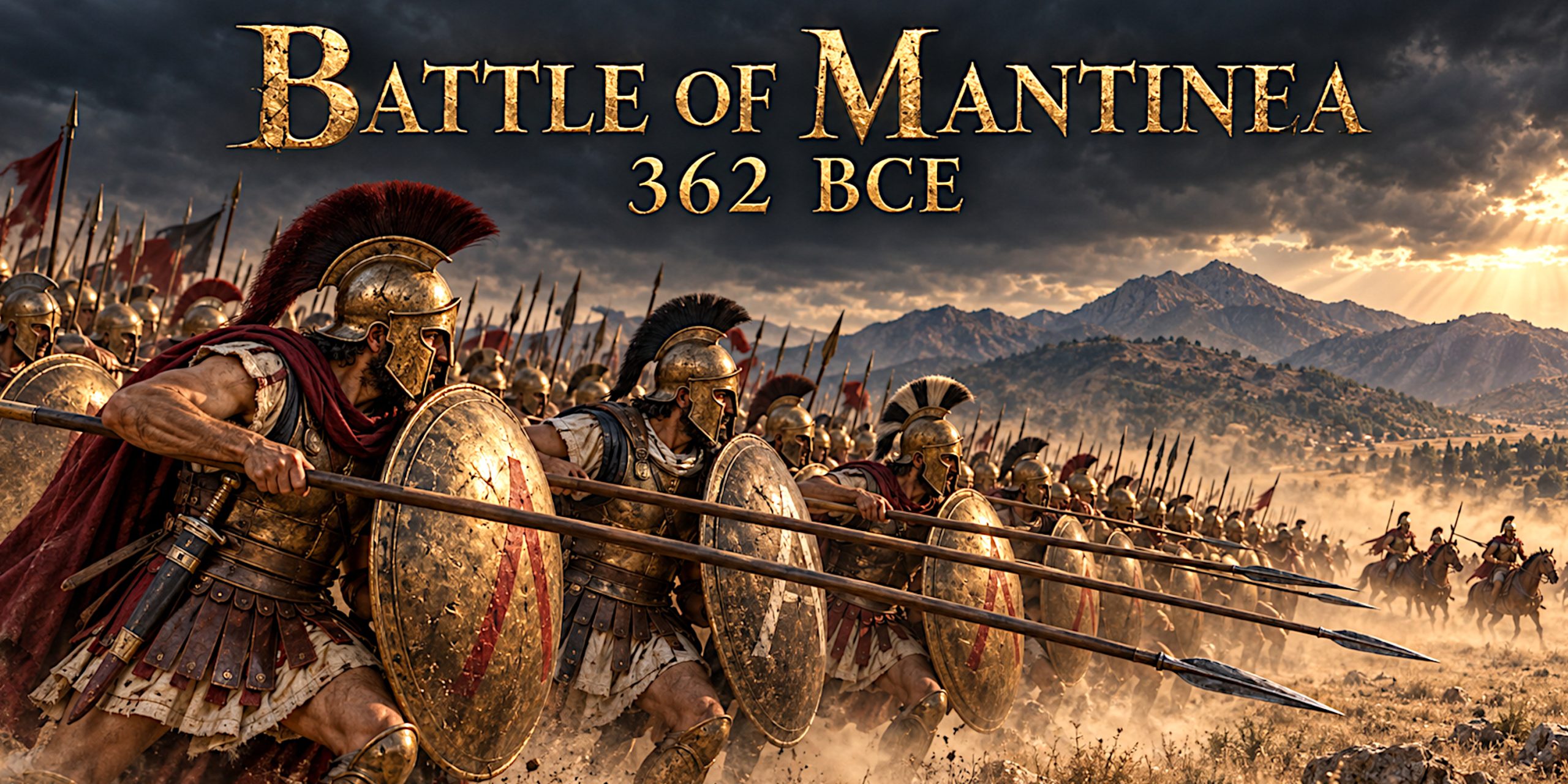
At the Battle of Mantinea in 362 BCE, the Theban commander Epaminondas broke through an enemy army and received a mortal wound. His allies had achieved a battlefield success, but they struggled to turn it into a settlement that would secure their supremacy.
That tension makes Mantinea so compelling. Military skill could win ground. It could not oblige the Greek city-states to agree on who should govern it.
I find the battle more revealing when we resist treating it as the moment Greece inevitably surrendered its future to Macedon. The people fighting outside Mantinea were defending immediate interests, local alliances and vulnerable communities. They were not obligingly arranging the next chapter of a history book.
Battle of Mantinea at a Glance
| Detail | Summary |
|---|---|
| Date | Summer 362 BCE |
| Location | Near Mantinea, also written Mantineia, in Arcadia in the Peloponnese |
| Principal opponents | Thebes and its allies against a coalition centred on Mantinea, Sparta and Athens |
| Leading Theban commander | Epaminondas |
| Battlefield result | Theban breakthrough, followed by an incomplete exploitation of success |
| Principal loss | Epaminondas, mortally wounded |
| Wider outcome | A disputed victory and no durable settlement of Greek leadership |
| Casualties | No securely established totals |
This was a different engagement from the Battle of Mantinea in 418 BCE, when Sparta defeated an alliance including Argos and Athens.
Why Was the Battle Fought?
Thebes’ victory over Sparta at Leuctra in 371 BCE had transformed Greek politics. Spartan military prestige was damaged, and Theban intervention helped sustain a new balance of power in the Peloponnese.
Yet opposition to Sparta did not produce agreement about Thebes. By 362 BCE, Arcadia itself was divided. Tegea supported the Theban alliance, while Mantinea sought assistance from Athens and Sparta.
Xenophon describes the fear that Theban intervention would keep the Peloponnesians dependent and divided. That suspicion mattered as much as any grand ambition for supremacy. A protective ally could begin to look rather like a permanent supervisor.
Epaminondas therefore faced a political problem as well as a military one: his presence had to reassure supporters while compelling opponents to accommodate Theban influence.
Forces
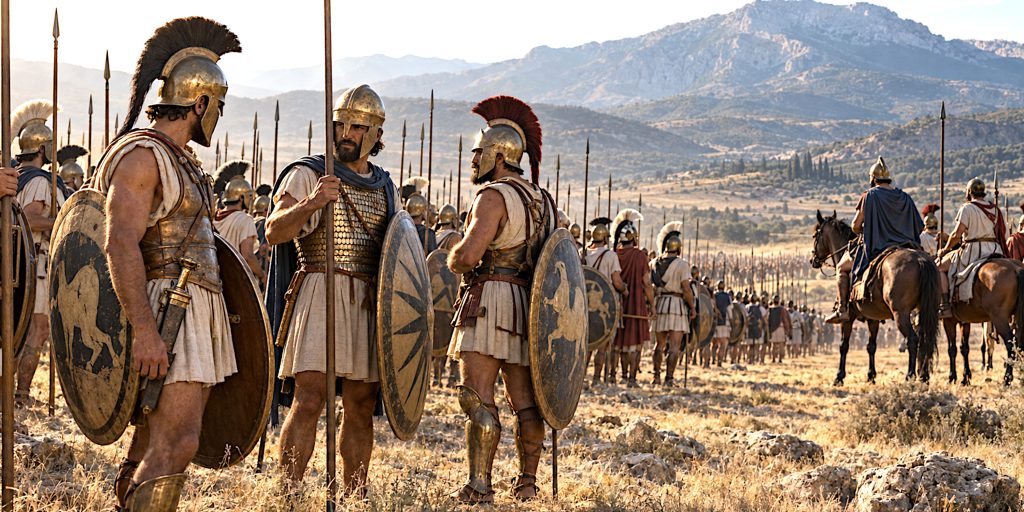
The familiar troop figures come from Diodorus Siculus, writing centuries after the battle. They are useful ancient estimates, not surviving muster rolls.
| Alliance | Principal contingents | Infantry reported by Diodorus | Cavalry reported by Diodorus |
|---|---|---|---|
| Thebes and allies | Boeotians, Tegeans and other allied Arcadians, Argives, Messenians, Thessalians and additional contingents | More than 30,000 | At least 3,000 |
| Mantinea and allies | Mantineans, Spartans, Athenians, Eleans, Achaeans and others | More than 20,000 | About 2,000 |
Neither army was simply a national force in the modern sense. Both were coalitions whose contingents brought their own loyalties, equipment and expectations.
Descriptions such as “Thebes versus Sparta” are convenient but incomplete. Mantinea was fought over Arcadian interests, and Arcadians stood on both sides.
Leaders and Troop Composition
| Figure | Role | Important qualification |
|---|---|---|
| Epaminondas | Directed the Theban campaign and decisive attack | His personal leadership is central to the surviving narratives |
| Agesilaus II | Spartan king involved in the campaign and defence of Sparta | He should not automatically be presented as commander of the entire allied army at Mantinea |
| Hegesileos | Named by Diodorus as the general accompanying Athenian reinforcements | His appearance does not establish unified command over the coalition |
| Podares | Mantinean leader commemorated locally after his death | Pausanias records his hero-shrine |
| Gryllus | Athenian cavalryman and son of Xenophon | A celebrated casualty, not an overall allied commander |
The surviving accounts distinguish individual commanders and local heroes more clearly than they establish an uncomplicated hierarchy for the whole allied army.
The main troop types were:
- Hoplites: heavy infantry fighting with large shields and spears.
- Cavalry: important for screening, attack and pressure against exposed formations.
- Light infantry: missile troops and other lightly equipped soldiers.
- Infantry supporting cavalry: foot soldiers whose presence could make a mounted engagement much less comfortable for the opposing horsemen.
Coalition warfare also complicated authority. Xenophon records an arrangement under which each participating people exercised leadership within its own territory. A single name above every allied unit would give a misleading impression of tidiness.
Arms and Armour
Equipment varied with wealth, local practice and individual preference. A reconstruction should show a recognisable Greek military culture without dressing every soldier identically.
| Equipment | Form and purpose | Qualification |
|---|---|---|
| Dory | Thrusting spear, the hoplite’s principal weapon | The sword normally supported the spear |
| Aspis | Large round shield, usually with a wooden body and bronze facing | Its construction mattered as much as its appearance |
| Helmet | Bronze protection in several contemporary forms, including Chalcidian and Thracian types | No single pattern equipped both armies |
| Body armour | Bronze cuirasses and organic armour, including linen-based forms | Protection was not uniform |
| Greaves | Shin protection, commonly bronze | Not necessarily worn by every combatant |
| Missile weapons | Javelins and sling stones among the light troops | Could influence fighting beyond the hoplite line |
The standard hoplite equipment combined offensive reach with substantial protection. Surviving objects and representations support this general picture; they do not provide an inventory for each contingent at Mantinea.
Specific sword types
| Sword | Characteristics | Likely military role |
|---|---|---|
| Xiphos | Straight, double-edged sword, often with a leaf-shaped blade | A sidearm suited to thrusts and cuts in close combat |
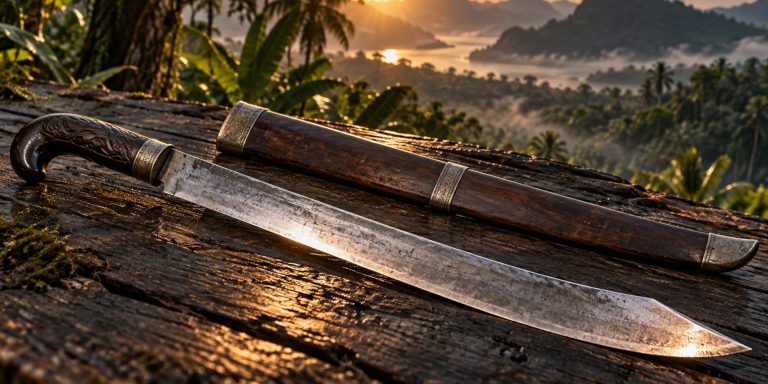
| Kopis | Single-edged cutting sword with a forward-curving profile | Associated with forceful cuts and mounted use |
| Machaira | A term used for cutting blades whose meaning overlaps with other sword terminology | Should not be treated as an entirely separate, standardised service weapon |
Xenophon’s On Horsemanship recommends a cutting blade for cavalry because a rider’s elevated position favours the cut. This supports the relevance of such weapons to the period, but does not prove which sword every Theban or Athenian carried.
There is no secure basis here for assigning a distinctive machaira pattern specifically to Theban cavalry.
Battle Timeline
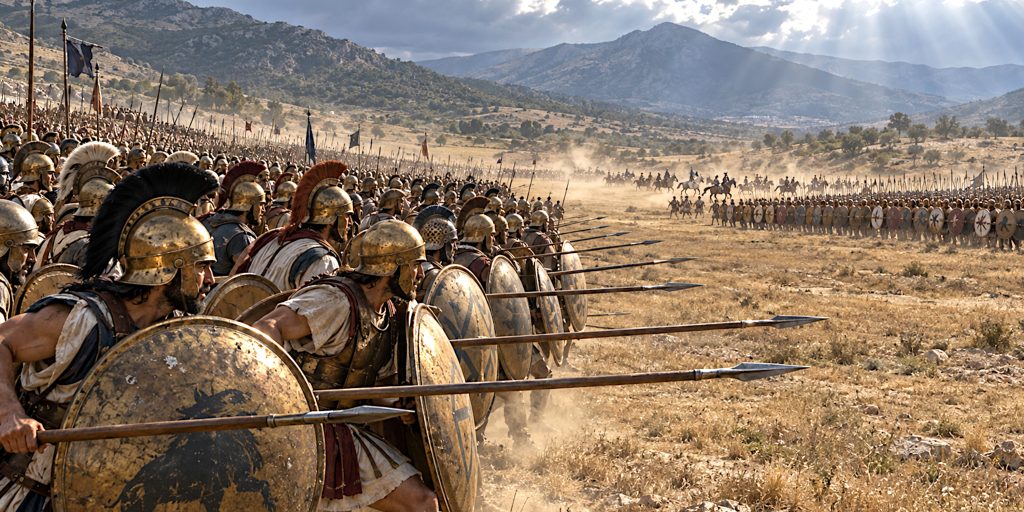
The sequence is clearer than the precise timing. Xenophon and Diodorus also differ in detail, so an hour-by-hour reconstruction would promise more than the sources can supply.
| Stage | What happened |
|---|---|
| Opening manoeuvres | Epaminondas attempted to surprise Sparta but failed to capture it |
| Return towards Mantinea | A subsequent Theban cavalry move was checked by Athenian horsemen |
| Preparation for battle | Epaminondas concentrated strength on his left and held weaker elements back |
| Main attack | His strongest formation advanced against the allied right |
| Breakthrough | The Theban attack gained the advantage |
| Mortal wound | Epaminondas fell during the fighting |
| Disrupted exploitation | His army failed to convert the breakthrough into a complete destruction of its opponents |
| Aftermath | Both sides claimed success; a general peace followed, with Sparta remaining outside it |
The preliminary cavalry fighting should be distinguished from the mounted engagements during the main battle. Compressing everything into one cavalry charge obscures the campaign’s sequence.
How Epaminondas Won the Breakthrough
Xenophon describes a calculated deception. Epaminondas appeared to settle near the hills, encouraging his opponents to relax, before launching an unexpected advance.
His strongest troops attacked while weaker elements remained behind. The purpose was to win at the chosen point before vulnerable parts of his own army could be defeated. Cavalry supported by intermingled infantry added another source of pressure.
The useful lesson is concentration: an army need not be equally strong everywhere if it can make one sector decisive. Its success still depends on timing, discipline and the enemy’s response.
It is tempting to turn this into a flawless diagram, with every formation moving exactly as intended. Real men had to perform those movements while watching an enemy approach. The diagram had the easier afternoon.
The Death of Epaminondas
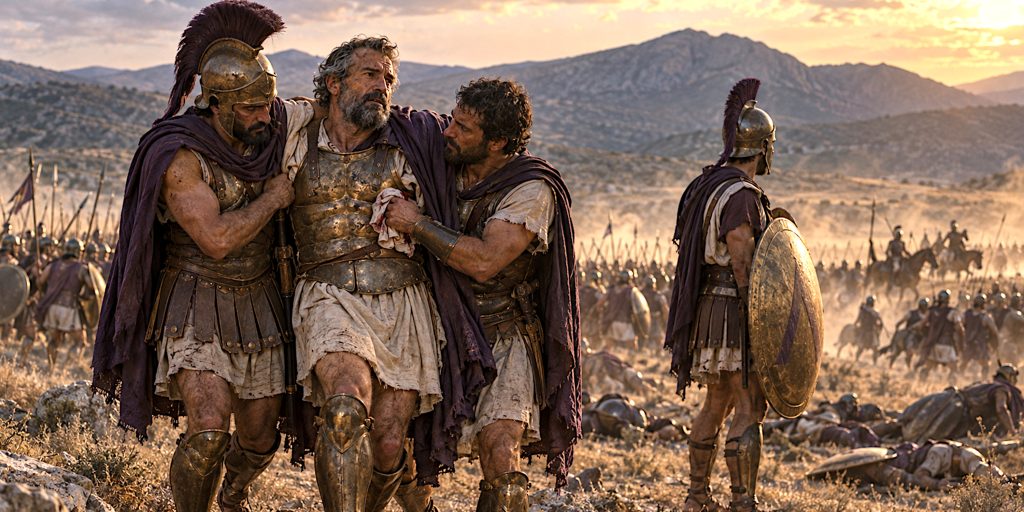
Cornelius Nepos, a later biographer, describes Spartan soldiers recognising Epaminondas and directing their attacks towards him. He presents the general’s survival as inseparable from his army’s prospects.
That is a powerful explanation, although the biographical tradition also gives his death an exemplary, almost theatrical shape. Stories of his composure after being wounded deserve to be read as crafted accounts, rather than transcripts taken beside a battlefield stretcher.
The identity of the man who inflicted the wound remains disputed. Pausanias preserves competing local claims, including the Athenian tradition crediting Gryllus. These accounts should be reported as rival traditions rather than combined into a single confident story.
Leading from the front could inspire an attack. It also placed an army’s most valuable commander within reach of an enemy weapon. Mantinea exposes that bargain with unusual severity.
Contemporary Quotes: Xenophon on Mantinea
Xenophon was contemporary with the events, although he should not automatically be described as an eyewitness to this battle.
In Hellenica 7.5.23, he captures the concentrated attack with the phrase:
“prow on, like a trireme”
The naval comparison conveys the intention to strike through a particular point.
His judgement on the wider outcome, in Hellenica 7.5.27, is considerably less triumphant:
“even more confusion and disorder in Greece after the battle than before”
Both extracts follow Carleton L. Brownson’s translation. Together they explain why a skilful attack and a successful political settlement are separate achievements.
Archaeology: What the Evidence Actually Shows
The archaeology needs more care than a list of plausible weapons.
The ancient city
Mantinea’s excavated theatre and civic centre help recover the community for which the battle was fought. They are evidence for the city’s history, rather than proof of particular battlefield movements. The theatre was uncovered during French excavations in the nineteenth century, and its surviving fabric reflects more than one period of construction.
Ancient memorials
Pausanias, writing in the second century CE, describes a tomb attributed to Epaminondas, its shield decoration and inscriptions. His account records how the battle was commemorated long afterwards. It does not by itself establish a modern archaeological identification.
A surviving political document
An alliance decree dated to 362/361 BCE, represented by a stele in the Acropolis Museum, records Athens’ defensive agreement with Peloponnesian partners after the battle. This is valuable material evidence for the continuing diplomatic activity behind the narrative of exhaustion.
Weapons attributed to the battle
Claims about recovered xiphos blades, shield fragments or spearheads require a published findspot and secure archaeological context. The sources checked for this article do not establish a securely attributed collection of weapons from the 362 BCE battlefield.
A Greek weapon found in Arcadia is not automatically a relic of Mantinea. Attractive labels are easier to manufacture than secure provenance.
Outcome and Legacy
Mantinea is best described as a Theban tactical success with an inconclusive wider result. Epaminondas’ death made the achievement more difficult to exploit, while his opponents retained enough strength to dispute the meaning of the day.
The aftermath also involved negotiation and new alliances. The surviving Athenian decree is a useful reminder that Greek political life continued through practical agreements, not simply through a collective collapse of confidence.
I would therefore avoid calling Mantinea the end of independent Greek power. That formulation makes later Macedonian success seem predetermined and compresses a complicated period into a convenient farewell scene.
The battle’s enduring significance lies in the gap between military achievement and political control. Epaminondas could create an opening on the battlefield. No commander could guarantee that the states of Greece would agree on what should follow.
Sources and Further Reading
- Xenophon, Hellenica, Book 7, Chapter 5: the principal contemporary narrative.
- Diodorus Siculus, Library of History, Book 15, Chapters 82–89: troop estimates and a later account.
- Pausanias, Description of Greece, Book 8: local memorials and competing traditions.
- Acropolis Museum, alliance decree of 362/361 BCE: material evidence for post-battle diplomacy.