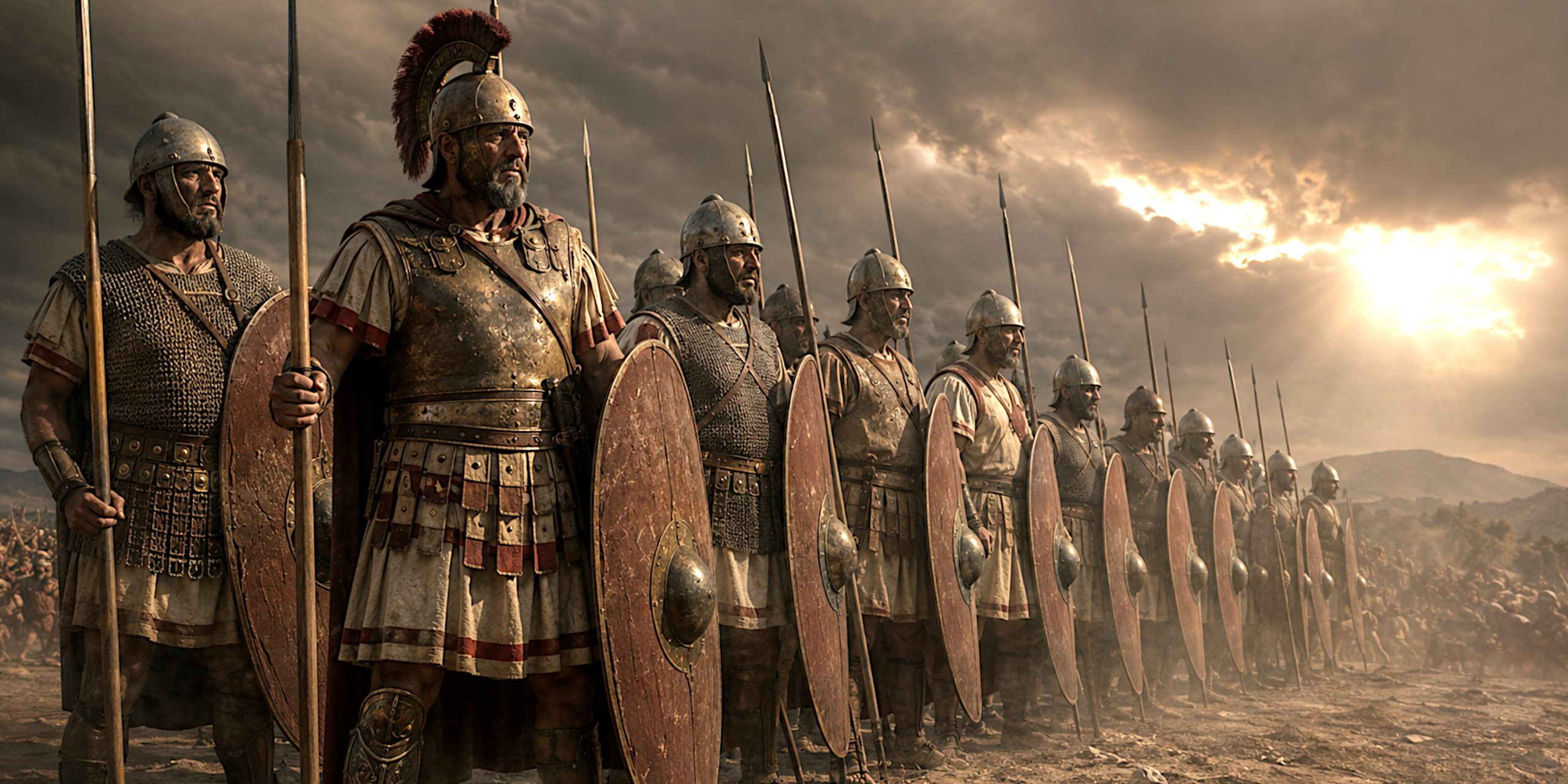
The triarii were the veteran heavy infantry of Rome’s manipular legion. Positioned behind the hastati and principes, they formed the final line of a battle formation designed to absorb shocks, renew an attack and prevent a defeat from becoming a rout.
Their reputation has rather overshadowed the evidence. Triarii are frequently presented as an elite corps of grey-haired spearmen who spent every battle kneeling patiently until ordered to save Rome. There is some truth beneath the theatrical version, but Roman military organisation changed repeatedly, ancient authors were not always describing the same period, and archaeology cannot conveniently label a corroded spearhead as belonging to a triarius.
Even so, the triarii reveal something important about Roman warfare. The Republic did not rely upon one decisive charge. It arranged infantry in depth, preserved experienced men as a reserve and expected a damaged formation to recover while the battle was still being fought. That was a rather more sophisticated system than simply placing the bravest men at the front and hoping Mars was paying attention.
Who Were the Triarii?
The triarii were the third and final line of heavy infantry in the middle Republican legion. Their name probably derives from tertius, meaning third, referring to their position in the formation.
They were generally experienced, established soldiers. Polybius associated the different classes of Roman infantry partly with age and military experience, although wealth, equipment and civic status also influenced Republican recruitment.
A typical manipular battle line consisted of:
| Line | Troops | General character | Principal battlefield role |
|---|---|---|---|
| Screening force | Velites | Younger or less heavily equipped skirmishers | Harassment, missile fighting and screening |
| First line | Hastati | Relatively young heavy infantry | Opening close-order engagement |
| Second line | Principes | More mature and experienced infantry | Renewing or reinforcing the main battle |
| Third line | Triarii | Veteran heavy infantry | Reserve, reinforcement and protection during withdrawal |
This arrangement should not be imagined as a permanent military caste system. A man was not necessarily appointed a triarius for life, nor did every Republican army follow an identical pattern across several centuries. Rome’s forces were levied for particular campaigns and discharged afterwards. The triarius was a category within a changing civic army, not the member of a standing regiment with an uninterrupted institutional history.
When Did the Triarii Exist?
The origins of the triarii are difficult to date precisely. Livy places them within his account of Roman warfare in the fourth century BCE, particularly during the Latin War. His description may preserve genuine early traditions, but it was written roughly three centuries after the events concerned.
The system is most securely described by Polybius, whose account relates to the Roman army of the middle Republic, particularly the period of the Punic Wars.
A cautious chronology looks like this:
| Period | Probable development |
|---|---|
| Fifth to early fourth century BCE | Roman infantry probably retained strong central Italian and Greek influences |
| Fourth century BCE | More flexible formations developed during wars against neighbouring Italian peoples |
| Third century BCE | The manipular legion became Rome’s characteristic field formation |
| Punic Wars | Hastati, principes and triarii are clearly associated with the legion in depth |
| Second century BCE | Equipment and tactical distinctions between the three lines became less rigid |
| Late second to early first century BCE | The triplex infantry classification disappeared as the cohort became the principal tactical formation |
The familiar claim that Gaius Marius abolished the triarii in a single sweeping reform around 107 BCE is too tidy. There was no surviving Roman document announcing a complete “Marian reform package”. The transition towards more uniform heavy infantry, cohort-based deployment and prolonged military service developed gradually.
Marius mattered, but Roman institutions had the inconsiderate habit of evolving without leaving historians a convenient launch date.
The Manipular Legion
During the period described by Polybius, the legion was divided into maniples rather than relying exclusively upon the later cohort system.
The hastati and principes each formed ten maniples. The triarii were also divided into ten tactical units, but Polybius gives them only half the manpower of the other heavy infantry classes.
Approximate Polybian legionary strength
| Infantry type | Approximate strength |
|---|---|
| Velites | 1,200 |
| Hastati | 1,200 |
| Principes | 1,200 |
| Triarii | 600 |
| Roman cavalry | 300 |
| Total Roman legion | Around 4,500 |
The numbers could vary when a legion was raised above normal strength. Polybius specifically notes that the number of triarii remained fixed at 600 even when other infantry contingents increased.
A triarii maniple therefore contained around 60 men, compared with approximately 120 hastati or principes. Each maniple was divided administratively into two centuries, although the word “century” did not guarantee a strength of exactly 100 men.
The legion normally fought alongside an allied formation supplied by Rome’s Italian partners. A consular army commonly contained two Roman legions and two corresponding allied contingents. The supposedly pure Roman battlefield machine was therefore heavily dependent upon other Italians, a fact later Roman storytelling sometimes treated with selective eyesight.
How the Triarii Fought
The triarii occupied the third line of the legion’s heavy infantry formation. They did not usually begin the main engagement. That task fell first to the velites and hastati.
A simplified sequence ran as follows:
- Velites moved forward to skirmish and disrupt the enemy.
- The skirmishers withdrew through spaces in the Roman formation.
- Hastati engaged as the first heavy infantry line.
- If the hastati could not prevail, they withdrew or were absorbed into the intervals of the principes.
- The principes renewed the contest.
- The triarii were committed when the first two lines had failed, become exhausted or needed support.
- If victory was no longer possible, the triarii could cover an organised withdrawal.
The actual process was probably less mechanical than this summary suggests. Battles produced dust, noise, wounded men, broken formations and confused orders. A commander could deploy troops differently according to terrain and circumstances. The lines may also have supported one another through local reinforcement rather than conducting three perfectly separated combats.
Modern scholarship has challenged the idea that Roman maniples routinely left broad, undefended gaps directly in front of the enemy. The intervals may have been closed before contact, offset in a chequered arrangement or used to allow troops to pass through during controlled relief. Ancient evidence does not provide a complete drill manual.
Did the Triarii Fight Kneeling?
Livy describes the triarii waiting behind the other lines with the left leg extended, their shields resting against the shoulder and their spears planted in the ground. This posture is often reduced to the claim that triarii always fought on one knee.
They almost certainly did not conduct spear combat while kneeling. Livy is describing a waiting or braced position before commitment. It may have allowed the reserve to rest, remain compact and present a lower target while the fighting continued ahead.
There are reasons for caution:
- Livy was describing a battle supposedly fought in 340 BCE.
- He wrote during the Augustan period.
- His terminology may combine early traditions with practices more familiar to later Romans.
- Polybius does not offer the same dramatic description of kneeling triarii.
The posture is possible, but it should not be treated as a universal regulation observed in every Republican battle.
Res Ad Triarios Rediit
The status of the triarii entered Roman language through the expression:
“The matter has come down to the triarii.”
Livy uses the Latin phrase res ad triarios rediit when describing the desperate final phase of battle. It became a proverb for a situation that had reached its last and most serious resort.
The saying did not mean that the triarii routinely won battles through heroic intervention. It meant that the normal fighting lines had failed to settle the matter. If the triarii were being committed, events had become distinctly uncomfortable.
This is one reason the veterans acquired such prestige. They represented the final organised strength of the legion. They were not simply another body of infantry waiting its turn.
Arms and Armour
Roman Republican equipment was neither completely uniform nor produced from a single state-controlled pattern. Soldiers traditionally supplied much of their own kit, while captured weapons, regional manufacturing and changing fashions all contributed to considerable variation.
The triarii nevertheless appear to have been among the more heavily equipped troops.
Typical triarii equipment
| Item | Description and use |
|---|---|
| Hasta | Long thrusting spear associated particularly with the triarii |
| Sword | A short or medium-length sidearm used when spear fighting became impractical |
| Scutum | Large, curved body shield, usually oval during much of the Republic |
| Helmet | Bronze helmets, especially Montefortino forms during the middle Republic |
| Body armour | Mail for wealthier men, or a bronze chest plate known as a pectoral |
| Greave | Polybius describes infantry wearing a single greave, probably on the leading leg |
| Dagger | Possible secondary weapon, though evidence for standard issue is uncertain |
The hasta
The defining weapon of the triarii was the hasta, a thrusting spear. Unlike the hastati and principes, who are associated in Polybius’ account with the pilum, the triarii retained a weapon suited to close formation and sustained defensive fighting.
The spear offered several advantages:
- Greater reach than a sword
- Strong defensive value against infantry
- Usefulness in maintaining an ordered line
- Potential value against cavalry
- Relatively simple construction and repair
Its retention may reflect the triarii’s tactical role. They were expected to hold ground, stabilise a failing battle or cover a retreat. A line of rested veterans with large shields and spears was a serious obstacle, even if it lacked the glamour later attached to the sword.
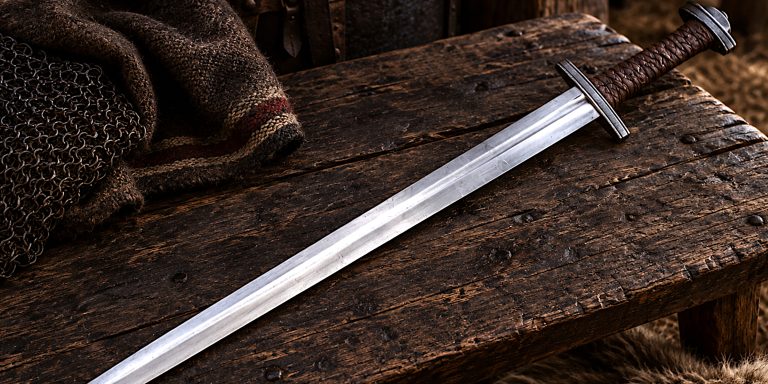
Swords used by the triarii
Triarii carried swords as secondary weapons, but the precise type depended upon the date.
Early Republican swords
Before the widespread adoption of the gladius Hispaniensis, Roman and central Italian soldiers used several sword forms influenced by Greek, Etruscan, Samnite and Celtic traditions. These probably included:
- Straight, double-edged cut-and-thrust swords
- Greek-influenced xiphos forms
- La Tène-influenced swords adopted or adapted through contact with Celtic peoples
- Locally produced Italian variants that resist neat modern classification
It would be misleading to place the later Imperial Pompeii-pattern gladius in the hand of a fourth-century BCE triarius.
Gladius Hispaniensis
By the later third and second centuries BCE, Roman infantry adopted the weapon conventionally known as the gladius Hispaniensis, or Spanish sword.
This was generally longer than many familiar Imperial gladii and was effective in both cut and thrust. Archaeological examples and related Iberian weapons suggest variation rather than one precisely regulated shape.
Polybius emphasised the horrifying wounds inflicted by Roman swords during the wars against Macedon. Livy similarly describes the shock caused by severed limbs and mutilated bodies. Such passages may contain literary exaggeration, but the Republican sword was certainly not designed only for neat, surgical thrusts. It could cut with considerable force.
The Mainz and Pompeii gladius types belong principally to the late Republic and Imperial periods. They should not be used as universal models for the triarii of the Punic Wars.
Shields
Polybius provides the fullest ancient description of the Republican scutum. It was a large, curved shield built from layers of wood and covered with hide or fabric. An iron boss protected the hand and could be used aggressively at close quarters.
The middle Republican shield was generally elongated and oval, rather than the curved rectangular shield familiar from films about Imperial legionaries.
For the triarii, the scutum served several purposes:
- Protection from missiles
- Coverage from shoulder to shin
- Support in close-order spear fighting
- A physical barrier during a controlled withdrawal
- An offensive tool for striking and forcing an opponent off balance
The large shield and spear together made the triarii capable of presenting a steady defensive front. They were not a classical Greek phalanx, but neither were they simply swordsmen waiting at the back.
Helmets and Body Armour
Montefortino helmets
The Montefortino was among the most common helmet families used by Republican armies. Usually made from bronze, it had a rounded bowl, a small neck guard and a knob for attaching a crest.
The design had Celtic roots and appeared in several regional variations. Its Roman adoption is a useful reminder that Republican military equipment developed through contact with Rome’s neighbours and enemies. Rome was very good at absorbing useful ideas and later behaving as if it had invented them.
Some triarii may also have used other Italo-Corinthian, Apulo-Corinthian or locally produced helmet forms, particularly in earlier periods.
Mail armour
Polybius reports that men assessed above a certain property level wore mail cuirasses. Mail, or lorica hamata in later terminology, was expensive and labour-intensive, but it provided flexible protection against cuts and many missile strikes.
As comparatively established soldiers, triarii may have been more likely than younger infantry to possess mail. This was a tendency rather than a universal uniform rule.
Bronze pectorals
Soldiers unable or unwilling to purchase mail could wear a small bronze chest plate. Polybius calls this a heart-protector. It offered limited coverage but protected the centre of the torso and cost far less than a full mail shirt.
The idea that every triarius marched in magnificent mail armour is attractive to illustrators and rather less secure historically.
Recruitment, Age and Social Position
Roman citizens were traditionally enrolled according to age, property and military experience. The triarii were drawn from older, seasoned men, but “older” should not be interpreted as elderly.
Military service in the Republic placed considerable demands on the body. A veteran in his thirties could have accumulated extensive campaigning experience, particularly during the long wars of the third and second centuries BCE.
Triarii probably included men who:
- Had served on previous campaigns
- Possessed the resources to equip themselves adequately
- Had demonstrated reliability in formation
- Understood Roman signals, commands and battlefield routines
- Could be trusted to remain steady when other lines withdrew through or around them
Experience was their real value. A reserve is useful only if it does not join the panic it is supposed to contain.
Command and Organisation
Each maniple was commanded by centurions selected for steadiness and leadership. Polybius states that Romans did not seek centurions who were merely bold attackers. They wanted men who could remain composed when pressed and who would die at their posts rather than abandon them.
That description suits the function of the triarii particularly well.
Every maniple had two centurions, with corresponding junior officers and standard-bearers. The senior centurion of the leading triarii maniple eventually became known as the primus pilus, although the office is documented more clearly in the later Republican and Imperial army.
Standards helped units maintain direction and cohesion. In the confusion of battle, a visible standard gave soldiers a point around which to rally. Losing one was both a tactical disaster and a profound disgrace.
The Triarii in Battle
Ancient narratives do not always identify which Roman infantry line performed each action, but several campaigns illustrate the sort of warfare in which the triarii served.
The Latin War
Livy provides his most detailed description of the three-line system during the Battle of Vesuvius in 340 BCE. He portrays hastati, principes and triarii as parts of a carefully layered formation, alongside lighter troops called rorarii and accensi.
This is important evidence, but not straightforward evidence. Livy’s account may preserve archaic features, later reconstruction or both.
The Pyrrhic War
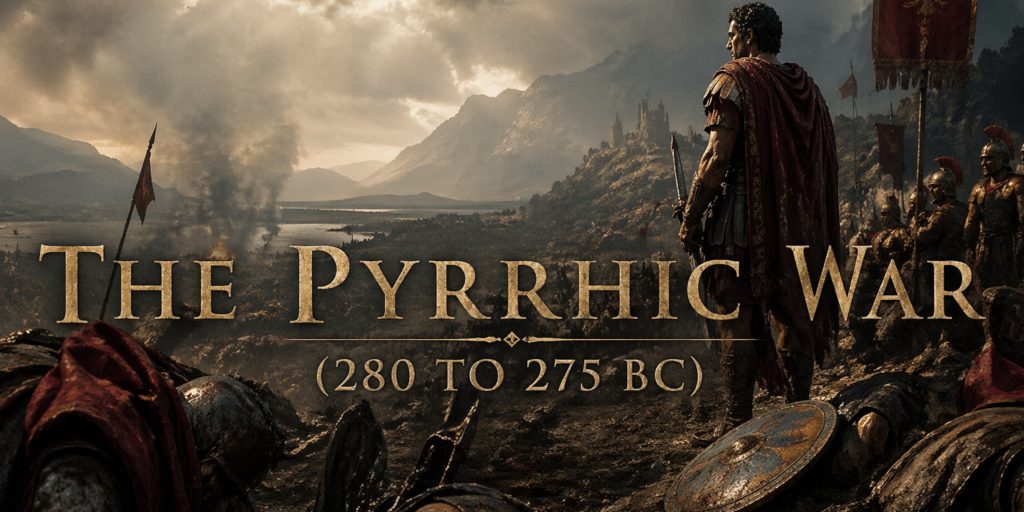
Fighting against Pyrrhus of Epirus exposed Roman infantry to Hellenistic phalanxes, experienced mercenaries and war elephants. The depth and flexibility of Rome’s manpower system helped it survive defeats that might have ended the ambitions of a smaller state.
Triarii are not described clearly enough to reconstruct their every deployment, but veteran reserves would have been particularly valuable in prolonged contests against Pyrrhic armies.
The Punic Wars
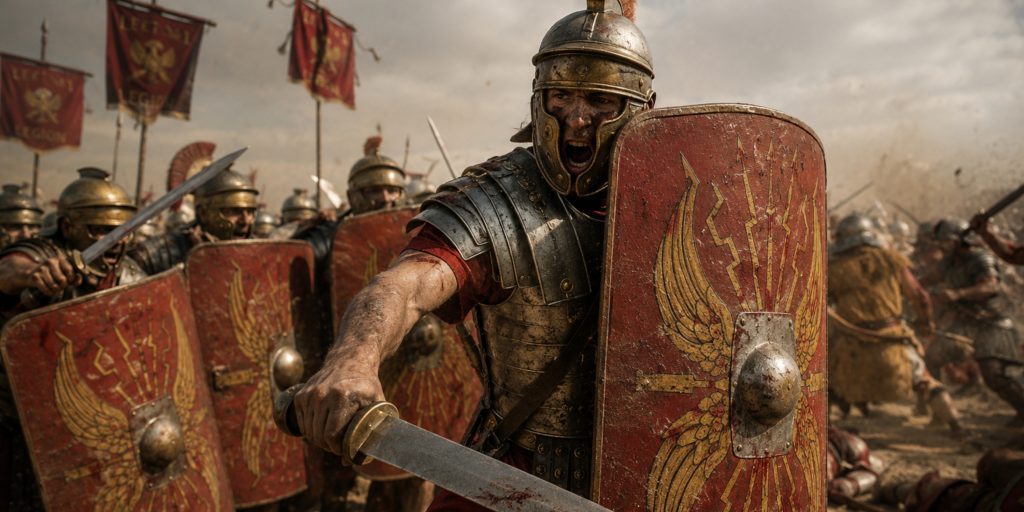
The triarii belonged to the army that fought Carthage across Italy, Sicily, Iberia and North Africa. At battles such as Cannae, their experience could not compensate for disastrous command decisions and encirclement. A reserve remains part of the army, and when the entire army is surrounded, there is nowhere especially clever for it to go.
At other battles, disciplined depth allowed Roman formations to recover, replace tired troops and maintain pressure for longer than opponents expected.
Campaigns in Greece and Macedon
Roman legions of the second century BCE confronted the Macedonian phalanx. The contest was not a simple duel between the gladius and sarissa. Terrain, command, cavalry, allied troops and the cohesion of each formation mattered enormously.
The Roman system offered greater tactical subdivision than the phalanx. Veterans in rear formations could exploit openings or support threatened sectors, although the distinction between triarii and other legionaries was becoming less pronounced during this period.
Archaeology and the Triarii
Archaeology confirms much about Republican equipment and battlefields, but it rarely identifies an individual object as specifically triarii equipment.
A spearhead found in a Republican military context may have belonged to a triarius, an allied infantryman, a cavalryman or an enemy. Roman battlefield assemblages also contain captured and locally produced weapons. Classification is therefore based on context, typology and comparison rather than convenient certainty.
Important forms of evidence
Montefortino helmets
Examples have been recovered from Italy, Iberia and other areas touched by Republican warfare. They demonstrate the broad use and considerable variation of a helmet family strongly associated with Rome’s expanding armies.
The type takes its modern name from the cemetery at Montefortino in Italy, where helmets were found in burials. Similar forms were used across Celtic and Mediterranean regions.
Republican swords from Iberia
Finds from Iberian sites have helped scholars study the emergence of the gladius Hispaniensis. Surviving blades show that Republican swords could be longer and more varied than later Imperial examples.
The relationship between Roman swords and Iberian prototypes remains debated. Adoption probably involved a period of experimentation, regional manufacture and gradual standardisation.
Numantia
The Roman siege camps around Numantia in Spain have produced extensive evidence for second-century BCE military activity. Weapons, fastenings, tools, coins and camp layouts illuminate the army during the period when manipular distinctions were evolving.
Numantia is particularly valuable because military objects can be considered within excavated Roman operational sites rather than as isolated museum pieces.
Baecula
Archaeological survey at the battlefield identified as Baecula, fought in 208 BCE, has recovered weapons, fasteners and coins distributed across the landscape. This material has helped researchers investigate troop movement and the location of camps during the Second Punic War.
It cannot show precisely where one maniple of triarii stood, but it places Roman equipment in a securely military environment close to the period described by Polybius.
The Aemilius Paullus monument
The monument commemorating the Roman victory at Pydna in 168 BCE provides important visual evidence for Republican combat. Its reliefs depict Romans and Macedonians in close action, although artistic convention and damage complicate interpretation.
Like all military art, it should be treated as evidence rather than a battlefield photograph.
What the Archaeology Cannot Tell Us
No known burial or equipment deposit can be assigned confidently to a triarius simply because it contains a spear, mail shirt and oval shield fittings.
Several problems prevent such certainty:
- Republican soldiers did not normally receive equipment marked with their tactical class.
- Organic shield components rarely survive.
- Battlefield objects may be displaced by erosion, agriculture or later occupation.
- Roman and allied Italian equipment overlapped.
- Captured weapons circulated between armies.
- The same soldier could serve in different classifications over the course of his military life.
Archaeology is invaluable for correcting overly uniform reconstructions. It also makes the picture messier, which is usually a sign that it is doing its job.
Contemporary and Ancient Descriptions
Polybius is the most important near-contemporary source for the middle Republican legion. Writing in the second century BCE, he describes the triarii as retaining spears while other heavy infantry carried pila.
On the size of the veteran reserve, he states:
“The triarii amount to six hundred.”
This apparently plain observation matters. Even when a legion’s total strength increased, the triarii remained a limited body of experienced troops rather than expanding proportionally.
Livy gives the most memorable account of their battlefield role:
“The matter had come to the triarii.”
His phrase conveys the seriousness of committing the last line. It eventually became proverbial.
Polybius also explains what Romans valued in their centurions:
“They wish them not so much to be venturesome and daredevil as to be natural leaders.”
He continues by praising officers who remained steady when beaten or pressed. The wording could almost have been composed with the triarii in mind.
Vegetius, writing many centuries later, describes the older formation as he understood it:
“In the rear of all the lines, the triarii, completely armed, were drawn up.”
Vegetius is useful for Roman military tradition, but he lived in late antiquity. He should not be treated as an eyewitness to the Republican legion.
Were the Triarii an Elite Unit?
They were elite in experience and battlefield responsibility, but not in the modern special-forces sense.
Triarii were not selected for secret operations, detached raids or unusual weapons training. They were line infantry trusted with a particularly important function. Their distinction lay in discipline, maturity and position within the legion.
It is reasonable to describe them as veteran heavy infantry. Calling them Rome’s “special forces” is an anachronism and does little to explain how they actually fought.
Strengths and Limitations
Advantages
- Experienced soldiers were preserved for the crisis of battle.
- A fresh third line gave the legion tactical depth.
- Spear-armed infantry could form a strong defensive barrier.
- Retreating troops had an organised body behind which to recover.
- Commanders retained a reserve for unexpected threats.
- Veterans could steady younger or exhausted soldiers.
Limitations
- Keeping veterans in reserve reduced the experience available in the opening line.
- A smaller body of 600 men could not repair every tactical disaster.
- Passing troops between lines required discipline and sufficient space.
- Confined terrain could disrupt the manipular arrangement.
- The system depended upon effective signals and local leadership.
- Once the triarii were defeated, the legion had no further heavy infantry reserve.
The formation was resilient, not miraculous. Roman armies containing triarii suffered catastrophic defeats at the Trebia, Lake Trasimene and Cannae. Institutions can improve the odds. They cannot abolish incompetent command, enemy skill or simple bad luck.
Why Did the Triarii Disappear?
By the late second century BC, the distinctions between hastati, principes and triarii were fading. Several long-term changes contributed.
Greater uniformity of equipment
Heavy infantry increasingly fought with similar combinations of pila, swords, shields and armour. The triarii’s distinctive association with the hasta disappeared.
The rise of the cohort
The cohort, containing several maniples, became the legion’s principal tactical unit. It was large enough to operate independently while remaining more flexible than a Hellenistic phalanx.
Longer campaigns
Wars in Spain, North Africa and the eastern Mediterranean required soldiers to remain in service for extended periods. Experience no longer fitted neatly into three age-based lines.
Recruitment pressures
Rome increasingly drew upon citizens with limited property. The older relationship between wealth class, personally owned equipment and battlefield position weakened.
Commanders’ changing needs
Cohort organisation offered a simpler way to divide, reinforce and manoeuvre a legion. Veteran status remained important, but it was no longer expressed through a separate spear-armed third line.
The disappearance of the triarii was therefore part of a broad transformation. It should not be attributed entirely to one decree by Marius.
The Legacy of the Triarii
The triarii left little institutional trace in the Imperial legion, but their reputation survived through literature and language.
They came to represent:
- Veteran steadiness
- The disciplined use of reserves
- A final line of defence
- Rome’s ability to recover during battle
- The moment when a crisis could no longer be disguised
Their importance also reaches beyond military nostalgia. The triarii demonstrate that Roman success did not depend solely upon superior weapons. The gladius, pilum and scutum were effective, but organisation gave those weapons purpose.
Rome arranged men according to experience, maintained several fighting lines and allowed a battle to continue after the first collision had failed. The system was imperfect and changed considerably over time, yet its underlying principle was sound: do not spend every capable soldier at once.
That is less cinematic than a heroic last stand, but considerably more Roman.
Frequently Asked Questions
What does triarii mean?
The name refers to the “third men” or soldiers of the third line in the Republican legion.
Were triarii the oldest Roman soldiers?
They were generally older and more experienced than the hastati and principes, but they were not elderly men. Many were probably veterans in early or mature adulthood.
Why did triarii carry spears?
Their long hastae suited their role as a steady reserve capable of holding ground, receiving an attack and protecting retreating troops.
Did triarii use the gladius?
Yes. They carried swords as sidearms. In the middle Republic this could include the gladius Hispaniensis, while earlier soldiers probably used a range of Greek-influenced, Celtic-influenced and Italian sword forms.
Did triarii kneel during battle?
Livy describes them waiting in a low, braced posture before being committed. They would have stood to advance and fight. The famous kneeling image should not be applied mechanically to every period.
How many triarii were in a legion?
Polybius gives a strength of 600 triarii in a standard legion, organised into ten maniples.
Were triarii better than principes?
They were normally more experienced and held in reserve for emergencies. That did not necessarily make every triarius individually stronger or more skilful than every princeps.
Did Marius abolish the triarii?
Their separate identity disappeared around the period associated with Marius, but the change was gradual. Modern historians generally avoid attributing every development of the late Republican army to a single package of Marian reforms.
Sources and Further Reading
- Polybius, The Histories, Book VI
- Livy, History of Rome, Book VIII
- Vegetius, Epitome of Military Science
- Adrian Goldsworthy, The Complete Roman Army
- Lawrence Keppie, The Making of the Roman Army
- M. C. Bishop and J. C. N. Coulston, Roman Military Equipment
- Michael Dobson, The Army of the Roman Republic
- Michael J. Taylor, “Roman Infantry Tactics in the Mid-Republic: A Reassessment”
- Michael J. Taylor, “The Evolution of the Manipular Legion in the Early Republic”
- Fernando Quesada-Sanz, “Gladius Hispaniensis: An Archaeological View from Iberia”
- Juan P. Bellón and others, archaeological studies of the battlefield at Baecula