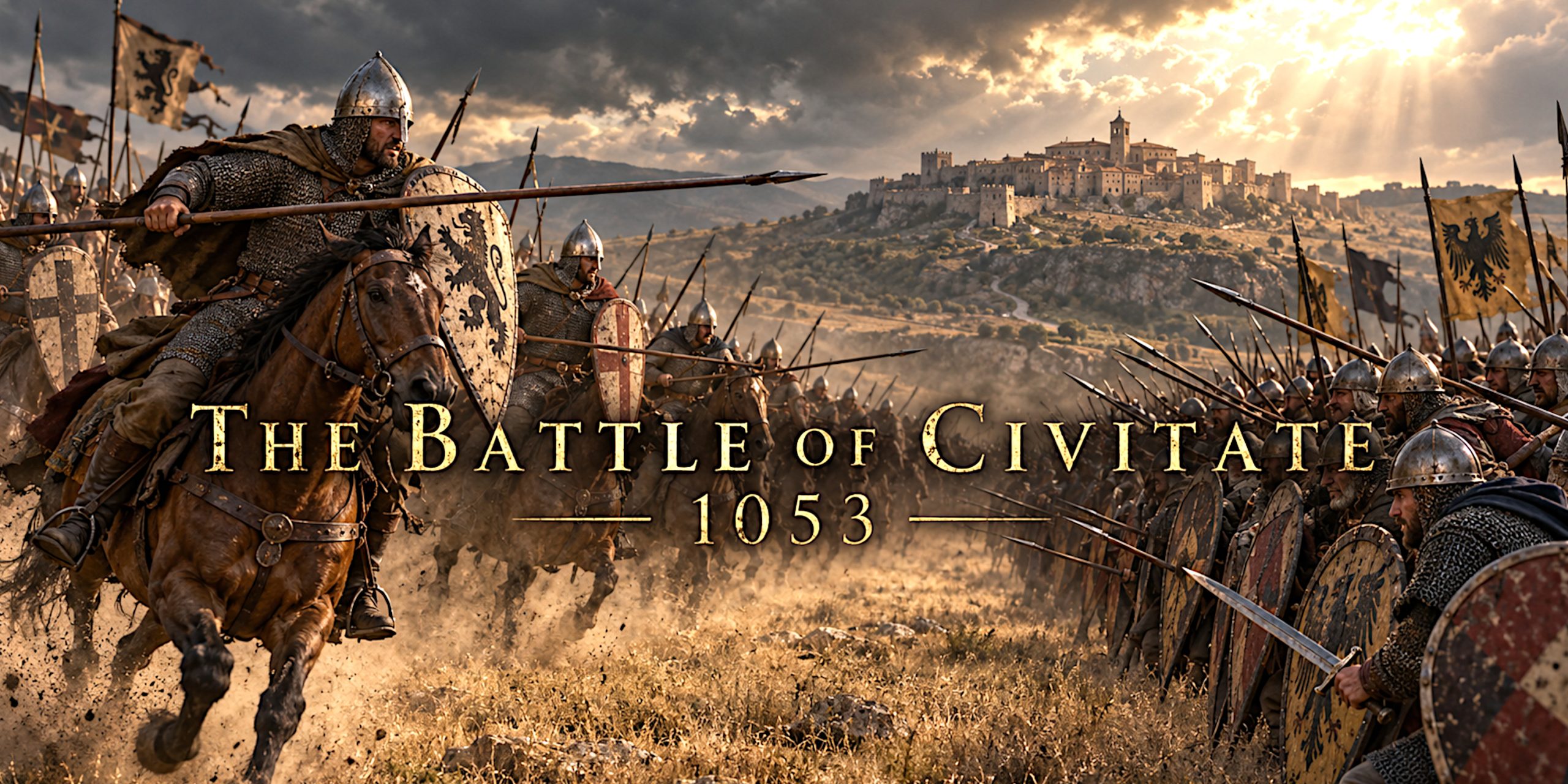
The Battle of Civitate, fought on 18 June 1053 near the River Fortore in southern Italy, ended in a Norman victory and the captivity of Pope Leo IX. It helped secure the position of the Norman lords of Apulia and Aversa, although their recognition by the papacy came through further negotiation rather than one decisive afternoon.
What interests me most is the awkwardness of the encounter. Both sides belonged to Latin Christendom. The Normans could defeat the pope’s army while continuing to acknowledge his spiritual authority. Medieval politics had considerable room for such arrangements.
Battle of Civitate at a Glance
| Detail | Summary |
|---|---|
| Date | 18 June 1053 |
| Location | Near medieval Civitate, in the vicinity of modern San Paolo di Civitate, Apulia |
| Opponents | Norman-led forces against a papal coalition of German and Italian contingents |
| Norman leaders | Humphrey of Hauteville, Richard of Aversa and Robert Guiscard |
| Papal leader | Pope Leo IX, organiser of the campaign |
| Result | Norman victory; Leo subsequently held at Benevento |
| Significance | A major setback to attempts to remove the Normans from southern Italy |
Why Was the Battle Fought?
Norman warriors had entered southern Italy as military adventurers and mercenaries. By the middle of the eleventh century, some were acquiring territories of their own. Aversa and the Norman settlements in Apulia became bases for further expansion.
That expansion threatened established rulers and communities. Calling these men enterprising newcomers rather understates the experience of anyone whose property they raided.
Leo IX’s campaign sought to contain their power. There was also a Byzantine interest in resisting Norman advances, but the pope’s army fought at Civitate without joining forces with the Byzantine commander Argyrus.
The struggle concerned land, security and authority. Treating it as a simple religious war obscures more than it explains.
Forces
No surviving muster roll gives us dependable totals. The following figures are conventional estimates, not audited strengths.
| Army | Approximate strength | Main elements | Caution |
|---|---|---|---|
| Norman-led army | Around 3,000 mounted men, with a smaller infantry element | Mounted warriors, foot soldiers and archers | The frequently repeated total of 3,500 is approximate |
| Papal coalition | Often estimated at around 6,000 overall | German infantry, Italian cavalry and foot troops | Its numerical advantage cannot be measured precisely |
| German contingent | About 700 Swabians in William of Apulia’s account | A determined body fighting on foot | The figure comes from a literary narrative |
“Norman” describes the leading military group rather than every soldier’s birthplace. Equally, the papal army was a coalition, not a uniform professional force.
Leaders and Troop Composition
| Leader | Position and role |
|---|---|
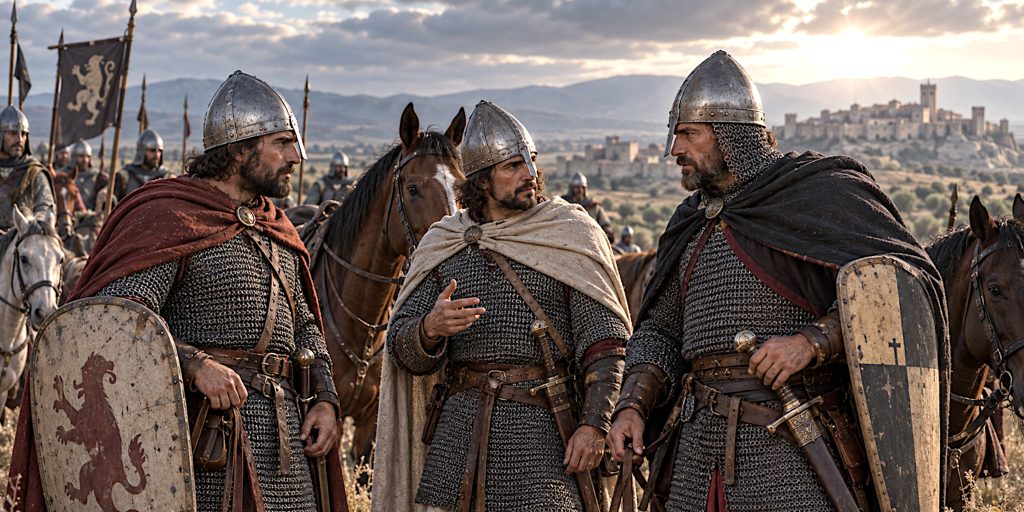
| Humphrey of Hauteville | Count of Apulia and a principal Norman commander |
| Richard of Aversa | Led the Norman right against the Italian contingents |
| Robert Guiscard | Humphrey’s brother; commanded the left and reinforced the central struggle |
| Leo IX | Assembled the coalition; should not be presented as personally directing cavalry charges |
Important distinctions:
- Humphrey deserves recognition in his own right, rather than appearing merely as Robert’s less interesting brother.
- Robert was not yet Duke of Apulia in 1053.
- Italian troops varied in equipment and experience. Their defeat does not justify treating them all as incompetent levies.
- The sources disagree over Leo’s movements around the town during the battle.
Arms and Armour
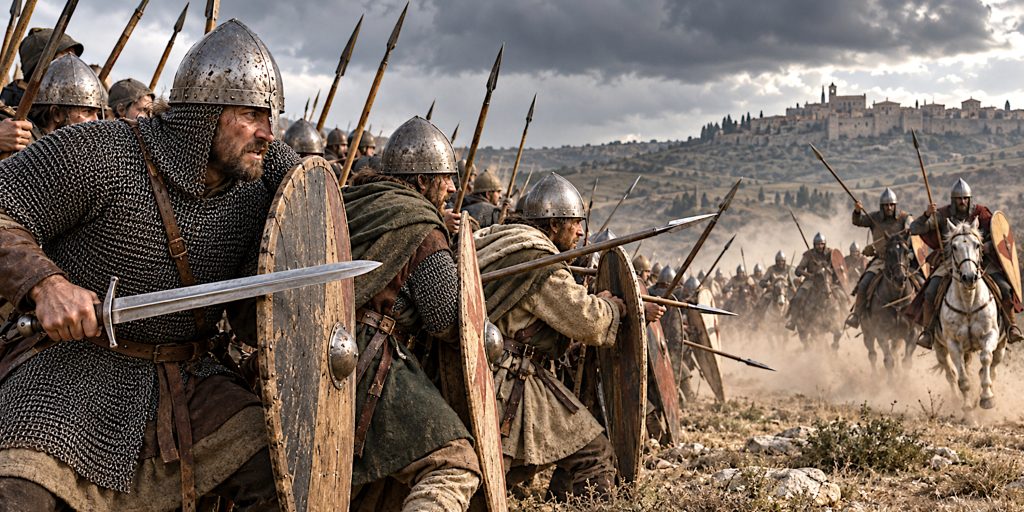
There is no securely identified collection of equipment from Civitate that allows us to dress each contingent precisely. Reconstruction must combine narrative evidence with wider knowledge of eleventh-century warfare.
| Equipment | Likely use | Limits of the evidence |
|---|---|---|
| Mail hauberk | Protection for better-equipped mounted warriors and some infantry | Not universal |
| Conical helmet, sometimes with nasal | Plausible head protection | Exact distributions are unknown |
| Kite and round shields | Protection in mounted and foot combat | Shield shape should not be assigned rigidly by nationality |
| Lance and spear | Mounted attack and infantry fighting | Not every mounted engagement involved an identical couched-lance technique |
| Bow | Missile exchanges | Numbers and organisation are uncertain |
| Straight, double-edged sword | Close combat | Individual battlefield examples have not been securely identified |
Which sword types were used?
Oakeshott Type X is a useful comparison for the period: a broad, double-edged blade, a substantial fuller and a short grip for one-handed use. Older early medieval sword forms could also remain in circulation. These are period comparisons, not confirmed identifications of swords recovered from Civitate.
William of Apulia emphasises the Germans’ long cutting swords. His description does not establish that they carried the later medieval longsword or an early version of the Renaissance greatsword.
I would also avoid giving every Swabian an enormous axe. A vivid reconstruction is welcome; an unsupported armoury is less helpful.
The Battle Timeline
The sequence below follows the broad narrative tradition. Exact timings are unavailable.
| Stage | Event |
|---|---|
| Before battle | The armies confront one another near Civitate; negotiation fails |
| Opening action | Richard attacks the Italian contingents and drives them into flight |
| Central struggle | Humphrey’s troops face sustained German resistance |
| Reinforcement | Robert brings support to the fighting in the centre |
| Decisive development | Richard returns from pursuit and joins the attack on the remaining resistance |
| Aftermath | The coalition is defeated; Leo comes into Norman hands |
This was not an effortless demonstration of cavalry superiority. The prolonged resistance in the centre matters. Victory in one sector still had to be converted into victory across the field.
Contemporary Accounts and Quotations
Our detailed narratives were written decades after the battle. They are near-contemporary accounts, not verified eyewitness transcripts.
William of Apulia composed his Deeds of Robert Guiscard in the late 1090s. In G. A. Loud’s translation, he describes the German swords as:
“very long and keen”
He also praises the soldiers themselves:
“they chose rather to die than to turn tail”
Both quotations come from Book II. They show that a writer celebrating Norman victory could acknowledge the courage of the defeated.
Geoffrey Malaterra offers another account shaped by Norman patronage. His explanation of the pope’s treatment should be read alongside other traditions, which differ over how Leo left Civitate and entered Norman custody.
The sensible approach is to compare these writers, rather than turn one confident passage into an unquestionable reconstruction.
Archaeology: What Has Actually Been Found?
The settlement landscape is archaeologically documented. That is different from having an excavated battlefield.
Italian heritage authorities describe the layered site of Tiati, Teanum Apulum and medieval Civitate. Excavation has revealed part of a Roman amphitheatre. The medieval fortified settlement occupied higher ground, and the surviving tower incorporates evidence of repeated rebuilding.
These remains help explain the location’s strategic setting above the Fortore and nearby communications.
They do not establish the precise positions of the armies. Nor does the published heritage account identify a mass grave securely linked to the battle of 1053.
Claims about battle-associated sword hilts, spurs or skeletons with weapon injuries need an identifiable excavation report and reliable dating. Without those, I would leave them out. Archaeology already has enough difficult work without being asked to confirm an attractive story.
What Happened to Pope Leo IX?
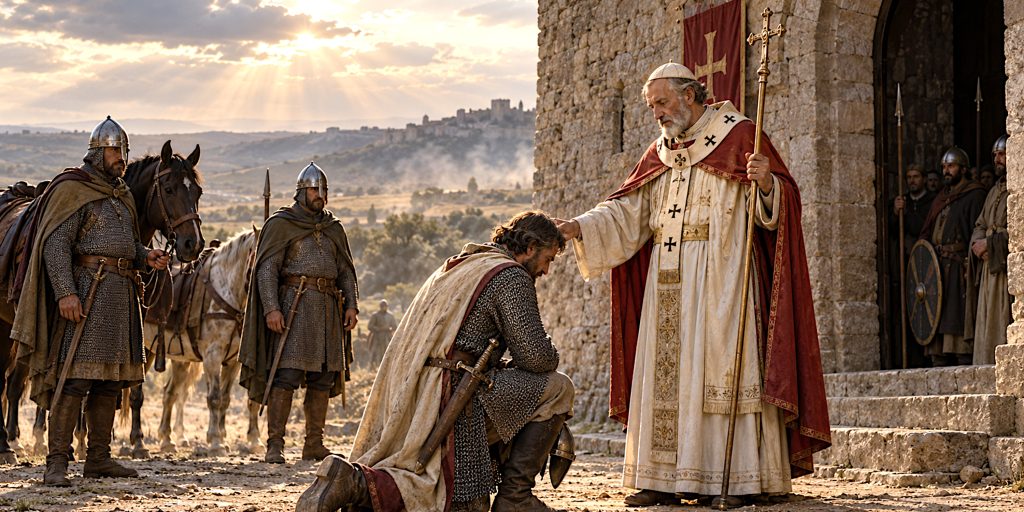
Leo was held at Benevento from June 1053 until March 1054. He returned to Rome and died on 19 April.
The Norman victors showed him conspicuous respect. Courtesy, however, did not restore his freedom of action.
Accounts differ over his departure from Civitate. Malaterra describes inhabitants expelling him under pressure from the Normans; other traditions frame events differently. His captivity is secure history. Its precise opening scene is less certain.
Outcome and Legacy
Civitate strengthened Norman power but did not immediately produce a settled papal alliance.
The important formal settlement followed at Melfi in 1059, under Nicholas II. Robert Guiscard received recognition as Duke of Apulia and Calabria, with a claim to Sicily still requiring conquest. Richard received recognition in Capua.
The battle therefore belongs within a longer political transformation. Military success made the Normans harder to remove; subsequent diplomacy helped turn possession into recognised authority.
For me, that is Civitate’s lasting interest. The pope lost an army, the Normans gained room to consolidate, and both institutions eventually found reasons to negotiate. Medieval principle was often remarkably attentive to the balance of power.
Sources and Further Reading
- William of Apulia, The Deeds of Robert Guiscard, translated by G. A. Loud
- Geoffrey Malaterra, Book I, chapter 14, critical edition with French translation and commentary
- Italian heritage authority: the archaeology of San Paolo di Civitate
- G. A. Loud, The Age of Robert Guiscard