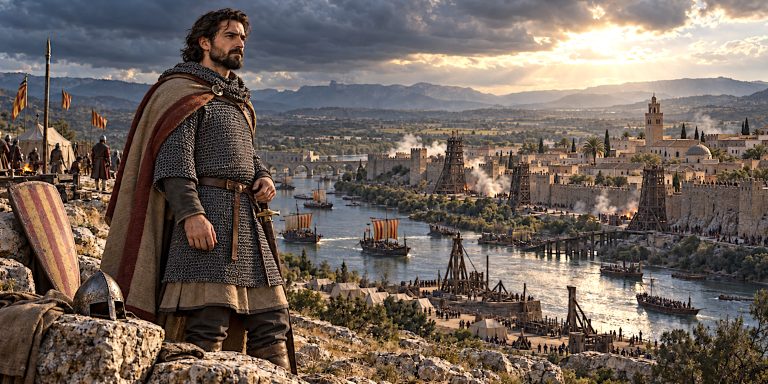
There are some medieval figures who seem trapped forever inside other men’s mistakes. Raymond III of Tripoli is one of them.
Popular memory tends to flatten the final decades of the Crusader states into a morality play. Saladin appears as the brilliant conqueror, Guy of Lusignan as the fool, Reynald of Châtillon as the reckless firestarter, and Raymond as the suspicious noble lurking somewhere in the background with folded arms and a tired expression. Reality was considerably messier. Medieval politics usually are.
Raymond III was arguably the most intelligent statesman in the Kingdom of Jerusalem during its final years before Hattin. He was experienced, politically cautious, militarily competent, and painfully aware that the Crusader states could not survive endless internal feuding. Unfortunately for him, being right in the twelfth century rarely guaranteed success. Quite often it simply meant you watched the catastrophe arrive slightly earlier than everyone else.
Who Was Raymond III of Tripoli?
Raymond III was born around 1140 into the powerful House of Tripoli, one of the great noble dynasties of the Latin East. He inherited the County of Tripoli in 1152 after the assassination of his father, Raymond II.
Tripoli itself sat along the Levantine coast and formed one of the major Crusader states alongside the Kingdom of Jerusalem, the Principality of Antioch, and the County of Edessa. By Raymond’s time, Edessa had already collapsed, and the remaining states were increasingly dependent upon fragile alliances, Italian naval support, and luck that bordered on divine intervention.
Raymond became one of the wealthiest and most influential lords in Outremer. He spoke Arabic, negotiated with Muslim rulers when necessary, and understood the military limitations of the Crusader states better than many of his contemporaries. Chroniclers often portrayed him as cold or calculating, though one suspects that surviving politics in Jerusalem for decades required precisely those qualities.
He married Eschiva of Bures, Princess of Galilee, which expanded his influence further inland. Through inheritance and marriage, Raymond controlled substantial territory stretching from Tripoli to Tiberias.
At various points he also served as regent for the Kingdom of Jerusalem during the reign of Baldwin IV, the leper king. That role placed him directly at the centre of the kingdom’s increasingly poisonous factional politics.
Raymond III and the Politics of Jerusalem
The political landscape of the Crusader kingdom during the 1170s and 1180s resembled a noble family argument that somehow acquired castles and armies.
Baldwin IV’s leprosy created an immediate succession crisis. Raymond emerged as leader of one political faction that favoured stability, diplomacy, and strategic caution. Opposing him were figures such as Reynald of Châtillon and later Guy of Lusignan, men more inclined toward aggressive confrontation with Saladin.
Modern historians sometimes unfairly accuse Raymond of weakness because he pursued truces and negotiations. That criticism ignores the brutal arithmetic facing the Crusader states. Saladin controlled vastly greater resources and manpower. Raymond understood that survival depended on preserving armies rather than gambling them recklessly in open battle.
That made him unpopular with men who confused caution with cowardice, a timeless political problem.
The divisions became so bitter that Raymond was temporarily exiled from influence at court. At one point, suspicion became so intense that he even negotiated separately with Saladin to secure his own territories. Medieval chroniclers treated this with outrage. Modern historians tend to see it as a symptom of a kingdom already drifting toward collapse.
Battles and Military Acumen
Raymond III was not merely a politician. He was an experienced military commander who spent decades fighting in one of the most dangerous frontiers in the medieval world.
Unlike some Crusader nobles intoxicated by visions of glorious charges and heroic martyrdom, Raymond appreciated logistics, terrain, and restraint. He understood that Muslim cavalry armies excelled at mobility and attritional warfare. Charging headlong into arid landscapes against mounted archers was usually a splendid way to die dramatically while achieving absolutely nothing.
A recurring theme in Raymond’s career is that his strategic advice was often ignored shortly before disaster followed.
The Battle of Harim (1164)
One of the defining moments of Raymond’s early life came at the Battle of Harim in 1164.
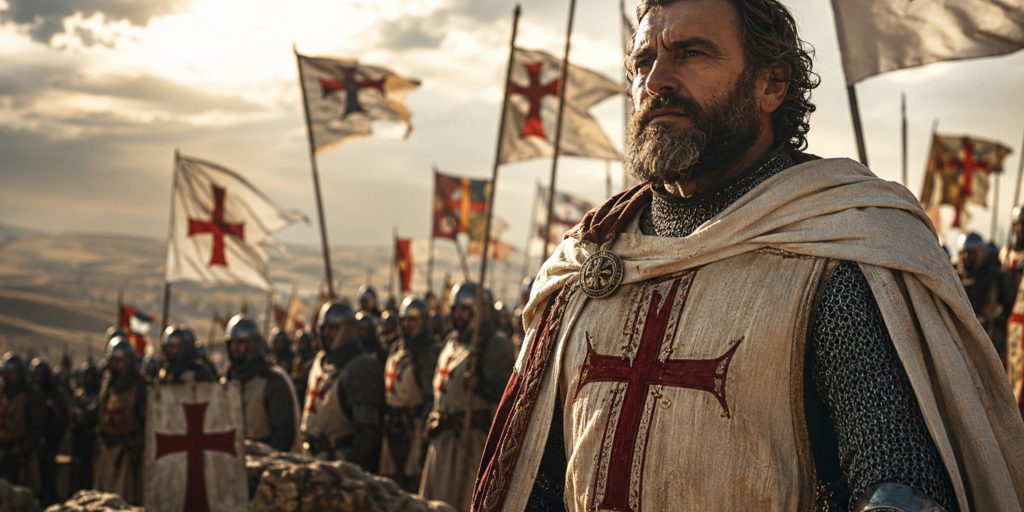
The Crusader coalition army faced Nur ad-Din near Antioch. The result was catastrophic. Raymond was captured alongside several other major nobles after the Frankish army collapsed.
He spent years imprisoned in Aleppo before eventually being ransomed. Captivity clearly shaped his later political thinking. He had witnessed firsthand the growing strength and organisation of Muslim powers in Syria.
Some later chroniclers interpreted his caution after release as weakness. Personally, I suspect years in a prison cell tend to cure men of romantic military fantasies rather efficiently.
The Battle of Montgisard (1177)
Raymond likely participated in the campaigns surrounding the famous Crusader victory at Montgisard, where Baldwin IV defeated Saladin against overwhelming odds.
Although Baldwin received most of the glory, experienced nobles such as Raymond played a major role in sustaining the kingdom’s military structure during this period. The victory temporarily masked deeper structural problems within the Crusader states, particularly manpower shortages and political division.
The Road to Hattin
Raymond’s most important military contribution may have been the advice nobody listened to.
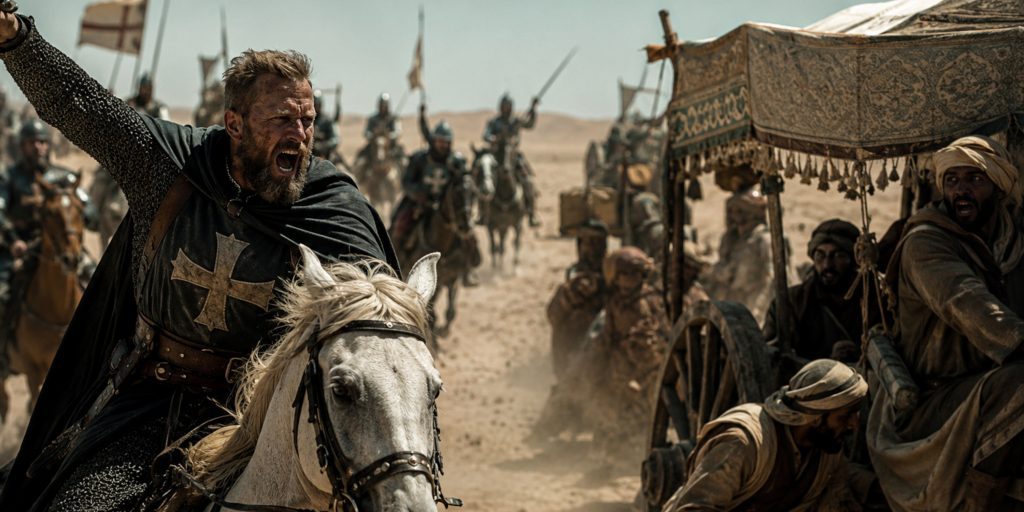
In 1187, after Reynald of Châtillon violated truces by attacking Muslim caravans, Saladin prepared for full-scale war. Raymond strongly advised against marching the main Crusader army across the arid plains toward Tiberias.
His reasoning was sound:
- The army would be exposed to heat and thirst
- Saladin could harass them constantly with mounted archers
- Defensive positioning near water offered better odds
- Preserving the army mattered more than protecting territory
Guy of Lusignan ignored this advice after pressure from more aggressive nobles.
The result was the Battle of Hattin.
The Battle of Hattin (1187)
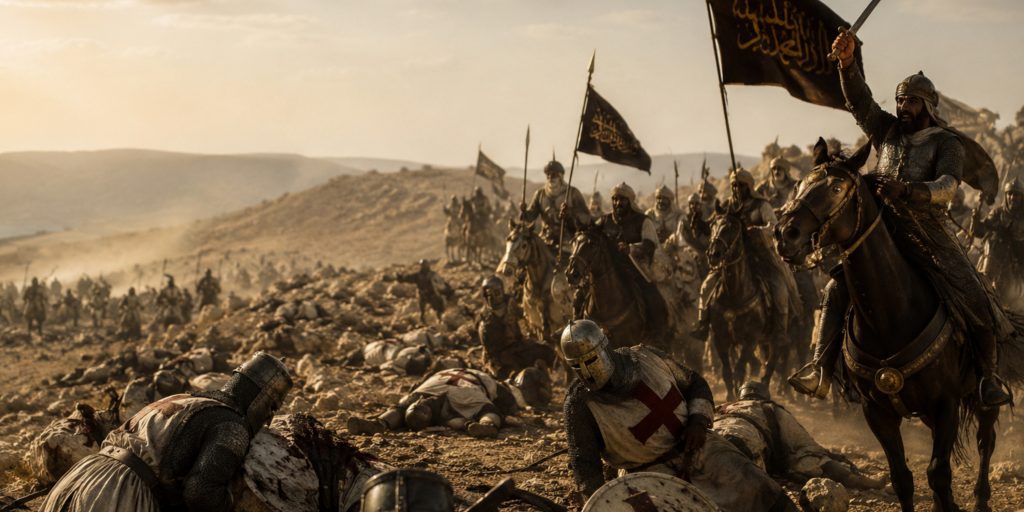
Hattin destroyed the Crusader kingdom.
Raymond commanded part of the Crusader vanguard during the battle. Surrounded, exhausted, and desperate for water, the Frankish army collapsed under Saladin’s assaults.
Ironically, Raymond himself managed to break through Muslim lines and escape with a small group of knights. Later critics accused him of treachery because he survived. Medieval people often become suspicious when the sensible man lives longer than the reckless ones.
There is little evidence Raymond betrayed the army. More likely, he recognised the battle was irretrievably lost and attempted the only viable breakout.
After Hattin, Jerusalem itself fell within months.
Raymond died later that same year, reportedly ill and disillusioned. It is difficult not to picture him as a man watching a disaster he had predicted unfold exactly as feared.
Arms and Armour of Raymond III’s Era
Raymond III fought during the mature period of Crusader warfare, when western European military equipment had adapted significantly to Levantine conditions.
A noble of Raymond’s rank would have possessed expensive and sophisticated arms.
Typical Arms
- Arming sword of Frankish knightly style
- Long cavalry lance
- Mace for close combat
- Dagger or misericorde
- Kite or transitional heater shield
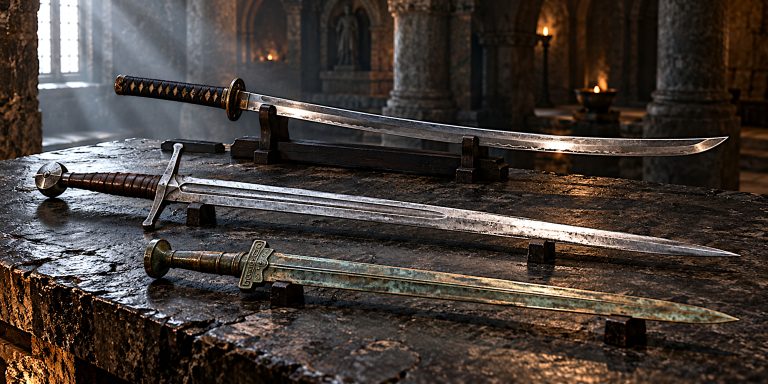
Crusader swords of the twelfth century were generally broad-bladed cutting weapons designed for mounted combat. Many surviving examples show influences from both European and eastern Mediterranean craftsmanship.
There is also evidence that Crusader nobles adopted certain local practices over time, including lighter garments beneath armour and increased use of silk padding against heat.
Armour
Raymond likely wore:
- Mail hauberk extending to the knees
- Coif integrated with mail hood
- Conical or early great helm
- Quilted gambeson beneath mail
- Chausses protecting the legs
- Surcoat over armour, possibly displaying heraldry
The image of Crusader knights stumbling around in impossibly heavy armour under desert suns is somewhat exaggerated. Mail remained hot and uncomfortable, certainly, but these men campaigned in the Levant for generations and adapted more than popular culture often admits.
By Raymond’s lifetime, equipment in Outremer had become a hybrid military culture shaped by both European and Near Eastern influences.
Raymond III and Saladin

One of the more fascinating aspects of Raymond’s career was his pragmatic relationship with Saladin.
Unlike Reynald of Châtillon, who appeared to treat diplomacy as a personal insult, Raymond understood that coexistence and temporary truces were often essential. He negotiated directly with Muslim rulers and maintained periods of uneasy peace when possible.
This pragmatism later damaged his reputation among hostile chroniclers who preferred simpler narratives about holy war.
Yet ironically, Raymond’s realism may have prolonged the survival of the Crusader states more effectively than the reckless aggression celebrated by some contemporaries.
History can be rather unfair to cautious men.
Artefacts and Where to See Them
No confirmed personal sword, armour, or seal belonging directly to Raymond III survives with certainty. This is common for Crusader nobles, especially after the upheavals following Hattin.
However, several important artefacts and collections connected to the Crusader states and Raymond’s era can still be seen today.
The Louvre Museum, Paris
The Louvre contains Crusader-era metalwork, coins, manuscripts, and Levantine artefacts that help illustrate the world Raymond inhabited.
Among the most important are Islamic and Frankish objects demonstrating the cultural overlap of the eastern Mediterranean during the twelfth century.
The Israel Museum, Jerusalem
The Israel Museum holds Crusader weapons, armour fragments, coins, and architectural remains from the Kingdom of Jerusalem.
Its collections provide one of the clearest material windows into the military culture Raymond belonged to.
The Citadel of Tripoli, Lebanon
Although altered heavily over later centuries, the Citadel of Tripoli preserves parts of the Crusader fortifications associated with the county Raymond ruled.
Walking through its surviving structures gives a sense of how strategically important Tripoli was to the Latin East.
The Metropolitan Museum of Art, New York
The Met contains important Crusader-period arms and religious artefacts, including objects connected to Frankish rule in the Levant.
Several surviving swords and helmets from the broader twelfth and thirteenth centuries closely resemble equipment used during Raymond’s lifetime.
Latest Archaeology and Historical Findings
Crusader archaeology has expanded significantly over recent decades.
Excavations across Israel, Lebanon, and Syria continue revealing evidence about military settlements, castles, and battlefield logistics from Raymond’s era.
Tiberias and Galilee Research
Archaeological surveys around Tiberias and the Horns of Hattin have improved understanding of troop movements during the 1187 campaign.
Recent terrain analysis supports many medieval accounts describing the catastrophic lack of water faced by Crusader forces during the march toward Hattin.
In other words, Raymond’s warnings appear even more sensible when examined against the geography itself.
Crusader Castle Excavations
Sites such as Belvoir Castle and Krak des Chevaliers have yielded insights into Crusader defensive planning, supply systems, and adaptation to Near Eastern warfare.
Excavations reveal sophisticated storage systems, layered fortifications, and evidence of long-term occupation rather than temporary colonial outposts.
This matters because it reminds us the Crusader states were not merely invading armies passing through. By Raymond’s lifetime, they had become deeply rooted societies attempting, however precariously, to survive.
Coins and Administrative Seals
Numismatic discoveries from Tripoli continue helping historians reconstruct trade networks and political authority during Raymond’s reign.
Coins issued under the Counts of Tripoli show both western Christian and eastern Mediterranean influences, reflecting the hybrid nature of Crusader society.
Raymond III’s Legacy
Raymond III remains one of the most debated figures of the Crusading era.
To some chroniclers he was indecisive, overly diplomatic, and politically divisive. To others he was one of the few leaders who genuinely understood the impossible situation facing the Kingdom of Jerusalem.
Personally, I find him difficult not to sympathise with. Raymond often resembles the exhausted realist trapped in a room full of men demanding glorious last stands. Medieval history tends to celebrate dramatic gestures, but kingdoms are usually preserved by patience, compromise, and knowing when not to fight.
Unfortunately for Raymond, twelfth-century Jerusalem had very little patience left.
His warnings before Hattin proved tragically accurate. The destruction of the Crusader field army opened the road to Jerusalem and permanently altered the balance of power in the eastern Mediterranean.
That alone secures Raymond III of Tripoli a crucial place in the history of the Crusades.