The medieval Islamic world produced no shortage of elite military formations, though few inspire quite the same fascination as the Black Guard of the Almohads. They appear in chronicles almost like shadows at the edge of battlefields, heavily armed, fiercely loyal, and unsettling enough that Christian chroniclers wrote about them with a mix of horror and grudging admiration.
The name itself carries weight. “Black Guard” immediately sounds like something dreamt up by a fantasy novelist after too much coffee and a binge of historical dramas. Yet they were entirely real, and for a time they stood at the centre of one of the most powerful empires in the western Islamic world.
Their story is tangled with slavery, imperial politics, religious reform, warfare in Iberia, and the harsh realities of medieval statecraft. It is not a comfortable history, though it is a fascinating one.
Who Were the Black Guard?
The Black Guard were elite soldiers attached to the Almohad Caliphate, a Berber Muslim empire that dominated much of North Africa and large parts of Al-Andalus during the 12th and 13th centuries.
Most sources describe them as sub-Saharan African troops, many of whom were enslaved or descended from enslaved communities integrated into the military system. Medieval Arabic chroniclers often referred to them simply as black soldiers or guardsmen attached directly to the caliph and ruling elite.
Their primary purpose was loyalty.
That mattered enormously in the Almohad world. Tribal politics in North Africa could shift with alarming speed. A caliph might trust his own bodyguard more than distant governors or ambitious Berber clans who suddenly developed opinions about succession after a few military setbacks.
The Black Guard therefore became a counterweight to tribal instability. Their fortunes depended entirely on the ruling dynasty.
The Almohad Empire They Served
The Almohads emerged in the 12th century from the Atlas Mountains of Morocco under the religious reformer Ibn Tumart. They overthrew the Almoravids and built a vast empire stretching across Morocco, Algeria, Tunisia, and Islamic Spain.
At their peak, the Almohads controlled cities such as Marrakesh, Seville, Córdoba, and Rabat. Their armies fought Christian kingdoms in Iberia while also suppressing rebellions across North Africa.
This empire was militant, ideological, and deeply centralised. Elite military units were essential to holding it together.
The Black Guard fit neatly into this structure. They served both as battlefield troops and as palace protectors. In some accounts they also acted as enforcers during periods of unrest, which probably did little for their popularity among local populations.
Origins and Recruitment
The precise origins of the Black Guard remain debated because medieval chroniclers rarely cared about the details modern historians desperately want.
Many soldiers likely came from regions south of the Sahara through trans-Saharan slave routes linking West Africa with Morocco and the Maghreb. Others may have been born within the empire itself into military households.
Arabic chroniclers describe black slave soldiers being purchased, trained, armed, and incorporated into elite regiments. This was not unique to the Almohads. Slave soldiery existed across parts of the medieval Islamic world, from the Mamluks in Egypt to the ghilman systems further east.
The Almohads, however, appear to have relied particularly heavily on these troops during moments of political danger.
The 13th century chronicler al-Marrakushi noted the presence of black guards surrounding Almohad rulers and participating in major military campaigns.
One contemporary account describes them as:
“Men of great strength and obedience, steadfast around the person of the caliph.”
That line appears repeatedly in later historical discussions because it captures precisely what rulers wanted from such troops. Strength was useful. Obedience was priceless.
Weapons and Armour
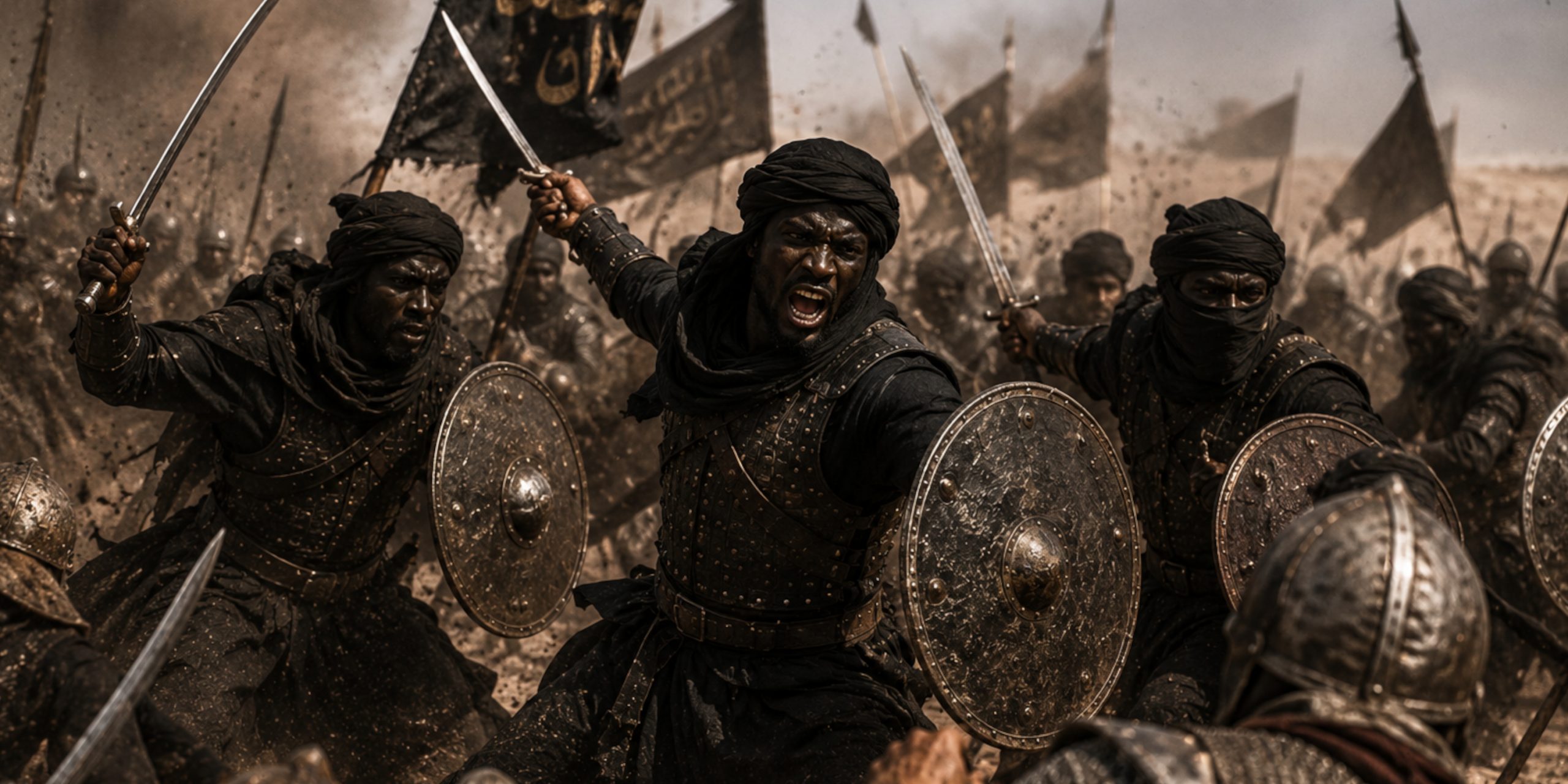
The Black Guard were not lightly equipped skirmishers wandering about with ceremonial spears. Contemporary descriptions suggest they were heavily armed professional soldiers.
Typical equipment likely included:
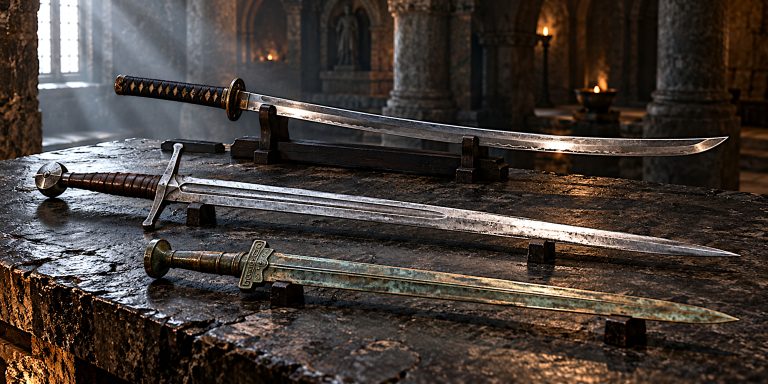
- Straight double-edged swords of North African and Andalusian styles
- Spears and long thrusting lances
- Large leather shields
- Mail armour or quilted protection
- Helmets influenced by Berber and Andalusian designs
- Javelins for close engagements
Some soldiers may also have carried curved blades influenced by Sahelian or Maghrebi traditions, though evidence is fragmentary.
The Almohads themselves maintained sophisticated arsenals. Their armies combined Berber cavalry, Andalusian infantry, archers, and elite guards. The Black Guard were probably positioned where discipline mattered most, around commanders, gates, standards, or key defensive points.
Christian chroniclers occasionally exaggerated their appearance, describing dark-armoured troops standing in rigid formations around the caliph. One gets the sense these writers were encountering something unfamiliar and rather intimidating.
Frankly, medieval Europeans were already nervous enough about facing disciplined Islamic armies. Seeing elite bodyguards in black robes and armour probably did not calm anyone’s nerves.
The Black Guard in Battle
The Black Guard fought in several major campaigns during the height of Almohad power.
They were present during the great conflicts against the Christian kingdoms of Castile, Aragon, and Portugal. Some historians believe they fought at the Battle of Alarcos in 1195, one of the Almohads’ greatest victories over Castile.
At Alarcos, the Almohad army crushed King Alfonso VIII’s forces. Muslim chroniclers describe disciplined reserve troops protecting the caliph’s position and stabilising the battle line during fierce fighting.
The Black Guard are also associated with the catastrophic Battle of Las Navas de Tolosa in 1212.
This battle changed the history of Iberia.
A coalition of Christian kingdoms shattered the Almohad army in central Spain. According to several accounts, the Black Guard formed a defensive ring around the caliph Muhammad al-Nasir during the final stages of the battle.
The Chronica Latina Regum Castellae described elite African guards defending the ruler with extraordinary determination.
Another source claimed:
“They stood chained together before the tent of the Miramamolín.”
“Miramamolín” was a Christian rendering of أمير المؤمنين, meaning Commander of the Faithful.
Whether the guards were literally chained remains debated. Medieval chroniclers adored dramatic imagery almost as much as modern streaming services do. Still, the image endured because it symbolised absolute loyalty.
The line eventually broke.
Las Navas de Tolosa marked the beginning of Almohad decline in Iberia. After the defeat, Christian kingdoms steadily advanced southward.
Contemporary Christian Views
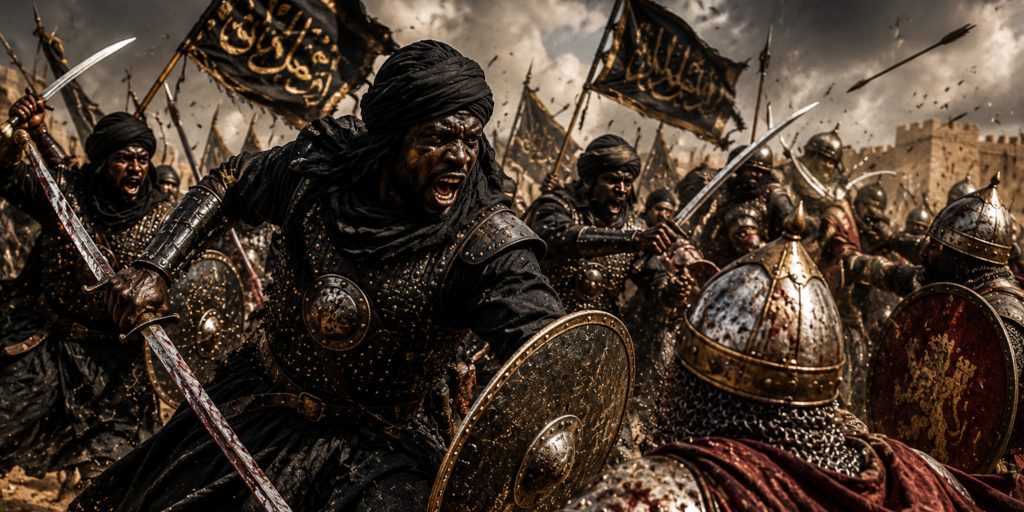
Christian chroniclers often portrayed the Black Guard with a mixture of fear, fascination, and outright propaganda.
To many writers in Iberia, they represented the exotic and dangerous power of the Islamic south. Descriptions exaggerated their numbers, appearance, and ferocity.
Rodrigo Jiménez de Rada, Archbishop of Toledo, wrote of black African troops serving the Almohads in language that mixed observation with theatrical flair. Medieval chroniclers were not exactly known for restraint. If ten soldiers looked intimidating, by the next manuscript copy there were suddenly ten thousand.
Still, beneath the exaggeration lies something important. These guards clearly made an impression on opponents.
Their presence symbolised imperial authority.
Religion and Identity
The Almohads were religious reformers with a strict ideological programme. Loyalty to the caliph carried spiritual significance as well as political meaning.
The Black Guard likely converted to Islam if they were not already Muslim upon entering service. Many would have been integrated into the court culture of Marrakesh and other major centres.
Identity within the guard was probably complex. Ethnic origins, military status, religion, and loyalty to the dynasty all intersected.
Modern attempts to simplify them into a single ethnic or cultural category usually miss the point. Medieval empires were messy places built from layered identities and competing loyalties.
The Almohads cared far more about obedience and military usefulness than modern categories of race or nationality.
Daily Life and Status
Despite their importance, surprisingly little survives about the daily lives of the Black Guard.
Elite guards often received salaries, housing, food allocations, and privileges unavailable to ordinary soldiers. Some may have risen to positions of influence within the court hierarchy.
Yet their status remained tied to servitude and dynastic dependence.
This contradiction sat at the heart of many slave soldier systems. Men could wield enormous military power while remaining socially constrained by the institution that created them.
The arrangement was effective, though hardly humane.
Medieval rulers tended not to lose much sleep over that distinction.
Decline of the Black Guard
As Almohad authority collapsed during the 13th century, the importance of the Black Guard faded alongside the empire itself.
Internal rebellions, dynastic disputes, economic strain, and military defeats gradually tore apart Almohad control. Rival dynasties emerged across North Africa while Christian kingdoms captured more territory in Iberia.
Without a strong central caliphate, elite palace guards lost their purpose.
Some surviving formations may have been absorbed into successor states. Others disappeared from the historical record entirely.
By the late medieval period, the Black Guard existed more as a memory within chronicles than as a coherent military institution.
Archaeology and Historical Evidence
Archaeological evidence directly tied to the Black Guard is sparse.
This is frustrating, though not surprising. Elite guards rarely left behind convenient labelled artefacts for modern historians.
Most evidence comes from:
- Arabic chronicles
- Christian Iberian chronicles
- Military descriptions from Almohad campaigns
- Art and manuscript depictions
- Comparative study of slave soldier systems
Weapons and armour associated with Almohad armies have been uncovered across Spain and North Africa, including sword fragments, spearheads, horse equipment, and mail remains.
The great Almohad fortifications at places such as Seville and Marrakesh also provide context for the military world these soldiers inhabited.
Legacy of the Black Guard
The Black Guard occupy an unusual place in medieval history.
They are remembered partly because they stood at the crossroads of several major historical themes: Islamic empire, slavery, African military history, and the struggle for Iberia.
Modern discussions sometimes oversimplify them into symbols rather than historical people. The reality was more complicated.
These soldiers were products of an empire trying to maintain authority across enormous territories filled with rival tribes, religious tensions, and constant warfare. They could be elite warriors, enslaved men, political tools, and symbols of power all at once.
That complexity makes them historically important.
It also makes them difficult to fit into tidy narratives, which is usually a sign the past is being approached honestly.
Seven Swords Takeaway
The Black Guard of the Almohads remain one of the more intriguing military formations of the medieval western Islamic world.
They appear in the sources as disciplined, intimidating, and fiercely loyal troops tied directly to the caliphate’s survival. Their battlefield role at moments like Las Navas de Tolosa ensured they would not vanish entirely from historical memory.
Yet much about them remains uncertain.
The medieval sources are fragmentary, biased, and often dramatic to the point of theatre. Historians must piece together their story from scattered references and hostile chroniclers who occasionally treated accuracy as an optional extra.
Still, enough survives to glimpse a formidable institution at the heart of Almohad power. Not merely ceremonial guards, but soldiers who stood beside emperors during some of the most consequential battles of medieval Iberian history.