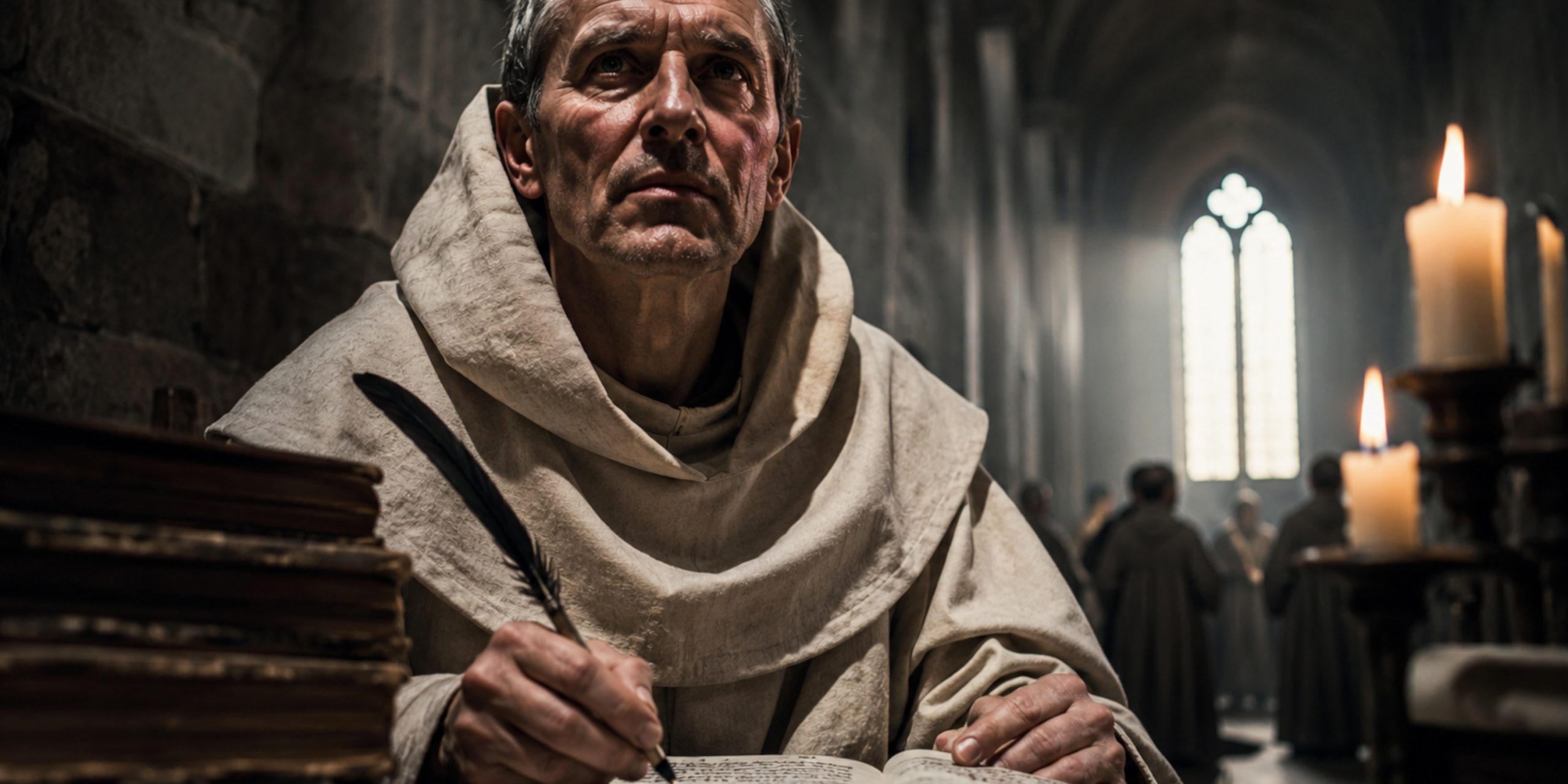
Few medieval figures loom over the 12th century quite like Bernard of Clairvaux. Monk, reformer, political adviser, theologian, crusade preacher, reluctant celebrity, Bernard somehow managed to become the moral conscience of Latin Christendom while living in what was supposed to be a quiet monastic retreat.
He founded monasteries, humbled bishops, advised popes, terrified heretics, inspired knights, and wrote sermons so intense they occasionally sound like someone trying to out-argue God Himself.
Modern historians sometimes struggle with Bernard because he embodies so many contradictions. He preached humility while influencing kings. He condemned worldly luxury while shaping European politics. He promoted peace in one decade and crusade in the next. Medieval people, meanwhile, had no such confusion. To them, Bernard was simply one of the greatest living Christians in Europe.
And frankly, once you read his letters, it becomes obvious why people listened to him. Bernard wrote with the confidence of a man entirely certain Heaven had already approved his draft.
Early Life and Education
Bernard was born around 1090 near Dijon in Burgundy, within the Kingdom of France. He came from a noble family, which gave him access to education and influence from an early age.
His father, Tescelin le Roux, was a knight and local lord. His mother, Aleth of Montbard, appears to have had a profound religious influence on him. Medieval writers later portrayed her almost as a saintly prototype for Bernard’s later spirituality.
Bernard received a classical education that included:
- Latin literature
- Scripture
- Theology
- Rhetoric
- Monastic traditions
He was intellectually gifted from an early age, though medieval chroniclers also describe him as physically frail. The classic combination for many famous monks, weak body, terrifyingly strong opinions.
Aleth died while Bernard was still young, and her death deeply affected him. Some historians believe this loss contributed to his growing attraction toward monastic life.
Entering the Cistercian Order
In 1112 or 1113, Bernard entered the relatively new Cistercian monastery at Cîteaux.
The Cistercians were attempting to reform monastic life by returning to stricter interpretations of the Rule of Saint Benedict. They rejected the increasing wealth and grandeur associated with many Benedictine houses.
The movement emphasised:
- Simplicity
- Poverty
- Manual labour
- Prayer
- Isolation from worldly distractions
Bernard did not arrive alone. He persuaded a remarkable number of relatives and companions to join him, including brothers, cousins, and friends. Medieval recruitment methods were apparently very direct.
One contemporary reportedly joked that mothers hid their sons from Bernard in case he convinced them to become monks.
Founding Clairvaux Abbey
In 1115 Bernard was sent to found a new monastery at Clairvaux in Champagne.
This became the centre of his life and influence.
Clairvaux began in extremely harsh conditions. Early Cistercians embraced austere living with almost alarming enthusiasm. Food was sparse, buildings primitive, and physical discipline severe. Bernard himself pushed asceticism so far that he permanently damaged his health.
Yet Clairvaux flourished.
Under Bernard’s leadership, the abbey became one of the most influential monasteries in Europe. Dozens of daughter houses emerged from it, helping spread Cistercian reform across France, England, the Holy Roman Empire, Italy, and beyond.
By the time of Bernard’s death, the Cistercian order had expanded dramatically, with hundreds of affiliated monasteries.
Bernard’s Personality and Reputation
Bernard possessed extraordinary charisma.
Contemporaries repeatedly described the emotional power of his preaching. He could move audiences to tears, repentance, or sudden religious fervour. Kings sought his advice. Popes consulted him. Nobles feared disappointing him.
He combined intellectual precision with emotional intensity. His sermons often focused on divine love, humility, and spiritual longing, yet he could also write with remarkable aggression against opponents.
Theologian Peter Abelard discovered this the hard way.
Bernard regarded abstract theological speculation with suspicion when it seemed disconnected from faith or obedience. He believed theology should inspire devotion rather than intellectual vanity.
That put him on a collision course with several rising scholastic thinkers.
Bernard and Peter Abelard
One of Bernard’s most famous disputes involved Peter Abelard, the brilliant and controversial philosopher.
Abelard represented the growing scholastic movement that emphasised logic and rational analysis. Bernard viewed aspects of this approach as spiritually dangerous.
Their conflict culminated at the Council of Sens in 1140.
Bernard accused Abelard of theological errors and excessive reliance on reason. Abelard attempted to defend himself but eventually appealed to Rome. The dispute damaged Abelard’s reputation and remains one of the defining intellectual clashes of the medieval period.
To modern readers, Bernard can sometimes appear intolerant here. Yet from his perspective, theology was not an academic game. Eternal salvation was at stake.
Medieval debates rarely involved polite agreement over coffee.
Bernard and the Knights Templar

Bernard played a major role in legitimising the Knights Templar during their early years.
The Templars emerged after the First Crusade as a military-religious order dedicated to protecting pilgrims in the Holy Land. Many churchmen initially found the concept unsettling. Monks were not traditionally expected to carry swords into battle.
Bernard helped solve this problem.
Around 1129 he wrote In Praise of the New Knighthood, a defence of the Templars that became enormously influential.
He argued that the Templars represented a new ideal:
- Monastic discipline
- Religious devotion
- Military skill
- Defence of Christianity
According to Bernard, a Templar fighting for Christ committed no sin in battle against enemies of the faith.
His support proved crucial in securing wider ecclesiastical approval for the order.
Without Bernard, the Templars might never have become the powerful institution remembered today.
Bernard and the Second Crusade
Bernard’s involvement in the Second Crusade remains one of the most controversial episodes of his life.
After the fall of Edessa in 1144, Pope Eugenius III called for a new crusade. Bernard became its chief preacher.
He travelled across France and the German lands urging Christians to take the cross. Contemporary accounts describe enormous crowds gathering to hear him speak.
King Louis VII of France joined the crusade after Bernard’s preaching. So did Emperor Conrad III.
For a moment, Bernard seemed capable of mobilising all Christendom through sheer force of personality.
Then the crusade collapsed.
The campaign ended in military failure and humiliation. Critics blamed Bernard for encouraging the expedition. He defended himself by arguing that the sins of the crusaders had caused divine punishment.
The failure deeply damaged his prestige, though not entirely his influence.
It is one of the great reminders that even medieval Europe’s most respected holy men occasionally backed catastrophically bad military ideas.
Bernard’s Theology and Spirituality
Bernard’s theological writings focused heavily on love, devotion, humility, and mystical union with God.
His sermons on the Song of Songs remain among the most celebrated works of medieval spirituality.
He interpreted the biblical text allegorically, presenting the soul’s relationship with God as an intimate spiritual union. His writing could become intensely emotional and poetic.
Key themes in Bernard’s thought included:
- The love of God
- Human humility
- Grace
- Inner spiritual transformation
- Devotion to the Virgin Mary
Bernard also helped popularise Marian devotion throughout medieval Europe.
His spirituality differed sharply from colder intellectual approaches. He wanted faith to be experienced emotionally, not merely analysed.
Contemporary Quotes About Bernard
Several medieval writers left vivid descriptions of Bernard and his reputation.
William of Saint-Thierry wrote:
“He was aflame with zeal for the house of God.”
Otto of Freising described Bernard as:
“A man truly apostolic.”
John of Salisbury, though sometimes critical, acknowledged Bernard’s immense influence:
“Europe listened to him as to a prophet.”
Bernard himself could also be strikingly direct. In one famous line, he declared:
“The road to hell is paved with good intentions.”
Another often quoted passage reads:
“You wish me to tell you why and how one should love God. My answer is that God himself is the reason he should be loved.”
Relationship with Popes and Kings
Bernard became deeply entangled in European politics despite his monastic ideals.
He supported Pope Innocent II during the papal schism of 1130 and worked tirelessly to secure recognition for him across Europe.
His influence extended into royal courts as well.
Rulers who sought Bernard’s counsel included:
- Louis VII of France
- Conrad III of Germany
- Various nobles across Burgundy and Champagne
Perhaps most remarkably, one of Bernard’s former monks became Pope Eugenius III.
At that point Bernard was effectively advising the papacy through personal correspondence. One suspects several cardinals found this arrangement mildly irritating.
Bernard’s Final Years and Death
By the 1150s Bernard’s health had significantly deteriorated.
Years of harsh asceticism had weakened him physically, though he continued writing and advising church leaders almost until the end of his life.
He died at Clairvaux on 20 August 1153.
His reputation for holiness spread rapidly after his death. He was canonised in 1174 by Pope Alexander III.
Later, in 1830, Pope Pius VIII declared him a Doctor of the Church, recognising the enduring importance of his theology and writings.
Bernard’s Legacy
Bernard of Clairvaux helped shape medieval Europe more profoundly than many kings.
His influence can be seen in:
- The expansion of the Cistercian order
- Medieval monastic reform
- Crusading ideology
- Marian devotion
- Mystical theology
- The early development of the Knights Templar
Historians continue debating aspects of his legacy. Some admire his spirituality and reforming zeal. Others criticise his intolerance toward intellectual opponents and his role in crusading propaganda.
Both views contain truth.
Bernard was neither saintly caricature nor medieval fanatic alone. He was a deeply complex figure whose convictions reshaped the religious and political landscape of 12th-century Europe.
And like many powerful medieval personalities, he genuinely believed he was serving God in every decision he made.
That certainty made him inspiring, formidable, and occasionally dangerous.
Where to Learn More About Bernard of Clairvaux
For readers interested in deeper study, the following sources remain particularly valuable:
- Bernard of Clairvaux’s On Loving God
- In Praise of the New Knighthood
- The Sermons on the Song of Songs
- Jean Leclercq’s studies on Bernardine spirituality
- Medieval chronicles by William of Saint-Thierry and Otto of Freising
Many manuscripts connected to Bernard and the Cistercians survive in French monastic archives and major European libraries.
Clairvaux Abbey itself no longer survives in its medieval form, though the site remains historically significant. Like many great monasteries, it eventually encountered the combined enthusiasm of revolutionaries and changing political realities. Medieval stonework rarely wins arguments against cannon and bureaucracy.