Military history becomes much easier to understand when you can see where events happened and how they fitted together. A battle has a date, certainly, but it also has a landscape, a political setting and a rather inconvenient relationship with everything that came before it.
I have always found that moving between a map and a chronology changes the questions I ask. Why fight there? What else was happening? How far had that army travelled before anyone expected it to do something heroic?
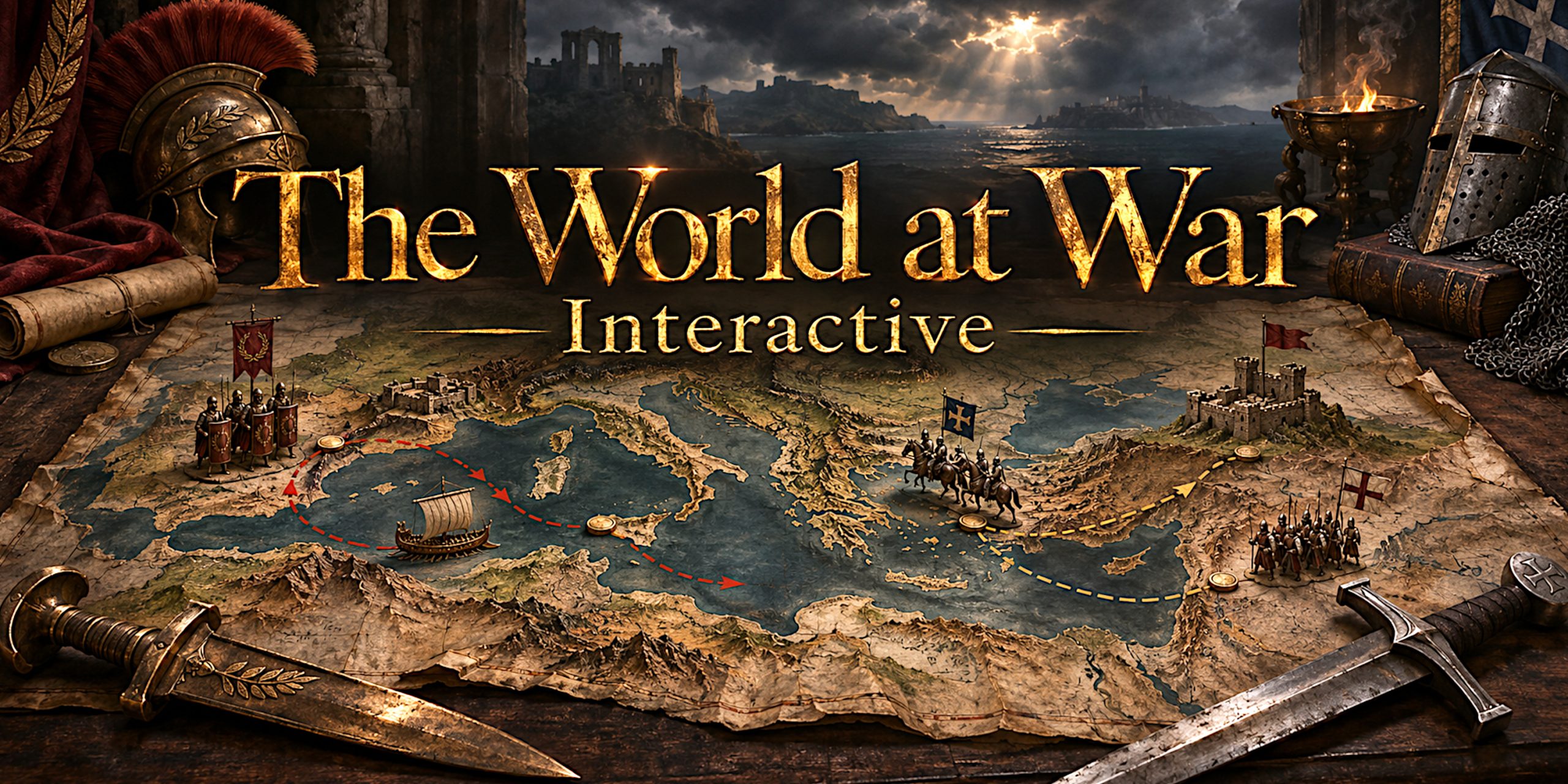
The SevenSwords World at War interactive map and timeline offers a way into those questions, connecting selected conflicts, battles, swords and commanders with further reading.
Explore the World at War interactive map and timeline.
See Military History in Place and Time
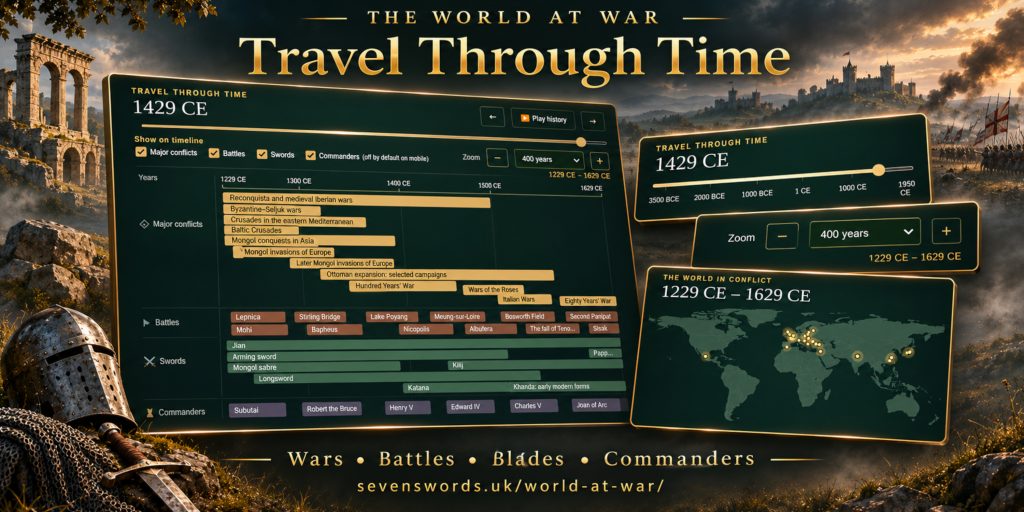
A chronology gives events an order. A map gives them a setting. Together, they encourage us to think beyond isolated victories and famous names.
For me, this is where military history becomes most interesting. Knowing who won is a beginning. Understanding the choices available to either side is a much better conversation.
Looking across a region invites questions about routes, distances and neighbouring powers. Moving through time encourages comparisons between successive campaigns. Neither view supplies every answer, but both help identify what needs explaining.
A successful general still needs supplies, political support and somewhere to take the army afterwards. Biographies tend to give the general rather more space than the grain.
How to Explore the World at War
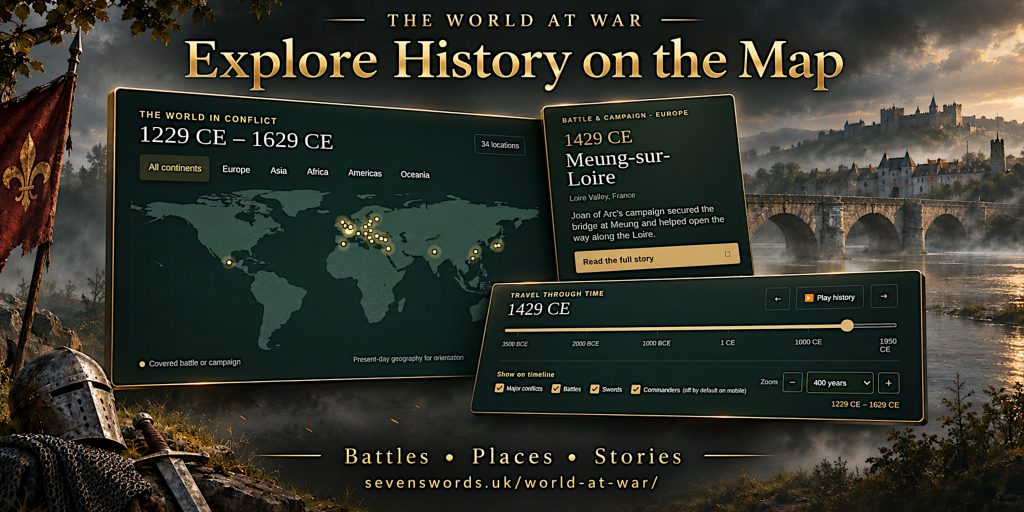
The atlas combines geographical markers with a movable timeline. Wars appear as spans, while individual battles appear as events. You can choose a major conflict, use the themed shortcuts or search for a battle, blade or leader.
The timeline can be swiped on mobile or moved by clicking and dragging on desktop. Zoom controls let you change the visible period, and filters let you choose which categories to display. Selected entries lead to supporting SevenSwords articles.
Start with something familiar. Then widen the period or follow a nearby entry. That small change of perspective can turn a single subject into an afternoon’s reading. Historians call this research. Everyone else notices that lunch has been missed.
Follow a Conflict Beyond Its Most Famous Battle
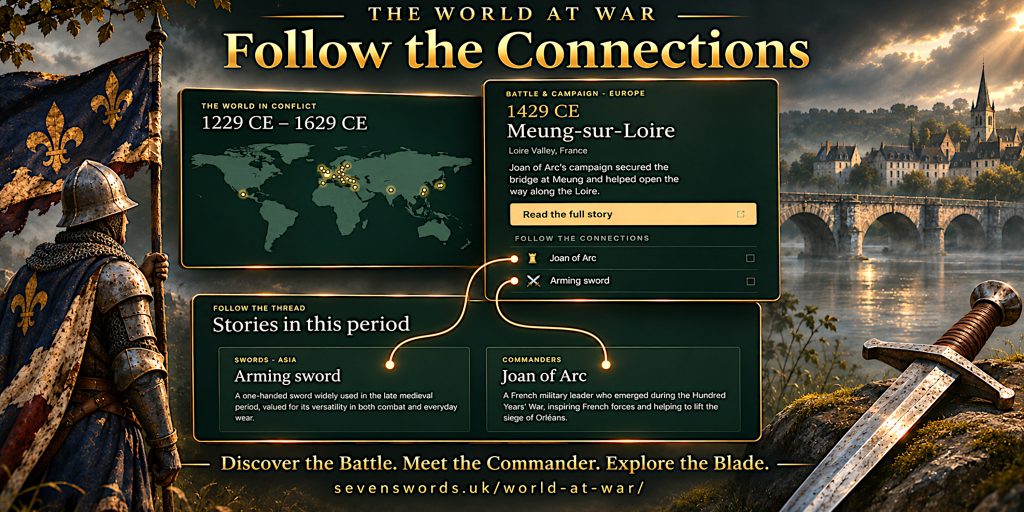
My preferred approach is to begin with a whole conflict before concentrating on one engagement.
A famous battle can become so prominent that it obscures the campaign around it. Read backwards as well as forwards. Ask what the commanders hoped to achieve, what resources they had already spent and whether victory actually brought their political aims any closer.
Useful questions to keep beside the map include:
- What made this location worth defending or attacking?
- Which earlier decisions limited the options available?
- Did the outcome settle the conflict or merely prolong it?
- Whose account shaped the version we remember?
These questions keep the human decisions in view. A coloured marker is pleasantly tidy. The circumstances behind it rarely were.
Put Swords and Commanders Back into Context
The inclusion of weapons alongside people and conflicts opens another route through the subject.
I find swords more revealing when they are treated as objects made, carried, maintained and paid for. Their appearance matters, but so do their users and the circumstances in which those users expected to fight.
The same applies to commanders. A reputation for brilliance deserves examination alongside the army, institutions and opponents that made a career possible. Admiration is allowed. So is checking the paperwork.
Comparing these subjects encourages a more rounded reading of warfare. It also helps resist the temptation to explain an entire victory through one exceptional person or one particularly attractive blade.
Read the Map with a Historian’s Caution
The World at War is a selective atlas of SevenSwords coverage, rather than a complete record of every conflict. Its present-day geography provides orientation. Sword dates indicate approximate periods of use, and commander bars represent military activity.
Those distinctions matter. A marker should prompt further reading, especially where the supporting entry identifies uncertainty about a location or date.
An empty part of a historical atlas is also worth treating carefully. It tells you about the material displayed, rather than proving that nothing happened there. Coverage and historical importance are different questions.
I would use the overview to find connections, then read the linked articles for the evidence and qualifications. Good historical tools should make it easier to ask precise questions without making uncertain answers look settled.
Choose a Starting Point and Follow the Connections
You do not need to begin with the earliest entry and work forwards. Start with a commander you recognise, a weapon you collect or a period you have always meant to understand properly.
Then look beyond it. Examine the wider conflict, move across the map and see what falls within the same stretch of time. Keep a question in mind as you go. Even a simple one, such as why an army chose a particular route, gives the reading a purpose.
That is the pleasure of exploring history this way. You can arrive looking for one battle and leave with a better question about the world around it.
Open the World at War map and timeline on SevenSwords.