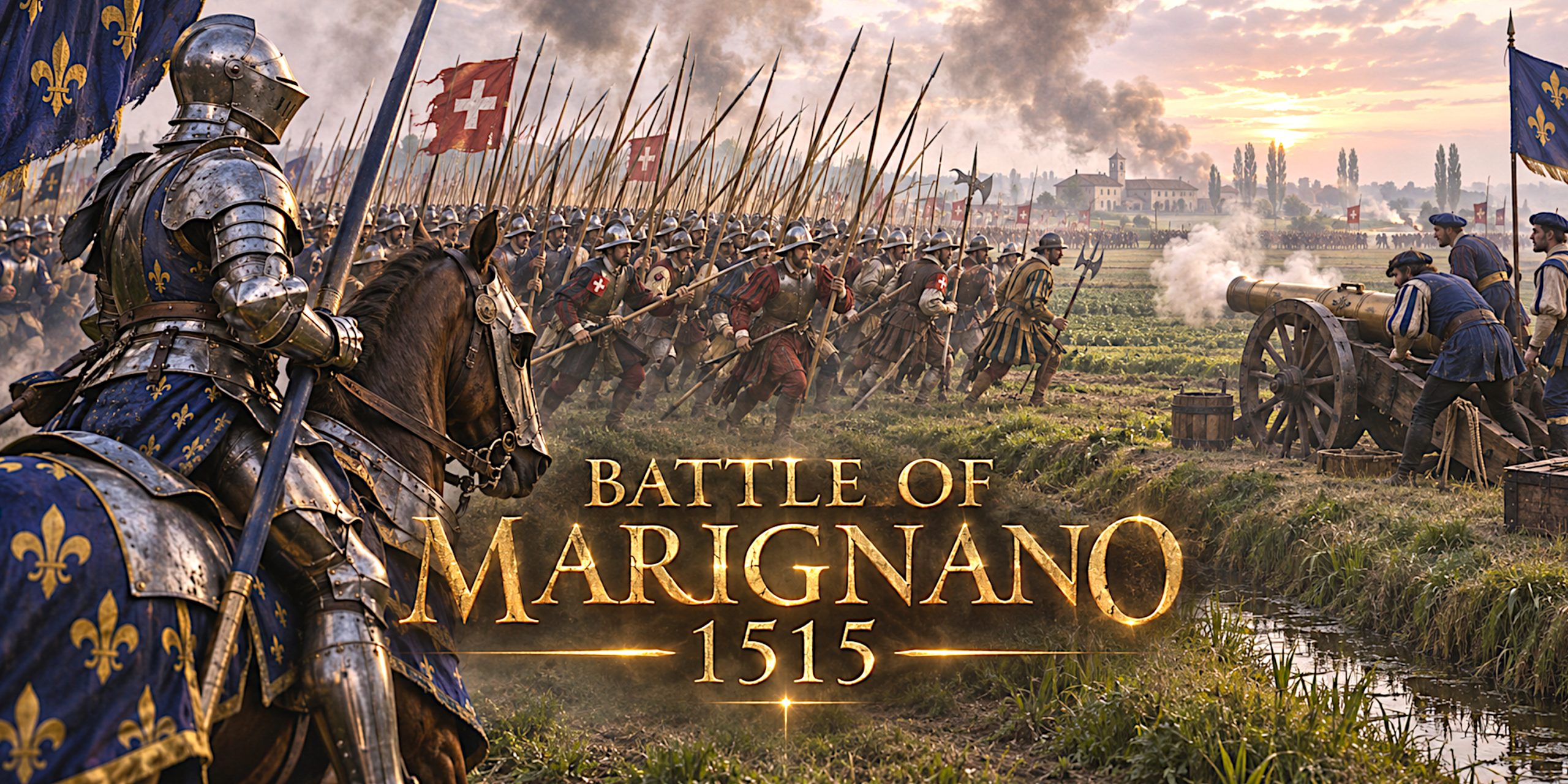
The Battle of Marignano, fought on 13–14 September 1515 near modern Melegnano, south-east of Milan, ended in victory for Francis I of France and his Venetian allies over the Swiss troops defending the Duchy of Milan.
It was a hard-won victory. Swiss infantry threatened the French artillery, fighting continued into darkness, and Venetian intervention helped settle the second day. The battle deserves attention for the difficulty of winning it, rather than the tidy royal triumph it later became.
What interests me most is the uncomfortable partnership at its centre: armoured cavalry, mercenary infantry and gun crews had to keep one another alive. Chivalry was present, certainly. So were the men loading the cannon.
Why Was the Battle of Marignano Fought?

Milan was the prize. Francis inherited the French claim to the duchy when he became king in January 1515. Recovering it would strengthen French influence in northern Italy and give his new reign a conspicuous success.
The Swiss had helped sustain Duke Massimiliano Sforza’s rule. Their victory over the French at Novara in 1513 gave them good reason to trust their infantry, although confidence did not resolve disagreements about whether to fight another campaign.
Francis crossed the Alps by an unexpected route and advanced towards Milan. Negotiations then divided the Swiss contingents: some accepted a settlement and withdrew, while others remained determined to resist. The army that marched to Marignano therefore represented neither a united Swiss political decision nor every soldier available to the wider anti-French coalition.
Forces at Marignano
Numbers vary between accounts, which sometimes mix campaign establishments with troops actually present. A cavalry “lance” also represented a service unit, not simply one mounted man.
| Force | Approximate strength | Main elements |
|---|---|---|
| French royal army | Around 30,000 present in one scholarly reconstruction; other estimates are higher | Gendarmes, German Landsknechts, French infantry and substantial artillery |
| Swiss-led army | Around 20,000–22,000 Swiss, with limited supporting troops | Pike formations, halberdiers, a small artillery contingent and Milanese cavalry |
| Venetian reinforcements | Strength and arrival sequence disputed | D’Alviano’s cavalry intervened on the second morning |
These figures should not be added into an apparently exact battlefield total. In particular, the full Venetian army should not be treated as though it arrived together in one formation. University of Tours: preparations
Leaders and Troop Composition
French and Venetian leadership
- Francis I: commanded the royal army and personally participated in the mounted fighting.
- Charles III, Duke of Bourbon: commanded the French vanguard.
- Gian Giacomo Trivulzio: an experienced commander whose cavalry helped resist the Swiss.
- Pedro Navarro: directed infantry and defensive preparations.
- Jacques Galiot de Genouillac: master of the royal artillery.
- Bartolomeo d’Alviano: led the Venetian intervention.
Swiss and Milanese leadership
- Cardinal Matthäus Schiner: an influential advocate of resistance, rather than a modern commander-in-chief.
- Cantonal captains and soldiers’ assemblies: shared authority within a politically divided army.
- Massimiliano Sforza: the duke whose position they defended.
The French force combined several military traditions. Its German pikemen were particularly important because they could contest the Swiss advance on foot. The Swiss depended much more heavily on their infantry formations. Their collective command system made agreement difficult once contingents wanted different things.
Arms and Armour

Marignano belonged to an age in which plate armour and gunpowder weapons developed alongside one another. Armour had not suddenly become useless, and cannon had not made infantry obsolete.
| Weapon or protection | Users | Battlefield purpose |
|---|---|---|
| Long pike | Swiss and German infantry | Maintained a threatening front against infantry and cavalry |
| Halberd | Infantry specialists | Close fighting when formations met |
| Lance and full plate armour | French gendarmes | Mounted shock action and personal protection |
| Arquebus and crossbow | Missile infantry | Supported the main formations |
| Cannon and lighter guns | Especially the French | Disrupted and damaged approaching troops |
The French advantage included the organisation behind the guns: trained crews, transport, ammunition and repairs. An impressive cannon without these was an expensive obstruction.
Which Sword Types Were Used?
Sword names need care. Surviving weapons establish what was available in this period, but do not provide an inventory of every contingent at Marignano.
- Arming swords: straight, double-edged sidearms suited to use in one hand.
- Hand-and-a-half swords: longer-gripped swords usable with one or both hands. The Metropolitan Museum holds a German example dated 1500–1525.
- Katzbalger: a compact infantry sword associated with Landsknechts, useful when a long polearm became awkward.
- Estoc: a stiff thrusting sword associated with armoured combat. Fourquevaux’s later sixteenth-century military instructions recommend one among a man-at-arms’ saddle weapons.
The last example is contextual evidence, not proof of an identical equipment rule in 1515. Nor should every German infantryman be pictured swinging an enormous two-handed sword. The pike formations did the principal work.
The Battlefield: Fields, Ditches and Canals
The fighting took place across cultivated ground around San Giuliano and Marignano. Watercourses and drainage channels interrupted the fields.
This mattered. Cavalry needed room to manoeuvre, while infantry formations depended on keeping their order. A ditch could obstruct a charge, protect a position or complicate withdrawal.
I find this landscape more revealing than a painting of a king on a magnificent horse. The horse might be magnificent; it still needed somewhere to go.
The First Day: 13 September 1515

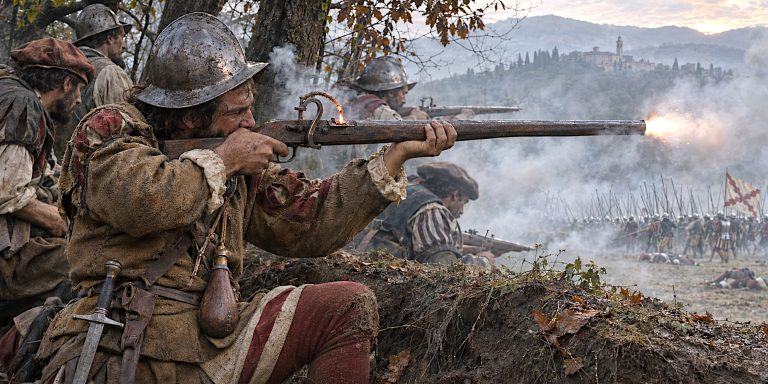
The Swiss sought to reach and capture the French artillery quickly. It was a dangerous objective, but a sensible response to guns that could punish dense infantry formations.
Their advance came close to success. Some French pieces were captured, although accounts disagree over the number. French cavalry counterattacks helped contain the assault while infantry resisted around the threatened positions.
Fighting continued after sunset. By the time darkness brought a respite, neither side had achieved a decisive victory. The royal army had survived a serious crisis.
The Second Day: 14 September 1515

The French used the interval to restore their formations and improve their defensive arrangements. Renewed Swiss attacks encountered artillery, infantry resistance and mounted counterattacks.
The Swiss remained dangerous. Their formations could still threaten a breakthrough, and the terrain restricted what French cavalry could accomplish.
D’Alviano’s Venetian cavalry then arrived, adding pressure at a critical moment. The Swiss captains ordered a withdrawal towards Milan. Their retreat retained enough cohesion to prevent defeat becoming complete destruction.
The central tactical point is cooperation. French cavalry bought time; infantry held ground; artillery inflicted damage; Venetian intervention helped force the decision. None of those contributions should disappear behind the king’s portrait. University of Tours: battle narrative
Battle Timeline
| Date | Event |
|---|---|
| January 1515 | Francis I becomes king and pursues the French claim to Milan |
| August 1515 | The French cross the Alps by an unexpected route |
| Early September | Negotiations divide the Swiss contingents |
| 13 September | Swiss attacks threaten the French guns; fighting continues into darkness |
| Night of 13–14 September | Both armies regroup |
| 14 September | Renewed attacks fail to secure victory; Venetian intervention helps force Swiss withdrawal |
| Autumn 1515 | French success brings Milan under Francis’s control |
| 29 November 1516 | France and the Confederates conclude the Perpetual Peace at Fribourg |
The peace settlement followed more than a year of negotiation, rather than an immediate battlefield agreement.
Contemporary Quotes and What They Tell Us
Francis wrote to his mother, Louise of Savoy, after the battle. Discussing Genouillac’s contribution, he praised the artillery service:
“Never did a man serve it better.”
This is an English translation of an extract reproduced by the University of Tours. Royal self-presentation deserves caution, but the acknowledgement is useful: even the victorious king credited a specialist whose achievement involved more than personal bravery.
Fourquevaux later described Swiss confidence in pikes and disciplined formations:
“Not only to withstand the assault of men-at-arms, but also to defeat them.”
This translated passage comes from his Instructions sur le fait de la guerre, published in 1548. It is a contemporary military assessment of the broader period, not an eyewitness quotation from Marignano. He explicitly compared Swiss experience at Novara and Marignano, observing that the outcomes differed. Fourquevaux extracts
Together, these comments explain why the contest was so difficult: effective artillery confronted infantry whose confidence had been earned in earlier victories.
Casualties and the Cost of Victory
Reliable casualty totals are elusive. The Historical Dictionary of Switzerland gives estimates of 9,000–10,000 Swiss dead and 5,000–8,000 on the king’s side. These are estimates, not audited returns.
Even allowing for uncertainty, the losses were severe. Marignano should not become a cheerful demonstration of tactical progress. Better coordination could win a battle while leaving thousands of families with very little interest in its military lessons.
Archaeology and Surviving Evidence
The ossuary associated with Santa Maria della Neve at Zivido is a significant place of remembrance. Its bones, however, cannot simply be presented as securely identified casualties of 1515.
The structure dates from the early eighteenth century. The origin of the remains has been questioned, including the possibility that they belong to later epidemic victims.
That distinction matters. A memorial can carry historical meaning without supplying scientifically verified battlefield remains. Equally, a period weapon found in the district would require a recorded location and archaeological context before being assigned to this battle.
The cautious conclusion is that Marignano’s commemorative landscape is easier to identify than securely attributable battlefield archaeology. SWI swissinfo: reporting from the site
Did Marignano Create Swiss Neutrality?
Marignano weakened Swiss ambitions in Milan, but it did not establish permanent neutrality overnight. Internal divisions, the Reformation, subsequent defeats and the costs of foreign military service all shaped later policy.
The 1516 Perpetual Peace formalised a settlement with France. A separate alliance in 1521 subsequently gave Francis access to Swiss recruits. Defeat had changed the relationship; it had not ended Swiss participation in European warfare.
My reading is that Marignano is most instructive when its outcome remains contingent. The Swiss came close to taking the guns. The French needed their infantry to hold. Venice mattered. A victory produced by so many dependencies is more interesting than an effortless triumph, and rather more believable.