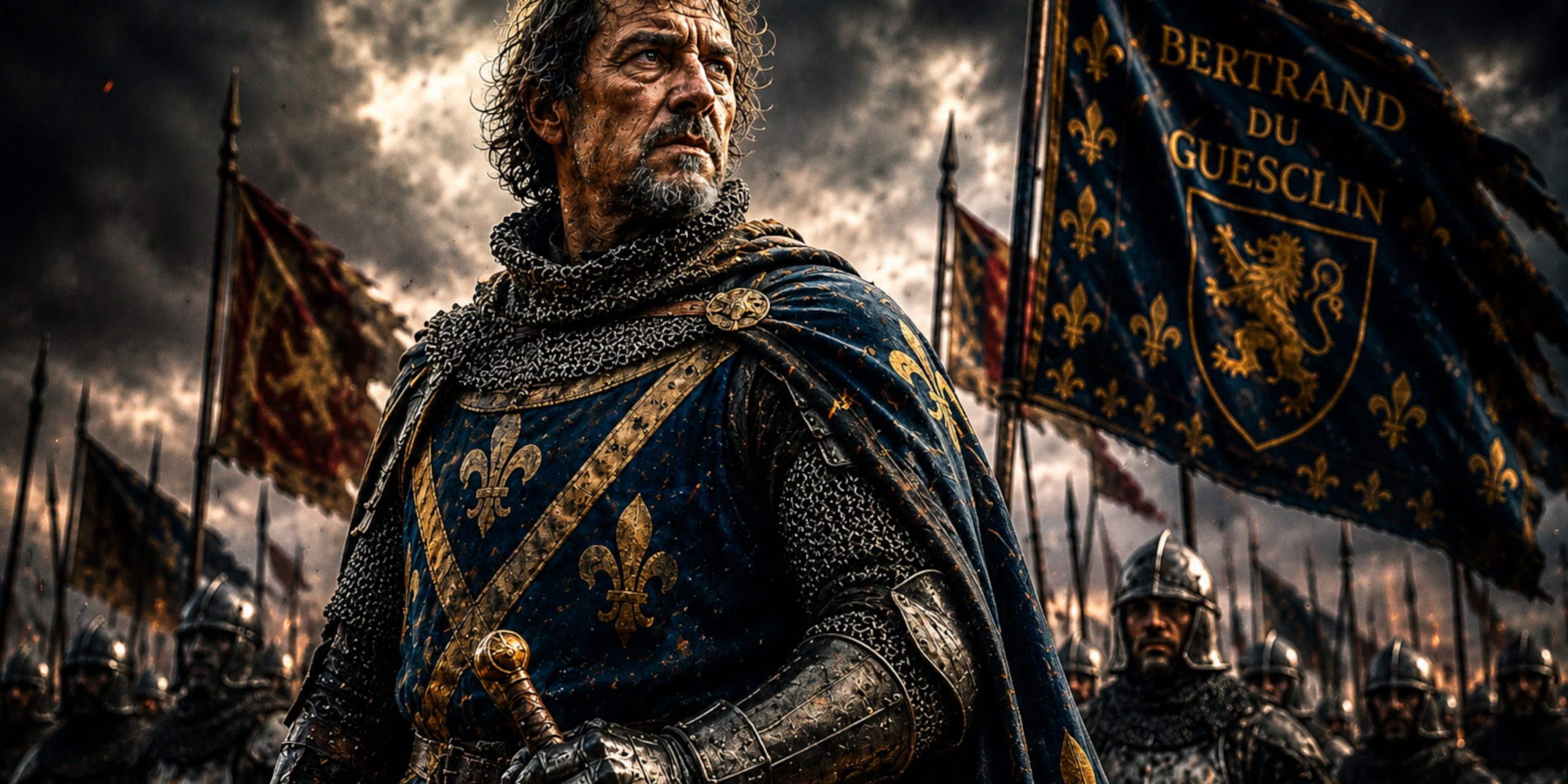
Bertrand du Guesclin (c.1320 to 1380) was one of the most important French commanders of the Hundred Years’ War. He was not the shining tournament hero of medieval romance. Contemporary descriptions often portrayed him as rough-looking, stubborn and physically unimpressive. Fortunately for France, wars are rarely won by cheekbones.
What made du Guesclin exceptional was his understanding of strategy. After decades of devastating English victories at battles such as Crécy and Poitiers, he recognised that France could not simply keep charging into English defensive positions and expecting a different result. His approach was patient, practical and often ruthless.
As Constable of France under Charles V, du Guesclin helped transform the French war effort. He avoided unnecessary pitched battles, targeted isolated English positions, relied on sieges and raids, and gradually recovered territory lost under earlier French kings.
He was less the perfect knight of legend and more the professional soldier medieval France desperately needed.
Early Life And Rise To Power
Bertrand du Guesclin was born near Dinan in Brittany around 1320 into a minor noble family. According to later accounts, he was a difficult child, more interested in fighting than courtly behaviour.
Some stories about his youth are probably exaggerated, especially those written after his death when chroniclers wanted to create a dramatic origin story. The core truth remains that he built his reputation through combat rather than inheritance.
His early career was shaped by the War of the Breton Succession, a conflict closely tied to the larger Hundred Years’ War.
He supported the French-backed claimant Charles of Blois against the English-supported Montfort faction. During this period, du Guesclin developed skills that defined his later campaigns:
- Ambush warfare
- Siege operations
- Small-unit leadership
- Rapid movement
- Intelligence gathering
He became known as a commander who could win without needing the grand heroic battlefield moment that medieval nobles often chased.
Arms And Armour Of Bertrand Du Guesclin
Du Guesclin lived during a period of rapid change in medieval military equipment. The fourteenth century saw the transition from mail-dominated protection towards increasingly sophisticated plate armour.
Armour Used
A commander of du Guesclin’s status would likely have worn:
| Armour | Purpose |
|---|---|
| Bascinet helmet with aventail | Protected the head and neck while allowing battlefield visibility |
| Mail hauberk | Flexible protection beneath plate sections |
| Coat of plates | Overlapping metal plates riveted beneath fabric |
| Plate arm and leg harness | Defence against swords, arrows and polearms |
| Gauntlets | Essential protection during close combat |
| Surcoat displaying heraldry | Identification on the battlefield |
By the late stages of his career, more complete plate harnesses were becoming common among elite knights.
Weapons Associated With Du Guesclin
| Weapon | Details |
| Arming sword | The classic knightly sidearm, effective for cutting and thrusting |
| Longsword | Increasingly popular two-handed weapon among late medieval warriors |
| Dagger or rondel dagger | Used in close combat against armoured opponents |
| Lance | Primary cavalry weapon during mounted engagements |
| Mace or war hammer | Useful against opponents wearing heavy armour |
The sword associated with knights of du Guesclin’s era was increasingly becoming a specialised weapon. Against plate armour, simply hacking away was not enough. Combat often involved targeting gaps around joints, visors and weak points.
Medieval fighting was considerably more technical than the chaotic swinging often shown on screen.
Battles And Military Acumen
Du Guesclin’s greatest talent was knowing when not to fight. This may sound unimpressive, but in a period when aristocratic pride regularly marched armies into disasters, restraint was revolutionary.
Key Battles And Campaigns
| Battle / Campaign | Date | Role And Outcome |
| Defence of Rennes | 1356 to 1357 | Built his reputation resisting English forces |
| Battle of Cocherel | 1364 | Major French victory over Charles II of Navarre’s forces |
| Battle of Auray | 1364 | Defeated and captured while supporting Charles of Blois |
| Castilian Civil War campaigns | 1360s | Helped Henry of Trastámara gain the Castilian throne |
| Battle of Nájera | 1367 | Captured after defeat against English forces under the Black Prince |
| Reconquest campaigns in France | 1370s | Recovered large areas from English control |
The Battle Of Cocherel: His Great Battlefield Victory
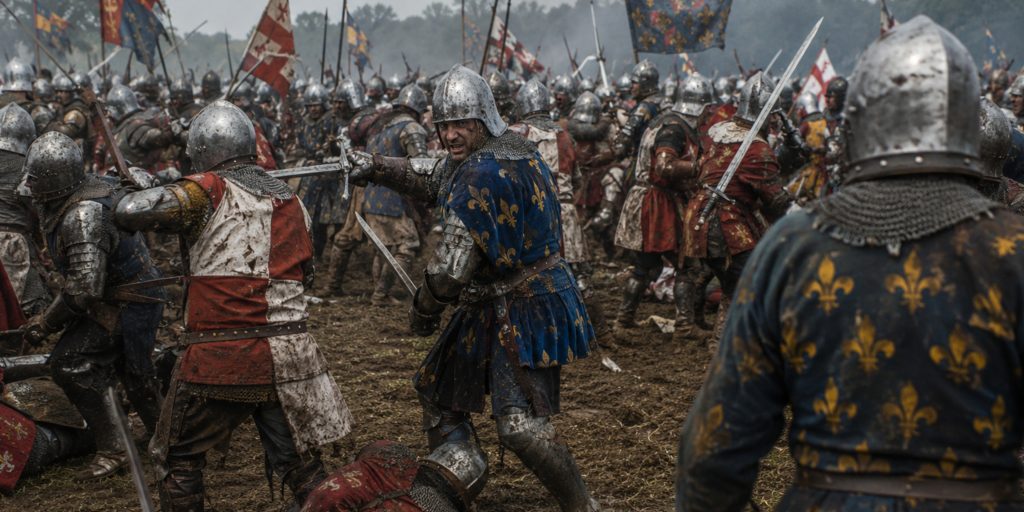
The Battle of Cocherel in 1364 showed du Guesclin at his tactical best.
Facing forces loyal to Charles II of Navarre, he avoided a reckless attack against a strong position. Instead, he reportedly used a feigned withdrawal to draw enemy troops into a weaker formation.
The result was a significant French victory shortly before the coronation of Charles V.
It proved that English-style tactical discipline could be challenged with patience and planning rather than another glorious but doomed cavalry charge.
The Disaster At Auray
Not every chapter was a success.
Later in 1364, du Guesclin fought at the Battle of Auray during the Breton succession conflict. His side was defeated, Charles of Blois was killed, and du Guesclin was captured.
His reputation survived because medieval commanders were judged not only by victories but also by conduct, loyalty and resilience.
A ransom was paid, and he returned to service.
Medieval warfare could sometimes resemble a very violent career break for wealthy knights.
Constable Of France And The War Against England
In 1370, Charles V appointed Bertrand du Guesclin as Constable of France, making him the kingdom’s highest military officer.
This appointment was significant because du Guesclin was not from the highest aristocracy. His promotion reflected ability over status.
His strategy against England included:
- Avoiding large battles where English longbow tactics were strongest
- Capturing castles and fortified towns
- Cutting supply routes
- Supporting experienced regional commanders
- Wearing down English control gradually
The approach worked. By the time of his death in 1380, France had recovered much of the territory lost after the Treaty of Brétigny.
Personality And Leadership
Du Guesclin was admired for courage but also for a very practical understanding of warfare.
Chroniclers such as Jean Froissart helped shape his image as a loyal and heroic knight. However, Froissart’s accounts must be read carefully. Medieval writers were interested in moral lessons and dramatic storytelling, not just recording facts.
The real du Guesclin was probably more interesting: a commander who balanced medieval ideals of honour with a willingness to adapt.
He was a knight who understood that winning mattered more than looking impressive.
Death And Burial
Bertrand du Guesclin died in 1380 during the siege of Châteauneuf-de-Randon.
Legend claims the defenders surrendered the fortress keys to his body after his death because they had promised to surrender to him personally. The story is difficult to prove, but it shows the level of respect attached to his name.
He received one of medieval France’s greatest honours when his remains were placed at the Basilica of Saint-Denis, the burial site of French monarchs.
For a minor Breton noble, resting among kings was quite the final promotion.
Where To See Artefacts Linked To Bertrand Du Guesclin
Very few surviving objects can be confidently connected directly to du Guesclin. Many medieval weapons and armour pieces attributed to famous figures were assigned those identities centuries later.
Important places connected with his life and era include:
Basilica Of Saint-Denis, France
Contains his tomb alongside many French rulers. It remains the most significant surviving monument connected directly with him.
Musée de l’Armée, Paris
Holds extensive collections of medieval weapons and armour from the period surrounding the Hundred Years’ War, including:
- Fourteenth-century swords
- Plate armour development examples
- Polearms
- Knightly equipment
Dinan, Brittany
His home region preserves his memory through monuments and historical interpretation connected with his early life.
Archaeology And Latest Research
Modern archaeology has helped historians better understand the type of warfare du Guesclin practised.
Research into fourteenth-century battlefields and castles has highlighted:
- The increasing importance of siege warfare
- The financial organisation behind medieval armies
- The changing role of professional soldiers
- Development from mail armour to plate harnesses
- The effectiveness of defensive tactics against traditional cavalry charges
Battlefield archaeology from the Hundred Years’ War continues to reshape older ideas. Medieval battles were not simply uncontrolled clashes. Commanders managed logistics, terrain, morale and intelligence.
Du Guesclin’s success makes more sense when viewed through this modern understanding.
Legacy: France’s Practical Hero
Bertrand du Guesclin became one of France’s great medieval military figures because he adapted faster than many of his rivals.
He was not undefeated. He was captured multiple times and experienced serious setbacks. Yet his career shows something more valuable than a flawless record: the ability to learn.
At a time when medieval warfare was changing, du Guesclin changed with it. His campaigns helped restore French confidence after some of the darkest years of the Hundred Years’ War.
He was not the romantic ideal of a knight. He was something far more dangerous to his enemies, a commander who understood reality.